Harnessing AtomisticSkills for Agentic Atomistic Research
Pith reviewed 2026-06-30 17:55 UTC · model grok-4.3
The pith
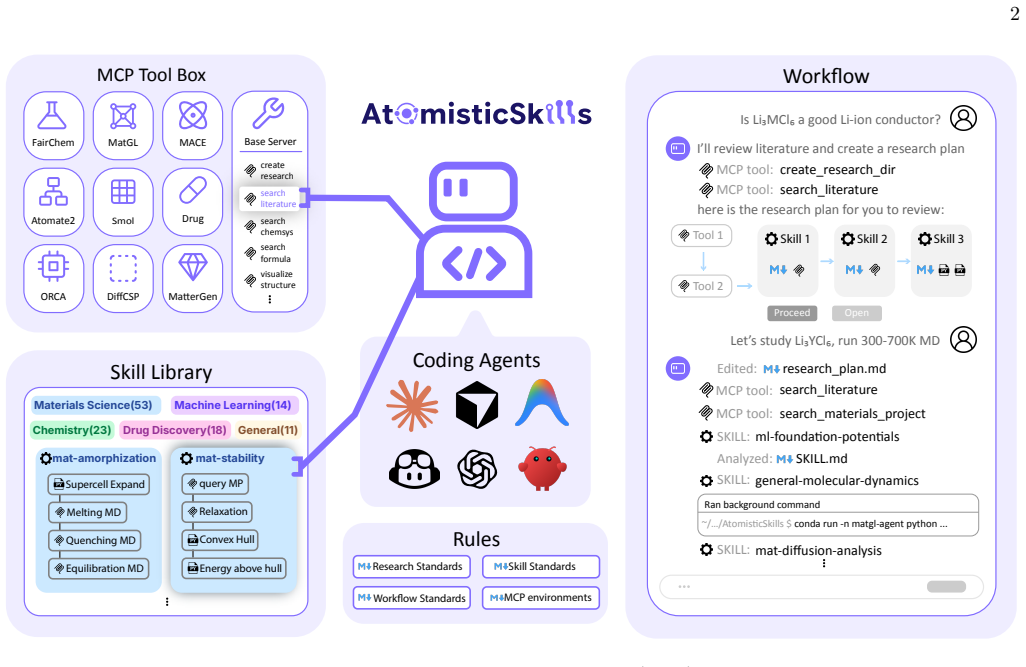
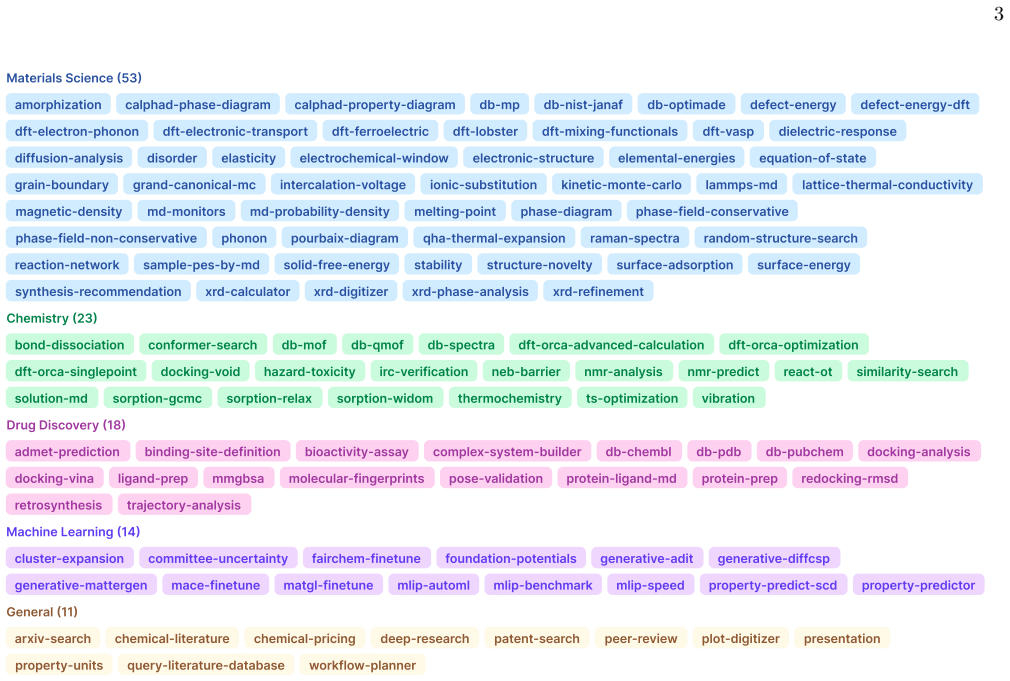
AtomisticSkills gives AI coding agents over 100 modular skills to run full atomistic research campaigns.
A machine-rendered reading of the paper's core claim, the machinery that carries it, and where it could break.
Core claim
AtomisticSkills is an open-source harness framework that empowers general-purpose AI coding agents to conduct atomistic research by hierarchically decomposing workflows into modular, extensible skills and tools, integrating more than 100 multidisciplinary capabilities including database access, thermodynamics and kinetics modeling, and simulation engines using MLIPs and DFT, and validating this through robust orchestration in generative design of Li-ion solid-state electrolytes, high-throughput screening of metal-organic frameworks for CO2 capture, autonomous MLIP benchmarking and fine-tuning, multi-stage structure-based virtual screening for drug design, multimodal X-ray diffraction pattern
What carries the argument
The AtomisticSkills harness, which decomposes workflows hierarchically into agent skills and tools for plug-and-play use.
If this is right
- Agents can execute generative materials design tasks like creating Li-ion electrolytes using the provided skills.
- High-throughput screening campaigns for applications such as CO2 capture or drug candidates become executable by agents without per-task custom code.
- Autonomous benchmarking, fine-tuning of MLIPs, and multimodal data analysis like XRD patterns integrate into agent-driven workflows.
- Catalyst screening and similar kinetic modeling tasks can be orchestrated across simulation engines by the same agent infrastructure.
Where Pith is reading between the lines
- The skill library could be expanded to new domains by adding targeted modules, allowing agents to tackle research outside the six demonstrated campaigns.
- Chaining multiple AtomisticSkills campaigns might enable longer discovery loops where agents iterate on their own outputs.
- Similar hierarchical skill decomposition could apply to experimental automation if skills for lab equipment control are added.
Load-bearing premise
The curated skills and their integration are complete enough that general AI agents can finish complex multi-stage campaigns without frequent human fixes for missing cases or errors.
What would settle it
An experiment in which a general-purpose AI agent equipped only with AtomisticSkills attempts a new unseen multi-stage campaign, such as screening for a different class of catalysts, and either completes it end-to-end or requires substantial additional human-written code or interventions.
Figures
read the original abstract
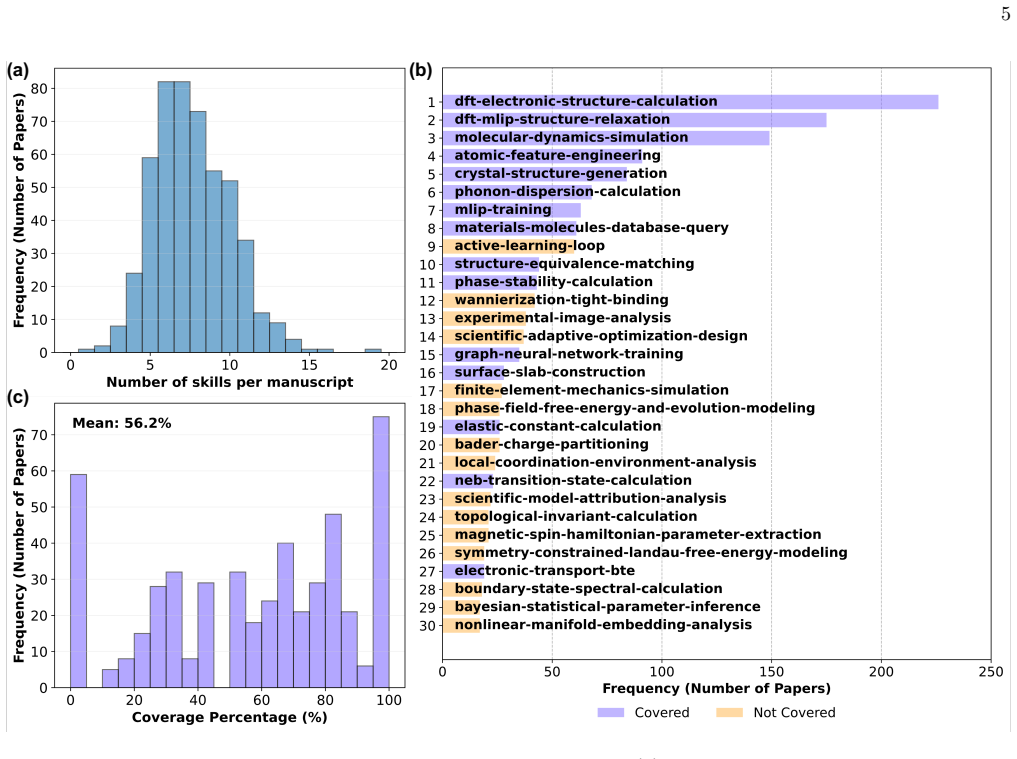
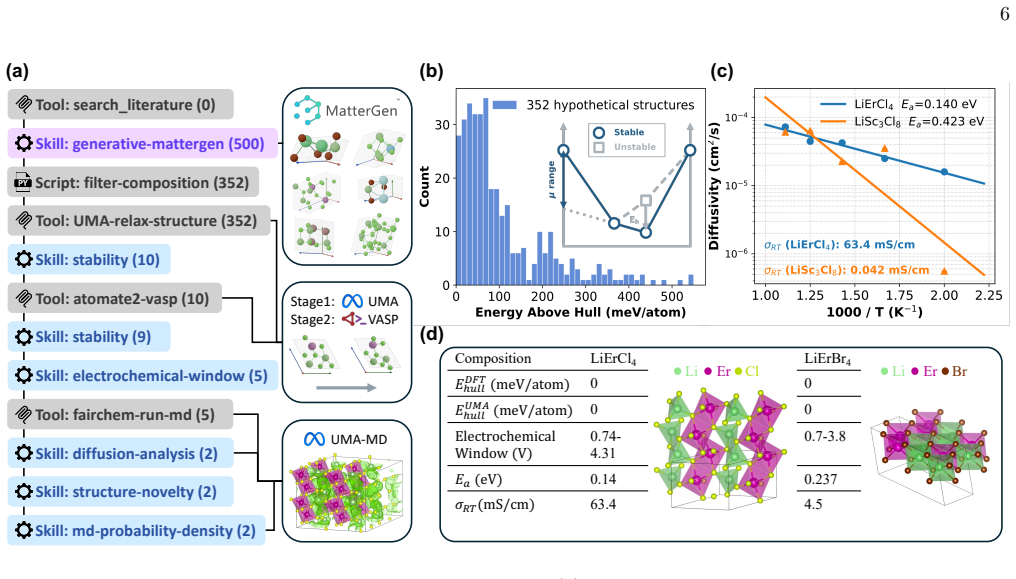
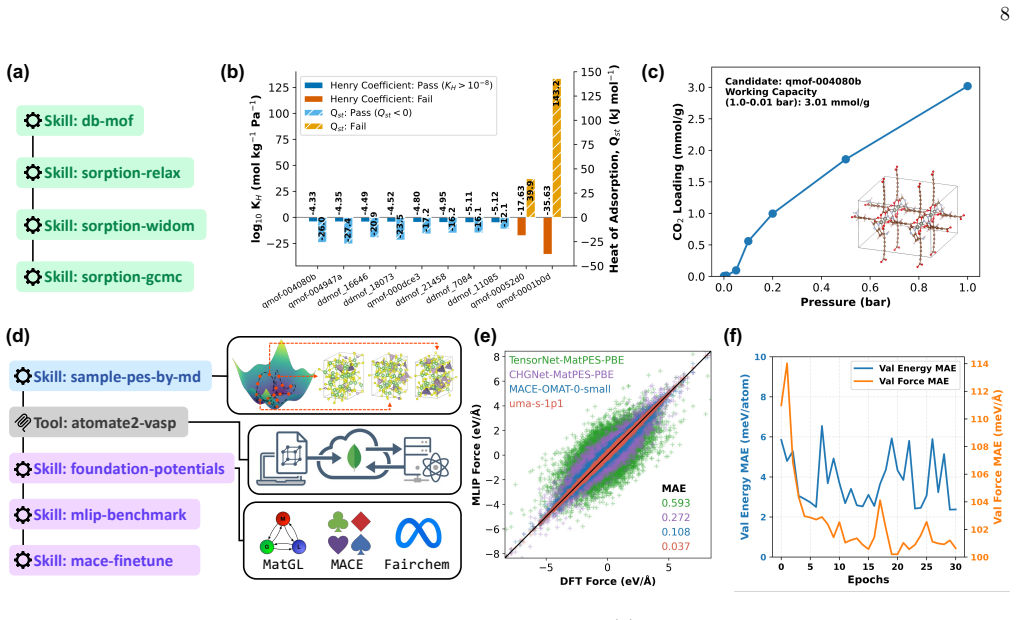
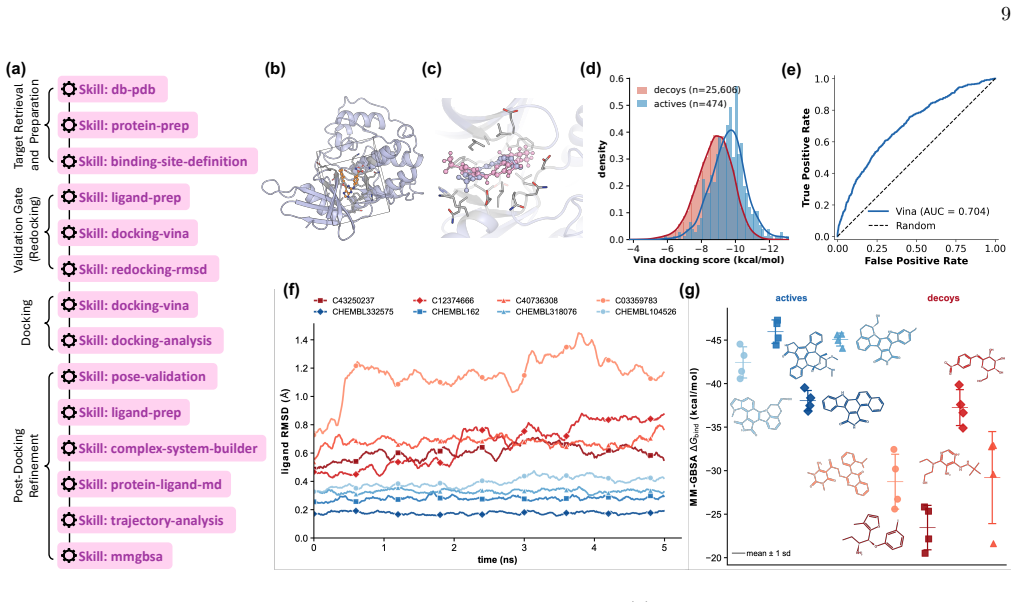
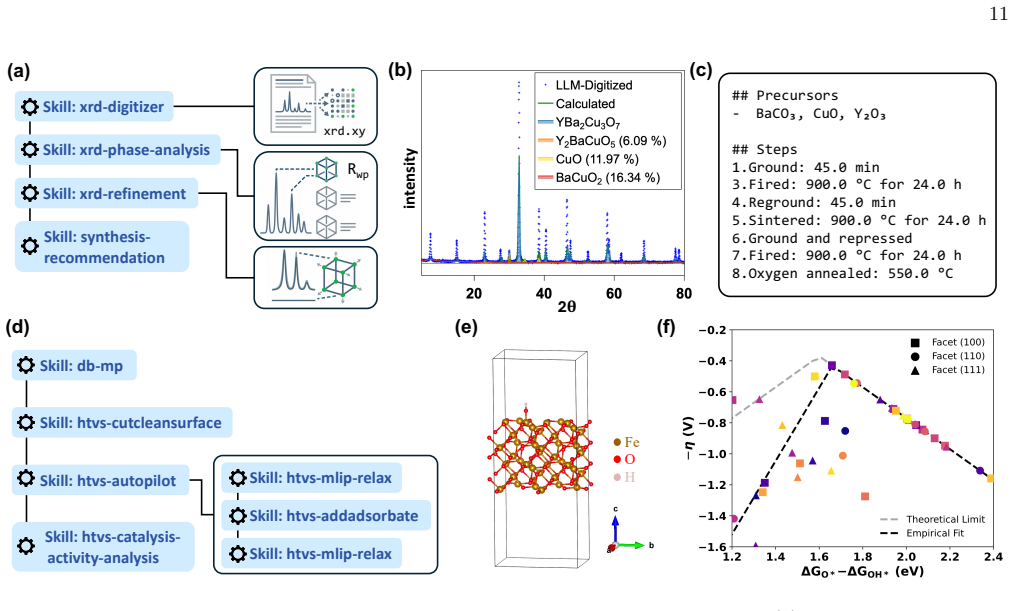
Computational materials science and chemistry span vast knowledge domains and fractured software ecosystems. Although large language models (LLMs) have demonstrated research capabilities, scaling monolithic agents to manage the rigor and complexity of atomistic research remains a challenge. Here, we introduce AtomisticSkills, an open-source harness framework that empowers general-purpose AI coding agents to conduct atomistic research across materials science, chemistry, and drug discovery. By hierarchically decomposing scientific workflows into agent skills and tools, AtomisticSkills provides agents with modular, extensible, and plug-and-play research capabilities. The framework integrates more than 100 human-curated multidisciplinary skills, including database access, thermodynamics and kinetics modeling, and diverse simulation engines employing machine learning interatomic potentials (MLIPs) and density functional theory (DFT). We validate its functional coverage against scientific literature and demonstrate robust orchestration capabilities across diverse scientific campaigns: generative design of Li-ion solid-state electrolytes, high-throughput screening of metal-organic frameworks for CO2 capture, autonomous MLIP benchmarking and fine-tuning, multi-stage structure-based virtual screening for drug design, multimodal X-ray diffraction pattern analysis, and screening of Fe-oxide catalysts for oxygen evolution reaction. AtomisticSkills provides a critical agent infrastructure towards building fully autonomous AI scientists.
Editorial analysis
A structured set of objections, weighed in public.
Referee Report
Summary. The manuscript introduces AtomisticSkills, an open-source framework that hierarchically decomposes atomistic research workflows into more than 100 human-curated modular skills and tools (including database access, thermodynamics modeling, MLIP/DFT simulations) for use by general-purpose AI coding agents. It claims functional coverage validated against literature and demonstrates 'robust orchestration' on six campaigns: generative design of Li-ion solid-state electrolytes, high-throughput MOF screening for CO2 capture, autonomous MLIP benchmarking/fine-tuning, multi-stage virtual screening for drug design, multimodal XRD pattern analysis, and Fe-oxide catalyst screening for the oxygen evolution reaction. The central contribution is positioned as critical infrastructure toward fully autonomous AI scientists.
Significance. If the framework's skills enable reliable, low-intervention autonomous execution of multi-stage campaigns, the work would supply a reusable, extensible harness that lowers the barrier for agentic AI in materials and chemistry research. The open-source release, integration of diverse simulation engines, and coverage of multidisciplinary tasks (from generative design to experimental data analysis) represent practical strengths that could accelerate reproducible agent-based workflows if quantitative performance data were supplied.
major comments (1)
- [Abstract] Abstract: The central claim of 'robust orchestration capabilities' across the six listed campaigns (and the broader assertion of providing 'critical agent infrastructure towards building fully autonomous AI scientists') is load-bearing yet unsupported by any quantitative metrics. No success rates, completion fractions, retry counts, human-intervention statistics, failure-mode analysis, or baseline comparisons (e.g., against un-augmented agents) are reported for any campaign, preventing evaluation of the weakest assumption that the >100 curated skills suffice for reliable autonomous operation.
Simulated Author's Rebuttal
We thank the referee for their constructive feedback. We address the single major comment below and commit to revisions that accurately reflect the manuscript's scope.
read point-by-point responses
-
Referee: [Abstract] Abstract: The central claim of 'robust orchestration capabilities' across the six listed campaigns (and the broader assertion of providing 'critical agent infrastructure towards building fully autonomous AI scientists') is load-bearing yet unsupported by any quantitative metrics. No success rates, completion fractions, retry counts, human-intervention statistics, failure-mode analysis, or baseline comparisons (e.g., against un-augmented agents) are reported for any campaign, preventing evaluation of the weakest assumption that the >100 curated skills suffice for reliable autonomous operation.
Authors: We agree that the abstract's phrasing of 'robust orchestration capabilities' and positioning as 'critical agent infrastructure towards building fully autonomous AI scientists' is not supported by quantitative metrics such as success rates, intervention counts, or baseline comparisons. The six campaigns serve as illustrative demonstrations of functional coverage, workflow decomposition, and integration with simulation engines, validated qualitatively against literature, rather than as statistical evaluations of autonomous performance. In the revised manuscript we will (1) revise the abstract to state that AtomisticSkills 'enables application to' the listed campaigns and (2) add an explicit Limitations section that acknowledges the lack of quantitative agent-performance benchmarks and identifies this as an important direction for future work. These changes will be incorporated in the next version. revision: yes
Circularity Check
No circularity: framework description with no derivations or self-referential fits
full rationale
The paper introduces and describes a software framework (AtomisticSkills) with >100 curated skills for agentic workflows. It lists campaigns and claims functional coverage validated against literature, but contains no equations, parameter fits, predictions, or derivation chains. Claims rest on the existence of the implemented skills and their demonstrated use, which are externally verifiable via the open-source release rather than reducing to self-definition or self-citation. This matches the default expectation of no significant circularity for non-mathematical software/framework contributions.
Axiom & Free-Parameter Ledger
invented entities (1)
-
AtomisticSkills
no independent evidence
Reference graph
Works this paper leans on
-
[1]
K. Jun, Y. Sun, Y. Xiao, Y. Zeng, R. Kim, H. Kim, L. J. Miara, D. Im, Y. Wang, and G. Ceder, Lithium superionic conductors with corner-sharing frameworks, Nature Materials21, 924–931 (2022)
2022
-
[2]
C. G. V. d. Walle and J. Neugebauer, First-principles calculations for defects and impurities: Applications to iii-nitrides, Journal of Applied Physics95, 3851–3879 (2004)
2004
-
[3]
B. Qiao, A. Wang, X. Yang, L. F. Allard, Z. Jiang, Y. Cui, J. Liu, J. Li, and T. Zhang, Single-atom cataly- sis of co oxidation using pt1/feox, Nature Chemistry3, 634–641 (2011)
2011
-
[4]
T. A. Halgren, Merck molecular force field. I. Ba- sis, form, scope, parameterization, and performance of MMFF94, Journal of Computational Chemistry17, 490 (1996)
1996
-
[5]
A. M. Ganose, H. Sahasrabuddhe, M. Asta, K. Beck, T. Biswas, A. Bonkowski, J. Bustamante, X. Chen, Y. Chiang, D. C. Chrzan, J. Clary, O. A. Cohen, C. Er- tural, M. C. Gallant, J. George, S. Gerits, R. E. A. Goodall, R. D. Guha, G. Hautier, M. Horton, T. J. Inizan, A. D. Kaplan, R. S. Kingsbury, M. C. Kuner, B. Li, X. Linn, M. J. McDermott, R. S. Mohanakri...
1944
-
[6]
Curtarolo, W
S. Curtarolo, W. Setyawan, G. L. Hart, M. Jahnatek, R. V. Chepulskii, R. H. Taylor, S. Wang, J. Xue, K. Yang, O. Levy, M. J. Mehl, H. T. Stokes, D. O. Dem- chenko, and D. Morgan, Aflow: An automatic frame- work for high-throughput materials discovery, Compu- tational Materials Science58, 218–226 (2012)
2012
-
[7]
Uhrin, S
M. Uhrin, S. P. Huber, J. Yu, N. Marzari, and G. Pizzi, Workflows in AiiDA: Engineering a high-throughput, event-based engine for robust and modular computa- tional workflows, Computational Materials Science187, 110086 (2021)
2021
-
[8]
A. Jain, S. P. Ong, W. Chen, B. Medasani, X. Qu, M. Kocher, M. Brafman, G. Petretto, G.-M. Rignanese, G. Hautier, D. Gunter, and K. A. Persson, FireWorks: a dynamic workflow system designed for high-throughput applications, Concurrency and Computation: Practice and Experience27, 5037 (2015)
2015
-
[9]
G. Wang, L. Peng, K. Li, L. Zhu, J. Zhou, N. Miao, and Z. Sun, ALKEMIE: An intelligent computational platform for accelerating materials discovery and design, Computational Materials Science186, 110064 (2021)
2021
-
[10]
Weymuth, J
T. Weymuth, J. P. Unsleber, P. L. T¨ urtscher, M. Steiner, J.-G. Sobez, C. H. M¨ uller, M. M¨ orchen, V. Klasovita, S. A. Grimmel, M. Eckhoff, K.-S. Csizi, F. Bosia, M. Bensberg, and M. Reiher, SCINE— Software for chemical interaction networks, J. Chem. Phys.160(2024)
2024
-
[11]
M. K. Horton, P. Huck, R. X. Yang, J. M. Munro, S. Dwaraknath, A. M. Ganose, R. S. Kingsbury, M. Wen, J. X. Shen, T. S. Mathis, A. D. Kaplan, K. Berket, J. Riebesell, J. George, A. S. Rosen, E. W. C. Spotte-Smith, M. J. McDermott, O. A. Co- hen, A. Dunn, M. C. Kuner, G.-M. Rignanese, G. Pe- tretto, D. Waroquiers, S. M. Griffin, J. B. Neaton, D. C. Chrzan,...
2025
-
[12]
D. A. Boiko, R. MacKnight, B. Kline, and G. Gomes, Autonomous chemical research with large language models, Nature624, 570–578 (2023)
2023
-
[13]
T. Song, M. Luo, X. Zhang, L. Chen, Y. Huang, J. Cao, Q. Zhu, D. Liu, B. Zhang, G. Zou, G. Zhang, F. Zhang, W. Shang, Y. Fu, J. Jiang, and Y. Luo, A multiagent- driven robotic ai chemist enabling autonomous chemical research on demand, Journal of the American Chemical Society147, 12534–12545 (2025)
2025
-
[14]
Y. Fei, B. Rendy, X. Yang, J. Woo, X. Huang, C. Li, S. Wang, D. Milsted, Y. Zeng, and G. Ceder, Agentic llm reasoning in a self-driving laboratory for air-sensitive lithium halide spinel conductors, arXiv (2026)
2026
-
[15]
Zhang, Z
Z. Zhang, Z. Ren, C.-W. Hsu, W. Chen, Z.-W. Hong, C.- F. Lee, A. Penn, H. Xu, D. J. Zheng, S. Miao, Y. Huang, Y. Gao, W. Chen, H. Smith, Y. Niu, Y. Tian, Y.-R. Lu, Y.-C. Shao, S. Li, H.-T. Wang, I. I. Abate, P. Agrawal, Y. Shao-Horn, and J. Li, A multimodal robotic platform for multi-element electrocatalyst discovery, Nature , 1–3 (2025)
2025
-
[16]
Chiang, E
Y. Chiang, E. Hsieh, C.-H. Chou, and J. Riebesell, Llamp: Large language model made powerful for high- fidelity materials knowledge retrieval, Proceedings of the 2025 Conference on Empirical Methods in Natural Language Processing , 25200–25232 (2025)
2025
-
[17]
Y. Zou, A. H. Cheng, A. Aldossary, J. Bai, S. X. Leong, J. A. Campos-Gonzalez-Angulo, C. Choi, C. T. Ser, G. Tom, A. Wang, Z. Zhang, I. Yakavets, H. Hao, C. Crebolder, V. Bernales, and A. Aspuru-Guzik, El agente: An autonomous agent for quantum chemistry, Matter8, 102263 (2025)
2025
-
[18]
Gustin, L
I. Gustin, L. M. Calder´ on, J. B. P´ erez-S´ anchez, J. F. Gonthier, Y. Nakamura, K. Panicker, M. Ramprasad, Z. Zhang, Y. Zou, V. Bernales, and A. Aspuru-Guzik, El agente cu´ antico: Automating quantum simulations, arXiv (2025)
2025
-
[19]
Marwitz, A
T. Marwitz, A. Colsmann, B. Breitung, C. Brabec, C. Kirchlechner, E. Blasco, G. C. Marques, H. Hahn, M. Hirtz, P. A. Levkin, Y. M. Eggeler, T. Schl¨ oder, and P. Friederich, Predicting new research directions in ma- terials science using large language models and concept graphs, Nature Machine Intelligence , 1–10 (2026)
2026
-
[20]
A. M. Bran, S. Cox, O. Schilter, C. Baldassari, A. D. White, and P. Schwaller, Augmenting large language models with chemistry tools, Nature Machine Intelli- gence6, 525–535 (2024)
2024
-
[21]
Ghafarollahi and M
A. Ghafarollahi and M. J. Buehler, Sciagents: Au- tomating scientific discovery through bioinspired multi- agent intelligent graph reasoning, Advanced Materials 37, 2413523 (2025)
2025
- [22]
-
[23]
Mitchener, A
L. Mitchener, A. Yiu, B. Chang, M. Bourdenx, T. Nadolski, A. Sulovari, E. C. Landsness, D. L. Barabasi, S. Narayanan, N. Evans, S. Reddy, M. Foiani, A. Kamal, L. P. Shriver, F. Cao, A. T. Wassie, J. M. Laurent, E. Melville-Green, M. Caldas, A. Bou, K. F. Roberts, S. Zagorac, T. C. Orr, M. E. Orr, K. J. Zwezdaryk, A. E. Ghareeb, L. McCoy, B. Gomes, E. A. A...
2025
-
[24]
Zheng, N
Z. Zheng, N. Rampal, T. J. Inizan, C. Borgs, J. T. Chayes, and O. M. Yaghi, Large language models for reticular chemistry, Nature Reviews Materials10, 369–381 (2025)
2025
-
[25]
Y. Wang, Z. Huang, Z. Ding, R. Liao, Y. Huang, X. Liu, J. Xie, S. Chen, and L. Zhang, Deploy-master: Au- tomating the deployment of 50,000+ agent-ready sci- entific tools in one day, arXiv (2026)
2026
-
[26]
L. Zhang, S. Chen, Y. Cai, J. Chai, J. Chang, K. Chen, Z. X. Chen, Z. Ding, Y. Du, Y. Gao, Y. Gao, J. Gao, Z. Gao, Q. Gu, Y. Hong, Y. Huang, X. Fang, X. Ji, G. Ke, Z. Lei, X. Li, Y. Li, R. Liao, H. Lin, X. Lin, Y. Liu, X. Liu, Z. Liu, J. Lu, T. Miao, H. Que, W. Sun, Y. Wang, B. Wu, T. Xue, R. Ye, J. Zeng, D. Zhang, J. Zhang, L. Zhang, T. Zhang, W. Zhang, ...
-
[27]
Ruˇ za and R
J. Ruˇ za and R. Gomez-Bombarelli, Reasoning-to- simulation: An agentic framework for discovery of elec- trolyte materials, inAI for Accelerated Materials Design - ICLR 2026(2026)
2026
-
[28]
Soleymanibrojeni, R
M. Soleymanibrojeni, R. Aydin, D. Guedes-Sobrinho, A. C. Dias, M. J. Piotrowski, W. Wenzel, and C. R. C. Rˆ ego, Genius: an agentic ai framework for autonomous design and execution of simulation protocols, Commu- nications Materials7, 115 (2026)
2026
-
[29]
S. G. H. Kumar, Y. Zou, A. Wang, J. Vald´ es- Hern´ andez, T. W. Ko, N. Yue, O. Leng, H. Xu, C. Cre- bolder, A. Aspuru-Guzik, and V. Bernales, El agente s´ olido: A new age(nt) for solid state simulations, arXiv 10.48550/arxiv.2602.17886 (2026)
-
[30]
Chase, LangChain (2022)
H. Chase, LangChain (2022)
2022
-
[31]
Anthropic, Claude code,https://www.anthropic.com/ claude-code(2025)
2025
-
[32]
Gauthier, Aider: AI pair programming in your termi- nal,https://aider.chat(2023), open-source software, https://github.com/Aider-AI/aider
P. Gauthier, Aider: AI pair programming in your termi- nal,https://aider.chat(2023), open-source software, https://github.com/Aider-AI/aider
2023
-
[33]
OpenAI, Introducing Codex,https://openai.com/i ndex/introducing-codex/(2025), codex CLI released April 2025; cloud agent research preview May 2025; gen- erally available October 6, 2025
2025
-
[34]
Google, Gemini CLI: Your open-source AI agent,https: //blog.google/technology/developers/introducin g-gemini-cli-open-source-ai-agent/(2025), open- source software,https://github.com/google-gemini/ gemini-cli
2025
-
[35]
Anysphere, Cursor: The AI Code Editor,https://cu rsor.com(2023)
2023
-
[36]
Google, Build with Google Antigravity, our new agentic development platform,https://developers.googleb log.com/build-with-google-antigravity-our-new -agentic-development-platform/(2025)
2025
-
[37]
Codeium, Windsurf Editor,https://windsurf.com (2024), codeium rebranded to Windsurf in April 2025; acquired by OpenAI in May 2025
2024
-
[38]
C. Zhou, H. Chai, W. Chen, Z. Guo, R. Shan, Y. Song, T. Xu, Y. Yang, A. Yu, W. Zhang, C. Zheng, J. Zhu, Z. Zheng, Z. Zhang, X. Lou, C. Zhang, Z. Fu, J. Wang, W. Liu, J. Lin, and W. Zhang, Externalization in llm agents: A unified review of memory, skills, protocols and harness engineering, arXiv 10.48550/arxiv.2604.08224 (2026)
work page internal anchor Pith review Pith/arXiv arXiv doi:10.48550/arxiv.2604.08224 2026
-
[39]
Kapoor, B
S. Kapoor, B. Stroebl, Z. S. Siegel, N. Nadgir, and A. Narayanan, AI agents that matter, Transactions on Machine Learning Research (2025)
2025
-
[40]
Kapoor, B
S. Kapoor, B. Stroebl, P. Kirgis, N. Nadgir, Z. S. Siegel, B. Wei, T. Xue, Z. Chen, F. Chen, S. Utpala, F. Nd- zomga, D. Oruganty, S. Luskin, K. Liu, B. Yu, A. Arora, D. Hahm, H. Trivedi, H. Sun, J. Lee, T. Jin, Y. Mai, Y. Zhou, Y. Zhu, R. Bommasani, D. Kang, D. Song, P. Henderson, Y. Su, P. Liang, and A. Narayanan, Holis- tic agent leaderboard: The missi...
2026
-
[41]
Anthropic, Equipping agents for the real world with Agent Skills,https://www.anthropic.com/engine ering/equipping-agents-for-the-real-world-wit h-agent-skills(2025)
2025
-
[42]
Retrieval-Augmented Generation for Knowledge-Intensive NLP Tasks
P. Lewis, E. Perez, A. Piktus, F. Petroni, V. Karpukhin, N. Goyal, H. K¨ uttler, M. Lewis, W.-t. Yih, T. Rockt¨ aschel, S. Riedel, and D. Kiela, Retrieval- augmented generation for knowledge-intensive nlp tasks, arXiv 10.48550/arxiv.2005.11401 (2020)
work page internal anchor Pith review Pith/arXiv arXiv doi:10.48550/arxiv.2005.11401 2005
-
[43]
N. F. Liu, K. Lin, J. Hewitt, A. Paranjape, M. Bevilac- qua, F. Petroni, and P. Liang, Lost in the middle: How language models use long contexts, Transactions of the Association for Computational Linguistics12, 157 (2024)
2024
-
[44]
RULER: What's the Real Context Size of Your Long-Context Language Models?
C.-P. Hsieh, S. Sun, S. Kriman, S. Acharya, D. Rekesh, F. Jia, Y. Zhang, and B. Ginsburg, Ruler: What’s the real context size of your long-context language models?, arXiv preprint arXiv:2404.06654 (2024)
work page internal anchor Pith review Pith/arXiv arXiv 2024
-
[45]
Modarressi, H
A. Modarressi, H. Deilamsalehy, F. Dernoncourt, T. Bui, R. A. Rossi, S. Yoon, and H. Sch¨ utze, No- lima: Long-context evaluation beyond literal matching, inForty-second International Conference on Machine Learning(2025)
2025
-
[46]
K. Hong, A. Troynikov, and J. Huber,Context Rot: How Increasing Input Tokens Impacts LLM Performance, Tech. Rep. (Chroma, 2025)
2025
-
[47]
F. Shi, X. Chen, K. Misra, N. Scales, D. Dohan, E. Chi, N. Sch¨ arli, and D. Zhou, Large language models can be easily distracted by irrelevant context, inProceedings of the 40th International Conference on Machine Learning, ICML’23 (JMLR.org, 2023)
2023
-
[48]
Anthropic, Introducing the Model Context Protocol,ht tps://www.anthropic.com/news/model-context-pro tocol(2024), accessed: 2026-04-28
2024
-
[49]
S. Gao, R. Zhu, P. Sui, Z. Kong, S. Aldogom, Y. Huang, A. Noori, R. Shamji, K. Parvataneni, T. Tsiligkaridis, and M. Zitnik, Democratizing ai scientists using toolu- niverse, arXiv 10.48550/arxiv.2509.23426 (2025)
-
[50]
K-Dense Inc., Scientific agent skills: A comprehensive collection of scientific tools for ai agents (2026), 133 skills covering databases, packages, integrations, and analysis tools
2026
-
[51]
Zhang, L
L. Zhang, L. Wang, X. Sun, W. Tang, H. Su, Y. Qian, Q. Yang, Q. Li, Z. Tang, H. Sun, Y. Han, Y. Jiang, W. Lou, B. Zhou, X. Wang, L. Bai, and Z. Xie, Molclaw: An autonomous agent with hierarchical skills for drug molecule evaluation, screening, and optimization, arXiv (2026)
2026
-
[52]
Ishimaru, S
M. Ishimaru, S. Munetoh, and T. Motooka, Genera- tion of amorphous silicon structures by rapid quench- ing: A molecular-dynamics study, Physical Review B 56, 15133–15138 (1997)
1997
-
[53]
W. Sun, S. T. Dacek, S. P. Ong, G. Hautier, A. Jain, W. D. Richards, A. C. Gamst, K. A. Persson, and G. Ceder, The thermodynamic scale of inorganic crys- talline metastability, Science Advances2, e1600225 (2016)
2016
-
[54]
B. M. Wood, M. Dzamba, X. Fu, M. Gao, M. Shuaibi, L. Barroso-Luque, K. Abdelmaqsoud, V. Gharakhanyan, J. R. Kitchin, D. S. Levine, K. Michel, A. Sriram, T. Cohen, A. Das, A. Rizvi, S. J. Sahoo, Z. W. Ulissi, and C. L. Zitnick, Uma: A family of universal models for atoms, arXiv 10.48550/arxiv.2506.23971 (2025)
-
[55]
T. W. Ko, B. Deng, M. Nassar, L. Barroso-Luque, R. Liu, J. Qi, A. C. Thakur, A. R. Mishra, E. Liu, G. Ceder, S. Miret, and S. P. Ong, Materials graph li- brary (matgl), an open-source graph deep learning li- 16 brary for materials science and chemistry, npj Compu- tational Materials11, 253 (2025)
2025
-
[56]
Batatia, P
I. Batatia, P. Benner, Y. Chiang, A. M. Elena, D. P. Kov´ acs, J. Riebesell, X. R. Advincula, M. Asta, M. Avaylon, W. J. Baldwin, F. Berger, N. Bernstein, A. Bhowmik, F. Bigi, S. M. Blau, V. C˘ arare, M. Ce- riotti, S. Chong, J. P. Darby, S. De, F. D. Pia, V. L. Deringer, R. Elijoˇ sius, Z. El-Machachi, E. Fako, F. Fal- cioni, A. C. Ferrari, J. L. A. Gard...
2025
-
[57]
Barroso-Luque, J
L. Barroso-Luque, J. H. Yang, F. Xie, T. Chen, R. L. Kam, Z. Jadidi, P. Zhong, and G. Ceder, smol: A python package for cluster expansions and beyond, Journal of Open Source Software7, 4504 (2022)
2022
-
[58]
C. Zeni, R. Pinsler, D. Z¨ ugner, A. Fowler, M. Hor- ton, X. Fu, Z. Wang, A. Shysheya, J. Crabb´ e, S. Ueda, R. Sordillo, L. Sun, J. Smith, B. Nguyen, H. Schulz, S. Lewis, C.-W. Huang, Z. Lu, Y. Zhou, H. Yang, H. Hao, J. Li, C. Yang, W. Li, R. Tomioka, and T. Xie, A generative model for inorganic materials design, Na- ture , 1–3 (2025)
2025
-
[59]
R. Jiao, W. Huang, Y. Liu, D. Zhao, and Y. Liu, Space group constrained crystal generation, inThe Twelfth International Conference on Learning Representations (2024)
2024
-
[60]
G. S. Na, Cross-modality material embedding loss for transferring knowledge between heterogeneous mate- rial descriptors, npj Computational Materials11, 235 (2025)
2025
-
[61]
T. Ueno, H. Hino, A. Hashimoto, Y. Takeichi, M. Sawada, and K. Ono, Adaptive design of an x-ray magnetic circular dichroism spectroscopy experiment with gaussian process modelling, npj Computational Materials4, 4 (2018)
2018
-
[62]
C. Liu, Y. Bai, J. Zhou, Q. Zhao, Y. Yang, H. Chen, and L. Qiao, High-performance bifunctional polarization switch chiral metamaterials by inverse design method, npj Computational Materials5, 93 (2019)
2019
-
[63]
T. Zhao, Y. Zhang, Q. Wei, X. Shi, P. Zhao, L.-Q. Chen, and S. Zhang, Active cell-matrix coupling regulates cel- lular force landscapes of cohesive epithelial monolayers, npj Computational Materials4, 10 (2018)
2018
-
[64]
Y. Zhu, X. He, and Y. Mo, Origin of outstanding sta- bility in the lithium solid electrolyte materials: Insights from thermodynamic analyses based on first-principles calculations, ACS Applied Materials & Interfaces7, 23685–23693 (2015)
2015
-
[65]
C. Chen, D. T. Nguyen, S. J. Lee, N. A. Baker, A. S. Karakoti, L. Lauw, C. Owen, K. T. Mueller, B. A. Bilodeau, V. Murugesan, and M. Troyer, Accelerating computational materials discovery with machine learn- ing and cloud high-performance computing: from large- scale screening to experimental validation, Journal of the American Chemical Society 10.1021/ja...
-
[66]
Majumdar, S
S. Majumdar, S. M. Moosavi, K. M. Jablonka, D. On- gari, and B. Smit, Diversifying databases of metal or- ganic frameworks for high-throughput computational screening, ACS applied materials & interfaces13, 61004 (2021)
2021
-
[67]
H. Park, S. Majumdar, X. Zhang, J. Kim, and B. Smit, Inverse design of metal–organic frameworks for direct air capture of co 2 via deep reinforcement learning, Dig- ital Discovery3, 728 (2024)
2024
-
[68]
Kang and J
Y. Kang and J. Kim, Chatmof: an artificial intel- ligence system for predicting and generating metal- organic frameworks using large language models, Nature Communications15, 4705 (2024)
2024
-
[69]
A. S. Rosen, S. M. Iyer, D. Ray, Z. Yao, A. Aspuru- Guzik, L. Gagliardi, J. M. Notestein, and R. Q. Snurr, Machine learning the quantum-chemical properties of metal–organic frameworks for accelerated materials dis- covery, Matter4, 1578 (2021)
2021
-
[70]
Burner, J
J. Burner, J. Luo, A. White, A. Mirmiran, O. Kwon, P. G. Boyd, S. Maley, M. Gibaldi, S. Simrod, V. Og- den,et al., Arc–mof: a diverse database of metal-organic frameworks with dft-derived partial atomic charges and descriptors for machine learning, Chemistry of Materi- als35, 900 (2023)
2023
-
[71]
Widom, Some topics in the theory of fluids, The Jour- nal of Chemical Physics39, 2808–2812 (1963)
B. Widom, Some topics in the theory of fluids, The Jour- nal of Chemical Physics39, 2808–2812 (1963)
1963
-
[72]
Kumar, D
A. Kumar, D. G. Madden, M. Lusi, K.-J. Chen, E. A. Daniels, T. Curtin, J. J. Perry, and M. J. Zaworotko, Di- rect air capture of co2 by physisorbent materials, Ange- wandte Chemie International Edition54, 14372–14377 (2015)
2015
-
[73]
Samanta, A
A. Samanta, A. Zhao, G. K. H. Shimizu, P. Sarkar, and R. Gupta, Post-combustion co2 capture using solid sor- bents: A review, Industrial & Engineering Chemistry Research51, 1438–1463 (2012)
2012
-
[74]
Jiang, W
L. Jiang, W. Liu, R. Wang, A. Gonzalez-Diaz, M. Rojas- Michaga, S. Michailos, M. Pourkashanian, X. Zhang, and C. Font-Palma, Sorption direct air capture with co2 utilization, Progress in Energy and Combustion Science 95, 101069 (2023)
2023
-
[75]
Chen and S
C. Chen and S. P. Ong, A universal graph deep learn- ing interatomic potential for the periodic table, Nature Computational Science2, 718–728 (2022)
2022
-
[76]
Jacobs, D
R. Jacobs, D. Morgan, S. Attarian, J. Meng, C. Shen, Z. Wu, C. Y. Xie, J. H. Yang, N. Artrith, B. Blaiszik, G. Ceder, K. Choudhary, G. Csanyi, E. D. Cubuk, B. Deng, R. Drautz, X. Fu, J. Godwin, V. Honavar, O. Isayev, A. Johansson, S. Martiniani, S. P. Ong, I. Poltavsky, K. Schmidt, S. Takamoto, A. P. Thomp- son, J. Westermayr, B. M. Wood, and B. Kozinsky,...
2025
-
[77]
E. C.-Y. Yuan, Y. Liu, J. Chen, P. Zhong, S. Raja, T. Kreiman, S. Vargas, W. Xu, M. Head-Gordon, C. Yang, S. M. Blau, B. Cheng, A. Krishnapriyan, 17 and T. Head-Gordon, Foundation models for atomistic simulation of chemistry and materials, Nature Reviews Chemistry10, 212–230 (2026)
2026
-
[78]
B. Deng, P. Zhong, K. Jun, J. Riebesell, K. Han, C. J. Bartel, and G. Ceder, Chgnet as a pretrained universal neural network potential for charge-informed atomistic modelling, Nature Machine Intelligence , 1–11 (2023)
2023
-
[79]
A. D. Kaplan, R. Liu, J. Qi, T. W. Ko, B. Deng, J. Riebesell, G. Ceder, K. A. Persson, and S. P. Ong, A foundational potential energy surface dataset for mate- rials, arXiv 10.48550/arxiv.2503.04070 (2025)
-
[80]
T. Perez and R. Gomez-Bombarelli, Self-conditioned denoising for atomistic representation learning, arXiv 10.48550/arXiv.2603.17196 (2026), arXiv:2603.17196
discussion (0)
Sign in with ORCID, Apple, or X to comment. Anyone can read and Pith papers without signing in.