Changing-look Active Galactic Nuclei from SDSS, LAMOST and DESI Survey
Pith reviewed 2026-06-30 13:23 UTC · model grok-4.3
The pith
Repeating changing-look AGNs trace a high-low-high accretion-state cycle across three spectroscopic epochs.
A machine-rendered reading of the paper's core claim, the machinery that carries it, and where it could break.
Core claim
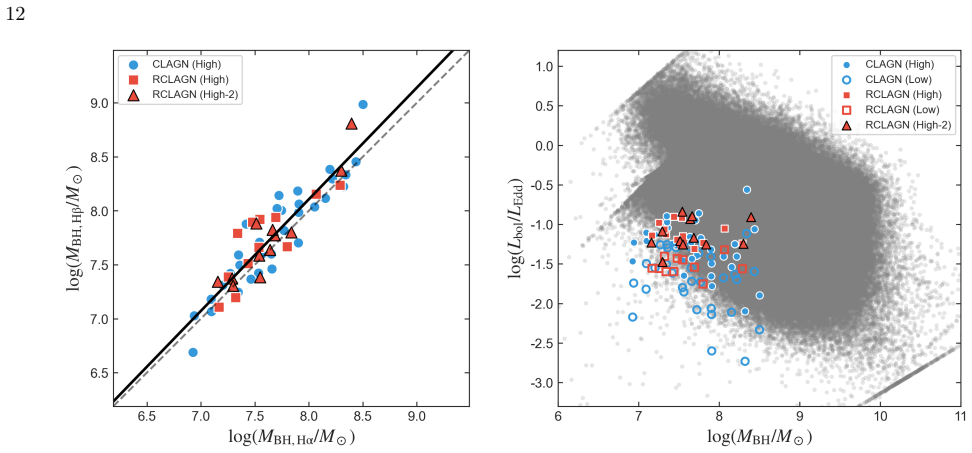
We identify 45 CLAGNs (40 new), of which 12 are RCLAGNs when DESI supplies the third epoch. The RCLAGNs display a clear high-low-high accretion-state evolution in the log MBH - log(Lbol/LEdd) plane, supporting a direct connection between CL behavior and recurrent changes in accretion power. The sample contains 43 turn-off and only 2 turn-on events.
What carries the argument
Three-epoch spectroscopy tracking of RCLAGNs in the log MBH - log(Lbol/LEdd) plane to expose recurrent accretion-state changes.
If this is right
- CL transitions arise from recurrent physical processes such as accretion-rate fluctuations or disk instabilities.
- RCLAGNs exhibit a clear high-low-high accretion-state evolution.
- The high detection rate of repeated CL behavior indicates that the underlying mechanism operates recurrently.
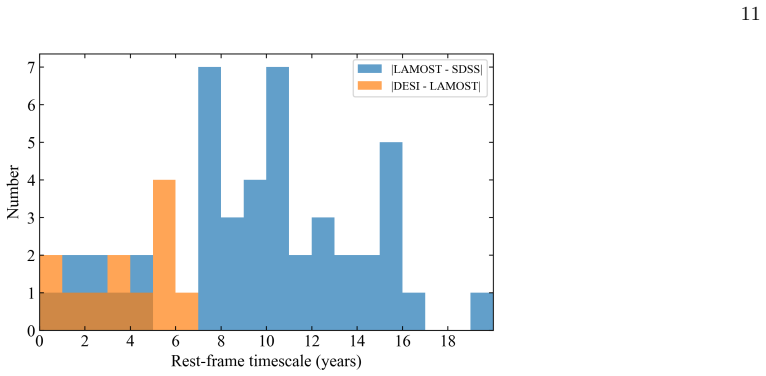
- Rest-frame upper limits place the first transition at roughly 10 yr and the second at roughly 4 yr.
Where Pith is reading between the lines
- Future multi-epoch surveys could use the same three-epoch method on known CLAGNs to measure the fraction that repeat and thereby constrain the typical recurrence timescale.
- The strong preference for turn-off over turn-on events may reflect either intrinsic differences in how accretion changes affect Type 1 versus Type 2 objects or simply the relative ease of detecting the loss of broad lines.
- If accretion fluctuations drive the repeats, the same sources should show correlated X-ray or UV variability on similar timescales.
Load-bearing premise
That the appearance or disappearance of broad emission lines signals genuine changes in accretion rate or broad-line-region visibility rather than variable dust obscuration.
What would settle it
A sample of RCLAGNs that fail to show the high-low-high accretion evolution or direct evidence that line changes in these objects are produced by changing line-of-sight dust.
Figures
read the original abstract
Although more than 1000 optical changing-look active galactic nuclei (CLAGNs) have been reported to date, their physical origin remains unclear, and repeating CLAGNs (RCLAGNs) are still rare. Expanding the CLAGN sample, especially RCLAGNs, is therefore important for constraining the underlying mechanism. We systematically search for CLAGNs by cross-matching spectroscopic observations from the Sloan Digital Sky Survey (SDSS) and the Large Sky Area Multi-Object Fiber Spectroscopic Telescope (LAMOST), and further use spectra from the Dark Energy Spectroscopic Instrument (DESI) to investigate repeating CL behavior. We identify 45 CLAGNs, including 40 newly reported sources. The sample is dominated by turn-off events, with 43 turn-off and 2 turn-on sources, possibly because Type 2 AGNs either lack a detectable broad-line region or have their broad emission lines obscured by circumnuclear dust. Using DESI as a third spectroscopic epoch, we identify 12 RCLAGNs. This high detection rate of repeated CL behavior suggests that CL transitions may arise from recurrent physical processes, such as accretion-rate fluctuations or disk instabilities. In the log MBH - log(Lbol/LEdd) plane, RCLAGNs further show a clear high-low-high accretion-state evolution, supporting a close link between CL behavior and recurrent changes in accretion power. Finally, the rest-frame upper limits on the transition timescales are about 10 yr for the first transition and about 4 yr for the second, reflecting different survey time baselines rather than intrinsic differences in physical transition timescales.
Editorial analysis
A structured set of objections, weighed in public.
Referee Report
Summary. The manuscript reports a systematic cross-match of SDSS, LAMOST, and DESI spectroscopic observations to search for changing-look AGNs (CLAGNs). It identifies 45 CLAGNs (40 new), dominated by turn-off events (43 turn-off, 2 turn-on), and uses DESI as a third epoch to find 12 repeating CLAGNs (RCLAGNs). The authors interpret the repeat rate as evidence that CL transitions arise from recurrent processes such as accretion-rate fluctuations or disk instabilities, report a high-low-high evolution for RCLAGNs in the log M_BH–log(L_bol/L_Edd) plane, and give rest-frame upper limits on transition timescales of ~10 yr (first) and ~4 yr (second).
Significance. If the spectral changes are shown to be intrinsic, the addition of 12 RCLAGNs and the three-epoch analysis would meaningfully expand the known repeating sample and provide observational support for recurrent accretion-driven models of CL behavior. The multi-survey cross-match and explicit reporting of concrete counts (45 total, 12 repeats) are strengths that facilitate future statistical studies of CL duty cycles.
major comments (1)
- [Abstract and RCLAGN results/discussion] Abstract and discussion of RCLAGNs: The central inference that the 12 RCLAGNs indicate recurrent physical processes (accretion-rate fluctuations or disk instabilities) and exhibit a 'clear high-low-high accretion-state evolution' in the log M_BH–log(L_bol/L_Edd) plane is load-bearing for the conclusions, yet the manuscript explicitly lists circumnuclear dust obscuration as a possible alternative explanation for the strong dominance of turn-off events (43 vs. 2). No quantitative multi-wavelength tests (e.g., mid-IR color variability, X-ray hardness ratios, or extinction diagnostics) are presented to exclude line-of-sight effects specifically for the repeating subset, leaving the intrinsic-accretion interpretation conditional.
minor comments (2)
- [Abstract] The abstract states a 'high detection rate' of repeats but does not quote the total number of three-epoch sources monitored or the selection function; adding this context would allow readers to evaluate the rate quantitatively.
- [Sample construction / methods] The manuscript should clarify the exact line-flux or equivalent-width thresholds and redshift cuts used to classify turn-off vs. turn-on events, as these directly affect the reported 43:2 ratio.
Simulated Author's Rebuttal
We thank the referee for the constructive feedback and for recognizing the value of the multi-survey cross-match and the identification of 12 RCLAGNs. We address the single major comment below.
read point-by-point responses
-
Referee: [Abstract and RCLAGN results/discussion] Abstract and discussion of RCLAGNs: The central inference that the 12 RCLAGNs indicate recurrent physical processes (accretion-rate fluctuations or disk instabilities) and exhibit a 'clear high-low-high accretion-state evolution' in the log M_BH–log(L_bol/L_Edd) plane is load-bearing for the conclusions, yet the manuscript explicitly lists circumnuclear dust obscuration as a possible alternative explanation for the strong dominance of turn-off events (43 vs. 2). No quantitative multi-wavelength tests (e.g., mid-IR color variability, X-ray hardness ratios, or extinction diagnostics) are presented to exclude line-of-sight effects specifically for the repeating subset, leaving the intrinsic-accretion interpretation conditional.
Authors: We acknowledge that the manuscript notes circumnuclear dust obscuration as one possible contributor to the overall dominance of turn-off events. However, the 12 RCLAGNs were selected precisely because they exhibit repeated spectral changes across three independent epochs, and these sources trace a coherent high-low-high trajectory in the log M_BH–log(L_bol/L_Edd) plane. Such a specific, recurrent evolutionary path is more naturally explained by changes in accretion rate than by variable line-of-sight obscuration, which would require finely tuned and repeatable dust geometry on the observed timescales. We therefore maintain that the repeating behavior and the accretion-state evolution provide observational support for recurrent accretion-driven processes. At the same time, we agree that the optical-only data set does not include the quantitative multi-wavelength diagnostics needed to fully exclude obscuration for the RCLAGN subset. We will revise the discussion (and, if space permits, the abstract) to state explicitly that the intrinsic-accretion interpretation is favored by the observed patterns but remains conditional pending future multi-wavelength follow-up. revision: partial
Circularity Check
No circularity: purely observational sample construction from survey cross-matches
full rationale
The paper identifies CLAGNs and RCLAGNs solely by cross-matching spectra from SDSS, LAMOST, and DESI, classifying turn-off/turn-on events and plotting sources in the log MBH-log(Lbol/LEdd) plane using standard derived quantities. No equations, fitted parameters, or self-citations reduce the reported counts (45 CLAGNs, 12 RCLAGNs), detection rate, or high-low-high evolution to quantities defined or fitted inside the paper itself. The derivation chain consists of direct observational selection and empirical plotting with no self-definitional, fitted-input, or self-citation-load-bearing steps.
Axiom & Free-Parameter Ledger
axioms (1)
- domain assumption Spectral classification of AGN types based on presence or absence of broad emission lines accurately reflects changes in accretion rate or broad-line-region visibility.
Reference graph
Works this paper leans on
-
[1]
2022, , 259, 35, 10.3847/1538-4365/ac4414
Abdurro’uf, Accetta, K., Aerts, C., et al. 2022, ApJS, 259, 35, doi: 10.3847/1538-4365/ac4414
-
[2]
Adelman-McCarthy, J. K., Ag¨ ueros, M. A., Allam, S. S., et al. 2008, ApJS, 175, 297, doi: 10.1086/524984
-
[3]
2017, MNRAS, 470, 2617, doi: 10.1093/mnras/stx721
Alam, S., Ata, M., Bailey, S., et al. 2017, MNRAS, 470, 2617, doi: 10.1093/mnras/stx721
-
[4]
Alexander, D. M., Davis, T. M., Chaussidon, E., et al. 2023, AJ, 165, 124, doi: 10.3847/1538-3881/acacfc
-
[5]
Amrutha, N., Wolf, C., Onken, C. A., et al. 2024, MNRAS, 535, 2322, doi: 10.1093/mnras/stae2470
-
[6]
1993, ARA&A, 31, 473, doi: 10.1146/annurev.aa.31.090193.002353
Antonucci, R. 1993, ARA&A, 31, 473, doi: 10.1146/annurev.aa.31.090193.002353
-
[7]
Bellm, E. C., Kulkarni, S. R., Graham, M. J., et al. 2019, PASP, 131, 018002, doi: 10.1088/1538-3873/aaecbe
-
[8]
Bolton, A. S., Schlegel, D. J., Aubourg, ´E., et al. 2012, AJ, 144, 144, doi: 10.1088/0004-6256/144/5/144
-
[9]
Boroson, T. A., & Green, R. F. 1992, ApJS, 80, 109, doi: 10.1086/191661
-
[10]
Cardelli, J. A., Clayton, G. C., & Mathis, J. S. 1989, ApJ, 345, 245, doi: 10.1086/167900
-
[11]
2023, ApJ, 944, 107, doi: 10.3847/1538-4357/acb3c2
Chaussidon, E., Y` eche, C., Palanque-Delabrouille, N., et al. 2023, ApJ, 944, 107, doi: 10.3847/1538-4357/acb3c2
-
[12]
2025, MNRAS, 544, 1926, doi: 10.1093/mnras/staf1818
Chen, G., Yang, W., Liu, Y., et al. 2025, MNRAS, 544, 1926, doi: 10.1093/mnras/staf1818
-
[13]
2026a, A&A, 707, A347, doi: 10.1051/0004-6361/202557975
Chen, G., Yang, W., Ye, X., et al. 2026a, A&A, 707, A347, doi: 10.1051/0004-6361/202557975
-
[14]
2024, ApJS, 271, 20, doi: 10.3847/1538-4365/ad1c67
Chen, G., Zheng, Z., Zeng, X., et al. 2024, ApJS, 271, 20, doi: 10.3847/1538-4365/ad1c67
-
[15]
2026b, ApJS, 282, 28, doi: 10.3847/1538-4365/ae23cb
Chen, Z.-Q., Jin, J.-J., Guo, W.-J., et al. 2026b, ApJS, 282, 28, doi: 10.3847/1538-4365/ae23cb
-
[16]
Foltz, C. B. 1986, ApJ, 311, 135, doi: 10.1086/164758
-
[17]
2022, in Active Galactic Nuclei, ed
Collin-Zahn, S. 2022, in Active Galactic Nuclei, ed. F. Combes, 1–63, doi: 10.1002/9781394163724.ch1
-
[18]
2012, Research in Astronomy and Astrophysics, 12, 1197, doi: 10.1088/1674-4527/12/9/003
Cui, X.-Q., Zhao, Y.-H., Chu, Y.-Q., et al. 2012, Research in Astronomy and Astrophysics, 12, 1197, doi: 10.1088/1674-4527/12/9/003
-
[19]
The DESI Experiment Part I: Science,Targeting, and Survey Design
Denney, K. D., De Rosa, G., Croxall, K., et al. 2014, ApJ, 796, 134, doi: 10.1088/0004-637X/796/2/134 DESI Collaboration, Aghamousa, A., Aguilar, J., et al. 2016a, arXiv e-prints, arXiv:1611.00036, doi: 10.48550/arXiv.1611.00036 —. 2016b, arXiv e-prints, arXiv:1611.00037, doi: 10.48550/arXiv.1611.00037 DESI Collaboration, Abareshi, B., Aguilar, J., et al....
work page internal anchor Pith review Pith/arXiv arXiv doi:10.1088/0004-637x/796/2/134 2014
-
[20]
Discovery of Repeating Transitions in 16 Changing-look Active Galactic Nuclei
Dong, Q., Zhang, Z.-X., Gu, W.-M., et al. 2025a, arXiv e-prints, arXiv:2510.18445, doi: 10.48550/arXiv.2510.18445
work page internal anchor Pith review Pith/arXiv arXiv doi:10.48550/arxiv.2510.18445
-
[21]
2025b, ApJ, 986, 160, doi: 10.3847/1538-4357/add331
Dong, Q., Zhang, Z.-X., Gu, W.-M., Sun, M., & Zheng, Y.-G. 2025b, ApJ, 986, 160, doi: 10.3847/1538-4357/add331
-
[22]
Drake, A. J., Djorgovski, S. G., Mahabal, A., et al. 2009, ApJ, 696, 870, doi: 10.1088/0004-637X/696/1/870
-
[23]
2016, ApJS, 227, 27, doi: 10.3847/1538-4365/227/2/27
Du, B., Luo, A.-L., Kong, X., et al. 2016, ApJS, 227, 27, doi: 10.3847/1538-4365/227/2/27
-
[24]
Elitzur, M., & Ho, L. C. 2009, ApJL, 701, L91, doi: 10.1088/0004-637X/701/2/L91
work page internal anchor Pith review doi:10.1088/0004-637x/701/2/l91 2009
-
[25]
2021, ApJ, 916, 61, doi: 10.3847/1538-4357/ac07a6 15
Feng, J., Cao, X., Li, J.-w., & Gu, W.-M. 2021, ApJ, 916, 61, doi: 10.3847/1538-4357/ac07a6 15
-
[26]
Fu, Y. 2021, QSOFITMORE: a python package for fitting UV-optical spectra of quasars, v1.1.0, Zenodo, Zenodo, doi: 10.5281/zenodo.5810042
-
[27]
Fukugita, M., Ichikawa, T., Gunn, J. E., et al. 1996, AJ, 111, 1748, doi: 10.1086/117915
-
[28]
J., Pulgarin-Duque, L., Anderson, S
Green, P. J., Pulgarin-Duque, L., Anderson, S. F., et al. 2022, ApJ, 933, 180, doi: 10.3847/1538-4357/ac743f
-
[29]
Greene, J. E., & Ho, L. C. 2005, ApJ, 630, 122, doi: 10.1086/431897
work page internal anchor Pith review doi:10.1086/431897 2005
-
[30]
Gunn, J. E., Siegmund, W. A., Mannery, E. J., et al. 2006, AJ, 131, 2332, doi: 10.1086/500975
-
[31]
2018, PyQSOFit: Python code to fit the spectrum of quasars, Astrophysics Source Code Library, record ascl:1809.008
Guo, H., Shen, Y., & Wang, S. 2018, PyQSOFit: Python code to fit the spectrum of quasars, Astrophysics Source Code Library, record ascl:1809.008. http://ascl.net/1809.008
2018
-
[32]
Guo, W.-J., Zou, H., Fawcett, V. A., et al. 2024, ApJS, 270, 26, doi: 10.3847/1538-4365/ad118a
-
[33]
Guo, W.-J., Zou, H., Greenwell, C. L., et al. 2025, ApJS, 278, 28, doi: 10.3847/1538-4365/adc124
-
[34]
Holt, S. S., Mushotzky, R. F., Becker, R. H., et al. 1980, ApJL, 241, L13, doi: 10.1086/183350
-
[35]
Hutchinson, T. A., Bolton, A. S., Dawson, K. S., et al. 2016, AJ, 152, 205, doi: 10.3847/0004-6256/152/6/205
-
[36]
2022, ApJ, 926, 184, doi: 10.3847/1538-4357/ac410c
Jin, J.-J., Wu, X.-B., & Feng, X.-T. 2022, ApJ, 926, 184, doi: 10.3847/1538-4357/ac410c
-
[37]
Jones, D. H., Read, M. A., Saunders, W., et al. 2009, MNRAS, 399, 683, doi: 10.1111/j.1365-2966.2009.15338.x
-
[38]
Kaspi, S., Smith, P. S., Netzer, H., et al. 2000, ApJ, 533, 631, doi: 10.1086/308704
-
[39]
Kochanek, C. S., Shappee, B. J., Stanek, K. Z., et al. 2017, PASP, 129, 104502, doi: 10.1088/1538-3873/aa80d9
-
[40]
Komatsu, E., Smith, K. M., Dunkley, J., et al. 2011, ApJS, 192, 18, doi: 10.1088/0067-0049/192/2/18
work page internal anchor Pith review doi:10.1088/0067-0049/192/2/18 2011
-
[41]
Kormendy, J., & Ho, L. C. 2013, ARA&A, 51, 511, doi: 10.1146/annurev-astro-082708-101811
work page internal anchor Pith review doi:10.1146/annurev-astro-082708-101811 2013
-
[42]
LaMassa, S. M., Cales, S., Moran, E. C., et al. 2015, ApJ, 800, 144, doi: 10.1088/0004-637X/800/2/144
-
[43]
The DESI Experiment, a whitepaper for Snowmass 2013
Levi, M., Bebek, C., Beers, T., et al. 2013, arXiv e-prints, arXiv:1308.0847, doi: 10.48550/arXiv.1308.0847
work page internal anchor Pith review Pith/arXiv arXiv doi:10.48550/arxiv.1308.0847 2013
-
[44]
2022, ApJ, 927, 57, doi: 10.3847/1538-4357/ac4bd9
Liu, S., Luo, A.-L., Yang, H., et al. 2022, ApJ, 927, 57, doi: 10.3847/1538-4357/ac4bd9
-
[45]
2025, ApJS, 276, 51, doi: 10.3847/1538-4365/ad9a5a
Lu, K.-X., Li, Y.-R., Wu, Q., et al. 2025, ApJS, 276, 51, doi: 10.3847/1538-4365/ad9a5a
-
[46]
L., Zhang, H.-T., Zhao, Y.-H., et al
Luo, A. L., Zhang, H.-T., Zhao, Y.-H., et al. 2012, Research in Astronomy and Astrophysics, 12, 1243, doi: 10.1088/1674-4527/12/9/004
-
[47]
2022, ApJ, 927, 227, doi: 10.3847/1538-4357/ac5256
Lyu, B., Wu, Q., Yan, Z., Yu, W., & Liu, H. 2022, ApJ, 927, 227, doi: 10.3847/1538-4357/ac5256
-
[48]
2025, A&A, 693, A173, doi: 10.1051/0004-6361/202451699
Lyu, B., Wu, X.-B., Pang, Y., et al. 2025, A&A, 693, A173, doi: 10.1051/0004-6361/202451699
-
[49]
MacLeod, C. L., Ross, N. P., Lawrence, A., et al. 2016, MNRAS, 457, 389, doi: 10.1093/mnras/stv2997
-
[50]
MacLeod, C. L., Green, P. J., Anderson, S. F., et al. 2019, ApJ, 874, 8, doi: 10.3847/1538-4357/ab05e2
-
[51]
K., Schramm, M., Rakshit, S., et al
Mandal, A. K., Schramm, M., Rakshit, S., et al. 2021, MNRAS, 508, 5296, doi: 10.1093/mnras/stab2909
-
[52]
McElroy, R. E., Husemann, B., Croom, S. M., et al. 2016, A&A, 593, L8, doi: 10.1051/0004-6361/201629102
-
[53]
2015, MNRAS, 452, 69, doi: 10.1093/mnras/stv1095
Merloni, A., Dwelly, T., Salvato, M., et al. 2015, MNRAS, 452, 69, doi: 10.1093/mnras/stv1095
-
[54]
2023, FastSpecFit: Fast spectral synthesis and emission-line fitting of DESI spectra, Astrophysics Source Code Library, record ascl:2308.005
Khederlarian, A. 2023, FastSpecFit: Fast spectral synthesis and emission-line fitting of DESI spectra, Astrophysics Source Code Library, record ascl:2308.005. http://ascl.net/2308.005
2023
-
[55]
2018, MNRAS, 480, 3898, doi: 10.1093/mnras/sty2032
Noda, H., & Done, C. 2018, MNRAS, 480, 3898, doi: 10.1093/mnras/sty2032
-
[56]
2021, A&A, 656, A47, doi: 10.1051/0004-6361/202040273
Padmanabhan, H., & Loeb, A. 2021, A&A, 656, A47, doi: 10.1051/0004-6361/202040273
-
[57]
2025, MNRAS, 540, L14, doi: 10.1093/mnrasl/slaf027 Pˆ aris, I., Petitjean, P., Aubourg,´E., et al
Palit, B., ´Sniegowska, M., Markowitz, A., et al. 2025, MNRAS, 540, L14, doi: 10.1093/mnrasl/slaf027 Pˆ aris, I., Petitjean, P., Aubourg,´E., et al. 2018, A&A, 613, A51, doi: 10.1051/0004-6361/201732445
-
[58]
Peterson, B. M., Balonek, T. J., Barker, E. S., et al. 1991, ApJ, 368, 119, doi: 10.1086/169675
-
[59]
2021, A&A, 650, A33, doi: 10.1051/0004-6361/202140597
Potts, B., & Villforth, C. 2021, A&A, 650, A33, doi: 10.1051/0004-6361/202140597
-
[60]
Raimundo, S. I., Vestergaard, M., Koay, J. Y., et al. 2019, MNRAS, 486, 123, doi: 10.1093/mnras/stz852
-
[61]
2023, Nature Astronomy, 7, 1282, doi: 10.1038/s41550-023-02108-4
Ricci, C., & Trakhtenbrot, B. 2023, Nature Astronomy, 7, 1282, doi: 10.1038/s41550-023-02108-4
-
[62]
Riffel, R., Rodr´ ıguez-Ardila, A., & Pastoriza, M. G. 2006, A&A, 457, 61, doi: 10.1051/0004-6361:20065291
-
[63]
Ruan, J. J., Anderson, S. F., Eracleous, M., et al. 2019, ApJ, 883, 76, doi: 10.3847/1538-4357/ab3c1a
-
[64]
Ruan, J. J., Anderson, S. F., Cales, S. L., et al. 2016, ApJ, 826, 188, doi: 10.3847/0004-637X/826/2/188
-
[65]
Runnoe, J. C., Cales, S., Ruan, J. J., et al. 2016, MNRAS, 455, 1691, doi: 10.1093/mnras/stv2385
-
[66]
Schlegel, D. J., Finkbeiner, D. P., & Davis, M. 1998, ApJ, 500, 525, doi: 10.1086/305772
work page internal anchor Pith review doi:10.1086/305772 1998
-
[67]
Shen, Y., & Ho, L. C. 2014, Nature, 513, 210, doi: 10.1038/nature13712
-
[68]
Shen, Y., Hall, P. B., Horne, K., et al. 2019, ApJS, 241, 34, doi: 10.3847/1538-4365/ab074f
-
[69]
2017, ApJL, 846, L7, doi: 10.3847/2041-8213/aa85de —
Sheng, Z., Wang, T., Jiang, N., et al. 2017, ApJL, 846, L7, doi: 10.3847/2041-8213/aa85de —. 2020, ApJ, 889, 46, doi: 10.3847/1538-4357/ab5af9
-
[70]
2020, A&A, 641, A167, doi: 10.1051/0004-6361/202038575 16
Sniegowska, M., Czerny, B., Bon, E., & Bon, N. 2020, A&A, 641, A167, doi: 10.1051/0004-6361/202038575 16
-
[71]
Taylor, M. B. 2005, in Astronomical Society of the Pacific Conference Series, Vol. 347, Astronomical Data Analysis Software and Systems XIV, ed. P. Shopbell, M. Britton, & R. Ebert, 29
2005
-
[72]
Tran, H. D. 2001, ApJL, 554, L19, doi: 10.1086/320926
-
[73]
Urry, C. M., & Padovani, P. 1995, PASP, 107, 803, doi: 10.1086/133630
work page internal anchor Pith review doi:10.1086/133630 1995
-
[74]
Vestergaard, M., & Wilkes, B. J. 2001, ApJS, 134, 1, doi: 10.1086/320357
-
[75]
2007, ApJ, 660, 1072, doi: 10.1086/513685
Wang, J.-M., & Zhang, E.-P. 2007, ApJ, 660, 1072, doi: 10.1086/513685
-
[76]
2018, MNRAS, 474, 1873, doi: 10.1093/mnras/stx2798
Wang, L.-L., Luo, A.-L., Shen, S.-Y., et al. 2018, MNRAS, 474, 1873, doi: 10.1093/mnras/stx2798
-
[77]
2025, ApJ, 981, 129, doi: 10.3847/1538-4357/adadf3 —
Wang, S., Woo, J.-H., Gallo, E., et al. 2025, ApJ, 981, 129, doi: 10.3847/1538-4357/adadf3 —. 2024, ApJ, 966, 128, doi: 10.3847/1538-4357/ad3049
-
[78]
Wilhite, B. C., Vanden Berk, D. E., Kron, R. G., et al. 2005, ApJ, 633, 638, doi: 10.1086/430821
-
[79]
Wright, E. L., Eisenhardt, P. R. M., Mainzer, A. K., et al. 2010, AJ, 140, 1868, doi: 10.1088/0004-6256/140/6/1868
work page internal anchor Pith review doi:10.1088/0004-6256/140/6/1868 2010
-
[80]
2022, ApJS, 263, 42, doi: 10.3847/1538-4365/ac9ead
Wu, Q., & Shen, Y. 2022, ApJS, 263, 42, doi: 10.3847/1538-4365/ac9ead
discussion (0)
Sign in with ORCID, Apple, or X to comment. Anyone can read and Pith papers without signing in.