Distorting Kerr Images with Parity-Odd Scalar Hair
Pith reviewed 2026-06-29 11:01 UTC · model grok-4.3
The pith
Kerr black holes with parity-odd scalar hair form a core-double-torus lensing structure whose photon ring and shadow shrink and distort with rising hair strength.
A machine-rendered reading of the paper's core claim, the machinery that carries it, and where it could break.
Core claim
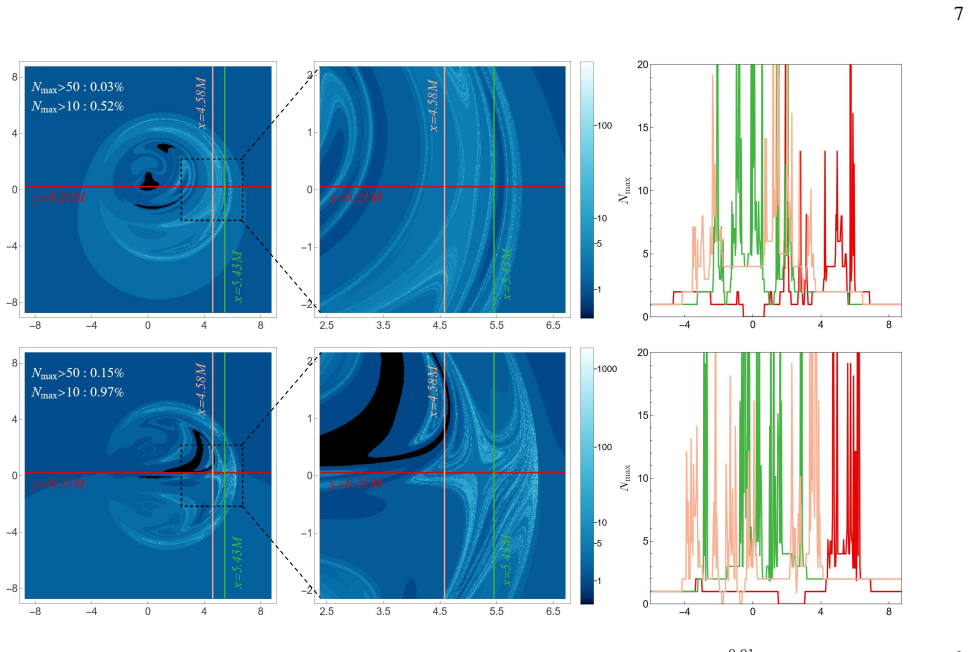
The spacetime of a Kerr black hole with backreacted parity-odd excited scalar hair displays a core-double-torus lensing structure consisting of a central black hole surrounded by two scalar clouds. Increasing hair strength causes the photon ring and shadow region to shrink and become more distorted. In the strong-hair regime gravitational lensing produces multiple disconnected shadow components, crescent-shaped structures, and signatures of chaotic lensing; nearly edge-on viewing angles generate nested ring-like patterns from repeated equatorial crossings.
What carries the argument
Thin-disk ray tracing through the backreacted metric of synchronized parity-odd excited states of a minimally coupled complex scalar field on a Kerr background, which supplies the core-double-torus lensing structure.
If this is right
- Photon ring and shadow shrink and distort as scalar hair strength increases.
- Strong hair produces multiple disconnected shadow components and crescent-shaped structures.
- Chaotic lensing signatures appear in the strong-hair regime.
- Nearly edge-on views generate nested ring-like patterns from repeated equatorial crossings.
Where Pith is reading between the lines
- If such configurations are realized astrophysically, their lensing features could serve as geometric discriminants from ordinary Kerr images in future observations.
- The core-double-torus structure suggests that scalar clouds act as additional refractive elements that reorganize null geodesics beyond standard Kerr photon orbits.
- The transition from weak to strong hair regimes offers a continuous parameter for testing how scalar hair modifies the boundary between captured and escaping light.
Load-bearing premise
Stable backreacted synchronized parity-odd excited states of a minimally coupled complex scalar field exist around a Kerr black hole and can be imaged with a thin equatorial accretion disk.
What would settle it
High-resolution images of a supermassive black hole either showing or failing to show multiple disconnected shadow components together with crescent structures at the expected hair-strength thresholds.
Figures
read the original abstract
We investigate thin-disk imaging of Kerr black holes with synchronized scalar hair, focusing on backreacted parity-odd excited states of a complex scalar field minimally coupled to Einstein gravity. The spacetime displays a core-double-torus lensing structure, with a central black hole surrounded by two scalar clouds. We study the dependence of the images on hair strength and viewing angle, identifying a weak-hair regime close to Kerr. With increasing hair, the photon ring and shadow region shrink and become more distorted. In the strong-hair regime, gravitational lensing produces new features, including multiple disconnected shadow components, crescent-shaped structures, and signatures of chaotic lensing. For nearly edge-on viewing angles, repeated equatorial crossings generate nested ring-like patterns. These results highlight possible geometric signatures of black holes with excited scalar hair.
Editorial analysis
A structured set of objections, weighed in public.
Referee Report
Summary. The manuscript numerically constructs backreacted spacetimes for Kerr black holes with synchronized parity-odd excited states of a minimally coupled complex scalar field and computes their thin equatorial accretion disk images. It reports a core-double-torus lensing structure, with the photon ring and shadow shrinking and distorting as hair strength increases; in the strong-hair regime new features appear including multiple disconnected shadow components, crescent-shaped structures, and signatures of chaotic lensing, plus nested ring-like patterns for near-edge-on views.
Significance. If the reported equilibria are dynamically stable, the work supplies concrete, falsifiable predictions for strong-field lensing signatures that could distinguish scalar-hairy black holes from Kerr in future EHT or ngEHT data, extending prior imaging studies of hairy solutions to the parity-odd excited sector.
major comments (2)
- [Numerical construction and results sections] The central imaging claims presuppose that the constructed parity-odd excited states are stable synchronized equilibria. No linear stability analysis, perturbation spectrum, or time-evolution check is presented to verify dynamical stability on relevant timescales; without this the reported lensing features (core-double-torus, disconnected shadows, chaotic lensing) may describe unphysical configurations.
- [Imaging and results sections] No convergence tests, grid-resolution studies, or error estimates are reported for either the Einstein-scalar solver or the subsequent ray-tracing; this undermines in quantitative statements about shadow shrinkage, distortion, and the appearance of new disconnected components.
minor comments (2)
- [Methods] Notation for the scalar field ansatz and synchronization condition should be stated explicitly in the methods section rather than assumed from prior literature.
- [Figures] Figure captions would benefit from explicit statements of the viewing angles and hair-strength parameter values used in each panel.
Simulated Author's Rebuttal
We thank the referee for the careful reading and constructive comments. We respond to each major comment below.
read point-by-point responses
-
Referee: [Numerical construction and results sections] The central imaging claims presuppose that the constructed parity-odd excited states are stable synchronized equilibria. No linear stability analysis, perturbation spectrum, or time-evolution check is presented to verify dynamical stability on relevant timescales; without this the reported lensing features (core-double-torus, disconnected shadows, chaotic lensing) may describe unphysical configurations.
Authors: We acknowledge that dynamical stability is essential to establish the physical viability of the reported configurations. The present manuscript is devoted to the construction of the backreacted equilibria and the computation of their thin-disk images; a dedicated linear stability analysis or long-term evolution study would require a separate numerical framework and is beyond the scope of this work. In the revised manuscript we have added an explicit statement in the conclusions section noting that stability has not been verified here and that the imaging results assume the existence of such equilibria, consistent with the approach taken in earlier studies of scalar-hairy black holes. revision: partial
-
Referee: [Imaging and results sections] No convergence tests, grid-resolution studies, or error estimates are reported for either the Einstein-scalar solver or the subsequent ray-tracing; this undermines in quantitative statements about shadow shrinkage, distortion, and the appearance of new disconnected components.
Authors: We agree that quantitative statements about shadow properties require documented numerical accuracy. In the revised version we have added a new subsection (and associated appendix) that reports the grid resolutions used for the Einstein-scalar solver, convergence tests under successive refinement for the metric and scalar-field functions, and error estimates for the ray-tracing integrator. These tests confirm that the reported trends—shrinkage and distortion of the photon ring, as well as the appearance of disconnected shadow components—remain robust. revision: yes
Circularity Check
No circularity: numerical construction and imaging are independent of inputs
full rationale
The paper numerically solves the Einstein-complex-scalar system for backreacted parity-odd synchronized states, then ray-traces thin-disk images to produce lensing features. No analytic derivation chain exists that reduces a claimed prediction to a fitted quantity, self-citation, or ansatz by construction. All reported structures (core-double-torus, distorted photon rings, disconnected shadows) are direct numerical outputs rather than reparameterizations of the input data or prior self-citations. The work is self-contained against external benchmarks.
Axiom & Free-Parameter Ledger
Reference graph
Works this paper leans on
-
[1]
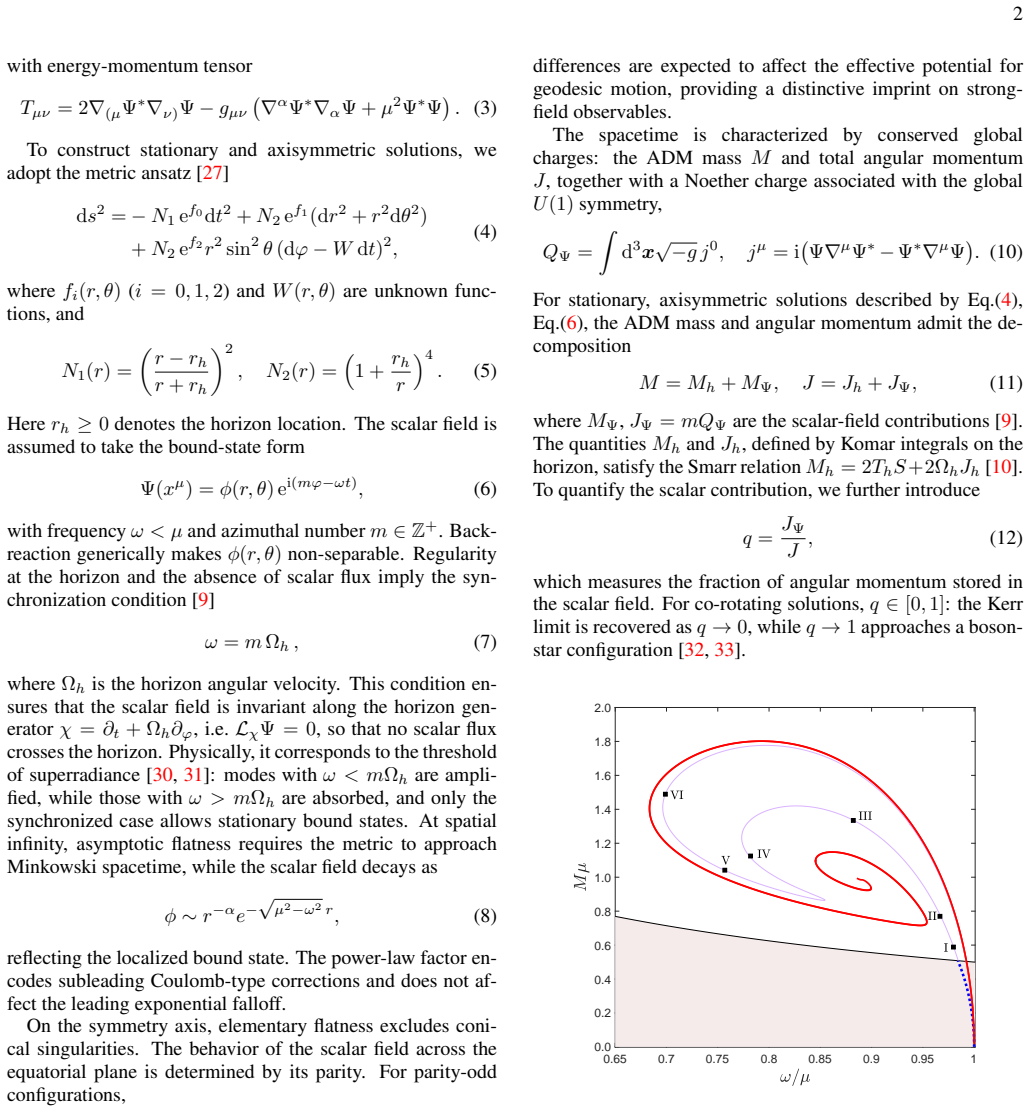
in theM−ωplane. The light-pink shaded region denotes the domain of existence of vacuum KBHs, while the black and red solid curves mark the extremal Kerr and parity-odd boson-star boundaries, respectively. The six black squares identify the parity-odd hairy black hole solutions adopted below for thin-disk imaging. All of them lie on the family withr h = 0....
-
[2]
max” and “min
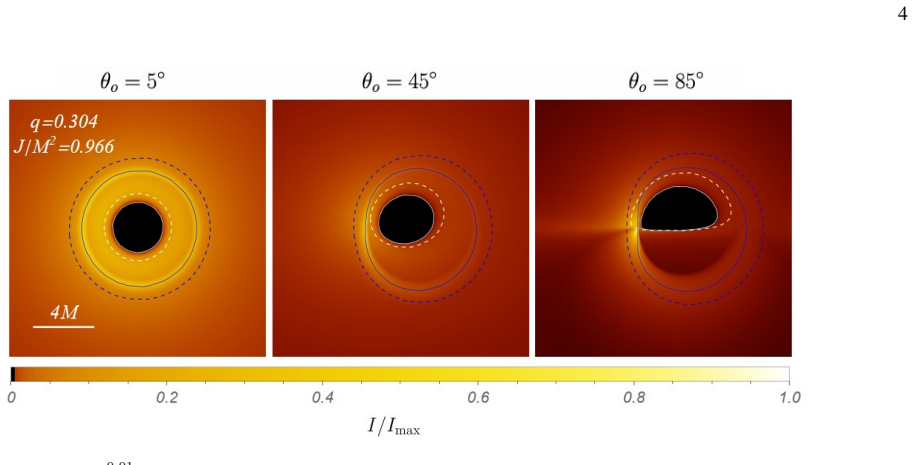
Small scalar charge regime We begin with the small scalar charge regime. Fig. 2 shows the images of I 0.01 0.304 for several viewing angles. The over- all morphology closely resembles that of a vacuum KBH: an asymmetric central dark region surrounded by a narrow bright ring. The bright ring corresponds to the photon ring, formed by photons that orbit the ...
-
[3]
ADM” or “Hori
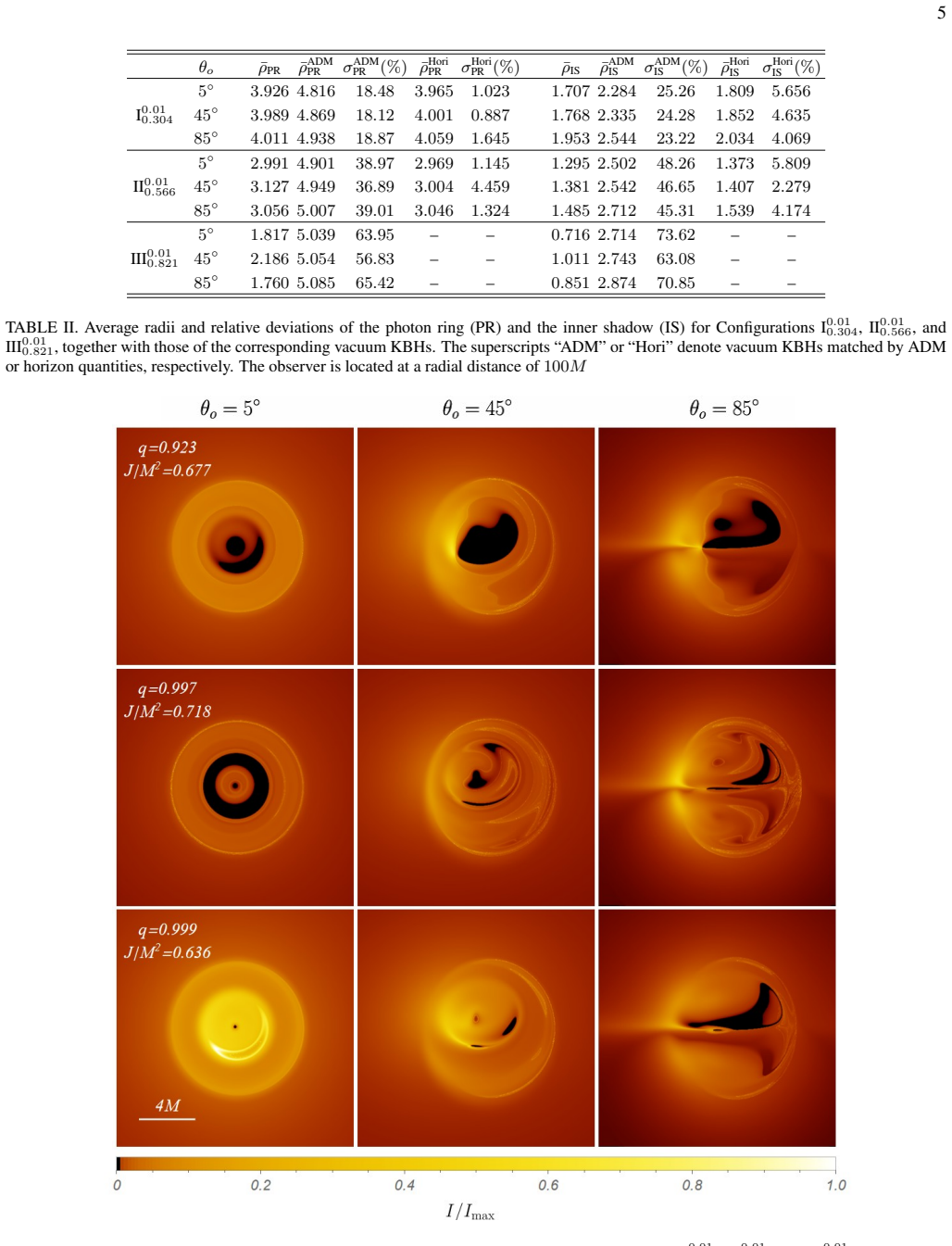
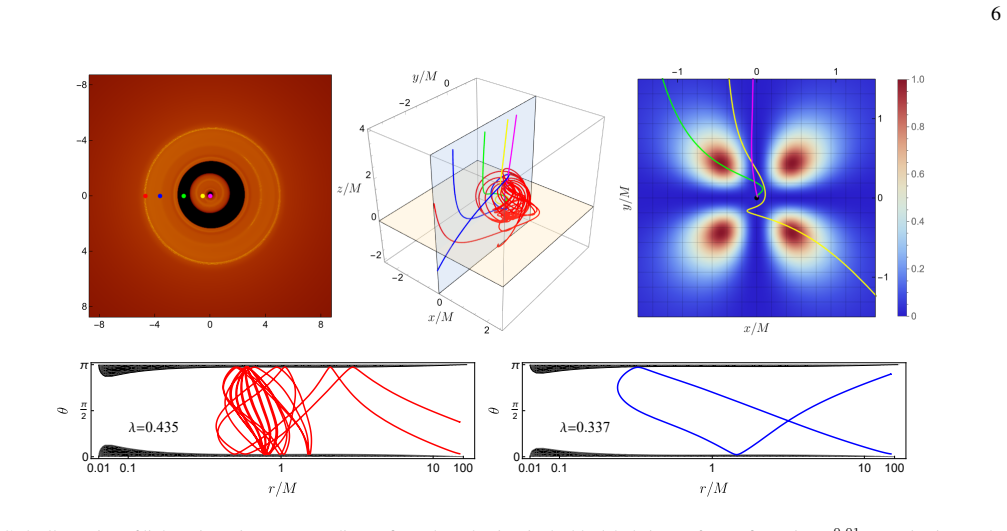
Large scalar charge regime As the scalar charge increases to sufficiently large values, the resulting images exhibit qualitative deviations from those of vacuum Kerr black holes. In Fig. 3, we show images for three representative solutions (IV 0.01 0.923, V0.01 0.997, and VI 0.01 0.999), all withq >0.9, viewed from different inclination angles. As 5 θo ¯ρ...
-
[4]
First M87 Event Horizon Telescope Results. I. The Shadow of the Supermassive Black Hole
K. Akiyama et al. (Event Horizon Telescope), Astrophys. J. Lett.875, L1 (2019), arXiv:1906.11238 [astro-ph.GA]
work page internal anchor Pith review Pith/arXiv arXiv 2019
-
[5]
K. Akiyama et al. (Event Horizon Telescope), Astrophys. J. Lett.930, L12 (2022), arXiv:2311.08680 [astro-ph.HE]
work page internal anchor Pith review Pith/arXiv arXiv 2022
-
[6]
P. V . P. Cunha, C. A. R. Herdeiro, E. Radu, and H. F. Runarsson, Phys. Rev. Lett.115, 211102 (2015), arXiv:1509.00021 [gr-qc]
work page internal anchor Pith review Pith/arXiv arXiv 2015
-
[7]
F. H. Vincent, E. Gourgoulhon, C. Herdeiro, and E. Radu, Phys. Rev. D94, 084045 (2016), arXiv:1606.04246 [gr-qc]
work page internal anchor Pith review Pith/arXiv arXiv 2016
- [8]
- [9]
-
[10]
Y . Huang, D.-J. Liu, and H. Zhang, Sci. China Phys. Mech. Astron.68, 280411 (2025), arXiv:2410.20867 [gr-qc]
-
[11]
Stationary Scalar Clouds Around Rotating Black Holes
S. Hod, Phys. Rev. D86, 104026 (2012), [Erratum: Phys.Rev.D 86, 129902 (2012)], arXiv:1211.3202 [gr-qc]
work page internal anchor Pith review Pith/arXiv arXiv 2012
-
[12]
C. A. R. Herdeiro and E. Radu, Phys. Rev. Lett.112, 221101 (2014), arXiv:1403.2757 [gr-qc]
work page internal anchor Pith review Pith/arXiv arXiv 2014
-
[13]
Construction and physical properties of Kerr black holes with scalar hair
C. Herdeiro and E. Radu, Class. Quant. Grav.32, 144001 (2015), arXiv:1501.04319 [gr-qc]
work page internal anchor Pith review Pith/arXiv arXiv 2015
-
[14]
Hod, Phys
S. Hod, Phys. Rev. D90, 024051 (2014)
2014
-
[15]
C. L. Benone, L. C. B. Crispino, C. Herdeiro, and E. Radu, Phys. Rev. D90, 104024 (2014), arXiv:1409.1593 [gr-qc]
work page internal anchor Pith review Pith/arXiv arXiv 2014
-
[16]
C. A. R. Herdeiro and E. Radu, Int. J. Mod. Phys. D23, 1442014 (2014), arXiv:1405.3696 [gr-qc]
work page internal anchor Pith review Pith/arXiv arXiv 2014
-
[17]
B. Kleihaus, J. Kunz, and S. Yazadjiev, Phys. Lett. B744, 406 (2015), arXiv:1503.01672 [gr-qc]
work page internal anchor Pith review Pith/arXiv arXiv 2015
-
[18]
C. A. R. Herdeiro, E. Radu, and H. Rúnarsson, Phys. Rev. D92, 084059 (2015), arXiv:1509.02923 [gr-qc]
work page internal anchor Pith review Pith/arXiv arXiv 2015
-
[19]
Extremal Kerr-Newman black holes with extremely short charged scalar hair
S. Hod, Phys. Lett. B751, 177 (2015), arXiv:1707.06246 [gr- qc]
work page internal anchor Pith review Pith/arXiv arXiv 2015
-
[20]
Kerr black holes with Proca hair
C. Herdeiro, E. Radu, and H. Rúnarsson, Class. Quant. Grav. 33, 154001 (2016), arXiv:1603.02687 [gr-qc]
work page internal anchor Pith review Pith/arXiv arXiv 2016
-
[21]
J. F. M. Delgado, C. A. R. Herdeiro, and E. Radu, Phys. Lett. B 792, 436 (2019), arXiv:1903.01488 [gr-qc]
work page internal anchor Pith review Pith/arXiv arXiv 2019
-
[22]
P. V . P. Cunha, J. Grover, C. Herdeiro, E. Radu, H. Runars- son, and A. Wittig, Phys. Rev. D94, 104023 (2016), arXiv:1609.01340 [gr-qc]
work page internal anchor Pith review Pith/arXiv arXiv 2016
- [23]
-
[24]
Y . Huang, D.-J. Liu, and H. Zhang, JHEP11, 027, arXiv:2507.04761 [gr-qc]
- [25]
- [26]
-
[27]
Y . Chen, L. Li, and P. Wang, (2026), arXiv:2604.11652 [gr-qc]
work page internal anchor Pith review Pith/arXiv arXiv 2026
-
[28]
V . O. Deliyski, G. N. Gyulchev, D. D. Doneva, P. G. Nedkova, and S. S. Yazadjiev, (2026), arXiv:2605.03006 [gr-qc]
work page internal anchor Pith review Pith/arXiv arXiv 2026
-
[29]
Excited Kerr black holes with scalar hair
Y .-Q. Wang, Y .-X. Liu, and S.-W. Wei, Phys. Rev. D99, 064036 (2019), arXiv:1811.08795 [gr-qc]
work page internal anchor Pith review Pith/arXiv arXiv 2019
- [30]
-
[31]
L. Medeiros, C.-K. Chan, R. Narayan, F. Ozel, and D. Psaltis, Astrophys. J.924, 46 (2022), arXiv:2105.03424 [astro-ph.HE]
-
[32]
V . Bernshteyn et al. (Event Horizon Telescope), Astrophys. J. 1000, 231 (2026), arXiv:2601.00394 [astro-ph.HE]
-
[33]
W. H. Press and S. A. Teukolsky, Nature238, 211 (1972)
1972
-
[34]
Superradiance -- the 2020 Edition
R. Brito, V . Cardoso, and P. Pani, Lect. Notes Phys.906, pp.1 (2015), arXiv:1501.06570 [gr-qc]
work page internal anchor Pith review Pith/arXiv arXiv 2015
-
[35]
D. J. Kaup, Phys. Rev.172, 1331 (1968)
1968
-
[36]
Ruffini and S
R. Ruffini and S. Bonazzola, Phys. Rev.187, 1767 (1969)
1969
-
[37]
Chandrasekhar and K
S. Chandrasekhar and K. S. Thorne, The mathematical theory of black holes (1985)
1985
-
[38]
R. W. Lindquist, Annals Phys.37, 487 (1966)
1966
-
[39]
S. E. Gralla, D. E. Holz, and R. M. Wald, Phys. Rev. D100, 024018 (2019), arXiv:1906.00873 [astro-ph.HE]
work page internal anchor Pith review Pith/arXiv arXiv 2019
-
[40]
A. Chael, M. D. Johnson, and A. Lupsasca, Astrophys. J.918, 6 (2021), arXiv:2106.00683 [astro-ph.HE]
- [41]
- [42]
-
[43]
Y . Meng, X.-J. Wang, Y .-Z. Li, and X.-M. Kuang, Eur. Phys. J. C85, 627 (2025), arXiv:2501.02496 [gr-qc]
-
[44]
He, C.-Y
K.-J. He, C.-Y . Yang, X.-X. Zeng, and Z.-X. Chang, Chin. Phys. C50, 035102 (2026)
2026
- [45]
- [46]
- [47]
-
[48]
F. Zhou, J. Huang, Y . Li, Z. Zhang, Y . Hou, M. Guo, and B. Chen, Astrophys. J.1002, 152 (2026), arXiv:2512.06803 [astro-ph.HE]
work page internal anchor Pith review Pith/arXiv arXiv 2026
- [49]
-
[50]
Photon Rings around Kerr and Kerr-like Black Holes
T. Johannsen, Astrophys. J.777, 170 (2013), arXiv:1501.02814 [astro-ph.HE]
work page internal anchor Pith review Pith/arXiv arXiv 2013
-
[51]
H. Olivares, Z. Younsi, C. M. Fromm, M. De Lauren- tis, O. Porth, Y . Mizuno, H. Falcke, M. Kramer, and L. Rezzolla, Mon. Not. Roy. Astron. Soc.497, 521 (2020), 9 arXiv:1809.08682 [gr-qc]
-
[52]
Binary black hole shadows, chaotic scattering and the Cantor set
J. Shipley and S. R. Dolan, Class. Quant. Grav.33, 175001 (2016), arXiv:1603.04469 [gr-qc]
work page internal anchor Pith review Pith/arXiv arXiv 2016
-
[53]
F. Bacchini, D. R. Mayerson, B. Ripperda, J. Davelaar, H. Oli- vares, T. Hertog, and B. Vercnocke, Phys. Rev. Lett.127, 171601 (2021), arXiv:2103.12075 [hep-th]
- [54]
- [55]
-
[56]
Revisiting the shadow of a black hole in the presence of a plasma
Y . Huang, Y .-P. Dong, and D.-J. Liu, Int. J. Mod. Phys. D27, 1850114 (2018), arXiv:1807.06268 [gr-qc]
work page internal anchor Pith review Pith/arXiv arXiv 2018
- [57]
- [58]
-
[59]
Dynamics and Radiative Signatures of Accretion Flows onto a Kerr-like Wormhole
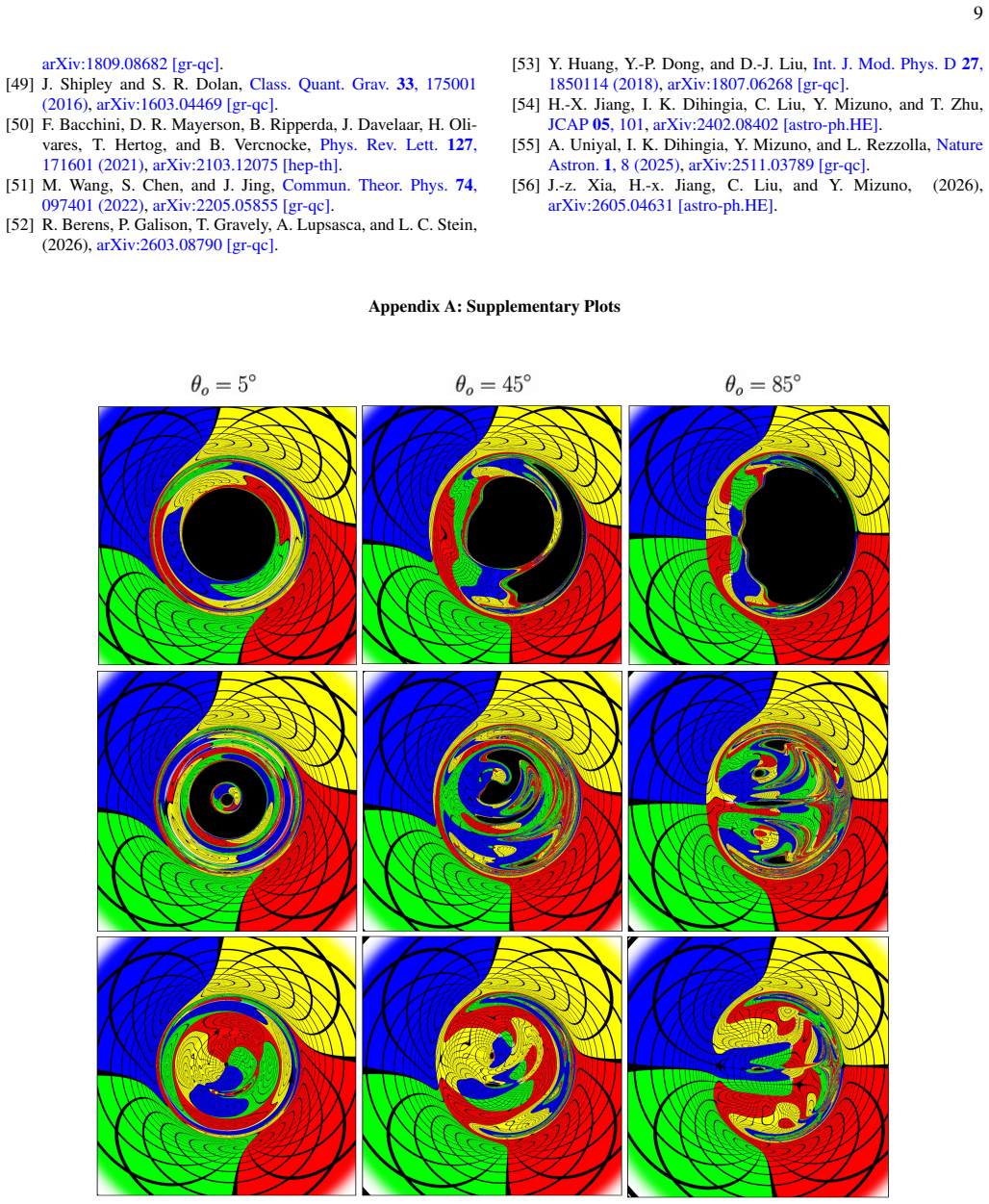
J.-z. Xia, H.-x. Jiang, C. Liu, and Y . Mizuno, (2026), arXiv:2605.04631 [astro-ph.HE]. Appendix A: Supplementary Plots FIG. 6. Synthetic images of Kerr black holes with parity-odd scalar hair illuminated by a colored celestial sphere. From top to bottom, the panels correspond to IV0.01 0.923, V0.01 0.997, and VI0.01 0.999, respectively. In Fig. 6, we sho...
work page internal anchor Pith review Pith/arXiv arXiv 2026
discussion (0)
Sign in with ORCID, Apple, or X to comment. Anyone can read and Pith papers without signing in.