Rethinking Memory as Continuously Evolving Connectivity
Pith reviewed 2026-06-29 12:23 UTC · model grok-4.3
The pith
Memory in LLM agents works better when modeled as a connectivity-evolving heterogeneous graph refined across three stages instead of a static repository.
A machine-rendered reading of the paper's core claim, the machinery that carries it, and where it could break.
Core claim
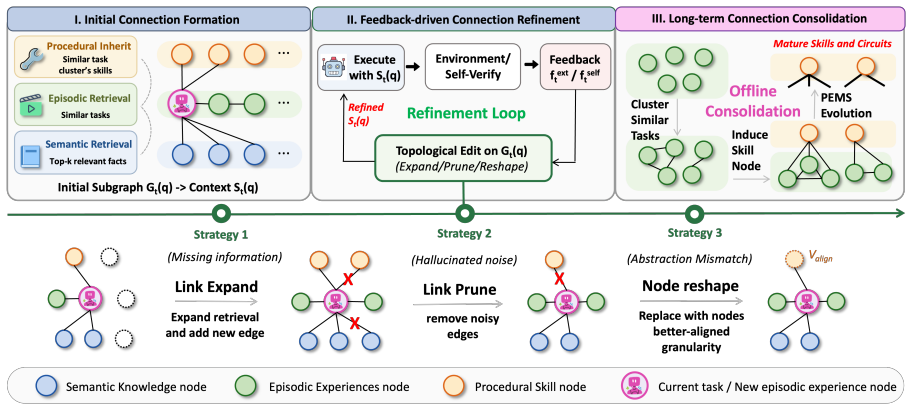
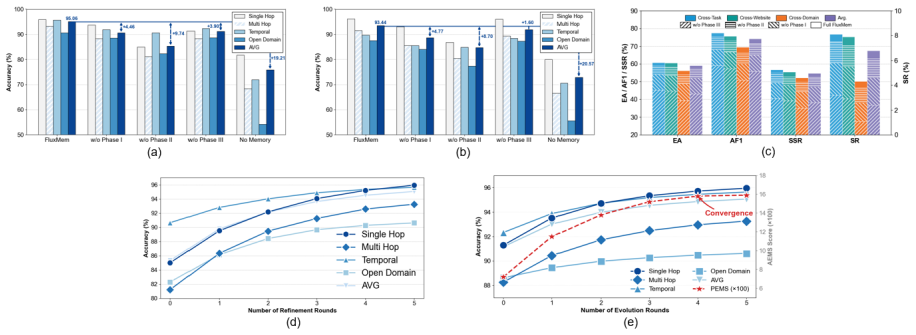
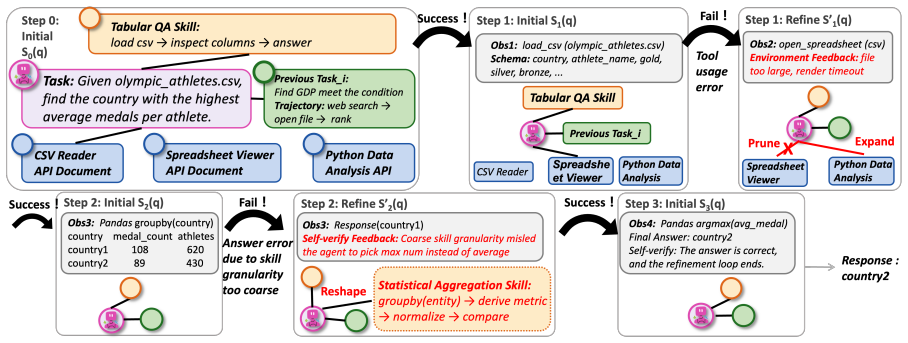
FluxMem models memory as a heterogeneous graph and progressively refines its topology through initial connection formation, feedback-driven refinement, and long-term consolidation. It repairs missing links, prunes interference, aligns abstraction granularity, and distills recurrent successful trajectories into reusable procedural circuits, guided by one metric for memory generalizability and evolutionary maturity, which produces state-of-the-art performance on LoCoMo, Mind2Web, and GAIA.
What carries the argument
The heterogeneous graph memory representation together with its three-stage progressive topology refinement process, guided by a single metric of generalizability and evolutionary maturity.
If this is right
- Agents gain the ability to dynamically repair and prune memory connections in response to ongoing feedback and task variation.
- Successful trajectories become reusable procedural circuits that reduce repeated computation in similar future tasks.
- A single guiding metric for generalizability and maturity simplifies oversight of the memory evolution process.
- Performance remains high across fundamentally different benchmarks that test complex agentic behavior.
Where Pith is reading between the lines
- The same graph-evolution approach could extend to non-agent LLM uses such as maintaining coherent long-context reasoning without fixed retrieval rules.
- If the three-stage process scales without added cost, it offers a path to reduce reliance on periodic full retraining when environments shift.
- Treating memory links as the primary object of change rather than stored content alone might generalize to other sequential decision systems.
Load-bearing premise
Progressively refining the topology of a heterogeneous graph memory through three stages guided by one metric will deliver reliable adaptation gains without instability or excessive cost.
What would settle it
If FluxMem fails to reach state-of-the-art results or shows performance instability on any of the LoCoMo, Mind2Web, or GAIA benchmarks under the described conditions, the central claim would not hold.
Figures
read the original abstract
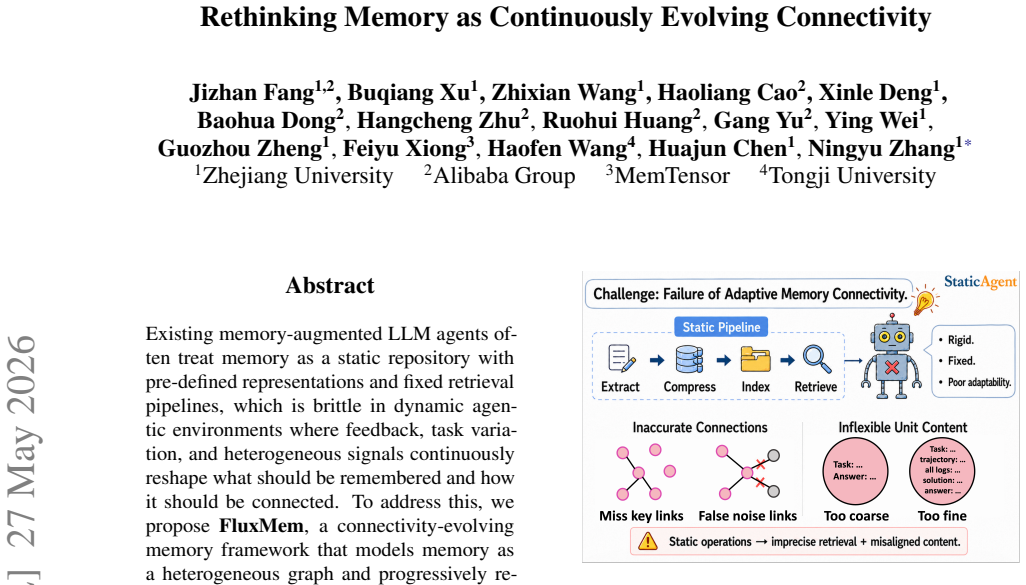
Existing memory-augmented LLM agents often treat memory as a static repository with pre-defined representations and fixed retrieval pipelines, which is brittle in dynamic agentic environments where feedback, task variation, and heterogeneous signals continuously reshape what should be remembered and how it should be connected. To address this, we propose FluxMem, a connectivity-evolving memory framework that models memory as a heterogeneous graph and progressively refines its topology through three stages: initial connection formation, feedback-driven refinement, and long-term consolidation. During execution, FluxMem repairs missing links, prunes interference, aligns abstraction granularity, and distills recurrent successful trajectories into reusable procedural circuits, guided by one metric for memory generalizability and evolutionary maturity. Across three fundamentally distinct benchmarks including LoCoMo, Mind2Web, and GAIA, FluxMem achieves consistent state-of-the-art performance, demonstrating strong adaptation and generalization in complex agentic environments. The code will be open-sourced in https://github.com/zjunlp/LightMem.
Editorial analysis
A structured set of objections, weighed in public.
Referee Report
Summary. The manuscript proposes FluxMem, a memory-augmented LLM agent framework that models memory as a heterogeneous graph whose topology evolves continuously via three stages—initial connection formation, feedback-driven refinement, and long-term consolidation—while repairing links, pruning interference, aligning abstraction levels, and distilling trajectories. A single (unspecified) metric for generalizability and evolutionary maturity is said to guide all operations. The central empirical claim is consistent state-of-the-art performance across three distinct benchmarks (LoCoMo, Mind2Web, GAIA) demonstrating superior adaptation and generalization in dynamic agentic settings.
Significance. If the three-stage refinement mechanism and its guiding metric can be shown to produce stable gains without ad-hoc fitting or excessive cost, the work would offer a substantive alternative to static memory repositories in agent literature. The planned open-sourcing of code is a positive step toward reproducibility.
major comments (3)
- [Abstract] Abstract: the claim that a single metric for 'memory generalizability and evolutionary maturity' reliably controls link repair, pruning, alignment, and distillation across three stages is load-bearing for the SOTA results, yet no definition, formula, or sensitivity analysis of this metric is supplied; without it the reported performance cannot be traced to the proposed mechanism.
- [Abstract] Abstract: no ablation isolating the contribution of each of the three stages (initial formation, feedback-driven refinement, long-term consolidation) or quantifying instability introduced by pruning is presented, leaving open the possibility that observed gains arise from other unstated factors rather than the evolving-connectivity design.
- [Abstract] Abstract: the benchmarks (LoCoMo, Mind2Web, GAIA) are described as 'fundamentally distinct,' but no baseline comparisons, metric definitions, or statistical significance tests are referenced, so it is impossible to verify that the 'consistent state-of-the-art' claim follows from the graph-evolution procedure.
Simulated Author's Rebuttal
We thank the referee for the constructive comments. We address each major point below and will revise the manuscript to supply the requested details and analyses.
read point-by-point responses
-
Referee: [Abstract] Abstract: the claim that a single metric for 'memory generalizability and evolutionary maturity' reliably controls link repair, pruning, alignment, and distillation across three stages is load-bearing for the SOTA results, yet no definition, formula, or sensitivity analysis of this metric is supplied; without it the reported performance cannot be traced to the proposed mechanism.
Authors: We agree that an explicit definition, formula, and sensitivity analysis of the guiding metric are required to trace performance to the mechanism. We will add these elements, including the precise formulation and sensitivity results, to the methods and experimental sections of the revised manuscript. revision: yes
-
Referee: [Abstract] Abstract: no ablation isolating the contribution of each of the three stages (initial formation, feedback-driven refinement, long-term consolidation) or quantifying instability introduced by pruning is presented, leaving open the possibility that observed gains arise from other unstated factors rather than the evolving-connectivity design.
Authors: We concur that stage-specific ablations and pruning instability analysis are necessary. We will incorporate these ablations and the associated instability quantification into the experiments section of the revised manuscript. revision: yes
-
Referee: [Abstract] Abstract: the benchmarks (LoCoMo, Mind2Web, GAIA) are described as 'fundamentally distinct,' but no baseline comparisons, metric definitions, or statistical significance tests are referenced, so it is impossible to verify that the 'consistent state-of-the-art' claim follows from the graph-evolution procedure.
Authors: We will expand the abstract and results discussion to explicitly reference the baseline comparisons, metric definitions, and statistical significance tests already computed on these benchmarks, thereby clarifying how the gains derive from the graph-evolution procedure. revision: yes
Circularity Check
No significant circularity: empirical framework with no equations or derivations
full rationale
The paper presents FluxMem as a three-stage heterogeneous graph refinement process guided by an unspecified metric for generalizability, with performance claims on external benchmarks (LoCoMo, Mind2Web, GAIA). No equations, formal derivations, fitted parameters renamed as predictions, or load-bearing self-citations appear in the abstract or description. The central claims are empirical and do not reduce by construction to inputs via self-definition or ansatz smuggling; they remain open to external validation or falsification.
Axiom & Free-Parameter Ledger
Reference graph
Works this paper leans on
-
[1]
online" 'onlinestring :=
ENTRY address archivePrefix author booktitle chapter edition editor eid eprint eprinttype howpublished institution journal key month note number organization pages publisher school series title type volume year doi pubmed url lastchecked label extra.label sort.label short.list INTEGERS output.state before.all mid.sentence after.sentence after.block STRING...
-
[2]
write newline
" write newline "" before.all 'output.state := FUNCTION n.dashify 't := "" t empty not t #1 #1 substring "-" = t #1 #2 substring "--" = not "--" * t #2 global.max substring 't := t #1 #1 substring "-" = "-" * t #2 global.max substring 't := while if t #1 #1 substring * t #2 global.max substring 't := if while FUNCTION word.in bbl.in capitalize " " * FUNCT...
- [3]
-
[4]
Huan ang Gao, Jiayi Geng, Wenyue Hua, Mengkang Hu, Xinzhe Juan, Hongzhang Liu, Shilong Liu, Jiahao Qiu, Xuan Qi, Yiran Wu, Hongru Wang, Han Xiao, Yuhang Zhou, Shaokun Zhang, Jiayi Zhang, Jinyu Xiang, Yixiong Fang, Qiwen Zhao, Dongrui Liu, and 8 others. 2026. https://arxiv.org/abs/2507.21046 A survey of self-evolving agents: What, when, how, and where to e...
work page internal anchor Pith review Pith/arXiv arXiv 2026
- [5]
- [6]
-
[7]
Ali Behrouz, Peilin Zhong, and Vahab Mirrokni. 2024. https://arxiv.org/abs/2501.00663 Titans: Learning to memorize at test time . Preprint, arXiv:2501.00663
work page internal anchor Pith review Pith/arXiv arXiv 2024
- [8]
-
[9]
Zouying Cao, Jiaji Deng, Li Yu, Weikang Zhou, Zhaoyang Liu, Bolin Ding, and Hai Zhao. 2025. https://arxiv.org/abs/2512.10696 Remember me, refine me: A dynamic procedural memory framework for experience-driven agent evolution . Preprint, arXiv:2512.10696
work page internal anchor Pith review Pith/arXiv arXiv 2025
- [10]
-
[11]
Yining Chen, Jihao Zhao, Bo Tang, Haofen Wang, Yue Zhang, Fei Huang, Feiyu Xiong, and Zhiyu Li. 2026 b . https://arxiv.org/abs/2605.09530 Memprivacy: Privacy-preserving personalized memory management for edge-cloud agents . Preprint, arXiv:2605.09530
work page internal anchor Pith review Pith/arXiv arXiv 2026
-
[12]
Prateek Chhikara, Dev Khant, Saket Aryan, Taranjeet Singh, and Deshraj Yadav. 2025. https://arxiv.org/abs/2504.19413 Mem0: Building production-ready ai agents with scalable long-term memory . Preprint, arXiv:2504.19413
work page internal anchor Pith review Pith/arXiv arXiv 2025
-
[13]
Xiang Deng, Yu Gu, Boyuan Zheng, Shijie Chen, Sam Stevens, Boshi Wang, Huan Sun, and Yu Su. 2023. Mind2web: Towards a generalist agent for the web. Advances in Neural Information Processing Systems, 36:28091--28114
2023
-
[14]
Jinyuan Fang, Yanwen Peng, Xi Zhang, Yingxu Wang, Xinhao Yi, Guibin Zhang, Yi Xu, Bin Wu, Siwei Liu, Zihao Li, Zhaochun Ren, Nikos Aletras, Xi Wang, Han Zhou, and Zaiqiao Meng. 2025 a . https://arxiv.org/abs/2508.07407 A comprehensive survey of self-evolving ai agents: A new paradigm bridging foundation models and lifelong agentic systems . Preprint, arXi...
work page internal anchor Pith review Pith/arXiv arXiv 2025
-
[15]
Jizhan Fang, Xinle Deng, Haoming Xu, Ziyan Jiang, Yuqi Tang, Ziwen Xu, Shumin Deng, Yunzhi Yao, Mengru Wang, Shuofei Qiao, and 1 others. 2025 b . Lightmem: Lightweight and efficient memory-augmented generation. arXiv preprint arXiv:2510.18866
work page internal anchor Pith review Pith/arXiv arXiv 2025
-
[16]
Runnan Fang, Yuan Liang, Xiaobin Wang, Jialong Wu, Shuofei Qiao, Pengjun Xie, Fei Huang, Huajun Chen, and Ningyu Zhang. 2026. https://arxiv.org/abs/2508.06433 Memp: Exploring agent procedural memory . Preprint, arXiv:2508.06433
work page internal anchor Pith review Pith/arXiv arXiv 2026
-
[17]
Adam Fourney, Gagan Bansal, Hussein Mozannar, Cheng Tan, Eduardo Salinas, Erkang, Zhu, Friederike Niedtner, Grace Proebsting, Griffin Bassman, Jack Gerrits, Jacob Alber, Peter Chang, Ricky Loynd, Robert West, Victor Dibia, Ahmed Awadallah, Ece Kamar, Rafah Hosn, and Saleema Amershi. 2024. https://arxiv.org/abs/2411.04468 Magentic-one: A generalist multi-a...
work page internal anchor Pith review Pith/arXiv arXiv 2024
-
[18]
Paul W Frankland and Bruno Bontempi. 2005. The organization of recent and remote memories. Nature reviews neuroscience, 6(2):119--130
2005
- [19]
-
[20]
Bernal Jiménez Gutiérrez, Yiheng Shu, Weijian Qi, Sizhe Zhou, and Yu Su. 2025 b . https://arxiv.org/abs/2502.14802 From rag to memory: Non-parametric continual learning for large language models . Preprint, arXiv:2502.14802
work page internal anchor Pith review Pith/arXiv arXiv 2025
-
[21]
Retrieval-Augmented Generation with Graphs (GraphRAG)
Haoyu Han, Yu Wang, Harry Shomer, Kai Guo, Jiayuan Ding, Yongjia Lei, Mahantesh Halappanavar, Ryan A. Rossi, Subhabrata Mukherjee, Xianfeng Tang, Qi He, Zhigang Hua, Bo Long, Tong Zhao, Neil Shah, Amin Javari, Yinglong Xia, and Jiliang Tang. 2025. https://arxiv.org/abs/2501.00309 Retrieval-augmented generation with graphs (graphrag) . Preprint, arXiv:2501.00309
work page internal anchor Pith review Pith/arXiv arXiv 2025
-
[22]
Donald Olding Hebb. 2005. The organization of behavior: A neuropsychological theory. Psychology press
2005
- [23]
-
[24]
Yuyang Hu, Shichun Liu, Yanwei Yue, Guibin Zhang, Boyang Liu, Fangyi Zhu, Jiahang Lin, Honglin Guo, Shihan Dou, Zhiheng Xi, Senjie Jin, Jiejun Tan, Yanbin Yin, Jiongnan Liu, Zeyu Zhang, Zhongxiang Sun, Yutao Zhu, Hao Sun, Boci Peng, and 28 others. 2026 b . https://arxiv.org/abs/2512.13564 Memory in the age of ai agents . Preprint, arXiv:2512.13564
work page internal anchor Pith review Pith/arXiv arXiv 2026
-
[25]
Bowen Jiang, Yuan Yuan, Maohao Shen, Zhuoqun Hao, Zhangchen Xu, Zichen Chen, Ziyi Liu, Anvesh Rao Vijjini, Jiashu He, Hanchao Yu, Radha Poovendran, Gregory Wornell, Lyle Ungar, Dan Roth, Sihao Chen, and Camillo Jose Taylor. 2025. https://arxiv.org/abs/2512.06688 Personamem-v2: Towards personalized intelligence via learning implicit user personas and agent...
- [26]
-
[27]
AM Clare Kelly and Hugh Garavan. 2005. Human functional neuroimaging of brain changes associated with practice. Cerebral cortex, 15(8):1089--1102
2005
- [28]
- [29]
-
[30]
Adyasha Maharana, Dong-Ho Lee, Sergey Tulyakov, Mohit Bansal, Francesco Barbieri, and Yuwei Fang. 2024. Evaluating very long-term conversational memory of llm agents. arXiv preprint arXiv:2402.17753
work page internal anchor Pith review Pith/arXiv arXiv 2024
-
[31]
Lingrui Mei, Jiayu Yao, Yuyao Ge, Yiwei Wang, Baolong Bi, Yujun Cai, Jiazhi Liu, Mingyu Li, Zhong-Zhi Li, Duzhen Zhang, Chenlin Zhou, Jiayi Mao, Tianze Xia, Jiafeng Guo, and Shenghua Liu. 2025. https://arxiv.org/abs/2507.13334 A survey of context engineering for large language models . Preprint, arXiv:2507.13334
work page internal anchor Pith review Pith/arXiv arXiv 2025
-
[32]
Gr \'e goire Mialon, Cl \'e mentine Fourrier, Thomas Wolf, Yann LeCun, and Thomas Scialom. 2023. Gaia: a benchmark for general ai assistants. In The Twelfth International Conference on Learning Representations
2023
-
[33]
Jiayan Nan, Wenquan Ma, Wenlong Wu, and Yize Chen. 2025. Nemori: Self-organizing agent memory inspired by cognitive science. arXiv preprint arXiv:2508.03341
work page internal anchor Pith review Pith/arXiv arXiv 2025
-
[34]
OpenAI. 2024. https://openai.com/index/introducing-deep-research/ deepresearch
2024
-
[35]
ReasoningBank: Scaling Agent Self-Evolving with Reasoning Memory
Siru Ouyang, Jun Yan, I-Hung Hsu, Yanfei Chen, Ke Jiang, Zifeng Wang, Rujun Han, Long T. Le, Samira Daruki, Xiangru Tang, Vishy Tirumalashetty, George Lee, Mahsan Rofouei, Hangfei Lin, Jiawei Han, Chen-Yu Lee, and Tomas Pfister. 2025. https://arxiv.org/abs/2509.25140 Reasoningbank: Scaling agent self-evolving with reasoning memory . Preprint, arXiv:2509.25140
work page internal anchor Pith review Pith/arXiv arXiv 2025
-
[36]
MemGPT: Towards LLMs as Operating Systems
Charles Packer, Sarah Wooders, Kevin Lin, Vivian Fang, Shishir G. Patil, Ion Stoica, and Joseph E. Gonzalez. 2024. https://arxiv.org/abs/2310.08560 Memgpt: Towards llms as operating systems . Preprint, arXiv:2310.08560
work page internal anchor Pith review Pith/arXiv arXiv 2024
-
[37]
Daiyi Peng. 2023. https://github.com/google/langfun Langfun
2023
-
[38]
Shihao Qi, Jie Ma, Rui Xing, Wei Guo, Xiao Huang, Zhitao Gao, Jianhao Deng, Jun Liu, Lingling Zhang, Bifan Wei, Boqian Yang, Pinghui Wang, Jianwen Sun, Jing Tao, Yaqiang Wu, Hui Liu, Yu Yao, and Tongliang Liu. 2026. https://arxiv.org/abs/2605.14892 Beyond individual intelligence: Surveying collaboration, failure attribution, and self-evolution in llm-base...
work page internal anchor Pith review Pith/arXiv arXiv 2026
-
[39]
Tianrui Qin, Qianben Chen, Sinuo Wang, He Xing, King Zhu, He Zhu, Dingfeng Shi, Xinxin Liu, Ge Zhang, Jiaheng Liu, Yuchen Eleanor Jiang, Xitong Gao, and Wangchunshu Zhou. 2025. https://arxiv.org/abs/2509.25301 Flash-searcher: Fast and effective web agents via dag-based parallel execution . Preprint, arXiv:2509.25301
-
[40]
Jiahao Qiu, Xuan Qi, Tongcheng Zhang, Xinzhe Juan, Jiacheng Guo, Yifu Lu, Yimin Wang, Zixin Yao, Qihan Ren, Xun Jiang, Xing Zhou, Dongrui Liu, Ling Yang, Yue Wu, Kaixuan Huang, Shilong Liu, Hongru Wang, and Mengdi Wang. 2025. https://arxiv.org/abs/2505.20286 Alita: Generalist agent enabling scalable agentic reasoning with minimal predefinition and maximal...
-
[41]
Preston Rasmussen, Pavlo Paliychuk, Travis Beauvais, Jack Ryan, and Daniel Chalef. 2025. https://arxiv.org/abs/2501.13956 Zep: A temporal knowledge graph architecture for agent memory . Preprint, arXiv:2501.13956
work page internal anchor Pith review Pith/arXiv arXiv 2025
-
[42]
Aymeric Roucher, Albert Villanova del Moral, Thomas Wolf, Leandro von Werra, and Erik Kaunismäki. 2025. `smolagents`: a smol library to build great agentic systems. https://github.com/huggingface/smolagents
2025
-
[43]
Yuchen Shi, Yuzheng Cai, Siqi Cai, Zihan Xu, Lichao Chen, Yulei Qin, Zhijian Zhou, Xiang Fei, Chaofan Qiu, Xiaoyu Tan, Gang Li, Zongyi Li, Haojia Lin, Guocan Cai, Yong Mao, Yunsheng Wu, Ke Li, and Xing Sun. 2025. https://arxiv.org/abs/2512.24615 Youtu-agent: Scaling agent productivity with automated generation and hybrid policy optimization . Preprint, ar...
-
[44]
Noah Shinn, Federico Cassano, Ashwin Gopinath, Karthik Narasimhan, and Shunyu Yao. 2023. Reflexion: Language agents with verbal reinforcement learning. Advances in Neural Information Processing Systems, 36:8634--8652
2023
-
[45]
Mirac Suzgun, Mert Yuksekgonul, Federico Bianchi, Dan Jurafsky, and James Zou. 2026. https://doi.org/10.18653/v1/2026.eacl-long.333 Dynamic cheatsheet: Test-time learning with adaptive memory . In Proceedings of the 19th Conference of the E uropean Chapter of the A ssociation for C omputational L inguistics (Volume 1: Long Papers) , pages 7080--7106, Raba...
-
[46]
Xiangru Tang, Tianyu Hu, Muyang Ye, Yanjun Shao, Xunjian Yin, Siru Ouyang, Wangchunshu Zhou, Pan Lu, Zhuosheng Zhang, Yilun Zhao, Arman Cohan, and Mark Gerstein. 2025 a . https://arxiv.org/abs/2501.06590 Chemagent: Self-updating library in large language models improves chemical reasoning . Preprint, arXiv:2501.06590
-
[47]
Xiangru Tang, Tianrui Qin, Tianhao Peng, Ziyang Zhou, Daniel Shao, Tingting Du, Xinming Wei, Peng Xia, Fang Wu, He Zhu, Ge Zhang, Jiaheng Liu, Xingyao Wang, Sirui Hong, Chenglin Wu, Hao Cheng, Chi Wang, and Wangchunshu Zhou. 2025 b . https://arxiv.org/abs/2507.06229 Agent kb: Leveraging cross-domain experience for agentic problem solving . Preprint, arXiv...
-
[48]
Chenxi Wang, Zhuoyun Yu, Xin Xie, Wuguannan Yao, Runnan Fang, Shuofei Qiao, Kexin Cao, Guozhou Zheng, Xiang Qi, Peng Zhang, and Shumin Deng. 2026. https://arxiv.org/abs/2604.04804 Skillx: Automatically constructing skill knowledge bases for agents . Preprint, arXiv:2604.04804
work page internal anchor Pith review Pith/arXiv arXiv 2026
-
[49]
Peng Wang, Zexi Li, Ningyu Zhang, Ziwen Xu, Yunzhi Yao, Yong Jiang, Pengjun Xie, Fei Huang, and Huajun Chen. 2024 a . Wise: Rethinking the knowledge memory for lifelong model editing of large language models. Advances in Neural Information Processing Systems, 37:53764--53797
2024
-
[50]
Yu Wang and Xi Chen. 2025. Mirix: Multi-agent memory system for llm-based agents. arXiv preprint arXiv:2507.07957
work page internal anchor Pith review Pith/arXiv arXiv 2025
- [51]
-
[52]
Zora Zhiruo Wang, Jiayuan Mao, Daniel Fried, and Graham Neubig. 2024 c . Agent workflow memory. arXiv preprint arXiv:2409.07429
work page internal anchor Pith review Pith/arXiv arXiv 2024
-
[53]
Evo-Memory: Benchmarking LLM Agent Test-time Learning with Self-Evolving Memory
Tianxin Wei, Noveen Sachdeva, Benjamin Coleman, Zhankui He, Yuanchen Bei, Xuying Ning, Mengting Ai, Yunzhe Li, Jingrui He, Ed H. Chi, Chi Wang, Shuo Chen, Fernando Pereira, Wang-Cheng Kang, and Derek Zhiyuan Cheng. 2025. https://arxiv.org/abs/2511.20857 Evo-memory: Benchmarking llm agent test-time learning with self-evolving memory . Preprint, arXiv:2511.20857
work page internal anchor Pith review Pith/arXiv arXiv 2025
-
[54]
Rong Wu, Xiaoman Wang, Jianbiao Mei, Pinlong Cai, Daocheng Fu, Cheng Yang, Licheng Wen, Xuemeng Yang, Yufan Shen, Yuxin Wang, and Botian Shi. 2025. https://arxiv.org/abs/2510.16079 Evolver: Self-evolving llm agents through an experience-driven lifecycle . Preprint, arXiv:2510.16079
work page internal anchor Pith review Pith/arXiv arXiv 2025
- [55]
-
[56]
Buqiang Xu, Yijun Chen, Jizhan Fang, Ruobin Zhong, Yunzhi Yao, Yuqi Zhu, Lun Du, and Shumin Deng. 2026. https://doi.org/10.48550/ARXIV.2604.21748 Structmem: Structured memory for long-horizon behavior in llms . CoRR, abs/2604.21748
work page internal anchor Pith review Pith/arXiv arXiv doi:10.48550/arxiv.2604.21748 2026
-
[57]
Wujiang Xu, Kai Mei, Hang Gao, Juntao Tan, Zujie Liang, and Yongfeng Zhang. 2025. A-mem: Agentic memory for llm agents. arXiv preprint arXiv:2502.12110
work page internal anchor Pith review Pith/arXiv arXiv 2025
- [58]
-
[59]
Chongrui Ye, Yuxiang Liu, Yu Wang, Haofei Yu, Yining Zhao, Ge Liu, Julian McAuley, and Jiaxuan You. 2026. https://arxiv.org/abs/2605.20616 Auto-dreamer: Learning offline memory consolidation for language agents . Preprint, arXiv:2605.20616
work page internal anchor Pith review Pith/arXiv arXiv 2026
- [60]
-
[61]
Yunpeng Zhai, Shuchang Tao, Cheng Chen, Anni Zou, Ziqian Chen, Qingxu Fu, Shinji Mai, Li Yu, Jiaji Deng, Zouying Cao, Zhaoyang Liu, Bolin Ding, and Jingren Zhou. 2025. https://arxiv.org/abs/2511.10395 Agentevolver: Towards efficient self-evolving agent system . Preprint, arXiv:2511.10395
- [62]
-
[63]
Guibin Zhang, Haotian Ren, Chong Zhan, Zhenhong Zhou, Junhao Wang, He Zhu, Wangchunshu Zhou, and Shuicheng Yan. 2025 b . https://arxiv.org/abs/2512.18746 Memevolve: Meta-evolution of agent memory systems . Preprint, arXiv:2512.18746
work page internal anchor Pith review Pith/arXiv arXiv 2025
-
[64]
Haozhen Zhang, Quanyu Long, Jianzhu Bao, Tao Feng, Weizhi Zhang, Haodong Yue, and Wenya Wang. 2026 a . https://arxiv.org/abs/2602.02474 Memskill: Learning and evolving memory skills for self-evolving agents . Preprint, arXiv:2602.02474
work page internal anchor Pith review Pith/arXiv arXiv 2026
-
[65]
Shengtao Zhang, Jiaqian Wang, Ruiwen Zhou, Junwei Liao, Yuchen Feng, Weinan Zhang, Ying Wen, Zhiyu Li, Feiyu Xiong, Yutao Qi, Bo Tang, and Muning Wen. 2026 b . https://arxiv.org/abs/2601.03192 Memrl: Self-evolving agents via runtime reinforcement learning on episodic memory . Preprint, arXiv:2601.03192
work page internal anchor Pith review Pith/arXiv arXiv 2026
-
[66]
Zeyu Zhang, Quanyu Dai, Xiaohe Bo, Chen Ma, Rui Li, Xu Chen, Jieming Zhu, Zhenhua Dong, and Ji-Rong Wen. 2025 c . A survey on the memory mechanism of large language model-based agents. ACM Transactions on Information Systems, 43(6):1--47
2025
-
[67]
Andrew Zhao, Daniel Huang, Quentin Xu, Matthieu Lin, Yong-Jin Liu, and Gao Huang. 2024. Expel: Llm agents are experiential learners. In Proceedings of the AAAI Conference on Artificial Intelligence, volume 38, pages 19632--19642
2024
- [68]
- [69]
discussion (0)
Sign in with ORCID, Apple, or X to comment. Anyone can read and Pith papers without signing in.