Hardware-Tailored Resource Estimation for Magic-State Distillation on Silicon Spin Qubits
Pith reviewed 2026-06-29 11:34 UTC · model grok-4.3
The pith
Silicon spin qubits achieve a threefold reduction in magic-state distillation footprint using biased codes and a 42 percent overhead cut with optimized pulses.
A machine-rendered reading of the paper's core claim, the machinery that carries it, and where it could break.
Core claim
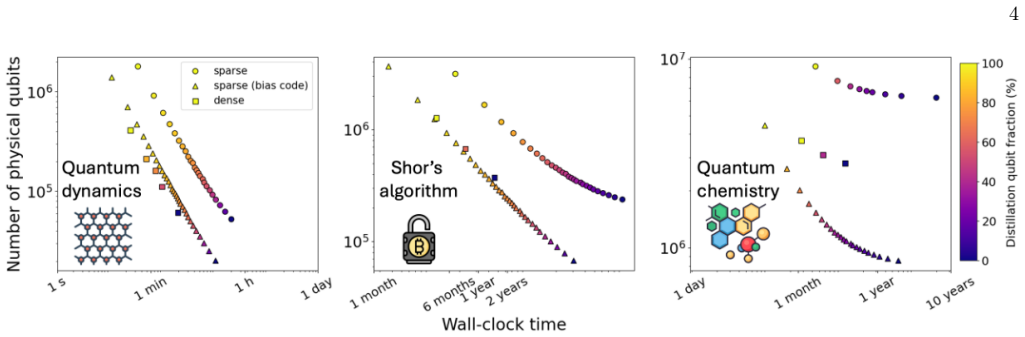
Silicon-tailored biased error-correcting codes achieve an approximately threefold reduction in physical footprint relative to the surface code for magic-state distillation protocols, even without physical-bias-preserving operations. In addition, optimized control pulses reduce magic-state distillation overhead by 42% compared to standard gate implementations. These results come from propagating error rates estimated from a silicon-processor Hamiltonian through different error-correcting codes to system-level overheads for applications such as quantum chemistry.
What carries the argument
The hardware-level noise model constructed from a silicon-processor Hamiltonian with realistic parameters and 1/f non-Markovian noise, used to estimate physical error rates and propagate them to logical resources in surface, color, and biased codes.
If this is right
- Target logical error rates translate into specific hardware performance requirements for silicon devices.
- Resource overheads for spin dynamics, factorization, and chemistry simulations decrease with the use of biased codes and optimized pulses.
- Architectures with shuttling, dense layouts, or hybrids can be ranked by their total physical qubit needs.
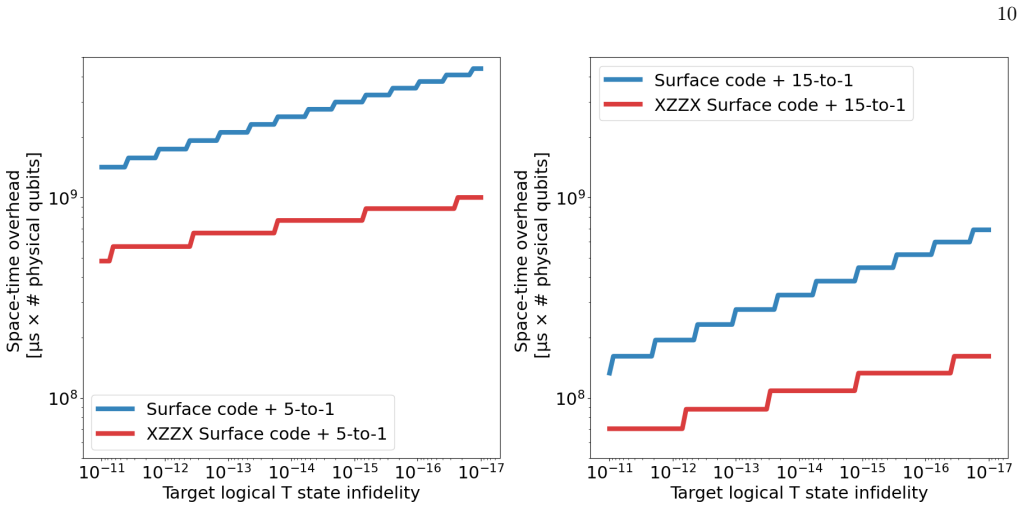
- Systematic comparison of 5-to-1 and 15-to-1 distillation protocols becomes possible under hardware-specific noise.
Where Pith is reading between the lines
- If the noise model proves accurate, silicon platforms could require fewer physical qubits than surface-code estimates suggest for early fault-tolerant tasks.
- Similar bottom-up modeling might apply to other qubit technologies to identify tailored codes.
- Experimental validation of the 1/f noise impact on distillation fidelity would test the predicted savings.
Load-bearing premise
The silicon Hamiltonian-based noise model with 1/f noise captures the main error processes that limit magic-state distillation fidelity on actual devices.
What would settle it
Measuring the fidelity of magic states produced on a real silicon spin qubit array and finding error rates higher than the model's predictions at the scale needed for the reported reductions would falsify the claims.
Figures


read the original abstract
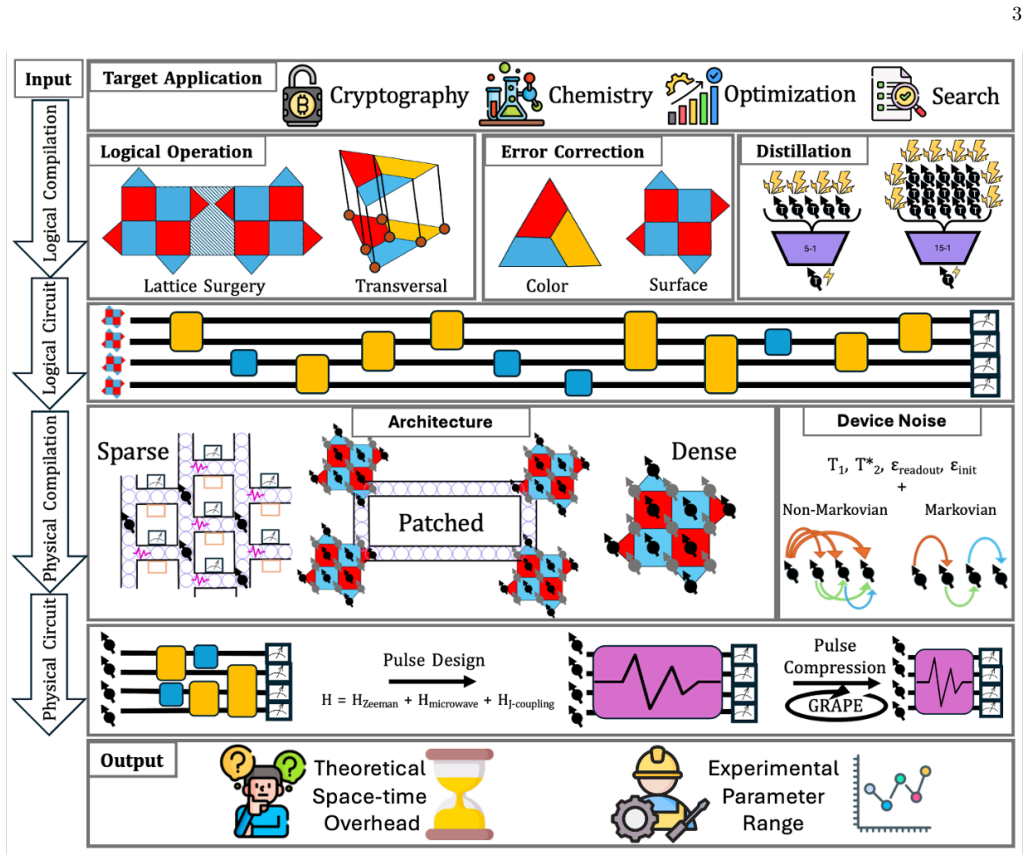
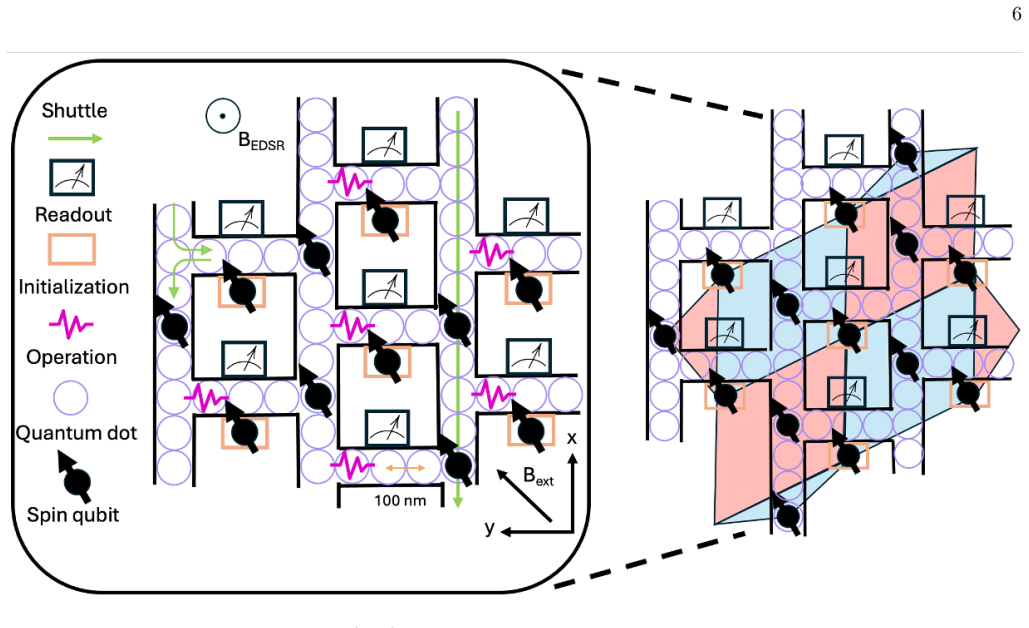
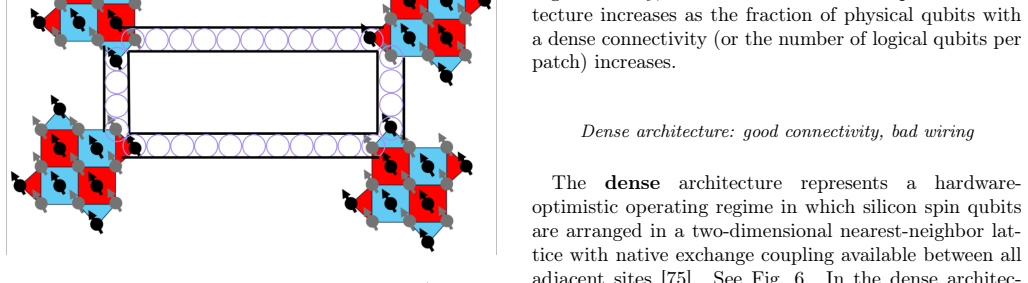
We present a resource analysis for generating high-fidelity logical magic states on silicon spin-qubit platforms. We consider a range of architectures, including a shuttling-based SpinBus design, a dense nearest-neighbor layout, and a hybrid scheme with shuttling-connected patches. We compare surface, color, and biased error-correcting codes, and analyze the $5\to1$ and $15\to1$ magic-state distillation protocols. Our approach combines bottom-up and top-down methodologies. We construct a hardware-level noise model based on a silicon-processor Hamiltonian with realistic parameters and $1/f$ non-Markovian noise, enabling estimation of physical resources required to reach target logical error rates. These results are propagated to system-level overheads for applications including spin dynamics, integer factorization, and quantum chemistry. Conversely, we fix target logical fidelities and derive corresponding constraints on hardware performance. Our framework enables systematic evaluation of resource-reduction strategies. We find that optimized control pulses reduce magic-state distillation overhead by 42\% compared to standard gate implementations. In addition, silicon-tailored biased error-correcting codes achieve an approximately threefold reduction in physical footprint relative to the surface code, even without physical-bias-preserving operations.
Editorial analysis
A structured set of objections, weighed in public.
Referee Report
Summary. The manuscript presents a resource estimation framework for magic-state distillation on silicon spin-qubit platforms. It constructs a bottom-up noise model from a silicon-processor Hamiltonian incorporating realistic parameters and 1/f non-Markovian noise, then propagates physical error rates through 5-to-1 and 15-to-1 distillation circuits. Architectures considered include shuttling-based SpinBus, dense nearest-neighbor, and hybrid schemes; codes compared are surface, color, and biased variants. The work claims that optimized control pulses reduce distillation overhead by 42% relative to standard gates and that silicon-tailored biased codes yield an approximately threefold reduction in physical footprint versus the surface code, even without bias-preserving operations. These estimates are applied to applications including spin dynamics, factorization, and quantum chemistry, with both bottom-up and top-down directions explored.
Significance. If the noise model is shown to be accurate and the numerical results are reproducible with sensitivity checks, the paper would offer a concrete, hardware-specific assessment of resource overheads for fault-tolerant operations on silicon spin qubits. The integration of a Hamiltonian-derived noise model with standard distillation protocols and code comparisons provides a useful template for platform-tailored estimation; the reported reductions, if substantiated, would directly inform hardware design priorities for biased codes and pulse optimization.
major comments (2)
- [Abstract and hardware-level noise model section] Abstract and the section describing the bottom-up noise model: the central numerical claims (42% overhead reduction and threefold footprint reduction) are obtained by propagating error rates from the silicon Hamiltonian plus 1/f noise through the distillation circuits, yet the manuscript provides no direct comparison of predicted gate or idling error rates to published silicon spin-qubit experiments, nor any ablation varying the 1/f exponent or cutoff frequency while recomputing the resource tables. This validation and sensitivity analysis is load-bearing for both headline results.
- [Abstract] Abstract: the stated numerical results (42%, threefold) are presented without accompanying derivations, error bars, data-exclusion criteria, or explicit propagation steps from the physical noise model to the logical overhead tables, preventing verification of the claims from the provided text.
minor comments (2)
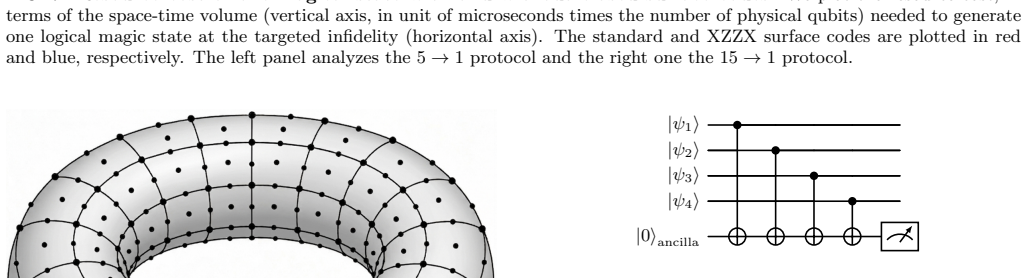
- [Methods] Notation for the 5-to-1 and 15-to-1 protocols should be introduced with explicit circuit diagrams or pseudocode in the methods to clarify how the physical error rates enter the fidelity calculations.
- [Results figures] Figure captions for resource tables should include the exact target logical error rate and the precise definition of 'physical footprint' (qubits imes time or similar) to avoid ambiguity when comparing codes.
Simulated Author's Rebuttal
We thank the referee for their thorough review and valuable feedback on our manuscript. We address each of the major comments below in detail. We agree with the need for additional validation and will make revisions accordingly to improve the robustness and clarity of our resource estimation framework.
read point-by-point responses
-
Referee: [Abstract and hardware-level noise model section] Abstract and the section describing the bottom-up noise model: the central numerical claims (42% overhead reduction and threefold footprint reduction) are obtained by propagating error rates from the silicon Hamiltonian plus 1/f noise through the distillation circuits, yet the manuscript provides no direct comparison of predicted gate or idling error rates to published silicon spin-qubit experiments, nor any ablation varying the 1/f exponent or cutoff frequency while recomputing the resource tables. This validation and sensitivity analysis is load-bearing for both headline results.
Authors: We acknowledge the importance of validating the noise model against experimental data and performing sensitivity analyses. The parameters in our Hamiltonian and 1/f noise model are chosen based on values commonly reported in silicon spin qubit experiments. However, the manuscript does not contain direct comparisons of our computed physical error rates to specific published experimental results, nor ablations on the 1/f parameters. We will revise the manuscript to include such comparisons to representative experimental works and add a sensitivity study by varying the 1/f exponent and cutoff frequency, updating the resource tables accordingly. This addresses the load-bearing nature of these claims. revision: yes
-
Referee: [Abstract] Abstract: the stated numerical results (42%, threefold) are presented without accompanying derivations, error bars, data-exclusion criteria, or explicit propagation steps from the physical noise model to the logical overhead tables, preventing verification of the claims from the provided text.
Authors: The numerical results in the abstract are summaries of findings derived in the body of the paper. The derivations, including how error rates from the silicon Hamiltonian and 1/f noise are propagated through the 5-to-1 and 15-to-1 distillation circuits and then to the logical overheads for different codes and architectures, are detailed in the relevant sections on the noise model and resource estimation. Since the calculations are based on fixed parameters without stochastic sampling, no error bars or data-exclusion criteria apply. We will update the abstract to reference the specific sections where the propagation steps are described, enabling easier verification from the text. revision: partial
Circularity Check
No circularity: bottom-up Hamiltonian model yields independent estimates
full rationale
The paper builds a hardware noise model from an external silicon-processor Hamiltonian with stated realistic parameters and 1/f noise, then propagates physical error rates through standard 5-to-1 and 15-to-1 distillation circuits and code comparisons. Resource reductions (threefold footprint, 42% overhead) are computed outputs of this propagation, not inputs redefined or fitted to themselves. No self-citation load-bearing steps, uniqueness theorems, or ansatz smuggling appear in the derivation chain; the model is presented as falsifiable against external benchmarks rather than self-referential.
Axiom & Free-Parameter Ledger
axioms (1)
- domain assumption Established 5-to-1 and 15-to-1 magic-state distillation protocols and surface/color/biased code performance models apply without additional unmodeled errors.
Forward citations
Cited by 1 Pith paper
-
Pulse-optimised circuit elements for scalable and noise-resilient quantum chemistry
Pulse-optimized implementations of single- and double-qubit excitations in VQE reduce runtimes by up to 15.3 times on silicon spin-qubit processors.
Reference graph
Works this paper leans on
-
[1]
We also compared the5→1and15→1protocols operating with either surface or color codes, and either lattice surgery or transversal gates
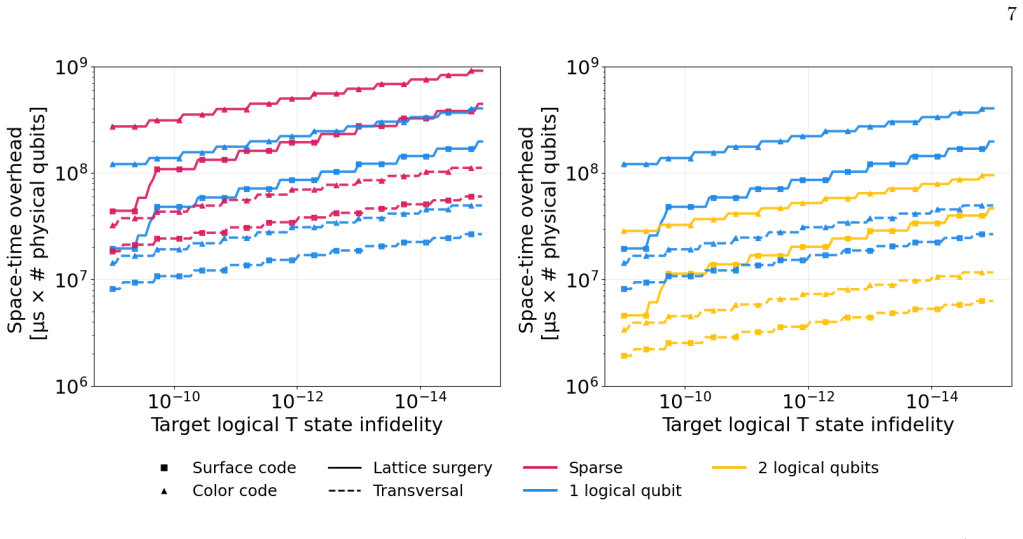
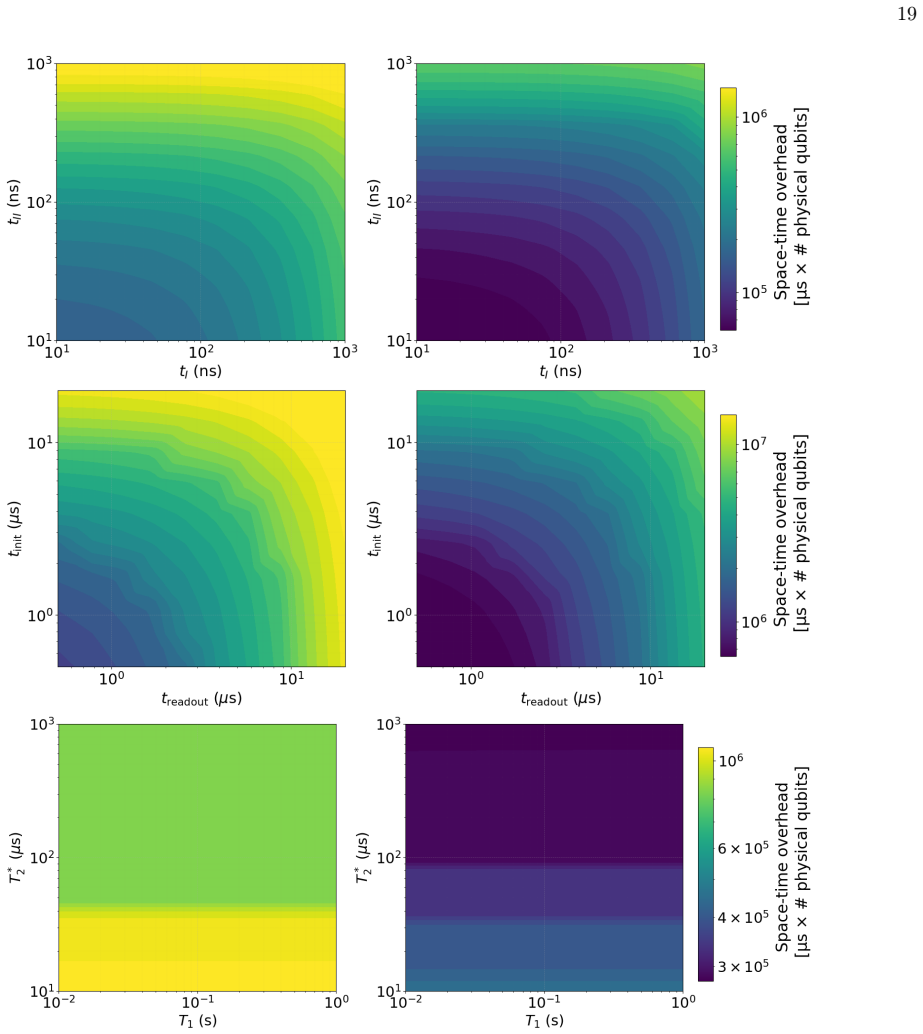
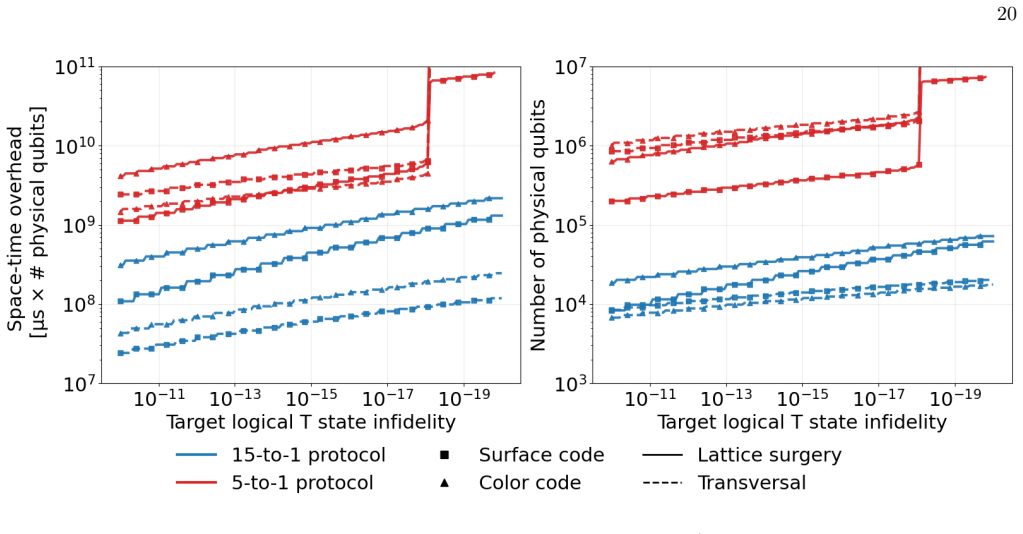
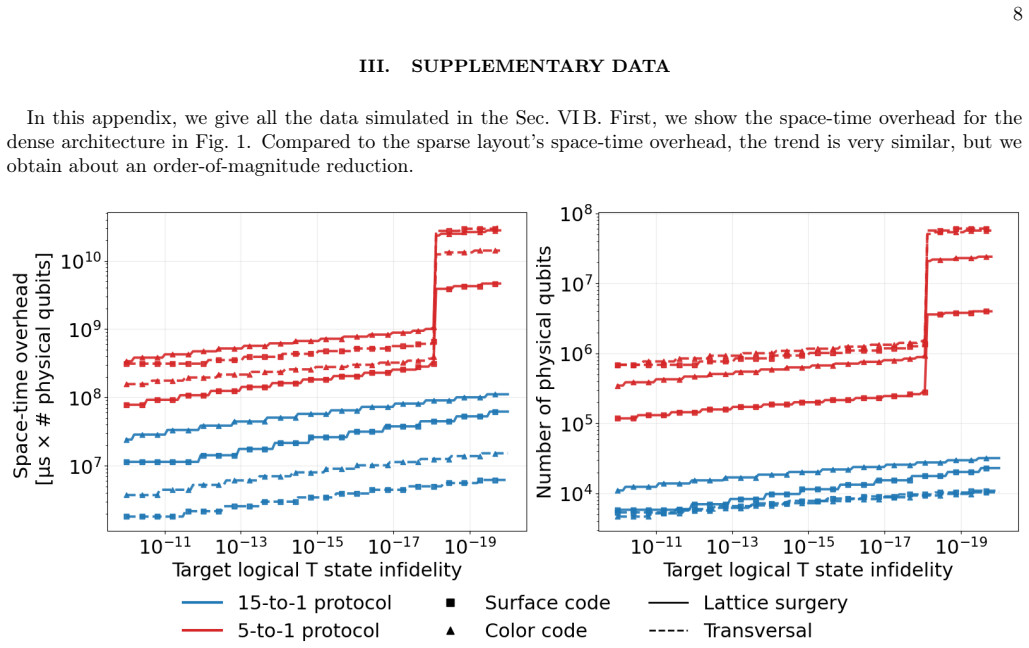
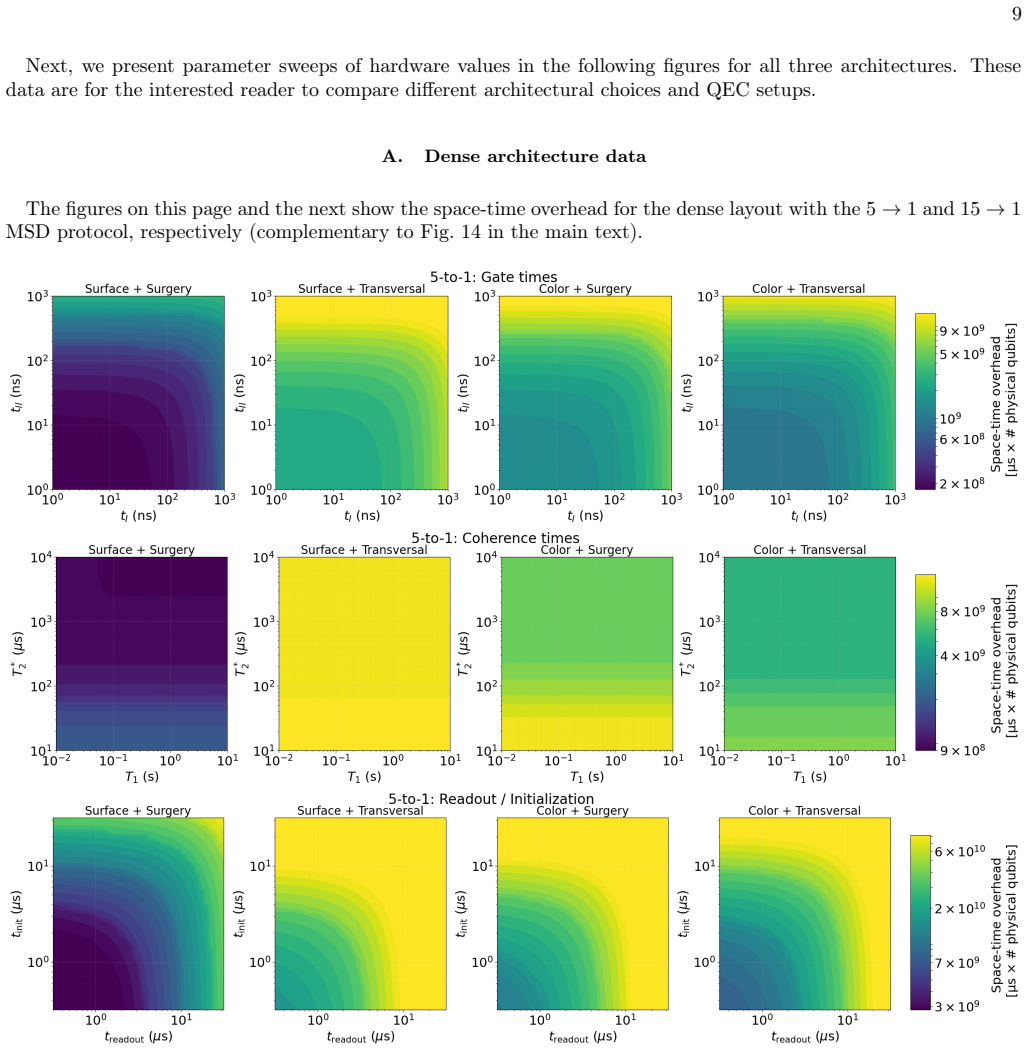
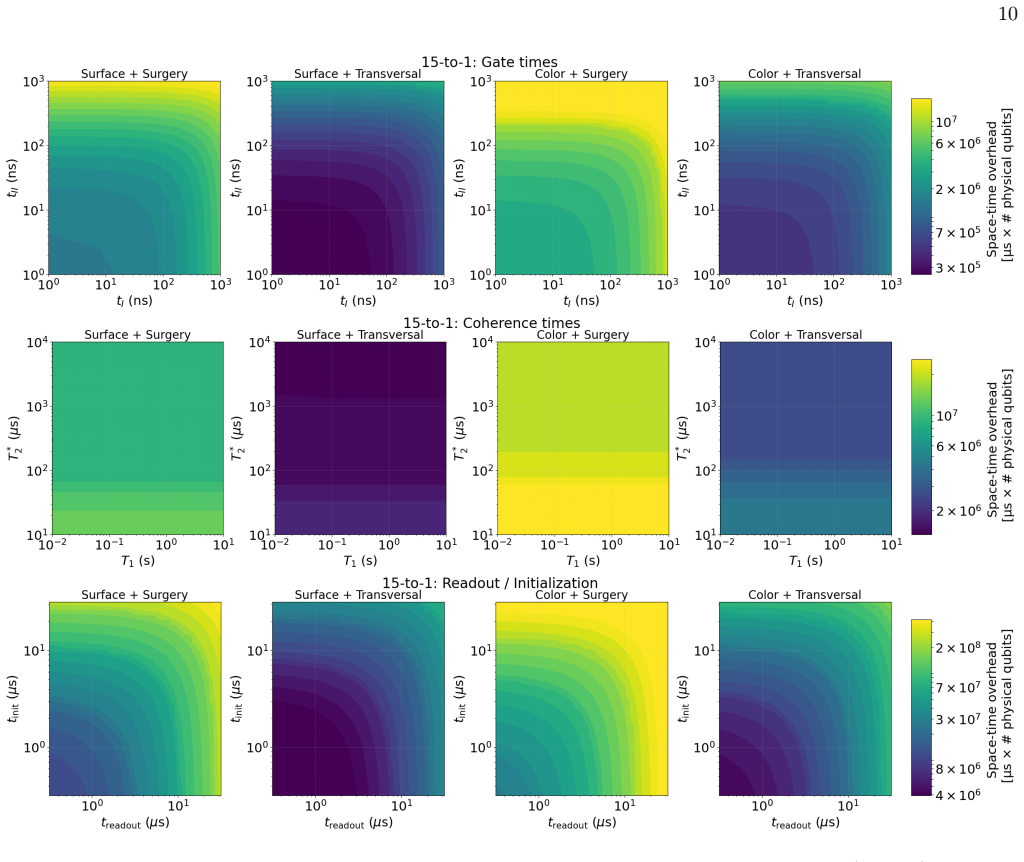
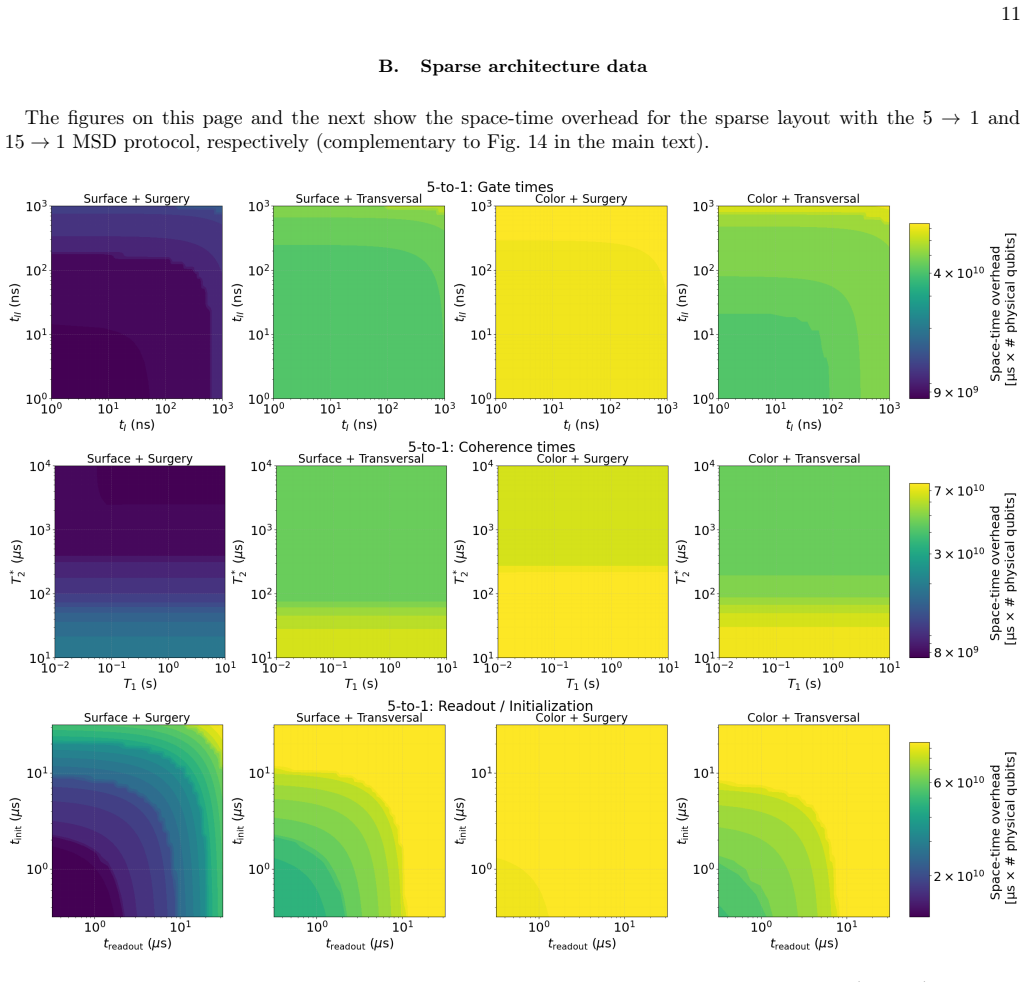
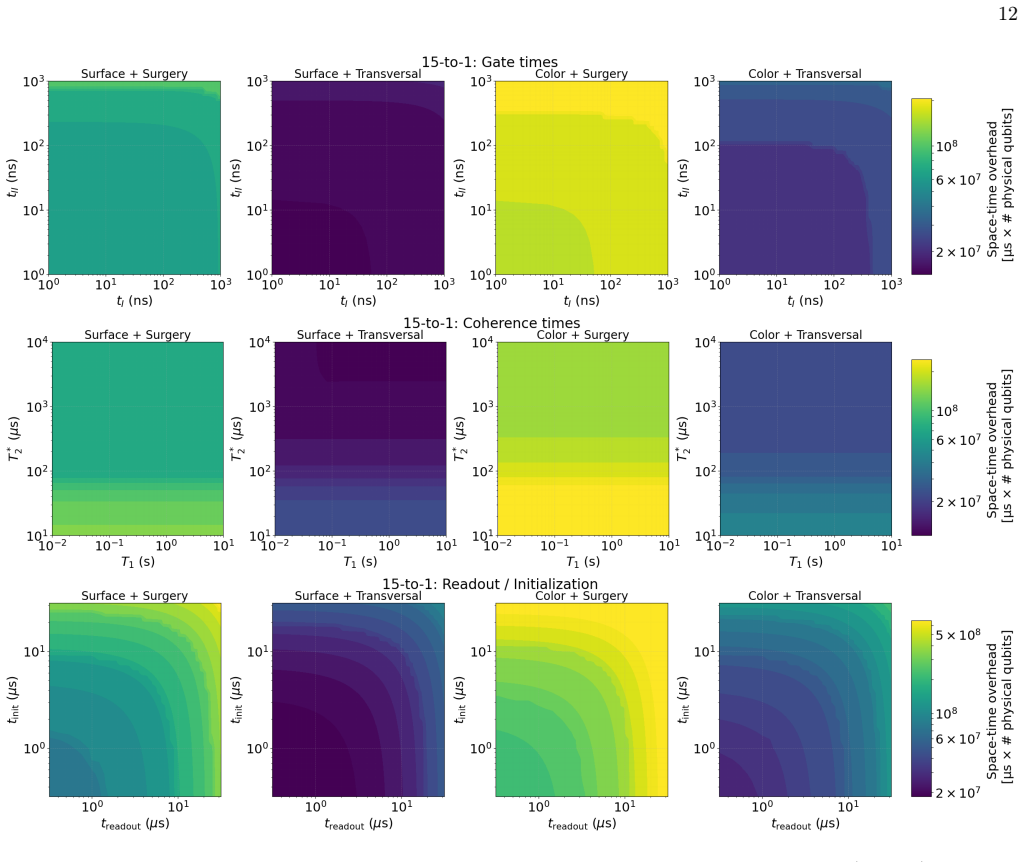
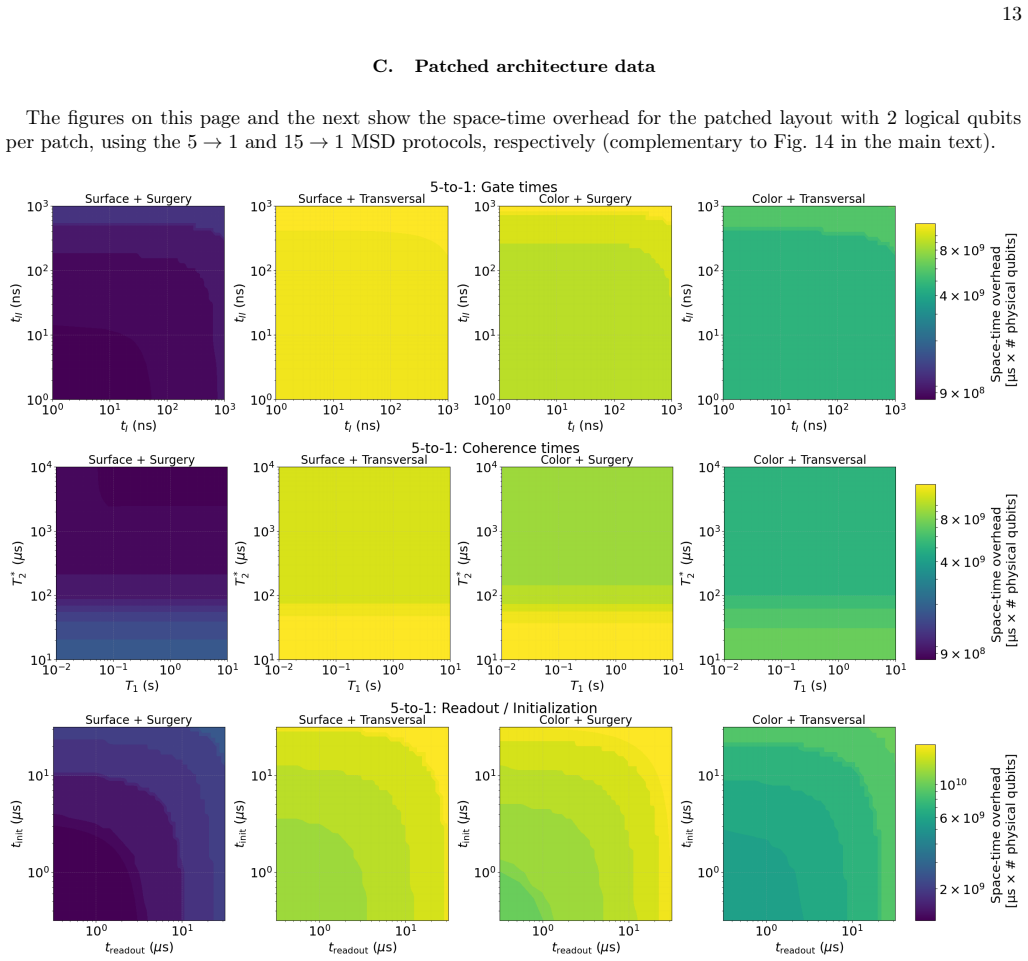
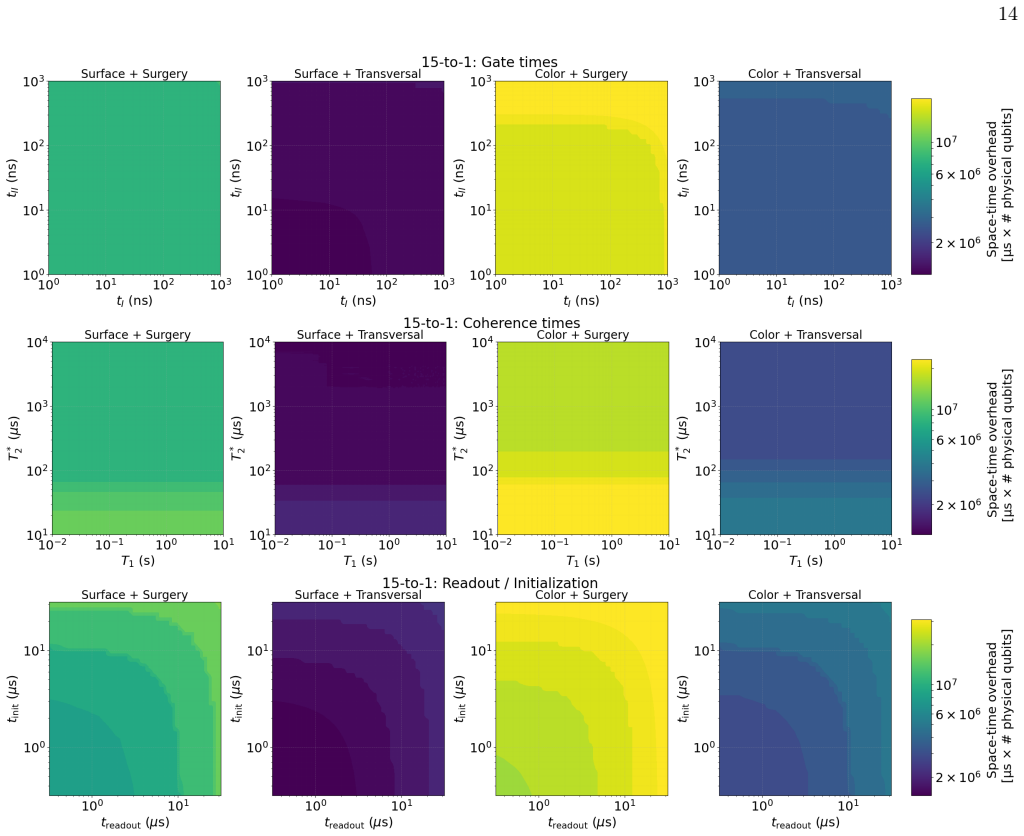
The noise bias in silicon (T∗ 2 ≪T 1) means that the resource improvements with increasedT1 times are less prominent. We also compared the5→1and15→1protocols operating with either surface or color codes, and either lattice surgery or transversal gates. In Fig. 15, we present the sparse architecture’s space-time overhead and qubit footprint as a function o...
2048
-
[2]
P. W. Shor, Algorithms for quantum computation: dis- crete logarithms and factoring, inProceedings of the 35th Annual Symposium on Foundations of Computer Science(1994) pp. 124–134
1994
-
[3]
Gidney and M
C. Gidney and M. Ekerå, How to factor 2048 bit rsa in- tegers in 8 hours using 20 million noisy qubits, Quantum 5, 433 (2021)
2048
-
[4]
Lloyd, Universal quantum simulators, Science273, 1073 (1996)
S. Lloyd, Universal quantum simulators, Science273, 1073 (1996)
1996
-
[5]
A. M. Childs, D. Maslov, Y. Nam, N. J. Ross, and Y. Su, Toward the first quantum simulation with quan- tum speedup, Proceedings of the National Academy of Sciences115, 9456 (2018)
2018
-
[7]
Babbush, C
R. Babbush, C. Gidney, D. W. Berry, N. Wiebe, J. Mc- Clean, A. Paler, A. Fowler, and H. Neven, Encoding electronic spectra in quantum circuits with linear t com- plexity, Physical Review X8, 041015 (2018)
2018
-
[8]
Y. Dong, L. Lin, and Y. Tong, Ground-state prepara- tion and energy estimation on early fault-tolerant quan- tum computers via quantum eigenvalue transformation of unitary matrices, PRX quantum3, 040305 (2022)
2022
-
[9]
S. Lee, J. Lee, H. Zhai, Y. Tong, A. M. Dalzell, A. Ku- mar, P. Helms, J. Gray, Z.-H. Cui, W. Liu,et al., Eval- uating the evidence for exponential quantum advantage in ground-state quantum chemistry, Nature communi- cations14, 1952 (2023)
1952
-
[10]
Gilyén, S
A. Gilyén, S. Arunachalam, and N. Wiebe, Optimizing quantum optimization algorithms via faster quantum gradient computation, inProceedings of the Thirtieth Annual ACM-SIAM Symposium on Discrete Algorithms (SIAM, 2019) pp. 1425–1444
2019
-
[11]
A Quantum Approximate Optimization Algorithm
E. Farhi, J. Goldstone, and S. Gutmann, A quantum approximate optimization algorithm, arXiv preprint arXiv:1411.4028 (2014)
work page internal anchor Pith review Pith/arXiv arXiv 2014
-
[12]
H. Zhou, M. Cain, and M. D. Lukin, Opportunities in full-stack design of low-overhead fault-tolerant quantum 23 computation, Nature Computational Science5, 1110 (2025)
2025
-
[13]
Gutiérrez, M
M. Gutiérrez, M. Müller, and A. Bermúdez, Transver- sality and lattice surgery: Exploring realistic routes to- ward coupled logical qubits with trapped-ion quantum processors, Physical Review A99, 022330 (2019)
2019
-
[14]
M. E. Beverland, P. Murali, M. Troyer, K. M. Svore, T. Hoefler, V. Kliuchnikov, G. H. Low, M. Soeken, A. Sundaram, and A. Vaschillo, Assessing requirements to scale to practical quantum advantage, arXiv preprint arXiv:2211.07629 (2022)
work page internal anchor Pith review Pith/arXiv arXiv 2022
-
[15]
Fontana, N
E. Fontana, N. Fitzpatrick, D. M. n. Ramo, R. Duncan, and I. Rungger, Evaluating the noise resilience of vari- ational quantum algorithms, Phys. Rev. A104, 022403 (2021)
2021
-
[16]
Stilck França and R
D. Stilck França and R. García-Patrón, Limitations of optimization algorithms on noisy quantum devices, Na- ture Physics17, 1221 (2021)
2021
-
[17]
De Palma, M
G. De Palma, M. Marvian, C. Rouzé, and D. S. França, Limitations of variational quantum algorithms: A quan- tum optimal transport approach, PRX Quantum4, 010309 (2023)
2023
-
[18]
Dalton, C
K. Dalton, C. K. Long, Y. S. Yordanov, C. G. Smith, C. H. W. Barnes, N. Mertig, and D. R. M. Arvidsson- Shukur, Quantifying the effect of gate errors on varia- tional quantum eigensolvers for quantum chemistry, npj Quantum Information10, 18 (2024)
2024
-
[19]
Preskill, Quantum computing in the nisq era and be- yond, Quantum2, 79 (2018)
J. Preskill, Quantum computing in the nisq era and be- yond, Quantum2, 79 (2018)
2018
-
[20]
Bouland, B
A. Bouland, B. Fefferman, C. Nirkhe, and U. Vazirani, On the complexity and verification of quantum random circuit sampling, Nature Physics15, 159 (2019)
2019
-
[21]
J. R. McClean, S. Boixo, V. N. Smelyanskiy, R. Bab- bush, and H. Neven, Barren plateaus in quantum neural network training landscapes, Nature communications9, 4812 (2018)
2018
-
[22]
A. M. Steane, Error correcting codes in quantum theory, Physical Review Letters77, 793 (1996)
1996
-
[23]
E. T. Campbell, B. M. Terhal, and C. Vuillot, Roads towards fault-tolerant universal quantum computation, Nature549, 172 (2017)
2017
-
[24]
E.Knill, R.Laflamme,andW.H.Zurek,Resilientquan- tum computation, Science279, 342 (1998)
1998
-
[25]
D. Gottesman, An introduction to quantum error cor- rection and fault-tolerant quantum computation, in Quantum information science and its contributions to mathematics, Proceedings of Symposia in Applied Math- ematics, Vol. 68 (2010) pp. 13–58
2010
-
[26]
B. M. Terhal, Quantum error correction for quantum memories, Reviews of Modern Physics87, 307 (2015)
2015
-
[27]
A. G. Fowler, M. Mariantoni, J. M. Martinis, and A. N. Cleland, Surface codes: Towards practical large-scale quantum computation, Physical Review A86, 032324 (2012)
2012
-
[28]
Bermudez, X
A. Bermudez, X. Xu, R. Nigmatullin, J. O’Gorman, V. Negnevitsky, P. Schindler, T. Monz, U. G. Poschinger, C. Hempel, J. Home,et al., Assessing the progress of trapped-ion processors towards fault- tolerant quantum computation, Physical Review X7, 041061 (2017)
2017
-
[29]
Suppressing quantum errors by scaling a surface code logical qubit, Nature614, 676 (2023)
2023
-
[30]
Quantumerrorcorrectionbelowthesurfacecodethresh- old, Nature638, 920 (2025)
2025
-
[31]
Fault-Tolerant Quantum Computing with Trapped Ions: The Walking Cat Architecture
F. Tripier, W. C. Chung, J. Young, S. Alam, B. Bjork, A. Brodutch, F. L. Buessen, N. J. Coble, T. Dellaert, D. Maslov,et al., Fault-tolerant quantum computing with trapped ions: The walking cat architecture, arXiv preprint arXiv:2604.19481 (2026)
work page internal anchor Pith review Pith/arXiv arXiv 2026
-
[32]
Aaronson and D
S. Aaronson and D. Gottesman, Improved simulation of stabilizer circuits, Physical Review A—Atomic, Molec- ular, and Optical Physics70, 052328 (2004)
2004
-
[33]
B. W. Reichardt, Improved magic states distillation for quantum universality, arXiv preprint quant-ph/0411036 (2004)
work page internal anchor Pith review Pith/arXiv arXiv 2004
-
[34]
Bravyi and A
S. Bravyi and A. Kitaev, Universal quantum computa- tion with ideal clifford gates and noisy ancillas, Physical Review A—Atomic, Molecular, and Optical Physics71, 022316 (2005)
2005
-
[35]
B. W. Reichardt, Quantum universality from magic states distillation applied to css codes, Quantum Infor- mation Processing4, 251 (2005)
2005
-
[36]
B. W. Reichardt, Quantum universality by state distil- lation, arXiv preprint quant-ph/0608085 (2006)
work page internal anchor Pith review Pith/arXiv arXiv 2006
-
[37]
A. M. Meier, B. Eastin, and E. Knill, Magic-state distillation with the four-qubit code, arXiv preprint arXiv:1204.4221 (2012)
work page internal anchor Pith review Pith/arXiv arXiv 2012
-
[38]
C.Jones,Multileveldistillationofmagicstatesforquan- tumcomputing,arXivpreprintarXiv:1210.3388 (2012)
work page internal anchor Pith review Pith/arXiv arXiv 2012
-
[39]
Bravyi and J
S. Bravyi and J. Haah, Magic-state distillation with low overhead, Physical Review A—Atomic, Molecular, and Optical Physics86, 052329 (2012)
2012
-
[40]
Litinski, Magic state distillation: Not as costly as you think, Quantum3, 205 (2019)
D. Litinski, Magic state distillation: Not as costly as you think, Quantum3, 205 (2019)
2019
-
[41]
Li, A magic state’s fidelity can be superior to the operations that created it, New Journal of Physics17, 023037 (2015)
Y. Li, A magic state’s fidelity can be superior to the operations that created it, New Journal of Physics17, 023037 (2015)
2015
-
[42]
Daguerre, R
L. Daguerre, R. Blume-Kohout, N. C. Brown, D. Hayes, and I. H. Kim, Experimental demonstration of high- fidelity logical magic states from code switching, Phys- ical Review X15, 041008 (2025)
2025
-
[43]
Sales Rodriguez, J
P. Sales Rodriguez, J. M. Robinson, P. N. Jepsen, Z. He, C. Duckering, C. Zhao, K.-H. Wu, J. Campo, K. Bag- nall, M. Kwon,et al., Experimental demonstration of logical magic state distillation, Nature645, 620 (2025)
2025
-
[44]
BenchQ,https://github.com/zapatacomputing/ben chq, accessed: 2026-03-03
2026
- [45]
-
[46]
van Dam, M
W. van Dam, M. Mykhailova, and M. Soeken, Using azure quantum resource estimator for assessing perfor- mance of fault tolerant quantum computation, inPro- ceedings of the SC’23 Workshops of the International Conference on High Performance Computing, Network, Storage, and Analysis(2023) pp. 1414–1419
2023
-
[47]
Litinski, A game of surface codes: Large-scale quan- tum computing with lattice surgery, Quantum3, 128 (2019)
D. Litinski, A game of surface codes: Large-scale quan- tum computing with lattice surgery, Quantum3, 128 (2019)
2019
-
[48]
How to Build a Quantum Supercomputer: Scaling from Hundreds to Millions of Qubits
M. Mohseni, A. Scherer, K. G. Johnson, O. Wertheim, M. Otten, N. A. Aadit, Y. Alexeev, K. M. Bresniker, K. Y. Camsari, B. Chapman,et al., How to build a quantum supercomputer: Scaling from hundreds to mil- lions of qubits, arXiv preprint arXiv:2411.10406 (2024)
work page internal anchor Pith review Pith/arXiv arXiv 2024
-
[49]
D. Litinski, How to compute a 256-bit elliptic curve pri- vatekeywithonly50milliontoffoligates,arXivpreprint arXiv:2306.08585 (2023). 24
-
[50]
Architecting Distributed Quantum Computers: Design Insights from Resource Estimation
D. Filippov, P. Yang, and P. Murali, Architecting dis- tributed quantum computers: Design insights from resource estimation, arXiv preprint arXiv:2508.19160 (2025)
work page internal anchor Pith review Pith/arXiv arXiv 2025
-
[51]
C. Campbell, R. Rines, V. Omole, T. Oberoi, P. Goipo- ria, R. Roy, R. P. Cline, E. B. Jones, and T. Tomesh, Resource estimation via efficient compilation of key quantum primitives, arXiv preprint arXiv:2604.01376 (2026)
- [52]
- [53]
-
[54]
Transversal architecture for megaquop-scale quantum simulation with neutral atoms
R. Ismail, I. Chen, C. Zhao, R. Weiss, F. Liu, H. Zhou, S.-T. Wang, A. Sornborger, and M. Korn- jača, Transversal star architecture for megaquop-scale quantum simulation with neutral atoms, arXiv preprint arXiv:2509.18294 (2025)
work page internal anchor Pith review Pith/arXiv arXiv 2025
-
[55]
H. Zhou, C. Duckering, C. Zhao, D. Bluvstein, M. Cain, A. Kubica, S.-T. Wang, and M. D. Lukin, Resource analysis of low-overhead transversal architectures for re- configurable atom arrays, inProceedings of the 52nd Annual International Symposium on Computer Archi- tecture(2025) pp. 1432–1448
2025
-
[56]
D. Litinski, Blocklet concatenation: Low-overhead fault-tolerant protocols for fusion-based quantum com- putation, arXiv preprint arXiv:2506.13619 (2025)
-
[57]
How to factor 2048 bit RSA integers with less than a million noisy qubits
C. Gidney, How to factor 2048 bit rsa integers with less than a million noisy qubits, arXiv preprint arXiv:2505.15917 (2025)
work page internal anchor Pith review Pith/arXiv arXiv 2048
- [58]
-
[59]
Loss and D
D. Loss and D. P. DiVincenzo, Quantum computation with quantum dots, Physical Review A57, 120 (1998)
1998
-
[60]
L. M. Vandersypen, H. Bluhm, J. S. Clarke, A. S. Dzurak, R. Ishihara, A. Morello, D. J. Reilly, L. R. Schreiber, and M. Veldhorst, Interfacing spin qubits in quantum dots and donors—hot, dense, and coherent, npj Quantum Information3, 34 (2017)
2017
-
[61]
Z. Cai, A. Siegel, and S. Benjamin, Looped pipelines en- abling effective 3d qubit lattices in a strictly 2d device, PRX Quantum4, 020345 (2023)
2023
- [62]
- [63]
-
[64]
Pataki and A
D. Pataki and A. Pályi, Compiling the surface code to crossbar spin qubit architectures, Physical Review B 111, 115307 (2025)
2025
-
[65]
J. M. Boter, J. P. Dehollain, J. P. Van Dijk, Y. Xu, T. Hensgens, R. Versluis, H. W. Naus, J. S. Clarke, M. Veldhorst, F. Sebastiano,et al., Spiderweb array: A sparse spin-qubit array, Physical review applied18, 024053 (2022)
2022
-
[66]
A.Siegel, A.Strikis,andM.Fogarty,Towardsearlyfault tolerance on a 2×n array of qubits equipped with shut- tling, PRX Quantum5, 040328 (2024)
2024
- [67]
-
[68]
R. Li, L. Petit, D. P. Franke, J. P. Dehollain, J. Helsen, M. Steudtner, N. K. Thomas, Z. R. Yoscovits, K. J. Singh, S. Wehner,et al., A crossbar network for sili- con quantum dot qubits, Science advances4, eaar3960 (2018)
2018
- [69]
-
[70]
A. Micciche, F. A. Mian, A. Chatterjee, A. McGregor, and S. Krastanov, Optimizing compilation of error cor- rection codes for 2xn quantum dot arrays and its np- hardness, arXiv preprint arXiv:2501.09061 (2025)
-
[71]
Gonzalez-Zalba, S
M. Gonzalez-Zalba, S. De Franceschi, E. Charbon, T. Meunier, M. Vinet, and A. Dzurak, Scaling silicon- based quantum computing using cmos technology, Na- ture Electronics4, 872 (2021)
2021
-
[72]
T. Ladd, M. Reed, and J. Blumoff, A digitally con- trolled silicon quantum processing unit, arXiv preprint arXiv:2604.16216 (2026)
work page internal anchor Pith review Pith/arXiv arXiv 2026
-
[73]
A. J. Moncy, R. Dastbasteh, J. E. Martinez, R. Na- gai, P. M. Crespo, N. Mertig, C. Smith, and R. M. Otxoa, Surface-code thresholds and qubit footprints in shuttling-based spin-qubit railways, arXiv preprint arXiv:2605.05881 (2026)
work page internal anchor Pith review Pith/arXiv arXiv 2026
-
[74]
Burkard, T
G. Burkard, T. D. Ladd, A. Pan, J. M. Nichol, and J. R. Petta, Semiconductor spin qubits, Reviews of Modern Physics95, 025003 (2023)
2023
-
[75]
F. A. Zwanenburg, A. S. Dzurak, A. Morello, M. Y. Simmons, L. C. Hollenberg, G. Klimeck, S. Rogge, S. N. Coppersmith,andM.A.Eriksson,Siliconquantumelec- tronics, Reviews of modern physics85, 961 (2013)
2013
-
[76]
Veldhorst, H
M. Veldhorst, H. G. Eenink, C.-H. Yang, and A. S. Dzu- rak, Silicon cmos architecture for a spin-based quantum computer, Nature communications8, 1766 (2017)
2017
-
[77]
Neyens, O
S. Neyens, O. K. Zietz, T. F. Watson, F. Luthi, A. Neth- wewala, H. C. George, E. Henry, M. Islam, A. J. Wag- ner, F. Borjans,et al., Probing single electrons across 300-mm spin qubit wafers, Nature629, 80 (2024)
2024
-
[78]
Zwerver, T
A. Zwerver, T. Krähenmann, T. Watson, L. Lampert, H. C. George, R. Pillarisetty, S. Bojarski, P. Amin, S. Amitonov, J. Boter,et al., Qubits made by ad- vanced semiconductor manufacturing, Nature Electron- ics5, 184 (2022)
2022
-
[79]
Canvel, J
A.Elsayed, M.Shehata, C.Godfrin, S.Kubicek, S.Mas- sar, Y. Canvel, J. Jussot, G. Simion, M. Mongillo, D. Wan,et al., Low charge noise quantum dots with industrial cmos manufacturing, npj Quantum Informa- tion10, 70 (2024)
2024
-
[80]
Stano and D
P. Stano and D. Loss, Review of performance metrics of spin qubits in gated semiconducting nanostructures, Nature Reviews Physics4, 672 (2022), (The preprint
2022
-
[81]
is regularly updated with new data.)
discussion (0)
Sign in with ORCID, Apple, or X to comment. Anyone can read and Pith papers without signing in.