Spectral Admissibility of Real Observers in Euclidean de Sitter Gravity
Pith reviewed 2026-06-29 05:59 UTC · model grok-4.3
The pith
Real observers satisfy a spectral bound on their rescaled source to remain admissible metric perturbations on the Euclidean de Sitter saddle.
A machine-rendered reading of the paper's core claim, the machinery that carries it, and where it could break.
Core claim
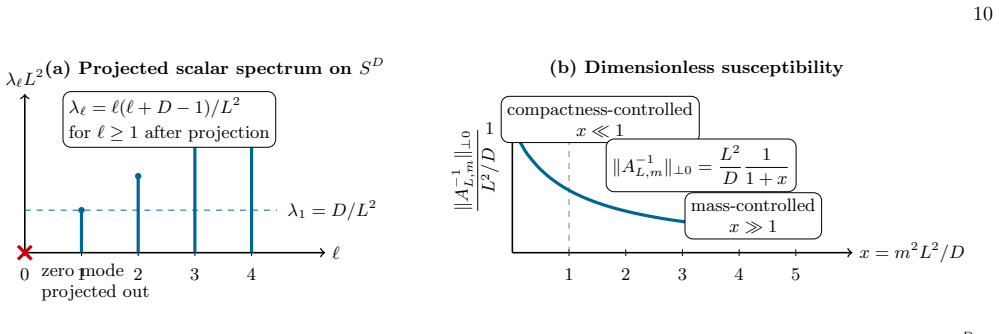
We prove that on any stable channel with coercive form Q_gg^P ≥ δ_P ||h||^2, the Gaussian saddle remains controlled whenever ||Δ_ΦΦ^{-1/2} j_P||_op^2 < δ_P. This criterion, based on the Schur complement of the observer kernel after gauge fixing and zero-mode projection, identifies the semiclassically admissible observer class for which the induced metric correction is a bounded quadratic-form perturbation. In the gapped case the bound follows from ||K^† Δ_ΦΦ^{-1} K||_op ≤ ||K||_op^2 / m_*^2, while metric-coupled soft modes produce corrections growing as 1/ε. The conformal channel is treated only as an indefinite sector where boundedness does not imply positivity.
What carries the argument
The form-domain criterion based on the Schur complement of the observer kernel (the effective operator obtained after eliminating observer degrees of freedom), which bounds the mixed metric-observer source after rescaling by Δ_ΦΦ^{-1/2} to keep backreaction controlled.
If this is right
- The Gaussian saddle approximation holds for any observer whose mixed source meets the operator-norm inequality on coercive channels.
- A localized gapped clock-detector with internal oscillators on a smeared worldline satisfies the criterion and yields an explicit bound on S^4 versus the round-sphere TT scale.
- Metric-coupled soft modes produce corrections that grow as 1/ε and therefore lie outside the admissible class.
- The conformal negative-mode sector requires a separate contour or state-counting prescription because the criterion guarantees only boundedness, not positivity.
Where Pith is reading between the lines
- The same Schur-complement test could be applied to classify admissible observers on other gravitational backgrounds beyond de Sitter.
- If a proposed observer violates the bound, the semiclassical expansion would require non-Gaussian resummation or a different path-integral contour.
- Numerical evaluation of the quadratic forms for concrete detector models could provide quantitative tests of the bound on S^4 or other spheres.
Load-bearing premise
After gauge fixing and zero-mode projection, the observer's quadratic influence is governed by a Schur complement whose positivity and boundedness after applying Δ_ΦΦ^{-1/2} suffice to keep the induced metric correction a bounded quadratic-form perturbation.
What would settle it
A direct computation of the quadratic form on a stable channel showing that an observer satisfying ||Δ_ΦΦ^{-1/2} j_P||_op^2 < δ_P nevertheless produces an unbounded or infrared-singular metric correction would disprove the sufficiency theorem.
Figures
read the original abstract
The Euclidean de Sitter path integral contains the familiar phase associated with conformal negative modes. Maldacena's construction shows that a suitably included real observer can reorganize the refined state-counting problem. This paper does not rederive that cancellation. It addresses the prior semiclassical admissibility question: which observer sectors couple to the de Sitter saddle as genuine metric observers without becoming spectators or producing infrared-singular backreaction? On $S^D$, after gauge fixing and zero-mode projection, the observer's quadratic influence is governed by a Schur complement. We formulate a form-domain criterion: if the observer kernel is positive and the mixed metric-observer source is bounded after applying $\Delta_{\Phi\Phi}^{-1/2}$, the induced metric correction is a bounded quadratic-form perturbation on the chosen channel. In the gapped case, $\Delta_{\Phi\Phi}\geq m_*^2\mathbf{1}$ gives $\|K^\dagger \Delta_{\Phi\Phi}^{-1} K\|_{\rm op} \leq \|K\|_{\rm op}^2/m_*^2$; metric-coupled soft modes produce corrections growing as $1/\varepsilon$. We prove a sufficiency theorem: on any stable channel with coercive form $Q_{gg}^P \geq \delta_P \|h\|^2$, the Gaussian saddle remains controlled whenever $\|\Delta_{\Phi\Phi}^{-1/2} \mathfrak{j}_P\|_{\rm op}^2 < \delta_P$. We construct a localized gapped clock-detector with internal oscillators on a smeared worldline that satisfies the criterion with a computable bound and gives explicit $S^4$ benchmark versus the round-sphere TT scale. The conformal channel is treated only as an indefinite or contour-defined sector; boundedness does not imply positivity. The criterion identifies the semiclassically admissible observer class. Phase cancellation follows only when this class overlaps the relevant conformal or negative-mode sector and is combined with an independent contour or state-counting prescription.
Editorial analysis
A structured set of objections, weighed in public.
Referee Report
Summary. The manuscript proves a sufficiency theorem for the semiclassical admissibility of real observers in the Euclidean de Sitter path integral. After gauge fixing and zero-mode projection on S^D, the observer's quadratic influence enters via a Schur complement; the central criterion states that if the metric channel satisfies the coercivity bound Q_gg^P ≥ δ_P ||h||^2, then the Gaussian saddle remains controlled whenever the mixed source obeys ||Δ_ΦΦ^{-1/2} j_P||_op^2 < δ_P. An explicit localized gapped clock-detector with internal oscillators on a smeared worldline is constructed that meets the bound, with the gapped-case estimate ||K† Δ_ΦΦ^{-1} K||_op ≤ ||K||_op^2 / m_*^2 and an explicit S^4 benchmark against the round-sphere TT scale. The conformal channel is treated separately as indefinite; phase cancellation is stated to require an independent contour prescription.
Significance. If the theorem holds, the work supplies a concrete, channel-by-channel test that distinguishes genuine metric-coupled observers from spectators or IR-singular sources, thereby clarifying the admissible class before Maldacena-type phase cancellation is applied to the refined state-counting problem. The explicit gapped bound, the Schur-complement derivation, and the S^4 benchmark constitute reproducible, falsifiable content that strengthens the result.
minor comments (2)
- The abstract states that the conformal channel is treated only as indefinite or contour-defined, yet the introduction would benefit from a one-sentence clarification of how the form-domain criterion is (or is not) applied to that sector.
- Notation for the observer kernel K and the source j_P is introduced without an explicit cross-reference to the quadratic-form definition; adding a short equation label in the paragraph on the Schur complement would improve readability.
Simulated Author's Rebuttal
We thank the referee for their careful reading, accurate summary of the manuscript, and recommendation of minor revision. The referee's description correctly captures the form-domain criterion, the Schur-complement derivation, the sufficiency theorem, the gapped-observer bound, and the treatment of the conformal channel. No specific major comments were raised in the report.
Circularity Check
No significant circularity; derivation applies standard perturbation bound
full rationale
The paper's central claim is a sufficiency theorem stating that a coercive quadratic form Q_gg^P ≥ δ_P ||h||^2 remains controlled under the observer perturbation when ||Δ_ΦΦ^{-1/2} j_P||_op^2 < δ_P. This is the direct application of the definition of coercivity plus the operator-norm bound on the Schur complement term (explicitly ||K† Δ^{-1} K|| ≤ ||K||^2 / m_*^2 in the gapped case). The text states it does not rederive Maldacena's phase cancellation and treats the conformal channel as indefinite. No step reduces by construction to a fitted input, self-citation, or renamed ansatz; the criterion is an independent boundedness condition derived from the quadratic form after gauge fixing.
Axiom & Free-Parameter Ledger
axioms (1)
- domain assumption After gauge fixing and zero-mode projection the observer-metric coupling is governed by a Schur complement whose positivity properties control backreaction.
invented entities (1)
-
localized gapped clock-detector with internal oscillators on a smeared worldline
no independent evidence
Reference graph
Works this paper leans on
-
[1]
G. W. Gibbons and S. W. Hawking, Phys. Rev. D15, 2738 (1977)
1977
-
[2]
G. W. Gibbons, S. W. Hawking, and M. J. Perry, Nucl. Phys. B138, 141 (1978)
1978
-
[3]
Polchinski, Phys
J. Polchinski, Phys. Lett. B219, 251 (1989)
1989
-
[4]
Law, JHEP2021(12), 213, arXiv:2012.06345 [hep- th]
Y.-Z. Law, JHEP2021(12), 213, arXiv:2012.06345 [hep- th]
- [5]
-
[6]
Real observers solving imaginary problems,
J. Maldacena, Real observers solving some imaginary prob- lems (2024), arXiv:2412.14014 [hep-th], arXiv:2412.14014 [hep-th]
-
[7]
A. F. Ali, Communications in Theoretical Physics78, 065401 (2026), arXiv:2603.18068 [hep-th]
work page internal anchor Pith review Pith/arXiv arXiv 2026
- [8]
- [9]
- [10]
- [12]
- [13]
- [14]
- [15]
-
[16]
B. Chen and J. Xu, An algebra for covariant observers in de sitter space (2025), arXiv:2511.00622 [hep-th], arXiv:2511.00622 [hep-th]
-
[17]
A. Blommaert, J. Kudler-Flam, and E. Y. Urbach, JHEP 2025(11), 113, arXiv:2505.14771 [hep-th]
- [18]
- [19]
-
[20]
R. Esp´ ındola and S. Miyashita, Flow-geometry microstates (2025), arXiv:2510.18901 [hep-th], arXiv:2510.18901 [hep-th]
work page internal anchor Pith review Pith/arXiv arXiv 2025
-
[21]
D. N. Page and W. K. Wootters, Phys. Rev. D27, 2885 (1983)
1983
-
[22]
A. Connes and C. Rovelli, Class. Quantum Grav.11, 2899 (1994), arXiv:gr-qc/9406019 [gr-qc]
work page internal anchor Pith review Pith/arXiv arXiv 1994
-
[23]
Wen and Q
X.-G. Wen and Q. Niu, Phys. Rev. B41, 9377 (1990)
1990
- [24]
-
[25]
X.-L. Qi, T. L. Hughes, and S.-C. Zhang, Phys. Rev. B 78, 195424 (2008), arXiv:0802.3537 [cond-mat.mes-hall]
work page internal anchor Pith review Pith/arXiv arXiv 2008
-
[26]
T. W. B. Kibble, J. Phys. A9, 1387 (1976)
1976
-
[27]
Vilenkin and E
A. Vilenkin and E. P. S. Shellard,Cosmic Strings and Other Topological Defects(Cambridge University Press, Cambridge, 1994)
1994
-
[28]
W. H. Zurek, Nature317, 505 (1985)
1985
-
[29]
Notes on Some Entanglement Properties of Quantum Field Theory
E. Witten, Rev. Mod. Phys.90, 045003 (2018), arXiv:1803.04993 [hep-th]
work page internal anchor Pith review Pith/arXiv arXiv 2018
- [30]
-
[31]
Witten,Gravity and the crossed product,JHEP10(2022) 008 [2112.12828]
E. Witten, JHEP2022(10), 008, arXiv:2112.12828 [hep- th]
-
[32]
V. Chandrasekaran, G. Penington, and E. Witten, JHEP 2023(04), 009, arXiv:2209.10454 [hep-th]
-
[33]
Witten, JHEP2024(03), 077, arXiv:2308.03663 [hep- th]
E. Witten, JHEP2024(03), 077, arXiv:2308.03663 [hep- th]
-
[34]
An Algebra of Observables for de Sitter Space
V. Chandrasekaran, R. Longo, G. Penington, and E. Wit- ten, JHEP2023(02), 082, arXiv:2206.10780 [hep-th]
work page internal anchor Pith review Pith/arXiv arXiv
-
[35]
Higuchi, Journal of Mathematical Physics28, 1553 (1987)
A. Higuchi, Journal of Mathematical Physics28, 1553 (1987)
1987
-
[36]
M. A. Rubin and C. R. Ordonez, Journal of Mathematical Physics25, 2888 (1984)
1984
-
[37]
C. J. Morningstar and M. Peardon, Phys. Rev. D60, 034509 (1999), arXiv:hep-lat/9901004 [hep-lat]
work page internal anchor Pith review Pith/arXiv arXiv 1999
-
[38]
Clay Mathematics Institute, Yang–mills and the mass gap, Official Millennium Prize Problem overview (2026), https://www.claymath.org/millennium/ yang-mills-the-maths-gap/
2026
-
[39]
A. F. Ali, Symmetry17, 888 (2025)
2025
- [40]
discussion (0)
Sign in with ORCID, Apple, or X to comment. Anyone can read and Pith papers without signing in.