RDGen: Demonstration Generation for High-Quality Robot Learning via Reinforcement Learning
Pith reviewed 2026-06-28 22:25 UTC · model grok-4.3
The pith
Reinforcement learning policies transferred from simulation generate higher-quality robot demonstration trajectories than human teleoperation for training vision-language-action models.
A machine-rendered reading of the paper's core claim, the machinery that carries it, and where it could break.
Core claim
The paper claims that an RL policy trained in simulation and transferred to the real robot can serve as a structured trajectory generator whose successful rollouts supply cleaner, smoother demonstrations than human teleoperation, resulting in superior downstream VLA performance on a pick-and-place task while simulation supplies additional trajectories at low marginal cost.
What carries the argument
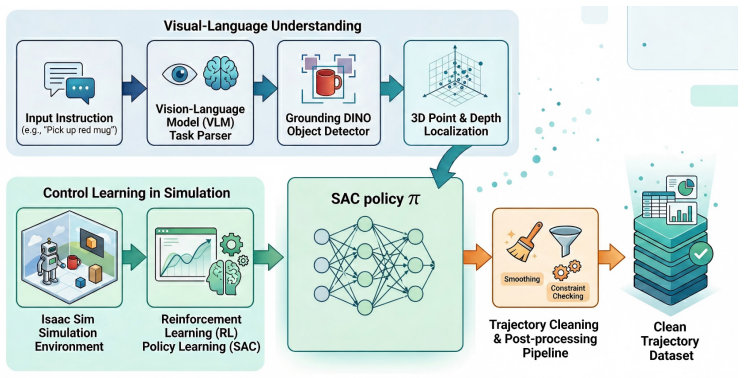
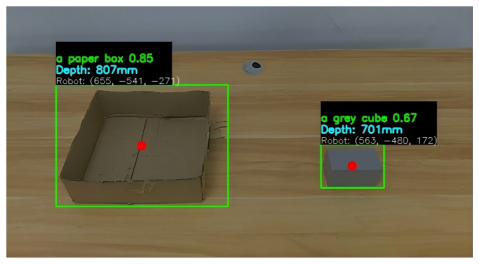
The sim-to-real transferred RL policy acting as a demonstration generator, supported by a VLM-based task parser and Grounding DINO-based object localizer, to produce and harvest successful real-world rollouts.
If this is right
- The transferred RL policy achieves a high success rate on real-world pick-and-place tasks.
- RDGen trajectories are significantly smoother than human teleoperation trajectories.
- VLA models trained on RDGen demonstrations outperform those trained on human teleoperation data.
- Simulation supplies additional trajectories at little marginal cost for VLA training.
Where Pith is reading between the lines
- The approach might reduce the overall cost and variability of collecting robot demonstration data if the RL transfer succeeds across tasks.
- Iterative retraining of the RL policy on its own harvested trajectories could further improve demonstration quality over time.
- Similar sim-to-real generators could be tested on manipulation tasks beyond pick-and-place to check generality.
Load-bearing premise
The transferred RL policy will reliably produce successful real-world rollouts whose trajectories are both smoother and more useful for VLA training than human teleoperation trajectories without post-hoc filtering.
What would settle it
A controlled experiment in which VLA models trained on RDGen trajectories show equal or lower task performance than VLA models trained on human teleoperation trajectories for the same pick-and-place task.
Figures

read the original abstract
Vision-Language-Action (VLA) models have emerged as a promising paradigm for general-purpose robot control. However, their performance remains fundamentally constrained by the availability of high-quality robot trajectory data. In current robot learning practice, such data are primarily collected through human teleoperation, which is labor-intensive, costly, and difficult to scale. In this paper, we propose RDGen, a sim-to-real reinforcement learning framework for generating high-quality robot demonstrations. Rather than employing reinforcement learning solely as the final control policy, RDGen leverages trained RL policies as a structured trajectory generator. The system consists of a VLM-based task parser that identifies task-relevant objects, a Grounding DINO-based object localizer, and an RL policy transferred from simulation to the real robot. Successful rollouts are then harvested as clean, high-quality demonstrations for downstream VLA training, while the simulation stage further provides a scalable source of additional trajectories at little marginal cost. Experiments on a pick-and-place task demonstrate that the transferred RL policy achieves a high task success rate. Compared with human teleoperation, RDGen produces significantly smoother trajectories and yields superior downstream VLA performance. These results indicate that RL-generated demonstrations can serve as more reliable and consistent supervisory signals for robot policy learning.
Editorial analysis
A structured set of objections, weighed in public.
Referee Report
Summary. The paper proposes RDGen, a sim-to-real RL framework that trains an RL policy in simulation, transfers it to a real robot via a VLM-based task parser and Grounding DINO localizer, and harvests successful real-world rollouts as demonstration trajectories for downstream VLA training. On a pick-and-place task the abstract claims the transferred policy achieves a high success rate, generates significantly smoother trajectories than human teleoperation, and yields superior VLA performance, while simulation supplies additional scalable data.
Significance. If the quantitative claims hold, RDGen would provide a scalable, lower-cost source of consistent robot trajectories that could improve VLA training over labor-intensive human teleoperation. The approach of using RL policies explicitly as demonstration generators rather than end controllers is a potentially useful distinction, but its value depends on verifiable sim-to-real reliability and measurable trajectory quality gains.
major comments (3)
- [Abstract] Abstract: the central empirical claims ('high task success rate', 'significantly smoother trajectories', 'superior downstream VLA performance') are stated without any numerical values, standard deviations, number of trials, baseline comparisons, or statistical tests, rendering the superiority assertion unevaluable from the provided text.
- [Abstract] Abstract: no definition or metric is supplied for trajectory smoothness (e.g., jerk, curvature variance, or velocity profile statistics), nor is any post-hoc filtering or task-specific tuning described, so the comparison to human teleoperation cannot be assessed.
- [Abstract] Abstract: the sim-to-real transfer method is outlined at the component level (VLM parser, Grounding DINO, RL policy) but supplies no domain-randomization parameters, sim-to-real success-rate gap, failure-mode analysis, or real-world rollout count, leaving the reliability of the harvested demonstrations unsupported.
Simulated Author's Rebuttal
Thank you for the constructive feedback on our manuscript. We agree that the abstract requires more quantitative detail to make the claims evaluable. We will revise the abstract accordingly and address each of the major comments below.
read point-by-point responses
-
Referee: [Abstract] Abstract: the central empirical claims ('high task success rate', 'significantly smoother trajectories', 'superior downstream VLA performance') are stated without any numerical values, standard deviations, number of trials, baseline comparisons, or statistical tests, rendering the superiority assertion unevaluable from the provided text.
Authors: We concur that the abstract would benefit from explicit numerical support for these claims. The full manuscript reports these results in detail (e.g., task success rates, trajectory quality metrics with standard deviations, trial counts, and statistical comparisons in the experiments section). We will update the abstract to include the key quantitative findings and baseline comparisons. revision: yes
-
Referee: [Abstract] Abstract: no definition or metric is supplied for trajectory smoothness (e.g., jerk, curvature variance, or velocity profile statistics), nor is any post-hoc filtering or task-specific tuning described, so the comparison to human teleoperation cannot be assessed.
Authors: We will revise the abstract to specify the smoothness metrics employed (jerk and curvature variance, as defined and computed in the methods) and clarify that the trajectories are used as generated by the RL policy without additional filtering. revision: yes
-
Referee: [Abstract] Abstract: the sim-to-real transfer method is outlined at the component level (VLM parser, Grounding DINO, RL policy) but supplies no domain-randomization parameters, sim-to-real success-rate gap, failure-mode analysis, or real-world rollout count, leaving the reliability of the harvested demonstrations unsupported.
Authors: The experimental section of the manuscript details the domain randomization parameters, reports the sim-to-real performance gap, analyzes failure modes, and specifies the number of real-world rollouts used to harvest demonstrations. We will add concise references to these elements in the revised abstract. revision: yes
Circularity Check
No circularity: empirical method description with no derivation chain or self-referential equations
full rationale
The paper presents a sim-to-real RL framework for generating robot demonstrations, consisting of a VLM parser, Grounding DINO localizer, and transferred RL policy whose successful rollouts are harvested for VLA training. No equations, fitted parameters, or mathematical derivations appear in the provided text. Claims rest on experimental comparison (smoother trajectories, superior VLA performance) rather than any prediction that reduces to its own inputs by construction. No self-citations are invoked as load-bearing uniqueness theorems or ansatzes. The central assertions are therefore independent empirical statements, not self-definitional or fitted-input loops.
Axiom & Free-Parameter Ledger
Reference graph
Works this paper leans on
-
[1]
GR00T N1: An Open Foundation Model for Generalist Humanoid Robots
Bjorck, J., Castañeda, F., Cherniadev, N., Da, X., Ding, R., Fan, L., Fang, Y., Fox, D., Hu, F., Huang, S., et al.: Gr00t n1: An open foundation model for generalist humanoid robots. arXiv preprint arXiv:2503.14734 (2025)
work page internal anchor Pith review Pith/arXiv arXiv 2025
-
[2]
In: Robotics: Science and Systems (2025)
Black, K., Brown, N., Driess, D., Esmail, A., Equi, M., Finn, C., Fusai, N., Groom, L., Hausman, K., Ichter, B., Jakubczak, S., Jones, T., Ke, L., Levine, S., Li-Bell, A., et al.:π0: A vision-language-action flow model for general robot control. In: Robotics: Science and Systems (2025)
2025
-
[3]
RT-1: Robotics Transformer for Real-World Control at Scale
Brohan, A., Brown, N., Carbajal, J., Chebotar, Y., Dabis, J., Finn, C., Gopalakrishnan, K., Hausman, K., Herzog, A., Hsu, J., et al.: Rt-1: Robotics transformer for real-world control at scale. arXiv preprint arXiv:2212.06817 (2022)
work page internal anchor Pith review Pith/arXiv arXiv 2022
-
[4]
In: Pro- ceedings of the IEEE International Conference on Robotics and Automation
Chebotar, Y., Handa, A., Makoviychuk, V., Macklin, M., Issac, J., Ratliff, N., Fox, D.: Closing the sim-to-real loop: Adapting simulation randomization with real world experience. In: Pro- ceedings of the IEEE International Conference on Robotics and Automation. pp. 8973–8979 (2019)
2019
-
[5]
Fu, Z., Zhao, T.Z., Finn, C.: Mobile ALOHA: Learning bimanual mobile manipulation with low-costwhole-bodyteleoperation.In: ProceedingsoftheConferenceonRobotLearning(2024)
2024
-
[6]
In: Proceedings of the International Conference on Machine Learning
Fujimoto, S., van Hoof, H., Meger, D.: Addressing function approximation error in actor-critic methods. In: Proceedings of the International Conference on Machine Learning. pp. 1587–1596. PMLR (2018)
2018
-
[7]
In: Proceedings of the IEEE/CVF conference on computer vision and pattern recognition
Grauman, K., Westbury, A., Byrne, E., Chavis, Z., Furnari, A., Girdhar, R., Hamburger, J., Jiang, H., Liu, M., Liu, X., et al.: Ego4d: Around the world in 3,000 hours of egocentric video. In: Proceedings of the IEEE/CVF conference on computer vision and pattern recognition. pp. 18995–19012 (2022)
2022
-
[8]
In: Proceedings of the International Conference on Machine Learning
Haarnoja, T., Zhou, A., Abbeel, P., Levine, S.: Soft actor-critic: Off-policy maximum en- tropy deep reinforcement learning with a stochastic actor. In: Proceedings of the International Conference on Machine Learning. pp. 1861–1870. PMLR (2018)
2018
-
[9]
In: International conference on machine learning
Huang, W., Abbeel, P., Pathak, D., Mordatch, I.: Language models as zero-shot planners: Extracting actionable knowledge for embodied agents. In: International conference on machine learning. pp. 9118–9147. PMLR (2022)
2022
- [10]
-
[11]
DROID: A Large-Scale In-The-Wild Robot Manipulation Dataset
Khazatsky, A., Pertsch, K., Nair, S., Balakrishna, A., Dasari, S., Karamcheti, S., Nasiriany, S., Srirama, M.K., Chen, L.Y., Ellis, K., etal.: Droid: Alarge-scalein-the-wildrobotmanipulation dataset. arXiv preprint arXiv:2403.12945 (2024)
work page internal anchor Pith review Pith/arXiv arXiv 2024
-
[12]
OpenVLA: An Open-Source Vision-Language-Action Model
Kim, M.J., Pertsch, K., Karamcheti, S., Xiao, T., Balakrishna, A., Nair, S., Rafailov, R., Foster, E., Lam, G., Sanketi, P., et al.: Openvla: An open-source vision-language-action model. arXiv preprint arXiv:2406.09246 (2024)
work page internal anchor Pith review Pith/arXiv arXiv 2024
-
[13]
In: 2023 IEEE International conference on robotics and automation (ICRA)
Liang, J., Huang, W., Xia, F., Xu, P., Hausman, K., Ichter, B., Florence, P., Zeng, A.: Code as policies: Language model programs for embodied control. In: 2023 IEEE International conference on robotics and automation (ICRA). pp. 9493–9500. IEEE (2023)
2023
-
[14]
Continuous control with deep reinforcement learning
Lillicrap, T.P., Hunt, J.J., Pritzel, A., Heess, N., Erez, T., Tassa, Y., Silver, D., Wierstra, D.: Continuous control with deep reinforcement learning. arXiv preprint arXiv:1509.02971 (2015)
work page internal anchor Pith review Pith/arXiv arXiv 2015
-
[15]
In: Conference on Robot Learning (2021)
Mandlekar, A., Xu, D., Wong, J., Nasiriany, S., Wang, C., Kulkarni, R., Fei-Fei, L., Savarese, S., Zhu, Y., Martín-Martín, R.: robomimic: A benchmark for robot learning from demonstration. In: Conference on Robot Learning (2021)
2021
-
[16]
In: Conference on Robot Learning (2018)
Mandlekar, A., Zhu, Y., Garg, A., Fei-Fei, L., Savarese, S.: RoboTurk: A crowdsourcing platform for robotic skill learning through imitation. In: Conference on Robot Learning (2018)
2018
-
[17]
Open X-Embodiment: Robotic Learning Datasets and RT-X Models
Open X-Embodiment Collaboration, Abou-Chakra, J., et al.: Open X-embodiment: Robotic learning datasets and RT-X models. arXiv preprint arXiv:2310.08864 (2023)
work page internal anchor Pith review Pith/arXiv arXiv 2023
-
[18]
Proximal Policy Optimization Algorithms
Schulman, J., Wolski, F., Dhariwal, P., Radford, A., Klimov, O.: Proximal policy optimization algorithms. arXiv preprint arXiv:1707.06347 (2017)
work page internal anchor Pith review Pith/arXiv arXiv 2017
-
[19]
arXiv preprint arXiv:2102.07459 (2021)
Sharkawy, A.N.: Minimum jerk trajectory generation for straight and curved movements: Mathematical analysis. arXiv preprint arXiv:2102.07459 (2021)
-
[20]
arXiv preprint arXiv:2603.08124 (2026)
Shi, X., Huang, W., Zou, M., Sun, X.: Saivla-0: Cerebrum–pons–cerebellum tripartite archi- tecture for compute-aware vision-language-action. arXiv preprint arXiv:2603.08124 (2026)
-
[21]
Gener- alist AI Blog (2025), https://generalistai.com/blog/nov-04-2025-GEN-0
Team, G.A.: Gen-0: Embodied foundation models that scale with physical interaction. Gener- alist AI Blog (2025), https://generalistai.com/blog/nov-04-2025-GEN-0
2025
-
[22]
Generalist AI Blog (2026), https://generalistai.com/blog/apr-02-2026-GEN-1
Team, G.A.: Gen-1: Scaling embodied foundation models to mastery. Generalist AI Blog (2026), https://generalistai.com/blog/apr-02-2026-GEN-1
2026
-
[23]
In: Proceedings of the IEEE/RSJ International Conference on Intelligent Robots and Systems
Tobin, J., Fong, R., Ray, A., Schneider, J., Zaremba, W., Abbeel, P.: Domain randomization for transferring deep neural networks from simulation to the real world. In: Proceedings of the IEEE/RSJ International Conference on Intelligent Robots and Systems. pp. 23–30 (2017)
2017
-
[24]
In: Conference on Robot Learning
Walke, H.R., Black, K., Zhao, T.Z., Vuong, Q., Zheng, C., Hansen-Estruch, P., He, A.W., Myers, V., Kim, M.J., Du, M., et al.: Bridgedata v2: A dataset for robot learning at scale. In: Conference on Robot Learning. pp. 1723–1736. PMLR (2023)
2023
-
[25]
In: Proceedings of the IEEE/CVF conference on computer vision and pattern recognition
Wang, C., Xu, D., Zhu, Y., Martín-Martín, R., Lu, C., Fei-Fei, L., Savarese, S.: Densefusion: 6d object pose estimation by iterative dense fusion. In: Proceedings of the IEEE/CVF conference on computer vision and pattern recognition. pp. 3343–3352 (2019)
2019
-
[26]
PoseCNN: A Convolutional Neural Network for 6D Object Pose Estimation in Cluttered Scenes
Xiang, Y., Schmidt, T., Narayanan, V., Fox, D.: Posecnn: A convolutional neural network for 6d object pose estimation in cluttered scenes. arXiv preprint arXiv:1711.00199 (2017) 12
work page internal anchor Pith review Pith/arXiv arXiv 2017
-
[27]
In: Robotics: Science and Systems (2023)
Zhao, T.Z., Kumar, V., Levine, S., Finn, C.: Learning fine-grained bimanual manipulation with low-cost hardware. In: Robotics: Science and Systems (2023)
2023
-
[28]
In: Conference on Robot Learning
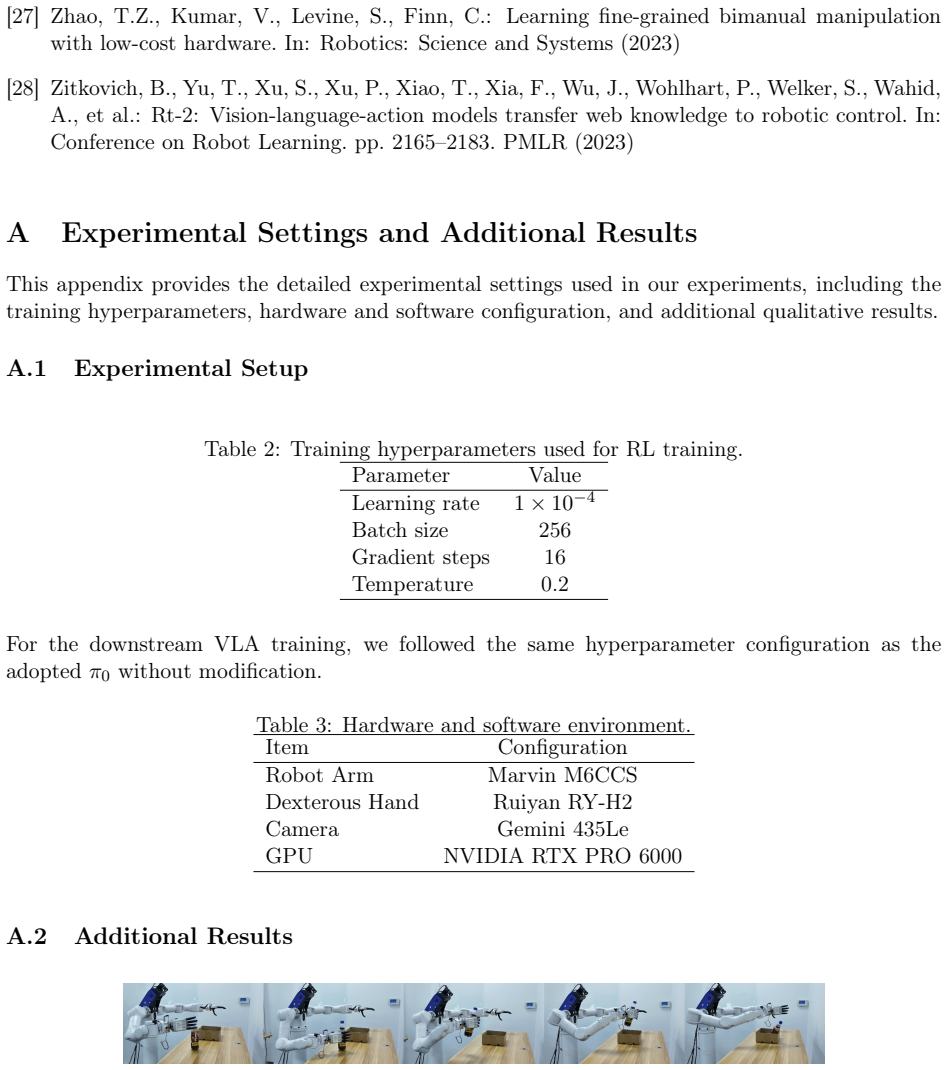
Zitkovich, B., Yu, T., Xu, S., Xu, P., Xiao, T., Xia, F., Wu, J., Wohlhart, P., Welker, S., Wahid, A., et al.: Rt-2: Vision-language-action models transfer web knowledge to robotic control. In: Conference on Robot Learning. pp. 2165–2183. PMLR (2023) A Experimental Settings and Additional Results This appendix provides the detailed experimental settings u...
2023
discussion (0)
Sign in with ORCID, Apple, or X to comment. Anyone can read and Pith papers without signing in.