A perturbative geometric approach for photon spheres, massive particle surfaces and black hole shadows with mass variations
Pith reviewed 2026-06-28 18:46 UTC · model grok-4.3
The pith
A perturbative method based on intrinsic curvatures calculates photon sphere and massive particle surface radii under black hole mass changes.
A machine-rendered reading of the paper's core claim, the machinery that carries it, and where it could break.
Core claim
The central claim is that a perturbative expansion grounded in intrinsic curvatures determines the radii of photon spheres and massive particle surfaces, including the leading-order shift induced by mass variations. For null geodesics the method reproduces known perturbative outcomes; for time-like geodesics it yields the perturbation radius itself, a result not previously obtained. The calculation also shows that mass changes directly alter both the photon-sphere radius and the massive-particle-surface radius.
What carries the argument
Perturbative expansion in geodesic curvature and Gaussian curvature that tracks how mass variations displace the locations of photon spheres and massive particle surfaces.
If this is right
- The method supplies the perturbation radius for time-like geodesics at leading order.
- Mass variations produce explicit shifts in both photon-sphere and massive-particle-surface radii.
- The framework recovers prior null-geodesic perturbative results.
- The resulting radii supply theoretical estimates that can be tested against future observations.
- The approach furnishes tools for modeling regions near extremely massive objects.
Where Pith is reading between the lines
- The curvature-based expansion may extend to spacetimes lacking exact closed-form solutions, allowing approximate radii where traditional methods stall.
- Linking the mass-variation shifts to shadow-size measurements could constrain accretion models in a manner not addressed in the paper.
- The same leading-order curvature tracking might apply to related geodesic quantities such as innermost stable circular orbits.
Load-bearing premise
The leading-order terms of the curvature-based expansion remain accurate for both null and time-like geodesics without higher-order contributions or coordinate choices altering the extracted radii.
What would settle it
An exact solution for the photon-sphere radius in a known metric with a controlled small mass perturbation that deviates numerically from the leading-order prediction of the curvature expansion.
Figures
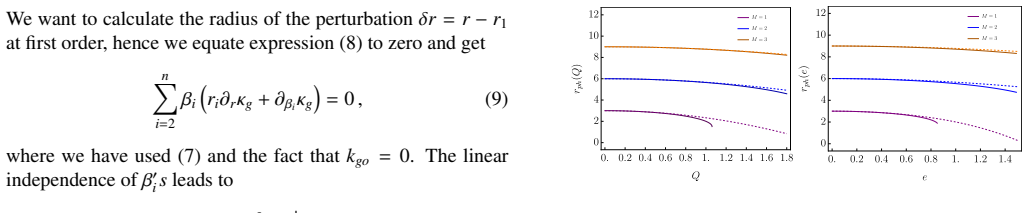

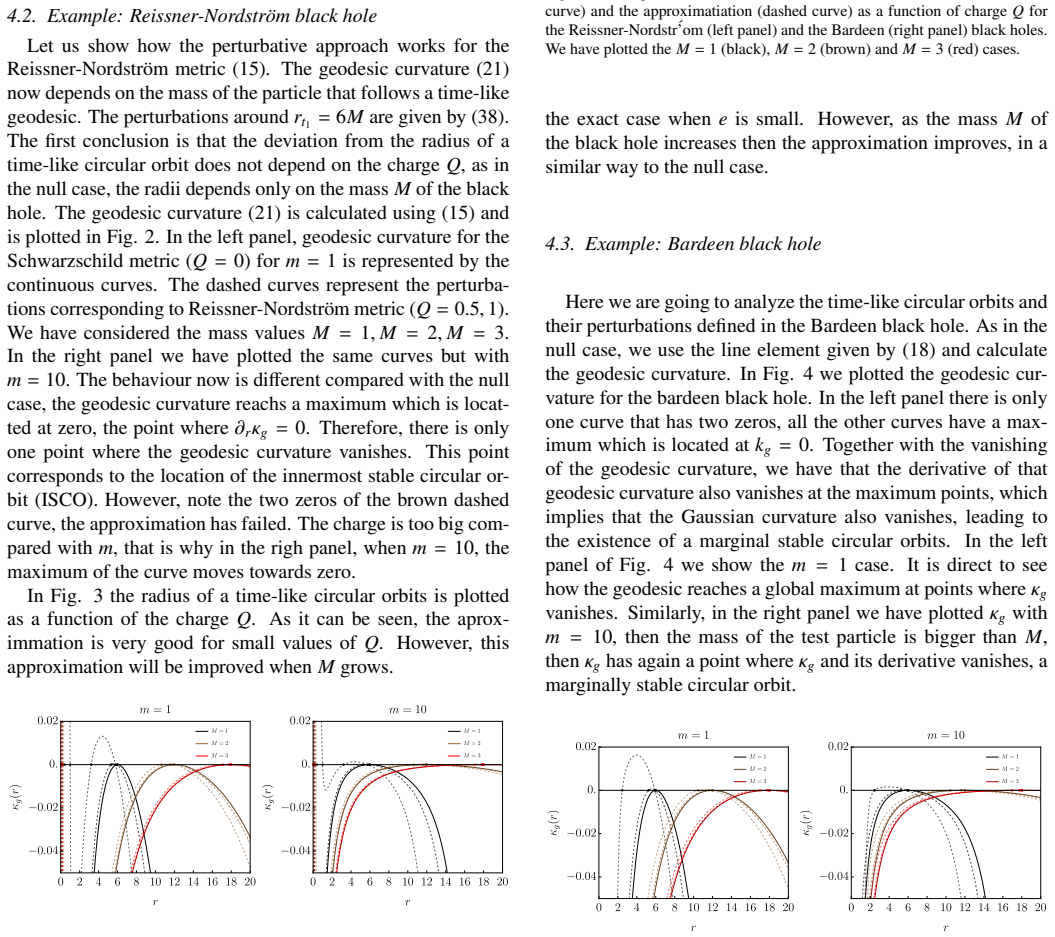
read the original abstract
The spacetime behavior at very extreme conditions, such as the regions near a black hole, can be very difficult to modelize. In this work we introduce a new geometric method that allows to calculate the parameters of photon spheres, massive particle surfaces and shadow radius of black holes. We build upon a perturvative approach but bases in intrinsic curvatures, such as the geodesic and Gaussian curvatures. At leading order, the method allows to find the radius of the perturbation in the time-like case, which has not been studied in the literature. In the null case we are able to recover the results found by the perturvative method only. We also study the mass variations and how they influence the photon sphere radius and the massive particle surface radius, leading to a new and powerful result, that could provide new different research directions. The approach presented here will provide a set of tools that will help to modelize gravity near extremely massive objects and help to improve the theoretical estimations of parameters than can be tested in the next generation experiments.
Editorial analysis
A structured set of objections, weighed in public.
Referee Report
Summary. The paper introduces a perturbative geometric method based on intrinsic curvatures (geodesic and Gaussian) to compute radii of photon spheres, massive particle surfaces, and black hole shadows. It claims to recover known null-geodesic results from existing perturbative approaches while providing a new leading-order result for the time-like case (previously unstudied) and a new result on how mass variations affect both photon-sphere and massive-particle-surface radii.
Significance. If the leading-order curvature-based expansion is shown to be accurate, the approach would supply a coordinate-independent geometric tool for near-horizon geodesic analysis that could be applied to a range of black-hole metrics and tested against next-generation shadow observations. The claimed novelty for the time-like radius and mass-variation effects would constitute a genuine extension beyond existing perturbative literature.
major comments (2)
- [Abstract] Abstract: the central claim that the leading-order curvature perturbation yields a new, previously unstudied radius for the time-like case rests on the unverified assumption that higher-order geodesic/Gaussian curvature terms (or coordinate artifacts) do not shift the reported radius; no explicit comparison to exact solutions or next-to-leading-order terms is indicated to secure this truncation.
- [Abstract] Abstract: the new result on mass variations influencing photon-sphere and massive-particle-surface radii is presented as load-bearing, yet the manuscript provides no derivation or consistency check against known static limits, leaving the perturbative treatment of mass dependence unanchored.
minor comments (1)
- [Abstract] Abstract contains repeated spelling errors ('perturvative', 'modelize') that should be corrected for clarity.
Simulated Author's Rebuttal
We thank the referee for their insightful comments, which help improve the clarity and rigor of our work. We address each major comment below.
read point-by-point responses
-
Referee: [Abstract] Abstract: the central claim that the leading-order curvature perturbation yields a new, previously unstudied radius for the time-like case rests on the unverified assumption that higher-order geodesic/Gaussian curvature terms (or coordinate artifacts) do not shift the reported radius; no explicit comparison to exact solutions or next-to-leading-order terms is indicated to secure this truncation.
Authors: We agree that additional validation is necessary to support the leading-order result for the time-like case. In the revised version, we will include comparisons with exact analytic solutions for standard black hole metrics such as Schwarzschild and Kerr, as well as an explicit calculation of the next-to-leading-order corrections in the curvature expansion. This will demonstrate that the reported radius remains stable under these checks. revision: yes
-
Referee: [Abstract] Abstract: the new result on mass variations influencing photon-sphere and massive-particle-surface radii is presented as load-bearing, yet the manuscript provides no derivation or consistency check against known static limits, leaving the perturbative treatment of mass dependence unanchored.
Authors: We acknowledge the need for a more detailed derivation and validation of the mass-variation effects. The revised manuscript will provide the full perturbative derivation for how mass variations enter the curvature-based expressions and will include consistency checks in the static limit (vanishing mass variation) to recover the known results. This will anchor the treatment of mass dependence. revision: yes
Circularity Check
Derivation self-contained; recovers known null results and extends independently to time-like and mass-variation cases
full rationale
The paper introduces a perturbative method based on intrinsic curvatures (geodesic and Gaussian) to compute photon sphere, massive particle surface, and shadow radii. It states that the null-case results are recovered from existing perturbative methods while the time-like radius and mass-variation effects constitute new leading-order findings. No load-bearing step is shown to reduce by construction to a fitted parameter, self-citation chain, or definitional equivalence; the central claims retain independent content beyond any prior work. The derivation chain is therefore self-contained against external benchmarks.
Axiom & Free-Parameter Ledger
Reference graph
Works this paper leans on
-
[1]
First M87 Event Horizon Telescope Results. I. The Shadow of the Supermassive Black Hole
K. Akiyama, et al., First M87 Event Horizon Telescope Results. I. The Shadow of the Supermassive Black Hole, Astrophys. J. Lett. 875 (2019) L1.arXiv:1906.11238, doi:10.3847/2041-8213/ab0ec7. 4WhenK=0 we have marginally stable circular orbit. 8
work page internal anchor Pith review Pith/arXiv arXiv doi:10.3847/2041-8213/ab0ec7 2019
-
[2]
J. P. Luminet, Image of a spherical black hole with thin accretion disk, Astron. Astrophys. 75 (1979) 228–235
1979
-
[3]
S. Vagnozzi, et al., Horizon-scale tests of gravity the- ories and fundamental physics from the Event Horizon Telescope image of Sagittarius A, Class. Quant. Grav. 40 (16) (2023) 165007.arXiv:2205.07787,doi:10. 1088/1361-6382/acd97b
work page internal anchor Pith review Pith/arXiv arXiv 2023
-
[4]
Viewing the Shadow of the Black Hole at the Galactic Center
H. Falcke, F. Melia, E. Agol, Viewing the shadow of the black hole at the galactic center, Astrophys. J. Lett. 528 (2000) L13.arXiv:astro-ph/9912263,doi:10. 1086/312423
work page internal anchor Pith review Pith/arXiv arXiv 2000
-
[5]
A. Olejak, K. Belczynski, T. Bulik, M. Sobolewska, Syn- thetic catalog of black holes in the Milky Way, Astron. Astrophys. 638 (2020) A94.arXiv:1908.08775,doi: 10.1051/0004-6361/201936557
-
[6]
P. Mróz, et al., No massive black holes in the Milky Way halo, Nature 632 (8026) (2024) 749–751.arXiv:2403. 02386,doi:10.1038/s41586-024-07704-6
-
[7]
R. Abbott, et al., Population Properties of Compact Ob- jects from the Second LIGO-Virgo Gravitational-Wave Transient Catalog, Astrophys. J. Lett. 913 (1) (2021) L7.arXiv:2010.14533,doi:10.3847/2041-8213/ abe949
-
[8]
B. P. Abbott, et al., Binary Black Hole Mergers in the first Advanced LIGO Observing Run, Phys. Rev. X 6 (4) (2016) 041015, [Erratum: Phys.Rev.X 8, 039903 (2018)].arXiv:1606.04856,doi:10.1103/ PhysRevX.6.041015
work page internal anchor Pith review Pith/arXiv arXiv 2016
-
[9]
K. Akiyama, et al., First Sagittarius A* Event Horizon Telescope Results. I. The Shadow of the Supermassive Black Hole in the Center of the Milky Way, Astrophys. J. Lett. 930 (2) (2022) L12.arXiv:2311.08680,doi: 10.3847/2041-8213/ac6674
work page internal anchor Pith review Pith/arXiv arXiv doi:10.3847/2041-8213/ac6674 2022
-
[10]
V . Perlick, O. Y . Tsupko, Calculating black hole shadows: Review of analytical studies, Phys. Rept. 947 (2022) 1–39. arXiv:2105.07101,doi:10.1016/j.physrep.2021. 10.004
-
[11]
D. Ayzenberg, et al., Fundamental physics opportunities with future ground-based mm/sub-mm VLBI arrays, Liv- ing Rev. Rel. 28 (1) (2025) 4, [Erratum: Living Rev.Rel. 28, 7 (2025)].arXiv:2312.02130,doi:10.1007/ s41114-025-00057-0
-
[12]
A. Lupsasca, A. Cárdenas-Avendaño, D. C. M. Palumbo, M. D. Johnson, S. E. Gralla, D. P. Marrone, P. Galison, P. Tiede, L. Keeble, The Black Hole Explorer: photon ring science, detection, and shape measurement, Proc. SPIE Int. Soc. Opt. Eng. 13092 (2024) 130926Q.arXiv:2406. 09498,doi:10.1117/12.3019437
-
[13]
S. E. Gralla, D. E. Holz, R. M. Wald, Black Hole Shad- ows, Photon Rings, and Lensing Rings, Phys. Rev. D 100 (2) (2019) 024018.arXiv:1906.00873,doi:10. 1103/PhysRevD.100.024018
work page internal anchor Pith review Pith/arXiv arXiv 2019
- [14]
- [15]
-
[16]
V . Vertogradov, A. Övgün, General approach on shadow radius and photon spheres in asymptotically flat space- times and the impact of mass-dependent variations, Phys. Lett. B 854 (2024) 138758.arXiv:2404.18536,doi: 10.1016/j.physletb.2024.138758
-
[17]
Qiao, Curvatures, photon spheres, and black hole shadows, Phys
C.-K. Qiao, Curvatures, photon spheres, and black hole shadows, Phys. Rev. D 106 (8) (2022) 084060.arXiv: 2208.01771,doi:10.1103/PhysRevD.106.084060
- [18]
-
[19]
B. Bermúdez-Cárdenas, O. L. Andino, Massive particle surfaces, partial umbilicity, and circular orbits, Phys. Rev. D 111 (6) (2025) 064001.arXiv:2409.10789,doi:10. 1103/PhysRevD.111.064001
-
[20]
B. Bermúdez-Cárdenas, O. Lasso Andino, Light rings, timelike circular orbits and curvature of traversable worm- holes, ArXiv (4 2025).arXiv:2504.10732
- [21]
-
[22]
P. V . P. Cunha, C. A. R. Herdeiro, J. a. P. A. Novo, Null and timelike circular orbits from equivalent 2D metrics, Class. Quant. Grav. 39 (22) (2022) 225007.arXiv:2207. 14506,doi:10.1088/1361-6382/ac987e
-
[23]
C.-K. Qiao, P. Su, Y . Huang, A general discussion on photon spheres in different categories of spacetimes, Eur. Phys. J. C 85 (6) (2025) 709.arXiv:2602.04573,doi: 10.1140/epjc/s10052-025-14435-z
-
[24]
J. M. Bardeen, Non-singular general-relativistic gravita- tional collapse, Proceedings of the International Confer- ence GR5 (1968) 174. 9
1968
-
[25]
Massive particle surfaces and black hole shadows from intrinsic curvature
B. Bermúdez-Cárdenas, O. L. Andino, Massive particle surfaces and black hole shadows from intrinsic curvature, Eur. Phys. J. C 85 (11) (2025) 1266.arXiv:2503.21203, doi:10.1140/epjc/s10052-025-15009-9
work page internal anchor Pith review Pith/arXiv arXiv doi:10.1140/epjc/s10052-025-15009-9 2025
-
[26]
M. Argañaraz, O. Lasso Andino, Dynamics in worm- hole spacetimes: a Jacobi metric approach, Class. Quant. Grav. 38 (4) (2021) 045004.arXiv:1906.11779,doi: 10.1088/1361-6382/abcf86
-
[27]
Á. Duenas-Vidal, O. Lasso Andino, The Jacobi met- ric approach for dynamical wormholes, Gen. Rel. Grav. 55 (1) (2023) 9.arXiv:2212.14147,doi:10.1007/ s10714-022-03060-w
-
[28]
Lasso Andino, A
O. Lasso Andino, A. León-Arteaga, G. Ramírez-Ulloa, Photon spheres and bulk probes in AdS3/CFT2: the quan- tum BTZ black hole, ArXiv (3 2026).arXiv:2603. 09169
2026
-
[29]
B. G. M. Berger, Differential Geometry: Manifolds, Curves and Surfaces., New York: Springer, 1988
1988
-
[30]
Kreyszig, Differential Geometry, New York: Dover, 1991
E. Kreyszig, Differential Geometry, New York: Dover, 1991
1991
-
[31]
G. W. Gibbons, The Jacobi-metric for timelike geodesics in static spacetimes, Class. Quant. Grav. 33 (2) (2016) 025004.arXiv:1508.06755,doi:10.1088/ 0264-9381/33/2/025004
work page internal anchor Pith review Pith/arXiv arXiv 2016
-
[32]
P. Das, R. Sk, S. Ghosh, Motion of charged particle in Reissner–Nordström spacetime: a Jacobi-metric ap- proach, Eur. Phys. J. C 77 (11) (2017) 735.arXiv:1609. 04577,doi:10.1140/epjc/s10052-017-5295-6
-
[33]
K. Kobialko, I. Bogush, D. Gal’tsov, Geometry of massive particle surfaces, Phys. Rev. D 106 (8) (2022) 084032.arXiv:2208.02690,doi:10.1103/ PhysRevD.106.084032
-
[34]
I. Bogush, K. Kobialko, D. Gal’tsov, Massive particle surfaces, Phys. Rev. D 108 (4) (2023) 044070.doi: 10.1103/PhysRevD.108.044070
- [35]
-
[36]
The geometry of photon surfaces
C.-M. Claudel, K. S. Virbhadra, G. F. R. Ellis, The Geom- etry of photon surfaces, J. Math. Phys. 42 (2001) 818–838. arXiv:gr-qc/0005050,doi:10.1063/1.1308507
work page internal anchor Pith review Pith/arXiv arXiv doi:10.1063/1.1308507 2001
-
[37]
J. M. M. Senovilla, Umbilical-Type Surfaces in Space- time, ArXiv (2011).arXiv:1111.6910
work page internal anchor Pith review Pith/arXiv arXiv 2011
-
[38]
Okumura, Totally umbilical hypersurfaces of a locally product Riemannian manifold, Kodai Math
M. Okumura, Totally umbilical hypersurfaces of a locally product Riemannian manifold, Kodai Math. Sem. Rep. (1967) 35 – 42doi:10.2996/kmj/1138845339. 10
discussion (0)
Sign in with ORCID, Apple, or X to comment. Anyone can read and Pith papers without signing in.