PHASOR: Phase-Anchored Universal Action Representations for Humanoid Embodiments
Pith reviewed 2026-06-28 14:26 UTC · model grok-4.3
The pith
Phase-anchored factorization of motion creates a unified action embedding space across humanoid robots.
A machine-rendered reading of the paper's core claim, the machinery that carries it, and where it could break.
Core claim
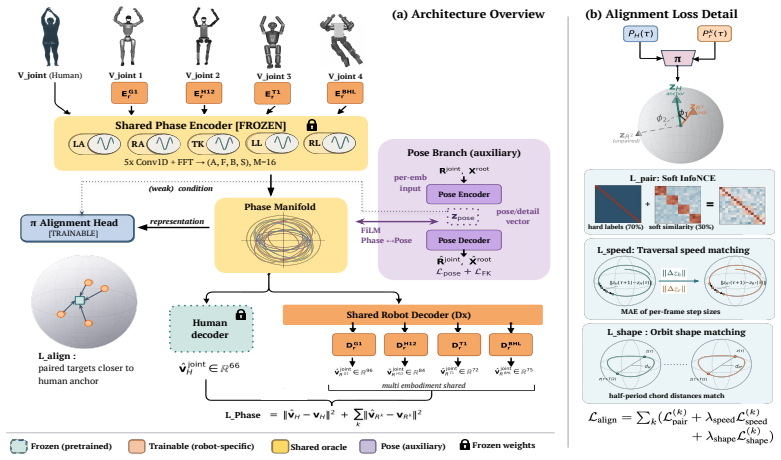
Factorizing motion into a phase manifold via FFT-parametric coefficients together with a pose branch, combined with motion-semantic distillation, produces an interpretable and embodiment-agnostic motion manifold. Anchoring multiple humanoid robots to a shared human-pretrained manifold then produces a unified action embedding space across diverse platforms.
What carries the argument
The phase manifold formed by FFT-parametric coefficients, conditioned by a pose branch and refined by semantic distillation, that serves as the shared anchor for cross-embodiment alignment.
If this is right
- Strong cross-embodiment motion retrieval becomes possible.
- Consistent gains appear on downstream robot tasks.
- Action representations gain interpretability and controllability by design.
- Policy learning scales across platforms without embodiment-specific redesign.
Where Pith is reading between the lines
- The same factorization might reduce data requirements for new robot hardware by leveraging the human anchor.
- Periodic motions outside locomotion could be handled by extending the phase branch.
- Explicit phase variables may allow direct editing of action timing without retraining the full policy.
Load-bearing premise
Motion periodicity can be factored reliably through FFT coefficients into a phase manifold that becomes embodiment-agnostic when combined with pose conditioning and semantic distillation.
What would settle it
If anchoring different humanoid robots to the shared human manifold produces no measurable improvement in cross-embodiment motion retrieval accuracy or downstream task performance, the central claim would be falsified.
Figures
read the original abstract
Learning a good action embedding space is fundamental to scalable robot policy learning, yet existing methods treat action latents as task-specific intermediates rather than first-class representations. The resulting latents are unstructured, embodiment-specific, and weakly tied to motion semantics, limiting interpretability, controllability, and transferability across robots. We position the action embedding space itself as a first-class design target, with downstream policy quality emerging from representation quality. Exploiting motion's intrinsic periodicity, we factorize it into a phase manifold that captures cyclic structure via FFT-parametric coefficients, together with a pose branch that conditions the manifold on non-periodic configuration detail. Combined with motion-semantic distillation, this factorized structure yields a cross-embodiment motion manifold that is interpretable and embodiment-agnostic by design. Anchoring multiple humanoid robots to a shared human-pretrained manifold then produces a unified action embedding space across diverse platforms, achieving strong cross-embodiment retrieval and consistent gains on downstream robot tasks.
Editorial analysis
A structured set of objections, weighed in public.
Referee Report
Summary. The paper proposes PHASOR, a framework that exploits motion periodicity by factorizing actions into a phase manifold (via FFT-parametric coefficients) plus a pose branch, augmented by motion-semantic distillation, to produce an embodiment-agnostic cross-embodiment motion manifold. Anchoring multiple humanoid robots to a shared human-pretrained instance of this manifold is claimed to yield a unified action embedding space that supports strong cross-embodiment retrieval and consistent gains on downstream robot tasks.
Significance. If the empirical results and ablations hold, the work would be significant for scalable humanoid policy learning by elevating the action embedding space to a first-class, interpretable target rather than a task-specific byproduct. The phase-anchoring plus human-pretraining approach offers a concrete route to embodiment-agnostic representations, which could improve transferability and controllability across diverse platforms.
major comments (1)
- [Abstract] Abstract: the central claim that the factorized structure 'yields a cross-embodiment motion manifold that is interpretable and embodiment-agnostic by design' is load-bearing for the subsequent anchoring step, yet the provided description supplies no equations, loss formulations, or ablation results quantifying the separate contributions of the FFT phase coefficients, pose branch, and semantic distillation; without these, it is impossible to confirm that the agnostic property is not reducible to the choice of human pretraining corpus.
minor comments (1)
- [Abstract] The abstract would benefit from explicit quantitative statements of the reported retrieval accuracy and downstream task gains (e.g., success-rate deltas) rather than qualitative descriptors such as 'strong' and 'consistent'.
Simulated Author's Rebuttal
We thank the referee for their review and for highlighting the need for clearer support of the central claim in the abstract. We address the concern directly below and note that the full manuscript contains the requested technical details and empirical quantification.
read point-by-point responses
-
Referee: [Abstract] Abstract: the central claim that the factorized structure 'yields a cross-embodiment motion manifold that is interpretable and embodiment-agnostic by design' is load-bearing for the subsequent anchoring step, yet the provided description supplies no equations, loss formulations, or ablation results quantifying the separate contributions of the FFT phase coefficients, pose branch, and semantic distillation; without these, it is impossible to confirm that the agnostic property is not reducible to the choice of human pretraining corpus.
Authors: We agree that the abstract, being a high-level summary, does not include equations or ablation numbers. The full manuscript supplies these: Section 3.1 presents the FFT-based phase manifold with explicit parametric coefficient equations; Section 3.2 details the pose branch and its conditioning; Section 3.3 formalizes the motion-semantic distillation loss. Section 5.3 contains targeted ablations that isolate each component, showing that ablating the phase manifold or distillation measurably degrades cross-embodiment retrieval and transfer even when the same human pretraining corpus is retained. These results indicate the factorization contributes to the agnostic property beyond corpus choice alone. We will revise the abstract to briefly reference the supporting ablations and equations. revision: yes
Circularity Check
No significant circularity detected
full rationale
The paper's central construction factorizes periodic motion via FFT coefficients into a phase manifold, augments it with a pose branch and semantic distillation, then anchors robots to a human-pretrained manifold. The abstract explicitly states this yields an embodiment-agnostic manifold 'by design,' but this is a statement of intended outcome from the architectural choices rather than a reduction where the claimed unification is mathematically equivalent to the inputs by construction. No equations, fitted parameters renamed as predictions, or self-citation chains are present in the provided text that would force the result. The derivation remains self-contained, with downstream claims resting on empirical retrieval and task performance rather than logical equivalence to the method definition.
Axiom & Free-Parameter Ledger
Reference graph
Works this paper leans on
-
[1]
Zitkovich, T
B. Zitkovich, T. Yu, S. Xu, P. Xu, T. Xiao, F. Xia, J. Wu, P. Wohlhart, S. Welker, A. Wahid, et al. Rt-2: Vision-language-action models transfer web knowledge to robotic control. In Conference on Robot Learning, 2023
2023
-
[2]
$\pi_0$: A Vision-Language-Action Flow Model for General Robot Control
K. Black, N. Brown, D. Driess, A. Esmail, M. Equi, C. Finn, N. Fusai, L. Groom, K. Hausman, B. Ichter, et al.π 0: A vision-language-action flow model for general robot control.arXiv preprint arXiv:2410.24164, 2024
work page internal anchor Pith review Pith/arXiv arXiv 2024
-
[3]
GR00T N1: An Open Foundation Model for Generalist Humanoid Robots
J. Bjorck, F. Casta ˜neda, N. Cherniadev, X. Da, R. Ding, L. Fan, Y . Fang, D. Fox, F. Hu, S. Huang, et al. Gr00t n1: An open foundation model for generalist humanoid robots.arXiv preprint arXiv:2503.14734, 2025
work page internal anchor Pith review Pith/arXiv arXiv 2025
-
[4]
C. Chi, Z. Xu, S. Feng, E. Cousineau, Y . Du, B. Burchfiel, R. Tedrake, and S. Song. Diffusion policy: Visuomotor policy learning via action diffusion.The International Journal of Robotics Research, 2025
2025
-
[5]
Z. Luo, Y . Yuan, T. Wang, C. Li, S. Chen, F. Castaneda, Z.-A. Cao, J. Li, D. Minor, Q. Ben, et al. Sonic: Supersizing motion tracking for natural humanoid whole-body control.arXiv preprint arXiv:2511.07820, 2025
work page internal anchor Pith review Pith/arXiv arXiv 2025
-
[6]
S. Ye, J. Jang, B. Jeon, S. J. Joo, J. Yang, B. Peng, A. Mandlekar, R. Tan, Y .-W. Chao, B. Y . Lin, et al. Latent action pretraining from videos. InInternational Conference on Learning Representations, volume 2025, pages 28213–28239, 2025
2025
-
[7]
A. Mete, H. Xue, A. Wilcox, Y . Chen, and A. Garg. Quest: Self-supervised skill abstractions for learning continuous control.Advances in Neural Information Processing Systems, 37: 4062–4089, 2024
2024
-
[8]
O. M. Team, D. Ghosh, H. Walke, K. Pertsch, K. Black, O. Mees, S. Dasari, J. Hejna, T. Kreiman, C. Xu, et al. Octo: An open-source generalist robot policy.arXiv preprint arXiv:2405.12213, 2024
work page internal anchor Pith review Pith/arXiv arXiv 2024
-
[9]
Q. Bu, Y . Yang, J. Cai, S. Gao, G. Ren, M. Yao, P. Luo, and H. Li. Univla: Learning to act anywhere with task-centric latent actions.arXiv preprint arXiv:2505.06111, 2025
work page internal anchor Pith review Pith/arXiv arXiv 2025
-
[10]
M. J. Kim, K. Pertsch, S. Karamcheti, T. Xiao, A. Balakrishna, S. Nair, R. Rafailov, E. P. Foster, P. R. Sanketi, Q. Vuong, et al. Openvla: An open-source vision-language-action model. InConference on Robot Learning, 2025
2025
-
[11]
Starke, I
S. Starke, I. Mason, and T. Komura. Deepphase: Periodic autoencoders for learning motion phase manifolds.ACM Transactions on Graphics (ToG), 41(4):1–13, 2022
2022
-
[12]
P. Li, S. Starke, Y . Ye, and O. Sorkine-Hornung. Walkthedog: Cross-morphology motion alignment via phase manifolds. InACM SIGGRAPH 2024 Conference Papers, pages 1–10, 2024
2024
-
[13]
B. Ji, Y . Pan, Z. Liu, S. Tan, X. Jin, and X. Yang. Pomp: Physics-consistent motion gen- erative model through phase manifolds. InProceedings of the Computer Vision and Pattern Recognition Conference, pages 22690–22701, 2025
2025
-
[14]
M. Pegoraro, E. Atherton, B. Roy, A. Khani, and A. Rampini. Funphase: A periodic functional autoencoder for motion generation via phase manifolds.arXiv preprint arXiv:2512.09423, 2025
-
[15]
Perez, F
E. Perez, F. Strub, H. De Vries, V . Dumoulin, and A. Courville. Film: Visual reasoning with a general conditioning layer. InProceedings of the AAAI conference on artificial intelligence, volume 32, 2018. 9
2018
-
[16]
Z. Li, W. Yuan, Y . He, L. Qiu, S. Zhu, X. Gu, W. Shen, Y . Dong, Z. Dong, and L. Yang. Lamp: Language-motion pretraining for motion generation, retrieval, and captioning. InInternational Conference on Learning Representations, volume 2025, pages 84238–84250, 2025
2025
-
[17]
Q. Bu, J. Cai, L. Chen, X. Cui, Y . Ding, S. Feng, S. Gao, X. He, X. Hu, X. Huang, et al. Agibot world colosseo: A large-scale manipulation platform for scalable and intelligent embodied systems.arXiv preprint arXiv:2503.06669, 2025
work page internal anchor Pith review Pith/arXiv arXiv 2025
- [18]
-
[19]
Holden, T
D. Holden, T. Komura, and J. Saito. Phase-functioned neural networks for character control. ACM Transactions on Graphics (TOG), 36(4):1–13, 2017
2017
-
[20]
Zhang, S
H. Zhang, S. Starke, T. Komura, and J. Saito. Mode-adaptive neural networks for quadruped motion control.ACM Transactions on Graphics (ToG), 37(4):1–11, 2018
2018
-
[21]
Starke, H
S. Starke, H. Zhang, T. Komura, and J. Saito. Neural state machine for character-scene inter- actions.ACM Transactions on Graphics, 38(6):178, 2019
2019
-
[22]
Starke, Y
S. Starke, Y . Zhao, T. Komura, and K. Zaman. Local motion phases for learning multi-contact character movements.ACM Transactions on Graphics, 39(4), 2020
2020
-
[23]
Mason, S
I. Mason, S. Starke, and T. Komura. Real-time style modelling of human locomotion via feature-wise transformations and local motion phases.Proceedings of the ACM on Computer Graphics and Interactive Techniques, 5(1):1–18, 2022
2022
-
[24]
Zhang, Z
X. Zhang, Z. Chang, Q. Men, and H. P. Shum. Motion in-betweening for densely interacting characters. InProceedings of the SIGGRAPH Asia 2025 Conference Papers, pages 1–11, 2025
2025
- [25]
-
[26]
J. Park, D. Cho, J. Lee, D. Shim, I. Jang, and H. J. Kim. Periodic skill discovery.Advances in Neural Information Processing Systems, 38:105404–105438, 2026
2026
-
[27]
Gleicher
M. Gleicher. Retargetting motion to new characters. InProceedings of the 25th annual con- ference on Computer graphics and interactive techniques, pages 33–42, 1998
1998
-
[28]
Aberman, P
K. Aberman, P. Li, D. Lischinski, O. Sorkine-Hornung, D. Cohen-Or, and B. Chen. Skeleton- aware networks for deep motion retargeting.ACM Transactions on Graphics (ToG), 39(4): 62–1, 2020
2020
-
[29]
Z. Luo, J. Cao, K. Kitani, W. Xu, et al. Perpetual humanoid control for real-time simulated avatars. InProceedings of the IEEE/CVF International Conference on Computer Vision, pages 10895–10904, 2023
2023
-
[30]
Z. Luo, J. Cao, J. Merel, A. Winkler, J. Huang, K. Kitani, and W. Xu. Universal humanoid motion representations for physics-based control. InInternational Conference on Learning Representations, volume 2024, pages 56766–56782, 2024
2024
-
[31]
L. Yang, X. Huang, Z. Wu, A. Kanazawa, P. Abbeel, C. Sferrazza, C. K. Liu, R. Duan, and G. Shi. Omniretarget: Interaction-preserving data generation for humanoid whole-body loco- manipulation and scene interaction.arXiv preprint arXiv:2509.26633, 2025
work page internal anchor Pith review Pith/arXiv arXiv 2025
-
[32]
Y . Yan, E. V . Mascaro, and D. Lee. Imitationnet: Unsupervised human-to-robot motion retar- geting via shared latent space. In2023 IEEE-RAS 22nd International Conference on Humanoid Robots (Humanoids), pages 1–8. IEEE, 2023. 10
2023
-
[33]
Expressive whole-body control for humanoid robots.arXiv preprint arXiv:2402.16796, 2024
X. Cheng, Y . Ji, J. Chen, R. Yang, G. Yang, and X. Wang. Expressive whole-body control for humanoid robots.arXiv preprint arXiv:2402.16796, 2024
- [34]
-
[35]
R.-Z. Qiu, S. Yang, X. Cheng, C. Chawla, J. Li, T. He, G. Yan, D. J. Yoon, R. Hoque, L. Paulsen, G. Yang, J. Zhang, S. Yi, G. Shi, and X. Wang. Humanoid policy human policy,
- [36]
- [37]
- [38]
- [39]
- [40]
- [41]
-
[42]
where in the action the body currently is
Z. Li, C. Chi, Y . Wei, B. Zhu, Y . Peng, T. Huang, P. Wang, Z. Wang, S. Zhang, and C. Xu. From language to locomotion: Retargeting-free humanoid control via motion latent guidance. arXiv preprint arXiv:2510.14952, 2025. 11 Appendix A Implementation Details A.1 Body-Part Partition and Channel Allocation To systematically capture local periodic structures,...
discussion (0)
Sign in with ORCID, Apple, or X to comment. Anyone can read and Pith papers without signing in.