Photon spheres in dynamical space-times
Pith reviewed 2026-06-28 13:45 UTC · model grok-4.3
The pith
A covariant approach describes photon surfaces in time-dependent spherical spacetimes.
A machine-rendered reading of the paper's core claim, the machinery that carries it, and where it could break.
Core claim
We present a novel covariant approach to describe radiation in dynamical spherical space-times. This allows a general description of photon surfaces and their dynamics in non-static space-times, recovering well known expressions in the static limit. The characterization of the photon region is extended beyond stationary cases to collapsing, accreting, or evaporating black holes and time-dependent boson star models.
What carries the argument
The novel covariant approach to radiation in dynamical spherical space-times, which permits reduction of the photon region description to a manageable set of dynamical equations under spherical symmetry.
If this is right
- Photon surfaces can be tracked during stellar collapse scenarios.
- Photon regions become describable in accreting and evaporating black hole models.
- Time-dependent configurations such as certain boson star models gain a general description of their photon surfaces.
- Standard static-limit expressions for photon spheres are recovered as special cases.
Where Pith is reading between the lines
- The framework could enable modeling of evolving black hole shadows during accretion or evaporation events.
- Numerical relativity simulations of dynamic spacetimes could test the derived photon surface equations directly.
- Open caveats in the dynamical scenarios may indicate where spherical symmetry breaks down in realistic astrophysical settings.
Load-bearing premise
The spacetime must be restricted to spherical symmetry to reduce the problem to manageable dynamical equations without full generality.
What would settle it
A direct computation of the time-dependent photon sphere location in a specific dynamical metric such as the Vaidya spacetime for an accreting black hole should match or contradict the equations derived from this covariant approach.
Figures
read the original abstract
The characterization of the photon region -- i.e. the region of space-time filled with unstable bound null geodesics -- is critical to understand the behavior of radiation near a compact-enough object, such as black holes. However, its study has been typically focused on stationary space-times that leave outside interesting theoretical and phenomenological scenarios such as collapsing, accreting, or evaporating black holes, besides time-dependent configurations such as those found in some boson star models. In this work, we present a novel covariant approach to describe radiation in dynamical spherical space-times. This allows a general description of photon surfaces and their dynamics in non-static space-times, recovering well known expressions in the static limit and clarifying their meanings. Furthermore, we illustrate our results via several examples of dynamical scenarios in stellar collapse and accreting/evaporating models, and discuss the open caveats regarding such scenarios.
Editorial analysis
A structured set of objections, weighed in public.
Referee Report
Summary. The manuscript develops a novel covariant formalism for describing radiation and photon surfaces (regions of unstable bound null geodesics) in spherically symmetric but non-stationary spacetimes. The approach yields dynamical equations for the photon region that reduce to standard static expressions in the appropriate limit and is illustrated through explicit examples of stellar collapse as well as accreting and evaporating compact-object models.
Significance. If the derivations hold, the work is significant because it extends photon-sphere analysis beyond the stationary case to time-dependent configurations that arise in realistic astrophysical processes. The covariant construction and explicit recovery of the static limit constitute clear strengths; the provision of concrete dynamical examples further increases the utility of the framework.
minor comments (3)
- [Abstract] The abstract states that the formalism recovers 'well known expressions in the static limit' but does not quote the recovered expressions; adding the explicit static-limit formulae would improve clarity.
- [Examples] In the examples section the paper discusses stellar collapse and accretion/evaporation but does not report quantitative error measures or direct numerical comparison against known static photon-sphere radii; including such checks would strengthen the validation.
- [Notation] Notation for the photon-surface radius function and its time derivative is introduced without an explicit summary table; a short table collecting the principal symbols and their meanings would aid readability.
Simulated Author's Rebuttal
We thank the referee for their positive and accurate summary of our manuscript, including the recognition of the covariant formalism for photon surfaces in dynamical spacetimes and its applications. We appreciate the recommendation for minor revision.
Circularity Check
No significant circularity; derivation self-contained
full rationale
The paper constructs a covariant formalism for photon surfaces in dynamical spherical spacetimes, explicitly choosing spherical symmetry to reduce the equations and recovering known static limits as a consistency check. No load-bearing step reduces by construction to a fitted parameter, self-citation chain, or renamed input; the central claim is the new covariant description itself, which is independent of the target results. This matches the default case of an honest non-finding.
Axiom & Free-Parameter Ledger
Reference graph
Works this paper leans on
-
[1]
dragging
Trapping horizons and photon surfaces Now, we calculate the characteristic surfaces of the space-time. We start by characterizing the trapping hori- zons defined by the trapping surface equation (12). On the vacuum region outside the star, the space-time is described by the static Schwarzschild metric. There- fore, the trapping horizon is constant and coi...
-
[2]
We graph a diagram of the Oppenheimer-Snyder collapse in Fig
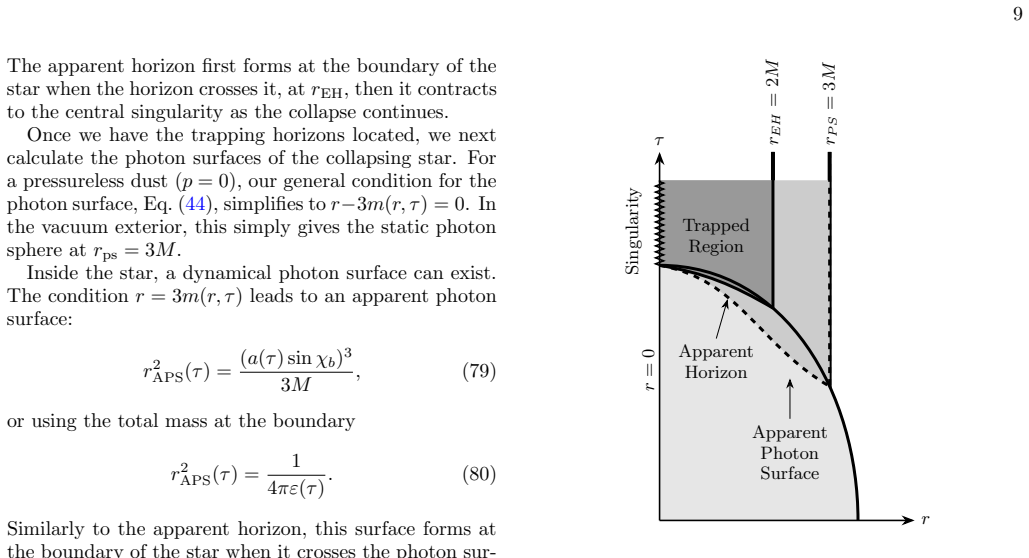
Formation of the horizon and the photon surface The OS model provides an idealized picture of how photon surfaces form and evolve in collapsing space- times. We graph a diagram of the Oppenheimer-Snyder collapse in Fig. 1. Initially, when the star’s radius is greater than 3M, the exterior space-time contains no photon sphere, and no light-trapping surface...
-
[3]
It assumes pressureless fluid, but an inhomogeneous matter density
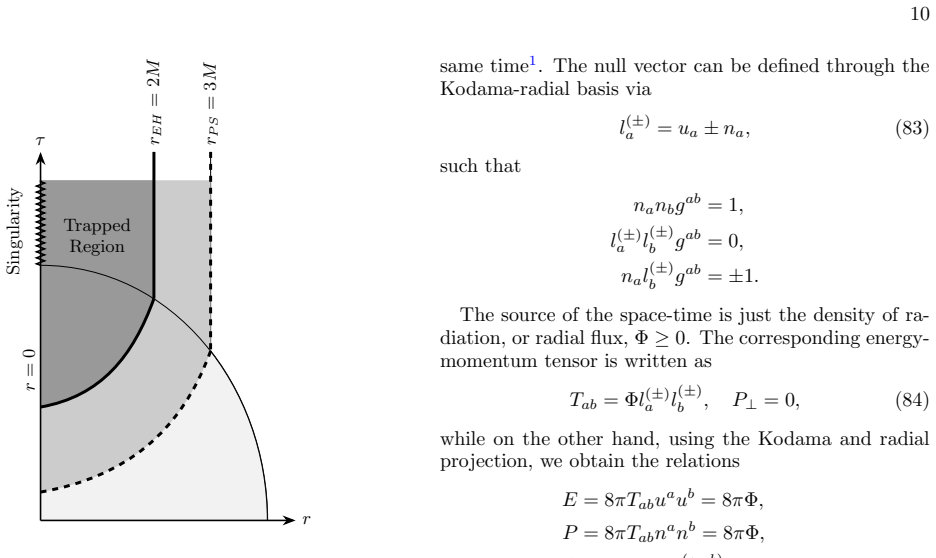
Lemaitre-Tolman-Bondi collapse A better physical model is the Lemaitre-Tolman-Bondi (LTB) collapse. It assumes pressureless fluid, but an inhomogeneous matter density. The model solves the causality problems associated to the formation of the surfaces. The apparent trapping horizon appears in the center and expands to the surface atR= 2M. Equiv- alently, ...
-
[4]
Linear evaporation/accretion model The simplest model considers a linear change in mass over time, whereλis a constant rate of accretion or evap- oration. ˙m(w) =±λ, m(w) =m 0 ±λw.(104) The photon surface in this case is located at: rps(w) = 3m(w)Aλ,(105) with Aλ ≡ 5 + √ 1 + 24λ 6(1−λ) ,(106) a constant that depends only on the rate parameterλ. Then, the ...
-
[5]
Hawking evaporation The Hawking evaporation model describes a black hole losing mass due to quantum effects. The rate of evapora- tion is assumed to be inversely proportional to the square of its mass [47]: ˙m(w) =− α m2 , m(w) = m3 0 −3αw 1 3 ,(108) withα >0 a constant characterizing the radiation flux. As an evaporation model, it has a maximum time when...
-
[6]
As the evaporation pro- ceeds, the photon surface collapses inward, tracking the collapsing trapping horizon
Initially, the black hole features an unstable pho- ton surface located near the standard Schwarzschild photon sphere,r ps ≃3m 0. As the evaporation pro- ceeds, the photon surface collapses inward, tracking the collapsing trapping horizon
-
[7]
This bounce point is determined by the condition drps dw = 0, yielding: wbounce =w m − √α 3 5 √ 33−21 2 !3/2
At some moment, the photon surface stops collaps- ing and bounces back to expanding outwards, while the trapping horizon keeps collapsing. This bounce point is determined by the condition drps dw = 0, yielding: wbounce =w m − √α 3 5 √ 33−21 2 !3/2
-
[8]
This regime emerges when|˙m|= 1/3, at the time wstable =w m − √ 3α
Some moments after the bounce, the expanding photon surface transitions into a locally stable pho- ton sphere, which no longer scatters circular orbits. This regime emerges when|˙m|= 1/3, at the time wstable =w m − √ 3α
-
[9]
Before the evaporation ends atw end, the expanding photon surface accelerates until the radial coordi- nate diverges when|˙m|= 1, at the time wdiv =w m − √α 3 . Consequently, even when the radius of the photon surface goes to zero at the end of the evaporation, lim w→wend rps = 0, the geometry of the photon surface features a divergent phase before
-
[10]
Eddington accretion The Eddington accretion model describes the maxi- mum rate at which a body can accrete matter when the outward radiation pressure balances the inward gravita- tional force [48]. The mass grows exponentially with a rateγ, that is ˙m(w) =γm, m(w) =m 0eγw .(111) The photon surface in this case is located at: rps(w) = 3m0eγw A(w),(112) 13 ...
-
[11]
Starting from an initial massm 0, the unstable pho- ton surface strictly expands outward from near the static Schwarzschild location, 3m0
-
[12]
At this moment, the exterior photon surface is pushed tor ps = 1/2γ
The photon surface reaches a marginal stability limit when the accreting mass hitsm= 1/(3γ). At this moment, the exterior photon surface is pushed tor ps = 1/2γ. This happens at a time given by wstable = 1 γ ln 1 3γm0
-
[13]
If the accretion continues, the mass reaches the in- verse of the exponential rate factor,m(w) = 1/γ, where the factorA(w) becomes singular. At this limit, the photon surface diverges to infinity, at a time wdiv = 1 γ ln 1 γm0 . This model shows that, while the continuous addition of mass initially induces a steady expansion of an unsta- ble photon surfac...
-
[14]
Chandrasekhar,The Mathematical Theory of Black Holes, International Series of Monographs on Physics, Vol
S. Chandrasekhar,The Mathematical Theory of Black Holes, International Series of Monographs on Physics, Vol. 69 (Oxford University Press, Oxford, 1983)
1983
-
[15]
Teo, Gen
E. Teo, Gen. Rel. Grav.35, 1909 (2003)
1909
-
[16]
P. V. P. Cunha and C. A. R. Herdeiro, Gen. Rel. Grav. 50, 42 (2018), arXiv:1801.00860 [gr-qc]
work page internal anchor Pith review Pith/arXiv arXiv 2018
-
[17]
Geodesic stability, Lyapunov exponents and quasinormal modes
V. Cardoso, A. S. Miranda, E. Berti, H. Witek, and V. T. Zanchin, Phys. Rev. D79, 064016 (2009), arXiv:0812.1806 [hep-th]
work page internal anchor Pith review Pith/arXiv arXiv 2009
-
[18]
P. V. P. Cunha, E. Berti, and C. A. R. Herdeiro, Phys. Rev. Lett.119, 251102 (2017), arXiv:1708.04211 [gr-qc]
work page internal anchor Pith review Pith/arXiv arXiv 2017
-
[19]
V. Cardoso, L. C. B. Crispino, C. F. B. Macedo, H. Okawa, and P. Pani, Phys. Rev. D90, 044069 (2014), arXiv:1406.5510 [gr-qc]
work page internal anchor Pith review Pith/arXiv arXiv 2014
- [20]
-
[21]
Is the gravitational-wave ringdown a probe of the event horizon?
V. Cardoso, E. Franzin, and P. Pani, Phys. Rev. Lett. 116, 171101 (2016), [Erratum: Phys.Rev.Lett. 117, 089902 (2016)], arXiv:1602.07309 [gr-qc]
work page internal anchor Pith review Pith/arXiv arXiv 2016
-
[22]
First M87 Event Horizon Telescope Results. I. The Shadow of the Supermassive Black Hole
K. Akiyamaet al.(Event Horizon Telescope), Astrophys. J. Lett.875, L1 (2019), arXiv:1906.11238 [astro-ph.GA]
work page internal anchor Pith review Pith/arXiv arXiv 2019
-
[23]
K. Akiyamaet al.(Event Horizon Telescope), Astrophys. J. Lett.930, L12 (2022), arXiv:2311.08680 [astro-ph.HE]
work page internal anchor Pith review Pith/arXiv arXiv 2022
-
[24]
A. G. Abacet al.(LIGO Scientific, VIRGO, KAGRA), GWTC-4.0: Updating the Gravitational-Wave Tran- sient Catalog with Observations from the First Part of the Fourth LIGO-Virgo-KAGRA Observing Run (2025), arXiv:2508.18082 [gr-qc]
work page internal anchor Pith review Pith/arXiv arXiv 2025
- [25]
-
[26]
Friedberg, T
R. Friedberg, T. D. Lee, and Y. Pang, Phys. Rev. D35, 3658 (1987)
1987
-
[27]
Seidel and W
E. Seidel and W. M. Suen, Phys. Rev. Lett.66, 1659 (1991)
1991
-
[28]
Numerical studies of Phi^2-Oscillatons
M. Alcubierre, R. Becerril, S. F. Guzman, T. Matos, D. Nunez, and L. A. Urena-Lopez, Class. Quant. Grav. 20, 2883 (2003), arXiv:gr-qc/0301105
work page internal anchor Pith review Pith/arXiv arXiv 2003
-
[29]
S. L. Liebling and C. Palenzuela, Living Rev. Rel.26, 1 (2023), arXiv:1202.5809 [gr-qc]
work page internal anchor Pith review Pith/arXiv arXiv 2023
-
[30]
L. Visinelli, Int. J. Mod. Phys. D30, 2130006 (2021), arXiv:2109.05481 [gr-qc]
- [31]
- [32]
- [33]
-
[34]
V. Jaramillo, L. Meneses, H. R. Olivares S´ anchez, C. Herdeiro, D. N´ u˜ nez, and S.-Y. Zhou, JCAP05, 100, arXiv:2603.16995 [gr-qc]
-
[35]
V. P. Frolov and I. D. Novikov, eds.,Black hole physics: Basic concepts and new developments(Springer, 1998)
1998
-
[36]
A. Ashtekar and B. Krishnan, Living Rev. Rel.28, 8 (2025), arXiv:2502.11825 [gr-qc]
-
[37]
C.-M. Claudel, K. S. Virbhadra, and G. F. R. Ellis, Jour- nal of Mathematical Physics42, 818 (2001), arXiv:gr- qc/0005050
-
[38]
A. K. Mishra, S. Chakraborty, and S. Sarkar, Phys. Rev. D99, 104080 (2019), arXiv:1903.06376 [gr-qc]
work page internal anchor Pith review Pith/arXiv arXiv 2019
-
[39]
J. Solanki and V. Perlick, Phys. Rev. D105, 064056 (2022), arXiv:2201.03274 [gr-qc]
-
[40]
R. Giamb` o and C. Lucamarini, arXiv e-prints (2025), arXiv:2509.01368 [gr-qc]
-
[41]
C. W. Misner and D. H. Sharp, Phys. Rev.136, B571 (1964)
1964
-
[42]
W. C. Hernandez, Jr. and C. W. Misner, ApJ143, 452 (1966)
1966
-
[43]
Kodama, Prog Theor Phys63, 1217 (1980)
H. Kodama, Prog Theor Phys63, 1217 (1980)
1980
- [44]
-
[45]
A. B. Nielsen and M. Visser, Class. Quant. Grav.23, 4637 (2006), arXiv:gr-qc/0510083
work page internal anchor Pith review Pith/arXiv arXiv 2006
-
[46]
C. W. Misner, K. S. Thorne, and J. A. Wheeler,Gravi- tation(W. H. Freeman, San Francisco, 1973)
1973
-
[47]
J. Keir, Class. Quant. Grav.33, 135009 (2016), arXiv:1404.7036 [gr-qc]
-
[48]
Testing the nature of dark compact objects: a status report
V. Cardoso and P. Pani, Living Rev. Rel.22, 4 (2019), arXiv:1904.05363 [gr-qc]
work page internal anchor Pith review Pith/arXiv arXiv 2019
- [49]
- [50]
-
[51]
B. Ripperda, F. Bacchini, and A. Philippov, Astrophys. J.900, 100 (2020), arXiv:2003.04330 [astro-ph.HE]
- [52]
-
[53]
S. E. Gralla, D. E. Holz, and R. M. Wald, Phys. Rev. D 100, 024018 (2019), arXiv:1906.00873 [astro-ph.HE]
work page internal anchor Pith review Pith/arXiv arXiv 2019
- [54]
- [55]
-
[56]
S. Staelens, D. R. Mayerson, F. Bacchini, B. Ripperda, and L. K¨ uchler, Phys. Rev. D107, 124026 (2023), arXiv:2303.02111 [gr-qc]
-
[57]
P. S. Joshi,Global Aspects in Gravitation and Cosmology (Oxford University Press, 1993)
1993
-
[58]
P. C. Vaidya, Proc. Indian Acad. Sci. A33, 264 (1951)
1951
-
[59]
Poisson and W
E. Poisson and W. Israel, Phys. Rev. Lett.63, 1663 (1989)
1989
-
[60]
W. A. Hiscock, Phys. Rev. D23, 2813 (1981)
1981
-
[61]
M. A. Abramowicz and P. C. Fragile, Living Rev. Rel. 16, 1 (2013), arXiv:1104.5499 [astro-ph.HE]
work page internal anchor Pith review Pith/arXiv arXiv 2013
discussion (0)
Sign in with ORCID, Apple, or X to comment. Anyone can read and Pith papers without signing in.