Upper limits on exosatellites around β Pictoris b
Pith reviewed 2026-06-28 04:06 UTC · model grok-4.3
The pith
No exomoon is detected around β Pictoris b, but radial velocity data set upper limits of 80 Earth masses at 1-day periods and 1 Jupiter mass at 200 days.
A machine-rendered reading of the paper's core claim, the machinery that carries it, and where it could break.
Core claim
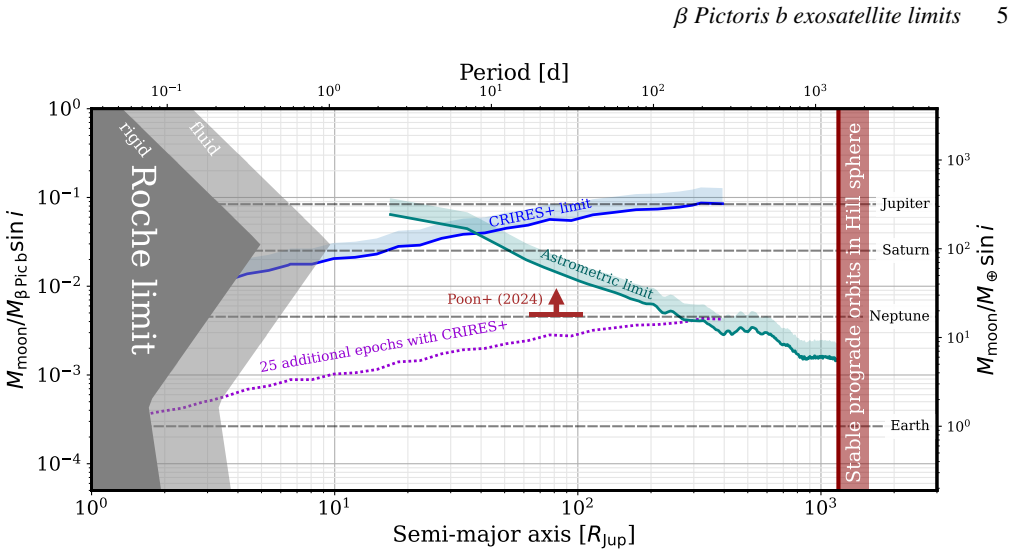
Although we do not detect an exomoon signal in our data, our detection limits for a single moon are 80 Earth masses at P=1 day and 1 Jupiter at P=200 days, comparable to RV exomoon searches around other substellar companions.
What carries the argument
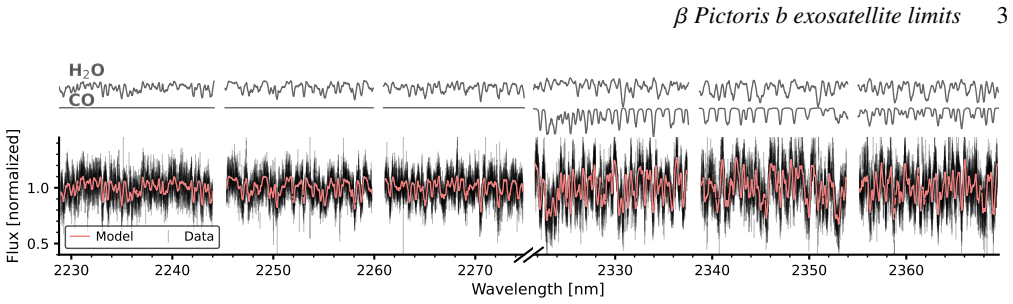
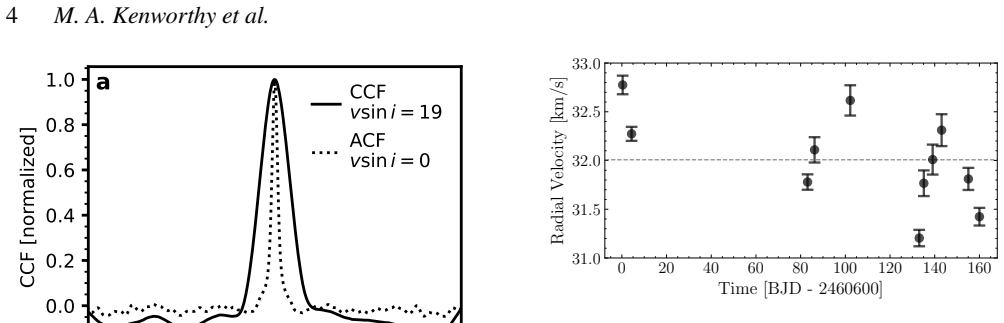
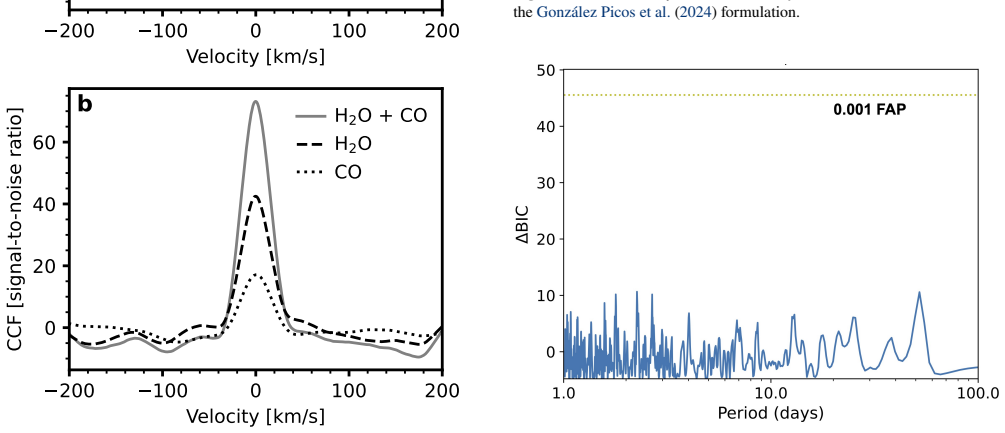
Cross-correlation of a template spectrum with the planet's atmospheric absorption lines to extract radial velocities, followed by periodogram analysis to search for periodic signals from an exomoon.
If this is right
- The radial velocity mass limits are comparable to the astrometric exomoon limit of 150 Earth masses at a 7-day period.
- For periods longer than about 7 days the astrometric method provides tighter mass limits than the radial velocity data.
- One additional observing season with CRIRES+ can reach a planet-to-moon mass ratio of 10^{-3}, or 4 Earth masses, at periods up to one day.
- The same additional data can detect a Neptune-mass moon at orbital distances of hundreds of Jupiter radii.
Where Pith is reading between the lines
- Tighter future limits could begin to test whether massive moons can form or be captured around young, directly imaged gas giants.
- Joint radial velocity and astrometric monitoring may cover a wider range of orbital periods than either technique alone.
- The achieved precision suggests that similar radial velocity campaigns on other directly imaged planets could yield comparable exomoon constraints.
Load-bearing premise
The scatter and sampling of the derived radial velocities are sufficient to turn a non-detection in the periodogram into quantitative mass upper limits as a function of period.
What would settle it
A future radial velocity measurement that reveals a periodic signal whose amplitude corresponds to a moon mass above the reported limits at a given period.
Figures
read the original abstract
$\beta$ Pictoris b is one of the closest known directly-imaged gas giant exoplanets with an orbit that is almost edge-on to our line of sight, making it an ideal target for radial velocity monitoring to search for massive exomoons. We measure the radial velocity of $\beta$ Pictoris b over several epochs between October 2024 and March 2025 by using the cross-correlation of a template spectrum with absorption lines in the planet's atmosphere, giving a mean precision of 160 m s$^{-1}$. The resultant set of radial velocities is analysed with a periodogram to search for candidate RV signals indicating a massive exomoon. Although we do not detect an exomoon signal in our data, our detection limits for a single moon are 80 Earth masses at P=1 day and 1 Jupiter at P=200 days, comparable to RV exomoon searches around other substellar companions. The RV limit is comparable with the astrometric exomoon limit at a period of 7 days and a mass of 150 Earth masses, where for longer periods the astrometric searches have lower mass limits. With an additional observing season, CRIRES+ can detect a planet/moon mass ratio of $10^{-3}$ (4 Earth masses) with a period of up to one day, and can detect a Neptune-mass moon at hundreds of Jupiter radii.
Editorial analysis
A structured set of objections, weighed in public.
Referee Report
Summary. The manuscript reports radial velocity monitoring of the directly imaged exoplanet β Pictoris b using cross-correlation of a template spectrum against atmospheric absorption lines, yielding a mean precision of 160 m s^{-1} across several epochs spanning October 2024 to March 2025. A periodogram search finds no significant periodic signal from an exomoon. The resulting upper limits are 80 Earth masses at a 1-day period and 1 Jupiter mass at a 200-day period; these are compared to existing astrometric limits, and projections for improved sensitivity with an additional observing season are presented.
Significance. If the noise model and sampling assumptions hold, the work supplies competitive RV-based exomoon mass limits around a young, directly imaged giant planet and illustrates the complementarity between RV and astrometric techniques. The reported precision on a substellar companion and the explicit mass-period limits constitute a concrete observational benchmark for future exomoon searches.
major comments (2)
- [RV measurement and periodogram analysis] The section on RV measurement and periodogram analysis does not specify the number of epochs, the precise temporal sampling, the false-alarm probability threshold adopted, or the procedure (injection-recovery or analytic) used to translate the non-detection into the quoted mass limits of 80 M_⊕ (P=1 d) and 1 M_Jup (P=200 d). These details are load-bearing because the ~5-month baseline and the assumption that the 160 m s^{-1} scatter is measurement-dominated directly determine whether the stated limits are robust or optimistic.
- [RV measurement and periodogram analysis] The conversion from observed RV scatter to companion mass via barycentric motion assumes negligible contribution from atmospheric dynamics or template mismatch; no quantitative test (e.g., residual analysis or red-noise model) is described to support this assumption, which underpins the entire set of upper limits.
minor comments (1)
- [Abstract] The abstract refers to 'several epochs' without giving the exact count or dates; the main text should list them explicitly for reproducibility.
Simulated Author's Rebuttal
We thank the referee for the constructive comments, which highlight areas where the manuscript can be strengthened for clarity and robustness. We address each major comment below.
read point-by-point responses
-
Referee: [RV measurement and periodogram analysis] The section on RV measurement and periodogram analysis does not specify the number of epochs, the precise temporal sampling, the false-alarm probability threshold adopted, or the procedure (injection-recovery or analytic) used to translate the non-detection into the quoted mass limits of 80 M_⊕ (P=1 d) and 1 M_Jup (P=200 d). These details are load-bearing because the ~5-month baseline and the assumption that the 160 m s^{-1} scatter is measurement-dominated directly determine whether the stated limits are robust or optimistic.
Authors: We agree these details are essential. The revised manuscript will add a table of all observation epochs with precise MJD sampling, state the adopted FAP threshold of 0.1%, and describe the injection-recovery procedure used to derive the mass limits from the periodogram non-detection. The ~5-month baseline will be explicitly noted along with the justification that the scatter is measurement-dominated. revision: yes
-
Referee: [RV measurement and periodogram analysis] The conversion from observed RV scatter to companion mass via barycentric motion assumes negligible contribution from atmospheric dynamics or template mismatch; no quantitative test (e.g., residual analysis or red-noise model) is described to support this assumption, which underpins the entire set of upper limits.
Authors: The referee correctly identifies that no such test was presented. We will add a new subsection with residual analysis after periodogram subtraction, a comparison of observed vs. expected uncertainties, and a simple red-noise assessment to support (or qualify) the assumption of negligible atmospheric/template contributions to the scatter. revision: yes
Circularity Check
No circularity: observational upper limits from RV non-detection
full rationale
The paper derives exomoon mass upper limits (80 M_earth at P=1 d; 1 M_Jup at P=200 d) directly from a non-detection in the periodogram of measured radial velocities obtained via template cross-correlation on CRIRES+ data. This is standard observational analysis: the reported limits follow from the observed RV scatter, temporal sampling, and periodogram sensitivity, without any equation or step that reduces the output masses to quantities defined by the fit itself or to a self-citation chain. No self-definitional, fitted-input-called-prediction, or ansatz-smuggled patterns appear in the derivation chain.
Axiom & Free-Parameter Ledger
Forward citations
Cited by 1 Pith paper
-
The carbon isotope ratio of \beta\ Pic b with high-resolution spectroscopy
Measured 12C/13C = 58+18-15 in β Pic b atmosphere via CRIRES+ spectroscopy and Bayesian retrieval, consistent with ISM value.
Reference graph
Works this paper leans on
-
[1]
Agnor C. B., Hamilton D. P., 2006, @doi [ ] 10.1038/nature04792 , https://ui.adsabs.harvard.edu/abs/2006Natur.441..192A 441, 192
-
[2]
Astropy Collaboration et al., 2013, @doi [ ] 10.1051/0004-6361/201322068 , http://adsabs.harvard.edu/abs/2013A
-
[3]
Bailey V., et al., 2014, @doi [ ] 10.1088/2041-8205/780/1/l4 , http://adsabs.harvard.edu/abs/2014ApJ...780L...4B 780, L4
-
[4]
Batalha N. M., 2014, @doi [Proceedings of the National Academy of Science] 10.1073/pnas.1304196111 , https://ui.adsabs.harvard.edu/abs/2014PNAS..11112647B 111, 12647
-
[5]
Batygin K., Morbidelli A., 2020, @doi [ ] 10.3847/1538-4357/ab8937 , https://ui.adsabs.harvard.edu/abs/2020ApJ...894..143B 894, 143
-
[6]
Bell C. P. M., Mamajek E. E., Naylor T., 2015, @doi [ ] 10.1093/mnras/stv1981 , https://ui.adsabs.harvard.edu/abs/2015MNRAS.454..593B 454, 593
-
[7]
Bennett D. P., et al., 2014, @doi [ ] 10.1088/0004-637X/785/2/155 , https://ui.adsabs.harvard.edu/abs/2014ApJ...785..155B 785, 155
-
[8]
Bohn A. J., et al., 2020, @doi [ ] 10.3847/2041-8213/aba27e , https://ui.adsabs.harvard.edu/abs/2020ApJ...898L..16B 898, L16
-
[9]
Buchner J., 2021, @doi [The Journal of Open Source Software] 10.21105/joss.03001 , https://ui.adsabs.harvard.edu/abs/2021JOSS....6.3001B 6, 3001
-
[10]
Canup R. M., Ward W. R., 2002, @doi [ ] 10.1086/344684 , http://adsabs.harvard.edu/abs/2002AJ....124.3404C 124, 3404
-
[11]
Canup R. M., Ward W. R., 2006, @doi [ ] 10.1038/nature04860 , http://adsabs.harvard.edu/abs/2006Natur.441..834C 441, 834
-
[12]
Chen J., Kipping D., 2017, @doi [ ] 10.3847/1538-4357/834/1/17 , https://ui.adsabs.harvard.edu/abs/2017ApJ...834...17C 834, 17
-
[13]
Deienno R., Yokoyama T., Nogueira E. C., Callegari N., Santos M. T., 2011, @doi [ ] 10.1051/0004-6361/201014862 , https://ui.adsabs.harvard.edu/abs/2011A&A...536A..57D 536, A57
-
[14]
Dobos V., Charnoz S., P \'a l A., Roque-Bernard A., Szab \'o G. M., 2021, @doi [ ] 10.1088/1538-3873/abfe04 , https://ui.adsabs.harvard.edu/abs/2021PASP..133i4401D 133, 094401
-
[15]
Domingos R. C., Winter O. C., Yokoyama T., 2006, @doi [ ] 10.1111/j.1365-2966.2006.11104.x , https://ui.adsabs.harvard.edu/abs/2006MNRAS.373.1227D 373, 1227
-
[16]
and Lang, Dustin and Goodman, Jonathan , year=
Foreman-Mackey D., Hogg D. W., Lang D., Goodman J., 2013, @doi [ ] 10.1086/670067 , https://ui.adsabs.harvard.edu/abs/2013PASP..125..306F 125, 306
-
[17]
Gonz \'a lez Picos D., et al., 2024, @doi [ ] 10.1051/0004-6361/202450028 , https://ui.adsabs.harvard.edu/abs/2024A&A...689A.212G 689, A212
-
[18]
Gonz \'a lez Picos D., Snellen I. A. G., de Regt S., Landman R., Zhang Y., Gandhi S., S \'a nchez-L \'o pez A., 2025, @doi [ ] 10.1051/0004-6361/202451936 , https://ui.adsabs.harvard.edu/abs/2025A&A...693A.298G 693, A298
-
[19]
Heller R., Barnes R., 2013, Astrobiology, http://adsabs.harvard.edu/abs/2012arXiv1209.5323H 13, 18
Pith/arXiv arXiv 2013
-
[20]
Heller R., Hippke M., 2024, @doi [Nature Astronomy] 10.1038/s41550-023-02148-w , https://ui.adsabs.harvard.edu/abs/2024NatAs...8..193H 8, 193
-
[21]
Hoch K. K. W., et al., 2025, @doi [ ] 10.1038/s41586-025-09174-w , https://ui.adsabs.harvard.edu/abs/2025Natur.643..938H 643, 938
-
[22]
Horstman K., et al., 2024, @doi [ ] 10.3847/1538-3881/ad73d8 , https://ui.adsabs.harvard.edu/abs/2024AJ....168..175H 168, 175
-
[23]
Howard A. W., Fulton B. J., 2016, @doi [ ] 10.1088/1538-3873/128/969/114401 , https://ui.adsabs.harvard.edu/abs/2016PASP..128k4401H 128, 114401
-
[24]
D., 2007, Computing in science & engineering, 9, 90
Hunter J. D., 2007, Computing in science & engineering, 9, 90
2007
-
[25]
Hwang K.-H., et al., 2018, @doi [ ] 10.3847/1538-3881/aac2cb , https://ui.adsabs.harvard.edu/abs/2018AJ....155..259H 155, 259
-
[26]
Kane S. R., Hinkel N. R., Raymond S. N., 2013, @doi [ ] 10.1088/0004-6256/146/5/122 , https://ui.adsabs.harvard.edu/abs/2013AJ....146..122K 146, 122
-
[27]
Kenworthy M. A., et al., 2021, @doi [ ] 10.1051/0004-6361/202040060 , https://ui.adsabs.harvard.edu/abs/2021A&A...648A..15K 648, A15
-
[28]
Kipping D. M., 2009a, @doi [ ] 10.1111/j.1365-2966.2008.13999.x , https://ui.adsabs.harvard.edu/abs/2009MNRAS.392..181K 392, 181
-
[29]
Kipping D. M., 2009b, @doi [ ] 10.1111/j.1365-2966.2009.14869.x , https://ui.adsabs.harvard.edu/abs/2009MNRAS.396.1797K 396, 1797
-
[30]
Kipping D. M., Bakos G. \'A ., Buchhave L., Nesvorn \'y D., Schmitt A., 2012, @doi [ ] 10.1088/0004-637x/750/2/115 , http://adsabs.harvard.edu/abs/2012ApJ...750..115K 750, 115
-
[31]
Kipping D. M., Hartman J., Buchhave L. A., Schmitt A. R., Bakos G. \'A ., Nesvorn \'y D., 2013, @doi [ ] 10.1088/0004-637x/770/2/101 , http://adsabs.harvard.edu/abs/2013ApJ...770..101K 770, 101
-
[32]
Kipping D. M., Schmitt A. R., Huang X., Torres G., Nesvorn \'y D., Buchhave L. A., Hartman J., Bakos G. \'A ., 2015, @doi [ ] 10.1088/0004-637x/813/1/14 , https://ui.adsabs.harvard.edu/abs/2015ApJ...813...14K 813, 14
-
[33]
Kipping D., et al., 2022, @doi [Nature Astronomy] 10.1038/s41550-021-01539-1 , https://ui.adsabs.harvard.edu/abs/2022NatAs...6..367K 6, 367
-
[34]
A JWST Transit of a Jupiter Analog: II. A Search for Exomoons
Kipping D., Cassese B., Changeat Q., Yahalomi D., Teachey A., Edwards B., 2025a, @doi [arXiv e-prints] 10.48550/arXiv.2511.15317 , https://ui.adsabs.harvard.edu/abs/2025arXiv251115317K p. arXiv:2511.15317
work page internal anchor Pith review Pith/arXiv arXiv doi:10.48550/arxiv.2511.15317
-
[35]
Kipping D., et al., 2025b, @doi [Nature Astronomy] 10.1038/s41550-025-02547-1 , https://ui.adsabs.harvard.edu/abs/2025NatAs...9..795K 9, 795
-
[36]
Kleisioti E., Dirkx D., Rovira-Navarro M., Kenworthy M. A., 2023, @doi [ ] 10.1051/0004-6361/202346082 , https://ui.adsabs.harvard.edu/abs/2023A&A...675A..57K 675, A57
-
[37]
Kleisioti E., Dirkx D., Tan X., Kenworthy M. A., 2024, @doi [ ] 10.1051/0004-6361/202449428 , https://ui.adsabs.harvard.edu/abs/2024A&A...687A.125K 687, A125
-
[38]
Kral Q., et al., 2026, @doi [ ] 10.1051/0004-6361/202557127 , https://ui.adsabs.harvard.edu/abs/2026A&A...705A.217K 705, A217
-
[39]
Kreidberg L., Luger R., Bedell M., 2019, @doi [ ] 10.3847/2041-8213/ab20c8 , https://ui.adsabs.harvard.edu/abs/2019ApJ...877L..15K 877, L15
-
[40]
Lacour S., et al., 2021, @doi [ ] 10.1051/0004-6361/202141889 , https://ui.adsabs.harvard.edu/abs/2021A&A...654L...2L 654, L2
-
[41]
Lagrange A., et al., 2009, @doi [ ] 10.1051/0004-6361/200912098 , http://adsabs.harvard.edu/abs/2009A
-
[42]
Landman R., et al., 2024, @doi [ ] 10.1051/0004-6361/202347846 , https://ui.adsabs.harvard.edu/abs/2024A&A...682A..48L 682, A48
-
[43]
Li G., Gordon I. E., Rothman L. S., Tan Y., Hu S.-M., Kassi S., Campargue A., Medvedev E. S., 2015, @doi [ ] 10.1088/0067-0049/216/1/15 , https://ui.adsabs.harvard.edu/abs/2015ApJS..216...15L 216, 15
-
[44]
Limbach M. A., Vos J. M., Winn J. N., Heller R., Mason J. C., Schneider A. C., Dai F., 2021, @doi [ ] 10.3847/2041-8213/ac1e2d , https://ui.adsabs.harvard.edu/abs/2021ApJ...918L..25L 918, L25
-
[45]
Limbach M. A., Vos J. M., Vanderburg A., Dai F., 2024, @doi [ ] 10.3847/1538-3881/ad4ed5 , https://ui.adsabs.harvard.edu/abs/2024AJ....168...54L 168, 54
-
[46]
Macias I., Jenkins S. A., Vanderburg A., 2026, @doi [ ] 10.3847/1538-3881/ae421c , https://ui.adsabs.harvard.edu/abs/2026AJ....171..197M 171, 197
-
[47]
P., van Boekel R., Henning T., Molaverdikhani K., Snellen I
Molli \`e re P., Wardenier J. P., van Boekel R., Henning T., Molaverdikhani K., Snellen I. A. G., 2019, @doi [ ] 10.1051/0004-6361/201935470 , https://ui.adsabs.harvard.edu/abs/2019A&A...627A..67M 627, A67
-
[48]
E., 2007, Computing in Science Engineering, 9, 10
Oliphant T. E., 2007, Computing in Science Engineering, 9, 10
2007
-
[49]
Oza A. V., et al., 2019, @doi [ ] 10.3847/1538-4357/ab40cc , https://ui.adsabs.harvard.edu/abs/2019ApJ...885..168O 885, 168
-
[50]
Pass E. K., Charbonneau D., Vanderburg A., Bean J. L., 2026, @doi [arXiv e-prints] 10.48550/arXiv.2604.05235 , https://ui.adsabs.harvard.edu/abs/2026arXiv260405235P p. arXiv:2604.05235
work page internal anchor Pith review Pith/arXiv arXiv doi:10.48550/arxiv.2604.05235 2026
-
[51]
Peters M. A., Turner E. L., 2013, @doi [ ] 10.1088/0004-637x/769/2/98 , http://adsabs.harvard.edu/abs/2013ApJ...769...98P 769, 98
-
[52]
Polyansky O. L., Kyuberis A. A., Zobov N. F., Tennyson J., Yurchenko S. N., Lodi L., 2018, @doi [ ] 10.1093/mnras/sty1877 , https://ui.adsabs.harvard.edu/abs/2018MNRAS.480.2597P 480, 2597
-
[53]
Poon M., Rein H., Pham D., 2024, @doi [The Open Journal of Astrophysics] 10.33232/001c.127130 , https://ui.adsabs.harvard.edu/abs/2024OJAp....7E.109P 7, 109
-
[54]
doi:10.3847/1538-3881/aabc4f , eid =
Price-Whelan A. M., et al., 2018, @doi [ ] 10.3847/1538-3881/aabc4f , https://ui.adsabs.harvard.edu/#abs/2018AJ....156..123T 156, 123
-
[55]
Ravet M., et al., 2025, @doi [ ] 10.1051/0004-6361/202553885 , https://ui.adsabs.harvard.edu/abs/2025A&A...704A.325R 704, A325
-
[56]
Roberts J., et al., 2025, @doi [ ] 10.3847/1538-3881/ae07cb , https://ui.adsabs.harvard.edu/abs/2025AJ....170..273R 170, 273
-
[57]
Rosenthal L. J., et al., 2021, @doi [ ] 10.3847/1538-4365/abe23c , https://ui.adsabs.harvard.edu/abs/2021ApJS..255....8R 255, 8
-
[58]
Rothman L. S., et al., 2010, @doi [ ] 10.1016/j.jqsrt.2010.05.001 , https://ui.adsabs.harvard.edu/abs/2010JQSRT.111.2139R 111, 2139
-
[59]
Ruffio J.-B., et al., 2021, @doi [ ] 10.3847/1538-3881/ac273a , https://ui.adsabs.harvard.edu/abs/2021AJ....162..290R 162, 290
-
[60]
Ruffio J.-B., et al., 2023, @doi [ ] 10.3847/1538-3881/acb34a , https://ui.adsabs.harvard.edu/abs/2023AJ....165..113R 165, 113
-
[61]
Snellen I. A. G., Brandl B. R., de Kok R. J., Brogi M., Birkby J., Schwarz H., 2014, @doi [ ] 10.1038/nature13253 , http://adsabs.harvard.edu/abs/2014Natur.509...63S 509, 63
-
[62]
Stolker T., Landman R., 2023, pycrires: Data reduction pipeline for VLT/CRIRES+ , Astrophysics Source Code Library, record ascl:2307.040 ( @eprint ascl 2307.040 )
2023
-
[63]
Teachey A., 2024, @doi [arXiv e-prints] 10.48550/arXiv.2401.13293 , https://ui.adsabs.harvard.edu/abs/2024arXiv240113293T p. arXiv:2401.13293
-
[64]
Teachey A., Kipping D. M., 2018, @doi [Science Advances] 10.1126/sciadv.aav1784 , https://ui.adsabs.harvard.edu/abs/2018SciA....4.1784T 4, eaav1784
-
[65]
Teachey A., Kipping D. M., Schmitt A. R., 2018, @doi [ ] 10.3847/1538-3881/aa93f2 , https://ui.adsabs.harvard.edu/abs/2018AJ....155...36T 155, 36
-
[66]
Vanderburg A., Rodriguez J. E., 2021, @doi [ ] 10.3847/2041-8213/ac33b4 , https://ui.adsabs.harvard.edu/abs/2021ApJ...922L...2V 922, L2
-
[67]
Virtanen P., et al., 2020, @doi [Nature Methods] https://doi.org/10.1038/s41592-019-0686-2 , https://rdcu.be/b08Wh 17, 261
-
[68]
Wenger M., et al., 2000, @doi [ ] 10.1051/aas:2000332 , http://adsabs.harvard.edu/abs/2000A
work page internal anchor Pith review doi:10.1051/aas:2000332 2000
-
[69]
Wilson M. J., et al., 2025, @doi [ ] 10.3847/1538-3881/ae17ca , https://ui.adsabs.harvard.edu/abs/2025AJ....170..357W 170, 357
-
[70]
Zhang Y., et al., 2024, @doi [ ] 10.3847/1538-3881/ad7ea9 , https://ui.adsabs.harvard.edu/abs/2024AJ....168..246Z 168, 246
-
[71]
de Regt S., et al., 2024, @doi [ ] 10.1051/0004-6361/202348508 , https://ui.adsabs.harvard.edu/abs/2024A&A...688A.116D 688, A116
-
[72]
van Capelleveen R. F., et al., 2025, @doi [ ] 10.1051/0004-6361/202556584 , https://ui.adsabs.harvard.edu/abs/2025A&A...704A.221V 704, A221
discussion (0)
Sign in with ORCID, Apple, or X to comment. Anyone can read and Pith papers without signing in.