Enhancement of charge correlations and real-space topological marker on an interacting non-Hermitian Su-Schrieffer-Heeger model
Pith reviewed 2026-06-27 23:13 UTC · model grok-4.3
The pith
A real-space topological marker stays reliable for non-Hermitian topological phases even after interactions trigger charge density waves.
A machine-rendered reading of the paper's core claim, the machinery that carries it, and where it could break.
Core claim
The topological marker remains a robust diagnostic of non-Hermitian topological phases in the presence of interactions and consistently signals their breakdown at the onset of a charge density wave. Non-Hermiticity enhances interaction effects, leading to pronounced amplification of staggered charge correlations near exceptional points under open boundary conditions due to accumulation of low-energy states.
What carries the argument
Real-space topological marker that evaluates local winding or polarization on finite chains and detects the transition to charge-density-wave order.
If this is right
- The marker can be used to map phase boundaries in other interacting non-Hermitian models without needing periodic-boundary winding numbers.
- Open-boundary charge correlations become a practical experimental probe for exceptional-point physics once non-Hermiticity is tuned.
- Charge-density-wave order is expected to appear at weaker interaction strengths near exceptional points than far from them.
- The complex many-body spectrum under open boundaries should exhibit level clustering that correlates with the observed correlation enhancement.
Where Pith is reading between the lines
- Similar amplification of ordering tendencies may appear in other one-dimensional non-Hermitian models with exceptional points, such as extended Kitaev chains.
- Cold-atom or photonic realizations could test the boundary-condition dependence by comparing periodic and open geometries in the same device.
- The marker's robustness suggests it could serve as a starting point for diagnosing topology in driven or dissipative many-body systems.
Load-bearing premise
Exact diagonalization on finite chains with the chosen interaction and non-Hermiticity strengths captures the spectrum and correlations without large finite-size effects that would change the reported enhancement near exceptional points.
What would settle it
A calculation on longer chains that shows the staggered charge-correlation peak near exceptional points disappearing or moving away from the reported location would falsify the claimed amplification.
Figures





read the original abstract
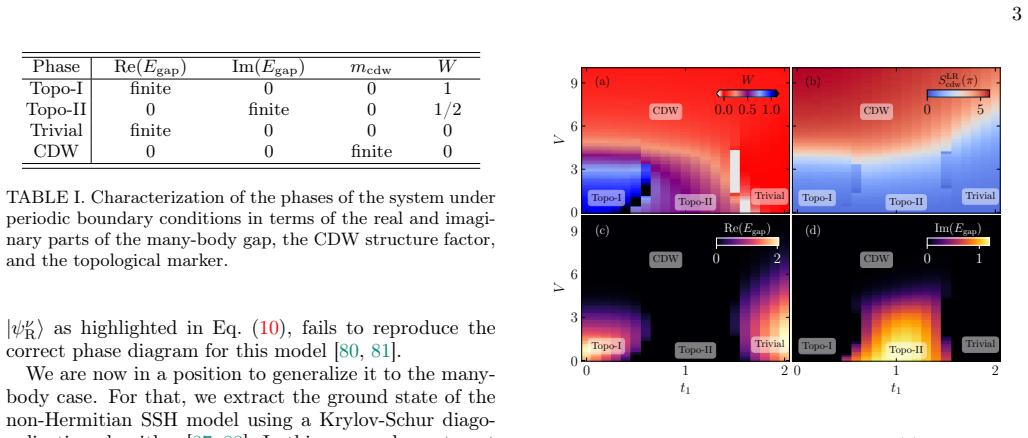
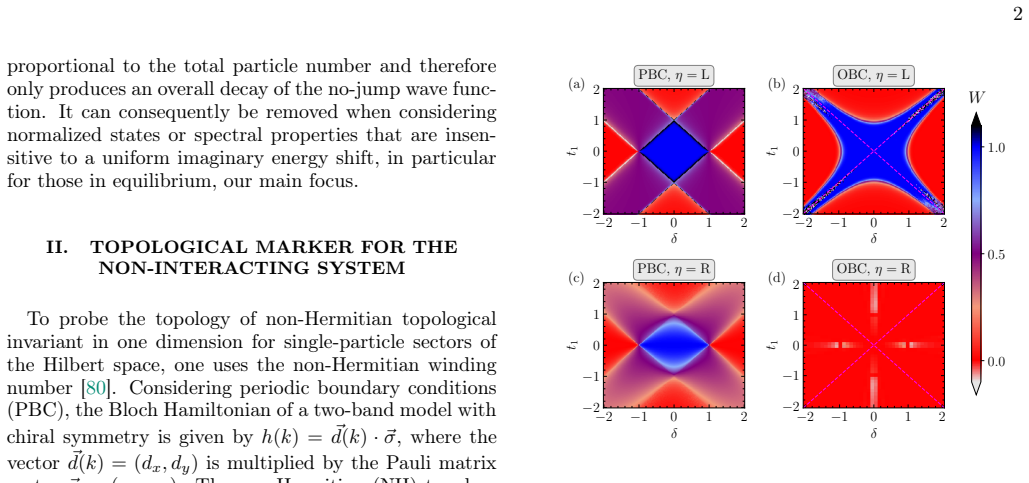
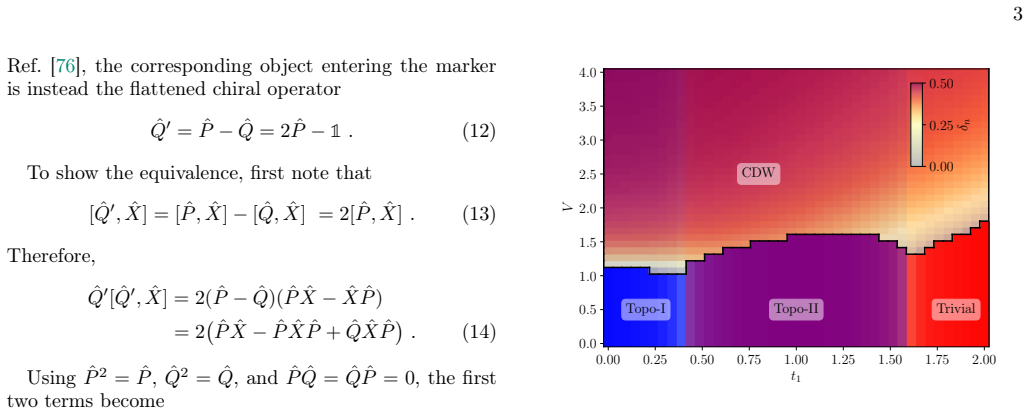
We investigate the interacting non-Hermitian Su-Schrieffer-Heeger (SSH) model, focusing on the interplay between topology and charge ordering. Using a real-space topological marker, charge correlations, and the complex many-body spectrum, we map out the phase diagram under periodic and open boundary conditions. We show that the topological marker remains a robust diagnostic of non-Hermitian topological phases in the presence of interactions and consistently signals their breakdown at the onset of a charge density wave (CDW). We further demonstrate that non-Hermiticity enhances interaction effects: While moderate changes occur under periodic boundary conditions, open boundary conditions lead to a pronounced amplification of staggered charge correlations near exceptional points. This enhancement arises from the accumulation of low-energy states near exceptional points, which promotes electronic instabilities and strengthens CDW tendencies.
Editorial analysis
A structured set of objections, weighed in public.
Referee Report
Summary. The manuscript investigates the interacting non-Hermitian Su-Schrieffer-Heeger model using exact diagonalization on finite chains. It maps the phase diagram under periodic and open boundary conditions via a real-space topological marker, staggered charge correlations, and the complex many-body spectrum. The central claims are that the topological marker remains a robust diagnostic of non-Hermitian topological phases even with interactions and signals their breakdown at the CDW onset, while non-Hermiticity enhances interaction effects, producing a pronounced amplification of staggered charge correlations near exceptional points under open boundary conditions due to accumulation of low-energy states.
Significance. If the reported OBC amplification and marker robustness hold after addressing finite-size concerns, the work would establish a concrete example of non-Hermiticity amplifying interaction-driven charge ordering in a topological chain and validate real-space markers for interacting non-Hermitian systems. The absence of system-size scaling data leaves the physical attribution of the enhancement open to reinterpretation as a numerical artifact.
major comments (1)
- [Numerical results on OBC charge correlations] The central claim of pronounced amplification of staggered charge correlations near EPs under OBC (abstract and numerical results section) rests on ED of finite chains with no system-size scaling shown for the correlation peak height or its location relative to the EP. This is load-bearing because the non-Hermitian skin effect plus discrete spectrum on small L can artificially pile up boundary weight, potentially inflating the CDW signal and undermining the attribution to low-energy state accumulation near EPs.
minor comments (1)
- The abstract does not specify the range of interaction strengths, non-Hermiticity parameters, or chain lengths L used in the ED calculations.
Simulated Author's Rebuttal
We thank the referee for their careful reading and constructive comments. Below we respond point-by-point to the major comment.
read point-by-point responses
-
Referee: [Numerical results on OBC charge correlations] The central claim of pronounced amplification of staggered charge correlations near EPs under OBC (abstract and numerical results section) rests on ED of finite chains with no system-size scaling shown for the correlation peak height or its location relative to the EP. This is load-bearing because the non-Hermitian skin effect plus discrete spectrum on small L can artificially pile up boundary weight, potentially inflating the CDW signal and undermining the attribution to low-energy state accumulation near EPs.
Authors: We agree that the lack of explicit system-size scaling for the OBC staggered charge correlation peak constitutes a genuine limitation of the present study. Exact diagonalization of the interacting non-Hermitian model restricts us to modest chain lengths, and the non-Hermitian skin effect can indeed concentrate weight near the boundaries on small systems. Our attribution of the enhancement to low-energy state accumulation rests on the observed correlation between the correlation peak and the closing of the many-body gap near exceptional points; however, without scaling data this link remains suggestive rather than conclusive. We will revise the manuscript to include an explicit discussion of finite-size caveats and to qualify the strength of the physical interpretation accordingly. revision: partial
Circularity Check
No circularity: claims rest on direct ED numerics and marker diagnostics
full rationale
The paper maps the phase diagram via exact diagonalization on finite chains, computing the complex spectrum, staggered charge correlations, and a real-space topological marker under PBC and OBC. These quantities are obtained as direct outputs of the numerical procedure rather than predictions derived from fitted parameters or self-referential definitions. The reported enhancement of correlations near exceptional points is presented as a numerical observation attributed to accumulation of low-energy states; no equation reduces the marker or correlation functions to their own inputs by construction. No load-bearing self-citations, uniqueness theorems imported from the authors' prior work, or ansatzes smuggled via citation are required for the central claims. The derivation chain is therefore self-contained against external benchmarks (the model Hamiltonian and ED solver).
Axiom & Free-Parameter Ledger
Forward citations
Cited by 1 Pith paper
-
Fast quantum-state transfer in Su-Schrieffer-Heeger chains beyond the noninteracting regime
Tunable next-nearest-neighbor hopping phases enable exact nonlinear shortcuts to adiabaticity for fast edge-state transfer in mean-field interacting SSH chains and near-perfect fidelity via many-body optimization.
Reference graph
Works this paper leans on
-
[1]
Colloquium: Topological insulators,
M. Z. Hasan and C. L. Kane,“Colloquium: Topological insulators,”Rev. Mod. Phys.82, 3045 (2010)
2010
-
[2]
Topological insulators and superconductors,
X.-L. Qi and S.-C. Zhang,“Topological insulators and superconductors,”Rev. Mod. Phys.83, 1057 (2011)
2011
-
[3]
B. A. Bernevig,Topological Insulators and Topological Superconductors(Princeton University Press, Prince- ton, 2013)
2013
-
[4]
Nonstandard symme- try classes in mesoscopic normal-superconducting hybrid structures,
A. Altland and M. R. Zirnbauer,“Nonstandard symme- try classes in mesoscopic normal-superconducting hybrid structures,”Phys. Rev. B55, 1142 (1997)
1997
-
[5]
Classification of topological quantum matter with sym- metries,
C.-K. Chiu, J. C. Y. Teo, A. P. Schnyder, and S. Ryu, “Classification of topological quantum matter with sym- metries,”Rev. Mod. Phys.88, 035005 (2016)
2016
-
[6]
Topological Crystalline Insulators,
L. Fu,“Topological Crystalline Insulators,”Phys. Rev. Lett.106, 106802 (2011)
2011
-
[7]
The space group classification of topological band- insulators,
R.-J. Slager, A. Mesaros, V. Juričić, and J. Zaa- nen,“The space group classification of topological band- insulators,”Nature Phys9, 98 (2013)
2013
-
[8]
Symmetry-based indicators of band topology in the 230 space groups,
H. C. Po, A. Vishwanath, and H. Watanabe, “Symmetry-based indicators of band topology in the 230 space groups,”Nat Commun8, 50 (2017)
2017
-
[9]
Topological characterization of periodically driven quantum systems,
T. Kitagawa, E. Berg, M. Rudner, and E. Dem- ler,“Topological characterization of periodically driven quantum systems,”Phys. Rev. B82, 235114 (2010)
2010
-
[10]
Transport properties of nonequilibrium systems un- der the application of light: Photoinduced quantum Hall insulators without Landau levels,
T. Kitagawa, T. Oka, A. Brataas, L. Fu, and E. Dem- ler,“Transport properties of nonequilibrium systems un- der the application of light: Photoinduced quantum Hall insulators without Landau levels,”Phys. Rev. B84, 235108 (2011)
2011
-
[11]
Floquet topological insulator in semiconductor quantum wells,
N. H. Lindner, G. Refael, and V. Galitski,“Floquet topological insulator in semiconductor quantum wells,” Nature Phys7, 490 (2011)
2011
-
[12]
Generation of higher-order topological insulators using periodic driv- ing,
A. K. Ghosh, T. Nag, and A. Saha,“Generation of higher-order topological insulators using periodic driv- ing,”J. Phys.: Condens. Matter36, 093001 (2023)
2023
-
[13]
Breuer and F
H.-P. Breuer and F. Petruccione,The Theory of Open Quantum Systems(Oxford University Press, 2002)
2002
-
[14]
Non-Hermitian physics and PT symmetry,
R. El-Ganainy, K. G. Makris, M. Khajavikhan, Z. H. Musslimani, S. Rotter, and D. N. Christodoulides, “Non-Hermitian physics and PT symmetry,”Nature Phys14, 11 (2018)
2018
-
[15]
Symmetry and Topology in Non-Hermitian Physics,
K. Kawabata, K. Shiozaki, M. Ueda, and M. Sato, “Symmetry and Topology in Non-Hermitian Physics,” Phys. Rev. X9, 041015 (2019)
2019
-
[16]
Non-Hermitian Skin Effect and Chiral Damping in Open Quantum Systems,
F. Song, S. Yao, and Z. Wang,“Non-Hermitian Skin Effect and Chiral Damping in Open Quantum Systems,” Phys. Rev. Lett.123, 170401 (2019)
2019
-
[17]
Quantum exceptional points of non-Hermitian Hamiltonians and Liouvillians: The effects of quantum jumps,
F. Minganti, A. Miranowicz, R. W. Chhajlany, and F. Nori,“Quantum exceptional points of non-Hermitian Hamiltonians and Liouvillians: The effects of quantum jumps,”Phys. Rev. A100, 062131 (2019)
2019
-
[18]
Tenfold Way for Quadratic Lindbladians,
S. Lieu, M. McGinley, and N. R. Cooper,“Tenfold Way for Quadratic Lindbladians,”Phys. Rev. Lett.124, 040401 (2020)
2020
-
[19]
Non-Hermitian physics,
Y. Ashida, Z. Gong, and M. Ueda,“Non-Hermitian physics,”Advances in Physics69, 249 (2020)
2020
-
[20]
Bulk detection of time-dependent topolog- ical transitions in quenched chiral models,
A. D’Errico, F. Di Colandrea, R. Barboza, A. Dauphin, M. Lewenstein, P. Massignan, L. Marrucci, and F. Cardano,“Bulk detection of time-dependent topolog- ical transitions in quenched chiral models,”Phys. Rev. Res.2, 023119 (2020)
2020
-
[21]
Excep- tional topology of non-Hermitian systems,
E. J. Bergholtz, J. C. Budich, and F. K. Kunst,“Excep- tional topology of non-Hermitian systems,”Rev. Mod. Phys.93, 015005 (2021). 7
2021
-
[22]
Anomalously large relaxation times in dissipative lattice models beyond the non-Hermitian skin effect,
G.Lee, A.McDonald, andA.Clerk,“Anomalously large relaxation times in dissipative lattice models beyond the non-Hermitian skin effect,”Phys. Rev. B108, 064311 (2023)
2023
-
[23]
Dissipative boundary state preparation,
F. Yang, P. Molignini, and E. J. Bergholtz,“Dissipative boundary state preparation,”Phys. Rev. Res.5, 043229 (2023)
2023
-
[24]
Majorana zero- modes in a dissipative Rashba nanowire,
A. K. Ghosh and A. M. Black-Schaffer,“Majorana zero- modes in a dissipative Rashba nanowire,”SciPost Phys. 17, 036 (2024)
2024
-
[25]
Dynamics of edge modes in monitored Su-Schrieffer-Heeger Models
G. Salatino, G. Passarelli, A. Russomanno, G. E. Santoro, P. Lucignano, and R. Fazio,“Dynamics of edge modes in monitored Su-Schrieffer-Heeger Models,” arXiv:2411.05671
work page internal anchor Pith review Pith/arXiv arXiv
-
[26]
Bernard and A
D. Bernard and A. LeClair, inStatistical Field Theories (Springer, 2002) pp. 207–214
2002
-
[27]
Topological Phases of Non- Hermitian Systems,
Z. Gong, Y. Ashida, K. Kawabata, K. Takasan, S. Hi- gashikawa, and M. Ueda,“Topological Phases of Non- Hermitian Systems,”Phys. Rev. X8, 031079 (2018)
2018
-
[28]
Anomalous Edge State in a Non-Hermitian Lattice,
T. E. Lee,“Anomalous Edge State in a Non-Hermitian Lattice,”Phys. Rev. Lett.116, 133903 (2016)
2016
-
[29]
Non-Hermitian robust edge states in one dimension: Anomalous localization and eigenspace condensation at exceptional points,
V. M. Martinez Alvarez, J. E. Barrios Vargas, and L. E. F. Foa Torres,“Non-Hermitian robust edge states in one dimension: Anomalous localization and eigenspace condensation at exceptional points,”Phys. Rev. B97, 121401(R) (2018)
2018
-
[30]
Anatomy of skin modes and topology in non-Hermitian systems,
C. H. Lee and R. Thomale,“Anatomy of skin modes and topology in non-Hermitian systems,”Phys. Rev. B99, 201103(R) (2019)
2019
-
[31]
Topological Band The- ory for Non-Hermitian Hamiltonians,
H. Shen, B. Zhen, and L. Fu,“Topological Band The- ory for Non-Hermitian Hamiltonians,”Phys. Rev. Lett. 120, 146402 (2018)
2018
-
[32]
Topological Origin of Non-Hermitian Skin Effects,
N. Okuma, K. Kawabata, K. Shiozaki, and M. Sato, “Topological Origin of Non-Hermitian Skin Effects,” Phys. Rev. Lett.124, 086801 (2020)
2020
-
[33]
Topological non- Hermitian skin effect,
R. Lin, T. Tai, L. Li, and C. H. Lee,“Topological non- Hermitian skin effect,”Frontiers of Physics18, 53605 (2023)
2023
-
[34]
Edge States and Topological In- variants of Non-Hermitian Systems,
S. Yao and Z. Wang,“Edge States and Topological In- variants of Non-Hermitian Systems,”Phys. Rev. Lett. 121, 086803 (2018)
2018
-
[35]
Non-Hermitian Chern Bands,
S. Yao, F. Song, and Z. Wang,“Non-Hermitian Chern Bands,”Phys. Rev. Lett.121, 136802 (2018)
2018
-
[36]
Biorthogonal Bulk-Boundary Corre- spondence in Non-Hermitian Systems,
F. K. Kunst, E. Edvardsson, J. C. Budich, and E. J. Bergholtz,“Biorthogonal Bulk-Boundary Corre- spondence in Non-Hermitian Systems,”Phys.Rev.Lett. 121, 026808 (2018)
2018
-
[37]
Non-Bloch band the- ory and bulk–edge correspondence in non-Hermitian sys- tems,
K. Yokomizo and S. Murakami,“Non-Bloch band the- ory and bulk–edge correspondence in non-Hermitian sys- tems,”Prog. Theor. Exp. Phys.2020, 12A102 (2020)
2020
-
[38]
Physics of Nonhermitian Degeneracies,
M. V. Berry,“Physics of Nonhermitian Degeneracies,” Czechoslovak Journal of Physics54, 1039 (2004)
2004
-
[39]
The physics of exceptional points,
W. D. Heiss,“The physics of exceptional points,”Jour- nal of Physics A: Mathematical and Theoretical45, 444016 (2012)
2012
-
[40]
Exceptional points in optics and photonics,
M.-A. Miri and A. Alù,“Exceptional points in optics and photonics,”Science363, eaar7709 (2019)
2019
-
[41]
Geometric phase around exceptional points,
A. A. Mailybaev, O. N. Kirillov, and A. P. Seyranian, “Geometric phase around exceptional points,”Phys. Rev. A72, 014104 (2005)
2005
-
[42]
Observation of bulk Fermi arc and polarization half charge from paired exceptional points,
H. Zhou, C. Peng, Y. Yoon, C. W. Hsu, K. A. Nelson, L. Fu, J. D. Joannopoulos, M. Soljačić, and B. Zhen, “Observation of bulk Fermi arc and polarization half charge from paired exceptional points,”Science359, 1009 (2018)
2018
-
[43]
Exceptional links and twisted Fermi ribbons in non-Hermitian systems,
J. Carlström and E. J. Bergholtz,“Exceptional links and twisted Fermi ribbons in non-Hermitian systems,”Phys. Rev. A98, 042114 (2018)
2018
-
[44]
Symmetry-protected nodal phases in non-Hermitian systems,
J. C. Budich, J. Carlström, F. K. Kunst, and E. J. Bergholtz,“Symmetry-protected nodal phases in non-Hermitian systems,”Phys. Rev. B99, 041406(R) (2019)
2019
-
[45]
Knotted non-Hermitian metals,
J. Carlström, M. Stålhammar, J. C. Budich, and E. J. Bergholtz,“Knotted non-Hermitian metals,”Phys. Rev. B99, 161115(R) (2019)
2019
-
[46]
Homotopy, symmetry, and non-Hermitian band topology,
K. Yang, Z. Li, J. L. K. König, L. Rødland, M. Stål- hammar, and E. J. Bergholtz,“Homotopy, symmetry, and non-Hermitian band topology,”Rep. Prog. Phys. 87, 078002 (2024)
2024
-
[47]
Non-Hermitian topological theory of finite-lifetime quasiparticles: Prediction of bulk Fermi arc due to exceptional point,
V. Kozii and L. Fu,“Non-Hermitian topological theory of finite-lifetime quasiparticles: Prediction of bulk Fermi arc due to exceptional point,”Phys. Rev. B109, 235139 (2024)
2024
-
[48]
Skin superfluid, topological Mott insulators, and asymmetric dynamics in an interacting non-Hermitian Aubry-André-Harper model,
D.-W. Zhang, Y.-L. Chen, G.-Q. Zhang, L.-J. Lang, Z. Li, and S.-L. Zhu,“Skin superfluid, topological Mott insulators, and asymmetric dynamics in an interacting non-Hermitian Aubry-André-Harper model,”Phys. Rev. B101, 235150 (2020)
2020
-
[49]
Non-Hermitian topological Mott insulators in one-dimensional fermionic superlattices,
T. Liu, J. J. He, T. Yoshida, Z.-L. Xiang, and F. Nori,“Non-Hermitian topological Mott insulators in one-dimensional fermionic superlattices,”Phys. Rev. B 102, 235151 (2020)
2020
-
[50]
Interaction-Induced Non- Hermitian Topological Phases from a Dynamical Gauge Field,
W. N. Faugno and T. Ozawa,“Interaction-Induced Non- Hermitian Topological Phases from a Dynamical Gauge Field,”Phys. Rev. Lett.129, 180401 (2022)
2022
-
[51]
Many-body topology of non-Hermitian systems,
K. Kawabata, K. Shiozaki, and S. Ryu,“Many-body topology of non-Hermitian systems,”Phys. Rev. B105, 165137 (2022)
2022
-
[52]
Symmetry breaking and spec- tral structure of the interacting Hatano-Nelson model,
S.-B. Zhang, M. M. Denner, T. c. v. Bzdušek, M. A. Sentef, and T. Neupert,“Symmetry breaking and spec- tral structure of the interacting Hatano-Nelson model,” Phys. Rev. B106, L121102 (2022)
2022
-
[53]
Fate of exceptional points under interactions: Reduction of topological classifica- tions,
T. Yoshida and Y. Hatsugai,“Fate of exceptional points under interactions: Reduction of topological classifica- tions,”Phys. Rev. B107, 075118 (2023)
2023
-
[54]
Non- Hermitian Haldane-Hubbard model: Effective descrip- tion of one- and two-body dissipation,
C. Wang, T.-C. Yi, J. Li, and R. Mondaini,“Non- Hermitian Haldane-Hubbard model: Effective descrip- tion of one- and two-body dissipation,”Phys. Rev. B 108, 085134 (2023)
2023
-
[55]
Hermitian and non- Hermitian topology from photon-mediated interactions,
F. Roccati, M. Bello, Z. Gong, M. Ueda, F. Cic- carello, A. Chenu, and A. Carollo,“Hermitian and non- Hermitian topology from photon-mediated interactions,” Nat Commun15, 2400 (2024)
2024
-
[56]
Density Matrix Renormalization Group Algorithm for non-Hermitian Systems,
P. Zhong, W. Pan, H. Lin, X. Wang, and S. Hu, “Density Matrix Renormalization Group Algorithm for non-Hermitian Systems,”Phys. Rev. Lett.135, 106502 (2025)
2025
-
[57]
Topological and Mott phases driven by gain and loss in a correlated Chern insulator,
T.-C. Yi and R. Mondaini,“Topological and Mott phases driven by gain and loss in a correlated Chern insulator,” Phys. Rev. B112, 045120 (2025)
2025
-
[58]
Choreographed entanglement dances: Topo- logical states of quantum matter,
X.-G.Wen,“Choreographed entanglement dances: Topo- logical states of quantum matter,”Science363, eaal3099 (2019)
2019
-
[59]
Symme- try protected topological orders and the group cohomol- ogy of their symmetry group,
X. Chen, Z.-C. Gu, Z.-X. Liu, and X.-G. Wen,“Symme- try protected topological orders and the group cohomol- ogy of their symmetry group,”Phys. Rev. B87, 155114 (2013). 8
2013
-
[60]
Beyond Band Insulators: Topology of Semi-metals and Interacting Phases
A.M.TurnerandA.Vishwanath,“Beyond Band Insula- tors: Topology of Semi-metals and Interacting Phases,” arXiv:1301.0330
work page internal anchor Pith review Pith/arXiv arXiv
-
[61]
Detecting Topological Order in a Ground State Wave Function,
M. Levin and X.-G. Wen,“Detecting Topological Order in a Ground State Wave Function,”Phys. Rev. Lett.96, 110405 (2006)
2006
-
[62]
Quantum Field Theory Anomalies in Condensed Matter Physics,
R. Arouca, A. Cappelli, and T. H. Hansson,“Quantum Field Theory Anomalies in Condensed Matter Physics,” SciPost Phys. Lect. Notes , 62 (2022)
2022
-
[63]
Topological marker approach to an inter- acting Su-Schrieffer-Heeger model,
P. B. Melo, S. a. A. S. Júnior, W. Chen, R. Mondaini, and T. Paiva,“Topological marker approach to an inter- acting Su-Schrieffer-Heeger model,”Phys. Rev. B108, 195151 (2023)
2023
-
[64]
Tensor network method for real-space topology in quasicrystal Chern mosaics
T. V. C. Antão, Y. Sun, A. O. Fumega, and J. L. Lado,“Tensor network method for real-space topology in quasicrystal Chern mosaics,”arXiv:2506.05230
work page internal anchor Pith review Pith/arXiv arXiv
-
[65]
Mapping topological order in coordinate space,
R. Bianco and R. Resta,“Mapping topological order in coordinate space,”Phys. Rev. B84, 241106 (2011)
2011
-
[66]
Universal topological marker,
W. Chen,“Universal topological marker,”Phys. Rev. B 107, 045111 (2023)
2023
-
[67]
Topological phases in fractals: Local spin Chern marker in the Kane-Mele-Rashba model on the Sierpinski carpet,
L. L. Lage, A. B. Félix, S. d. A. Sousa-Júnior, A. Latgé, and T. P. Cysne,“Topological phases in fractals: Local spin Chern marker in the Kane-Mele-Rashba model on the Sierpinski carpet,”Phys. Rev. B111, 245418 (2025)
2025
-
[68]
Topological characteriza- tion of modified Kane-Mele-Rashba models via local spin Chern marker,
S. a. d. A. Sousa-Júnior, M. V. d. S. Ferraz, J. P. de Lima, and T. P. Cysne,“Topological characteriza- tion of modified Kane-Mele-Rashba models via local spin Chern marker,”Phys. Rev. B111, 035411 (2025)
2025
-
[69]
Berry’s phase for energy bands in solids,
J. Zak,“Berry’s phase for energy bands in solids,”Phys. Rev. Lett.62, 2747 (1989)
1989
-
[70]
Quantal phase factors accompanying adi- abatic changes,
M. V. Berry,“Quantal phase factors accompanying adi- abatic changes,”Proceedings of the Royal Society of London. A. Mathematical and Physical Sciences392, 45 (1984)
1984
-
[71]
Flux insertion, entanglement, and quantized responses,
M. P. Zaletel, R. S. K. Mong, and F. Pollmann,“Flux insertion, entanglement, and quantized responses,” Journal of Statistical Mechanics: Theory and Experi- ment2014, P10007 (2014)
2014
-
[72]
Characterizing topological excitations of a long-range Heisenberg model with trapped ions,
S. Birnkammer, A. Bohrdt, F. Grusdt, and M. Knap, “Characterizing topological excitations of a long-range Heisenberg model with trapped ions,”Phys. Rev. B105, L241103 (2022)
2022
-
[73]
Characterization and stability of a fermionic ν= 1/3fractional Chern insulator,
A. G. Grushin, J. Motruk, M. P. Zaletel, and F. Poll- mann,“Characterization and stability of a fermionic ν= 1/3fractional Chern insulator,”Phys. Rev. B91, 035136 (2015)
2015
-
[74]
Inter- play of local order and topology in the extended Haldane- Hubbard model,
C. Shao, E. V. Castro, S. Hu, and R. Mondaini,“Inter- play of local order and topology in the extended Haldane- Hubbard model,”Phys. Rev. B103, 035125 (2021)
2021
-
[75]
Phase transitions in the Haldane-Hubbard model,
W.-X. He, R. Mondaini, H.-G. Luo, X. Wang, and S. Hu,“Phase transitions in the Haldane-Hubbard model,”Phys. Rev. B109, 035126 (2024)
2024
-
[76]
Non-Hermitian Topo- logical Invariants in Real Space,
F. Song, S. Yao, and Z. Wang,“Non-Hermitian Topo- logical Invariants in Real Space,”Phys. Rev. Lett.123, 246801 (2019)
2019
-
[77]
Probing the Topology of Density Matri- ces,
C.-E. Bardyn, L. Wawer, A. Altland, M. Fleischhauer, and S. Diehl,“Probing the Topology of Density Matri- ces,”Phys. Rev. X8, 011035 (2018)
2018
-
[78]
Interacting local topologi- cal markers: A one-particle density matrix approach for characterizing the topology of interacting and disordered states,
J. D. Hannukainen, M. F. Martínez, J. H. Bardar- son, and T. K. Kvorning,“Interacting local topologi- cal markers: A one-particle density matrix approach for characterizing the topology of interacting and disordered states,”Phys. Rev. Res.6, L032045 (2024)
2024
-
[79]
Real-space topology and charge order in the Haldane-Holstein Model
S. dos Anjos Sousa-Júnior, J. Faúndez, T. P. Cysne, R. T. Scalettar, and R. Mondaini,“Real-space topol- ogy and charge order in the Haldane-Holstein Model,” arXiv:2602.09335
work page internal anchor Pith review arXiv
-
[80]
Geomet- rical meaning of winding number and its characteriza- tion of topological phases in one-dimensional chiral non- Hermitian systems,
C. Yin, H. Jiang, L. Li, R. Lü, and S. Chen,“Geomet- rical meaning of winding number and its characteriza- tion of topological phases in one-dimensional chiral non- Hermitian systems,”Phys. Rev. A97, 052115 (2018)
2018
discussion (0)
Sign in with ORCID, Apple, or X to comment. Anyone can read and Pith papers without signing in.