The Roasting Marshmallows Program with IGRINS on Gemini South V: Atmosphere of MASCARA-1b is Enriched in Refractory Elements
Pith reviewed 2026-06-27 20:49 UTC · model grok-4.3
The pith
MASCARA-1b's atmosphere shows 2.5 times solar refractory abundance while maintaining solar metallicity and C/O ratio.
A machine-rendered reading of the paper's core claim, the machinery that carries it, and where it could break.
Core claim
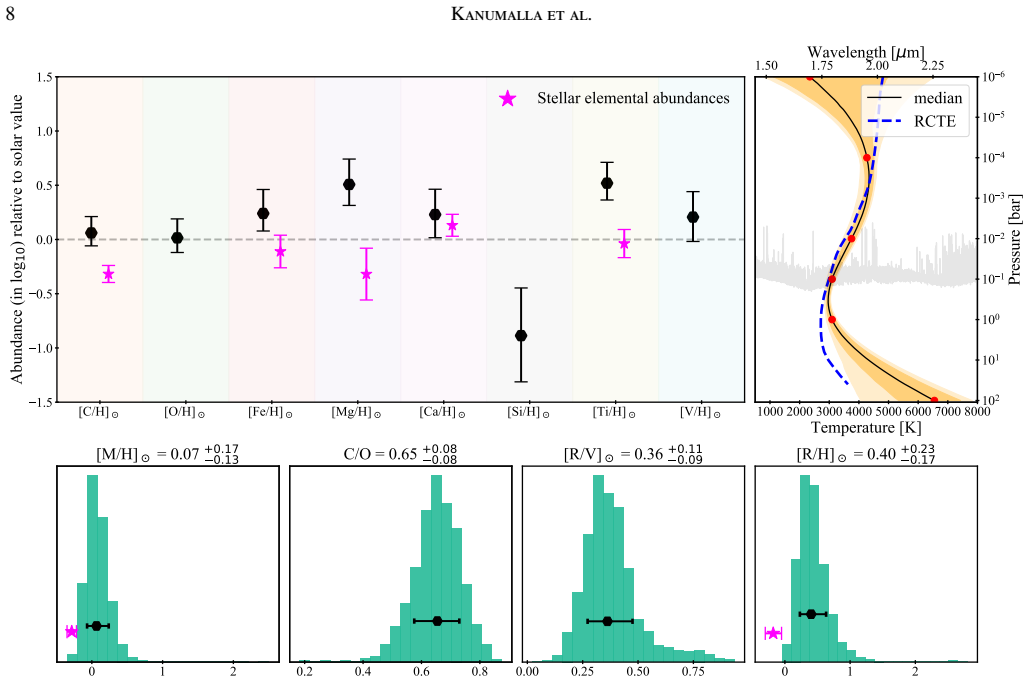
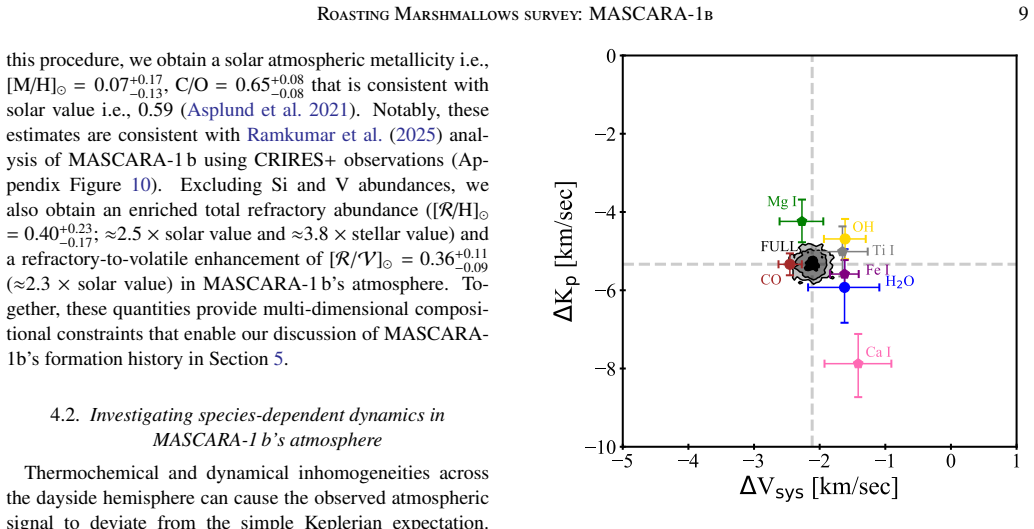
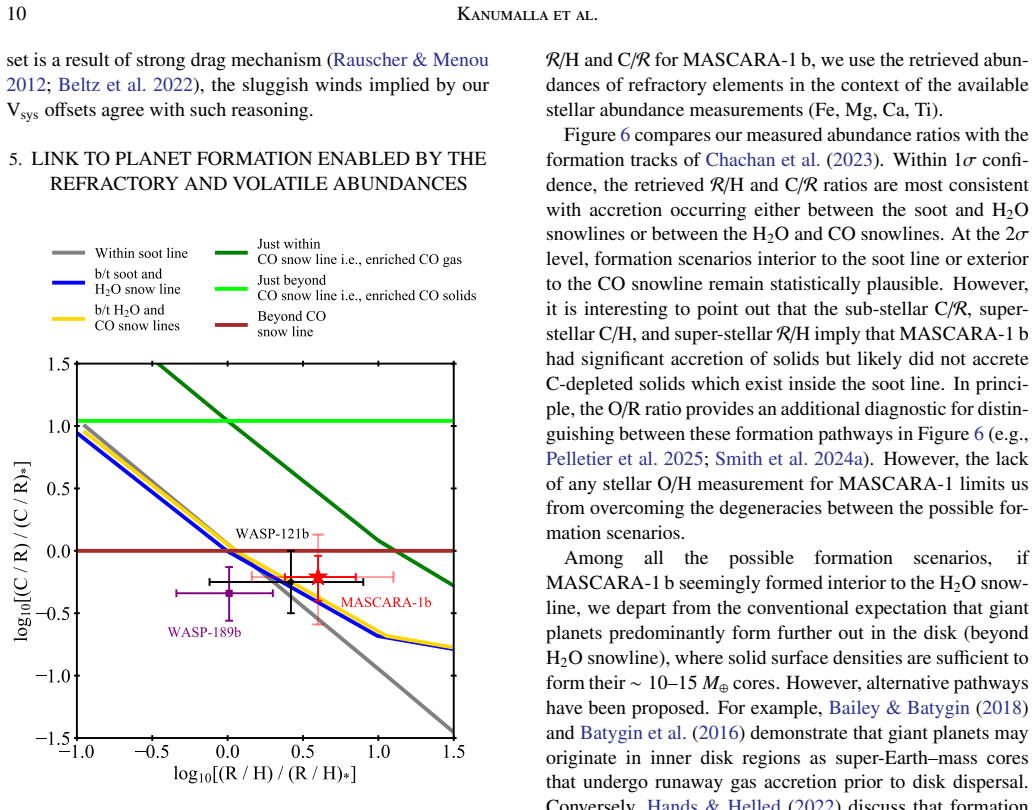
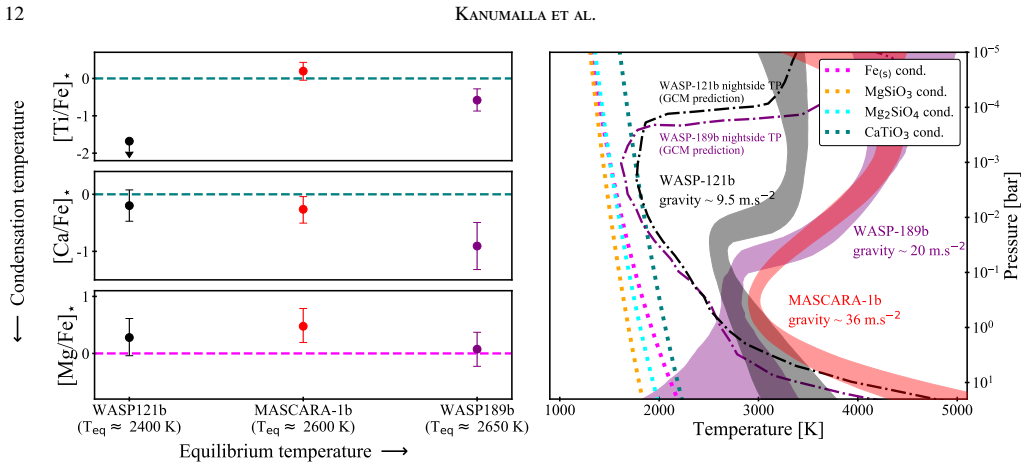
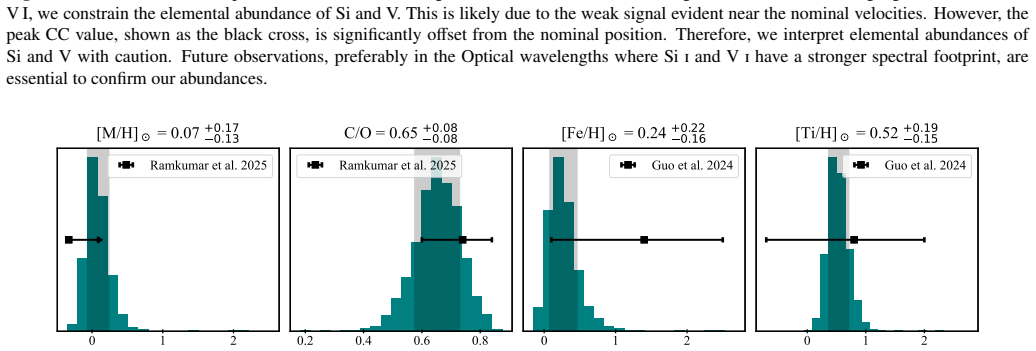
The retrieval yields a solar atmospheric metallicity ([M/H]⊙ = 0.07+0.17−0.13 ≈1.2× solar), solar C/O (0.65+0.08−0.08), enhanced refractory abundance ([R/H]⊙ = 0.40+0.23−0.17 ≈2.5× solar), and super-solar refractory-to-volatile ratio ([R/V]⊙ = 0.36+0.11−0.09 ≈2.3× solar). Comparison with formation models indicates accretion between the soot-H2O or H2O-CO snowlines at 68% confidence, with stellar Ti/Mg, Ca/Mg, and Mg/Fe ratios showing no strong nightside cold trapping.
What carries the argument
Chemically consistent atmospheric inference framework that fits cross-correlation signals from multiple species to retrieve elemental abundances simultaneously.
If this is right
- MASCARA-1b most likely accreted material between the soot-H2O or H2O-CO snowlines.
- Atmospheric Ti/Mg and Ca/Mg ratios match stellar values, and Mg/Fe is consistent at 95% confidence.
- No strong indication of nightside cold trapping is present in the abundance ratios.
- Expanding homogeneous refractory-to-volatile measurements across UHJs will enable statistical tests of giant planet formation trends.
Where Pith is reading between the lines
- The same chemically consistent retrieval approach could map snowline accretion locations for a larger sample of ultra-hot Jupiters observed with future facilities.
- If refractory enrichment turns out to be widespread, it would suggest that disk processing or pebble accretion commonly delivers rock-forming material to giant planet envelopes.
- Precise stellar abundance comparisons for individual elements like Ti, Mg, and Ca could further constrain whether any species are sequestered on the nightside.
Load-bearing premise
The line lists, temperature-pressure profile, and chemical equilibrium model accurately reproduce the observed cross-correlation signals without significant bias from unmodeled opacity or data artifacts.
What would settle it
An independent retrieval or observation that finds sub-solar refractory abundance or a refractory-to-volatile ratio inconsistent with the snowline accretion region would falsify the formation interpretation.
Figures
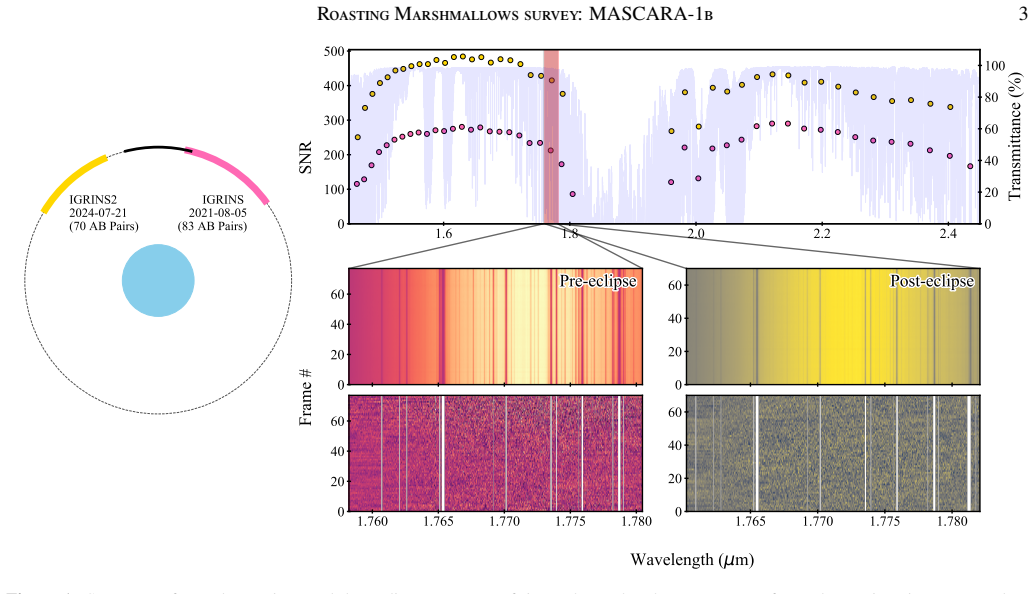
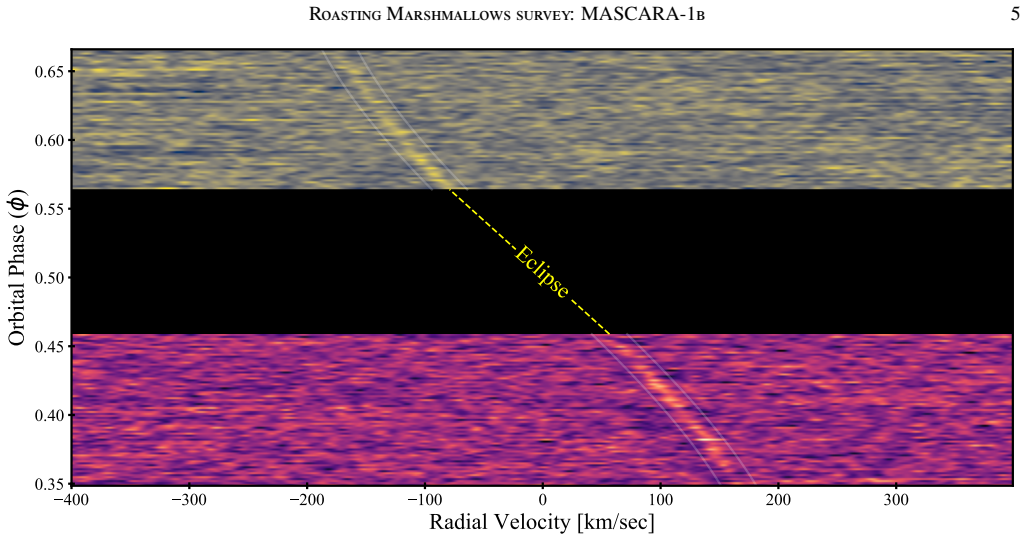
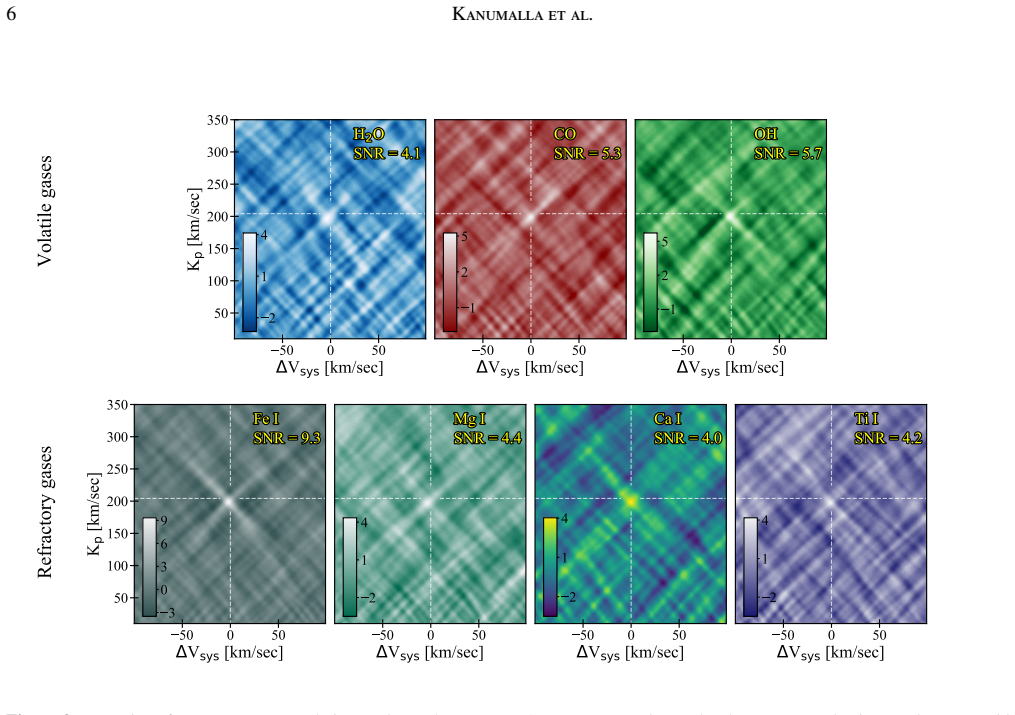
read the original abstract
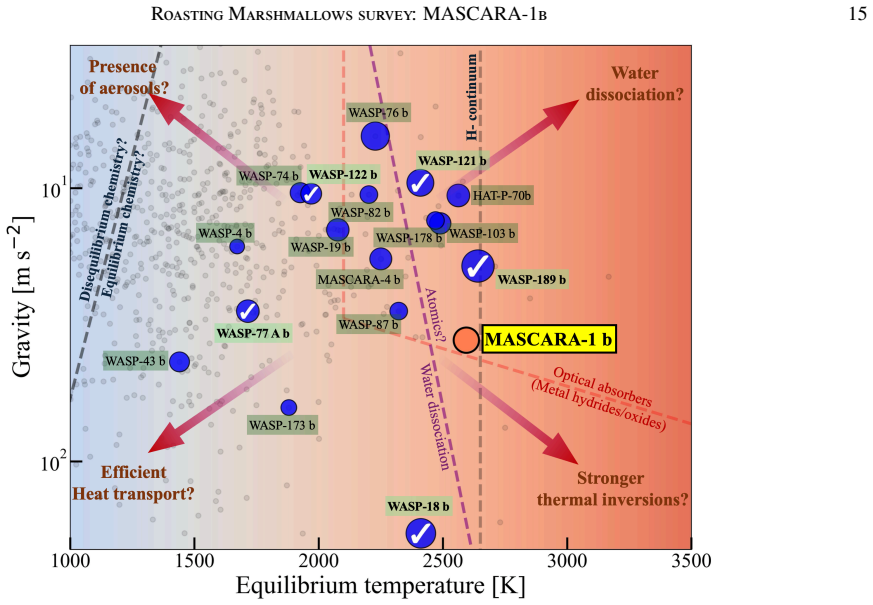
Ultra-hot Jupiters (UHJs; $T_{\rm eq} \gtrsim 2000$ K) enable simultaneous detection of volatile (ice-forming) and refractory (rock-forming) species in planetary atmospheres, providing a powerful diagnostic of planet formation and atmospheric processing. We present a comprehensive high-resolution cross-correlation spectroscopy (HRCCS) analysis of the UHJ MASCARA-1b ($T_{\rm eq} \approx 2600$ K) using the IGRINS and IGRINS-2 spectrographs. We detect robust (SNR$>$4) signals from H$_2$O, CO, OH, Fe I, Mg I, Ca I, and Ti I, marking the most complete atmospheric inventory of MASCARA-1b to date. Using a chemically consistent atmospheric inference framework, we constrain elemental abundances to a typical precision of $\approx$0.2 dex, retrieving a solar atmospheric metallicity ([M/H]$_\odot$ $= 0.07^{+0.17}_{-0.13}$ $\approx 1.2\times$ solar), a C/O ratio (C/O $= 0.65^{+0.08}_{-0.08}$) consistent with solar value (C/O $=$ 0.59), an enhanced refractory abundance ([R/H]$_\odot$ $= 0.40^{+0.23}_{-0.17} \approx 2.5\times$ solar; $\approx 3.8\times$ stellar), and a moderately super-solar refractory-to-volatile ratio ([R/V]$_\odot$ $= 0.36^{+0.11}_{-0.09}$ $\approx 2.3\times$ solar). Comparison with formation models suggests that MASCARA-1b most likely accreted material between the soot-H$_2$O or H$_2$O-CO snowlines (at 68$\%$ confidence). We additionally find stellar values for atmospheric Ti/Mg and Ca/Mg ratios (at 68$\%$ confidence). The Mg/Fe is also found to be consistent with stellar value at 95$\%$ confidence. Therefore, we do not find strong indication of nightside cold trapping in MASCARA-1b. As homogeneous refractory-to-volatile measurements expand across the UHJ population, particularly with upcoming Extremely Large Telescopes, these diagnostics will enable statistically robust tests of emerging trends in giant planet formation and atmospheric evolution.
Editorial analysis
A structured set of objections, weighed in public.
Referee Report
Summary. The paper reports high-resolution cross-correlation spectroscopy of the ultra-hot Jupiter MASCARA-1b with IGRINS, claiming robust (SNR>4) detections of H2O, CO, OH, Fe I, Mg I, Ca I, and Ti I. Using a chemically consistent retrieval framework, it derives solar atmospheric metallicity ([M/H]⊙=0.07+0.17−0.13), solar C/O (0.65+0.08−0.08), enhanced refractory abundance ([R/H]⊙=0.40+0.23−0.17 ≈2.5×solar), and super-solar refractory-to-volatile ratio ([R/V]⊙=0.36+0.11−0.09 ≈2.3×solar), inferring accretion between the soot-H2O or H2O-CO snowlines at 68% confidence, with stellar Ti/Mg, Ca/Mg, and Mg/Fe ratios.
Significance. If the abundance ratios hold, the work supplies one of the most complete UHJ inventories to date and demonstrates the diagnostic power of simultaneous volatile/refractory measurements for formation pathways. The reported 0.2 dex precisions and multi-species SNR>4 detections are concrete strengths that enable direct comparison to snowline models.
major comments (1)
- [methods (chemically consistent atmospheric inference)] Chemically consistent retrieval (methods section describing the inference framework): the headline values [R/H]⊙=0.40+0.23−0.17 and [R/V]⊙=0.36+0.11−0.09, together with the 68% snowline probability, are obtained from a single equilibrium-chemistry step that ties all species through a shared T-P profile and line lists. The manuscript does not report free-chemistry retrievals or injection-recovery tests that would isolate whether unmodeled opacities or residual artifacts alter the relative CCF amplitudes of refractory versus volatile species; this assumption is load-bearing for the central formation claim.
minor comments (1)
- [abstract and results] The abstract states 'stellar values for atmospheric Ti/Mg and Ca/Mg ratios (at 68% confidence)' and 'Mg/Fe consistent with stellar value at 95% confidence'; the exact definition of 'stellar value' and the reference stellar abundances should be stated explicitly in the results section for reproducibility.
Simulated Author's Rebuttal
We thank the referee for their thorough review and valuable comments on our manuscript. We address the major comment point by point below.
read point-by-point responses
-
Referee: [methods (chemically consistent atmospheric inference)] Chemically consistent retrieval (methods section describing the inference framework): the headline values [R/H]⊙=0.40+0.23−0.17 and [R/V]⊙=0.36+0.11−0.09, together with the 68% snowline probability, are obtained from a single equilibrium-chemistry step that ties all species through a shared T-P profile and line lists. The manuscript does not report free-chemistry retrievals or injection-recovery tests that would isolate whether unmodeled opacities or residual artifacts alter the relative CCF amplitudes of refractory versus volatile species; this assumption is load-bearing for the central formation claim.
Authors: We agree with the referee that the manuscript does not report free-chemistry retrievals or injection-recovery tests to specifically validate the relative CCF amplitudes between refractory and volatile species. Although the chemically consistent framework is well-suited for the high-temperature regime of MASCARA-1b, where thermochemical equilibrium is expected, we recognize that demonstrating the robustness against potential unmodeled effects would further support the formation interpretation. Accordingly, in the revised version of the manuscript, we will add comparisons with free-chemistry retrievals and include injection-recovery tests focused on the refractory-to-volatile ratios. revision: yes
Circularity Check
No circularity: abundances are direct retrieval outputs from independent HRCCS data
full rationale
The paper's central results ([M/H]⊙, C/O, [R/H]⊙, [R/V]⊙ and snowline probability) are obtained by fitting a chemically consistent atmospheric model to observed cross-correlation signals from multiple species (H₂O, CO, OH, Fe I, Mg I, Ca I, Ti I). No equation or step defines any reported ratio in terms of itself, renames a fitted parameter as a prediction, or reduces the outcome to a self-citation chain; the chemically consistent assumption is an explicit modeling choice whose validity is external to the derivation itself. The derivation chain is therefore self-contained against the spectroscopic dataset.
Axiom & Free-Parameter Ledger
free parameters (1)
- elemental abundances [M/H], [R/H], C/O, [R/V]
axioms (2)
- domain assumption Line lists and opacities for H2O, CO, OH, Fe I, Mg I, Ca I, Ti I are complete and accurate at the relevant temperatures.
- domain assumption The planet's atmosphere is in chemical equilibrium and can be described by a single 1D T-P profile.
Reference graph
Works this paper leans on
-
[1]
2024, A&A, 692, A67, doi: 10.1051/0004-6361/202452193
Adibekyan, V ., Deal, M., Dorn, C., et al. 2024, A&A, 692, A67, doi: 10.1051/0004-6361/202452193
-
[2]
Asplund, M., Amarsi, A. M., & Grevesse, N. 2021, A&A, 653, A141, doi: 10.1051/0004-6361/202140445 Astropy Collaboration, Price-Whelan, A. M., Lim, P. L., et al. 2022, ApJ, 935, 167, doi: 10.3847/1538-4357/ac7c74
work page internal anchor Pith review doi:10.1051/0004-6361/202140445 2021
-
[3]
2018, ApJL, 866, L2, doi: 10.3847/2041-8213/aade90
Bailey, E., & Batygin, K. 2018, ApJL, 866, L2, doi: 10.3847/2041-8213/aade90
-
[4]
Batygin, K., Bodenheimer, P. H., & Laughlin, G. P. 2016, ApJ, 829, 114, doi: 10.3847/0004-637X/829/2/114
-
[5]
2025, A&A, 701, A276, doi: 10.1051/0004-6361/202553724
Bazinet, L., Allart, R., Benneke, B., et al. 2025, A&A, 701, A276, doi: 10.1051/0004-6361/202553724
-
[6]
Bell, T. J., Dang, L., Cowan, N. B., et al. 2021, MNRAS, 504, 3316, doi: 10.1093/mnras/stab1027
-
[7]
J., Welbanks, L., Schlawin, E., et al
Bell, T. J., Welbanks, L., Schlawin, E., et al. 2023, Nature, 623, 709, doi: 10.1038/s41586-023-06687-0
-
[8]
Beltz, H., Rauscher, E., Brogi, M., & Kempton, E. M.-R. 2021, AJ, 161, 1, doi: 10.3847/1538-3881/abb67b
-
[9]
Exoplanet Atmospheres at High Spectral Resolution
Beltz, H., Rauscher, E., Kempton, E. M.-R., et al. 2022, AJ, 164, 140, doi: 10.3847/1538-3881/ac897b Birkby. 2018, arXiv e-prints, arXiv:1806.04617. https://arxiv.org/abs/1806.04617
work page internal anchor Pith review Pith/arXiv arXiv doi:10.3847/1538-3881/ac897b 2022
-
[10]
Borsato, N. W., Hoeijmakers, H. J., Prinoth, B., et al. 2023, A&A, 673, A158, doi: 10.1051/0004-6361/202245121
-
[11]
Brogi, M., & Line, M. R. 2019, AJ, 157, 114, doi: 10.3847/1538-3881/aaffd3
-
[12]
Brogi, M., Emeka-Okafor, V ., Line, M. R., et al. 2023a, AJ, 165, 91, doi: 10.3847/1538-3881/acaf5c —. 2023b, AJ, 165, 91, doi: 10.3847/1538-3881/acaf5c
-
[13]
Buchner, J., Georgakakis, A., Nandra, K., et al. 2014, A&A, 564, A125, doi: 10.1051/0004-6361/201322971
work page internal anchor Pith review doi:10.1051/0004-6361/201322971 2014
-
[14]
2019, A&A, 628, A9, doi: 10.1051/0004-6361/201935623
Casasayas-Barris, N., Pall´e, E., Yan, F., et al. 2019, A&A, 628, A9, doi: 10.1051/0004-6361/201935623
-
[15]
2022, A&A, 664, A121, doi: 10.1051/0004-6361/202143016
Casasayas-Barris, N., Borsa, F., Palle, E., et al. 2022, A&A, 664, A121, doi: 10.1051/0004-6361/202143016
-
[16]
Chachan, Y ., Knutson, H. A., Lothringer, J., & Blake, G. A. 2023, ApJ, 943, 112, doi: 10.3847/1538-4357/aca614
-
[17]
Chachan, Y ., Lee, E. J., & Knutson, H. A. 2021, ApJ, 919, 63, doi: 10.3847/1538-4357/ac0bb6
-
[18]
2025, AJ, 170, 234, doi: 10.3847/1538-3881/adfbeb
Chachan, Y ., Lothringer, J., Inglis, J., et al. 2025, AJ, 170, 234, doi: 10.3847/1538-3881/adfbeb
-
[19]
2025, AJ, 170, 238, doi: 10.3847/1538-3881/aded8c
Choi, Y .-H., Jeong, U., Lee, J.-J., et al. 2025, AJ, 170, 238, doi: 10.3847/1538-3881/aded8c
-
[20]
2021, A&A, 651, A33, doi: 10.1051/0004-6361/202140732
Cont, D., Yan, F., Reiners, A., et al. 2021, A&A, 651, A33, doi: 10.1051/0004-6361/202140732
-
[21]
Dawson, R. I., & Johnson, J. A. 2018, ARA&A, 56, 175, doi: 10.1146/annurev-astro-081817-051853 de Kok et al. 2013, A&A, 554, A82, doi: 10.1051/0004-6361/201321381 de Regt, S., Kesseli, A. Y ., Snellen, I. A. G., Merritt, S. R., &
work page internal anchor Pith review doi:10.1146/annurev-astro-081817-051853 2018
-
[22]
Chubb, K. L. 2022, A&A, 661, A109, doi: 10.1051/0004-6361/202142683
-
[23]
Deibert, E. K., Langeveld, A. B., Young, M. E., et al. 2024, AJ, 168, 148, doi: 10.3847/1538-3881/ad643f
-
[24]
2015, A&A, 577, A83, doi: 10.1051/0004-6361/201424915
Dorn, C., Khan, A., Heng, K., et al. 2015, A&A, 577, A83, doi: 10.1051/0004-6361/201424915
-
[25]
2007, ApJ, 669, 1298, doi: 10.1086/521702
Fabrycky, D., & Tremaine, S. 2007, ApJ, 669, 1298, doi: 10.1086/521702
-
[26]
Feroz, F., Hobson, M. P., & Bridges, M. 2009, MNRAS, 398, 1601, doi: 10.1111/j.1365-2966.2009.14548.x
-
[27]
Fulton, B. J., Rosenthal, L. J., Hirsch, L. A., et al. 2021, ApJS, 255, 14, doi: 10.3847/1538-4365/abfcc1
-
[28]
2023, AJ, 165, 242, doi: 10.3847/1538-3881/accd65
Gandhi, S., Kesseli, A., Zhang, Y ., et al. 2023, AJ, 165, 242, doi: 10.3847/1538-3881/accd65
-
[29]
Gharib-Nezhad, E., Iyer, A. R., Line, M. R., et al. 2021, ApJS, 254, 34, doi: 10.3847/1538-4365/abf504
-
[30]
Gibson, N. P., Nugroho, S. K., Lothringer, J., Maguire, C., & Sing, D. K. 2022, MNRAS, 512, 4618, doi: 10.1093/mnras/stac091
-
[31]
Gibson, N. P., Merritt, S., Nugroho, S. K., et al. 2020, MNRAS, 493, 2215, doi: 10.1093/mnras/staa228
-
[32]
Grimm, S. L., & Heng, K. 2015, ApJ, 808, 182, doi: 10.1088/0004-637X/808/2/182
-
[33]
Guillot, T., Fletcher, L. N., Helled, R., et al. 2023, in Astronomical Society of the Pacific Conference Series, V ol. 534, Protostars and Planets VII, ed. S. Inutsuka, Y . Aikawa, T. Muto, K. Tomida, & M. Tamura, 947, doi: 10.48550/arXiv.2205.04100
-
[34]
2024, A&A, 687, A103, doi: 10.1051/0004-6361/202449890
Guo, B., Yan, F., Nortmann, L., et al. 2024, A&A, 687, A103, doi: 10.1051/0004-6361/202449890
-
[35]
Hands, T. O., & Helled, R. 2022, MNRAS, 509, 894, doi: 10.1093/mnras/stab2967
-
[36]
Harris, C. R., Millman, K. J., van der Walt, S. J., et al. 2020, Nature, 585, 357, doi: 10.1038/s41586-020-2649-2
-
[37]
Hoeijmakers, H. J., de Kok, R. J., Snellen, I. A. G., et al. 2015, A&A, 575, A20, doi: 10.1051/0004-6361/201424794 Hoeijmakers et al. 2018, Nature, 560, 453, doi: 10.1038/s41586-018-0401-y
-
[38]
Holmberg, M., & Madhusudhan, N. 2022, AJ, 164, 79, doi: 10.3847/1538-3881/ac77eb
-
[39]
J., Hoyer, S., Kitzmann, D., et al
Hooton, M. J., Hoyer, S., Kitzmann, D., et al. 2022, A&A, 658, A75, doi: 10.1051/0004-6361/202141645
-
[40]
Hunter, J. D. 2007, Computing in Science & Engineering, 9, 90, doi: 10.1109/MCSE.2007.55
-
[41]
A new extensive library of PHOENIX stellar atmospheres and synthetic spectra
Husser, T. O., Wende-von Berg, S., Dreizler, S., et al. 2013, A&A, 553, A6, doi: 10.1051/0004-6361/201219058
work page internal anchor Pith review doi:10.1051/0004-6361/201219058 2013
-
[42]
John, T. L. 1988, A&A, 193, 189 JWST Transiting Exoplanet Community Early Release Science
1988
-
[43]
2023, Nature, 614, 649, doi: 10.1038/s41586-022-05269-w RoastingMarshmallows survey: MASCARA-1b19
Team, Ahrer, E.-M., Alderson, L., et al. 2023, Nature, 614, 649, doi: 10.1038/s41586-022-05269-w RoastingMarshmallows survey: MASCARA-1b19
-
[44]
R., Weiner Mansfield, M., et al
Kanumalla, K., Line, M. R., Weiner Mansfield, M., et al. 2024, AJ, 168, 201, doi: 10.3847/1538-3881/ad72f3
-
[45]
Karman, T., Gordon, I. E., van der Avoird, A., et al. 2019, Icarus, 328, 160, doi: 10.1016/j.icarus.2019.02.034
-
[46]
Kasper, D., Bean, J. L., Line, M. R., et al. 2023, AJ, 165, 7, doi: 10.3847/1538-3881/ac9f40
-
[47]
Kitzmann, D., Stock, J. W., & Patzer, A. B. C. 2024, MNRAS, 527, 7263, doi: 10.1093/mnras/stad3515
-
[48]
Komacek, T. D., & Showman, A. P. 2020, ApJ, 888, 2, doi: 10.3847/1538-4357/ab5b0b
-
[49]
Kozai, Y . 1962, AJ, 67, 591, doi: 10.1086/108790
-
[50]
Kraft, R. P. 1967, ApJ, 150, 551, doi: 10.1086/149359
-
[51]
Kurucz, R. L. 1993, in Astronomical Society of the Pacific Conference Series, V ol. 44, IAU Colloquium 138: Peculiar versus Normal Phenomena in A-type and Related Stars, ed. M. M. Dworetsky, F. Castelli, & R. Faraggiana, 87
1993
-
[52]
Kurucz, R. L. 2017, Canadian Journal of Physics, 95, 825, doi: 10.1139/cjp-2016-0794
-
[53]
Lee, E. K. H., Prinoth, B., Kitzmann, D., et al. 2022, MNRAS, 517, 240, doi: 10.1093/mnras/stac2246
-
[54]
2016, plp: v2.1 alpha 3, v2.1-alpha.3, Zenodo, doi: 10.5281/zenodo.56067
Lee, J.-J., & Gullikson, K. 2016, plp: v2.1 alpha 3, v2.1-alpha.3, Zenodo, doi: 10.5281/zenodo.56067
-
[55]
Li, G., Gordon, I. E., Rothman, L. S., et al. 2015, ApJS, 216, 15, doi: 10.1088/0067-0049/216/1/15
-
[56]
Lidov, M. L. 1962, Planet. Space Sci., 9, 719, doi: 10.1016/0032-0633(62)90129-0
-
[57]
Line, M. R., Brogi, M., Bean, J. L., et al. 2021, Nature, 598, 580, doi: 10.1038/s41586-021-03912-6
-
[58]
Lothringer, J. D., Rustamkulov, Z., Sing, D. K., et al. 2021, ApJ, 914, 12, doi: 10.3847/1538-4357/abf8a9
-
[59]
Lothringer, J. D., Bennett, K. A., Sing, D. K., et al. 2025, AJ, 169, 274, doi: 10.3847/1538-3881/adc117
-
[60]
2018, in Society of Photo-Optical Instrumentation Engineers (SPIE) Conference
Mace, G., Sokal, K., Lee, J.-J., et al. 2018, in Society of Photo-Optical Instrumentation Engineers (SPIE) Conference
2018
-
[61]
10702, Ground-based and Airborne Instrumentation for Astronomy VII, ed
Series, V ol. 10702, Ground-based and Airborne Instrumentation for Astronomy VII, ed. C. J. Evans, L. Simard, & H. Takami, 107020Q, doi: 10.1117/12.2312345
-
[62]
Mansfield, M., Bean, J. L., Line, M. R., et al. 2018, AJ, 156, 10, doi: 10.3847/1538-3881/aac497
-
[63]
K., Masseron, T., Hoeijmakers, H
McKemmish, L. K., Masseron, T., Hoeijmakers, H. J., et al. 2019, MNRAS, 488, 2836, doi: 10.1093/mnras/stz1818
-
[64]
McKemmish, L. K., Yurchenko, S. N., & Tennyson, J. 2016, MNRAS, 463, 771, doi: 10.1093/mnras/stw1969
-
[65]
2016, ApJ, 832, 41, doi: 10.3847/0004-637X/832/1/41
Benneke, B. 2016, ApJ, 832, 41, doi: 10.3847/0004-637X/832/1/41
-
[66]
Detection of the resolved signatures of a supersonic equatorial jet and cool poles in a hot planet
Nortmann, L., Lesjak, F., Yan, F., et al. 2024, arXiv e-prints, arXiv:2404.12363, doi: 10.48550/arXiv.2404.12363
-
[67]
Nugroho, S. K., Kawahara, H., Gibson, N. P., et al. 2021, ApJL, 910, L9, doi: 10.3847/2041-8213/abec71 Nugroho et al. 2017, AJ, 154, 221, doi: 10.3847/1538-3881/aa9433 ¨Oberg, K. I., Murray-Clay, R., & Bergin, E. A. 2011, ApJL, 743, L16, doi: 10.1088/2041-8205/743/1/L16
-
[68]
2024, in Society of Photo-Optical Instrumentation Engineers (SPIE) Conference Series, V ol
Oh, H., Park, C., Kim, S., et al. 2024, in Society of Photo-Optical Instrumentation Engineers (SPIE) Conference Series, V ol. 13096, Ground-based and Airborne Instrumentation for Astronomy X, ed. J. J. Bryant, K. Motohara, & J. R. D. Vernet, 1309608, doi: 10.1117/12.3017710
-
[69]
2025, MNRAS, 541, 3561, doi: 10.1093/mnras/staf1150
Panwar, V ., Brogi, M., Kanumalla, K., et al. 2025, MNRAS, 541, 3561, doi: 10.1093/mnras/staf1150
-
[70]
T., Yuk, I.-S., et al
Park, C., Jaffe, D. T., Yuk, I.-S., et al. 2014, in Society of Photo-Optical Instrumentation Engineers (SPIE) Conference
2014
-
[71]
Series, V ol. 9147, Ground-based and Airborne Instrumentation for Astronomy V , ed. S. K. Ramsay, I. S. McLean, & H. Takami, 91471D, doi: 10.1117/12.2056431
-
[72]
Parmentier, V ., Showman, A. P., & Fortney, J. J. 2021, MNRAS, 501, 78, doi: 10.1093/mnras/staa3418
-
[73]
Parmentier, V ., Showman, A. P., & Lian, Y . 2013, A&A, 558, A91, doi: 10.1051/0004-6361/201321132
-
[74]
Parmentier, V ., Line, M. R., Bean, J. L., et al. 2018, A&A, 617, A110, doi: 10.1051/0004-6361/201833059
-
[75]
Pelletier, S., Benneke, B., Darveau-Bernier, A., et al. 2021, AJ, 162, 73, doi: 10.3847/1538-3881/ac0428
-
[76]
2023, Nature, 619, 491, doi: 10.1038/s41586-023-06134-0
Pelletier, S., Benneke, B., Ali-Dib, M., et al. 2023, Nature, 619, 491, doi: 10.1038/s41586-023-06134-0
-
[77]
2025, AJ, 169, 10, doi: 10.3847/1538-3881/ad8b28
Pelletier, S., Benneke, B., Chachan, Y ., et al. 2025, AJ, 169, 10, doi: 10.3847/1538-3881/ad8b28
-
[78]
2026, A&A, 706, A2, doi: 10.1051/0004-6361/202556985
Pelletier, S., Coulombe, L.-P., Splinter, J., et al. 2026, A&A, 706, A2, doi: 10.1051/0004-6361/202556985
-
[79]
Pino, L., Brogi, M., D´esert, J. M., et al. 2022, A&A, 668, A176, doi: 10.1051/0004-6361/202244593
-
[80]
Piskorz, D., Buzard, C., Line, M. R., et al. 2018, The Astronomical Journal, 156, 133, doi: 10.3847/1538-3881/aad781
discussion (0)
Sign in with ORCID, Apple, or X to comment. Anyone can read and Pith papers without signing in.