PTA-Compatible Domain Walls at LISA and Taiji: Bayesian Reconstruction and Multiband Inference
Pith reviewed 2026-06-27 15:58 UTC · model grok-4.3
The pith
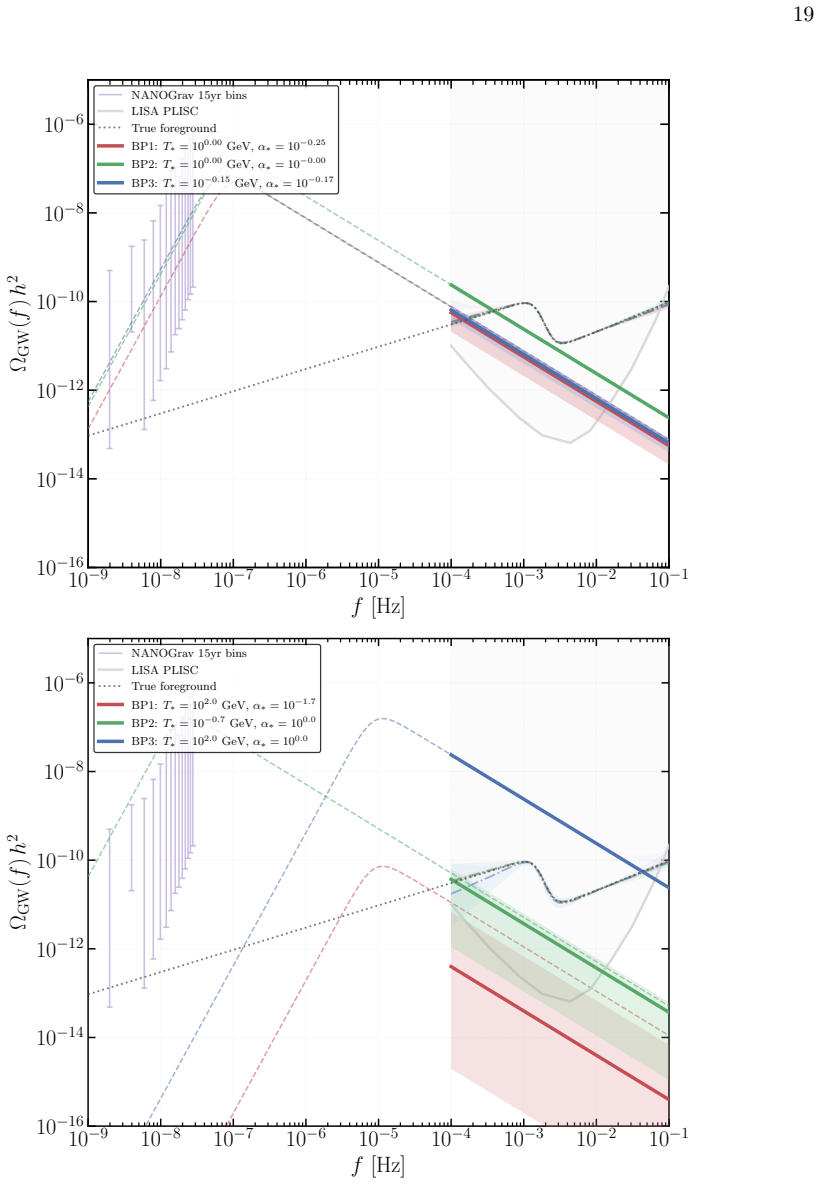
Domain walls fitting PTA data produce an ultraviolet gravitational wave tail that LISA and Taiji can reach in the milli-Hz band.
A machine-rendered reading of the paper's core claim, the machinery that carries it, and where it could break.
Core claim
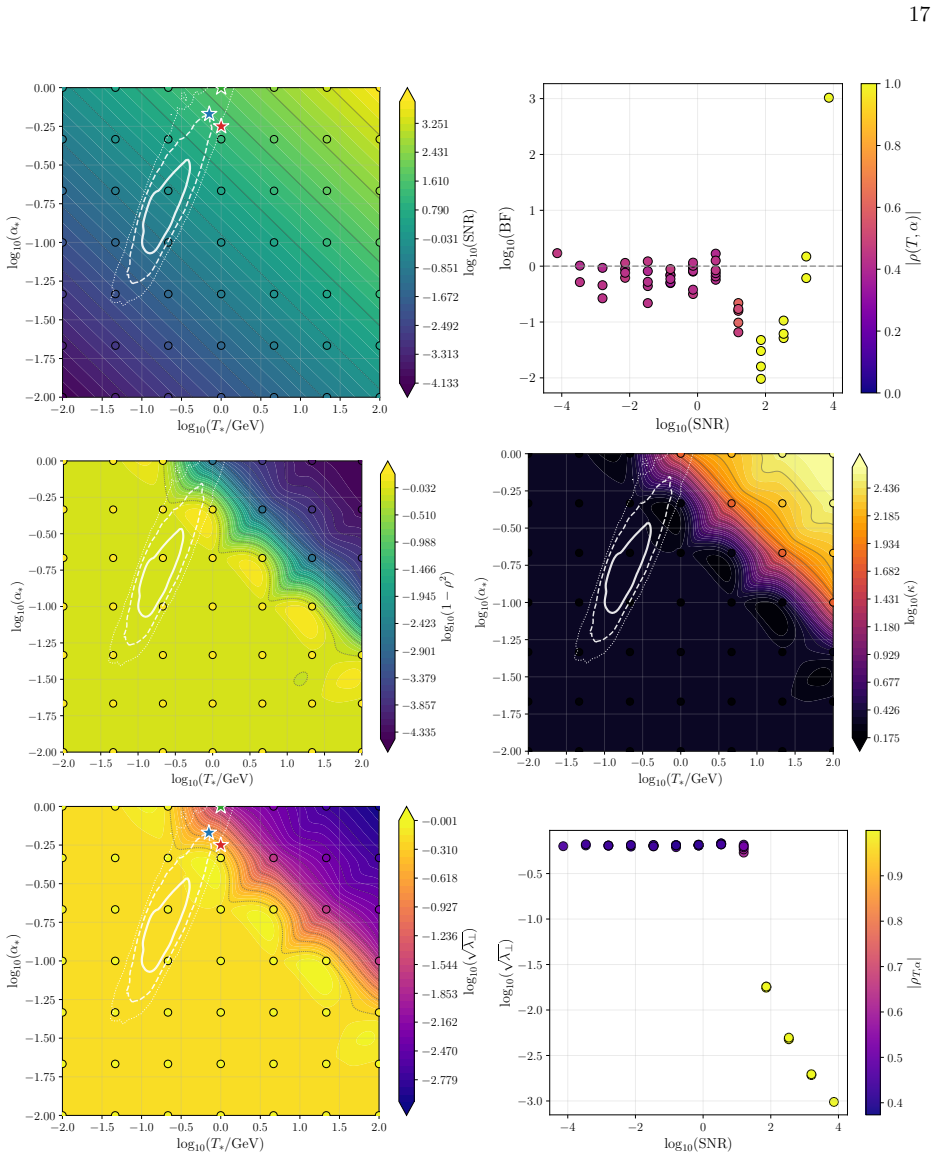
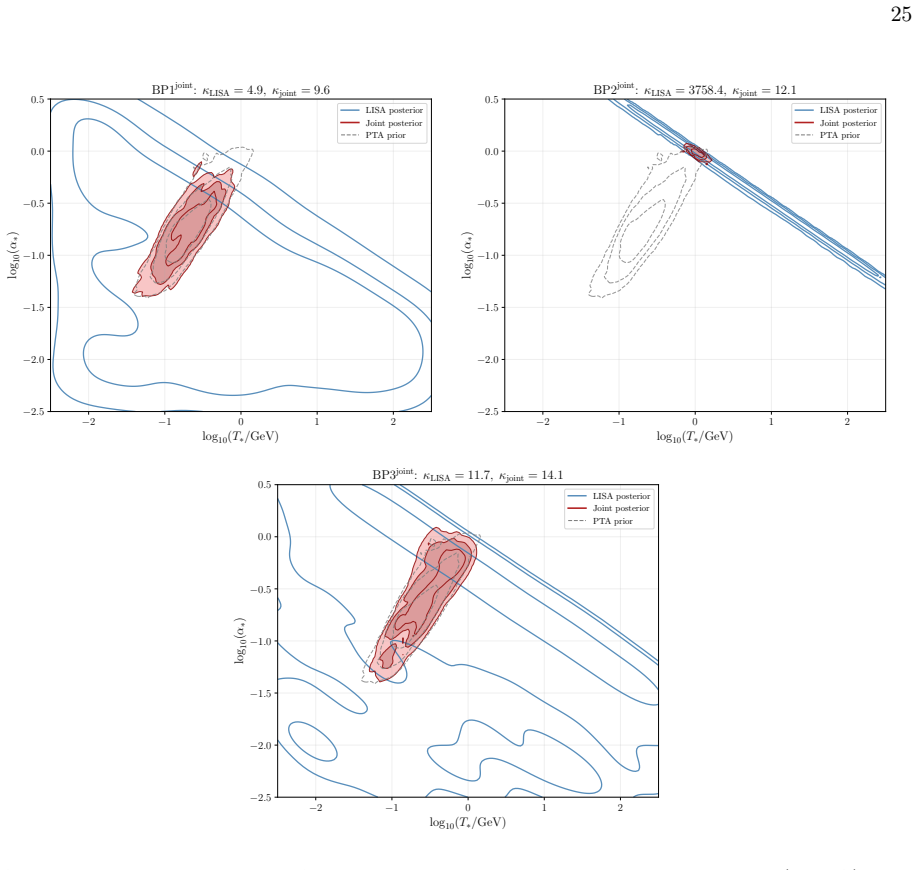
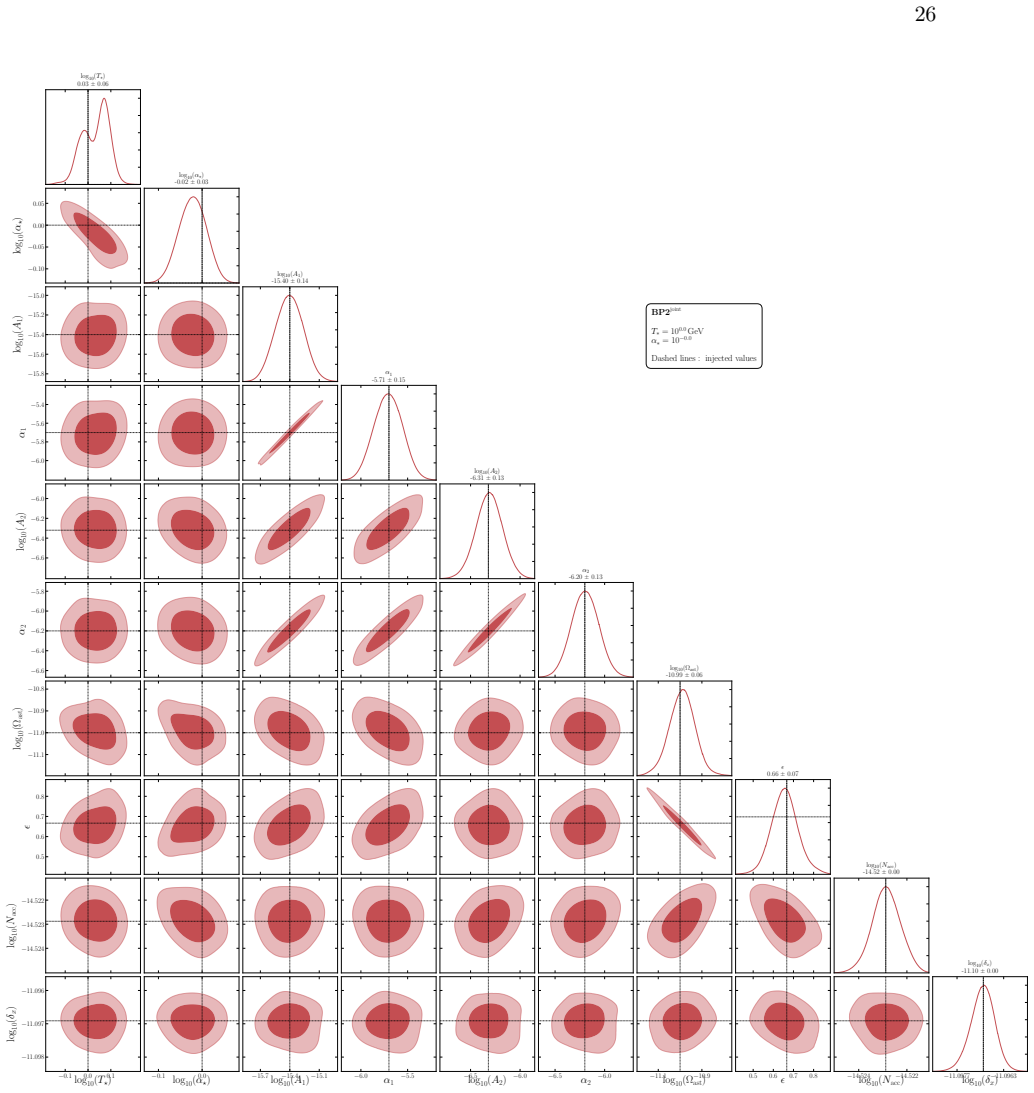
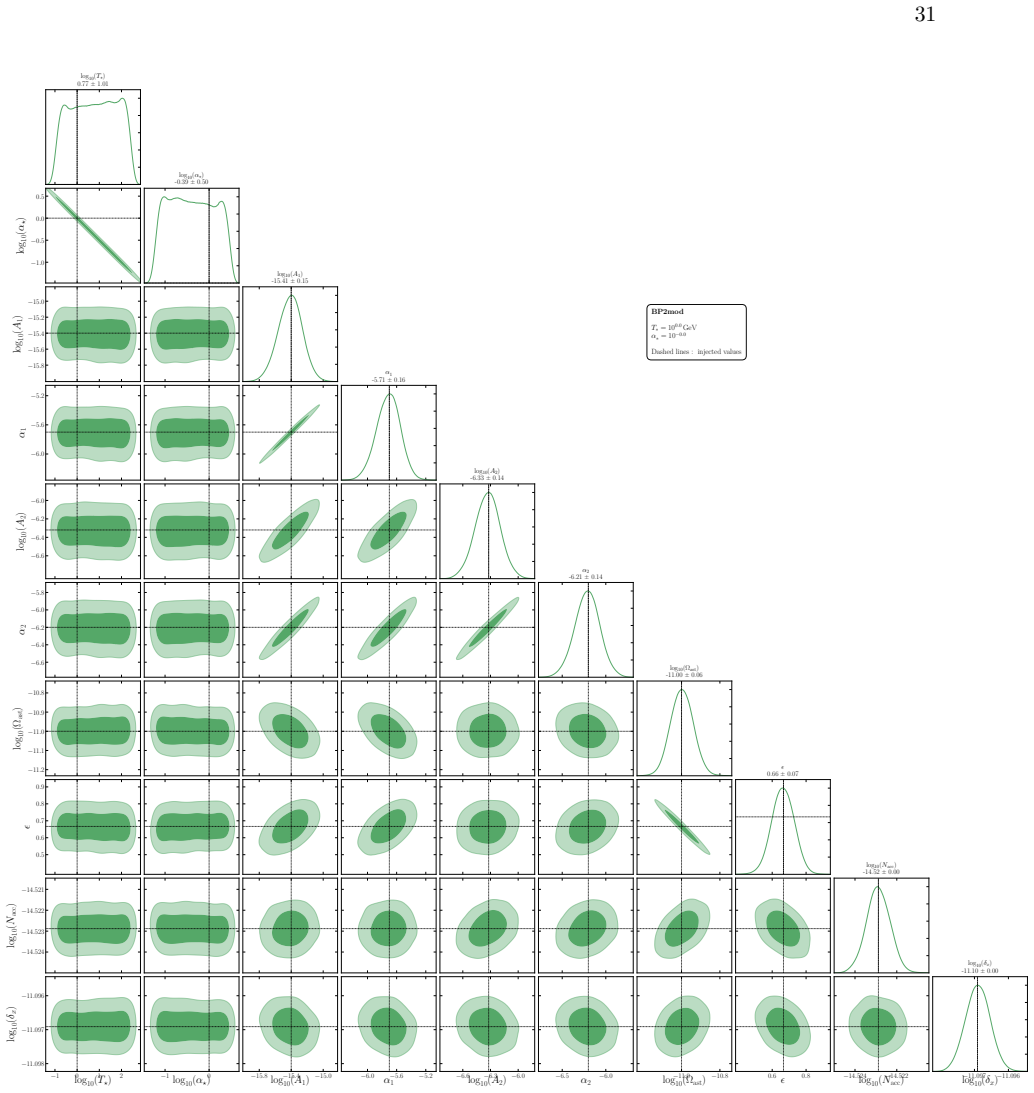
Domain-wall models that reproduce the PTA signal possess a gravitational-wave spectrum whose ultraviolet tail reaches the milli-Hz band; LISA and Taiji therefore have access to an extended slice of the PTA-compatible parameter space, while joint PTA-LISA and PTA-Taiji analyses yield additional information gain that is localized to the high-signal edge and that suppresses the degeneracies present in space-based-only inference.
What carries the argument
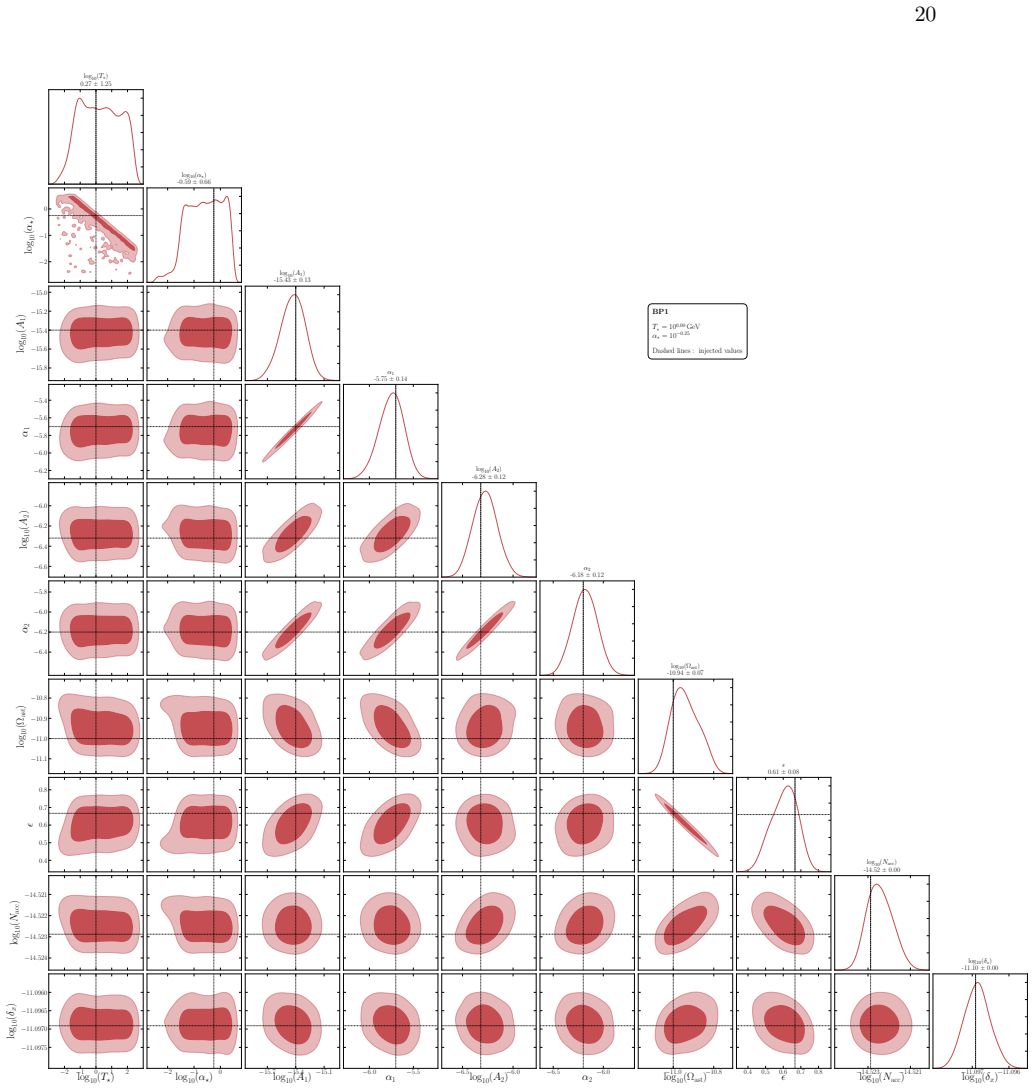
Ten-dimensional Bayesian inference on two domain-wall signal parameters together with eight instrumental and foreground nuisance parameters, performed on 49 grid injections for single-detector runs and 65 PTA-supported injections for joint runs, with Clough-Tocher interpolation to build posterior heat maps.
If this is right
- LISA and Taiji can probe an extended region of PTA-compatible domain-wall parameter space even after astrophysical foregrounds are subtracted.
- Within the PTA-supported slice the informative regime is confined to the high-signal boundary.
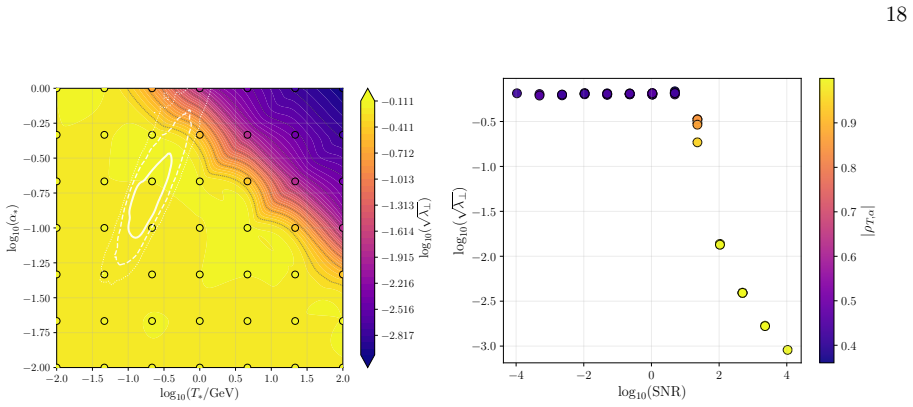
- Space-based-only posteriors remain strongly degenerate in the two signal parameters except where the signal is strong enough to allow one principal combination to be recovered precisely.
- PTA-informed priors produce a non-negligible posterior shift and largely eliminate the LISA/Taiji-only degeneracy, but the final posterior axis ratio often stays comparable to the PTA-only case.
Where Pith is reading between the lines
- If the high-signal edge is eventually detected, multiband data would allow the domain-wall tension and formation epoch to be cross-checked between nano-Hz and milli-Hz bands.
- The restricted informative region implies that sensitivity improvements in LISA and Taiji would be needed to access most of the PTA-compatible space.
- The same multiband Bayesian machinery could be applied to other PTA sources whose spectra also possess high-frequency tails.
Load-bearing premise
The precise shape and amplitude of the ultraviolet tail in the domain-wall gravitational-wave spectrum are assumed to be known and to be the correct description of whatever is producing the PTA signal.
What would settle it
A null result at the high-signal edge of the PTA-compatible domain-wall region in actual LISA or Taiji data, or a reconstructed posterior that fails to overlap the PTA-supported region once the space-based likelihood is included.
Figures
read the original abstract
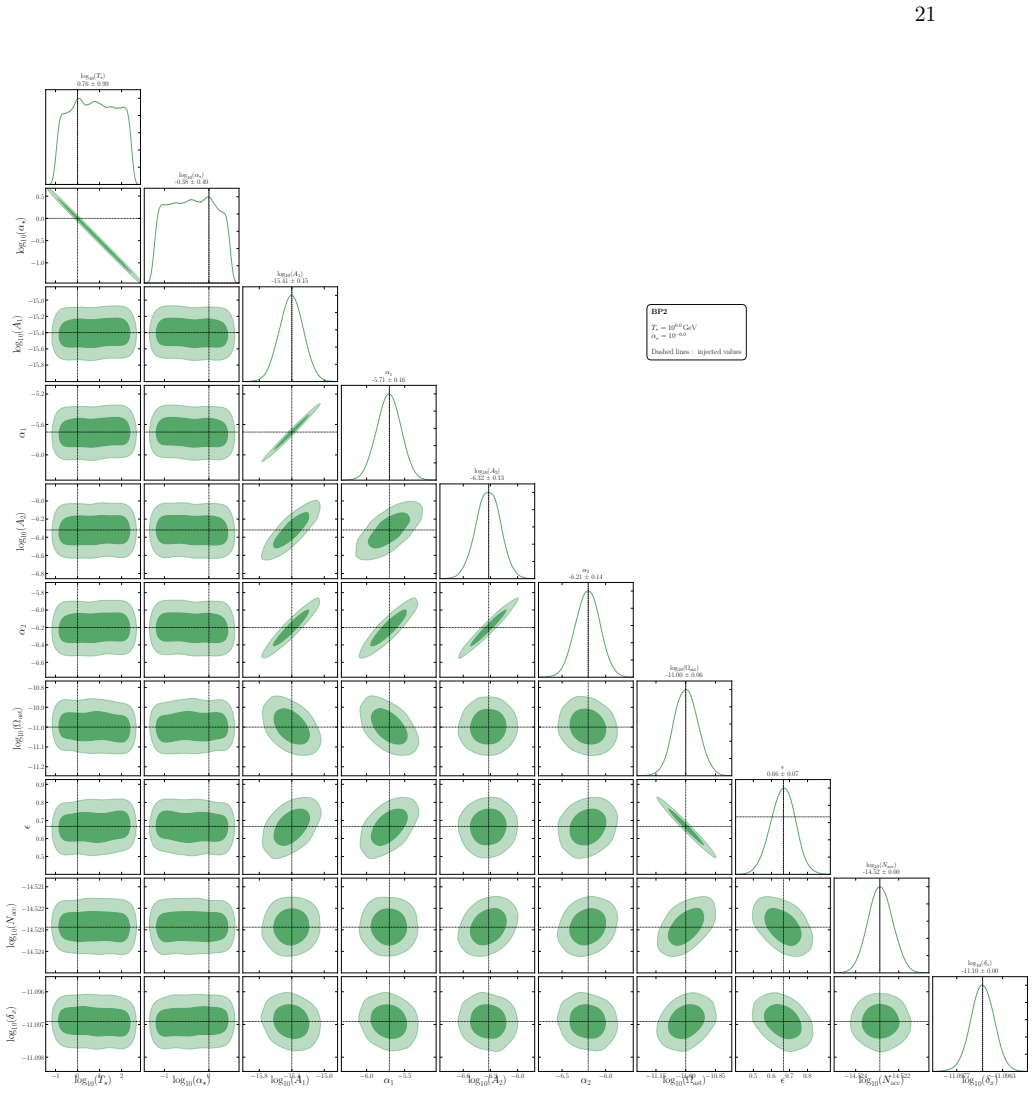
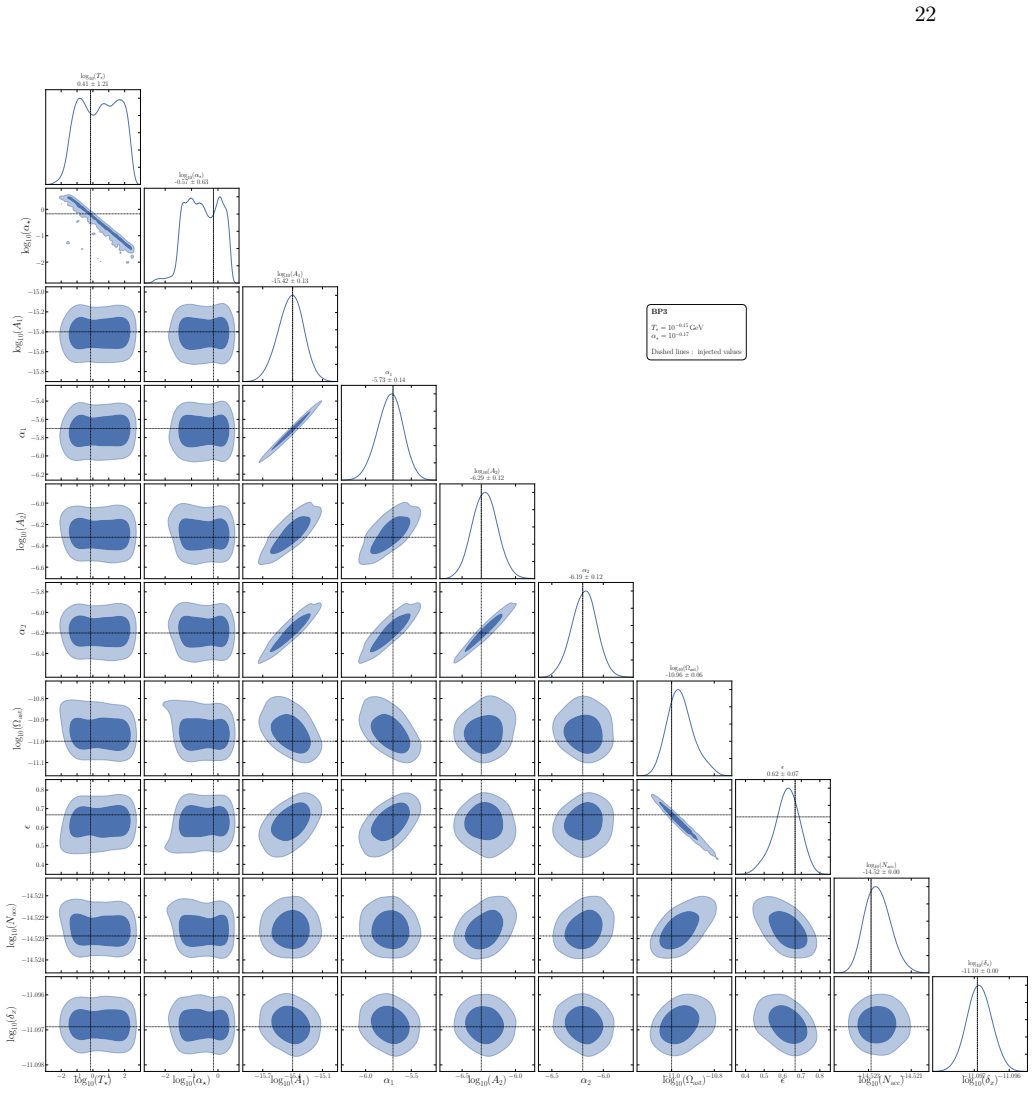
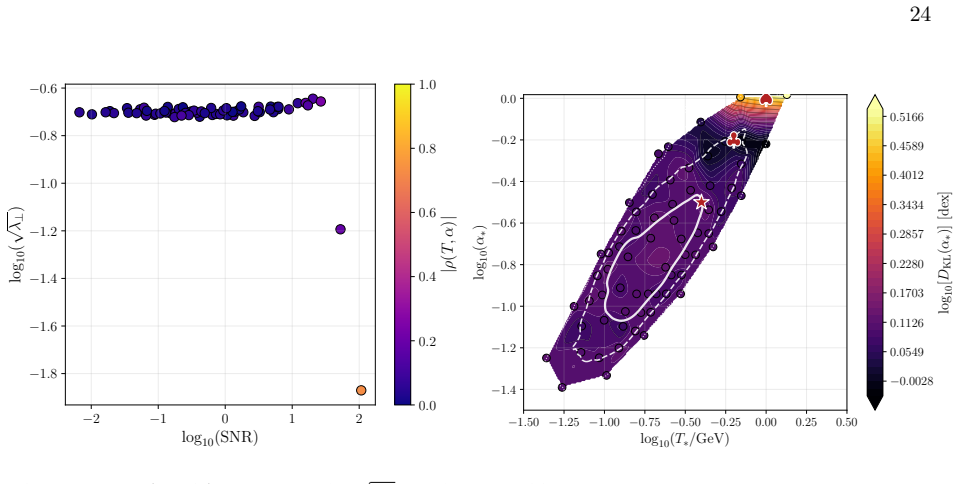
Domain walls provide an excellent fit to Pulsar Timing Array (PTA) data. A distinctive feature of the associated gravitational-wave (GW) spectrum is its ultraviolet (UV) tail, which can extend into the mHz band and thereby make cross-detection with space-based interferometers such as LISA and Taiji possible. In this work, we explore the PTA-compatible parameter space of domain-wall models and study both the reconstruction prospects at LISA and Taiji and the information gain achievable through joint PTA--LISA and PTA--Taiji analyses. We find that LISA and Taiji can probe an extended region of parameter space yielding an ultraviolet tail in the milli-Hz band, even in the presence of astrophysical foregrounds. Within the PTA-supported region, however, the genuinely informative regime is more restricted and concentrated toward the high-signal edge. In the space-based-detector-only analysis, the posterior is strongly degenerate in the underlying model parameters, although one principal parameter combination can be reconstructed with high precision where the signal is sufficiently strong. When PTA-informed priors are incorporated, the additional information gain is localized to the same high-signal region: there the space-based data produce a non-negligible posterior update and strongly suppress the catastrophic LISA(Taiji)-only degeneracy, while the final posterior often retains an axis ratio comparable to that of PTA alone. Our analysis is based on a 10-dimensional Bayesian inference with two domain-wall signal parameters and eight nuisance parameters describing instrumental noise and astrophysical foregrounds. We use 49 grid injections for the LISA-only and Taiji-only analyses and 65 injections from the PTA-supported region for the joint analyses, with Clough--Tocher interpolation used to construct posterior heat maps.
Editorial analysis
A structured set of objections, weighed in public.
Referee Report
Summary. The manuscript presents a 10-dimensional Bayesian analysis exploring PTA-compatible domain-wall gravitational-wave signals, their ultraviolet tail into the milli-Hz band, and reconstruction prospects at LISA and Taiji (including joint PTA--LISA/Taiji analyses with astrophysical foregrounds). Using 49 grid injections for single-detector cases and 65 from the PTA-supported region for joint cases, with Clough--Tocher interpolation to map posteriors, the central claims are that space-based detectors can access an extended parameter space even with foregrounds, but the genuinely informative regime is restricted to the high-signal edge where joint analyses suppress degeneracies while retaining axis ratios comparable to PTA-only posteriors.
Significance. If the results hold, the work supplies a concrete multiband framework for domain-wall models, explicitly demonstrating localized information gain from PTA-informed priors and the use of grid injections plus interpolation to handle high-dimensional degeneracies. The explicit separation of space-based-only versus joint posteriors and the focus on principal parameter combinations are strengths that allow falsifiable projections.
major comments (2)
- [Methods (Bayesian pipeline)] Methods section (Bayesian pipeline description): the domain-wall GW spectrum (including the precise shape and amplitude of its UV tail) is adopted as a fixed template that exactly matches the PTA signal. No variations in network evolution, annihilation efficiency, or scaling assumptions are reported; this assumption is load-bearing for the definition of the PTA-supported region explored by the 65 grid injections and for the claimed LISA/Taiji reach.
- [Results (joint analyses)] Results (joint-analysis posteriors): the claim that PTA-informed priors produce a non-negligible update and strongly suppress the LISA/Taiji-only degeneracy is tied directly to the fixed UV-tail template. A concrete robustness test (varying the template parameters while keeping the same 10D setup) is required to confirm that the reported posterior compression is not an artifact of the template choice.
minor comments (2)
- Clarify whether the 49/65 grid points are dense enough to support reliable Clough--Tocher interpolation across the full 10D space (two signal + eight nuisance parameters) without introducing artifacts in the high-signal edge.
- The abstract states that one principal parameter combination is reconstructed with high precision; define this combination explicitly (e.g., via the eigenvector or linear combination) in the text or a table.
Simulated Author's Rebuttal
We thank the referee for their careful reading of the manuscript and for the constructive major comments. We address each point below, clarifying the scope of our fixed-template analysis while acknowledging its limitations.
read point-by-point responses
-
Referee: Methods section (Bayesian pipeline description): the domain-wall GW spectrum (including the precise shape and amplitude of its UV tail) is adopted as a fixed template that exactly matches the PTA signal. No variations in network evolution, annihilation efficiency, or scaling assumptions are reported; this assumption is load-bearing for the definition of the PTA-supported region explored by the 65 grid injections and for the claimed LISA/Taiji reach.
Authors: We agree that the GW spectrum is implemented as a fixed template calibrated to reproduce the PTA signal. This modeling choice is deliberate: the work is restricted to the PTA-compatible domain-wall parameter space and its ultraviolet extension into the milli-Hz band. Variations in network evolution, annihilation efficiency, or scaling relations would define distinct signal models and lie outside the present scope. We have revised the Methods section to state this assumption explicitly and to note its role in defining the PTA-supported region sampled by the 65 injections. revision: yes
-
Referee: Results (joint-analysis posteriors): the claim that PTA-informed priors produce a non-negligible update and strongly suppress the LISA/Taiji-only degeneracy is tied directly to the fixed UV-tail template. A concrete robustness test (varying the template parameters while keeping the same 10D setup) is required to confirm that the reported posterior compression is not an artifact of the template choice.
Authors: The reported posterior compression and information gain from PTA priors are demonstrated under the fixed UV-tail template that defines the PTA-supported region throughout the paper. A dedicated robustness test that varies the template parameters inside the identical 10D setup would require a new suite of grid injections and interpolations; such an extension is beyond the computational resources allocated to this study. The present results therefore remain conditional on the standard PTA-calibrated template adopted in the analysis. revision: no
- A concrete robustness test varying the UV-tail template parameters while retaining the full 10D Bayesian setup with grid injections and Clough-Tocher interpolation
Circularity Check
No circularity: independent likelihoods and fixed external template
full rationale
The paper adopts a fixed domain-wall GW spectrum template stated to fit PTA data and performs 10D Bayesian inference on LISA/Taiji data (with 8 nuisance parameters) using grid injections and Clough-Tocher interpolation. PTA-supported regions supply priors for joint runs, but the space-based likelihood remains separate and no equation reduces any reported posterior, degeneracy suppression, or information gain to a fitted quantity defined from the same data by construction. No self-citations, uniqueness theorems, or ansatzes appear in the text; the central claims rest on standard numerical marginalization under an external model assumption rather than self-referential reduction.
Axiom & Free-Parameter Ledger
free parameters (2)
- domain-wall signal parameters
- nuisance parameters
axioms (2)
- domain assumption Domain-wall gravitational-wave spectrum possesses an ultraviolet tail that can reach the milliHertz band for PTA-compatible parameters
- standard math Standard likelihood and prior forms for stochastic gravitational-wave background searches
Reference graph
Works this paper leans on
-
[1]
B. P. Abbottet al.(LIGO Scientific, Virgo), Observation of Gravitational Waves from a Binary Black Hole Merger, Phys. Rev. Lett.116, 061102 (2016), arXiv:1602.03837 [gr-qc]
Pith/arXiv arXiv 2016
-
[2]
B. P. Abbottet al.(LIGO Scientific, Virgo), Upper Limits on the Stochastic Gravitational-Wave Back- ground from Advanced LIGO’s First Observing Run, Phys. Rev. Lett.118, 121101 (2017), [Erratum: Phys.Rev.Lett. 119, 029901 (2017)], arXiv:1612.02029 [gr-qc]
Pith/arXiv arXiv 2017
-
[3]
G. Agazieet al.(International Pulsar Timing Array), Comparing recent PTA results on the nanohertz stochastic gravitational wave background, (2023), arXiv:2309.00693 [astro-ph.HE]
arXiv 2023
-
[4]
P. Amaro-Seoaneet al.(LISA), Laser Interferometer Space Antenna, (2017), arXiv:1702.00786 [astro- ph.IM]
Pith/arXiv arXiv 2017
-
[5]
W.-H. Ruan, Z.-K. Guo, R.-G. Cai, and Y.-Z. Zhang, Taiji program: Gravitational-wave sources, Int. J. Mod. Phys. A35, 2050075 (2020), arXiv:1807.09495 [gr-qc]
arXiv 2020
-
[6]
Z. Luo, Y. Wang, Y. Wu, W. Hu, and G. Jin, The Taiji program: A concise overview, PTEP2021, 05A108 (2021)
2021
-
[7]
Luoet al.(TianQin), TianQin: a space-borne gravitational wave detector, Class
J. Luoet al.(TianQin), TianQin: a space-borne gravitational wave detector, Class. Quant. Grav.33, 035010 (2016), arXiv:1512.02076 [astro-ph.IM]
Pith/arXiv arXiv 2016
-
[8]
Sathyaprakashet al., Scientific Objectives of Einstein Telescope, Class
B. Sathyaprakashet al., Scientific Objectives of Einstein Telescope, Class. Quant. Grav.29, 124013 (2012), [Erratum: Class.Quant.Grav. 30, 079501 (2013)], arXiv:1206.0331 [gr-qc]
Pith/arXiv arXiv 2012
-
[9]
Kawamuraet al., The Japanese space gravitational wave antenna DECIGO, Class
S. Kawamuraet al., The Japanese space gravitational wave antenna DECIGO, Class. Quant. Grav.23, S125 (2006)
2006
-
[10]
S. Chenet al.(EPTA), Common-red-signal analysis with 24-yr high-precision timing of the European Pulsar Timing Array: inferences in the stochastic gravitational-wave background search, Mon. Not. Roy. Astron. Soc.508, 4970 (2021), arXiv:2110.13184 [astro-ph.HE]
arXiv 2021
-
[11]
Z. Arzoumanianet al.(NANOGrav), The NANOGrav 12.5 yr Data Set: Search for an Isotropic Stochastic Gravitational-wave Background, Astrophys. J. Lett.905, L34 (2020), arXiv:2009.04496 [astro-ph.HE]
arXiv 2020
-
[12]
G. Agazieet al.(NANOGrav), The NANOGrav 15 yr Data Set: Evidence for a Gravitational-wave Background, Astrophys. J. Lett.951, L8 (2023), arXiv:2306.16213 [astro-ph.HE]
Pith/arXiv arXiv 2023
-
[13]
Antoniadiset al.(EPTA, InPTA:), The second data release from the European Pulsar Timing Array - III
J. Antoniadiset al.(EPTA, InPTA:), The second data release from the European Pulsar Timing Array - III. Search for gravitational wave signals, Astron. Astrophys.678, A50 (2023), arXiv:2306.16214 [astro-ph.HE]
Pith/arXiv arXiv 2023
-
[14]
D. J. Reardonet al., Search for an Isotropic Gravitational-wave Background with the Parkes Pulsar Timing Array, Astrophys. J. Lett.951, L6 (2023), arXiv:2306.16215 [astro-ph.HE]
Pith/arXiv arXiv 2023
-
[15]
H. Xuet al., Searching for the Nano-Hertz Stochastic Gravitational Wave Background with the Chinese Pulsar Timing Array Data Release I, Res. Astron. Astrophys.23, 075024 (2023), arXiv:2306.16216 [astro-ph.HE]
Pith/arXiv arXiv 2023
-
[16]
Afzalet al.(NANOGrav), The NANOGrav 15 yr Data Set: Search for Signals from New Physics, Astrophys
A. Afzalet al.(NANOGrav), The NANOGrav 15 yr Data Set: Search for Signals from New Physics, Astrophys. J. Lett.951, L11 (2023), arXiv:2306.16219 [astro-ph.HE]
Pith/arXiv arXiv 2023
-
[17]
Y. B. Zeldovich, I. Y. Kobzarev, and L. B. Okun, Cosmological Consequences of the Spontaneous Breakdown of Discrete Symmetry, Zh. Eksp. Teor. Fiz.67, 3 (1974). 33
1974
-
[18]
W. H. Press, B. S. Ryden, and D. N. Spergel, Dynamical Evolution of Domain Walls in an Expanding Universe, Astrophys. J.347, 590 (1989)
1989
-
[19]
K. Saikawa, A review of gravitational waves from cosmic domain walls, Universe3, 40 (2017), arXiv:1703.02576 [hep-ph]
Pith/arXiv arXiv 2017
-
[20]
M. R. Adams and N. J. Cornish, Detecting a Stochastic Gravitational Wave Background in the presence of a Galactic Foreground and Instrument Noise, Phys. Rev. D89, 022001 (2014), arXiv:1307.4116 [gr- qc]
Pith/arXiv arXiv 2014
-
[21]
G. Boileau, N. Christensen, R. Meyer, and N. J. Cornish, Spectral separation of the stochastic gravitational-wave background for LISA: Observing both cosmological and astrophysical backgrounds, Phys. Rev. D103, 103529 (2021), arXiv:2011.05055 [gr-qc]
arXiv 2021
-
[22]
G. Boileau, A. Lamberts, N. Christensen, N. J. Cornish, and R. Meyer, Spectral separation of the stochastic gravitational-wave background for LISA in the context of a modulated Galactic foreground, Mon. Not. Roy. Astron. Soc.508, 803 (2021), [Erratum: Mon.Not.Roy.Astron.Soc. 508, 5554–5555 (2021)], arXiv:2105.04283 [gr-qc]
arXiv 2021
- [23]
-
[24]
V. Korolet al., Populations of double white dwarfs in Milky Way satellites and their detectability with LISA, Astron. Astrophys.638, A153 (2020), arXiv:2002.10462 [astro-ph.GA]
arXiv 2020
- [25]
-
[26]
E. S. Phinney, A Practical theorem on gravitational wave backgrounds, (2001), arXiv:astro-ph/0108028
Pith/arXiv arXiv 2001
-
[27]
Regimbau, The astrophysical gravitational wave stochastic background, Res
T. Regimbau, The astrophysical gravitational wave stochastic background, Res. Astron. Astrophys.11, 369 (2011), arXiv:1101.2762 [astro-ph.CO]
Pith/arXiv arXiv 2011
- [28]
-
[29]
L. Lehoucq, I. Dvorkin, R. Srinivasan, C. Pellouin, and A. Lamberts, Astrophysical uncertainties in the gravitational-wave background from stellar-mass compact binary mergers, Mon. Not. Roy. Astron. Soc.526, 4378 (2023), arXiv:2306.09861 [astro-ph.HE]
arXiv 2023
-
[30]
D. T. Lee and B. J. Schachter, Two algorithms for constructing a delaunay triangulation, International Journal of Computer & Information Sciences9, 219 (1980)
1980
-
[31]
R. J. Renka and A. K. Cline, A triangle-basedc 1 interpolation method, Rocky Mountain Journal of Mathematics14, 223 (1984)
1984
-
[32]
Nielson, A method for interpolating scattered data based upon a minimum norm network, Mathe- matics of Computation40, 253 (1983)
G. Nielson, A method for interpolating scattered data based upon a minimum norm network, Mathe- matics of Computation40, 253 (1983)
1983
-
[33]
T. Hiramatsu, M. Kawasaki, and K. Saikawa, On the estimation of gravitational wave spectrum from cosmic domain walls, JCAP02, 031, arXiv:1309.5001 [astro-ph.CO]
-
[34]
I. Dankovsky, E. Babichev, D. Gorbunov, S. Ramazanov, and A. Vikman, Revisiting evolution of domain walls and their gravitational radiation with CosmoLattice, JCAP09, 047, arXiv:2406.17053 [astro-ph.CO]
-
[35]
E. Babichev, I. Dankovsky, D. Gorbunov, S. Ramazanov, and A. Vikman, Biased domain walls: faster annihilation, weaker gravitational waves, JCAP10, 103, arXiv:2504.07902 [hep-ph]
- [36]
-
[37]
B. Cyr, S. Cotterill, and R. Battye, Near-peak spectrum of gravitational waves from collapsing domain walls, Phys. Rev. D113, 043549 (2026), arXiv:2504.02076 [astro-ph.CO]
arXiv 2026
-
[38]
M. Tinto and S. V. Dhurandhar, TIME DELAY, Living Rev. Rel.8, 4 (2005), arXiv:gr-qc/0409034
arXiv 2005
-
[39]
McNamara, S
P. McNamara, S. Vitale, and K. Danzmann (LISA), LISA Pathfinder, Class. Quant. Grav.25, 114034 (2008)
2008
-
[40]
Armanoet al., Beyond the Required LISA Free-Fall Performance: New LISA Pathfinder Results down to 20µHz, Phys
M. Armanoet al., Beyond the Required LISA Free-Fall Performance: New LISA Pathfinder Results down to 20µHz, Phys. Rev. Lett.120, 061101 (2018)
2018
-
[41]
C. Caprini, D. G. Figueroa, R. Flauger, G. Nardini, M. Peloso, M. Pieroni, A. Ricciardone, and G. Tasinato, Reconstructing the spectral shape of a stochastic gravitational wave background with LISA, JCAP11, 017, arXiv:1906.09244 [astro-ph.CO]. 34
arXiv 1906
-
[42]
R. Flauger, N. Karnesis, G. Nardini, M. Pieroni, A. Ricciardone, and J. Torrado, Improved recon- struction of a stochastic gravitational wave background with LISA, JCAP01, 059, arXiv:2009.11845 [astro-ph.CO]
arXiv 2009
-
[43]
C. Caprini, R. Jinno, M. Lewicki, E. Madge, M. Merchand, G. Nardini, M. Pieroni, A. Roper Pol, and V. Vaskonen (LISA Cosmology Working Group), Gravitational waves from first-order phase transitions in LISA: reconstruction pipeline and physics interpretation, JCAP10, 020, arXiv:2403.03723 [astro- ph.CO]
-
[44]
N. J. Cornish, Detecting a stochastic gravitational wave background with the Laser Interferometer Space Antenna, Phys. Rev. D65, 022004 (2002), arXiv:gr-qc/0106058
Pith/arXiv arXiv 2002
-
[45]
T. L. Smith and R. Caldwell, LISA for Cosmologists: Calculating the Signal-to-Noise Ratio for Stochas- tic and Deterministic Sources, Phys. Rev. D100, 104055 (2019), [Erratum: Phys.Rev.D 105, 029902 (2022)], arXiv:1908.00546 [astro-ph.CO]
arXiv 2019
- [46]
-
[47]
Z.-C. Chen, Q.-G. Huang, C. Liu, L. Liu, X.-J. Liu, Y. Wu, Y.-M. Wu, Z. Yi, and Z.-Q. You, Prospects for Taiji to detect a gravitational-wave background from cosmic strings, JCAP03, 022, arXiv:2310.00411 [astro-ph.IM]
-
[48]
Giampieri and A
G. Giampieri and A. G. Polnarev, Detecting an anisotropic gravitational wave background with LISA, Class. Quant. Grav.14, 1521 (1997)
1997
-
[49]
A. W. Criswell, S. Rieck, and V. Mandic, Templated anisotropic analyses of the LISA Galactic fore- ground, Phys. Rev. D111, 023025 (2025), arXiv:2410.23260 [astro-ph.IM]
arXiv 2025
-
[50]
M. C. Digman and N. J. Cornish, LISA Gravitational Wave Sources in a Time-varying Galactic Stochas- tic Background, Astrophys. J.940, 10 (2022), arXiv:2206.14813 [astro-ph.IM]
arXiv 2022
-
[51]
M. Hindmarsh, D. C. Hooper, T. Minkkinen, and D. J. Weir, Recovering a phase transition signal in simulated LISA data with a modulated galactic foreground, JCAP04, 052, arXiv:2406.04894 [astro- ph.CO]
-
[52]
R. Buscicchio, A. Klein, V. Korol, F. Di Renzo, C. J. Moore, D. Gerosa, and A. Carzaniga, Test for LISA foreground Gaussianity and stationarity: galactic white-dwarf binaries, Eur. Phys. J. C85, 887 (2025), arXiv:2410.08263 [astro-ph.HE]
arXiv 2025
-
[53]
Trotta, Bayes in the sky: Bayesian inference and model selection in cosmology, Contemp
R. Trotta, Bayes in the sky: Bayesian inference and model selection in cosmology, Contemp. Phys.49, 71 (2008), arXiv:0803.4089 [astro-ph]
Pith/arXiv arXiv 2008
-
[54]
E. Thrane and C. Talbot, An introduction to bayesian inference in gravitational-wave astronomy: Pa- rameter estimation, model selection, and hierarchical models, Publications of the Astronomical Society of Australia36, 10.1017/pasa.2019.2 (2019)
-
[55]
R. E. Kass and A. E. Raftery, Bayes Factors, J. Am. Statist. Assoc.90, 773 (1995)
1995
-
[56]
M. Pieroni and E. Barausse, Foreground cleaning and template-free stochastic background extraction for LISA, JCAP07, 021, [Erratum: JCAP 09, E01 (2020)], arXiv:2004.01135 [astro-ph.CO]
arXiv 2020
-
[57]
S. Guan, H.-K. Guo, D. Jiao, Q. Liang, L. Wu, and Y. Zhang, Measuring gravitational wave spec- trum from electroweak phase transition and Higgs self-couplings, Phys. Rev. D113, 075014 (2026), arXiv:2511.00996 [hep-ph]
Pith/arXiv arXiv 2026
-
[58]
Samanta, Probing leptogenesis at LISA: a Fisher analysis, JCAP08, 095, arXiv:2503.09884 [hep-ph]
R. Samanta, Probing leptogenesis at LISA: a Fisher analysis, JCAP08, 095, arXiv:2503.09884 [hep-ph]
-
[59]
J. S. Speagle, dynesty: a dynamic nested sampling package for estimating bayesian posteriors and evidences, Monthly Notices of the Royal Astronomical Society493, 3132 (2020)
2020
-
[60]
G. Ashtonet al., BILBY: A user-friendly Bayesian inference library for gravitational-wave astronomy, Astrophys. J. Suppl.241, 27 (2019), arXiv:1811.02042 [astro-ph.IM]
Pith/arXiv arXiv 2019
-
[61]
I. Jolliffe, Principal component analysis, inWiley StatsRef: Statistics Reference Online(John Wiley & Sons, Ltd, 2014) https://onlinelibrary.wiley.com/doi/pdf/10.1002/9781118445112.stat06472
-
[62]
M. Vallisneri, Use and abuse of the Fisher information matrix in the assessment of gravitational-wave parameter-estimation prospects, Phys. Rev. D77, 042001 (2008), arXiv:gr-qc/0703086
Pith/arXiv arXiv 2008
-
[63]
A. Mitridate, D. Wright, R. von Eckardstein, T. Schr¨ oder, J. Nay, K. Olum, K. Schmitz, and T. Trickle, PTArcade (2023), arXiv:2306.16377 [hep-ph]
arXiv 2023
-
[64]
Kullback and R
S. Kullback and R. A. Leibler, On Information and Sufficiency, The Annals of Mathematical Statistics 22, 79 (1951)
1951
-
[65]
E. Babichev, D. Gorbunov, S. Ramazanov, R. Samanta, and A. Vikman, NANOGrav spectral index γ=3 from melting domain walls, Phys. Rev. D108, 123529 (2023), arXiv:2307.04582 [hep-ph]. 35
arXiv 2023
-
[66]
I. Dankovsky, S. Ramazanov, E. Babichev, D. Gorbunov, and A. Vikman, Numerical analysis of melting domain walls and their gravitational waves, JCAP02, 064, arXiv:2410.21971 [hep-ph]
-
[67]
N. Seto, S. Kawamura, and T. Nakamura, Possibility of direct measurement of the acceleration of the universe using 0.1-Hz band laser interferometer gravitational wave antenna in space, Phys. Rev. Lett. 87, 221103 (2001), arXiv:astro-ph/0108011
Pith/arXiv arXiv 2001
-
[68]
K. Yagi and N. Seto, Detector configuration of DECIGO/BBO and identification of cosmological neutron-star binaries, Phys. Rev. D83, 044011 (2011), [Erratum: Phys.Rev.D 95, 109901 (2017)], arXiv:1101.3940 [astro-ph.CO]
Pith/arXiv arXiv 2011
discussion (0)
Sign in with ORCID, Apple, or X to comment. Anyone can read and Pith papers without signing in.