From Dense Gas Clouds to Supermassive Black Hole Seeds: Hybrid Hydro/Direct N-body Simulations of Runaway Collision-driven Intermediate-mass Black Hole Formation
Pith reviewed 2026-06-27 15:57 UTC · model grok-4.3
The pith
Dense gas clouds at high redshift form very massive stars via runaway collisions that collapse into IMBHs and grow to 62000 solar masses in 100 Myr under steady accretion.
A machine-rendered reading of the paper's core claim, the machinery that carries it, and where it could break.
Core claim
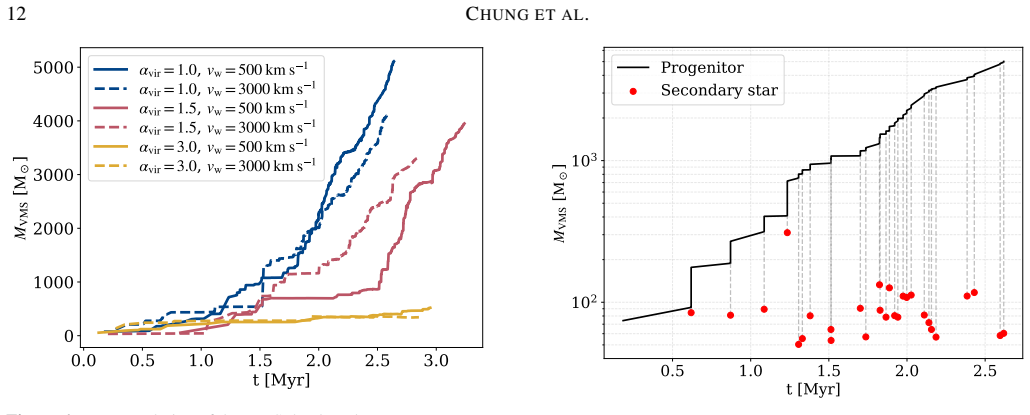
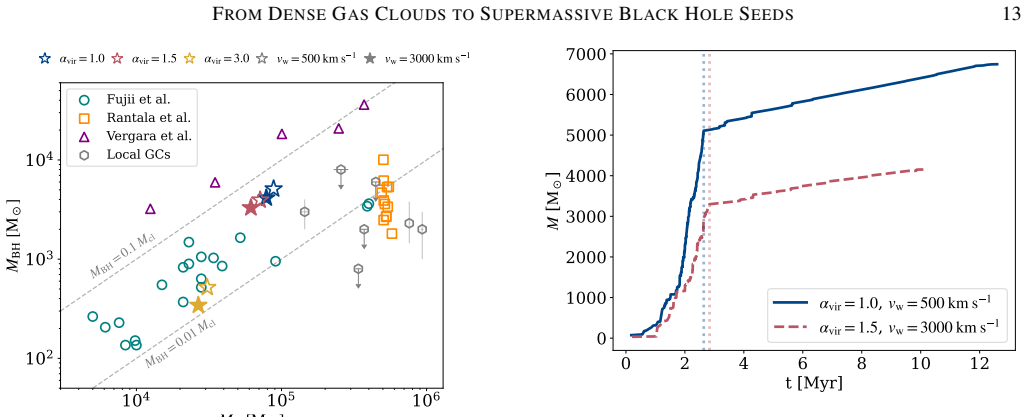
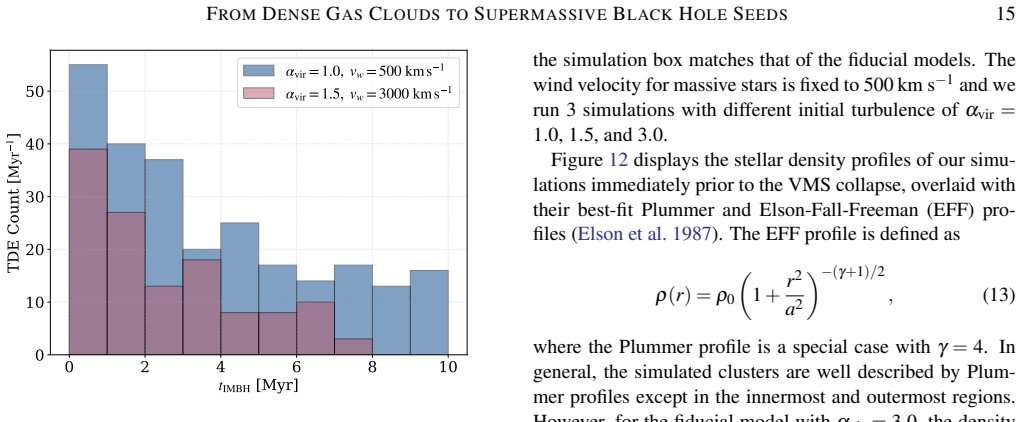
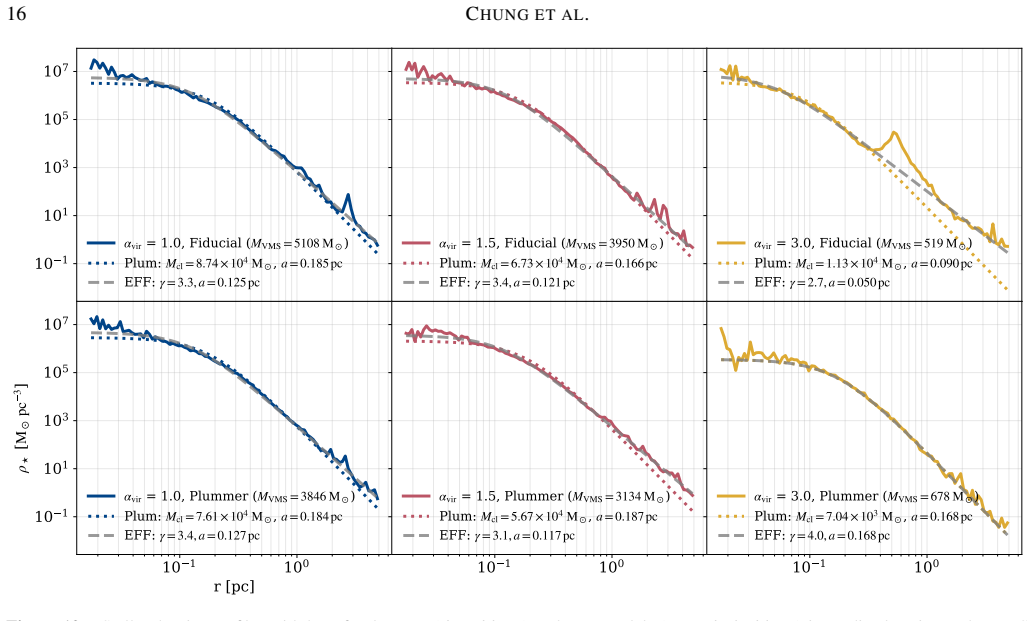
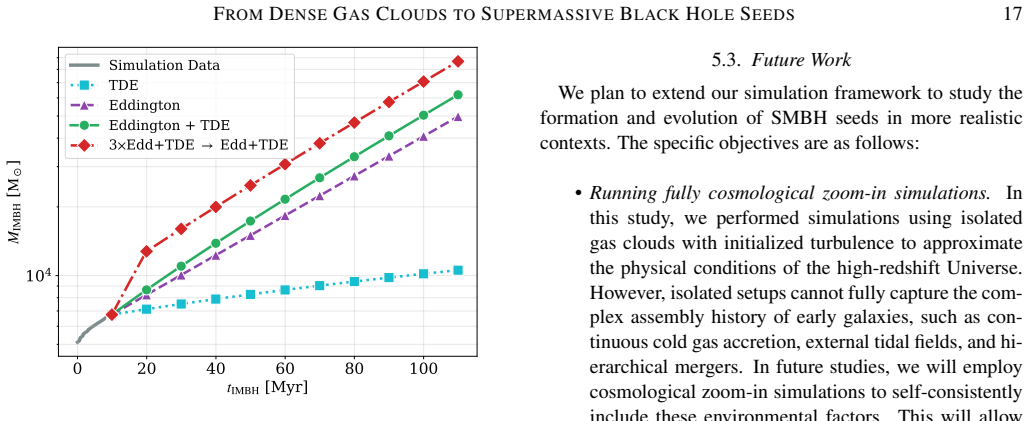
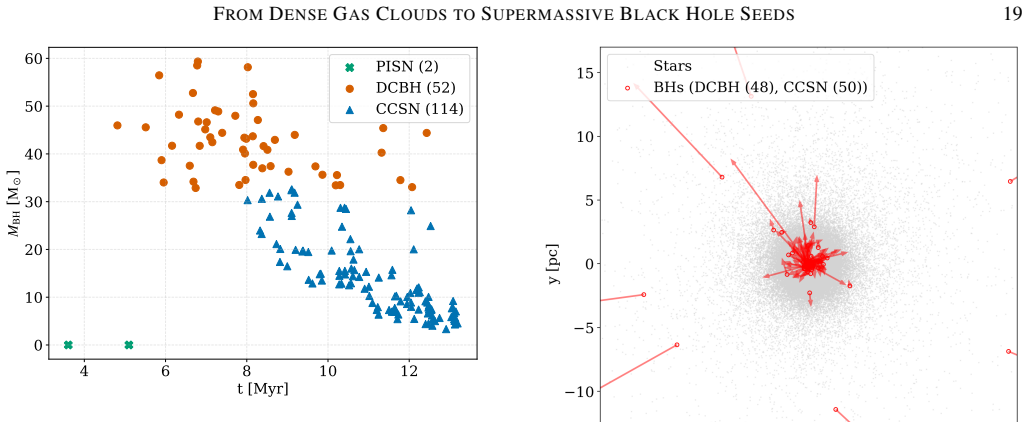
Modeling initially dense, metal-poor gas clouds with varying turbulence consistently produces dense clusters resembling early nuclear star clusters and very massive stars from 343 to 5108 solar masses via runaway collisions. Following direct collapse, the resulting IMBHs grow through Eddington-limited gas accretion and TDEs; in the most optimistic case the accretion rate reaches 1.64 times 10 to the minus 4 solar masses per year with TDEs supplying 23 percent of the mass over 10 Myr. Projecting with steady gas supply and constant TDE rate, an IMBH of initial mass 6747 solar masses reaches about 62000 solar masses in 100 Myr.
What carries the argument
Hybrid hydro/direct N-body integration in Enzo-Abyss that couples gas dynamics, self-gravity, stellar evolution and collisions, allowing runaway stellar collisions inside dense clusters formed from turbulent gas clouds.
If this is right
- IMBHs form naturally inside dense clusters without separate seeding prescriptions.
- Tidal disruption events can supply up to 23 percent of early IMBH mass growth over the first 10 Myr.
- The process operates across a range of initial turbulence levels and stellar wind strengths.
- Such IMBHs provide viable seeds capable of reaching supermassive scales within 100 Myr in high-redshift environments.
Where Pith is reading between the lines
- The same collision-driven channel may operate in other dense stellar systems at lower redshift if gas densities remain high enough.
- Targeted searches for IMBHs in the centers of high-redshift nuclear star clusters could directly test the predicted mass range and growth timescale.
- Variations in metallicity or initial cloud density could alter the upper mass limit of the very massive stars and therefore the starting IMBH masses.
Load-bearing premise
The long-term growth projection assumes a steady supply of gas into the nuclear star cluster together with a constant tidal disruption event rate over 100 million years.
What would settle it
A measurement showing that gas inflow into high-redshift nuclear star clusters falls below the level needed to sustain 1.64 times 10 to the minus 4 solar masses per year accretion, or that TDE rates are substantially lower than assumed, would prevent the projected growth from 6747 to 62000 solar masses.
Figures
read the original abstract
A population of dense stellar systems at high redshift has recently been uncovered by the JWST. To investigate the formation of supermassive black hole (SMBH) seeds in these dense environments without invoking any \textit{ad hoc} seeding mechanisms, we present star cluster-scale simulations performed with an updated version of the hydrodynamics code \texttt{Enzo-Abyss}, which self-consistently integrates the gravity using a direct $N$-body method coupled with stellar evolution. By modeling initially dense, metal-poor gas clouds with varying turbulence, we consistently find the formation of dense clusters resembling early-stage nuclear star clusters (NSCs), as well as the formation of very massive stars (VMSs) ranging from $343\;\mathrm{M_\odot}$ to $5108\;\mathrm{M_\odot}$ via runaway collisions, irrespective of stellar wind feedback strength. Following the direct collapse of these VMSs, the resulting intermediate-mass black holes (IMBHs) grow through Eddington-limited gas accretion and tidal disruption events (TDEs). In our most optimistic model, we find a mass accretion rate of $1.64\times10^{-4}\;\mathrm{M_\odot\;yr^{-1}}$, with TDEs contributing $23\%$ of the total accretion over $\sim10\;\mathrm{Myr}$. Assuming a steady gas supply into the NSC driven by rapid structural assembly in the high-redshift environment, together with a constant TDE rate, we project that an IMBH with an initial mass of $6747\;\mathrm{M_\odot}$ at the center of the NSC can grow to $\sim62000\;\mathrm{M_\odot}$ within $100\;\mathrm{Myr}$ of its formation. Our numerical study, conducted within a single self-consistent framework that incorporates the essential physical processes, suggests that VMSs can form in dense gas clouds, collapse into IMBHs, and subsequently provide viable seeds for the SMBHs observed at high redshift.
Editorial analysis
A structured set of objections, weighed in public.
Referee Report
Summary. The paper presents hybrid hydrodynamics/direct N-body simulations with an updated Enzo-Abyss code of initially dense, metal-poor gas clouds. It reports consistent formation of nuclear-star-cluster-like systems and very massive stars (343–5108 M⊙) via runaway collisions, independent of stellar-wind feedback strength. These VMSs collapse to IMBHs that grow by Eddington-limited accretion plus TDEs; the most optimistic run yields 1.64×10^{-4} M⊙ yr^{-1} with 23 % from TDEs over ~10 Myr. Under the explicit assumption of steady gas supply driven by high-redshift structural assembly and constant TDE rate, the authors project that a 6747 M⊙ IMBH reaches ~62 000 M⊙ in 100 Myr, offering a channel for high-z SMBH seeds without ad-hoc prescriptions.
Significance. If the VMS-formation and short-term accretion results are robust, the work supplies a single self-consistent numerical framework linking dense-cloud collapse to IMBH seeds, directly relevant to JWST-detected high-redshift dense stellar systems. The direct N-body gravity integration and inclusion of stellar evolution constitute clear technical strengths. The long-term growth projection, however, is the load-bearing element for the claim of viable SMBH seeds.
major comments (1)
- [Abstract] Abstract: the headline claim that an IMBH grows from 6747 M⊙ to ~62 000 M⊙ in 100 Myr is obtained solely by linear extrapolation of the ~10 Myr simulation result (accretion rate 1.64×10^{-4} M⊙ yr^{-1}, 23 % from TDEs) under the untested assumptions of steady gas supply and constant TDE rate. No part of the reported runs models the external reservoir or its replenishment; because the final mass scales directly with the assumed duration and constancy, any deviation (episodic inflow, feedback depletion, or NSC dynamical evolution) alters the projected seed mass and therefore the viability conclusion.
Simulated Author's Rebuttal
We thank the referee for their thoughtful and constructive report. The single major comment concerns the presentation of the long-term IMBH growth projection in the abstract. We address it point by point below and outline the revisions we will make.
read point-by-point responses
-
Referee: [Abstract] Abstract: the headline claim that an IMBH grows from 6747 M⊙ to ~62 000 M⊙ in 100 Myr is obtained solely by linear extrapolation of the ~10 Myr simulation result (accretion rate 1.64×10^{-4} M⊙ yr^{-1}, 23 % from TDEs) under the untested assumptions of steady gas supply and constant TDE rate. No part of the reported runs models the external reservoir or its replenishment; because the final mass scales directly with the assumed duration and constancy, any deviation (episodic inflow, feedback depletion, or NSC dynamical evolution) alters the projected seed mass and therefore the viability conclusion.
Authors: We agree that the 100 Myr projection is a linear extrapolation of the ~10 Myr simulated accretion rate under the explicit assumptions of steady gas supply and constant TDE rate, neither of which is modeled by extending the external reservoir in the runs. The abstract already qualifies the projection with the phrase “Assuming a steady gas supply…”, but we accept that the headline framing can be read as overstating the robustness of the long-term result. The primary scientific contribution remains the self-consistent hydro + direct N-body demonstration of VMS formation via runaway collisions and the subsequent short-term IMBH growth within the simulated NSC; the extrapolation is offered only as an order-of-magnitude illustration of possible seed viability under high-redshift conditions. We will revise the abstract to foreground the extrapolative character of the 100 Myr figure and will add a new paragraph in the discussion section that quantifies the sensitivity of the final mass to plausible variations in inflow duty cycle, TDE rate evolution, and NSC dynamical heating. revision: yes
Circularity Check
No circularity: core results from direct simulation; 100 Myr projection explicitly assumption-based extrapolation
full rationale
The paper's load-bearing claims (VMS formation via runaway collisions, IMBH seed masses, and the measured accretion rate of 1.64e-4 Msun/yr with 23% TDE contribution over ~10 Myr) are outputs of the Enzo-Abyss hydro + direct N-body runs described in the abstract and full text. The subsequent projection to ~62000 Msun in 100 Myr is introduced with the explicit qualifier 'Assuming a steady gas supply... together with a constant TDE rate, we project...', so it is not presented as a first-principles derivation or prediction forced by the simulation equations. No self-definitional loops, fitted inputs renamed as predictions, or load-bearing self-citations appear in the quoted material. The derivation chain is therefore self-contained against its stated simulation outputs and external assumptions.
Axiom & Free-Parameter Ledger
free parameters (2)
- initial turbulence levels
- stellar wind feedback strength
axioms (2)
- domain assumption Direct collapse of VMSs into IMBHs
- domain assumption Eddington-limited accretion
Reference graph
Works this paper leans on
-
[1]
2025, arXiv e-prints, arXiv:2512.08054, doi: 10.48550/arXiv.2512.08054
Abdurro’uf, Coe, D., Resseguier, T., et al. 2025, arXiv e-prints, arXiv:2512.08054, doi: 10.48550/arXiv.2512.08054
-
[2]
Adamo, A., Bradley, L. D., Vanzella, E., et al. 2024, Nature, 632, 513, doi: 10.1038/s41586-024-07703-7
-
[3]
1973, Journal of Computational Physics, 12, 389, doi: 10.1016/0021-9991(73)90160-5
Ahmad, A., & Cohen, L. 1973, Journal of Computational Physics, 12, 389, doi: 10.1016/0021-9991(73)90160-5
-
[4]
Akins, H. B., Casey, C. M., Lambrides, E., et al. 2025, ApJ, 991, 37, doi: 10.3847/1538-4357/ade984
-
[5]
2008, ApJ, 682, 1195, doi: 10.1086/589278
Ardi, E., Baumgardt, H., & Mineshige, S. 2008, ApJ, 682, 1195, doi: 10.1086/589278
-
[6]
Baumgardt, H., & Makino, J. 2003, MNRAS, 340, 227, doi: 10.1046/j.1365-8711.2003.06286.x
-
[7]
Begelman, M. C., V olonteri, M., & Rees, M. J. 2006, MNRAS, 370, 289, doi: 10.1111/j.1365-2966.2006.10467.x
-
[8]
Bernard, Y ., Moraux, E., Price, D. J., et al. 2025, A&A, 702, A26, doi: 10.1051/0004-6361/202554938
-
[9]
, year = 1952, month = jan, volume =
Bondi, H. 1952, MNRAS, 112, 195, doi: 10.1093/mnras/112.2.195
-
[10]
Bonnell, I. A., Bate, M. R., & Vine, S. G. 2003, MNRAS, 343, 413, doi: 10.1046/j.1365-8711.2003.06687.x
-
[11]
Booth, C. M., & Schaye, J. 2009, MNRAS, 398, 53, doi: 10.1111/j.1365-2966.2009.15043.x Bradaˇc, M., Judeˇz, J., Willott, C., et al. 2025, arXiv e-prints, arXiv:2509.20446, doi: 10.48550/arXiv.2509.20446
-
[12]
D., Adamo, A., Vanzella, E., et al
Bradley, L. D., Adamo, A., Vanzella, E., et al. 2025, ApJ, 991, 32, doi: 10.3847/1538-4357/adf638
-
[13]
2025, ApJ, 980, 41, doi: 10.3847/1538-4357/ada4a1
Brauer, K., Emerick, A., Mead, J., et al. 2025, ApJ, 980, 41, doi: 10.3847/1538-4357/ada4a1
-
[14]
Bressan, A., Marigo, P., Girardi, L., et al. 2012, MNRAS, 427, 127, doi: 10.1111/j.1365-2966.2012.21948.x
-
[15]
Brown, G., & Gnedin, O. Y . 2021, MNRAS, 508, 5935, doi: 10.1093/mnras/stab2907
-
[16]
Computer Physics Communications , series =
Bryan, G. L., Norman, M. L., Stone, J. M., Cen, R., & Ostriker, J. P. 1995, Computer Physics Communications, 89, 149, doi: 10.1016/0010-4655(94)00191-4
-
[17]
Bryan, G. L., Norman, M. L., O’Shea, B. W., et al. 2014, ApJS, 211, 19, doi: 10.1088/0067-0049/211/2/19
-
[18]
Cameron, A. J., Katz, H., Rey, M. P., & Saxena, A. 2023, MNRAS, 523, 3516, doi: 10.1093/mnras/stad1579
-
[19]
MESA Isochrones and Stellar Tracks (MIST). I: Solar-Scaled Models
Choi, J., Dotter, A., Conroy, C., et al. 2016, ApJ, 823, 102, doi: 10.3847/0004-637X/823/2/102
work page internal anchor Pith review doi:10.3847/0004-637x/823/2/102 2016
-
[20]
Cielo, S., Bieri, R., V olonteri, M., Wagner, A. Y ., & Dubois, Y . 2018, MNRAS, 477, 1336, doi: 10.1093/mnras/sty708
-
[21]
Colella, P., & Woodward, P. R. 1984, Journal of Computational Physics, 54, 174, doi: 10.1016/0021-9991(84)90143-8
-
[22]
2021, MNRAS, 501, 4514, doi: 10.1093/mnras/staa3916
Costa, G., Bressan, A., Mapelli, M., et al. 2021, MNRAS, 501, 4514, doi: 10.1093/mnras/staa3916
-
[23]
2019, MNRAS, 485, 4641, doi: 10.1093/mnras/stz728
Costa, G., Girardi, L., Bressan, A., et al. 2019, MNRAS, 485, 4641, doi: 10.1093/mnras/stz728
-
[24]
Cournoyer-Cloutier, C., Tran, A., Lewis, S., et al. 2021, MNRAS, 501, 4464, doi: 10.1093/mnras/staa3902
-
[25]
Cournoyer-Cloutier, C., Andersson, E. P., Appel, S. M., et al. 2025, ApJ, 990, 112, doi: 10.3847/1538-4357/adef01
-
[26]
doi:10.1088/0004-637X/703/1/785 , eprint =
Dekel, A., Sari, R., & Ceverino, D. 2009, ApJ, 703, 785, doi: 10.1088/0004-637X/703/1/785 Di Matteo, T., Springel, V ., & Hernquist, L. 2005, Nature, 433, 604, doi: 10.1038/nature03335
-
[27]
2025, ApJL, 989, L8, doi: 10.3847/2041-8213/adf286
Disberg, P., & Mandel, I. 2025, ApJL, 989, L8, doi: 10.3847/2041-8213/adf286
-
[28]
Dubois, Y ., Devriendt, J., Slyz, A., & Teyssier, R. 2012, MNRAS, 420, 2662, doi: 10.1111/j.1365-2966.2011.20236.x
-
[29]
Eisenstein, D. J., & Loeb, A. 1995, ApJ, 443, 11, doi: 10.1086/175498
-
[30]
Elson, R. A. W., Fall, S. M., & Freeman, K. C. 1987, ApJ, 323, 54, doi: 10.1086/165807
-
[31]
Emerick, A., Bryan, G. L., & Mac Low, M.-M. 2019, MNRAS, 482, 1304, doi: 10.1093/mnras/sty2689
-
[32]
2025, ApJ, 995, 44, doi: 10.3847/1538-4357/ae200e
Escala, A., Zimmermann, L., Valdebenito, S., et al. 2025, ApJ, 995, 44, doi: 10.3847/1538-4357/ae200e
-
[33]
Fabian, A. C. 2012, ARA&A, 50, 455, doi: 10.1146/annurev-astro-081811-125521
work page internal anchor Pith review doi:10.1146/annurev-astro-081811-125521 2012
-
[34]
Rosen, A. L. 2024, MNRAS, 527, 6732, doi: 10.1093/mnras/stad3609
-
[35]
Ferland, G. J., Porter, R. L., van Hoof, P. A. M., et al. 2013, RMxAA, 49, 137, doi: 10.48550/arXiv.1302.4485
work page internal anchor Pith review Pith/arXiv arXiv doi:10.48550/arxiv.1302.4485 2013
-
[36]
Foster, J. B., Cottaar, M., Covey, K. R., et al. 2015, ApJ, 799, 136, doi: 10.1088/0004-637X/799/2/136 FROMDENSEGASCLOUDS TOSUPERMASSIVEBLACKHOLESEEDS21
-
[37]
L., Belczynski, K., Wiktorowicz, G., et al
Fryer, C. L., Belczynski, K., Wiktorowicz, G., et al. 2012, ApJ, 749, 91, doi: 10.1088/0004-637X/749/1/91
-
[38]
S., Hattori, K., Wang, L., et al
Fujii, M. S., Hattori, K., Wang, L., et al. 2022, MNRAS, 514, 43, doi: 10.1093/mnras/stac808
-
[39]
Fujii, M. S., & Portegies Zwart, S. 2011, Science, 334, 1380, doi: 10.1126/science.1211927
-
[40]
Fujii, M. S., Saitoh, T. R., Hirai, Y ., & Wang, L. 2021, PASJ, 73, 1074, doi: 10.1093/pasj/psab061
-
[41]
S., Wang, L., Tanikawa, A., Hirai, Y., & Saitoh, T
Fujii, M. S., Wang, L., Tanikawa, A., Hirai, Y ., & Saitoh, T. R. 2024, Science, 384, 1488, doi: 10.1126/science.adi4211
-
[42]
2025, Nature Astronomy, 9, 1553, doi: 10.1038/s41550-025-02592-w
Fujimoto, S., Ouchi, M., Kohno, K., et al. 2025, Nature Astronomy, 9, 1553, doi: 10.1038/s41550-025-02592-w
-
[43]
2020, ApJ, 891, 141, doi: 10.3847/1538-4357/ab7335
Giacobbo, N., & Mapelli, M. 2020, ApJ, 891, 141, doi: 10.3847/1538-4357/ab7335
-
[44]
2018, MNRAS, 474, 2959, doi: 10.1093/mnras/stx2933
Giacobbo, N., Mapelli, M., & Spera, M. 2018, MNRAS, 474, 2959, doi: 10.1093/mnras/stx2933
-
[45]
Gieles, M., Heggie, D. C., & Zhao, H. 2011, MNRAS, 413, 2509, doi: 10.1111/j.1365-2966.2011.18320.x
-
[46]
Goldbaum, N. J., Krumholz, M. R., & Forbes, J. C. 2015, ApJ, 814, 131, doi: 10.1088/0004-637X/814/2/131 —. 2016, ApJ, 827, 28, doi: 10.3847/0004-637X/827/1/28
-
[47]
Goulding, A. D., Greene, J. E., Setton, D. J., et al. 2023, ApJL, 955, L24, doi: 10.3847/2041-8213/acf7c5 Grudi´c, M. Y ., Guszejnov, D., Hopkins, P. F., Offner, S. S. R., &
-
[48]
Faucher-Gigu`ere, C.-A. 2021, MNRAS, 506, 2199, doi: 10.1093/mnras/stab1347
-
[49]
A., Pacucci, F., & Kocevski, D
Guia, C. A., Pacucci, F., & Kocevski, D. D. 2024, Research Notes of the American Astronomical Society, 8, 207, doi: 10.3847/2515-5172/ad7262
-
[50]
2012, ApJ, 746, 125, doi: 10.1088/0004-637X/746/2/125
Haardt, F., & Madau, P. 2012, ApJ, 746, 125, doi: 10.1088/0004-637X/746/2/125
-
[51]
arXiv , author =:2303.11946 , journal =
Harikane, Y ., Zhang, Y ., Nakajima, K., et al. 2023, ApJ, 959, 39, doi: 10.3847/1538-4357/ad029e
-
[52]
Heger, A., & Woosley, S. E. 2002, ApJ, 567, 532, doi: 10.1086/338487
-
[53]
C., Hut, P., Mineshige, S., Makino, J., & Baumgardt, H
Heggie, D. C., Hut, P., Mineshige, S., Makino, J., & Baumgardt, H. 2007, PASJ, 59, L11, doi: 10.1093/pasj/59.3.L11
-
[54]
Hirai, Y ., Fujii, M. S., & Saitoh, T. R. 2021, PASJ, 73, 1036, doi: 10.1093/pasj/psab038
-
[55]
Monthly Notices of the Royal Astronomical Society , author =
Hobbs, G., Lorimer, D. R., Lyne, A. G., & Kramer, M. 2005, MNRAS, 360, 974, doi: 10.1111/j.1365-2966.2005.09087.x
-
[56]
W., & Eastwood, J
Hockney, R. W., & Eastwood, J. W. 1988, Computer simulation using particles
1988
-
[57]
Hoyle, F., & Lyttleton, R. A. 1939, Proceedings of the Cambridge Philosophical Society, 35, 405, doi: 10.1017/S0305004100021150
-
[58]
Hurley, J. R., Pols, O. R., & Tout, C. A. 2000, MNRAS, 315, 543, doi: 10.1046/j.1365-8711.2000.03426.x
-
[59]
Monthly Notices of the Royal Astronomical Society , author =
Hurley, J. R., Tout, C. A., & Pols, O. R. 2002, MNRAS, 329, 897, doi: 10.1046/j.1365-8711.2002.05038.x
-
[60]
Igoshev, A. P. 2020, MNRAS, 494, 3663, doi: 10.1093/mnras/staa958
-
[61]
Inayoshi, K., Haiman, Z., & Ostriker, J. P. 2016, MNRAS, 459, 3738, doi: 10.1093/mnras/stw836
-
[62]
doi:10.1146/annurev-astro-120419-014455 , eprint =
Inayoshi, K., Visbal, E., & Haiman, Z. 2020, ARA&A, 58, 27, doi: 10.1146/annurev-astro-120419-014455
-
[63]
2023, MNRAS, 524, 426, doi: 10.1093/mnras/stad1630
Iorio, G., Mapelli, M., Costa, G., et al. 2023, MNRAS, 524, 426, doi: 10.1093/mnras/stad1630
-
[64]
Jo, Y ., Jung, M., Bryan, G. L., et al. 2026, arXiv e-prints, arXiv:2603.18242, doi: 10.48550/arXiv.2603.18242
-
[65]
Jo, Y ., Kim, S., Kim, J.-h., & Bryan, G. L. 2024, ApJ, 974, 193, doi: 10.3847/1538-4357/ad6b16
-
[66]
Kim, J.-h., Wise, J. H., Abel, T., et al. 2019, ApJ, 887, 120, doi: 10.3847/1538-4357/ab510b
-
[67]
Kim, J.-h., Wise, J. H., Alvarez, M. A., & Abel, T. 2011, ApJ, 738, 54, doi: 10.1088/0004-637X/738/1/54 Kızıltan, B., Baumgardt, H., & Loeb, A. 2017, Nature, 542, 203, doi: 10.1038/nature21361
-
[68]
D., Onoue, M., Inayoshi, K., et al
Kocevski, D. D., Onoue, M., Inayoshi, K., et al. 2023, ApJL, 954, L4, doi: 10.3847/2041-8213/ace5a0
-
[69]
Kochanek, C. S. 1992, ApJ, 385, 604, doi: 10.1086/170966
-
[70]
The Astrophysical Journal , author =
Kokorev, V ., Caputi, K. I., Greene, J. E., et al. 2024, ApJ, 968, 38, doi: 10.3847/1538-4357/ad4265 Kov´acs, O. E., Bogd´an, ´A., Natarajan, P., et al. 2024, ApJL, 965, L21, doi: 10.3847/2041-8213/ad391f
-
[71]
Kroupa, P. 2001, MNRAS, 322, 231, doi: 10.1046/j.1365-8711.2001.04022.x
-
[72]
STIEFEL, E. 1965, Journal f¨ur die reine und angewandte Mathematik, 1965, 204, doi: doi:10.1515/crll.1965.218.204 Lah´en, N., Naab, T., Rantala, A., & Partmann, C. 2025, MNRAS, 543, 1023, doi: 10.1093/mnras/staf1546
-
[73]
2003, ApJS, 146, 417, doi: 10.1086/374373
Lanz, T., & Hubeny, I. 2003, ApJS, 146, 417, doi: 10.1086/374373
-
[74]
Larson, R. L., Finkelstein, S. L., Kocevski, D. D., et al. 2023, ApJL, 953, L29, doi: 10.3847/2041-8213/ace619
-
[75]
Lattimer, J. M., & Yahil, A. 1989, ApJ, 340, 426, doi: 10.1086/167404
-
[76]
Lee, H. M. 1987, ApJ, 319, 801, doi: 10.1086/165498
-
[77]
Lee, S., Kim, J.-h., & Oh, B. K. 2023, ApJ, 943, 77, doi: 10.3847/1538-4357/aca75d
-
[78]
Lee, S., Lee, H. M., Kim, J.-h., et al. 2025, ApJ, 988, 15, doi: 10.3847/1538-4357/adde52
-
[79]
Lodato, G., & Natarajan, P. 2006, MNRAS, 371, 1813, doi: 10.1111/j.1365-2966.2006.10801.x
-
[80]
Loeb, A., & Rasio, F. A. 1994, ApJ, 432, 52, doi: 10.1086/174548 L¨utzgendorf, N., Kissler-Patig, M., Gebhardt, K., et al. 2013, A&A, 552, A49, doi: 10.1051/0004-6361/201220307
discussion (0)
Sign in with ORCID, Apple, or X to comment. Anyone can read and Pith papers without signing in.