Revealing the Origin of Desert Dwellers via Stellar Obliquities
Pith reviewed 2026-06-27 11:35 UTC · model grok-4.3
The pith
Roche lobe overflow during gas giant destruction aligns host star spins with remnant planet orbits.
A machine-rendered reading of the paper's core claim, the machinery that carries it, and where it could break.
Core claim
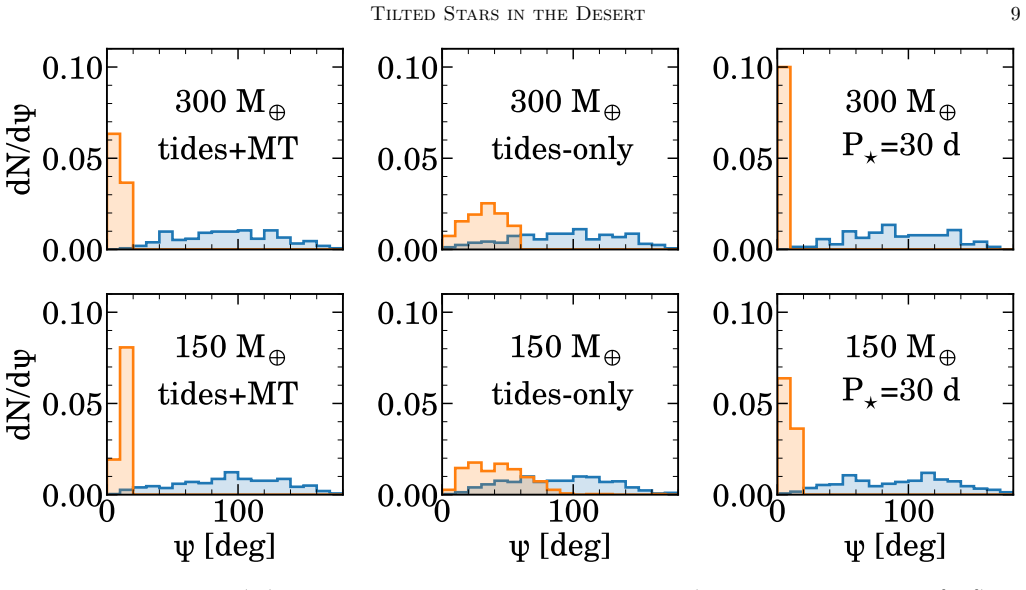
Lossy Roche lobe overflow tilts host stars into spin-orbit alignment within a few tens of degrees regardless of initial conditions; the alignment is reversed only by misaligned companion planets inside about 2 au. Retrograde cases of the same mass transfer produce slowly rotating stars, reconciling theory with the anomalously slow host of LTT 9779.
What carries the argument
Lossy Roche lobe overflow, the regime in which most of the planet's orbital angular momentum is removed during planet-to-star mass transfer.
If this is right
- Desert-dweller systems should show low stellar obliquities.
- Misaligned companions inside 2 au are the only way to produce high-obliquity desert dwellers under this channel.
- Some host stars can finish RLO as slow rotators when the initial orbit is retrograde.
- The resulting obliquity distribution differs from the broad distribution expected after high-eccentricity migration.
Where Pith is reading between the lines
- Obliquity measurements of known desert systems could map which planets arrived via RLO versus other routes.
- The same alignment signature may appear in other close-in sub-Neptune populations if they also experienced lossy mass transfer.
Load-bearing premise
Mass transfer during Roche lobe overflow removes most of the planet's orbital angular momentum.
What would settle it
A desert dweller found with stellar obliquity above a few tens of degrees and no misaligned companion inside 2 au would contradict the alignment prediction.
Figures
read the original abstract
Observations suggest that the hot Neptune desert contains the remnants of destroyed gas giants. Recent theoretical work has shown that gas giant destruction via Roche lobe overflow (RLO) can indeed populate the desert with remnant planets, but only if mass transfer removes most of the planet's orbital angular momentum ("lossy" RLO). Motivated by the fact that stellar accretion naturally gives rise to such lossy RLO, in this Letter we examine how planet-to-star mass and angular momentum transfer manifests in the distribution of stellar obliquities. We find that RLO tilts host stars into spin/orbit alignment (within a few ${\sim}$tens of degrees) regardless of initial conditions. Obliquity damping by RLO can only be reversed by the presence of misaligned companion planets within ${\lesssim}$2 au. While tides and mass transfer usually produce stellar spin up, host stars can also emerge from RLO slowly rotating if systems begin strongly retrograde; retrograde RLO reconciles theory with the anomalously slow rotation of the desert dweller host, LTT 9779. Predicted spin/orbit alignment may differentiate RLO from alternative giant planet destruction mechanisms, in particular hot Jupiter disruption during high eccentricity migration (which tends to produce broadly distributed stellar obliquities). We summarize other population-level predictions that can further distinguish RLO from high eccentricity migration. Our work suggests that follow-up obliquity measurements may reveal the formation pathways of desert dwellers, and potentially open a window into gas giants' exposed interiors.
Editorial analysis
A structured set of objections, weighed in public.
Referee Report
Summary. The manuscript argues that lossy Roche lobe overflow (RLO) during gas giant destruction populates the hot Neptune desert while driving host-star spin-orbit alignment to within a few tens of degrees regardless of initial conditions. Alignment damping is claimed to be reversible only by misaligned companions within ≲2 au; retrograde RLO is invoked to explain slow rotators such as LTT 9779; and obliquity measurements are proposed as a discriminant between RLO and high-eccentricity migration.
Significance. If the numerical results are robust, the work supplies an observable signature (near-alignment) that could distinguish RLO from alternative giant-planet destruction channels and thereby constrain the formation pathways of desert dwellers.
major comments (2)
- [Abstract / modeling description] The claim that alignment occurs 'regardless of initial conditions' (abstract) is load-bearing and rests entirely on the lossy-RLO assumption that mass transfer removes most of the planet's orbital angular momentum. The manuscript motivates this regime from stellar accretion but supplies no planet-specific derivation, torque calculation, or parameter sweep demonstrating that the specific angular momentum carried away by the transferred gas is high enough to produce the reported damping; a nearer-to-conservative transfer would change the torque on the stellar spin vector and could eliminate the alignment result.
- [Abstract / modeling description] The statement that obliquity damping 'can only be reversed by the presence of misaligned companion planets within ≲2 au' (abstract) is presented as a firm outcome of the modeling, yet no quantitative threshold or companion-mass dependence is shown; the result appears to depend on the same unexamined angular-momentum-loss prescription.
minor comments (2)
- The abstract states modeling results without equations, integration method, explored initial-condition ranges, or error analysis; these details should be supplied even in Letter format.
- The phrase 'a few ∼tens of degrees' should be replaced by the actual median or range of final obliquities obtained from the simulations.
Simulated Author's Rebuttal
We thank the referee for their constructive comments, which highlight areas where the modeling assumptions can be better justified. We address each major comment below and will revise the manuscript to incorporate additional derivations and quantitative details.
read point-by-point responses
-
Referee: [Abstract / modeling description] The claim that alignment occurs 'regardless of initial conditions' (abstract) is load-bearing and rests entirely on the lossy-RLO assumption that mass transfer removes most of the planet's orbital angular momentum. The manuscript motivates this regime from stellar accretion but supplies no planet-specific derivation, torque calculation, or parameter sweep demonstrating that the specific angular momentum carried away by the transferred gas is high enough to produce the reported damping; a nearer-to-conservative transfer would change the torque on the stellar spin vector and could eliminate the alignment result.
Authors: We agree that the lossy RLO assumption is central and that a planet-specific justification would strengthen the paper. The motivation from stellar accretion is noted in the manuscript, but we will add an appendix with a torque calculation for the planet-star mass transfer case and a parameter sweep over mass-transfer efficiencies (including values approaching conservative transfer) to demonstrate the range over which the alignment damping holds. This will explicitly address how the specific angular momentum loss produces the reported result. revision: yes
-
Referee: [Abstract / modeling description] The statement that obliquity damping 'can only be reversed by the presence of misaligned companion planets within ≲2 au' (abstract) is presented as a firm outcome of the modeling, yet no quantitative threshold or companion-mass dependence is shown; the result appears to depend on the same unexamined angular-momentum-loss prescription.
Authors: We agree that the abstract phrasing would benefit from supporting quantitative details. The ≲2 au threshold and reversal condition are outcomes of our post-RLO N-body integrations, but we will expand the main text (and add a figure) to show the explicit dependence on companion mass, semi-major axis, and the angular-momentum-loss efficiency. This will clarify the conditions under which reversal occurs within the lossy RLO framework. revision: yes
Circularity Check
No circularity: alignment follows from angular-momentum equations under explicit lossy-RLO assumption
full rationale
The paper states lossy RLO (most orbital angular momentum removed during mass transfer) as an input assumption motivated by stellar accretion, then integrates the resulting torques on stellar spin and orbital angular momentum to obtain the alignment outcome. This is a forward dynamical calculation, not a self-definition, fitted-parameter prediction, or reduction to a self-citation. The cited prior work on desert population is external to the obliquity derivation and does not render the present equations tautological. The model remains falsifiable against observed obliquity distributions once the lossy assumption is granted.
Axiom & Free-Parameter Ledger
free parameters (1)
- initial obliquity and stellar rotation rates
axioms (1)
- domain assumption Mass transfer during RLO removes most of the planet's orbital angular momentum (lossy RLO)
Reference graph
Works this paper leans on
-
[1]
Albrecht, S. H., Dawson, R. I., & Winn, J. N. 2022, PASP, 134, 082001, doi: 10.1088/1538-3873/ac6c09
-
[2]
Anderson, K. R., Storch, N. I., & Lai, D. 2016, MNRAS, 456, 3671, doi: 10.1093/mnras/stv2906
-
[3]
Armstrong, D. J., Lopez, T. A., Adibekyan, V., et al. 2020, Nature, 583, 39, doi: 10.1038/s41586-020-2421-7
-
[4]
2006, ApJ, 650, 394, doi: 10.1086/506011
Arras, P., & Bildsten, L. 2006, ApJ, 650, 394, doi: 10.1086/506011
-
[5]
2023, A&A, 674, A120, doi: 10.1051/0004-6361/202245237
Attia, M., Bourrier, V., Delisle, J.-B., & Eggenberger, P. 2023, A&A, 674, A120, doi: 10.1051/0004-6361/202245237
-
[6]
2018, ApJL, 866, L2, doi: 10.3847/2041-8213/aade90
Bailey, E., & Batygin, K. 2018, ApJL, 866, L2, doi: 10.3847/2041-8213/aade90
-
[7]
2004, A&A, 419, L13, doi: 10.1051/0004-6361:20040129
Baraffe, I., Selsis, F., Chabrier, G., et al. 2004, A&A, 419, L13, doi: 10.1051/0004-6361:20040129
-
[8]
Barker, A. J., & Ogilvie, G. I. 2009, MNRAS, 395, 2268, doi: 10.1111/j.1365-2966.2009.14694.x
-
[9]
A., Weingrill, J., Fritzewski, D., Strassmeier, K
Barnes, S. A., Weingrill, J., Fritzewski, D., Strassmeier, K. G., & Platais, I. 2016, ApJ, 823, 16, doi: 10.3847/0004-637X/823/1/16 5 Available here. Beaug´ e, C., & Nesvorn´ y, D. 2013, ApJ, 763, 12, doi: 10.1088/0004-637X/763/1/12
-
[10]
Beyer, A. C., & White, R. J. 2024, ApJ, 973, 28, doi: 10.3847/1538-4357/ad6b0d
-
[11]
Bourrier, V., Attia, M., Mallonn, M., et al. 2023, A&A, 669, A63, doi: 10.1051/0004-6361/202245004
-
[12]
2025, A&A, 701, A190, doi: 10.1051/0004-6361/202554856
Bourrier, V., Steiner, M., Castro-Gonz´ alez, A., et al. 2025, A&A, 701, A190, doi: 10.1051/0004-6361/202554856
-
[13]
2017, MNRAS, 470, 1360, doi: 10.1093/mnras/stx1277
Bovy, J. 2017, MNRAS, 470, 1360, doi: 10.1093/mnras/stx1277
-
[14]
Campbell, C. G. 1984, MNRAS, 211, 83, doi: 10.1093/mnras/211.1.83
-
[15]
Carleo, I., Castro-Gonz´ alez, A., Pall´ e, E., et al. 2026, A&A, 707, A4, doi: 10.1051/0004-6361/202557186 Castro-Gonz´ alez, A., Bourrier, V., Lillo-Box, J., et al. 2024, A&A, 689, A250, doi: 10.1051/0004-6361/202450957
-
[16]
2025, ApJ, 994, 43, doi: 10.3847/1538-4357/ae0cbf
Murray-Clay, R. 2025, ApJ, 994, 43, doi: 10.3847/1538-4357/ae0cbf
-
[17]
2023, A&A, 674, A67, doi: 10.1051/0004-6361/202346250
Claret, A. 2023, A&A, 674, A67, doi: 10.1051/0004-6361/202346250
-
[18]
1989, A&AS, 81, 37
Claret, A., & Gimenez, A. 1989, A&AS, 81, 37
1989
-
[19]
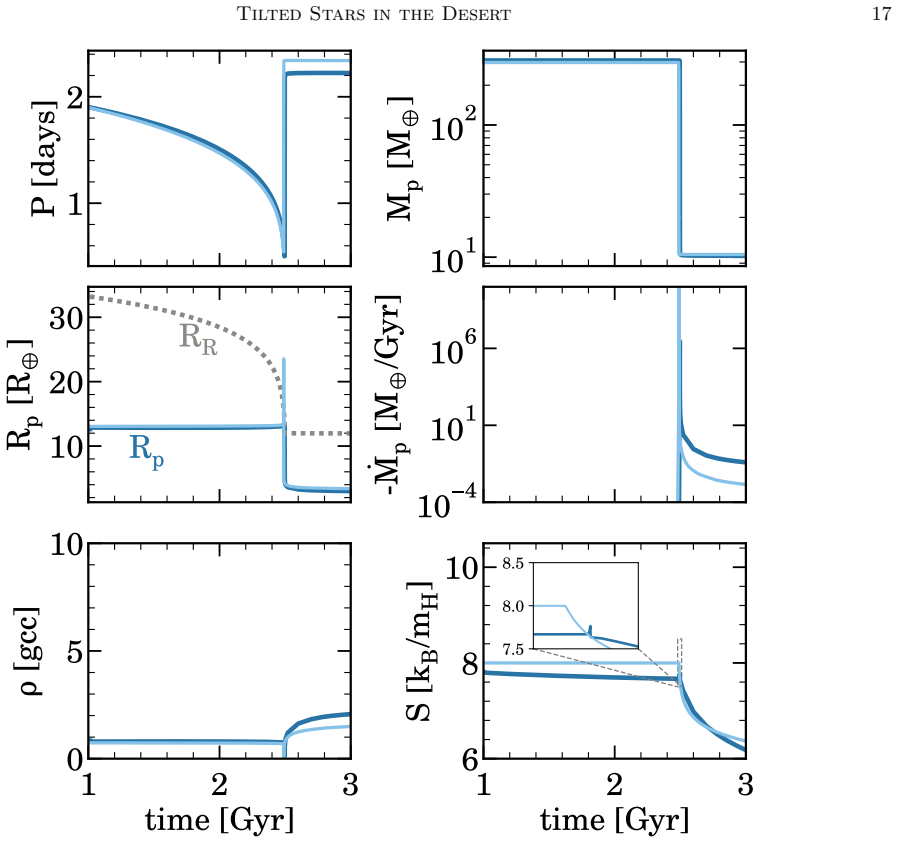
Cropper, M. 1990, SSRv, 54, 195, doi: 10.1007/BF00177799 Tilted Stars in the Desert17 1 2P [days] 101 102 Mp [M ] 10 20 30 Rp [R ] Rp RR 10 4 101 106 - ˙Mp [M /Gyr] 1 2 3 time [Gyr] 0 5 10 [gcc] 1 2 3 time [Gyr] 6 8 10 S [kB/mH] 7.5 8.0 8.5 Figure 8.“Lossy” RLO of a hot Jupiter with a 10M ⊕ core as computed two different ways. Top to bottom, left panels: ...
-
[20]
Cui, K., Armstrong, D. J., Hadjigeorghiou, A., et al. 2026, MNRAS, 546, stag022, doi: 10.1093/mnras/stag022
-
[21]
PASP , archivePrefix = "arXiv", eprint =
Cumming, A., Butler, R. P., Marcy, G. W., et al. 2008, PASP, 120, 531, doi: 10.1086/588487
-
[22]
Dawson, R. I. 2014, ApJL, 790, L31, doi: 10.1088/2041-8205/790/2/L31
-
[23]
Dawson, R. I., & Johnson, J. A. 2018, ARA&A, 56, 175, doi: 10.1146/annurev-astro-081817-051853
work page internal anchor Pith review doi:10.1146/annurev-astro-081817-051853 2018
-
[24]
Dobbs-Dixon, I., Lin, D. N. C., & Mardling, R. A. 2004, ApJ, 610, 464, doi: 10.1086/421510
-
[25]
Doyle, L., Armstrong, D. J., Acu˜ na, L., et al. 2025, MNRAS, doi: 10.1093/mnras/staf670
-
[26]
2022, MNRAS, 517, 4916, doi: 10.1093/mnras/stac2945
El-Badry, K., Conroy, C., Fuller, J., et al. 2022, MNRAS, 517, 4916, doi: 10.1093/mnras/stac2945
-
[27]
POSEIDON I: The Dynamical Origins of Transiting Neptunes
Espinoza-Retamal, J. I., Winn, J. N., Brahm, R., et al. 2026, arXiv e-prints, arXiv:2602.18553, doi: 10.48550/arXiv.2602.18553
work page internal anchor Pith review Pith/arXiv arXiv doi:10.48550/arxiv.2602.18553 2026
-
[28]
2007, ApJ, 669, 1298, doi: 10.1086/521702
Fabrycky, D., & Tremaine, S. 2007, ApJ, 669, 1298, doi: 10.1086/521702
-
[29]
H., Naoz, S., Li, G., & Inzunza, N
Faridani, T. H., Naoz, S., Li, G., & Inzunza, N. 2023, ApJ, 956, 90, doi: 10.3847/1538-4357/acf378 Fern´ andez Fern´ andez, J., Wheatley, P. J., King, G. W., &
-
[30]
Jenkins, J. S. 2024, MNRAS, 527, 911, doi: 10.1093/mnras/stad3263
-
[31]
Fulton, B. J., Rosenthal, L. J., Hirsch, L. A., et al. 2021, ApJS, 255, 14, doi: 10.3847/1538-4365/abfcc1
-
[32]
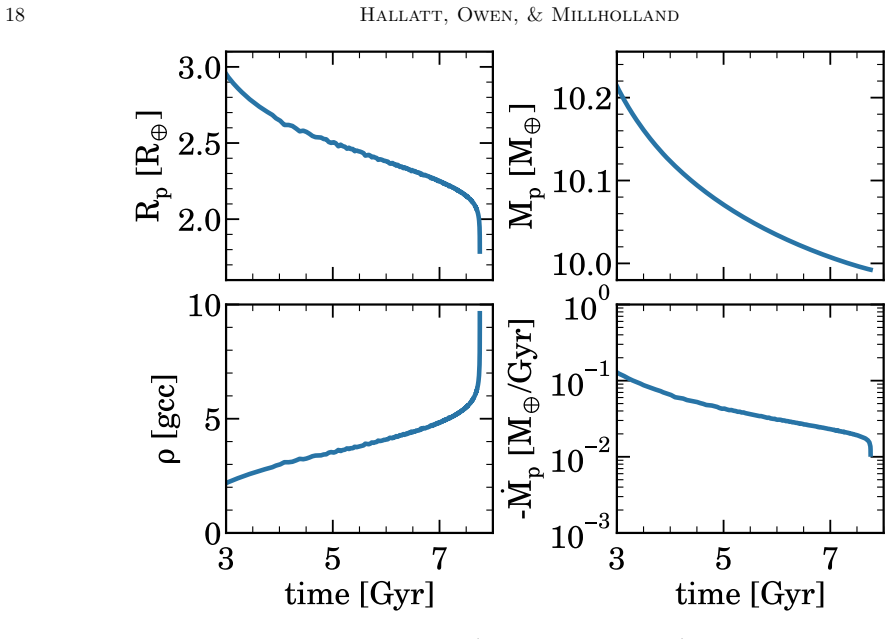
Gallet, F., & Bouvier, J. 2013, A&A, 556, A36, doi: 10.1051/0004-6361/201321302 18Hallatt, Owen, & Millholland 2.0 2.5 3.0 Rp [R ] 10.0 10.1 10.2 Mp [M ] 3 5 7 time [Gyr] 0 5 10 [gcc] 3 5 7 time [Gyr] 10 3 10 2 10 1 100 - ˙Mp [M /Gyr] Figure 9.Post-RLO evolution of the planet from Figure 8 (note the differingxyaxes). OurMESAcalculation produces late-time ...
-
[33]
Giacalone, S., Howard, A. W., Rubenzahl, R. A., et al. 2025, PASP, 137, 074401, doi: 10.1088/1538-3873/adecc2
-
[34]
Goldreich, P., & Tremaine, S. 1979, ApJ, 233, 857, doi: 10.1086/157448 —. 1980, ApJ, 241, 425, doi: 10.1086/158356
-
[35]
2011, ApJ, 732, 74, doi: 10.1088/0004-637X/732/2/74
Guillochon, J., Ramirez-Ruiz, E., & Lin, D. 2011, ApJ, 732, 74, doi: 10.1088/0004-637X/732/2/74
-
[36]
Gupta, A. F., Millholland, S. C., Im, H., et al. 2024, Nature, 632, 50, doi: 10.1038/s41586-024-07688-3
-
[37]
Hallatt, T., & Lee, E. J. 2020, ApJ, 904, 134, doi: 10.3847/1538-4357/abc1d7 —. 2022, ApJ, 924, 9, doi: 10.3847/1538-4357/ac32c9
-
[38]
2026a, ApJ, 997, 139, doi: 10.3847/1538-4357/adfb75 —
Hallatt, T., & Millholland, S. 2026a, ApJ, 997, 139, doi: 10.3847/1538-4357/adfb75 —. 2026b, ApJ, 997, 138, doi: 10.3847/1538-4357/ae129d
-
[39]
Hansen, B. M. S. 2017, MNRAS, 467, 1531, doi: 10.1093/mnras/stx182
-
[40]
Harris, A. W., & Ward, W. R. 1982, Annual Review of Earth and Planetary Sciences, 10, 61, doi: 10.1146/annurev.ea.10.050182.000425
-
[41]
Harris, C. R., Millman, K. J., van der Walt, S. J., et al. 2020, Nature, 585, 357, doi: 10.1038/s41586-020-2649-2
-
[42]
Haswell, C. A., Staab, D., Barnes, J. R., et al. 2020, Nature Astronomy, 4, 408, doi: 10.1038/s41550-019-0973-y
-
[43]
Hubbard, W. B. 1977, Icarus, 30, 305, doi: 10.1016/0019-1035(77)90164-6
-
[44]
Hunter, J. D. 2007, Computing in Science & Engineering, 9, 90, doi: 10.1109/MCSE.2007.55
-
[45]
Ionov, D. E., Pavlyuchenkov, Y. N., & Shematovich, V. I. 2018, MNRAS, 476, 5639, doi: 10.1093/mnras/sty626
-
[46]
Jenkins, J. S., D´ ıaz, M. R., Kurtovic, N. T., et al. 2020, Nature Astronomy, 4, 1148, doi: 10.1038/s41550-020-1142-z
-
[47]
Jia, S., & Spruit, H. C. 2017, MNRAS, 465, 149, doi: 10.1093/mnras/stw1693
-
[48]
R., Frank, J., & Whitehurst, R
King, A. R., Frank, J., & Whitehurst, R. 1990, MNRAS, 244, 731
1990
-
[49]
2023, MNRAS, 519, 5637, doi: 10.1093/mnras/stac3684
Knudstrup, E., Gandolfi, D., Nowak, G., et al. 2023, MNRAS, 519, 5637, doi: 10.1093/mnras/stac3684
-
[50]
Kraft, R. P. 1967, ApJ, 150, 551, doi: 10.1086/149359
-
[51]
2014, ApJ, 783, 54, doi: 10.1088/0004-637X/783/1/54
Kurokawa, H., & Nakamoto, T. 2014, ApJ, 783, 54, doi: 10.1088/0004-637X/783/1/54
-
[52]
Lai, D. 2012, MNRAS, 423, 486, doi: 10.1111/j.1365-2966.2012.20893.x Tilted Stars in the Desert19
-
[53]
Lai, D., Anderson, K. R., & Pu, B. 2018, MNRAS, 475, 5231, doi: 10.1093/mnras/sty133
-
[54]
Lamb, F. K., Pethick, C. J., & Pines, D. 1973, ApJ, 184, 271, doi: 10.1086/152325
-
[55]
Lee, E. J. 2019, ApJ, 878, 36, doi: 10.3847/1538-4357/ab1b40
-
[56]
Lee, E. J., & Chiang, E. 2017, ApJ, 842, 40, doi: 10.3847/1538-4357/aa6fb3
-
[57]
The Astrophysical Journal , author =
Li, G., Naoz, S., Kocsis, B., & Loeb, A. 2014, ApJ, 785, 116, doi: 10.1088/0004-637X/785/2/116
-
[58]
Lin, D. N. C., & Papaloizou, J. 1979, MNRAS, 186, 799, doi: 10.1093/mnras/186.4.799
-
[59]
Liu, S.-F., Guillochon, J., Lin, D. N. C., & Ramirez-Ruiz, E. 2013, ApJ, 762, 37, doi: 10.1088/0004-637X/762/1/37
-
[60]
Liu, S.-F., Hori, Y., Lin, D. N. C., & Asphaug, E. 2015, ApJ, 812, 164, doi: 10.1088/0004-637X/812/2/164
-
[61]
Stability of Multiplanet Systems Through Hot Jupiter Destruction
Liveoak, D., Hallatt, T., & Millholland, S. 2026, arXiv e-prints, arXiv:2604.19918, doi: 10.48550/arXiv.2604.19918
work page internal anchor Pith review Pith/arXiv arXiv doi:10.48550/arxiv.2604.19918 2026
-
[62]
Louden, E. M., & Millholland, S. C. 2024, ApJ, 974, 304, doi: 10.3847/1538-4357/ad74ff
-
[63]
S., Kjeldsen, H., Albrecht, S., et al
Lundkvist, M. S., Kjeldsen, H., Albrecht, S., et al. 2016, Nature Communications, 7, 11201, doi: 10.1038/ncomms11201
-
[64]
Marleau, G. D., & Cumming, A. 2014, MNRAS, 437, 1378, doi: 10.1093/mnras/stt1967
-
[65]
2016, ApJL, 820, L8, doi: 10.3847/2041-8205/820/1/L8 —
Matsakos, T., & K¨ onigl, A. 2016, ApJL, 820, L8, doi: 10.3847/2041-8205/820/1/L8 —. 2017, AJ, 153, 60, doi: 10.3847/1538-3881/153/2/60
-
[66]
Matsumura, S., Peale, S. J., & Rasio, F. A. 2010, ApJ, 725, 1995, doi: 10.1088/0004-637X/725/2/1995
-
[67]
Greene, T. P. 2012, ApJL, 754, L26, doi: 10.1088/2041-8205/754/2/L26
-
[68]
2016, A&A, 589, A75, doi: 10.1051/0004-6361/201528065
Mazeh, T., Holczer, T., & Faigler, S. 2016, A&A, 589, A75, doi: 10.1051/0004-6361/201528065
-
[69]
Murray, C. D., & Dermott, S. F. 1999, Solar System Dynamics (Cambridge University Press), doi: 10.1017/CBO9781139174817
-
[70]
Murray-Clay, R. A., Chiang, E. I., & Murray, N. 2009, ApJ, 693, 23, doi: 10.1088/0004-637X/693/1/23
-
[71]
Mustill, A. J., Davies, M. B., & Johansen, A. 2015, ApJ, 808, 14, doi: 10.1088/0004-637X/808/1/14
-
[72]
Owen, J. E., & Jackson, A. P. 2012, MNRAS, 425, 2931, doi: 10.1111/j.1365-2966.2012.21481.x
-
[73]
Owen, J. E., & Lai, D. 2018, MNRAS, 479, 5012, doi: 10.1093/mnras/sty1760
-
[74]
Owen, J. E., & Wu, Y. 2016, ApJ, 817, 107, doi: 10.3847/0004-637X/817/2/107 Paczy´ nski, B., & Sienkiewicz, R. 1972, AcA, 22, 73
-
[75]
2011, , 192, 3, 10.1088/0067-0049/192/1/3
Paxton, B., Bildsten, L., Dotter, A., et al. 2011, ApJS, 192, 3, doi: 10.1088/0067-0049/192/1/3
-
[76]
2013, , 208, 4, 10.1088/0067-0049/208/1/4
Paxton, B., Cantiello, M., Arras, P., et al. 2013, ApJS, 208, 4, doi: 10.1088/0067-0049/208/1/4
work page internal anchor Pith review doi:10.1088/0067-0049/208/1/4 2013
-
[77]
2015, , 220, 15, 10.1088/0067-0049/220/1/15
Paxton, B., Marchant, P., Schwab, J., et al. 2015, ApJS, 220, 15, doi: 10.1088/0067-0049/220/1/15
work page internal anchor Pith review doi:10.1088/0067-0049/220/1/15 2015
-
[78]
Paxton, B., Schwab, J., Bauer, E. B., et al. 2018, ApJS, 234, 34, doi: 10.3847/1538-4365/aaa5a8
work page internal anchor Pith review doi:10.3847/1538-4365/aaa5a8 2018
-
[79]
2019, The Astrophysical Journal Supplement Series, 243, 10, doi: 10.3847/1538-4365/ab2241
Paxton, B., Smolec, R., Schwab, J., et al. 2019, ApJS, 243, 10, doi: 10.3847/1538-4365/ab2241
-
[80]
Petigura, E. A., Marcy, G. W., Winn, J. N., et al. 2018, AJ, 155, 89, doi: 10.3847/1538-3881/aaa54c
discussion (0)
Sign in with ORCID, Apple, or X to comment. Anyone can read and Pith papers without signing in.