Recalibration of SDSS photometric zero-points based on the InfraRed Flux Method temperature scale
Pith reviewed 2026-06-27 08:42 UTC · model grok-4.3
The pith
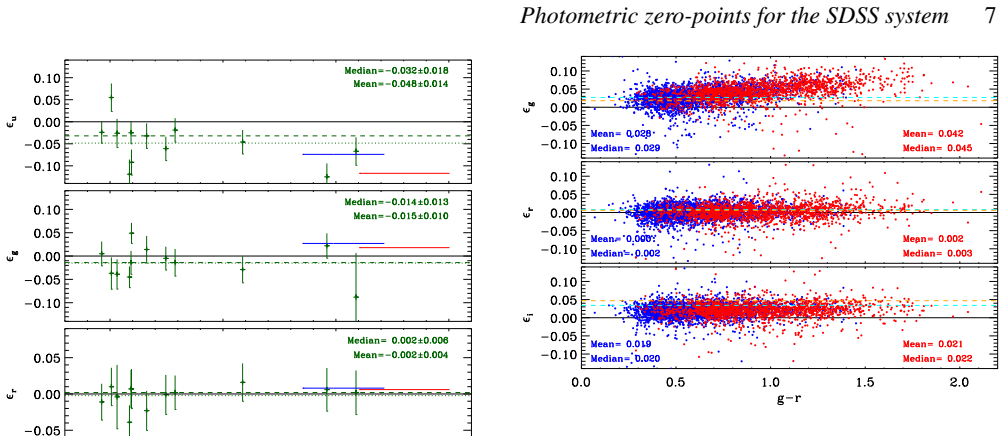
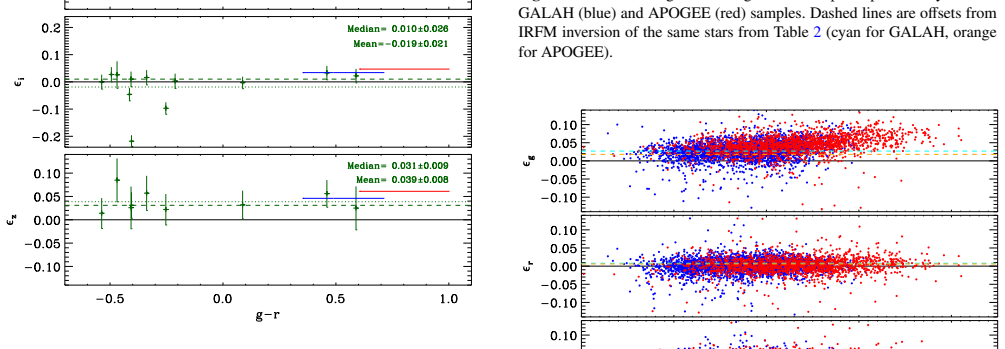
Inverting the Infrared Flux Method on 6000 FGK stars reveals that SDSS u-band photometry needs a color-dependent zero-point offset while the r band is already on the nominal AB scale.
A machine-rendered reading of the paper's core claim, the machinery that carries it, and where it could break.
Core claim
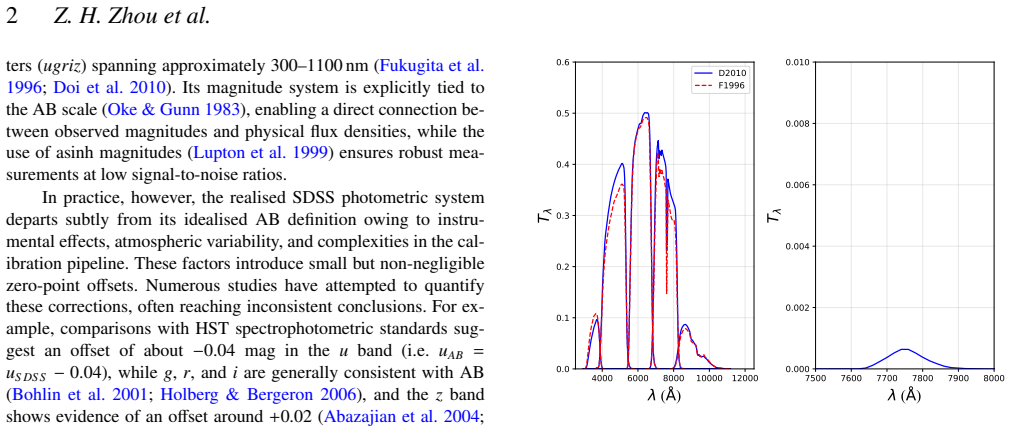
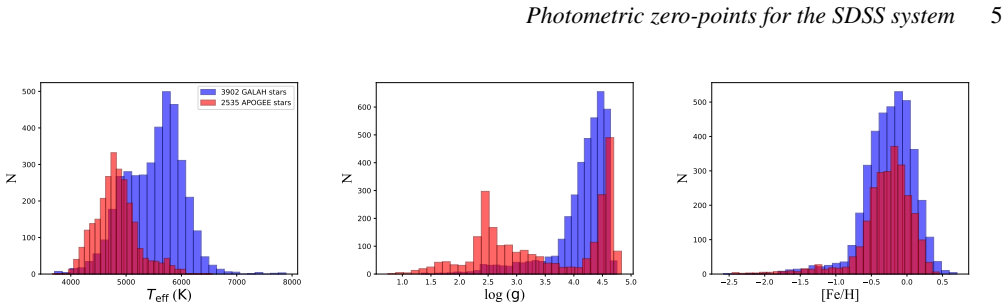
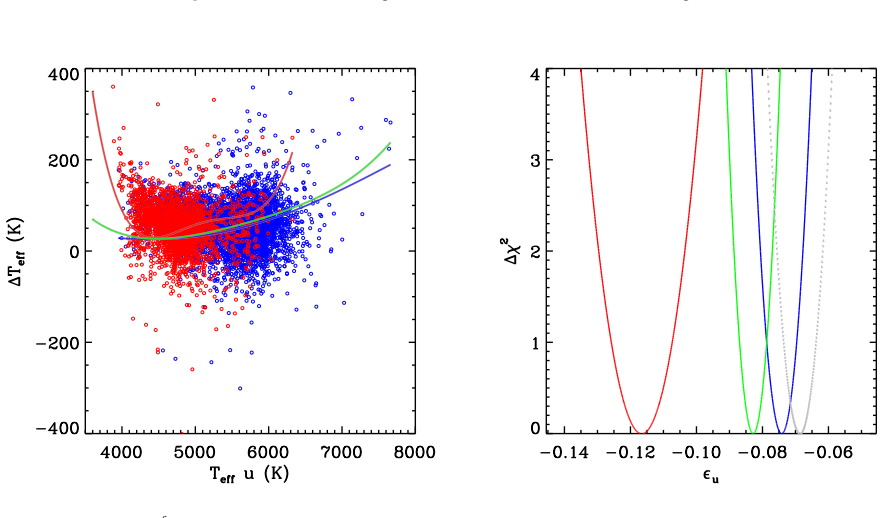
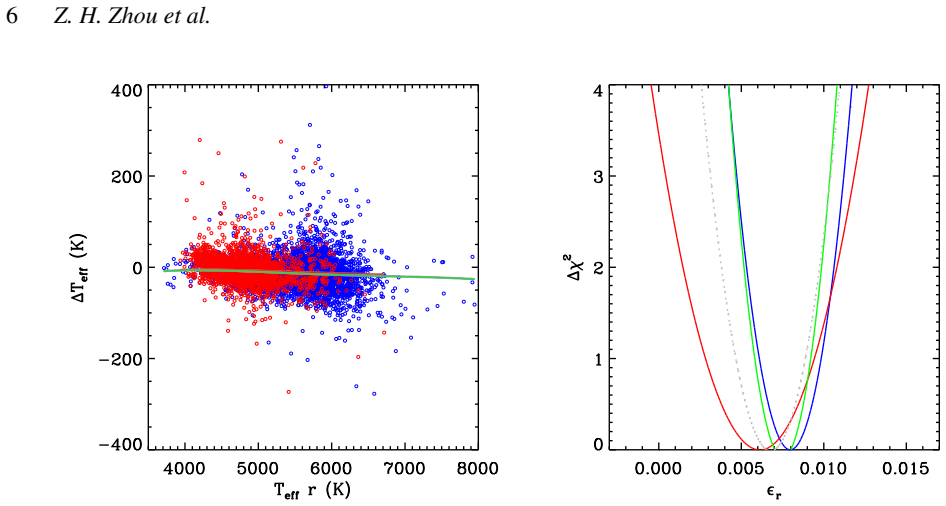
Using benchmark effective temperatures for more than 6000 FGK-type stars, the authors invert the Infrared Flux Method to solve for the zero-point corrections that SDSS ugriz photometry must receive to recover the adopted temperature scale. The r band requires essentially no correction. The i and z bands show offsets of a few hundredths of a magnitude. A small offset appears in g. The u band exhibits the largest discrepancy, and the size of the correction changes markedly according to whether the original filter transmission curves or updated curves that include a red leak are adopted; the latter produces a color-dependent offset visible in late-type stars. Independent checks against CALSPEC
What carries the argument
Inversion of the Infrared Flux Method (IRFM) using benchmark effective temperatures to solve for SDSS ugriz zero-point corrections.
If this is right
- The r-band zero-point can be treated as already correct for most applications.
- i- and z-band magnitudes require adjustments of order 0.02-0.05 mag to align with the IRFM temperature scale.
- u-band photometry carries a color-dependent systematic that is traceable to the choice of filter transmission curve.
- Revised zero-points anchored to the IRFM scale can be applied directly to existing SDSS catalogs.
- Large stellar samples offer a viable route to calibrate future wide-field surveys without relying solely on a small number of spectrophotometric standards.
Where Pith is reading between the lines
- The same inversion technique could be tested on photometry from other surveys that overlap the SDSS footprint to check for consistent offsets.
- If the u-band red-leak correction proves necessary, it may affect derived metallicities or temperatures for cool stars in any catalog that uses the original SDSS u transmission curves.
- The method supplies an independent cross-check on Gaia XP spectra, which could be used to extend the calibration to fainter magnitudes.
- Applying the recalibration to color-color diagrams of FGK stars should tighten the locus and reduce scatter in temperature-sensitive indices.
Load-bearing premise
The benchmark effective temperatures for the 6000 stars were determined independently of the SDSS ugriz photometry being recalibrated.
What would settle it
If new, fully independent effective-temperature determinations for the same stars (for example from high-resolution spectroscopy or interferometry) produce a different set of required zero-point offsets when fed into the same IRFM inversion, the derived SDSS corrections would be falsified.
Figures
read the original abstract
Accurate photometric zero-points are essential for translating observed magnitudes into physical fluxes, from comparing with models to ensuring consistency across surveys. We determine the zero-points needed to place the Sloan Digital Sky Survey (SDSS) $ugriz$ system on its nominal AB definition, by exploiting the sensitivity of the Infrared Flux Method (IRFM) to broadband flux calibration. Using benchmark effective temperatures for over 6,000 FGK-type stars, we invert the method to identify the zero-point corrections required for SDSS photometry to reproduce the adopted temperature scale. The $r$ band is found to be very well standardized, while the $i$ and $z$ bands show offsets of a few hundredths of a magnitude, consistent with previous studies. We also find a small offset in the $g$ band. The largest discrepancy occurs in the $u$ band, where the derived offset depends strongly on the adopted filter transmission curves, in particular whether one uses the original definition commonly adopted in the literature or the updated measurements that account for the presence of a red leak. This effect introduces a colour-dependent zero-point offset that becomes apparent when using a sample of late-type stars. Independent comparisons with CALSPEC spectrophotometric standards and Gaia XP spectra broadly support the offsets derived from the IRFM analysis. Our results provide a revised set of SDSS zero-points anchored to the IRFM temperature scale and demonstrate that large stellar samples can be used to constrain photometric calibration. The methodology presented here offers a complementary approach to traditional spectrophotometric calibration and may prove useful for future large-scale surveys.
Editorial analysis
A structured set of objections, weighed in public.
Referee Report
Summary. The manuscript claims to recalibrate SDSS ugriz zero-points by inverting the Infrared Flux Method (IRFM) on benchmark effective temperatures for over 6,000 FGK-type stars. It reports the r band as well standardized, small offsets in g/i/z, and a larger u-band offset that depends strongly on the choice of filter transmission curves (original vs. updated with red leak). Independent checks with CALSPEC standards and Gaia XP spectra are said to support the derived offsets.
Significance. If the benchmark Teff values are fully independent of SDSS photometry, the work supplies a useful large-sample, IRFM-anchored complement to spectrophotometric calibration. The reported consistency with CALSPEC and Gaia XP adds external support, and the approach may be applicable to future surveys.
major comments (1)
- [Benchmark sample description (abstract and methods)] The inversion's validity rests on the benchmark Teff being determined entirely independently of SDSS ugriz photometry or any correlated system. The abstract asserts the temperatures are 'benchmark' but supplies no explicit cross-check, provenance table, or discussion of the input catalogue's construction; this is load-bearing for all reported offsets and requires a dedicated verification section or appendix.
Simulated Author's Rebuttal
We thank the referee for their review and for highlighting the importance of clearly establishing the independence of the benchmark temperatures. We address the single major comment below.
read point-by-point responses
-
Referee: [Benchmark sample description (abstract and methods)] The inversion's validity rests on the benchmark Teff being determined entirely independently of SDSS ugriz photometry or any correlated system. The abstract asserts the temperatures are 'benchmark' but supplies no explicit cross-check, provenance table, or discussion of the input catalogue's construction; this is load-bearing for all reported offsets and requires a dedicated verification section or appendix.
Authors: We agree that the current manuscript does not provide sufficient detail on the provenance and independence of the benchmark Teff values. The temperatures are taken from an external compilation based on high-resolution spectroscopy and other non-photometric methods that predate and do not incorporate SDSS ugriz data. In the revised manuscript we will add a dedicated subsection (and supporting appendix table) that (i) cites the original catalogue sources, (ii) summarises the construction and selection criteria, and (iii) explicitly verifies that no SDSS photometry entered the Teff determinations. This addition will make the independence of the temperature scale transparent and address the referee's concern directly. revision: yes
Circularity Check
No significant circularity; derivation anchored to external benchmarks and cross-validated
full rationale
The paper inverts the IRFM using benchmark Teff values for >6000 stars (presented as an adopted external temperature scale) to solve for SDSS ugriz zero-point offsets needed to recover those Teff. It then reports consistency with independent CALSPEC spectrophotometric standards and Gaia XP spectra. No equations or steps reduce the derived offsets to the input photometry by construction, no fitted parameters are relabeled as predictions, and no load-bearing self-citation chain is invoked to justify the central result. The methodology is self-contained against external benchmarks, satisfying the default expectation of no circularity.
Axiom & Free-Parameter Ledger
axioms (1)
- domain assumption Benchmark effective temperatures for the 6000 FGK stars are accurate and independent of SDSS photometry
Reference graph
Works this paper leans on
-
[1]
The u'g'r'i'z' Standard Star Network
The u'g'r'i'z' Standard-Star System. , keywords =. doi:10.1086/339311 , archivePrefix =. astro-ph/0201143 , primaryClass =
work page internal anchor Pith review Pith/arXiv arXiv doi:10.1086/339311
-
[2]
Preliminary flux tables for the calibration of Gaia DR2 and (E)DR3
The Gaia spectrophotometric standard stars survey - V. Preliminary flux tables for the calibration of Gaia DR2 and (E)DR3. , keywords =. doi:10.1093/mnras/stab766 , archivePrefix =. 2103.07154 , primaryClass =
-
[3]
M dwarfs: effective temperatures, radii and metallicities. , keywords =. doi:10.1111/j.1365-2966.2008.13573.x , archivePrefix =. 0806.2471 , primaryClass =
-
[4]
Astrometry and Photometry for Cool Dwarfs and Brown Dwarfs
Astrometry and Photometry for Cool Dwarfs and Brown Dwarfs. , keywords =. doi:10.1086/341646 , archivePrefix =. astro-ph/0205050 , primaryClass =
work page internal anchor Pith review Pith/arXiv arXiv doi:10.1086/341646
-
[5]
Maps of Dust IR Emission for Use in Estimation of Reddening and CMBR Foregrounds
Maps of Dust Infrared Emission for Use in Estimation of Reddening and Cosmic Microwave Background Radiation Foregrounds. , keywords =. doi:10.1086/305772 , archivePrefix =. astro-ph/9710327 , primaryClass =
work page internal anchor Pith review Pith/arXiv arXiv doi:10.1086/305772
-
[6]
The Seventeenth Data Release of the Sloan Digital Sky Surveys: Complete Release of MaNGA, MaStar, and APOGEE-2 Data. , keywords =. doi:10.3847/1538-4365/ac4414 , archivePrefix =. 2112.02026 , primaryClass =
-
[7]
The GALAH+ survey: Third data release. , keywords =. doi:10.1093/mnras/stab1242 , archivePrefix =. 2011.02505 , primaryClass =
-
[8]
The Second Data Release of the Sloan Digital Sky Survey
The Second Data Release of the Sloan Digital Sky Survey. , keywords =. doi:10.1086/421365 , archivePrefix =. astro-ph/0403325 , primaryClass =
work page internal anchor Pith review Pith/arXiv arXiv doi:10.1086/421365
-
[9]
Application to Arcturus and other stars; with effective temperatures
Stellar angular diameters from infrared photometry. Application to Arcturus and other stars; with effective temperatures. , keywords =. doi:10.1093/mnras/180.2.177 , adsurl =
-
[10]
, keywords =
Determination of temperatures and angular diameters of 114 F-M stars using the infrared flux method (IRFM). , keywords =
-
[11]
Thakar, Ani R. and Li, Nolan , journal=. 2008 , volume=. doi:10.1109/MCSE.2008.6 , url =
-
[12]
The infrared flux method for determining stellar angular diameters and effective temperatures. , keywords =. doi:10.1093/mnras/188.4.847 , adsurl =
-
[13]
, keywords =
Use of the infra-red flux method for determining stellar effective temperatures and angular diameters; the stellar temperature scale. , keywords =
-
[14]
, keywords =
Determination of effective temperatures for an extended sample of dwarfs and subdwarfs (F0-K5). , keywords =
-
[15]
The GALAH survey: effective temperature calibration from the InfraRed Flux Method in the Gaia system. , keywords =. doi:10.1093/mnras/stab2304 , archivePrefix =. 2011.02517 , primaryClass =
-
[16]
The Effective Temperature Scale of FGK Stars. II. T _ eff :Color:[Fe/H] Calibrations. , keywords =. doi:10.1086/430102 , archivePrefix =. astro-ph/0503110 , primaryClass =
work page internal anchor Pith review Pith/arXiv arXiv doi:10.1086/430102
-
[17]
A new implementation of the infrared flux method using the 2MASS catalogue
A new implementation of the infrared flux method using the 2MASS catalogue. , keywords =. doi:10.1051/0004-6361/200810904 , archivePrefix =. 0901.3034 , primaryClass =
work page internal anchor Pith review Pith/arXiv arXiv doi:10.1051/0004-6361/200810904
-
[18]
An absolutely calibrated effective temperature scale from the InfraRed Flux Method
An absolutely calibrated T _ eff scale from the infrared flux method. Dwarfs and subgiants. , keywords =. doi:10.1051/0004-6361/200913204 , archivePrefix =. 1001.3142 , primaryClass =
work page internal anchor Pith review Pith/arXiv arXiv doi:10.1051/0004-6361/200913204
-
[19]
The Sloan Digital Sky Survey Photometric System. , keywords =. doi:10.1086/117915 , adsurl =
-
[20]
Photometric Response Functions of the SDSS Imager
Photometric Response Functions of the Sloan Digital Sky Survey Imager. , keywords =. doi:10.1088/0004-6256/139/4/1628 , archivePrefix =. 1002.3701 , primaryClass =
work page internal anchor Pith review Pith/arXiv arXiv doi:10.1088/0004-6256/139/4/1628
-
[21]
SkyMapper stellar parameters for Galactic Archaeology on a grand-scale
SkyMapper stellar parameters for Galactic Archaeology on a grand-scale. , keywords =. doi:10.1093/mnras/sty2878 , archivePrefix =. 1810.09581 , primaryClass =
work page internal anchor Pith review Pith/arXiv arXiv doi:10.1093/mnras/sty2878
-
[22]
The Sloan Digital Sky Survey: Technical Summary
The Sloan Digital Sky Survey: Technical Summary. , keywords =. doi:10.1086/301513 , archivePrefix =. astro-ph/0006396 , primaryClass =
work page internal anchor Pith review Pith/arXiv arXiv doi:10.1086/301513
-
[23]
A Modified Magnitude System that Produces Well-Behaved Magnitudes, Colors, and Errors Even for Low Signal-to-Noise Ratio Measurements. , keywords =. doi:10.1086/301004 , archivePrefix =. astro-ph/9903081 , primaryClass =
work page internal anchor Pith review Pith/arXiv arXiv doi:10.1086/301004
-
[24]
Astronomical Data Analysis Software and Systems XIV , year = 2005, editor =
TOPCAT & STIL: Starlink Table/VOTable Processing Software. Astronomical Data Analysis Software and Systems XIV , year = 2005, editor =
2005
-
[25]
Blackbody Stars. , keywords =. doi:10.3847/1538-3881/aac88b , archivePrefix =. 1711.01122 , primaryClass =
work page internal anchor Pith review Pith/arXiv arXiv doi:10.3847/1538-3881/aac88b
-
[26]
Secondary standard stars for absolute spectrophotometry. , keywords =. doi:10.1086/160817 , adsurl =
-
[27]
, year = 2005, month = sep, volume =
Standard Photometric Systems. , year = 2005, month = sep, volume =. doi:10.1146/annurev.astro.41.082801.100251 , adsurl =
-
[28]
The 13th Data Release of the Sloan Digital Sky Survey: First Spectroscopic Data from the SDSS-IV Survey Mapping Nearby Galaxies at Apache Point Observatory. , keywords =. doi:10.3847/1538-4365/aa8992 , archivePrefix =. 1608.02013 , primaryClass =
work page internal anchor Pith review Pith/arXiv arXiv doi:10.3847/1538-4365/aa8992
-
[29]
, keywords =
Model atmospheres for Vega. , keywords =
-
[30]
SDSS-III: Massive Spectroscopic Surveys of the Distant Universe, the Milky Way, and Extra-Solar Planetary Systems. , keywords =. doi:10.1088/0004-6256/142/3/72 , archivePrefix =. 1101.1529 , primaryClass =
work page internal anchor Pith review Pith/arXiv arXiv doi:10.1088/0004-6256/142/3/72
-
[31]
New Grids of ATLAS9 Model Atmospheres
New Grids of ATLAS9 Model Atmospheres. Modelling of Stellar Atmospheres , year = 2003, editor =. doi:10.48550/arXiv.astro-ph/0405087 , archivePrefix =. astro-ph/0405087 , primaryClass =
work page internal anchor Pith review Pith/arXiv arXiv doi:10.48550/arxiv.astro-ph/0405087 2003
-
[32]
Synthetic stellar photometry - I. General considerations and new transformations for broad-band systems. , keywords =. doi:10.1093/mnras/stu1476 , archivePrefix =. 1407.6095 , primaryClass =
work page internal anchor Pith review Pith/arXiv arXiv doi:10.1093/mnras/stu1476
-
[33]
A Catalog of Spectroscopically Confirmed White Dwarfs from the Sloan Digital Sky Survey Data Release 4. , keywords =. doi:10.1086/507110 , archivePrefix =. astro-ph/0606700 , primaryClass =
work page internal anchor Pith review Pith/arXiv arXiv doi:10.1086/507110
-
[34]
Use of a self-consistent calibration
Effect of improved H- opacity on the infrared flux method temperature scale and derived angular diameters. Use of a self-consistent calibration. , keywords =
-
[35]
Accurate fundamental parameters for lower main-sequence stars. , keywords =. doi:10.1111/j.1365-2966.2006.10999.x , archivePrefix =. astro-ph/0608504 , primaryClass =
-
[36]
Hubble Space Telescope CALSPEC Flux Standards: Sirius (and Vega). , keywords =. doi:10.1088/0004-6256/147/6/127 , adsurl =
-
[37]
Spectrophotometric Standards from the Far-Ultraviolet to the Near-Infrared: STIS and NICMOS Fluxes. , keywords =. doi:10.1086/323137 , adsurl =
-
[38]
Update of the STIS CTE Correction Formula for Stellar Spectra
-
[39]
The Galaxy in your preferred colours: Synthetic photometry from Gaia low-resolution spectra
Gaia Data Release 3. The Galaxy in your preferred colours: Synthetic photometry from Gaia low-resolution spectra. , keywords =. doi:10.1051/0004-6361/202243709 , archivePrefix =. 2206.06215 , primaryClass =
-
[40]
Gaia Data Release 3. Summary of the content and survey properties. , keywords =. doi:10.1051/0004-6361/202243940 , archivePrefix =. 2208.00211 , primaryClass =
-
[41]
Calibration of Synthetic Photometry Using DA White Dwarfs. , keywords =. doi:10.1086/505938 , adsurl =
-
[42]
, keywords =
Stellar effective temperatures and angular diameters determined by the infrared flux method (IRFM) : revisions using improved Kurucz LTE stellar atmospheres. , keywords =
-
[43]
The Two Micron All Sky Survey (2MASS). , keywords =. doi:10.1086/498708 , adsurl =
-
[44]
Faint White Dwarf Flux Standards: Data and Models. , keywords =. doi:10.3847/1538-3881/ad93d8 , archivePrefix =. 2411.09049 , primaryClass =
-
[45]
LSST: from Science Drivers to Reference Design and Anticipated Data Products
LSST: From Science Drivers to Reference Design and Anticipated Data Products. , keywords =. doi:10.3847/1538-4357/ab042c , archivePrefix =. 0805.2366 , primaryClass =
work page internal anchor Pith review Pith/arXiv arXiv doi:10.3847/1538-4357/ab042c
-
[46]
A catalogue of the Chandra Deep Field South with multi-colour classification and photometric redshifts from COMBO-17. , keywords =. doi:10.1051/0004-6361:20040525 , archivePrefix =. astro-ph/0403666 , primaryClass =
work page internal anchor Pith review Pith/arXiv arXiv doi:10.1051/0004-6361:20040525
-
[47]
Morphological Classification of Galaxies Using Photometric Parameters: The Concentration Index versus the Coarseness Parameter. , keywords =. doi:10.1086/444416 , archivePrefix =. astro-ph/0507060 , primaryClass =
work page internal anchor Pith review Pith/arXiv arXiv doi:10.1086/444416
-
[48]
The Photometric Classification Server for Pan-STARRS1
The Photometric Classification Server for Pan-STARRS1. , keywords =. doi:10.1088/0004-637X/746/2/128 , archivePrefix =. 1109.5080 , primaryClass =
work page internal anchor Pith review Pith/arXiv arXiv doi:10.1088/0004-637x/746/2/128
-
[49]
A novel optimal transport-based approach for interpolating spectral time series: Paving the way for photometric classification of supernovae. , keywords =. doi:10.1051/0004-6361/202449170 , archivePrefix =. 2409.10701 , primaryClass =
-
[50]
Machine learning-based photometric classification of galaxies, quasars, emission-line galaxies, and stars. , keywords =. doi:10.1093/mnras/stad3436 , archivePrefix =. 2311.02951 , primaryClass =
-
[51]
A 3D Dust Map Based on Gaia, Pan-STARRS 1 and 2MASS
A 3D Dust Map Based on Gaia, Pan-STARRS 1, and 2MASS. , keywords =. doi:10.3847/1538-4357/ab5362 , archivePrefix =. 1905.02734 , primaryClass =
work page internal anchor Pith review Pith/arXiv arXiv doi:10.3847/1538-4357/ab5362 1905
-
[52]
The GALAH Survey: Scientific Motivation
The GALAH survey: scientific motivation. , keywords =. doi:10.1093/mnras/stv327 , archivePrefix =. 1502.04767 , primaryClass =
work page internal anchor Pith review Pith/arXiv arXiv doi:10.1093/mnras/stv327
-
[53]
APOGEE: The Apache Point Observatory Galactic Evolution Experiment
APOGEE: The Apache Point Observatory Galactic Evolution Experiment. Astronomische Nachrichten , keywords =. doi:10.1002/asna.200811080 , archivePrefix =. 0809.2362 , primaryClass =
work page internal anchor Pith review Pith/arXiv arXiv doi:10.1002/asna.200811080
-
[54]
doi:10.5281/zenodo.6563093 , version =
gaia-dpci/GaiaXPy: Release 1.0.0. doi:10.5281/zenodo.6563093 , version =
-
[55]
The Wide Field Infrared Survey Telescope: 100 Hubbles for the 2020s
The Wide Field Infrared Survey Telescope: 100 Hubbles for the 2020s. arXiv e-prints , keywords =. doi:10.48550/arXiv.1902.05569 , archivePrefix =. 1902.05569 , primaryClass =
work page internal anchor Pith review Pith/arXiv arXiv doi:10.48550/arxiv.1902.05569 1902
-
[56]
Scientia Sinica Physica, Mechanica & Astronomica , year = 2011, month = jan, volume =
Consideration for a large-scale multi-color imaging and slitless spectroscopy survey on the Chinese space station and its application in dark energy research. Scientia Sinica Physica, Mechanica & Astronomica , year = 2011, month = jan, volume =. doi:10.1360/132011-961 , adsurl =
-
[57]
Testing photometric redshift measurements with filter definition of the Chinese Space Station Optical Survey (CSS-OS). , keywords =. doi:10.1093/mnras/sty1980 , archivePrefix =. 1706.09586 , primaryClass =
work page internal anchor Pith review Pith/arXiv arXiv doi:10.1093/mnras/sty1980
-
[58]
Cosmology from the Chinese Space Station Optical Survey (CSS-OS). , keywords =. doi:10.3847/1538-4357/ab391e , archivePrefix =. 1901.04634 , primaryClass =
-
[59]
Combined APOGEE-GALAH stellar catalogues using the Cannon. , keywords =. doi:10.1093/mnras/stac873 , archivePrefix =. 2011.02783 , primaryClass =
-
[60]
The Gaia mission. , keywords =. doi:10.1051/0004-6361/201629272 , archivePrefix =. 1609.04153 , primaryClass =
work page internal anchor Pith review Pith/arXiv arXiv doi:10.1051/0004-6361/201629272
-
[61]
Internal calibration of Gaia BP/RP low-resolution spectra. , keywords =. doi:10.1051/0004-6361/202141249 , archivePrefix =. 2106.01752 , primaryClass =
-
[62]
Processing and validation of BP/RP low-resolution spectral data
Gaia Data Release 3. Processing and validation of BP/RP low-resolution spectral data. , keywords =. doi:10.1051/0004-6361/202243680 , archivePrefix =. 2206.06143 , primaryClass =
-
[63]
External calibration of BP/RP low-resolution spectroscopic data
Gaia Data Release 3. External calibration of BP/RP low-resolution spectroscopic data. , keywords =. doi:10.1051/0004-6361/202243880 , archivePrefix =. 2206.06205 , primaryClass =
-
[64]
The Early-type Stars from the LAMOST Survey: Atmospheric Parameters. , keywords =. doi:10.3847/1538-4365/ac2ded , archivePrefix =. 2110.06246 , primaryClass =
-
[65]
Deriving the Stellar Labels of LAMOST Spectra with the Stellar LAbel Machine (SLAM). , keywords =. doi:10.3847/1538-4365/ab55ef , archivePrefix =. 1908.08677 , primaryClass =
-
[66]
Estimating the Atmospheric Parameters of Early-type Stars from the Chinese Space Station Telescope (CSST) Slitless Spectra Survey. , keywords =. doi:10.3847/1538-3881/ad4463 , archivePrefix =. 2408.10803 , primaryClass =
-
[67]
Empirical effective temperatures and bolometric corrections for early-type stars. , keywords =. doi:10.1086/154093 , adsurl =
-
[68]
Fundamental stellar parameters of benchmark stars from CHARA interferometry. I. Metal-poor stars. , keywords =. doi:10.1051/0004-6361/202037590 , archivePrefix =. 2006.05411 , primaryClass =
-
[69]
Sulphur and zinc abundances in Galactic halo stars revisited
Sulphur and zinc abundances in Galactic halo stars revisited. , keywords =. doi:10.1051/0004-6361:20077344 , archivePrefix =. astro-ph/0702689 , primaryClass =
work page internal anchor Pith review Pith/arXiv arXiv doi:10.1051/0004-6361:20077344
-
[70]
Nearby stars of the Galactic disc and halo - IV. , keywords =. doi:10.1111/j.1365-2966.2007.12671.x , adsurl =
discussion (0)
Sign in with ORCID, Apple, or X to comment. Anyone can read and Pith papers without signing in.