Calibration of an Analog-to-Digital Conversion Nonlinearity in JWST/NIRISS
Pith reviewed 2026-06-27 08:21 UTC · model grok-4.3
The pith
Periodic ADC nonlinearity in NIRISS data is flux-dependent and correctable to remove 30ppm systematics in spectra.
A machine-rendered reading of the paper's core claim, the machinery that carries it, and where it could break.
Core claim
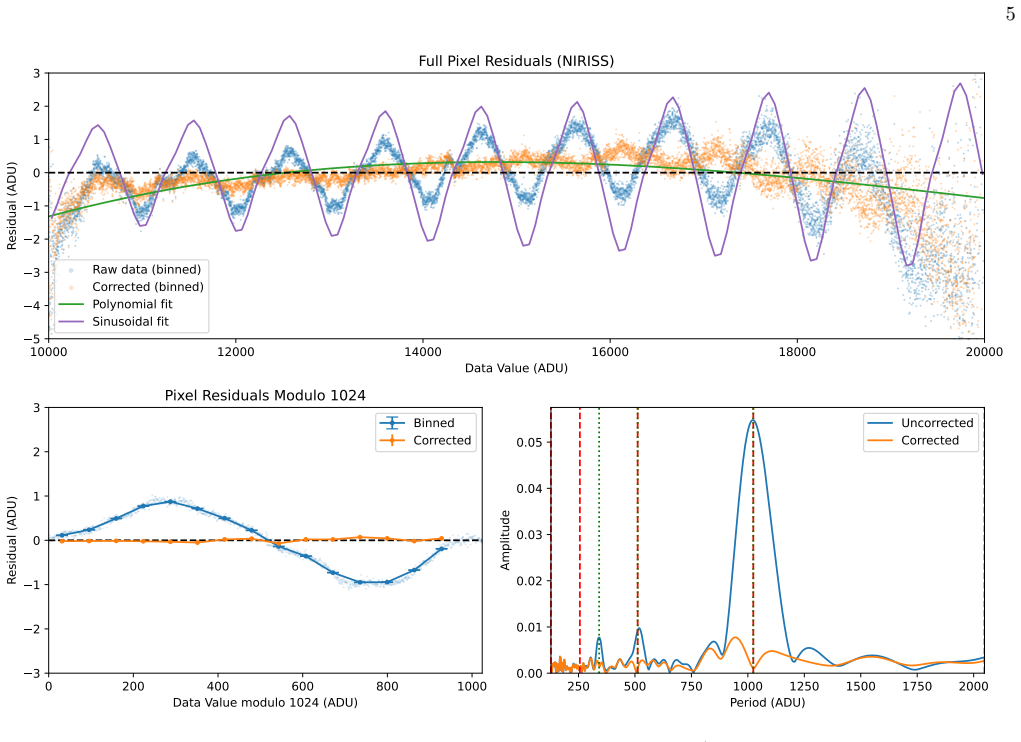
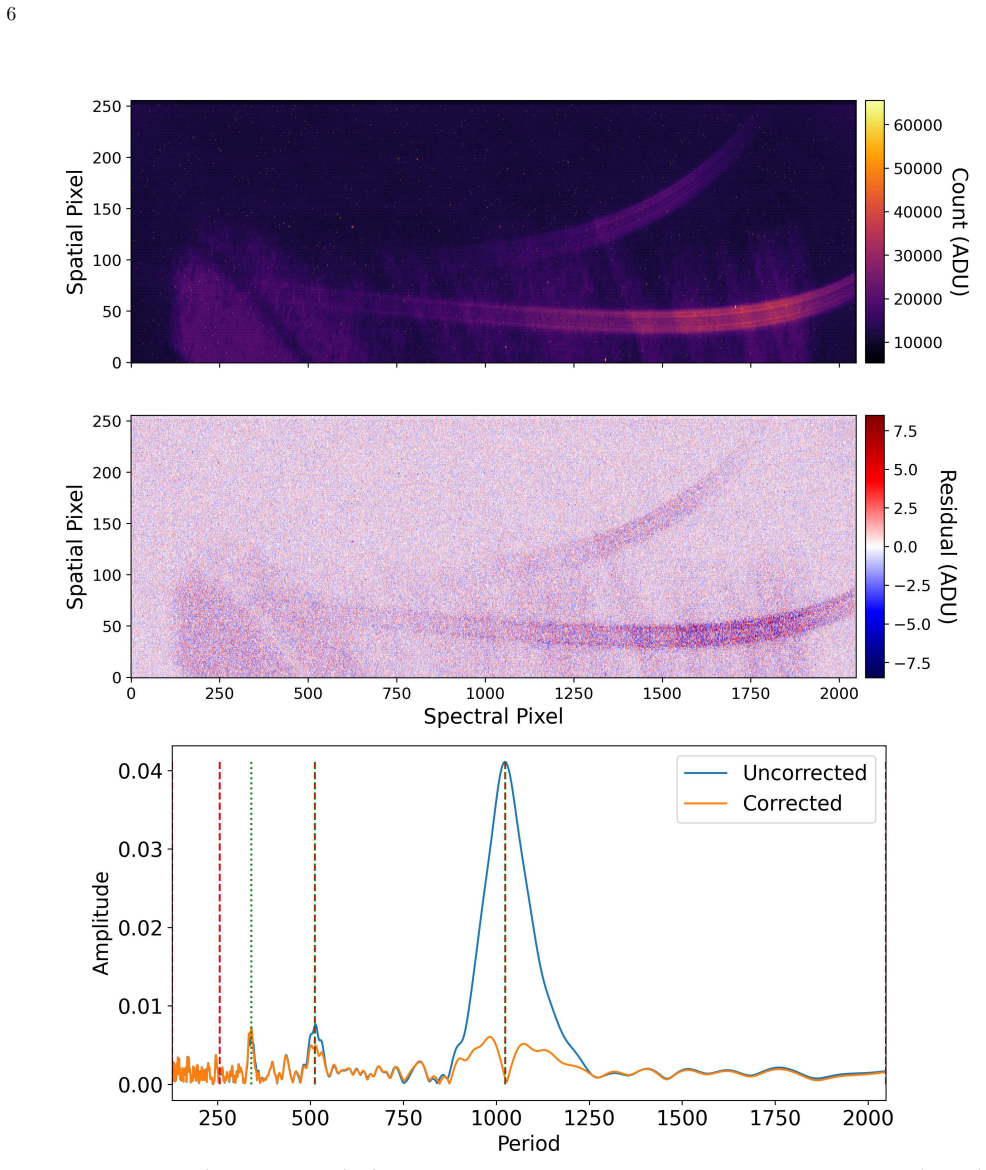
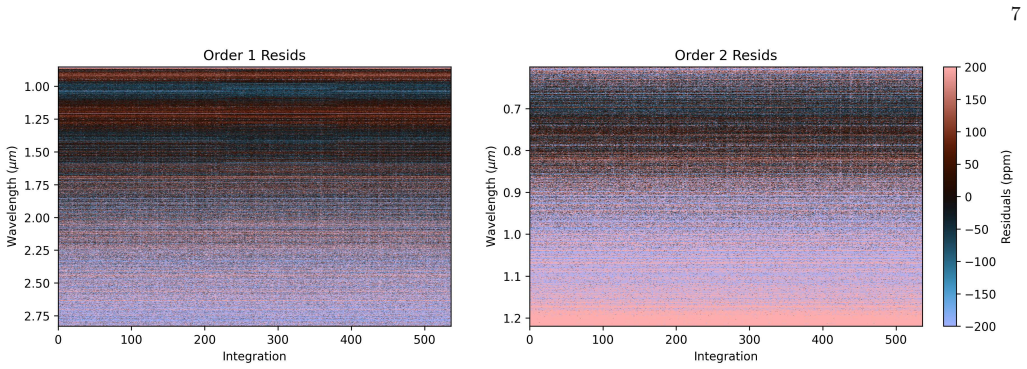
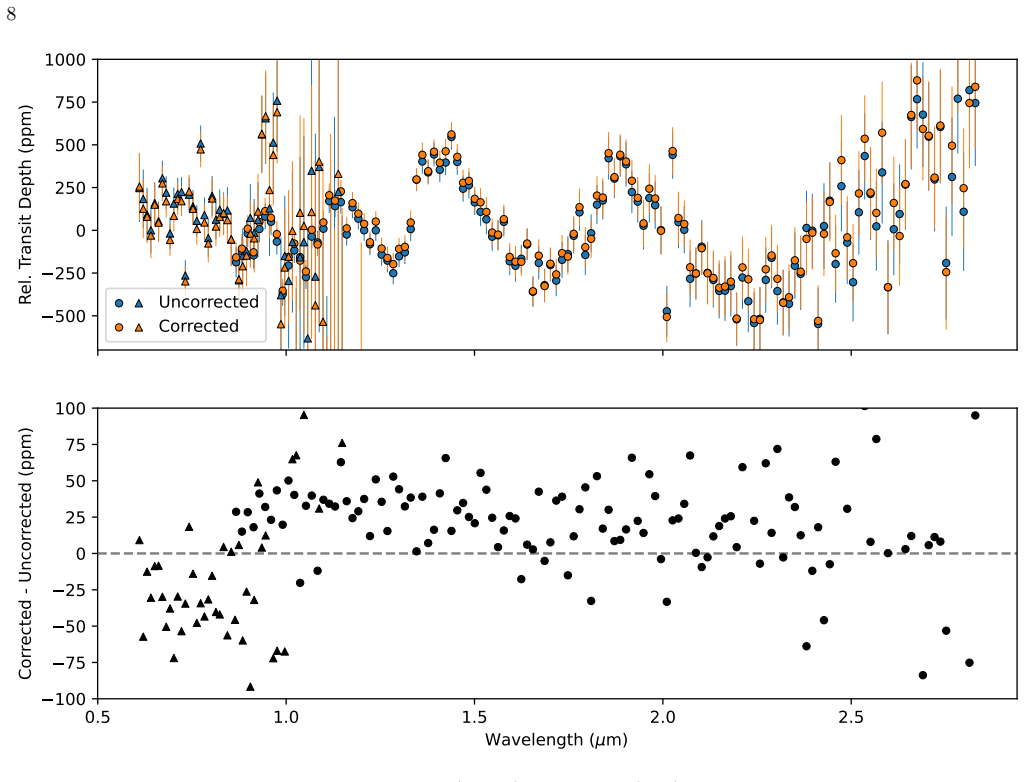
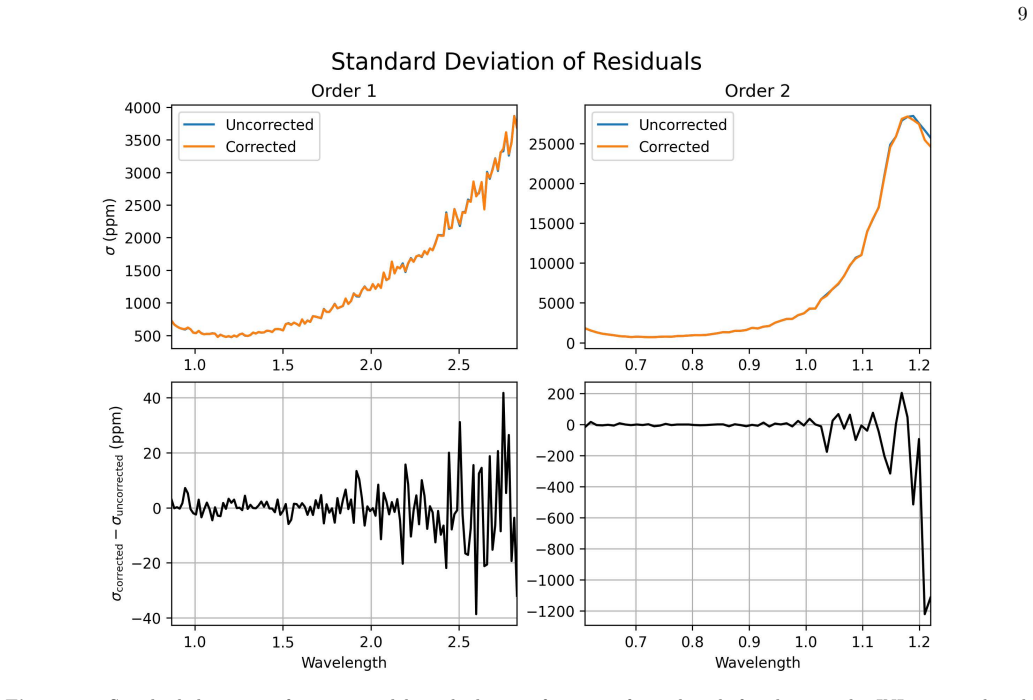
The periodic INL is shown to be flux-dependent, increasing in amplitude with higher pixel counts on the detector. We derive a model of this periodic INL by fitting a combination of a polynomial and sinusoid multiplied with the residuals of ramp fits to the uncalibrated data and find an amplitude of 125ppm, up to a 2.5-count shift for a pixel with 20,000ADU. We apply this model to correct the well-studied NIRISS SOSS Program ERS1366 dataset of WASP-39b and reduce the data into a transmission spectrum. We find that our corrected transmission spectrum removes the INL systematic from the uncorrected spectrum at the 30ppm level across both orders, and also corrects a 55ppm offset between Order 1
What carries the argument
Polynomial-plus-sinusoid model of the flux-dependent periodic INL (period 1024 ADU) fitted to ramp-fit residuals on uncalibrated data.
If this is right
- The correction removes the INL systematic at the 30ppm level across both orders in transmission spectra.
- A 55ppm offset between Order 1 and Order 2 is eliminated after correction.
- The effect is present in all NIRISS modes including AMI and SOSS.
- A larger-scale data-driven calibration is recommended for adoption into NIRISS pipelines.
Where Pith is reading between the lines
- The same correction procedure could be tested on other JWST instruments that use similar detector readout electronics.
- Incorporating the model into standard calibration pipelines would allow all archival NIRISS data to be re-reduced at higher precision without new observations.
- Because amplitude scales with flux, the largest corrections apply to bright targets, which may explain why the signal was first noticed in high-signal AMI data.
Load-bearing premise
The observed periodic signal originates from ADC integral nonlinearity and the polynomial-sinusoid fit fully captures the effect without residual biases or mode-specific differences.
What would settle it
Reprocessing a separate set of NIRISS ramp data with the model and verifying that the 1024-ADU periodic component disappears from the residuals at the 30 ppm level would test the claim.
Figures
read the original abstract
We quantify an unusual flux-dependent systematic which is periodic in raw counts in flight data from the James Webb Space Telescope's Near Infrared Imager and Slitless Spectrograph (JWST/NIRISS), used extensively for exoplanet imaging and spectroscopy. Originally discovered in the aperture masking interferometry (AMI) mode, it also manifests in the Single Object Slitless Spectroscopy (SOSS) mode with the same dominant period of 1024 in raw analog-to-digital units (ADU). The likely cause of the signal is an analog-to-digital converter (ADC) integral nonlinearity (INL) in which case it will apply to all observations taken with the NIRISS instrument. Fortunately, it is straightforward to correct the data in postprocessing. The periodic INL is shown to be flux-dependent, increasing in amplitude with higher pixel counts on the detector. We derive a model of this periodic INL by fitting a combination of a polynomial and sinusoid multiplied with the residuals of ramp fits to the uncalibrated data and find an amplitude of 125ppm, up to a 2.5-count shift for a pixel with 20,000ADU. We apply this model to correct the well-studied NIRISS SOSS Program ERS1366 dataset of WASP-39b and reduce the data into a transmission spectrum. We find that our corrected transmission spectrum removes the INL systematic from the uncorrected spectrum at the 30ppm level across both orders, and also corrects a 55ppm offset between Order 1 and Order 2. We recommend a larger scale data-driven calibration of the periodic INL and the adoption of the outcome into NIRISS data pipelines.
Editorial analysis
A structured set of objections, weighed in public.
Referee Report
Summary. The manuscript identifies a flux-dependent periodic systematic in JWST/NIRISS data (dominant period 1024 ADU) observed in both AMI and SOSS modes, attributes it to ADC integral nonlinearity, and derives a correction model consisting of a polynomial plus sinusoid fitted to ramp-fit residuals on uncalibrated data (amplitude 125 ppm, up to 2.5 count shift at 20,000 ADU). The model is applied to the ERS1366 WASP-39b SOSS dataset, yielding a transmission spectrum in which the INL systematic is removed at the 30 ppm level across both orders and a 55 ppm offset between Order 1 and Order 2 is corrected. The authors recommend incorporating a larger-scale data-driven calibration into NIRISS pipelines.
Significance. If the correction is shown to be robust and generalizable, the result would be significant for high-precision exoplanet spectroscopy with NIRISS, as it targets a potentially instrument-wide effect at the tens-of-ppm level that affects both imaging and spectroscopic modes. The explicit flux dependence and the practical post-processing approach are strengths. However, the demonstration rests on a single program without reported independent validation, limiting the assessed impact until cross-checks are provided.
major comments (3)
- [Abstract] Abstract: the reported 30 ppm removal of the INL systematic and 55 ppm order offset are presented without error bars, uncertainty estimates, or a quantitative assessment of significance, making it impossible to determine whether the improvement exceeds the noise or fit residuals.
- [Abstract] Abstract: the polynomial-plus-sinusoid model is obtained by direct fitting to ramp-fit residuals of the uncalibrated data, after which the same functional form is applied to produce the corrected ERS1366 transmission spectrum; this procedure risks circularity because the quoted improvement is measured against a quantity derived from the input data itself.
- [Abstract] Abstract: no validation on an independent dataset, no tests for wavelength- or time-dependent residuals, and no exploration of alternative functional forms or sensitivity to the post-hoc choice of polynomial-sinusoid model are described, leaving open the possibility that the reported correction partly reflects overfitting rather than isolation of a true ADC INL term.
minor comments (2)
- [Abstract] The abstract states that the periodic signal 'also manifests in the SOSS mode' but provides no quantitative comparison of amplitude or phase between AMI and SOSS, which would strengthen the claim of a common origin.
- [Abstract] The recommendation for 'a larger scale data-driven calibration' is appropriate but would benefit from a brief outline of what such a calibration would entail (e.g., number of datasets, fitting strategy) to guide future work.
Simulated Author's Rebuttal
We thank the referee for their detailed and constructive comments on the manuscript. We address each major comment below and indicate the revisions that will be incorporated.
read point-by-point responses
-
Referee: [Abstract] Abstract: the reported 30 ppm removal of the INL systematic and 55 ppm order offset are presented without error bars, uncertainty estimates, or a quantitative assessment of significance, making it impossible to determine whether the improvement exceeds the noise or fit residuals.
Authors: We agree that the abstract would benefit from explicit uncertainty estimates and significance assessment. In the revised manuscript we will report the 30 ppm and 55 ppm values together with uncertainties obtained from the spectral extraction covariance and a bootstrap resampling of the binned light curves, and we will state the improvement relative to the per-bin noise floor. revision: yes
-
Referee: [Abstract] Abstract: the polynomial-plus-sinusoid model is obtained by direct fitting to ramp-fit residuals of the uncalibrated data, after which the same functional form is applied to produce the corrected ERS1366 transmission spectrum; this procedure risks circularity because the quoted improvement is measured against a quantity derived from the input data itself.
Authors: The model parameters are determined solely from the ramp-fit residuals of the raw, uncalibrated pixel ramps; these residuals are computed before any spectral extraction or binning. The transmission spectrum is subsequently derived from the corrected count-rate images using the standard pipeline steps. The 30 ppm figure therefore quantifies the change in the final science product after an independent correction step. We will revise the abstract and methods to make this workflow and independence explicit. revision: partial
-
Referee: [Abstract] Abstract: no validation on an independent dataset, no tests for wavelength- or time-dependent residuals, and no exploration of alternative functional forms or sensitivity to the post-hoc choice of polynomial-sinusoid model are described, leaving open the possibility that the reported correction partly reflects overfitting rather than isolation of a true ADC INL term.
Authors: The periodic signal was first identified in AMI-mode data from a separate program and later confirmed in the SOSS ERS1366 observations; this provides cross-mode consistency for the 1024 ADU period. In the revision we will add explicit checks for wavelength and time dependence of the residuals after correction, and we will report a brief sensitivity test to the choice of polynomial order and sinusoid amplitude. A fully independent SOSS dataset is not analyzed in the present work, which we will note as a limitation while emphasizing that the physical origin (ADC INL) is supported by the shared periodicity across modes. revision: partial
Circularity Check
Poly+sinusoid model fitted to ramp residuals of ERS1366 data, then applied to same data's transmission spectrum to claim 30ppm removal
specific steps
-
fitted input called prediction
[Abstract]
"We derive a model of this periodic INL by fitting a combination of a polynomial and sinusoid multiplied with the residuals of ramp fits to the uncalibrated data and find an amplitude of 125ppm, up to a 2.5-count shift for a pixel with 20,000ADU. We apply this model to correct the well-studied NIRISS SOSS Program ERS1366 dataset of WASP-39b and reduce the data into a transmission spectrum. We find that our corrected transmission spectrum removes the INL systematic from the uncorrected spectrum at the 30ppm level across both orders, and also corrects a 55ppm offset between Order 1 and Order 2."
The correction parameters are obtained by fitting the poly+sinusoid form to ramp-fit residuals on the uncalibrated ERS1366 data; the claimed 30ppm removal is then measured by applying that same fitted model to derive the corrected spectrum from the identical dataset, so the improvement metric is the direct numerical consequence of the fit rather than an independent test.
full rationale
The paper derives its INL correction by fitting a polynomial-plus-sinusoid model directly to ramp-fit residuals on the uncalibrated ERS1366 dataset, then applies that fitted model to produce a corrected transmission spectrum from the identical observations and reports a 30ppm systematic removal plus 55ppm order offset correction. This reduction is by construction: the reported improvement is the direct effect of subtracting the model fitted to the input residuals, with no independent dataset or hardware validation shown. The assumption that the periodic signal is purely ADC INL is stated but not independently verified. No self-citations, ansatzes, or other load-bearing reductions appear in the provided text.
Axiom & Free-Parameter Ledger
free parameters (2)
- INL amplitude =
125 ppm
- Dominant period =
1024 ADU
axioms (1)
- domain assumption The periodic signal in raw counts is caused by ADC integral nonlinearity
Reference graph
Works this paper leans on
-
[1]
2025a, ApJL, 985, L10, doi: 10.3847/2041-8213/add010
Ahrer, Radica, Piaulet-Ghorayeb, et al. 2025, ApJL, 985, L10, doi: 10.3847/2041-8213/add010
-
[2]
The Wide Field Infrared Survey Telescope: 100 Hubbles for the 2020s
Akeson, Armus, Bachelet, et al. 2019, arXiv e-prints, arXiv:1902.05569, doi: 10.48550/arXiv.1902.05569
work page internal anchor Pith review Pith/arXiv arXiv doi:10.48550/arxiv.1902.05569 2019
-
[3]
2023, PASP, 135, 075001, doi: 10.1088/1538-3873/acd7a3
Albert, Lafreni` ere, Ren´ e, et al. 2023, PASP, 135, 075001, doi: 10.1088/1538-3873/acd7a3
-
[4]
Antilogus, Astier, Doherty, Guyonnet, & Regnault. 2014, Journal of Instrumentation, 9, C03048, doi: 10.1088/1748-0221/9/03/C03048 Astropy Collaboration, Price-Whelan, Lim, et al. 2022, ApJ, 935, 167, doi: 10.3847/1538-4357/ac7c74
-
[5]
2024, in Society of Photo-Optical Instrumentation Engineers (SPIE) Conference Series, Vol
Baines, Espinoza, Filippazzo, Volk, & Carter. 2024, in Society of Photo-Optical Instrumentation Engineers (SPIE) Conference Series, Vol. 13092, Space Telescopes and Instrumentation 2024: Optical, Infrared, and Millimeter Wave, ed. Coyle, Matsuura, & Perrin, 1309212, doi: 10.1117/12.3020330
-
[6]
Baines, Espinoza, Fillipazzo, & Volk. 2023, Characterization of the visit-to-visit Stability of the GR700XD Spectral Traces for NIRISS/SOSS Observations, Tech. Rep. Technical Report JWST-STScI-008448, STScI, doi: 10.48550/arXiv.2311.07769
-
[7]
2011, in Astronomical Society of the Pacific Conference Series, Vol
Blank, Anglin, Beletic, et al. 2011, in Astronomical Society of the Pacific Conference Series, Vol. 437, Solar Polarization 6, ed. Kuhn, Harrington, Lin, Berdyugina,
2011
-
[8]
2021, arXiv preprint arXiv:2105.15183
Blondel, Berthet, Cuturi, et al. 2021, arXiv preprint arXiv:2105.15183
arXiv 2021
-
[9]
2018, JAX: composable transformations of Python+NumPy programs, 0.3.13 http://github.com/google/jax
Bradbury, Frostig, Hawkins, et al. 2018, JAX: composable transformations of Python+NumPy programs, 0.3.13 http://github.com/google/jax
2018
-
[10]
Cadieux, Doyon, MacDonald, et al. 2024, ApJL, 970, L2, doi: 10.3847/2041-8213/ad5afa
-
[11]
Carter, May, Espinoza, et al. 2024, Nature Astronomy, 8, 1008, doi: 10.1038/s41550-024-02292-x
-
[12]
2014, in Society of Photo-Optical Instrumentation Engineers (SPIE) Conference Series, Vol
Chen, Loose, Ricardo, et al. 2014, in Society of Photo-Optical Instrumentation Engineers (SPIE) Conference Series, Vol. 9154, High Energy, Optical, and Infrared Detectors for Astronomy VI, ed. Holland & Beletic, 915426, doi: 10.1117/12.2056481
-
[13]
2024, arXiv e-prints, arXiv:2406.08704, doi: 10.48550/arXiv.2406.08704
Desdoigts, Pope, Gully-Santiago, & Tuthill. 2024, arXiv e-prints, arXiv:2406.08704, doi: 10.48550/arXiv.2406.08704
-
[14]
AMIGO: a Data-Driven Calibration of the JWST Interferometer
Desdoigts, Pope, Charles, et al. 2025, arXiv e-prints, arXiv:2510.09806, doi: 10.48550/arXiv.2510.09806
work page internal anchor Pith review Pith/arXiv arXiv doi:10.48550/arxiv.2510.09806 2025
-
[15]
Doyon, Willott, Hutchings, et al. 2023, PASP, 135, 098001, doi: 10.1088/1538-3873/acd41b
-
[16]
2011, A&A, 531, A40, doi: 10.1051/0004-6361/201116671
Faedi, Barros, Anderson, et al. 2011, A&A, 531, A40, doi: 10.1051/0004-6361/201116671
-
[17]
D., Radica, M., Welbanks, L., et al
Feinstein, Radica, Welbanks, et al. 2023, Nature, 614, 670, doi: 10.1038/s41586-022-05674-1
-
[18]
2024, MNRAS, 528, 3354, doi: 10.1093/mnras/stad3813
Fournier-Tondreau, MacDonald, Radica, et al. 2024, MNRAS, 528, 3354, doi: 10.1093/mnras/stad3813
-
[19]
2025, MNRAS, 539, 422, doi: 10.1093/mnras/staf489
Fournier-Tondreau, Pan, Morel, et al. 2025, MNRAS, 539, 422, doi: 10.1093/mnras/staf489
-
[20]
2023, PASP, 135, 068001, doi: 10.1088/1538-3873/acd1b5
Gardner, Mather, Abbott, et al. 2023, PASP, 135, 068001, doi: 10.1088/1538-3873/acd1b5
-
[21]
2020, Nature, 585, 357
Harris, Millman, van der Walt, et al. 2020, Nature, 585, 357
2020
-
[22]
The No-U-Turn Sampler: Adaptively Setting Path Lengths in Hamiltonian Monte Carlo
Hattori, Garcia, Murray, et al. 2024, exoplanet-dev/jaxoplanet: Astronomical time series analysis with JAX, v0.0.2 Zenodo, doi: 10.5281/zenodo.10736936 Hirata, & Choi. 2020, PASP, 132, 014501, doi: 10.1088/1538-3873/ab44f7 Hoffman, & Gelman. 2011, arXiv e-prints, arXiv:1111.4246, doi: 10.48550/arXiv.1111.4246 Holmberg, & Madhusudhan. 2023, MNRAS, 524, 377...
work page internal anchor Pith review Pith/arXiv arXiv doi:10.5281/zenodo.10736936 2024
-
[23]
2024, AJ, 168, 220, doi: 10.3847/1538-3881/ad82ee
Hviding, Momcheva, & Clarke. 2024, AJ, 168, 220, doi: 10.3847/1538-3881/ad82ee
-
[24]
Jones, Oliphant, Peterson, & Others. 2001, SciPy: Open source scientific tools for Python, http://www.scipy.org/ Lomb. 1976, Ap&SS, 39, 447, doi: 10.1007/BF00648343
-
[25]
2005, in Society of Photo-Optical Instrumentation Engineers (SPIE) Conference Series, Vol
Loose, Beletic, Blackwell, et al. 2005, in Society of Photo-Optical Instrumentation Engineers (SPIE) Conference Series, Vol. 5904, Cryogenic Optical Systems and Instruments XI, ed. Heaney & Burriesci, 293–302, doi: 10.1117/12.619638
-
[26]
2023, ApJL, 956, L13, doi: 10.3847/2041-8213/acf577
Madhusudhan, Sarkar, Constantinou, et al. 2023, ApJL, 956, L13, doi: 10.3847/2041-8213/acf577 12 Mahalanobis. 1936, Proceedings of the National Institute of Sciences (Calcutta), 2, 49
-
[27]
Moran, Stevenson, Sing, et al. 2023, ApJL, 948, L11, doi: 10.3847/2041-8213/accb9c Parviainen. 2025, arXiv e-prints, arXiv:2509.15913, doi: 10.48550/arXiv.2509.15913
-
[28]
Composable Effects for Flexible and Accelerated Probabilistic Programming in NumPyro
Phan, Pradhan, & Jankowiak. 2019, arXiv preprint arXiv:1912.11554 Radica. 2024, The Journal of Open Source Software, 9, 6898, doi: 10.21105/joss.06898
work page internal anchor Pith review Pith/arXiv arXiv doi:10.21105/joss.06898 2019
-
[29]
2023, Monthly Notices of the Royal Astronomical Society, 524, 835–856, doi: 10.1093/mnras/stad1762
Radica, Welbanks, Espinoza, et al. 2023, MNRAS, 524, 835, doi: 10.1093/mnras/stad1762
-
[30]
2025, ApJL, 983, L25, doi: 10.3847/2041-8213/adaeb7
Ray, Sallum, Hinkley, et al. 2025, ApJL, 983, L25, doi: 10.3847/2041-8213/adaeb7
-
[31]
2023, PASP, 135, 048001, doi: 10.1088/1538-3873/acb293
Rigby, Perrin, McElwain, et al. 2023, PASP, 135, 048001, doi: 10.1088/1538-3873/acb293
-
[32]
2026, arXiv e-prints, arXiv:2601.02556, doi: 10.48550/arXiv.2601.02556
Roy, Feldman, Klupar, et al. 2026, arXiv e-prints, arXiv:2601.02556, doi: 10.48550/arXiv.2601.02556
-
[33]
2024, ApJL, 963, L2, doi: 10.3847/2041-8213/ad21fb Scargle
Sallum, Ray, Kammerer, et al. 2024, ApJL, 963, L2, doi: 10.3847/2041-8213/ad21fb Scargle. 1982, ApJ, 263, 835, doi: 10.1086/160554
-
[34]
Schmidt, MacDonald, Tsai, et al. 2025, AJ, 170, 298, doi: 10.3847/1538-3881/ae019a
-
[35]
2023, PASP, 135, 015003, doi: 10.1088/1538-3873/acaebd
Sivaramakrishnan, Tuthill, Lloyd, et al. 2023, PASP, 135, 015003, doi: 10.1088/1538-3873/acaebd
-
[36]
2025, arXiv e-prints, arXiv:2509.09760, doi: 10.48550/arXiv.2509.09760
Splinter, Coulombe, Frazier, et al. 2025, arXiv e-prints, arXiv:2509.09760, doi: 10.48550/arXiv.2509.09760
-
[37]
2018, in American Astronomical Society Meeting Abstracts, Vol
Stevenson, Fowler, Lewis, et al. 2018, in American Astronomical Society Meeting Abstracts, Vol. 231, American Astronomical Society Meeting Abstracts #231, 148.14
2018
-
[38]
Taylor, Radica, Chatterjee, et al. 2025, MNRAS, 540, 3677, doi: 10.1093/mnras/staf894 VanderPlas. 2018, ApJS, 236, 16, doi: 10.3847/1538-4365/aab766
-
[39]
2026, arXiv e-prints, arXiv:2602.22327, doi: 10.48550/arXiv.2602.22327
Wallack, Gao, Greklek-McKeon, et al. 2026, arXiv e-prints, arXiv:2602.22327, doi: 10.48550/arXiv.2602.22327
-
[40]
J., Doyon, R., Albert, L., et al
Willott, Doyon, Albert, et al. 2022, PASP, 134, 025002, doi: 10.1088/1538-3873/ac5158
discussion (0)
Sign in with ORCID, Apple, or X to comment. Anyone can read and Pith papers without signing in.