REVIEW 3 minor 61 references
A pre-trained vision-language alignment model can be directly repurposed for multimodal coreference resolution without target-domain training.
Reviewed by Pith at T0; open to challenge. T0 means a machine referee read the full paper against a public rubric. the ladder, T0–T4 →
A pre-trained alignment model is adapted for multimodal coreference resolution via similarity aggregation and evidence theory, reporting gains on the CIN benchmark over prior dedicated methods and VLLMs.
T0 review reviewed 2026-06-27 challenge →
load-bearing objection The paper shows you can repurpose a pre-trained vision-language alignment model for multimodal coreference via similarity aggregation and evidence theory fusion, getting modest gains on CIN without target training.
Plug-and-Adapt: Multimodal Coreference Resolution at First Sight with a Pretrained Alignment Model
The pith
A machine-rendered reading of the paper's core claim, the machinery that carries it, and where it could break.
The reading
Core claim
Repurposing a pre-trained fine-grained alignment model via similarity aggregation and evidence theory fusion enables immediate, training-free multimodal coreference resolution that improves CoNLL F1 by 5.31% over state-of-the-art dedicated methods and 2.12% over popular VLLMs on the CIN dataset, while also showing robustness on masked data and generalization on a constructed VCR-MCR dataset.
What carries the argument
The pre-trained alignment model between textual and visual contextual information, repurposed through similarity aggregation fused with evidence theory.
Load-bearing premise
A general pre-trained alignment model between textual and visual information can be directly repurposed to coreference resolution through similarity aggregation and evidence theory fusion without target-domain training.
What would settle it
Failure to improve CoNLL F1 scores on a new multimodal coreference dataset or underperformance compared to fine-tuned baselines when the evidence theory fusion step is removed.
If this is right
- Enables immediate application to new coreference datasets without collecting annotations or running fine-tuning.
- Reduces dependence on billion-parameter vision-language models that are costly to deploy or access only via APIs.
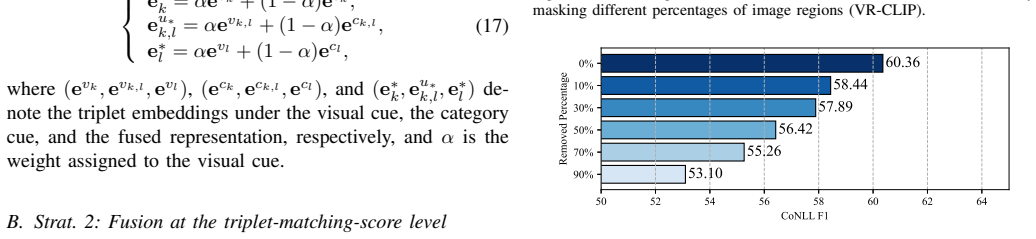
- Supports evaluation on masked and constructed datasets to verify robustness and cross-dataset generalization.
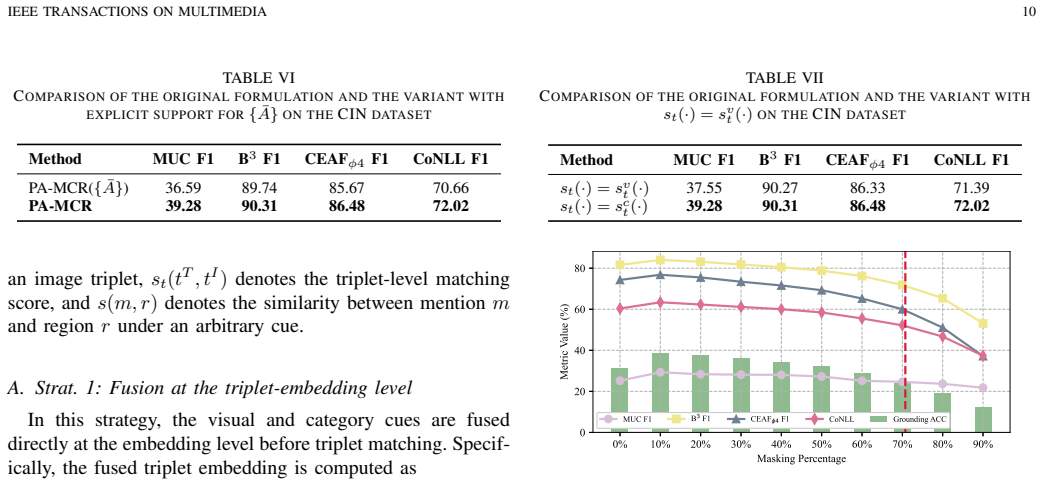
- Demonstrates that fusion of visual and categorical cues can enhance effectiveness beyond either cue alone.
Where Pith is reading between the lines
- The same alignment-plus-fusion pattern could extend to other vision-language reasoning tasks that currently require task-specific training.
- Smaller alignment models may suffice for many multimodal disambiguation problems if evidence fusion is applied at inference time.
- Direct plug-and-adapt approaches could reduce the data hunger of multimodal systems in domains where labeled coreference data remains scarce.
Editorial analysis
A structured set of objections, weighed in public.
Referee Report
Summary. The paper proposes a plug-and-adapt method for multimodal coreference resolution (MCR) that pre-trains a fine-grained alignment model on vision-language datasets and repurposes it for MCR via similarity aggregation of visual and categorical cues combined with evidence theory fusion, eliminating the need for target-domain training or large VLLMs. Experiments on the CIN benchmark report 5.31% and 2.12% CoNLL F1 gains over SOTA dedicated methods and popular VLLMs, respectively, with further tests on a masked CIN variant for robustness and a constructed VCR-MCR dataset for generalization.
Significance. If the empirical results hold, the work is significant for offering a lightweight, immediately deployable alternative to both task-specific trained MCR models and inaccessible billion-parameter VLLMs. The approach leverages existing pre-trained alignment models with explicit fusion mechanics, and the manuscript includes ablation tables isolating the fusion contribution plus generalization experiments, which are strengths.
minor comments (3)
- Abstract and §4: The reported percentage gains on CIN lack accompanying standard deviations, number of runs, or statistical significance tests; adding these would make the 5.31% and 2.12% improvements easier to interpret.
- §3.2: The evidence-theory fusion step is described at a high level; a short worked numerical example showing how similarity scores map to mass functions and are combined would improve clarity without lengthening the section.
- §5.3: The construction details of the VCR-MCR dataset (e.g., how coreference pairs were selected or annotated) are only summarized; a brief appendix table with example instances would aid reproducibility.
Simulated Author's Rebuttal
We thank the referee for the positive assessment of our work, the accurate summary of the plug-and-adapt method, and the recommendation for minor revision. We are pleased that the significance for providing a lightweight alternative to task-specific models and large VLLMs is recognized, along with the value of the ablation and generalization experiments.
Circularity Check
No significant circularity
full rationale
The paper pre-trains a fine-grained alignment model on external vision-language alignment datasets, then applies similarity aggregation and evidence-theory fusion to repurpose it for MCR on the CIN benchmark without any target-domain training or fine-tuning. Performance is measured via empirical gains on held-out external benchmarks (CIN, masked CIN, VCR-MCR) against SOTA methods and VLLMs. No equations, fitted parameters, or self-citations are described that would reduce the central claim to its own inputs by construction; the derivation chain remains self-contained against external data and benchmarks.
Axiom & Free-Parameter Ledger
Cite this review
Pith. "Pith review of Plug-and-Adapt: Multimodal Coreference Resolution at First Sight with a Pretrained Alignment Model." pith.science (2026). https://pith.science/paper/IPUZDGBN
@misc{pith2026260617950,
  author       = {Pith},
  title        = {Pith review of: Plug-and-Adapt: Multimodal Coreference Resolution at First Sight with a Pretrained Alignment Model},
  year         = {2026},
  howpublished = {\url{https://pith.science/paper/IPUZDGBN}},
  note         = {Machine review of arXiv:2606.17950}
}
read the original abstract
Visual information helps resolve ambiguity in coreference resolution, leading to notable performance gains. However, existing Multi-modal Coreference Resolution (MCR) methods require training with (partially) annotated data from the target dataset before they can be applied, preventing their direct usability and raising concerns about generalization. While Vision-Language Large Models (VLLMs) with billions of parameters offer promising zero-shot capabilities, they remain largely inaccessible. Their massive size limits deployability, and many are only accessible through paid APIs. In this paper, we propose a plug-and-adapt method that strategically adapts a carefully pre-trained \emph{alignment model} for immediate use in MCR tasks, designed to eliminate the need for training on scarce benchmark datasets or relying on resource-intensive VLLMs. Specifically, we first pre-train a fine-grained alignment model between textual and visual contextual information using vision-language alignment datasets. We then repurpose the alignment model to MCR through similarity aggregation by fusing visual and categorical cues with evidence theory, thereby enhancing effectiveness. Experiments on the Coreference Image Narratives (CIN) benchmark dataset demonstrate the effectiveness of our method, achieving a 5.31\% and 2.12\% improvement in CoNLL F1 over SOTA dedicated methods and popular VLLMs, respectively. We further evaluate our method on a masked CIN dataset for robustness testing and on a specially constructed VCR-MCR dataset for generalization assessment, with results confirming both capabilities.
Figures




Reference graph
Works this paper leans on
-
[1]
A brief survey on recent advances in coreference resolution,
R. Liu, R. Mao, A. T. Luu, and E. Cambria, “A brief survey on recent advances in coreference resolution,”Artificial Intelligence Review, vol. 56, no. 12, pp. 14 439–14 481, 2023
2023
-
[2]
Spanbert: Improving pre-training by representing and predicting spans,
M. Joshi, D. Chen, Y . Liu, D. S. Weld, L. Zettlemoyer, and O. Levy, “Spanbert: Improving pre-training by representing and predicting spans,” Transactions of the Association for Computational Linguistics, vol. 8, pp. 64–77, 2020
2020
-
[3]
Coreference resolution without span representations,
Y . Kirstain, O. Ram, and O. Levy, “Coreference resolution without span representations,” inProceedings of the Annual Meeting of the Association for Computational Linguistics, 2021, pp. 14–19
2021
-
[4]
Image-based storytelling using deep learning,
Y . Zhu and W. Q. Yan, “Image-based storytelling using deep learning,” in Proceedings of the International Conference on Control and Computer Vision, 2022, pp. 179–186
2022
-
[5]
Pixels to prose: Understanding the art of image captioning,
H. Singh, A. Sharma, and M. Pant, “Pixels to prose: Understanding the art of image captioning,”arXiv preprint arXiv:2408.15714, 2024
-
[6]
Multi-modal self- perception enhanced large language model for 3d region-of-interest captioning with limited data,
L. Shi, S. Kan, Y . Jin, L. Zhang, and Y . Cen, “Multi-modal self- perception enhanced large language model for 3d region-of-interest captioning with limited data,”IEEE Transactions on Multimedia, 2025
2025
-
[7]
Video storytelling: Textual summaries for events,
J. Li, Y . Wong, Q. Zhao, and M. S. Kankanhalli, “Video storytelling: Textual summaries for events,”IEEE Transactions on Multimedia, vol. 22, no. 2, pp. 554–565, 2019
2019
-
[8]
What are you talking about? text-to-image coreference,
C. Kong, D. Lin, M. Bansal, R. Urtasun, and S. Fidler, “What are you talking about? text-to-image coreference,” inProceedings of the Conference on Computer Vision and Pattern Recognition, 2014, pp. 3558–3565
2014
-
[9]
Who’s waldo? linking people across text and images,
Y . Cui, A. Khandelwal, Y . Artzi, N. Snavely, and H. Averbuch-Elor, “Who’s waldo? linking people across text and images,” inProceedings of the International Conference on Computer Vision, 2021, pp. 1374– 1384
2021
-
[10]
Phrase decoupling cross-modal hierarchical matching and progressive position correction for visual grounding,
M. Xie, M. Wang, H. Li, Y . Zhang, D. Tao, and Z. Yu, “Phrase decoupling cross-modal hierarchical matching and progressive position correction for visual grounding,”IEEE Transactions on Multimedia, 2025
2025
-
[11]
Gravl-bert: Graphical visual-linguistic representations for multimodal coreference resolution,
D. Guo, A. Gupta, S. Agarwal, J.-Y . Kao, S. Gao, A. Biswas, C.-W. Lin, T. Chung, and M. Bansal, “Gravl-bert: Graphical visual-linguistic representations for multimodal coreference resolution,” inProceedings of the International Conference on Computational Linguistics, 2022, pp. 285–297
2022
-
[12]
Reclip: A strong zero-shot baseline for referring ex- pression comprehension,
S. Subramanian, W. Merrill, T. Darrell, M. Gardner, S. Singh, and A. Rohrbach, “Reclip: A strong zero-shot baseline for referring ex- pression comprehension,” inProceedings of the Annual Meeting of the Association for Computational Linguistics, 2022, pp. 5198–5215
2022
-
[13]
A dual reinforcement learning framework for weakly supervised phrase grounding,
Z. Wang, C. Yang, B. Jiang, and J. Yuan, “A dual reinforcement learning framework for weakly supervised phrase grounding,”IEEE Transactions on Multimedia, vol. 26, pp. 394–405, 2023
2023
-
[14]
Simmc 2.0: A task-oriented dialog dataset for immersive multimodal conversations,
S. Kottur, S. Moon, A. Geramifard, and B. Damavandi, “Simmc 2.0: A task-oriented dialog dataset for immersive multimodal conversations,” arXiv preprint arXiv:2104.08667, 2021
-
[15]
Who are you referring to? coreference resolution in image narrations,
A. Goel, B. Fernando, F. Keller, and H. Bilen, “Who are you referring to? coreference resolution in image narrations,” inProceedings of the International Conference on Computer Vision, 2023, pp. 15 247–15 258
2023
-
[16]
Semi-supervised multimodal coreference resolution in image narrations,
——, “Semi-supervised multimodal coreference resolution in image narrations,” inProceedings of the Conference on Empirical Methods in Natural Language Processing, 2023, pp. 11 067–11 081
2023
-
[17]
Self-adaptive fine-grained multi-modal data augmentation for semi- supervised multi-modal coreference resolution,
L. Zheng, B. Chen, H. Fei, F. Li, S. Wu, L. Liao, D. Ji, and C. Teng, “Self-adaptive fine-grained multi-modal data augmentation for semi- supervised multi-modal coreference resolution,” inProceedings of the International Conference on Multimedia, 2024, pp. 8576–8585. IEEE TRANSACTIONS ON MULTIMEDIA 12
2024
-
[18]
Connecting vision and language with localized narratives,
J. Pont-Tuset, J. Uijlings, S. Changpinyo, R. Soricut, and V . Ferrari, “Connecting vision and language with localized narratives,” inProceed- ings of the European Conference on Computer Vision. Springer, 2020, pp. 647–664
2020
-
[19]
Revisiting multi-modal llm evaluation,
J. Lu, S. Srivastava, J. Chen, R. Shrestha, M. Acharya, K. Kafle, and C. Kanan, “Revisiting multi-modal llm evaluation,” inProceedings of the Computer Vision and Pattern Recognition Conference, 2025, pp. 555–564
2025
-
[20]
Knowledge en- hanced vision and language model for multi-modal fake news detection,
X. Gao, X. Wang, Z. Chen, W. Zhou, and S. C. Hoi, “Knowledge en- hanced vision and language model for multi-modal fake news detection,” IEEE Transactions on Multimedia, vol. 26, pp. 8312–8322, 2024
2024
-
[21]
Learning transferable visual models from natural language supervision,
A. Radford, J. W. Kim, C. Hallacy, A. Ramesh, G. Goh, S. Agarwal, G. Sastry, A. Askell, P. Mishkin, J. Clarket al., “Learning transferable visual models from natural language supervision,” inProceedings of the International Conference on Machine Learning. PmLR, 2021, pp. 8748–8763
2021
-
[22]
Combination of evidence in dempster-shafer theory,
K. Sentz and S. Ferson, “Combination of evidence in dempster-shafer theory,” 2002
2002
-
[23]
Jøsang,Subjective logic
A. Jøsang,Subjective logic. Springer, 2016, vol. 3
2016
-
[24]
VisualBERT: A Simple and Performant Baseline for Vision and Language
L. H. Li, M. Yatskar, D. Yin, C. Hsieh, and K. Chang, “Visualbert: A simple and performant baseline for vision and language,”arXiv preprint arXiv:1908.03557, 2019
work page internal anchor Pith review Pith/arXiv arXiv 1908
-
[25]
Uniter: Universal image-text representation learning,
Y .-C. Chen, L. Li, L. Yu, A. El Kholy, F. Ahmed, Z. Gan, Y . Cheng, and J. Liu, “Uniter: Universal image-text representation learning,” in Proceedings of the European Conference on Computer Vision. Springer, 2020, pp. 104–120
2020
-
[26]
Vinvl: Revisiting visual representations in vision-language models,
P. Zhang, X. Li, X. Hu, J. Yang, L. Zhang, L. Wang, Y . Choi, and J. Gao, “Vinvl: Revisiting visual representations in vision-language models,” inProceedings of the Conference on Computer Vision and Pattern Recognition, 2021, pp. 5579–5588
2021
-
[27]
Zero-shot referring expression comprehension via structural similarity between images and captions,
Z. Han, F. Zhu, Q. Lao, and H. Jiang, “Zero-shot referring expression comprehension via structural similarity between images and captions,” inProceedings of the Conference on Computer Vision and Pattern Recognition, 2024, pp. 14 364–14 374
2024
-
[28]
Models overview - anthropic,
Anthropic, “Models overview - anthropic,” https://docs.anthropic.com/ en/docs/models-overview., 2024, accessed 17-07-2025
2024
-
[29]
LLaVA-OneVision: Easy Visual Task Transfer
B. Li, Y . Zhang, D. Guo, R. Zhang, F. Li, H. Zhang, K. Zhang, P. Zhang, Y . Li, Z. Liuet al., “Llava-onevision: Easy visual task transfer,”arXiv preprint arXiv:2408.03326, 2024
work page internal anchor Pith review Pith/arXiv arXiv 2024
-
[30]
S. Bai, K. Chen, X. Liu, J. Wang, W. Ge, S. Song, K. Dang, P. Wang, S. Wang, J. Tanget al., “Qwen2.5-vl technical report,”arXiv preprint arXiv:2502.13923, 2025
work page internal anchor Pith review Pith/arXiv arXiv 2025
-
[31]
C. Wu, J. Lei, Q. Zheng, W. Zhao, W. Lin, X. Zhang, X. Zhou, Z. Zhao, Y . Zhang, Y . Wanget al., “Can gpt-4v (ision) serve medical applications? case studies on gpt-4v for multimodal medical diagnosis,”arXiv preprint arXiv:2310.09909, 2023
-
[32]
Gpt-4 in a cancer center—institute-wide deployment challenges and lessons learned,
R. Umeton, A. Kwok, R. Maurya, D. Leco, N. Lenane, J. Willcox, G. A. Abel, M. Tolikas, and J. M. Johnson, “Gpt-4 in a cancer center—institute-wide deployment challenges and lessons learned,”The New England Journal of Medicine Artificial Intelligence, vol. 1, no. 4, p. AIcs2300191, 2024
2024
-
[33]
3ur-llm: An end- to-end multimodal large language model for 3d scene understanding,
H. Xiong, Y . Zhuge, J. Zhu, L. Zhang, and H. Lu, “3ur-llm: An end- to-end multimodal large language model for 3d scene understanding,” IEEE Transactions on Multimedia, 2025
2025
-
[34]
Hico: A benchmark for recognizing human-object interactions in images,
Y .-W. Chao, Z. Wang, Y . He, J. Wang, and J. Deng, “Hico: A benchmark for recognizing human-object interactions in images,” inProceedings of the IEEE international conference on computer vision, 2015, pp. 1017– 1025
2015
-
[35]
Grounded situation recognition,
S. Pratt, M. Yatskar, L. Weihs, A. Farhadi, and A. Kembhavi, “Grounded situation recognition,” inProceedings of the European Conference on Computer Vision. Springer, 2020, pp. 314–332
2020
-
[36]
Visual genome: Connecting language and vision using crowdsourced dense image annotations,
R. Krishna, Y . Zhu, O. Groth, J. Johnson, K. Hata, J. Kravitz, S. Chen, Y . Kalantidis, L.-J. Li, D. A. Shammaet al., “Visual genome: Connecting language and vision using crowdsourced dense image annotations,” International Journal of Computer Vision, vol. 123, pp. 32–73, 2017
2017
-
[37]
A. S. Asratian, T. M. Denley, and R. H ¨aggkvist,Bipartite graphs and their applications. Cambridge university press, 1998, vol. 131
1998
-
[38]
Classification-then- grounding: Reformulating video scene graphs as temporal bipartite graphs,
K. Gao, L. Chen, Y . Niu, J. Shao, and J. Xiao, “Classification-then- grounding: Reformulating video scene graphs as temporal bipartite graphs,” inProceedings of the Conference on Computer Vision and Pattern Recognition, 2022, pp. 19 497–19 506
2022
-
[39]
Llm meets scene graph: Can large language models understand and generate scene graphs? a benchmark and empirical study,
D. Yang, M. Kim, S. Mac Kim, B.-w. Kwak, M. Park, J. Hong, W. Woo, and J. Yeo, “Llm meets scene graph: Can large language models understand and generate scene graphs? a benchmark and empirical study,” inACL, 2025, pp. 21 335–21 360
2025
-
[40]
Information extraction,
R. Grishman, “Information extraction,”IEEE Intelligent Systems, vol. 30, no. 5, pp. 8–15, 2015
2015
-
[41]
Open information extraction: A review of baseline techniques, approaches, and applications,
S. Kamp, M. Fayazi, Z. Benameur-El, S. Yu, and R. Dreslinski, “Open information extraction: A review of baseline techniques, approaches, and applications,”arXiv preprint arXiv:2310.11644, 2023
-
[42]
Faster r-cnn: Towards real-time object detection with region proposal networks,
S. Ren, K. He, R. Girshick, and J. Sun, “Faster r-cnn: Towards real-time object detection with region proposal networks,”Advances in Neural Information Processing Systems, vol. 28, 2015
2015
-
[43]
Generalization of dempster–shafer theory: A complex mass function,
F. Xiao, “Generalization of dempster–shafer theory: A complex mass function,”Applied Intelligence, vol. 50, pp. 3266–3275, 2020
2020
-
[44]
Trusted multi-view classi- fication with dynamic evidential fusion,
Z. Han, C. Zhang, H. Fu, and J. T. Zhou, “Trusted multi-view classi- fication with dynamic evidential fusion,”IEEE transactions on Pattern Analysis and Machine Intelligence, vol. 45, no. 2, pp. 2551–2566, 2022
2022
-
[45]
S. Schrodi, D. T. Hoffmann, M. Argus, V . Fischer, and T. Brox, “Two effects, one trigger: On the modality gap, object bias, and informa- tion imbalance in contrastive vision-language models,”arXiv preprint arXiv:2404.07983, 2024
-
[46]
Bridge the modality and capability gaps in vision-language model selection,
C. Yi, Y . He, D.-C. Zhan, and H.-J. Ye, “Bridge the modality and capability gaps in vision-language model selection,”Advances in Neural Information Processing Systems, vol. 37, pp. 34 429–34 452, 2024
2024
-
[47]
Towards under- standing the modality gap in clip,
P. Shi, M. C. Welle, M. Bj ¨orkman, and D. Kragic, “Towards under- standing the modality gap in clip,” inProceedings of the International Conference on Learning Representations Workshop on Multimodal Rep- resentation Learning, 2023
2023
-
[48]
Confidence- aware contrastive learning for selective classification,
Y .-C. Wu, S.-H. Lyu, H. Shang, X. Wang, and C. Qian, “Confidence- aware contrastive learning for selective classification,” inICML, 2024, pp. 53 706–53 729
2024
-
[49]
On calibration of modern neural networks,
C. Guo, G. Pleiss, Y . Sun, and K. Q. Weinberger, “On calibration of modern neural networks,” inICML. PMLR, 2017, pp. 1321–1330
2017
-
[50]
Overview of results of the muc-6 evaluation,
B. M. Sundheim, “Overview of results of the muc-6 evaluation,” in Proceedings of the Message Understanding Conference, 1995
1995
-
[51]
Algorithms for scoring coreference chains,
A. Bagga and B. Baldwin, “Algorithms for scoring coreference chains,” inProceedings of the International Conference on Language Resources and Evaluation Workshop, vol. 1. Citeseer, 1998, pp. 563–566
1998
-
[52]
On coreference resolution performance metrics,
X. Luo, “On coreference resolution performance metrics,” inProceed- ings of the Human Language Technology Conference and Conference on Empirical Methods in Natural Language Processing, 2005, pp. 25–32
2005
-
[53]
Conll- 2012 shared task: Modeling multilingual unrestricted coreference in ontonotes,
S. Pradhan, A. Moschitti, N. Xue, O. Uryupina, and Y . Zhang, “Conll- 2012 shared task: Modeling multilingual unrestricted coreference in ontonotes,” inProceedings of the Joint Conference on EMNLP and CoNLL-shared task, 2012, pp. 1–40
2012
-
[54]
Stanford’s multi-pass sieve coreference resolution system at the conll-2011 shared task,
H. Lee, Y . Peirsman, A. Chang, N. Chambers, M. Surdeanu, and D. Jurafsky, “Stanford’s multi-pass sieve coreference resolution system at the conll-2011 shared task,” inProceedings of the Conference on Computational Natural Language Learning, 2011, pp. 28–34
2011
-
[55]
End-to-end neural coreference resolution,
K. Lee, L. He, M. Lewis, and L. Zettlemoyer, “End-to-end neural coreference resolution,” inProceedings of the Conference on Empirical Methods in Natural Language Processing, 2017, pp. 188–197
2017
-
[56]
On gen- eralization in coreference resolution,
S. Toshniwal, P. Xia, S. Wiseman, K. Livescu, and K. Gimpel, “On gen- eralization in coreference resolution,” inProceedings of the Workshop on Computational Models of Reference, Anaphora and Coreference, 2021, pp. 111–120
2021
-
[57]
Qwen, A. Yang, B. Yang, B. Zhang, B. Hui, B. Zheng, B. Yu, C. Li, D. Liu, and F. Huang, “Qwen2.5 technical report,”arXiv preprint arXiv:2412.15115, 2024
work page internal anchor Pith review Pith/arXiv arXiv 2024
-
[58]
Maf: Multimodal alignment framework for weakly-supervised phrase grounding,
Q. Wang, H. Tan, S. Shen, M. Mahoney, and Z. Yao, “Maf: Multimodal alignment framework for weakly-supervised phrase grounding,” inPro- ceedings of the Conference on Empirical Methods in Natural Language Processing, 2020, pp. 2030–2038
2020
-
[59]
Are language models robust coreference resolvers?
N. T. Le and A. Ritter, “Are language models robust coreference resolvers?” inProceedings of the Conference on Language Modeling, 2024
2024
-
[60]
Open information extraction via chunks,
K. Dong, A. Sun, J.-J. Kim, and X. Li, “Open information extraction via chunks,”Proceedings of the Conference on Empirical Methods in Natural Language Processing, 2023
2023
-
[61]
From recognition to cogni- tion: Visual commonsense reasoning,
R. Zellers, Y . Bisk, A. Farhadi, and Y . Choi, “From recognition to cogni- tion: Visual commonsense reasoning,” inProceedings of the Conference on Computer Vision and Pattern Recognition, 2019, pp. 6720–6731. IEEE TRANSACTIONS ON MULTIMEDIA 13 Jinghan Wureceived the B.S. degree in automation science and technology in Xi’an Jiaotong University, Shaanxi, C...
2019
This paper was first reviewed by grok-4.3 on June 27, 2026.
discussion (0)
Sign in with ORCID, Apple, or X to comment. Anyone can read and Pith papers without signing in.