Impact of inhomogeneous curvature on growth rate measurements from magnitude fluctuations
Pith reviewed 2026-06-26 22:55 UTC · model grok-4.3
The pith
Inhomogeneous curvature causes only sub-dominant systematic offsets in low-redshift growth rate measurements from magnitude fluctuations.
A machine-rendered reading of the paper's core claim, the machinery that carries it, and where it could break.
Core claim
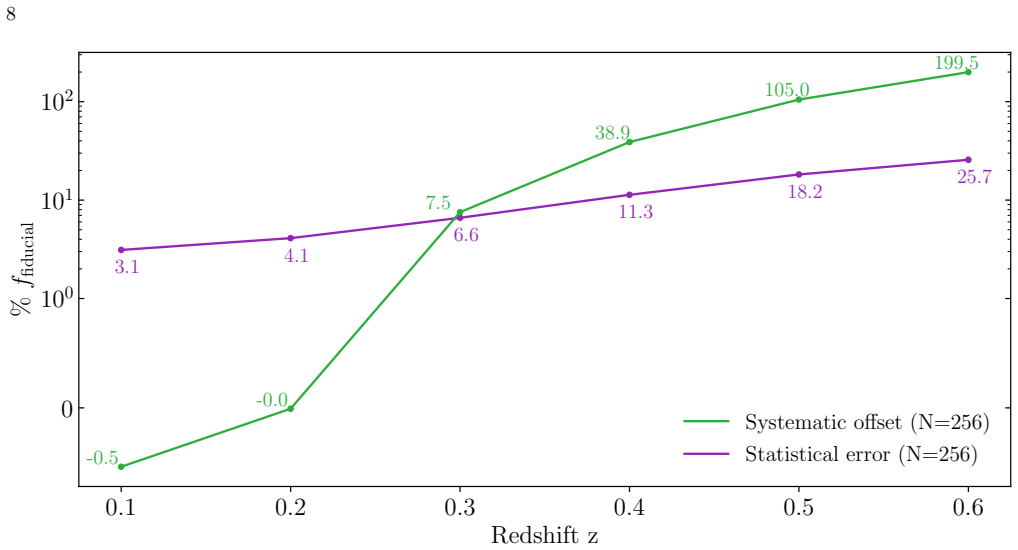
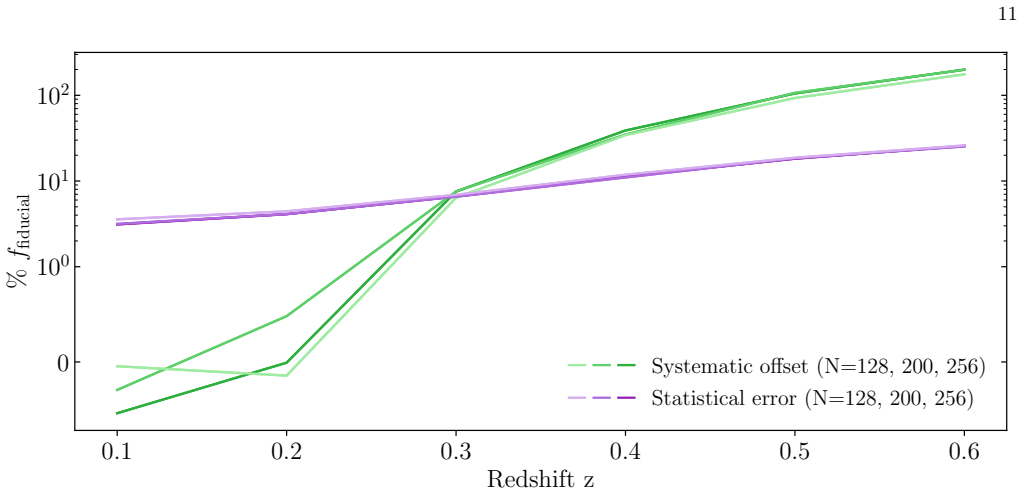
Numerical cosmological simulations generated in full General Relativity show that the systematic offset in growth rate measurements between the full numerical relativity and FLRW treatments is sub-dominant to the statistical error of current datasets at z ≲ 0.2, confirming that FLRW modelling is adequate for current low-redshift peculiar velocity experiments.
What carries the argument
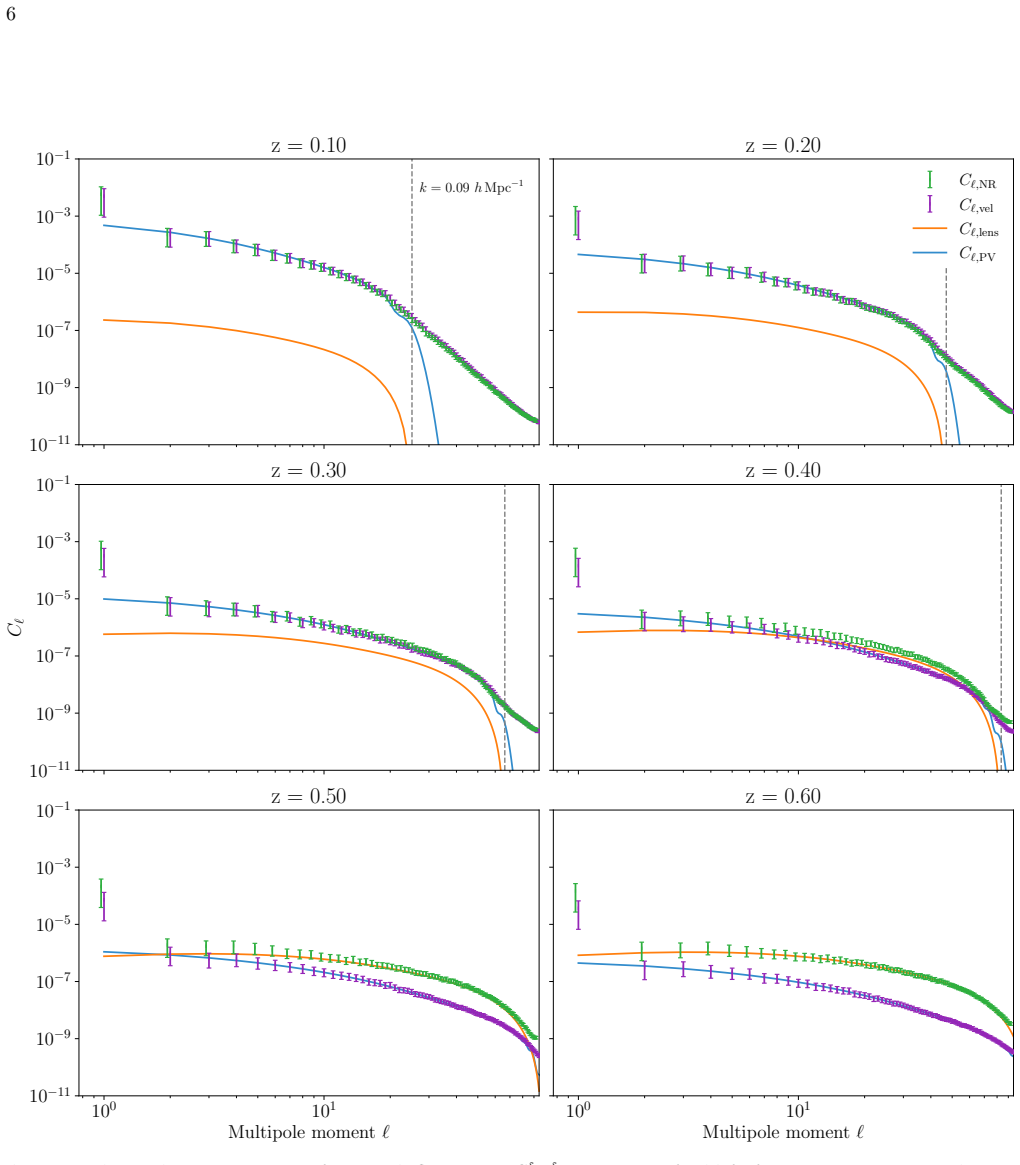
The magnitude correlation spectrum, which encodes angular-scale and redshift-dependent distortions from inhomogeneous curvature and is used to extract the growth-rate systematic offset between GR and FLRW treatments.
If this is right
- FLRW modelling is adequate for current low-redshift peculiar velocity experiments.
- Future datasets extending to higher redshift may require theoretical models that additionally incorporate gravitational lensing and inhomogeneous curvature.
- Distortions in the magnitude correlation spectrum vary with angular scale and redshift.
Where Pith is reading between the lines
- The same conclusion may hold for other low-redshift probes that assume homogeneity.
- Running the same simulations at higher redshifts would map the redshift where inhomogeneous effects exceed statistical errors.
- Including curvature inhomogeneity in growth-rate models could refine constraints on dark energy or modified gravity parameters.
Load-bearing premise
The numerical cosmological simulations generated in full General Relativity accurately capture the relevant effects of inhomogeneous spacetime on magnitude fluctuations without significant resolution artifacts or missing physics.
What would settle it
A low-redshift peculiar-velocity survey that yields a growth-rate offset between full-GR and FLRW analyses larger than the reported statistical error would falsify the claim that the systematic offset is sub-dominant.
Figures
read the original abstract
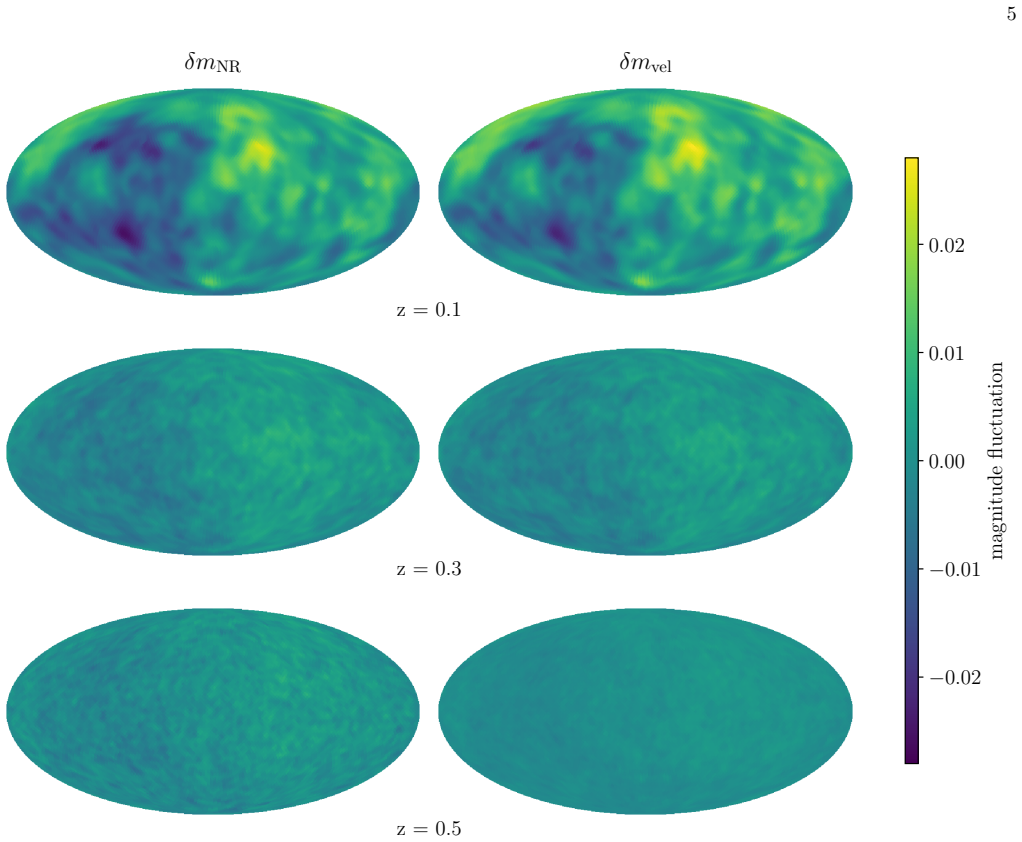
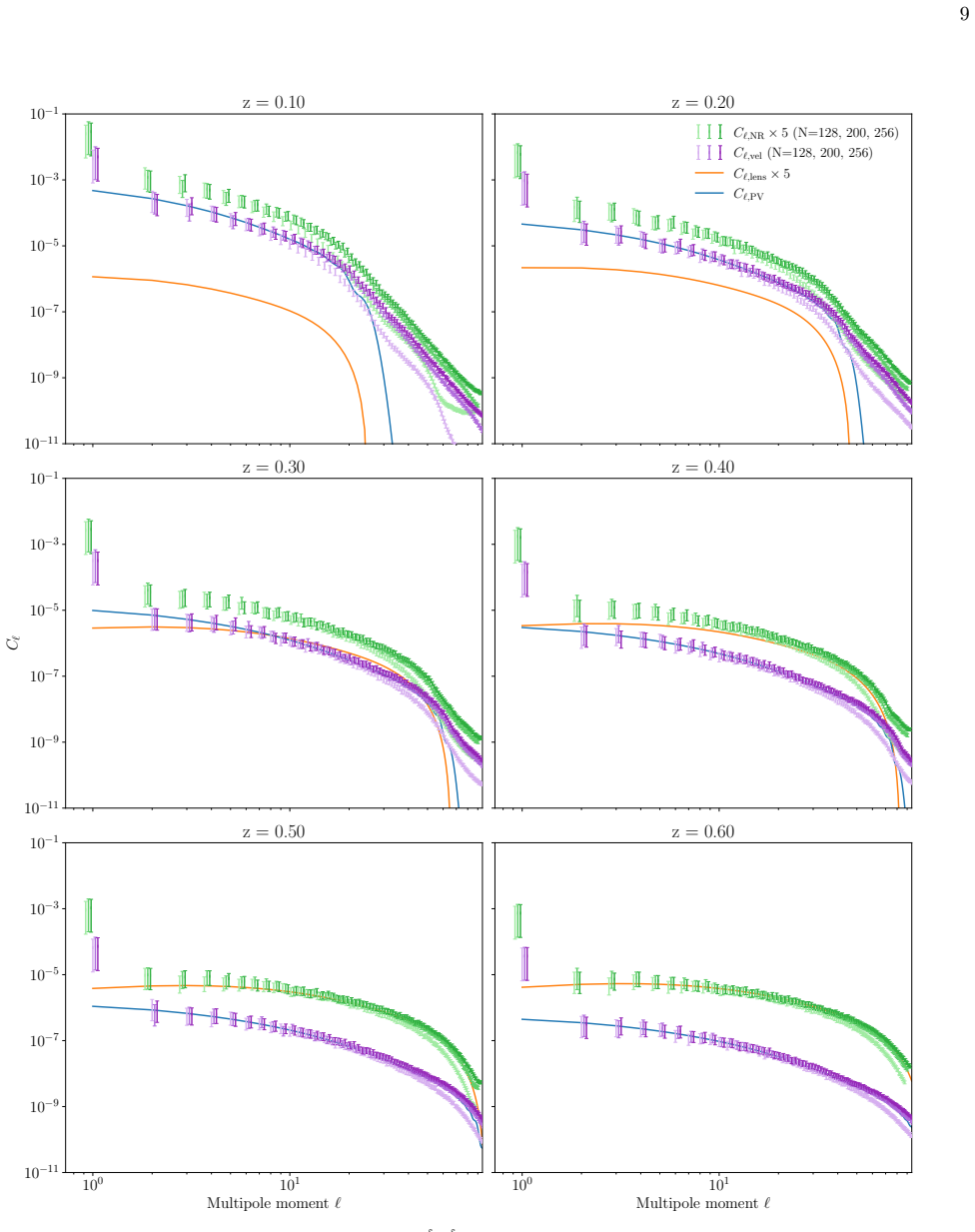
Our interpretation of current cosmological observations rests on the assumptions of homogeneity and isotropy, leading to uniform background curvature and expansion characterised by the Friedmann-Lema\^itre-Robertson-Walker (FLRW) spacetime metric. However, the large-scale structure of the Universe is non-uniform in detail, inducing inhomogeneous curvature and scale factor variations. In this paper, we use numerical cosmological simulations generated in full General Relativity to study the impact of inhomogeneous spacetime on the magnitude fluctuations of distant objects, focusing on their use as a probe of the growth rate of cosmic structure. We quantify the distortions in the magnitude correlation spectrum as a function of angular scale and redshift, and use these distortions to infer the systematic offset in the growth rate measurement. We find that at $z \lesssim 0.2$, the systematic offset in growth rate measurements between the full numerical relativity and FLRW treatments is sub-dominant to the statistical error of current datasets, confirming that FLRW modelling is adequate for current low-redshift peculiar velocity experiments. Future datasets extending to higher redshift may require theoretical models that additionally incorporate the contributions of gravitational lensing and inhomogeneous curvature.
Editorial analysis
A structured set of objections, weighed in public.
Referee Report
Summary. The paper uses numerical cosmological simulations generated in full General Relativity to quantify distortions in the magnitude correlation spectrum induced by inhomogeneous curvature and scale factor variations. These distortions are used to infer the systematic offset in growth rate measurements relative to the standard FLRW prediction. The central claim is that at z ≲ 0.2 the offset is sub-dominant to the statistical error of current datasets, confirming that FLRW modelling is adequate for present low-redshift peculiar velocity experiments, while future higher-redshift data may require models that incorporate gravitational lensing and inhomogeneous curvature.
Significance. If the simulations are shown to be converged and the error analysis complete, the direct numerical comparison between full-GR runs and the FLRW baseline provides a parameter-free test of the robustness of growth-rate inferences from magnitude fluctuations. This strengthens in the adequacy of standard modelling for current low-z datasets and delineates the redshift range where additional physics must be included.
major comments (1)
- [Abstract] Abstract: the quantitative conclusion that the systematic offset is sub-dominant to current statistical errors is stated without any information on simulation resolution, convergence tests, error propagation, or the exact definition of the magnitude correlation spectrum. These details are required to verify the central claim.
Simulated Author's Rebuttal
We thank the referee for their comment highlighting the need for additional context in the abstract to support the central claim. We agree that the abstract would benefit from brief references to key technical aspects and will revise it accordingly while keeping it concise.
read point-by-point responses
-
Referee: [Abstract] Abstract: the quantitative conclusion that the systematic offset is sub-dominant to current statistical errors is stated without any information on simulation resolution, convergence tests, error propagation, or the exact definition of the magnitude correlation spectrum. These details are required to verify the central claim.
Authors: We agree that the abstract, being a high-level summary, does not include these specifics. The manuscript body provides the simulation resolution, convergence tests, error propagation details, and the definition of the magnitude correlation spectrum. We will revise the abstract to add a short clause noting the simulation resolution and that convergence has been verified, while directing readers to the main text for the remaining details on error analysis and definitions. This addresses the concern without substantially lengthening the abstract. revision: yes
Circularity Check
No significant circularity identified
full rationale
The paper's central claim rests on a direct numerical comparison between full-GR cosmological simulations and standard FLRW modeling of magnitude fluctuations, with the reported offset at z ≲ 0.2 found sub-dominant to statistical errors. This constitutes an independent external benchmark rather than any reduction of the result to a fitted parameter, self-definition, or self-citation chain. No load-bearing steps matching the enumerated circularity patterns are present in the abstract or described methodology; the derivation is self-contained against the simulation outputs.
Axiom & Free-Parameter Ledger
Reference graph
Works this paper leans on
-
[1]
A local measurement of the growth rate from peculiar velocities and galaxy clustering correlations in the 6dF Galaxy Survey. , keywords =. doi:10.1093/mnras/stac3256 , archivePrefix =. 2207.03707 , primaryClass =
-
[2]
Correlated fluctuations in luminosity distance and the importance of peculiar motion in supernova surveys. , keywords =. doi:10.1103/PhysRevD.73.123526 , archivePrefix =. astro-ph/0512159 , primaryClass =
work page internal anchor Pith review Pith/arXiv arXiv doi:10.1103/physrevd.73.123526
-
[3]
Can redshift errors bias measurements of the Hubble Constant?. , keywords =. doi:10.1093/mnras/stz2652 , archivePrefix =. 1907.12639 , primaryClass =
-
[4]
The DESI Experiment, a whitepaper for Snowmass 2013
The DESI Experiment, a whitepaper for Snowmass 2013. arXiv e-prints , keywords =. doi:10.48550/arXiv.1308.0847 , archivePrefix =. 1308.0847 , primaryClass =
work page internal anchor Pith review Pith/arXiv arXiv doi:10.48550/arxiv.1308.0847 2013
-
[5]
The DESI Experiment Part I: Science,Targeting, and Survey Design
The DESI Experiment Part I: Science,Targeting, and Survey Design. arXiv e-prints , keywords =. doi:10.48550/arXiv.1611.00036 , archivePrefix =. 1611.00036 , primaryClass =
work page internal anchor Pith review Pith/arXiv arXiv doi:10.48550/arxiv.1611.00036
-
[6]
The DESI Experiment Part II: Instrument Design
The DESI Experiment Part II: Instrument Design. arXiv e-prints , keywords =. doi:10.48550/arXiv.1611.00037 , archivePrefix =. 1611.00037 , primaryClass =
work page internal anchor Pith review Pith/arXiv arXiv doi:10.48550/arxiv.1611.00037
-
[7]
Overview of the DESI Legacy Imaging Surveys
Overview of the DESI Legacy Imaging Surveys. , keywords =. doi:10.3847/1538-3881/ab089d , archivePrefix =. 1804.08657 , primaryClass =
work page internal anchor Pith review Pith/arXiv arXiv doi:10.3847/1538-3881/ab089d
-
[8]
The Robotic Multiobject Focal Plane System of the Dark Energy Spectroscopic Instrument (DESI). , keywords =. doi:10.3847/1538-3881/ac9ab1 , archivePrefix =. 2205.09014 , primaryClass =
-
[9]
The Spectroscopic Data Processing Pipeline for the Dark Energy Spectroscopic Instrument. , keywords =. doi:10.3847/1538-3881/acb212 , archivePrefix =. 2209.14482 , primaryClass =
-
[10]
Survey Operations for the Dark Energy Spectroscopic Instrument. , keywords =. doi:10.3847/1538-3881/ad0832 , archivePrefix =. 2306.06309 , primaryClass =
-
[11]
Validation of the Scientific Program for the Dark Energy Spectroscopic Instrument. , keywords =. doi:10.3847/1538-3881/ad0b08 , archivePrefix =. 2306.06307 , primaryClass =
-
[12]
, year=2024, month=aug, volume=
The Early Data Release of the Dark Energy Spectroscopic Instrument. , keywords =. doi:10.3847/1538-3881/ad3217 , archivePrefix =. 2306.06308 , primaryClass =
-
[13]
The DESI Bright Galaxy Survey: Final Target Selection, Design, and Validation. , keywords =. doi:10.3847/1538-3881/accff8 , archivePrefix =. 2208.08512 , primaryClass =
-
[14]
The Pantheon+ Analysis: The Full Dataset and Light-Curve Release
The Pantheon+ Analysis: The Full Data Set and Light-curve Release. , keywords =. doi:10.3847/1538-4357/ac8b7a , archivePrefix =. 2112.03863 , primaryClass =
work page internal anchor Pith review Pith/arXiv arXiv doi:10.3847/1538-4357/ac8b7a
-
[15]
The Pantheon+ Analysis: SuperCal-fragilistic Cross Calibration, Retrained SALT2 Light-curve Model, and Calibration Systematic Uncertainty. , keywords =. doi:10.3847/1538-4357/ac8bcc , archivePrefix =. 2112.03864 , primaryClass =
-
[16]
DESI 2024 III: Baryon Acoustic Oscillations from Galaxies and Quasars
DESI 2024 III: Baryon Acoustic Oscillations from Galaxies and Quasars. arXiv e-prints , keywords =. doi:10.48550/arXiv.2404.03000 , archivePrefix =. 2404.03000 , primaryClass =
work page internal anchor Pith review Pith/arXiv arXiv doi:10.48550/arxiv.2404.03000 2024
-
[17]
The Supernova Legacy Survey 3-year sample: Type Ia supernovae photometric distances and cosmological constraints. , keywords =. doi:10.1051/0004-6361/201014468 , archivePrefix =. 1010.4743 , primaryClass =
work page internal anchor Pith review Pith/arXiv arXiv doi:10.1051/0004-6361/201014468
-
[18]
, keywords =
A two-parameter luminosity correction for Type IA supernovae. , keywords =
-
[19]
Correcting Type Ia Supernova Distances for Selection Biases and Contamination in Photometrically Identified Samples. , keywords =. doi:10.3847/1538-4357/836/1/56 , archivePrefix =. 1610.04677 , primaryClass =
work page internal anchor Pith review Pith/arXiv arXiv doi:10.3847/1538-4357/836/1/56
-
[20]
Improved Treatment of Host-galaxy Correlations in Cosmological Analyses with Type Ia Supernovae. , keywords =. doi:10.3847/1538-4357/abf14f , archivePrefix =. 2102.01776 , primaryClass =
-
[21]
The Pantheon+ Analysis: Cosmological Constraints
The Pantheon+ Analysis: Cosmological Constraints. , keywords =. doi:10.3847/1538-4357/ac8e04 , archivePrefix =. 2202.04077 , primaryClass =
work page internal anchor Pith review Pith/arXiv arXiv doi:10.3847/1538-4357/ac8e04
-
[22]
The Gigaparsec WiggleZ simulations: characterizing scale-dependant bias and associated systematics in growth of structure measurements. , keywords =. doi:10.1093/mnras/stv314 , archivePrefix =. 1407.0390 , primaryClass =
work page internal anchor Pith review Pith/arXiv arXiv doi:10.1093/mnras/stv314
-
[23]
Improved cosmological constraints from a joint analysis of the SDSS-II and SNLS supernova samples
Improved cosmological constraints from a joint analysis of the SDSS-II and SNLS supernova samples. , keywords =. doi:10.1051/0004-6361/201423413 , archivePrefix =. 1401.4064 , primaryClass =
work page internal anchor Pith review Pith/arXiv arXiv doi:10.1051/0004-6361/201423413
-
[24]
Redshift evolution of the underlying type Ia supernova stretch distribution. , keywords =. doi:10.1051/0004-6361/202038447 , archivePrefix =. 2005.09441 , primaryClass =
-
[25]
2020, A&A, 644, A176, doi: 10.1051/0004-6361/201730404 Rivera Sandoval, L
Strong dependence of Type Ia supernova standardization on the local specific star formation rate. , keywords =. doi:10.1051/0004-6361/201730404 , archivePrefix =. 1806.03849 , primaryClass =
-
[26]
Generating mock galaxy catalogues for flux-limited samples like the DESI Bright Galaxy Survey. , keywords =. doi:10.1093/mnras/stae1503 , archivePrefix =. 2312.08792 , primaryClass =
-
[27]
The ABACUS cosmological N-body code. , keywords =. doi:10.1093/mnras/stab2482 , archivePrefix =. 2110.11392 , primaryClass =
-
[28]
ABACUSSUMMIT: a massive set of high-accuracy, high-resolution N-body simulations. , keywords =. doi:10.1093/mnras/stab2484 , archivePrefix =. 2110.11398 , primaryClass =
-
[29]
COMPASO: A new halo finder for competitive assignment to spherical overdensities. , keywords =. doi:10.1093/mnras/stab2980 , archivePrefix =. 2110.11408 , primaryClass =
-
[30]
A Lightcone Catalogue from the Millennium-XXL Simulation
A lightcone catalogue from the Millennium-XXL simulation. , keywords =. doi:10.1093/mnras/stx1432 , archivePrefix =. 1701.06581 , primaryClass =
work page internal anchor Pith review Pith/arXiv arXiv doi:10.1093/mnras/stx1432
-
[31]
A light-cone catalogue from the Millennium-XXL simulation: improved spatial interpolation and colour distributions for the DESI BGS. , keywords =. doi:10.1093/mnras/stac2519 , archivePrefix =. 2207.04902 , primaryClass =
-
[32]
Rates and Properties of Type Ia Supernovae as a Function of Mass and Star Formation in Their Host Galaxies. , keywords =. doi:10.1086/506137 , archivePrefix =. astro-ph/0605455 , primaryClass =
work page internal anchor Pith review Pith/arXiv arXiv doi:10.1086/506137
-
[33]
The supernova rate per unit mass
The supernova rate per unit mass. , keywords =. doi:10.1051/0004-6361:20041411 , archivePrefix =. astro-ph/0411450 , primaryClass =
work page internal anchor Pith review Pith/arXiv arXiv doi:10.1051/0004-6361:20041411
-
[34]
On the correlations of galaxy peculiar velocities and their covariance. , keywords =. doi:10.1093/mnras/stad3217 , archivePrefix =. 2308.15735 , primaryClass =
-
[35]
Fast and accurate mock catalogue generation for low-mass galaxies
Fast and accurate mock catalogue generation for low-mass galaxies. , keywords =. doi:10.1093/mnras/stw763 , archivePrefix =. 1507.05329 , primaryClass =
work page internal anchor Pith review Pith/arXiv arXiv doi:10.1093/mnras/stw763
-
[36]
Solving Large Scale Structure in Ten Easy Steps with COLA
Solving large scale structure in ten easy steps with COLA. , keywords =. doi:10.1088/1475-7516/2013/06/036 , archivePrefix =. 1301.0322 , primaryClass =
work page internal anchor Pith review Pith/arXiv arXiv doi:10.1088/1475-7516/2013/06/036 2013
-
[37]
On the Pattern of Perturbations of the Hubble Flow. , keywords =. doi:10.1086/185255 , adsurl =
-
[38]
Improving estimates of the growth rate using galaxy-velocity correlations: a simulation study. , keywords =. doi:10.1093/mnras/stab212 , archivePrefix =. 2101.09026 , primaryClass =
-
[39]
Power Spectrum Analysis of Three-Dimensional Redshift Surveys
Power-Spectrum Analysis of Three-dimensional Redshift Surveys. , keywords =. doi:10.1086/174036 , archivePrefix =. astro-ph/9304022 , primaryClass =
work page internal anchor Pith review Pith/arXiv arXiv doi:10.1086/174036
-
[40]
Bias and Variance of Angular Correlation Functions. , keywords =. doi:10.1086/172900 , adsurl =
-
[41]
The Zwicky Transient Facility: System Overview, Performance, and First Results
The Zwicky Transient Facility: System Overview, Performance, and First Results. , keywords =. doi:10.1088/1538-3873/aaecbe , archivePrefix =. 1902.01932 , primaryClass =
work page internal anchor Pith review Pith/arXiv arXiv doi:10.1088/1538-3873/aaecbe 1902
-
[42]
LSST: from Science Drivers to Reference Design and Anticipated Data Products
LSST: From Science Drivers to Reference Design and Anticipated Data Products. , keywords =. doi:10.3847/1538-4357/ab042c , archivePrefix =. 0805.2366 , primaryClass =
work page internal anchor Pith review Pith/arXiv arXiv doi:10.3847/1538-4357/ab042c
-
[43]
Physics of the Dark Universe , keywords =
On the amount of peculiar velocity field information in supernovae from LSST and beyond. Physics of the Dark Universe , keywords =. doi:10.1016/j.dark.2020.100519 , archivePrefix =. 1905.00746 , primaryClass =
-
[44]
J.Carrick,S.J.Turnbull,G.Lavaux,andM.J.Hudson.MNRAS,450(1):317–332,June2015
Growth-rate measurement with type-Ia supernovae using ZTF survey simulations. , keywords =. doi:10.1051/0004-6361/202346173 , archivePrefix =. 2303.01198 , primaryClass =
-
[45]
The density and peculiar velocity fields of nearby galaxies
The density and peculiar velocity fields of nearby galaxies. , keywords =. doi:10.1016/0370-1573(95)00013-7 , archivePrefix =. astro-ph/9502079 , primaryClass =
work page internal anchor Pith review Pith/arXiv arXiv doi:10.1016/0370-1573(95)00013-7
-
[46]
The 6dF Galaxy Velocity Survey: Cosmological constraints from the velocity power spectrum
The 6dF Galaxy Survey: cosmological constraints from the velocity power spectrum. , keywords =. doi:10.1093/mnras/stu1615 , archivePrefix =. 1404.3799 , primaryClass =
work page internal anchor Pith review Pith/arXiv arXiv doi:10.1093/mnras/stu1615
-
[47]
Testing $\Lambda$CDM at the lowest redshifts with SN Ia and galaxy velocities
Testing CDM at the lowest redshifts with SN Ia and galaxy velocities. , keywords =. doi:10.1088/1475-7516/2017/05/015 , archivePrefix =. 1611.09862 , primaryClass =
work page internal anchor Pith review Pith/arXiv arXiv doi:10.1088/1475-7516/2017/05/015 2017
-
[48]
2MTF VI. Measuring the velocity power spectrum
2MTF - VI. Measuring the velocity power spectrum. , keywords =. doi:10.1093/mnras/stx1521 , archivePrefix =. 1706.05130 , primaryClass =
work page internal anchor Pith review Pith/arXiv arXiv doi:10.1093/mnras/stx1521
-
[49]
Joint growth-rate measurements from redshift-space distortions and peculiar velocities in the 6dF Galaxy Survey. , keywords =. doi:10.1093/mnras/staa845 , archivePrefix =. 2004.06399 , primaryClass =
-
[50]
Using peculiar velocity surveys to constrain the growth rate of structure with the wide-angle effect. , keywords =. doi:10.1093/mnras/stac3252 , archivePrefix =. 2209.04166 , primaryClass =
-
[51]
Velocity-Density Correlations from the cosmicflows-3 Distance Catalog and the 2MASS Redshift Survey
Velocity-density correlations from the cosmicflows-3 distance catalogue and the 2MASS Redshift Survey. , keywords =. doi:10.1093/mnras/stx1225 , archivePrefix =. 1703.05324 , primaryClass =
work page internal anchor Pith review Pith/arXiv arXiv doi:10.1093/mnras/stx1225
-
[52]
An estimation of the Local growth rate from Cosmicflows-3 peculiar velocities
An estimation of the local growth rate from Cosmicflows peculiar velocities. , keywords =. doi:10.1093/mnras/stz901 , archivePrefix =. 1901.03530 , primaryClass =
work page internal anchor Pith review Pith/arXiv arXiv doi:10.1093/mnras/stz901 1901
-
[53]
The redshift-space momentum power spectrum - II. Measuring the growth rate from the combined 2MTF and 6dFGSv surveys. , keywords =. doi:10.1093/mnras/stz1576 , archivePrefix =. 1906.02874 , primaryClass =
work page internal anchor Pith review Pith/arXiv arXiv doi:10.1093/mnras/stz1576 1906
-
[54]
The Redshift-Space Momentum Power Spectrum I: Optimal Estimation From Peculiar Velocity Surveys
The redshift-space momentum power spectrum - I. Optimal estimation from peculiar velocity surveys. , keywords =. doi:10.1093/mnras/stz1403 , archivePrefix =. 1906.02875 , primaryClass =
work page internal anchor Pith review Pith/arXiv arXiv doi:10.1093/mnras/stz1403 1906
-
[55]
Cosmic momentum field and mass fluctuation power spectrum. , keywords =. doi:10.1046/j.1365-8711.2000.03886.x , archivePrefix =. astro-ph/0012066 , primaryClass =
-
[56]
Power Spectrum of Cosmic Momentum Field Measured from the SFI Galaxy Sample
Power Spectrum of Cosmic Momentum Field Measured from the SFI Galaxy Sample. , keywords =. doi:10.1086/498258 , archivePrefix =. astro-ph/0509740 , primaryClass =
work page internal anchor Pith review Pith/arXiv arXiv doi:10.1086/498258
-
[57]
Local gravity versus local velocity: solutions for and non-linear bias. , keywords =. doi:10.1111/j.1365-2966.2011.18362.x , archivePrefix =. 1011.3114 , primaryClass =
-
[58]
The effect of peculiar velocities on supernova cosmology
The Effect of Peculiar Velocities on Supernova Cosmology. , keywords =. doi:10.1088/0004-637X/741/1/67 , archivePrefix =. 1012.2912 , primaryClass =
work page internal anchor Pith review Pith/arXiv arXiv doi:10.1088/0004-637x/741/1/67
-
[59]
Cosmological parameters from the comparison of peculiar velocities with predictions from the 2M++ density field. , keywords =. doi:10.1093/mnras/stv547 , archivePrefix =. 1504.04627 , primaryClass =
work page internal anchor Pith review Pith/arXiv arXiv doi:10.1093/mnras/stv547
-
[60]
Cosmic flows in the nearby Universe: new peculiar velocities from SNe and cosmological constraints. , keywords =. doi:10.1093/mnras/staa2485 , archivePrefix =. 1912.09383 , primaryClass =
-
[61]
Joint analysis of 6dFGS and SDSS peculiar velocities for the growth rate of cosmic structure and tests of gravity. , keywords =. doi:10.1093/mnras/staa2032 , archivePrefix =. 2007.04993 , primaryClass =
-
[62]
Measuring the Hubble function with standard candle clustering. , keywords =. doi:10.1093/mnras/stab887 , archivePrefix =. 1912.10255 , primaryClass =
-
[63]
Observational Evidence from Supernovae for an Accelerating Universe and a Cosmological Constant. , keywords =. doi:10.1086/300499 , archivePrefix =. astro-ph/9805201 , primaryClass =
work page internal anchor Pith review Pith/arXiv arXiv doi:10.1086/300499
-
[64]
Measurements of and from 42 High-Redshift Supernovae. , keywords =. doi:10.1086/307221 , archivePrefix =. astro-ph/9812133 , primaryClass =
work page internal anchor Pith review Pith/arXiv arXiv doi:10.1086/307221
-
[65]
The High-Z Supernova Search: Measuring Cosmic Deceleration and Global Curvature of the Universe Using Type IA Supernovae. , keywords =. doi:10.1086/306308 , archivePrefix =. astro-ph/9805200 , primaryClass =
work page internal anchor Pith review Pith/arXiv arXiv doi:10.1086/306308
-
[66]
Improving constraints on the growth rate of structure by modelling the density-velocity cross-correlation in the 6dF Galaxy Survey. , keywords =. doi:10.1093/mnras/stx1529 , archivePrefix =. 1706.05205 , primaryClass =
work page internal anchor Pith review Pith/arXiv arXiv doi:10.1093/mnras/stx1529
-
[67]
LSST Science Book, Version 2.0
LSST Science Book, Version 2.0. arXiv e-prints , keywords =. doi:10.48550/arXiv.0912.0201 , archivePrefix =. 0912.0201 , primaryClass =
work page internal anchor Pith review Pith/arXiv arXiv doi:10.48550/arxiv.0912.0201
-
[68]
Testing modified gravity scenarios with direct peculiar velocities. , keywords =. doi:10.1093/mnras/stac3323 , archivePrefix =. 2211.07101 , primaryClass =
-
[69]
Lyall, Stuart and Blake, Chris and Turner, Ryan J. , year =. Constraining Modified Gravity Scenarios with the. Monthly Notices of the Royal Astronomical Society , volume =. doi:10.1093/mnras/stae1718 , archiveprefix =. 2407.18684 , primaryclass =
-
[70]
Complementarity of peculiar velocity surveys and redshift space distortions for testing gravity. , keywords =. doi:10.1103/PhysRevD.101.023516 , archivePrefix =. 1911.09121 , primaryClass =
-
[71]
, keywords =
A new method of determining distances to galaxies. , keywords =
-
[72]
and Davis, Marc , month = feb, year =
Fundamental Properties of Elliptical Galaxies. , keywords =. doi:10.1086/164948 , adsurl =
-
[73]
Spectroscopy and Photometry of Elliptical Galaxies. I. New Distance Estimator. , keywords =. doi:10.1086/164947 , adsurl =
-
[74]
Measuring the growth rate of structure with Type IA Supernovae from LSST
Measuring the Growth Rate of Structure with Type IA Supernovae from LSST. , keywords =. doi:10.3847/1538-4357/aa88c8 , archivePrefix =. 1708.08236 , primaryClass =
work page internal anchor Pith review Pith/arXiv arXiv doi:10.3847/1538-4357/aa88c8
-
[75]
28 Cosmology with Tully-FisherHiGalaxy Surveys J
The 4MOST Hemisphere Survey of the Nearby Universe (4HS). The Messenger , year = 2023, month = mar, volume =. doi:10.18727/0722-6691/5312 , adsurl =
-
[76]
4MOST: Project overview and information for the First Call for Proposals
4MOST: Project overview and information for the First Call for Proposals. The Messenger , keywords =. doi:10.18727/0722-6691/5117 , archivePrefix =. 1903.02464 , primaryClass =
work page internal anchor Pith review Pith/arXiv arXiv doi:10.18727/0722-6691/5117 1903
-
[77]
Parameterized Beyond-Einstein Growth
Parameterized beyond-Einstein growth. Astroparticle Physics , keywords =. doi:10.1016/j.astropartphys.2007.09.003 , archivePrefix =. astro-ph/0701317 , primaryClass =
work page internal anchor Pith review Pith/arXiv arXiv doi:10.1016/j.astropartphys.2007.09.003 2007
-
[78]
arXiv e-prints , keywords =
Data Release 1 of the Dark Energy Spectroscopic Instrument. arXiv e-prints , keywords =
-
[79]
The effects of velocities and lensing on moments of the Hubble diagram
The effects of velocities and lensing on moments of the Hubble diagram. , keywords =. doi:10.1093/mnras/stw3339 , archivePrefix =. 1607.03966 , primaryClass =
work page internal anchor Pith review Pith/arXiv arXiv doi:10.1093/mnras/stw3339
-
[80]
Efficient Computation of CMB anisotropies in closed FRW models
Efficient Computation of Cosmic Microwave Background Anisotropies in Closed Friedmann-Robertson-Walker Models. , keywords =. doi:10.1086/309179 , archivePrefix =. astro-ph/9911177 , primaryClass =
work page internal anchor Pith review Pith/arXiv arXiv doi:10.1086/309179
discussion (0)
Sign in with ORCID, Apple, or X to comment. Anyone can read and Pith papers without signing in.