Photon surfaces extension in general spherical dust collapse
Pith reviewed 2026-06-26 16:58 UTC · model grok-4.3
The pith
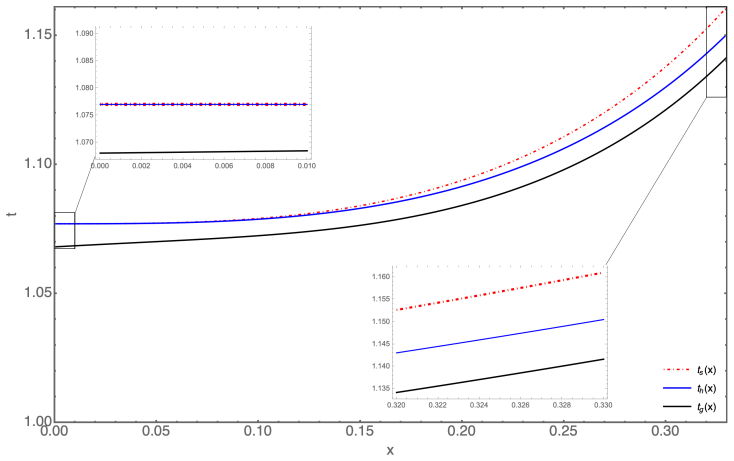
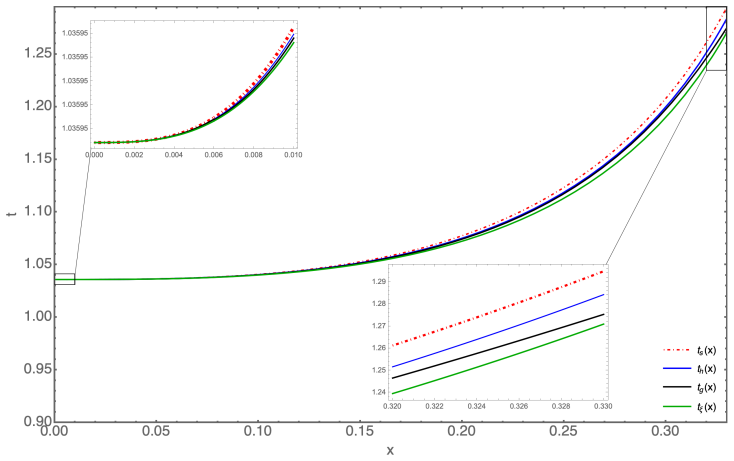
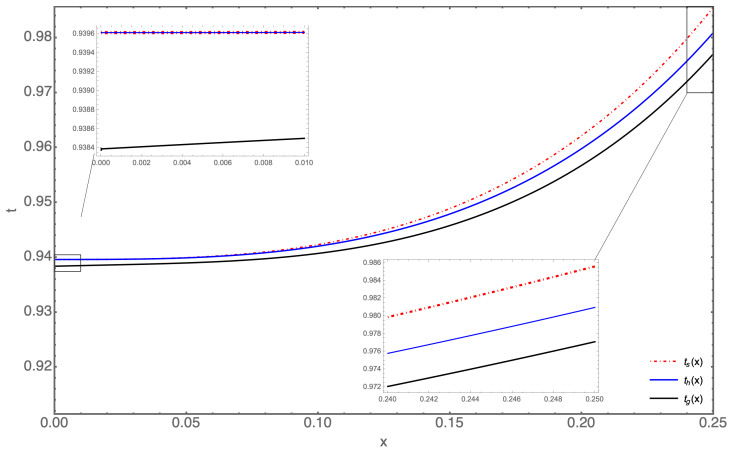
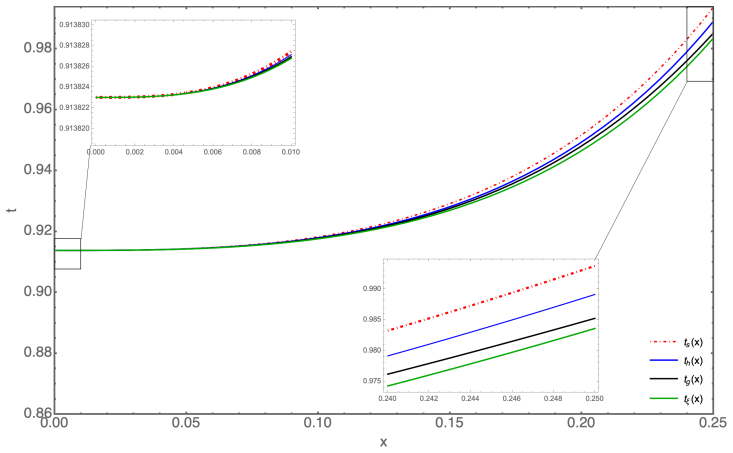
In general LTB dust collapse the only valid extension of the exterior photon sphere is a null hypersurface generated by outgoing radial null geodesics.
A machine-rendered reading of the paper's core claim, the machinery that carries it, and where it could break.
Core claim
The only physically acceptable extension of the exterior photon sphere r=3M into the collapsing dust cloud is a null hypersurface, generated by outgoing radial null geodesics. Combining this with the known causal structure of the general LTB model shows that the photon surface reaches the central singularity if and only if the singularity is naked.
What carries the argument
The non-autonomous first-order dynamical system obtained by recasting the geometric condition for a timelike hypersurface to be a photon surface in the LTB metric with nonzero k(x).
If this is right
- The interior photon surface is everywhere null and ruled by outgoing radial null geodesics.
- The surface reaches the central singularity precisely when that singularity is naked.
- The same naked-versus-covered dichotomy that appears in the marginally bound case persists for general k(x).
- Early-time evolution of black-hole shadows may carry observable signatures that distinguish the two end states.
Where Pith is reading between the lines
- The result supplies a geometric criterion that could be checked in numerical simulations of collapse with generic initial data.
- If the same null-extension property holds in non-spherical or non-dust models it would link photon-surface behavior directly to the visibility of the central singularity across a wider class of spacetimes.
Load-bearing premise
Implicit solutions from the literature together with comparison theorems for ordinary differential equations are enough to establish the null character without an explicit closed-form LTB evolution when k(x) is nonzero.
What would settle it
A concrete counter-example, obtained either by explicit integration or high-resolution numerical solution of the photon-surface ODE, showing a timelike hypersurface that extends the exterior photon sphere inside the cloud for some nonzero k(x).
Figures
read the original abstract
We extend the analysis of photon surfaces in spherical dust collapse to the general, non-marginally bound case, i.e.\ allowing the \textit{energy function} $k(x)$ of the Lema\^{\i}tre--Tolman--Bondi (LTB) model to be non-zero. Starting from the dynamical-systems formulation developed in our previous work for the marginally bound case (arXiv:2509.01368), we derive the photon surface equations for the LTB metric with $k(x)\neq 0$, and we recast the geometric condition for a timelike hypersurface to be a photon surface as a non-autonomous first-order dynamical system. Even though the LTB evolution equation does not integrate in closed form when $k(x)\neq 0$, the implicit solutions available in the literature, together with comparison theorems for ordinary differential equations, are sufficient to show that the only physically acceptable extension of the exterior photon sphere $r=3M$ into the collapsing dust cloud is a null hypersurface, generated by outgoing radial null geodesics. Combining this fact with the known results on the causal structure of the general LTB model, we then establish that the photon surface reaches the central singularity if and only if the singularity is naked, thereby extending to the general case the picture already known in the marginally bound regime. The structural dichotomy between the naked and covered end states is also discussed in connection with possible observational signatures in the early-time evolution of black-hole shadows.
Editorial analysis
A structured set of objections, weighed in public.
Referee Report
Summary. The manuscript extends the analysis of photon surfaces from the marginally bound LTB case to general spherical dust collapse with nonzero energy function k(x). Starting from a dynamical-systems formulation, it recasts the geometric photon-surface condition as a non-autonomous first-order ODE system. Using implicit LTB solutions from the literature together with ODE comparison theorems, the authors conclude that the only physically acceptable extension of the exterior photon sphere r=3M into the cloud is a null hypersurface generated by outgoing radial null geodesics. Combining this with known LTB causal structure results yields the claim that the photon surface reaches the central singularity if and only if the singularity is naked, with discussion of possible observational signatures.
Significance. If the central uniqueness result holds, the work completes the characterization of photon surfaces for all LTB models and strengthens the link between photon-surface termination and nakedness of the singularity. The methodological use of implicit solutions plus comparison theorems to handle non-integrable cases is a clear strength, as is the explicit connection drawn to early-time shadow observables.
major comments (2)
- [derivation of the non-autonomous system and application of comparison theorems] The paragraph on derivation (abstract and the section recasting the photon-surface condition): the assertion that implicit LTB solutions plus ODE comparison theorems suffice to establish the strict null character (and thereby rule out timelike or spacelike extensions) for arbitrary k(x)≠0 is load-bearing for the uniqueness claim, yet the manuscript does not exhibit the explicit bounds or the precise invocation of the comparison theorem that would confirm the inequalities remain strict under the physical-acceptability condition.
- [causal-structure combination and naked-singularity iff claim] The section combining the null result with LTB causal structure: the iff statement that the photon surface reaches the singularity precisely when the singularity is naked inherits the same gap; without an explicit verification that the comparison theorems exclude all non-null extensions for the full range of admissible k(x), the dichotomy cannot be asserted for the general case.
minor comments (2)
- Notation for the energy function k(x) and the radial coordinate should be checked for consistency between the dynamical-system equations and the implicit LTB expressions cited from the literature.
- A brief remark on the domain of applicability of the cited comparison theorems (e.g., Lipschitz conditions or monotonicity requirements) would improve readability.
Simulated Author's Rebuttal
We thank the referee for the careful reading and constructive comments. The two major comments correctly identify that the manuscript asserts sufficiency of implicit LTB solutions plus comparison theorems without exhibiting the explicit bounds or precise theorem invocation needed to confirm strict null character for arbitrary admissible k(x). We agree this constitutes a presentational gap that must be closed for the uniqueness and iff claims to be fully supported. We will revise accordingly.
read point-by-point responses
-
Referee: [derivation of the non-autonomous system and application of comparison theorems] The paragraph on derivation (abstract and the section recasting the photon-surface condition): the assertion that implicit LTB solutions plus ODE comparison theorems suffice to establish the strict null character (and thereby rule out timelike or spacelike extensions) for arbitrary k(x)≠0 is load-bearing for the uniqueness claim, yet the manuscript does not exhibit the explicit bounds or the precise invocation of the comparison theorem that would confirm the inequalities remain strict under the physical-acceptability condition.
Authors: We accept the criticism. The submitted text states that the implicit solutions and comparison theorems suffice but does not display the explicit bounds or the step-by-step invocation of the relevant ODE comparison result. In the revised manuscript we will add an expanded subsection (or short appendix) that (i) recalls the implicit parametric LTB solution for k(x)≠0, (ii) derives the strict differential inequalities satisfied by the photon-surface ODE under the physical conditions k(x)>-1 and the weak-energy condition, and (iii) invokes the standard comparison theorem for first-order ODEs to prove that any solution starting from the exterior photon sphere r=3M remains strictly null inside the cloud. This will make the exclusion of timelike or spacelike extensions fully explicit and verifiable. revision: yes
-
Referee: [causal-structure combination and naked-singularity iff claim] The section combining the null result with LTB causal structure: the iff statement that the photon surface reaches the singularity precisely when the singularity is naked inherits the same gap; without an explicit verification that the comparison theorems exclude all non-null extensions for the full range of admissible k(x), the dichotomy cannot be asserted for the general case.
Authors: This objection follows directly from the first. Once the explicit bounds and comparison-theorem invocation are supplied, the combination with the already-established causal-structure results for general LTB collapse will rigorously justify the iff statement. In the revision we will (i) insert a cross-reference to the new detailed verification and (ii) restate the dichotomy with the strengthened justification, thereby removing the inherited gap. revision: yes
Circularity Check
Minor self-citation to prior dynamical-systems formulation; extension uses external implicit solutions and ODE comparison theorems
specific steps
-
self citation load bearing
[Abstract, first paragraph]
"Starting from the dynamical-systems formulation developed in our previous work for the marginally bound case (arXiv:2509.01368), we derive the photon surface equations for the LTB metric with k(x)≠0"
The extension begins by invoking the authors' own prior formulation; while not reducing the final uniqueness result to that citation alone, the step qualifies as a minor self-citation that is load-bearing for the setup of the non-autonomous system.
full rationale
The paper cites its own prior work (arXiv:2509.01368) only for the starting dynamical-systems formulation in the marginally bound case. The load-bearing step for the new claim (null character of the photon surface when k(x)≠0) is instead the application of implicit LTB solutions from the literature plus standard ODE comparison theorems to the recast first-order system. No step reduces the central result to a definition, a fit, or an unverified self-citation chain; the derivation remains self-contained against external mathematical benchmarks.
Axiom & Free-Parameter Ledger
Reference graph
Works this paper leans on
-
[1]
First M87 Event Horizon Telescope Results. I. The Shadow of the Supermassive Black Hole
Kazunori Akiyama and others. First M87 Event Horizon Telescope Results. I. The Shadow of the Supermassive Black Hole.Astrophys. J. Lett., 875:L1, 2019.arXiv:1906.11238, doi:10.3847/2041-8213/ab0ec7
work page internal anchor Pith review Pith/arXiv arXiv doi:10.3847/2041-8213/ab0ec7 2019
-
[2]
The persistent shadow of the supermassive black hole of M87
Kazunori Akiyama and others. The persistent shadow of the supermassive black hole of M87. I. Observations, calibration, imaging, and analysis.Astron. Astrophys., 681:A79, 2024.doi:10.1051/0004-6361/202347932
-
[3]
Quasi-local photon surfaces in general spherically symmetric spacetimes.Eur
Li-Ming Cao and Yong Song. Quasi-local photon surfaces in general spherically symmetric spacetimes.Eur. Phys. J. C, 81(8):714, 2021.arXiv:1910.13758,doi:10.1140/epjc/ s10052-021-09502-0. 13
-
[4]
Clarissa-Marie Claudel, K. S. Virbhadra, and G. F. R. Ellis. The geometry of photon sur- faces.J. Math. Phys., 42:818–838, 2001.arXiv:gr-qc/0005050,doi:10.1063/1.1308507
work page internal anchor Pith review Pith/arXiv arXiv doi:10.1063/1.1308507 2001
-
[5]
Gauthier-Villars, Paris, 1927
Georges Darmois.Les ´ equations de la Gravitation Einsteinienne, volume 25 ofM´ emorial des Sciences Math´ ematiques. Gauthier-Villars, Paris, 1927. URL:https://www.numdam. org/item/MSM_1927__25__1_0/
1927
-
[6]
S. S. Deshingkar, P. S. Joshi, and I. H. Dwivedi. Physical nature of the central singularity in spherical collapse.Phys. Rev. D, 59:044018, 1999.arXiv:gr-qc/9805055,doi:10. 1103/PhysRevD.59.044018
Pith/arXiv arXiv 1999
-
[7]
I. H. Dwivedi. Photon redshift and the appearance of a naked singularity.Phys. Rev. D, 58:064004, 1998.arXiv:gr-qc/9805029,doi:10.1103/PhysRevD.58.064004
work page internal anchor Pith review Pith/arXiv arXiv doi:10.1103/physrevd.58.064004 1998
-
[8]
New mathematical framework for spherical gravitational collapse
Roberto Giamb` o, Fabio Giannoni, Giulio Magli, and Paolo Piccione. New mathematical framework for spherical gravitational collapse.Class. Quant. Grav., 20:L75–L82, 2003. arXiv:gr-qc/0212082,doi:10.1088/0264-9381/20/6/102
work page internal anchor Pith review Pith/arXiv arXiv doi:10.1088/0264-9381/20/6/102 2003
-
[9]
New solutions of Einstein equations in spherical symmetry: the Cosmic Censor to the court
Roberto Giamb` o, Fabio Giannoni, Giulio Magli, and Paolo Piccione. New solutions of Einstein equations in spherical symmetry: The Cosmic censor to the court.Commun. Math. Phys., 235:545–563, 2003.arXiv:gr-qc/0204030,doi:10.1007/s00220-003-0793-9
work page internal anchor Pith review Pith/arXiv arXiv doi:10.1007/s00220-003-0793-9 2003
-
[10]
Photon surfaces extensions for dynamical gravi- tational collapse
Roberto Giamb` o and Camilla Lucamarini. Photon surfaces extensions for dynamical gravi- tational collapse. 2025. Preprint, to appear on Phil. Trans. R. Soc. A.arXiv:2509.01368
arXiv 2025
-
[11]
Singular hypersurfaces and thin shells in general relativity.Nuovo Cim
Werner Israel. Singular hypersurfaces and thin shells in general relativity.Nuovo Cim. B, 44S10:1–14, 1966. Erratum: Nuovo Cim. B48, 463 (1967).doi:10.1007/BF02710419
-
[12]
Joshi.Gravitational Collapse and Spacetime Singularities
Pankaj S. Joshi.Gravitational Collapse and Spacetime Singularities. Cambridge Mono- graphs on Mathematical Physics. Cambridge University Press, Cambridge, 2007. Paperback edition, 2012.doi:10.1017/CBO9780511536274
-
[13]
Can we observationally test the weak cosmic censorship conjecture?
Lingyao Kong, Daniele Malafarina, and Cosimo Bambi. Can we observationally test the weak cosmic censorship conjecture?Eur. Phys. J. C, 74:2983, 2014.arXiv:1310.8376, doi:10.1140/epjc/s10052-014-2983-3
work page internal anchor Pith review Pith/arXiv arXiv doi:10.1140/epjc/s10052-014-2983-3 2014
-
[14]
Gravitational collapse with non-vanishing tangential stresses: a generalization of the Tolman–Bondi model.Class
Giulio Magli. Gravitational collapse with non-vanishing tangential stresses: a generalization of the Tolman–Bondi model.Class. Quant. Grav., 14(7):1937–1953, 1997.doi:10.1088/ 0264-9381/14/7/026
1937
-
[15]
Marc Mars and Jos´ e M. M. Senovilla. Geometry of general hypersurfaces in space-time: junction conditions.Class. Quant. Grav., 10:1865–1897, 1993.arXiv:gr-qc/0201054, doi:10.1088/0264-9381/10/9/026
work page internal anchor Pith review Pith/arXiv arXiv doi:10.1088/0264-9381/10/9/026 1993
-
[16]
Filipe C. Mena and Brien C. Nolan. Non-radial null geodesics in spherical dust col- lapse.Class. Quant. Grav., 18:4531–4548, 2001.arXiv:gr-qc/0108008,doi:10.1088/ 0264-9381/18/21/310
Pith/arXiv arXiv 2001
-
[17]
The role of anisotropy and inhomogeneity in Lemaitre-Tolman-Bondi collapse
Filipe C. Mena, Brien C. Nolan, and Reza Tavakol. Role of anisotropy and inhomogeneity in Lemaˆ ıtre–Tolman–Bondi collapse.Phys. Rev. D, 70:084030, 2004.arXiv:gr-qc/0405041, doi:10.1103/PhysRevD.70.084030
work page internal anchor Pith review Pith/arXiv arXiv doi:10.1103/physrevd.70.084030 2004
-
[18]
N´ estor Ortiz, Olivier Sarbach, and Thomas Zannias. Shadow of a naked singularity.Phys. Rev. D, 92(4):044035, 2015.arXiv:1505.07017,doi:10.1103/PhysRevD.92.044035
work page internal anchor Pith review Pith/arXiv arXiv doi:10.1103/physrevd.92.044035 2015
-
[19]
Gravitational collapse and space-time singularities.Phys
Roger Penrose. Gravitational collapse and space-time singularities.Phys. Rev. Lett., 14:57– 59, 1965.doi:10.1103/PhysRevLett.14.57. 14
-
[20]
Cambridge University Press, Cambridge, 2006.doi:10.1017/CBO9780511617676
Jerzy Pleba´ nski and Andrzej Krasi´ nski.An Introduction to General Relativity and Cos- mology. Cambridge University Press, Cambridge, 2006.doi:10.1017/CBO9780511617676
-
[21]
Rajibul Shaikh, Prashant Kocherlakota, Ramesh Narayan, and Pankaj S. Joshi. Shadows of spherically symmetric black holes and naked singularities.Mon. Not. Roy. Astron. Soc., 482(1):52–64, 2019.arXiv:1802.08060,doi:10.1093/mnras/sty2624
work page internal anchor Pith review Pith/arXiv arXiv doi:10.1093/mnras/sty2624 2019
-
[22]
T. P. Singh and P. S. Joshi. The final fate of spherical inhomogeneous dust collapse.Class. Quant. Grav., 13:559–572, 1996.arXiv:gr-qc/9409062,doi:10.1088/0264-9381/13/3/ 019
work page internal anchor Pith review Pith/arXiv arXiv doi:10.1088/0264-9381/13/3/ 1996
-
[23]
K. S. Virbhadra and G. F. R. Ellis. Gravitational lensing by naked singularities.Phys. Rev. D, 65:103004, 2002.doi:10.1103/PhysRevD.65.103004. 15
discussion (0)
Sign in with ORCID, Apple, or X to comment. Anyone can read and Pith papers without signing in.