An Interplay Between Fractional Calculus and Holographic Dark Energy
Pith reviewed 2026-06-26 10:09 UTC · model grok-4.3
The pith
Inserting a Riesz fractional derivative into the Schwarzschild black hole Hamiltonian constraint produces fractionally corrected entropy that defines a new holographic dark energy density.
A machine-rendered reading of the paper's core claim, the machinery that carries it, and where it could break.
Core claim
A Riesz fractional spatial derivative inserted into the Hamiltonian constraint of a Schwarzschild black hole generates a Fractional Wheeler-DeWitt equation. Solutions of this equation yield a fractional Bekenstein-Hawking entropy governed by the Lévy index α (1 < α ≤ 2). Substituting the entropy into Cohen's inequality defines the Fractional Holographic Dark Energy density, whose late-time evolution is analyzed within the Hubble cutoff, reconstructed via effective field descriptions, and extended to Brans-Dicke, DGP, EPN and Horndeski theories; the same framework also determines the occurrence of big, little and pseudo-rip singularities.
What carries the argument
The Riesz fractional spatial derivative placed inside the Hamiltonian constraint of the Schwarzschild black hole, which produces the Fractional Wheeler-DeWitt equation and the α-dependent correction to Bekenstein-Hawking entropy.
If this is right
- FHDE deviates from standard holographic dark energy and can mitigate some Hubble-cutoff inconsistencies.
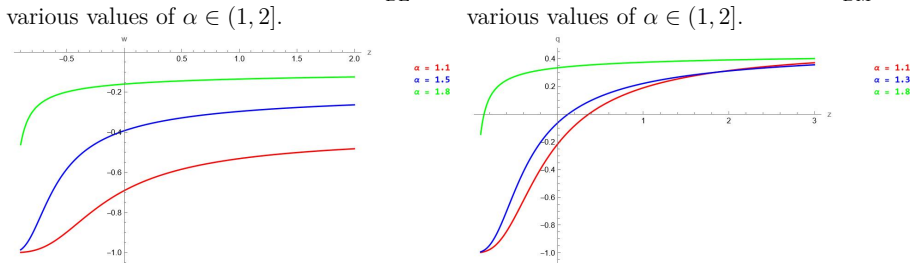
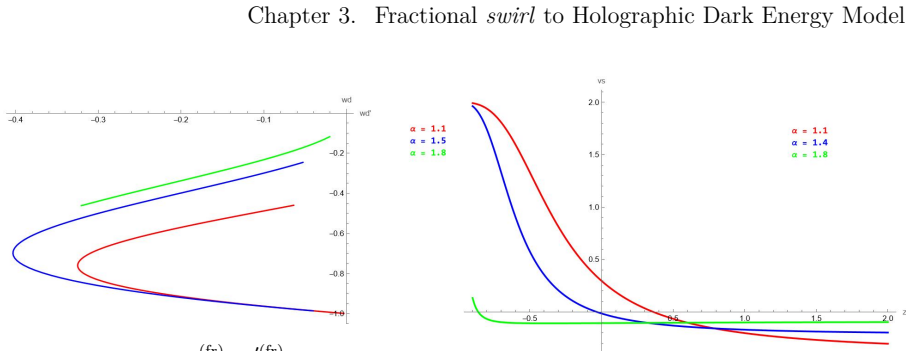
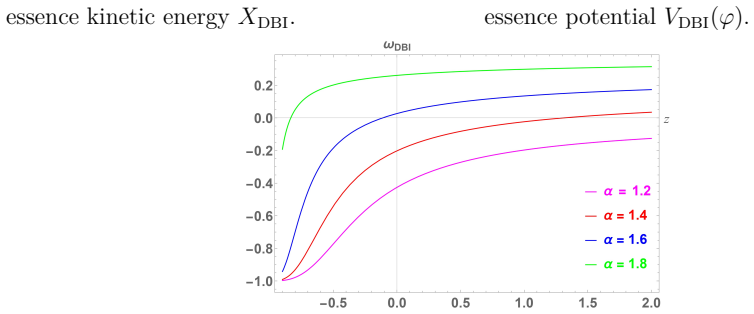
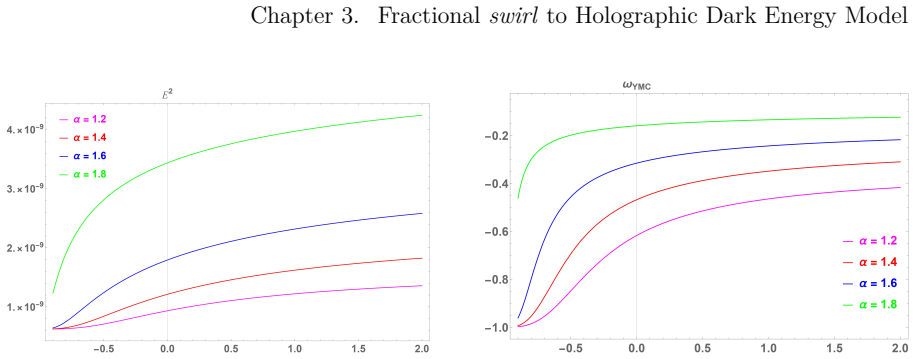
- Cosmological observables, equation-of-state and deceleration parameters become explicit functions of redshift z and the Lévy index α.
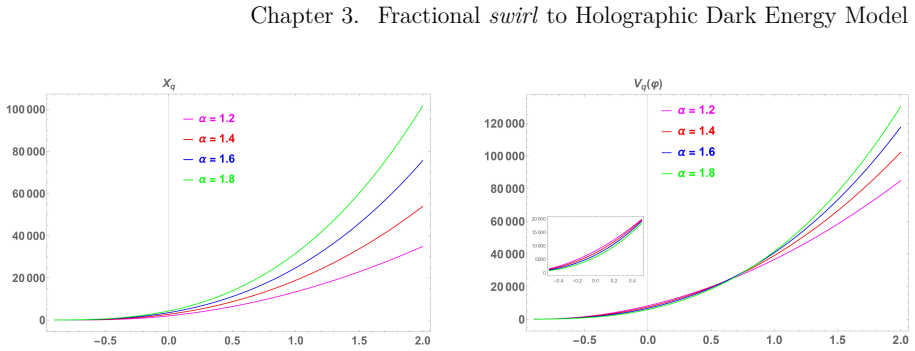
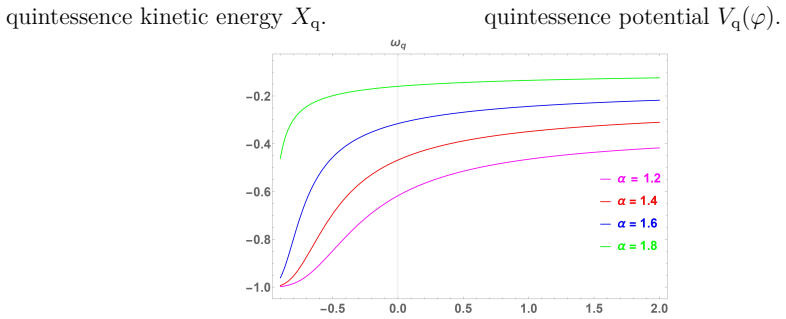
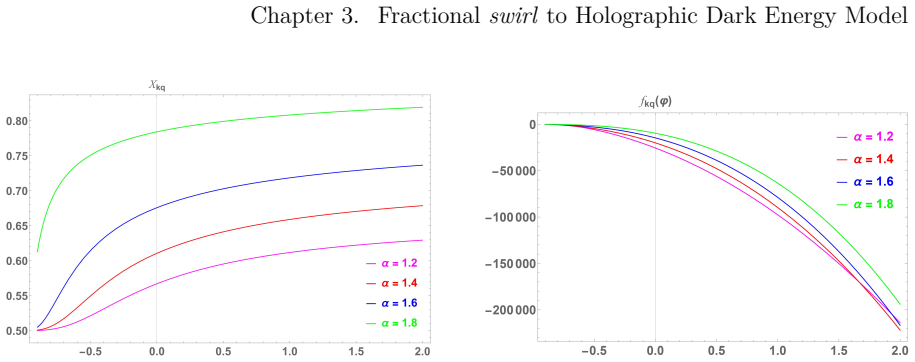
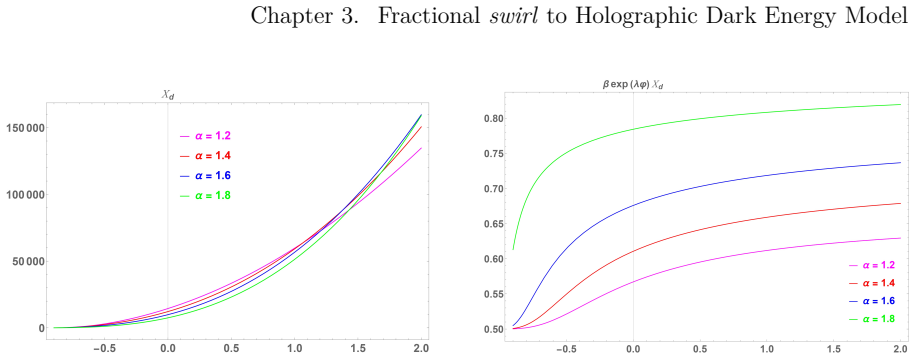
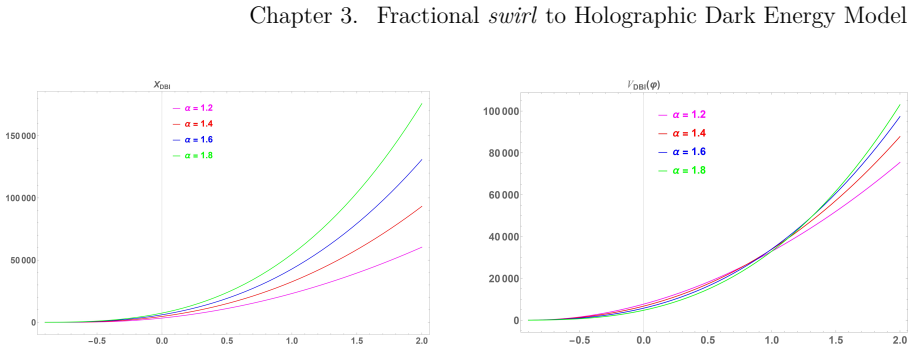
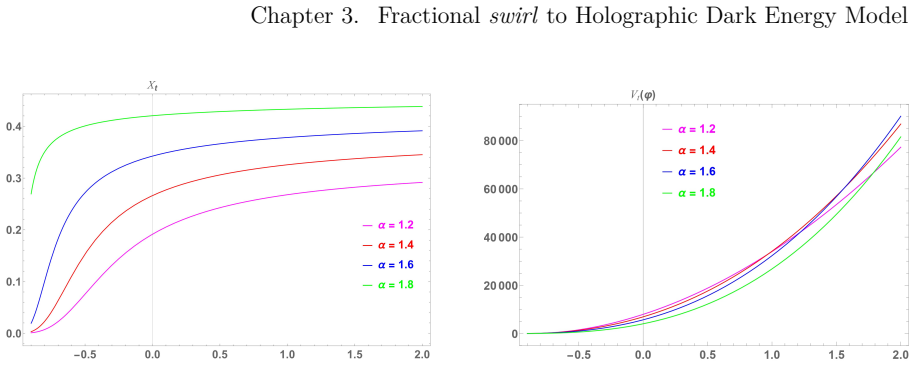
- Effective-field reconstructions yield kinetic and potential terms for spin-0 and spin-1 candidates as functions of z and α.
- The framework supplies explicit expressions for the equation of state and deceleration parameter inside Brans-Dicke, DGP, EPN and Horndeski theories.
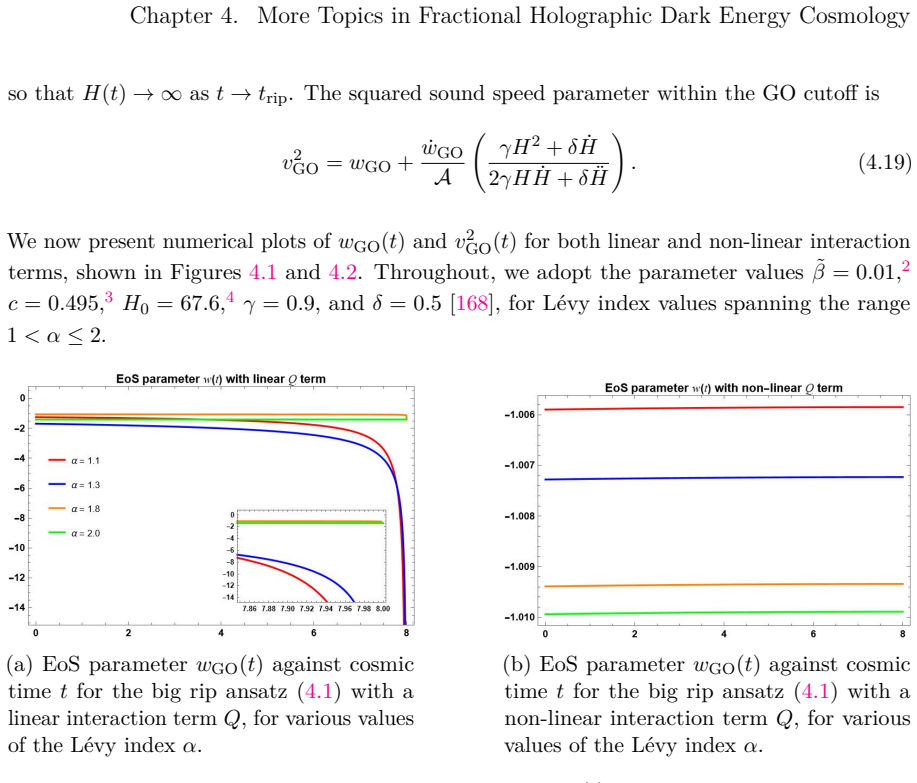
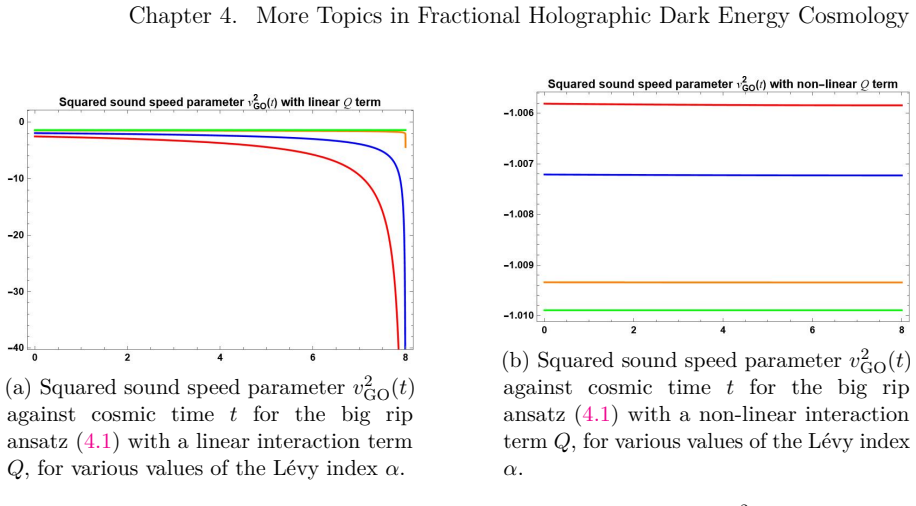
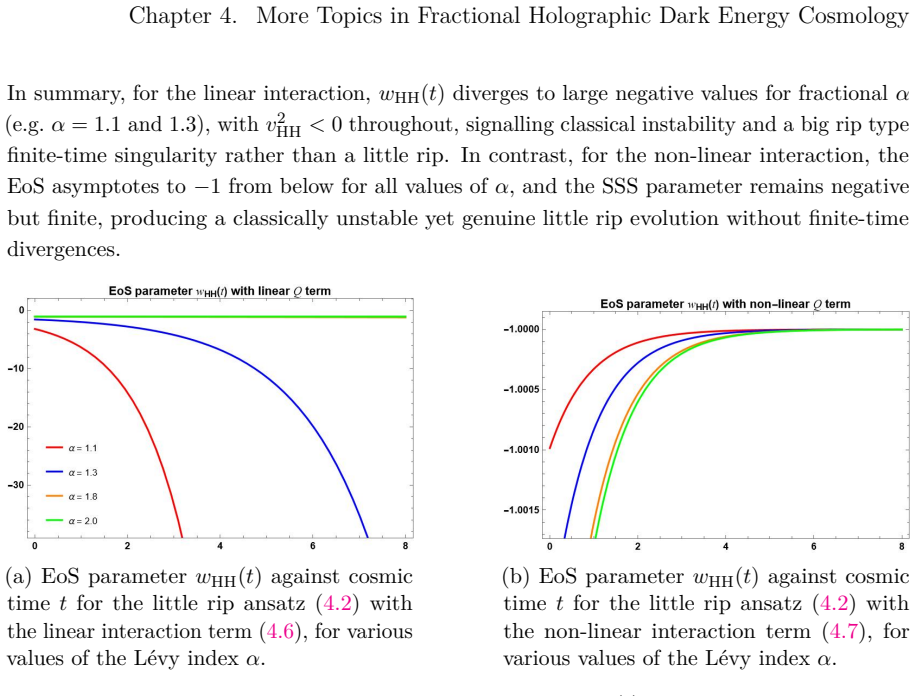
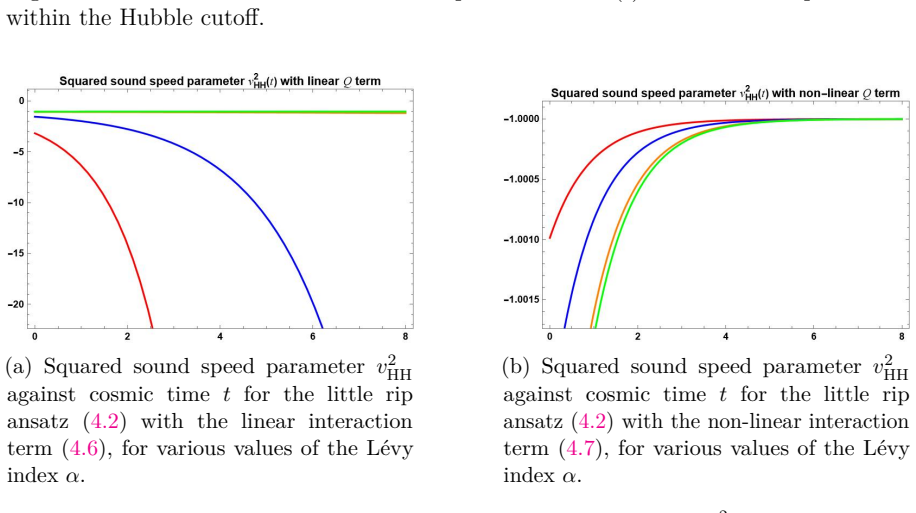
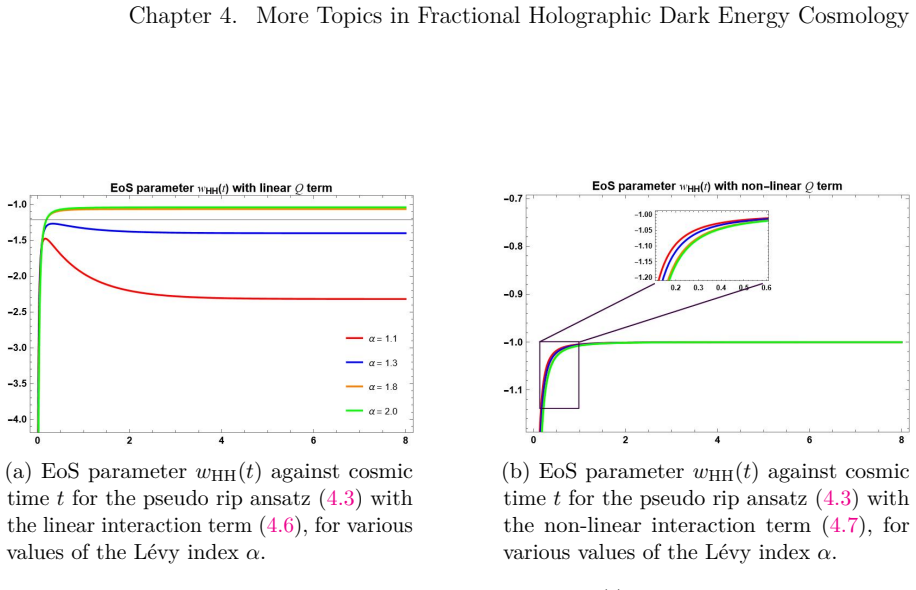
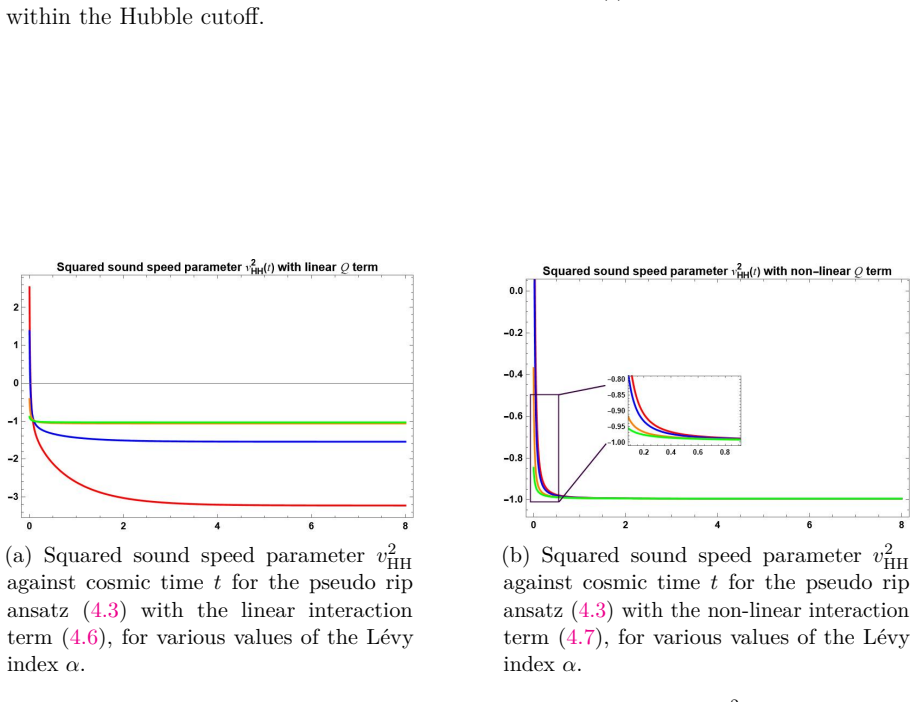
- The Granda-Oliveros cutoff version of FHDE predicts the occurrence of big-rip, little-rip and pseudo-rip singularities at late times.
Where Pith is reading between the lines
- Non-local memory effects encoded in the fractional derivative could source cosmic acceleration without introducing new scalar fields.
- Observational constraints on the present-day value of the deceleration parameter might bound the allowed range of α independently of other cosmological parameters.
- The same fractional modification of the Wheeler-DeWitt equation could be applied to other holographic setups or to the thermodynamics of different black-hole solutions.
- Consistency checks between the fractional entropy and other quantum-gravity approaches, such as loop quantum gravity or causal sets, would test whether the Lévy-index correction survives beyond the present construction.
Load-bearing premise
That a Riesz fractional spatial derivative can be inserted into the Hamiltonian constraint of a Schwarzschild black hole so that the resulting entropy correction remains consistent when used in Cohen's inequality to define a dark-energy density.
What would settle it
A high-precision measurement of the dark-energy equation-of-state parameter at late times showing no dependence on any parameter α in the interval (1,2] that matches the fractional-entropy prediction, or an independent calculation demonstrating that the fractional entropy correction violates the area law or unitarity for the same range of α.
Figures

read the original abstract
This dissertation aims to put forth a systematic construction of a fractional-calculus extension of holographic dark energy (HDE). We show that linking late-time cosmic acceleration to non-local or memory effects encoded in a fractional (Riesz) derivative within black hole thermodynamics produces deviations from standard HDE and can address some challenges of the Hubble cutoff. In particular, a Riesz fractional spatial derivative is introduced into the Hamiltonian constraint of a Schwarzschild black hole in quantum geometrodynamics, leading to a Fractional Wheeler--DeWitt equation whose solutions yield fractionally corrected thermodynamic quantities, notably fractional Bekenstein--Hawking entropy governed by the L\'evy index \(\alpha\), with \(1<\alpha\leq2\). Using this entropy with Cohen's inequality, a new dark energy density is constructed, defining the Fractional Holographic Dark Energy (FHDE) framework. The cosmological implications of FHDE are then investigated. Within the Hubble cutoff, its late-time evolution is analysed through cosmological observables, and the model is reconstructed using effective field descriptions with spin-\(0\) and spin-\(1\) candidates, allowing kinetic and potential terms to be extracted as functions of redshift \(z\) and \(\alpha\). The framework is then extended to BD, DGP, EPN, and Horndeski theories to derive the equation-of-state and deceleration parameters in terms of \(z\) and \(\alpha\). In addition, the fate of the Universe is studied through late-time singularities, namely the big, little, and pseudo-rip, within the Granda--Oliveros FHDE setting. In short, this dissertation proposes FHDE as a theoretically motivated extension of HDE, bridging non-locality in quantum gravity with the late-time dynamics of the Universe, and offering a route toward understanding cosmic acceleration beyond \(\Lambda\)CDM.
Editorial analysis
A structured set of objections, weighed in public.
Referee Report
Summary. The manuscript constructs a fractional extension of holographic dark energy (FHDE) by inserting a Riesz fractional spatial derivative into the Hamiltonian constraint of a Schwarzschild black hole in quantum geometrodynamics. This produces a Fractional Wheeler-DeWitt equation whose solutions yield a fractional Bekenstein-Hawking entropy governed by the Lévy index α (1 < α ≤ 2). The fractional entropy is substituted into Cohen's inequality to define the FHDE density. Cosmological implications are then explored under the Hubble cutoff, including effective-field reconstructions with spin-0 and spin-1 candidates, extensions to Brans-Dicke, DGP, EPN and Horndeski theories, and analysis of late-time singularities (big rip, little rip, pseudo-rip) in the Granda-Oliveros setting.
Significance. If the insertion of the Riesz derivative can be placed on a firm footing, the work would supply a concrete route from non-local quantum-gravity effects to late-time acceleration, generating parameterized deviations from standard HDE that could be confronted with observational data on the equation-of-state and deceleration parameters. The explicit reconstructions and singularity classifications provide falsifiable outputs once α is fixed.
major comments (2)
- [Abstract and Fractional Wheeler-DeWitt construction] Abstract and the section describing the Fractional Wheeler-DeWitt equation: the Riesz fractional spatial derivative is stated to be 'introduced' into the Hamiltonian constraint without derivation from a fractional gravitational action, without verification that the constraint algebra is preserved, and without demonstration that the resulting solutions remain real and normalizable. This step is load-bearing; the fractional entropy, its insertion into Cohen's inequality, and all subsequent cosmological observables rest directly on it.
- [FHDE density definition] Construction of the FHDE density via Cohen's inequality: no consistency check or error estimate is supplied showing that the standard Cohen bound remains applicable once the entropy has been non-locally modified; the thermodynamic interpretation required for the dark-energy density therefore lacks supporting analysis.
minor comments (2)
- [Parameter definition] The range 1 < α ≤ 2 is stated without explicit justification for the lower bound or discussion of the α → 1 limit.
- [Notation] Notation for the Riesz derivative and the fractional Wheeler-DeWitt operator should be introduced with a brief reminder of the definition before first use.
Simulated Author's Rebuttal
We thank the referee for the constructive and detailed report. The comments highlight important foundational aspects of the construction that require clarification. We address each major comment below and will revise the manuscript accordingly to improve transparency regarding the assumptions and limitations.
read point-by-point responses
-
Referee: Abstract and the section describing the Fractional Wheeler-DeWitt equation: the Riesz fractional spatial derivative is stated to be 'introduced' into the Hamiltonian constraint of a Schwarzschild black hole in quantum geometrodynamics. This produces a Fractional Wheeler-DeWitt equation whose solutions yield a fractional Bekenstein-Hawking entropy governed by the Lévy index α (1 < α ≤ 2). The fractional entropy is substituted into Cohen's inequality to define the FHDE density. Cosmological implications are then explored under the Hubble cutoff, including effective-field reconstructions with spin-0 and spin-1 candidates, extensions to Brans-Dicke, DGP, EPN and Horndeski theories, and analysis of late-time singularities (big rip, little rip, pseudo-rip) in the Granda-Oliveros setting.
Authors: We agree that the Riesz fractional derivative is introduced by construction into the Hamiltonian constraint without a derivation from a fractional gravitational action, without explicit verification that the constraint algebra remains closed, and without a demonstration that the resulting wave-function solutions are real and normalizable for the full range of α. The manuscript treats this insertion as a motivated ansatz to incorporate non-local effects, with solutions assumed to inherit the properties of the standard case. In the revised version we will expand the relevant section (and abstract if needed) to explicitly state these assumptions, note that preservation of the constraint algebra is an open question, and clarify that the construction is exploratory rather than derived from first principles. This will not alter the subsequent cosmological analysis but will better contextualize its foundational status. revision: yes
-
Referee: Construction of the FHDE density via Cohen's inequality: no consistency check or error estimate is supplied showing that the standard Cohen bound remains applicable once the entropy has been non-locally modified; the thermodynamic interpretation required for the dark-energy density therefore lacks supporting analysis.
Authors: We acknowledge that the manuscript applies Cohen's inequality in its standard form after substituting the fractional entropy, without providing a dedicated consistency check, error estimate, or extended thermodynamic analysis for the non-local modification. This step follows the conventional procedure used in the holographic dark energy literature. In the revision we will add a short discussion paragraph addressing the thermodynamic interpretation, noting the potential limitations introduced by the fractional entropy, and emphasizing the exploratory character of the bound in this setting. No quantitative error estimate will be added, as that would require further theoretical development beyond the present scope. revision: yes
Circularity Check
No significant circularity; model construction is self-contained
full rationale
The paper introduces a Riesz fractional derivative into the Schwarzschild Hamiltonian constraint by ansatz, obtains a Fractional Wheeler-DeWitt equation, and extracts a fractional Bekenstein-Hawking entropy parameterized by the Lévy index α (1 < α ≤ 2). This entropy is then inserted into Cohen's inequality to define the FHDE density. All subsequent cosmological observables, reconstructions, and extensions to other theories are expressed as functions of redshift z and the free parameter α. This constitutes a standard parameterized model-building exercise rather than any reduction of outputs to inputs by construction. No self-citations, fitted parameters renamed as predictions, or definitional loops are present in the abstract or described chain; the framework remains externally falsifiable against observational data for chosen α values.
Axiom & Free-Parameter Ledger
free parameters (1)
- Levy index alpha =
1 < alpha <= 2
axioms (2)
- domain assumption Cohen's inequality remains valid when applied to the fractionally corrected Bekenstein-Hawking entropy.
- ad hoc to paper The Riesz fractional derivative can be meaningfully substituted into the Hamiltonian constraint of the Schwarzschild black hole in quantum geometrodynamics.
invented entities (2)
-
Fractional Holographic Dark Energy (FHDE)
no independent evidence
-
Fractional Bekenstein-Hawking entropy
no independent evidence
Reference graph
Works this paper leans on
-
[1]
Journal of the Association of Arab Universities for Basic and Applied Sciences , volume=
A fractional model of Navier--Stokes equation arising in unsteady flow of a viscous fluid , author=. Journal of the Association of Arab Universities for Basic and Applied Sciences , volume=. 2015 , publisher=
2015
-
[2]
Communications in Nonlinear Science and Numerical Simulation , volume=
Fractional dynamics in DNA , author=. Communications in Nonlinear Science and Numerical Simulation , volume=. 2011 , publisher=
2011
-
[3]
What a fractional world!
I say to myself:“What a fractional world!” , author=. Fract. Calc. Appl. Anal , volume=
-
[4]
2016 , eprint=
Applications of fractional calculus in solving Abel-type integral equations: Surface-volume reaction problem , author=. 2016 , eprint=
2016
-
[5]
1976 , publisher=
The heat equation , author=. 1976 , publisher=
1976
-
[6]
2024 , publisher=
Methods of mathematical physics, volume 2 , author=. 2024 , publisher=
2024
-
[7]
Fractional holographic dark energy
Trivedi, Oem and Bidlan, Ayush and Moniz, Paulo. Fractional holographic dark energy. Phys. Lett. B. 2024. doi:10.1016/j.physletb.2024.139074. arXiv:2407.16685
-
[8]
Reconstructing Fractional Holographic Dark Energy with scalar and gauge fields
Bidlan, Ayush and Moniz, Paulo and Trivedi, Oem. Reconstructing Fractional Holographic Dark Energy with scalar and gauge fields. Eur. Phys. J. C. 2025. doi:10.1140/epjc/s10052-025-14238-2. arXiv:2502.00292
-
[9]
Future Rip Scenarios in Fractional Holographic Dark Energy
Bidlan, Ayush and Moniz, Paulo and Trivedi, Oem. Future Rip Scenarios in Fractional Holographic Dark Energy. 2026. arXiv:2601.04414
arXiv 2026
-
[10]
The Journal of Chemical Physics , volume=
Relaxation in filled polymers: A fractional calculus approach , author=. The Journal of Chemical Physics , volume=. 1995 , publisher=
1995
-
[11]
Symmetry , volume=
Application of fractional derivative without singular and local kernel to enhanced heat transfer in CNTs nanofluid over an inclined plate , author=. Symmetry , volume=. 2020 , publisher=
2020
-
[12]
New York , year=
The fractal geometry of nature/Revised and enlarged edition , author=. New York , year=
-
[13]
2017 , publisher=
Statistics for long-memory processes , author=. 2017 , publisher=
2017
-
[14]
Journal of physics A: Mathematical and general , volume=
Fractional diffusion equation on fractals: One-dimensional case and asymptotic behaviour , author=. Journal of physics A: Mathematical and general , volume=
-
[15]
2014 , eprint=
Fractional Brownian Motion and the Fractional Stochastic Calculus , author=. 2014 , eprint=
2014
-
[16]
2010 , publisher=
Quantum mechanics and path integrals , author=. 2010 , publisher=
2010
-
[17]
Fractional Calculus and applied analysis , volume=
On riesz derivative , author=. Fractional Calculus and applied analysis , volume=. 2019 , publisher=
2019
-
[18]
Journal of Mathematical Physics , volume=
Definition of the Riesz derivative and its application to space fractional quantum mechanics , author=. Journal of Mathematical Physics , volume=. 2016 , publisher=
2016
-
[19]
Physical Review E , volume=
Fractional quantum mechanics , author=. Physical Review E , volume=. 2000 , publisher=
2000
-
[20]
Fractional schr
Laskin, Nick , journal=. Fractional schr. 2002 , publisher=
2002
-
[21]
Fractional quantum mechanics and L
Laskin, Nikolai , journal=. Fractional quantum mechanics and L. 2000 , publisher=
2000
-
[22]
Chaos: An Interdisciplinary Journal of Nonlinear Science , volume=
Fractals and quantum mechanics , author=. Chaos: An Interdisciplinary Journal of Nonlinear Science , volume=. 2000 , publisher=
2000
-
[23]
Chaos, Solitons & Fractals , volume=
Time fractional quantum mechanics , author=. Chaos, Solitons & Fractals , volume=. 2017 , publisher=
2017
-
[24]
Generalized fractional Schr
Wang, Shaowei and Xu, Mingyu , journal=. Generalized fractional Schr. 2007 , publisher=
2007
-
[25]
Time fractional Schr
Naber, Mark , journal=. Time fractional Schr. 2004 , publisher=
2004
-
[26]
Fractional calculus and its applications: proceedings of the international conference held at the University of New Haven, June 1974 , pages=
A brief history and exposition of the fundamental theory of fractional calculus , author=. Fractional calculus and its applications: proceedings of the international conference held at the University of New Haven, June 1974 , pages=. 2006 , organization=
1974
-
[27]
An introduction to the theory of L
Kyprianou, Andreas E , journal=. An introduction to the theory of L
-
[28]
Mathematics , volume=
From Fractional Quantum Mechanics to Quantum Cosmology: An Overture , author=. Mathematics , volume=. 2020 , publisher=
2020
-
[29]
arXiv preprint arXiv:0909.1171 , year=
Fractional derivative cosmology , author=. arXiv preprint arXiv:0909.1171 , year=
-
[30]
Journal of Physics: Conference Series , volume=
Fractional action cosmology with power law weight function , author=. Journal of Physics: Conference Series , volume=. 2012 , organization=
2012
-
[31]
Fractal and Fractional , volume=
Exact solutions and cosmological constraints in fractional cosmology , author=. Fractal and Fractional , volume=. 2023 , publisher=
2023
-
[32]
arXiv preprint arXiv:2304.14465 , year=
Cosmology under the fractional calculus approach: a possible H\_0 tension resolution? , author=. arXiv preprint arXiv:2304.14465 , year=
-
[33]
and Michea, Claudio and Paliathanasis, Andronikos
Marroqu\' n, Kevin and Leon, Genly and Millano, Alfredo D. and Michea, Claudio and Paliathanasis, Andronikos. Conformal and Non-Minimal Couplings in Fractional Cosmology. Fractal Fract. 2024. doi:10.3390/fractalfract8050253. arXiv:2402.13850
-
[34]
Landim, Ricardo G. Fractional dark energy. Phys. Rev. D. 2021. doi:10.1103/PhysRevD.103.083511. arXiv:2101.05072
-
[35]
Fumeron, Sebastien and Henkel, Malte and Lopez, Alexander. Fractional cosmic strings. Class. Quant. Grav. 2024. doi:10.1088/1361-6382/ad1713. arXiv:2309.13934
-
[36]
Communications in Theoretical Physics , volume=
Cosmological models with fractional derivatives and fractional action functional , author=. Communications in Theoretical Physics , volume=. 2011 , publisher=
2011
-
[37]
Junior, P. F. da Silva and Costa, E. W. de Oliveira and Jalalzadeh, S. Emergence of fractal cosmic space from fractional quantum gravity. Eur. Phys. J. Plus. 2023. doi:10.1140/epjp/s13360-023-04506-z. arXiv:2309.12478
-
[38]
Universe , volume=
Quantum cosmology of fab four John theory with conformable fractional derivative , author=. Universe , volume=. 2020 , publisher=
2020
-
[39]
Var \ a o, Gislaine and Lobo, Iarley P. and Bezerra, Valdir B. Fractional quantum mechanics meets quantum gravity phenomenology. EPL. 2024. doi:10.1209/0295-5075/ad8b65. arXiv:2405.13544
-
[40]
Susskind, Leonard. The World as a hologram. J. Math. Phys. 1995. doi:10.1063/1.531249. arXiv:hep-th/9409089
work page internal anchor Pith review Pith/arXiv arXiv doi:10.1063/1.531249 1995
-
[41]
The Large N Limit of Superconformal Field Theories and Supergravity
Maldacena, Juan Martin. The Large N limit of superconformal field theories and supergravity. Adv. Theor. Math. Phys. 1998. doi:10.4310/ATMP.1998.v2.n2.a1. arXiv:hep-th/9711200
work page internal anchor Pith review Pith/arXiv arXiv doi:10.4310/atmp.1998.v2.n2.a1 1998
-
[42]
Quantum gravity and the holographic principle
de Haro Olle, Sebastian. Quantum gravity and the holographic principle. 2001. arXiv:hep-th/0107032
Pith/arXiv arXiv 2001
-
[43]
Dark energy from string theory: an introductory review
Andriot, David. Dark energy from string theory: an introductory review. 2026. arXiv:2603.25797
Pith/arXiv arXiv 2026
-
[45]
Nojiri, Shin'ichi and Odintsov, S. D. Covariant Generalized Holographic Dark Energy and Accelerating Universe. Eur. Phys. J. C. 2017. doi:10.1140/epjc/s10052-017-5097-x. arXiv:1703.06372
work page internal anchor Pith review Pith/arXiv arXiv doi:10.1140/epjc/s10052-017-5097-x 2017
-
[46]
A Model of Holographic Dark Energy
Li, Miao. A Model of holographic dark energy. Phys. Lett. B. 2004. doi:10.1016/j.physletb.2004.10.014. arXiv:hep-th/0403127
work page internal anchor Pith review Pith/arXiv arXiv doi:10.1016/j.physletb.2004.10.014 2004
-
[47]
Cosmological constant and vacuum energy: old and new ideas
Sola, Joan. Cosmological constant and vacuum energy: old and new ideas. J. Phys. Conf. Ser. 2013. doi:10.1088/1742-6596/453/1/012015. arXiv:1306.1527
work page internal anchor Pith review Pith/arXiv arXiv doi:10.1088/1742-6596/453/1/012015 2013
-
[48]
de Rham, Claudia. Massive Gravity. Living Rev. Rel. 2014. doi:10.12942/lrr-2014-7. arXiv:1401.4173
work page internal anchor Pith review Pith/arXiv arXiv doi:10.12942/lrr-2014-7 2014
-
[49]
An effective field theory of holographic dark energy
Lin, Chunshan. An effective field theory of holographic dark energy. 2021. doi:10.1088/1475-7516/2021/07/003. arXiv:2101.08092
-
[50]
P V Moniz and J M Mourao , title =. 1991 , publisher =. doi:10.1088/0264-9381/8/10/008 , url =
-
[51]
P V Moniz and J M Mourao and P M Sa , title =. 1993 , publisher =. doi:10.1088/0264-9381/10/3/012 , url =
-
[52]
On the cosmological constant problem
Lombriser, Lucas. On the cosmological constant problem. Phys. Lett. B. 2019. doi:10.1016/j.physletb.2019.134804. arXiv:1901.08588
-
[53]
Holographic scalar field models of dark energy , volume=
Sheykhi, Ahmad , year=. Holographic scalar field models of dark energy , volume=. Physical Review D , publisher=. doi:10.1103/physrevd.84.107302 , number=
-
[54]
Cosmological consequences of a rolling homogeneous scalar field , author =. Phys. Rev. D , volume =. 1988 , month =. doi:10.1103/PhysRevD.37.3406 , url =
-
[55]
Wetterich, C. , year=. Cosmology and the fate of dilatation symmetry , volume=. Nuclear Physics B , publisher=. doi:10.1016/0550-3213(88)90193-9 , number=
-
[56]
Quintessence and the Separation of Cosmic Microwave Background Peaks , volume=
Doran, Michael and Lilley, Matthew and Schwindt, Jan and Wetterich, Christof , year=. Quintessence and the Separation of Cosmic Microwave Background Peaks , volume=. The Astrophysical Journal , publisher=. doi:10.1086/322253 , number=
-
[58]
Implications for Fifth-Force-Type Experiments and Quintessence , volume=
Dvali, Gia and Zaldarriaga, Matias , year=. Implications for Fifth-Force-Type Experiments and Quintessence , volume=. Physical Review Letters , publisher=. doi:10.1103/physrevlett.88.091303 , number=
-
[59]
Natural quintessence in string theory , volume=
Cicoli, Michele and Pedro, Francisco G and Tasinato, Gianmassimo , year=. Natural quintessence in string theory , volume=. Journal of Cosmology and Astroparticle Physics , publisher=. doi:10.1088/1475-7516/2012/07/044 , number=
-
[61]
Does Hubble tension signal a breakdown in FLRW cosmology? , volume=
Krishnan, C and Mohayaee, R and Colgáin, E Ó and Sheikh-Jabbari, M M and Yin, L , year=. Does Hubble tension signal a breakdown in FLRW cosmology? , volume=. Classical and Quantum Gravity , publisher=. doi:10.1088/1361-6382/ac1a81 , number=
-
[62]
Armendáriz-Picón, C. and Damour, T. and Mukhanov, V. , year=. k-Inflation , volume=. Physics Letters B , publisher=. doi:10.1016/s0370-2693(99)00603-6 , number=
-
[63]
Holographic dark energy , volume=
Wang, Shuang and Wang, Yi and Li, Miao , year=. Holographic dark energy , volume=. doi:10.1016/j.physrep.2017.06.003 , journal=
-
[64]
Interacting agegraphic quintessence dark energy in non-flat universe , volume=
Sheykhi, A and Bagheri, A and Yazdanpanah, M.M , year=. Interacting agegraphic quintessence dark energy in non-flat universe , volume=. Journal of Cosmology and Astroparticle Physics , publisher=. doi:10.1088/1475-7516/2010/09/017 , number=
-
[65]
Quintessence reconstruction of the new agegraphic dark energy model , journal =
Jian-Pin Wu and Da-Zhu Ma and Yi Ling , abstract =. Quintessence reconstruction of the new agegraphic dark energy model , journal =. 2008 , issn =. doi:https://doi.org/10.1016/j.physletb.2008.03.071 , url =
-
[66]
Li, Miao and Li, Xiao-Dong and Wang, Shuang and Wang, Yi , year=. Dark Energy , volume=. Communications in Theoretical Physics , publisher=. doi:10.1088/0253-6102/56/3/24 , number=
-
[69]
Cosmological Considerations in the General Theory of Relativity
Einstein, Albert. Cosmological Considerations in the General Theory of Relativity. Sitzungsber. Preuss. Akad. Wiss. Berlin (Math. Phys. ). 1917
1917
-
[70]
Astier, P. and Guy, J. and Regnault, N. and Pain, R. and Aubourg, E. and Balam, D. and Basa, S. and Carlberg, R. G. and Fabbro, S. and Fouchez, D. and Hook, I. M. and Howell, D. A. and Lafoux, H. and Neill, J. D. and Palanque-Delabrouille, N. and Perrett, K. and Pritchet, C. J. and Rich, J. and Sullivan, M. and Taillet, R. and Aldering, G. and Antilogus, ...
-
[71]
and Strolger, Louis‐Gregory and Tonry, John and Casertano, Stefano and Ferguson, Henry C
Riess, Adam G. and Strolger, Louis‐Gregory and Tonry, John and Casertano, Stefano and Ferguson, Henry C. and Mobasher, Bahram and Challis, Peter and Filippenko, Alexei V. and Jha, Saurabh and Li, Weidong and Chornock, Ryan and Kirshner, Robert P. and Leibundgut, Bruno and Dickinson, Mark and Livio, Mario and Giavalisco, Mauro and Steidel, Charles C. and B...
-
[72]
and Strolger, Louis‐Gregory and Casertano, Stefano and Ferguson, Henry C
Riess, Adam G. and Strolger, Louis‐Gregory and Casertano, Stefano and Ferguson, Henry C. and Mobasher, Bahram and Gold, Ben and Challis, Peter J. and Filippenko, Alexei V. and Jha, Saurabh and Li, Weidong and Tonry, John and Foley, Ryan and Kirshner, Robert P. and Dickinson, Mark and MacDonald, Emily and Eisenstein, Daniel and Livio, Mario and Younger, Jo...
-
[73]
Wood‐Vasey, W. M. and Miknaitis, G. and Stubbs, C. W. and Jha, S. and Riess, A. G. and Garnavich, P. M. and Kirshner, R. P. and Aguilera, C. and Becker, A. C. and Blackman, J. W. and Blondin, S. and Challis, P. and Clocchiatti, A. and Conley, A. and Covarrubias, R. and Davis, T. M. and Filippenko, A. V. and Foley, R. J. and Garg, A. and Hicken, M. and Kri...
-
[74]
Davis, T. M. and Mortsell, E. and Sollerman, J. and Becker, A. C. and Blondin, S. and Challis, P. and Clocchiatti, A. and Filippenko, A. V. and Foley, R. J. and Garnavich, P. M. and Jha, S. and Krisciunas, K. and Kirshner, R. P. and Leibundgut, B. and Li, W. and Matheson, T. and Miknaitis, G. and Pignata, G. and Rest, A. and Riess, A. G. and Schmidt, B. P...
-
[75]
Kowalski, M. and Rubin, D. and Aldering, G. and Agostinho, R. J. and Amadon, A. and Amanullah, R. and Balland, C. and Barbary, K. and Blanc, G. and Challis, P. J. and Conley, A. and Connolly, N. V. and Covarrubias, R. and Dawson, K. S. and Deustua, S. E. and Ellis, R. and Fabbro, S. and Fadeyev, V. and Fan, X. and Farris, B. and Folatelli, G. and Frye, B....
-
[77]
Spergel, D. N. and Bean, R. and Dore, O. and Nolta, M. R. and Bennett, C. L. and Dunkley, J. and Hinshaw, G. and Jarosik, N. and Komatsu, E. and Page, L. and Peiris, H. V. and Verde, L. and Halpern, M. and Hill, R. S. and Kogut, A. and Limon, M. and Meyer, S. S. and Odegard, N. and Tucker, G. S. and Weiland, J. L. and Wollack, E. and Wright, E. L. , year=...
-
[78]
, archivePrefix = "arXiv", eprint =
Komatsu, E. and Dunkley, J. and Nolta, M. R. and Bennett, C. L. and Gold, B. and Hinshaw, G. and Jarosik, N. and Larson, D. and Limon, M. and Page, L. and Spergel, D. N. and Halpern, M. and Hill, R. S. and Kogut, A. and Meyer, S. S. and Tucker, G. S. and Weiland, J. L. and Wollack, E. and Wright, E. L. , year=. FIVE-YEARWILKINSON MICROWAVE ANISOTROPY PROB...
-
[79]
Komatsu, E. and Smith, K. M. and Dunkley, J. and Bennett, C. L. and Gold, B. and Hinshaw, G. and Jarosik, N. and Larson, D. and Nolta, M. R. and Page, L. and Spergel, D. N. and Halpern, M. and Hill, R. S. and Kogut, A. and Limon, M. and Meyer, S. S. and Odegard, N. and Tucker, G. S. and Weiland, J. L. and Wollack, E. and Wright, E. L. , year=. SEVEN-YEARW...
work page internal anchor Pith review doi:10.1088/0067-0049/192/2/18
-
[80]
Eisenstein, Daniel J. and Zehavi, Idit and Hogg, David W. and Scoccimarro, Roman and Blanton, Michael R. and Nichol, Robert C. and Scranton, Ryan and Seo, Hee‐Jong and Tegmark, Max and Zheng, Zheng and Anderson, Scott F. and Annis, Jim and Bahcall, Neta and Brinkmann, Jon and Burles, Scott and Castander, Francisco J. and Connolly, Andrew and Csabai, Istva...
-
[81]
Monthly Notices of the Royal Astronomical Society , keywords =
Percival, Will J. and Cole, Shaun and Eisenstein, Daniel J. and Nichol, Robert C. and Peacock, John A. and Pope, Adrian C. and Szalay, Alexander S. , year=. Measuring the Baryon Acoustic Oscillation scale using the Sloan Digital Sky Survey and 2dF Galaxy Redshift Survey: Measuring the BAO scale , volume=. Monthly Notices of the Royal Astronomical Society ...
-
[82]
Percival, Will J. and Reid, Beth A. and Eisenstein, Daniel J. and Bahcall, Neta A. and Budavari, Tamas and Frieman, Joshua A. and Fukugita, Masataka and Gunn, J. E. and Ivezić, Željko and Knapp, Gillian R. and Kron, Richard G. and Loveday, Jon and Lupton, Robert H. and McKay, Timothy A. and Meiksin, Avery and Nichol, Robert C. and Pope, Adrian C. and Schl...
-
[83]
Challenges for ΛCDM: An update.New Astron
Perivolaropoulos, Leandros and Skara, Foteini. Challenges for CDM: An update. New Astron. Rev. 2022. doi:10.1016/j.newar.2022.101659. arXiv:2105.05208
-
[84]
Condon, J. J. and Matthews, A. M. CDM Cosmology for Astronomers. Publ. Astron. Soc. Pac. 2018. doi:10.1088/1538-3873/aac1b2. arXiv:1804.10047
work page internal anchor Pith review Pith/arXiv arXiv doi:10.1088/1538-3873/aac1b2 2018
-
[85]
Agegraphic dark energy with fractional entropy: Implications for cosmological evolution
Naeem, Muhammad and Bibi, Aysha. Agegraphic dark energy with fractional entropy: Implications for cosmological evolution. Gen. Rel. Grav. 2025. doi:10.1007/s10714-025-03401-5
-
[86]
and Garc \' a-Aspeitia, Miguel A
Robles-Barba, Regina and Garc \' a-Rivera, Andr \'e s and Molina-Ponce, Larisa and Volin, Mark and Hern \'a ndez-Almada, A. and Garc \' a-Aspeitia, Miguel A. Holographic-fractional model constrained with recent datasamples and DESI data. Phys. Scripta. 2025. doi:10.1088/1402-4896/adfb09
discussion (0)
Sign in with ORCID, Apple, or X to comment. Anyone can read and Pith papers without signing in.