X-rays Mark the Spot: The Effects of Reduced Metallicity on X-ray AGN Obscuration at High Redshift
Pith reviewed 2026-06-25 22:35 UTC · model grok-4.3
The pith
Reduced metallicity at high redshift allows more X-rays to escape AGN tori
A machine-rendered reading of the paper's core claim, the machinery that carries it, and where it could break.
Core claim
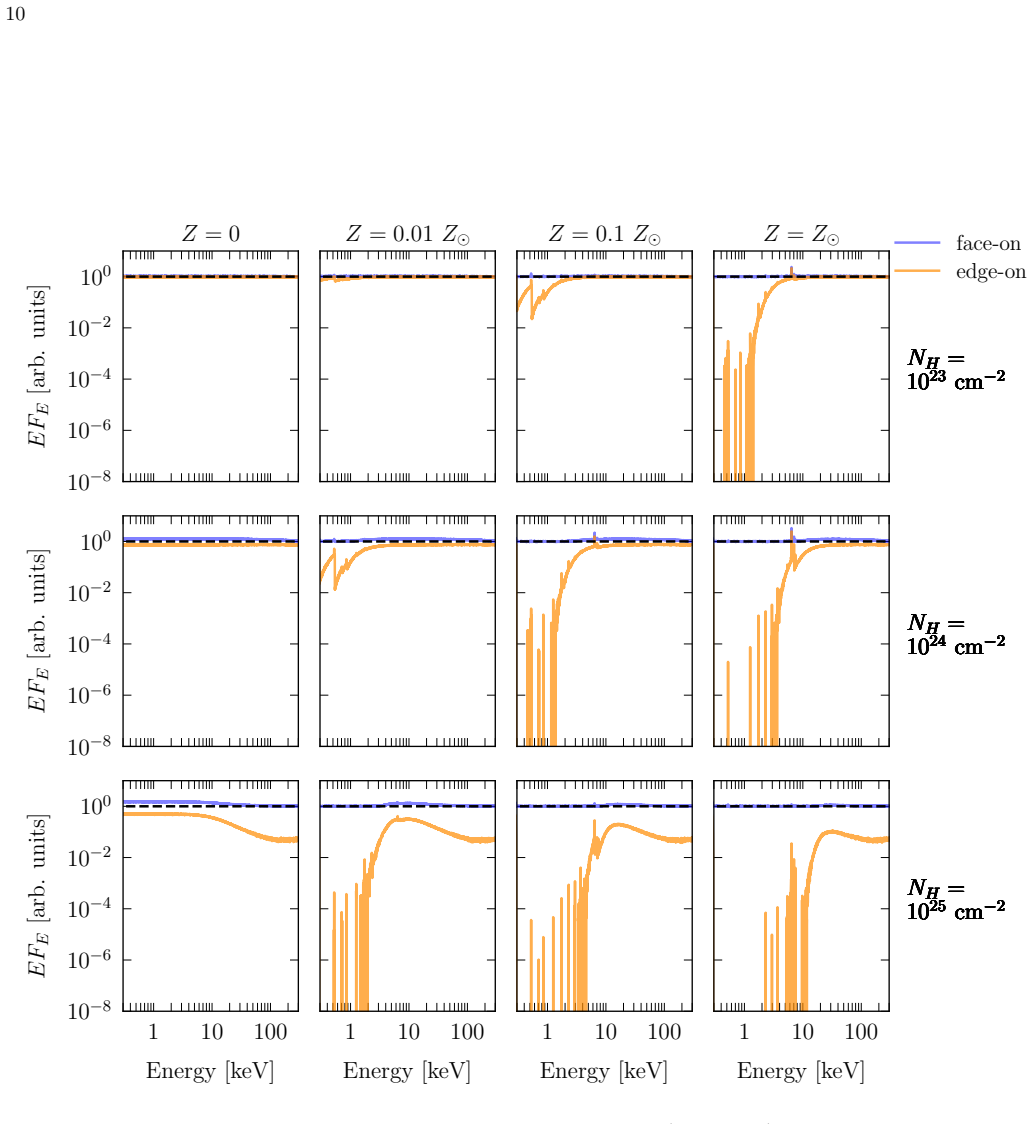
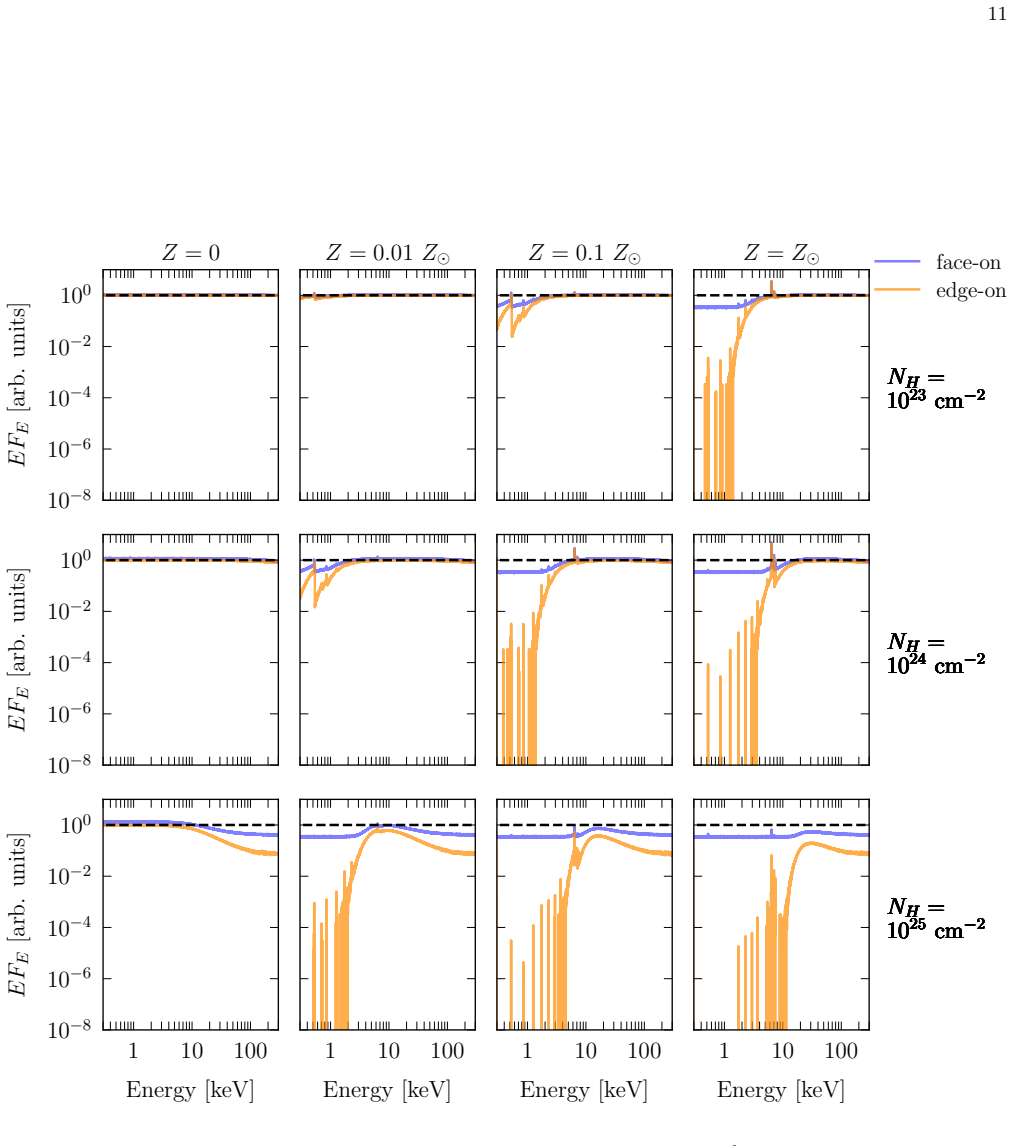
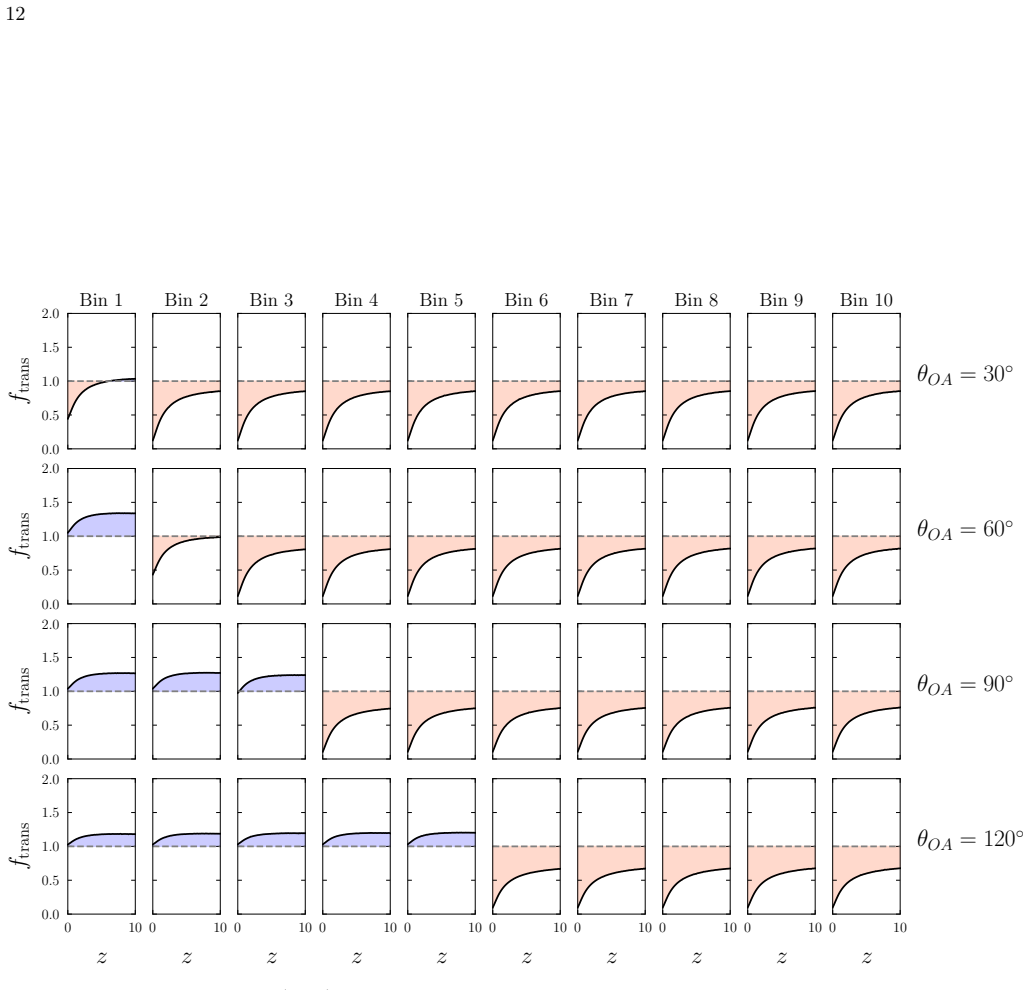
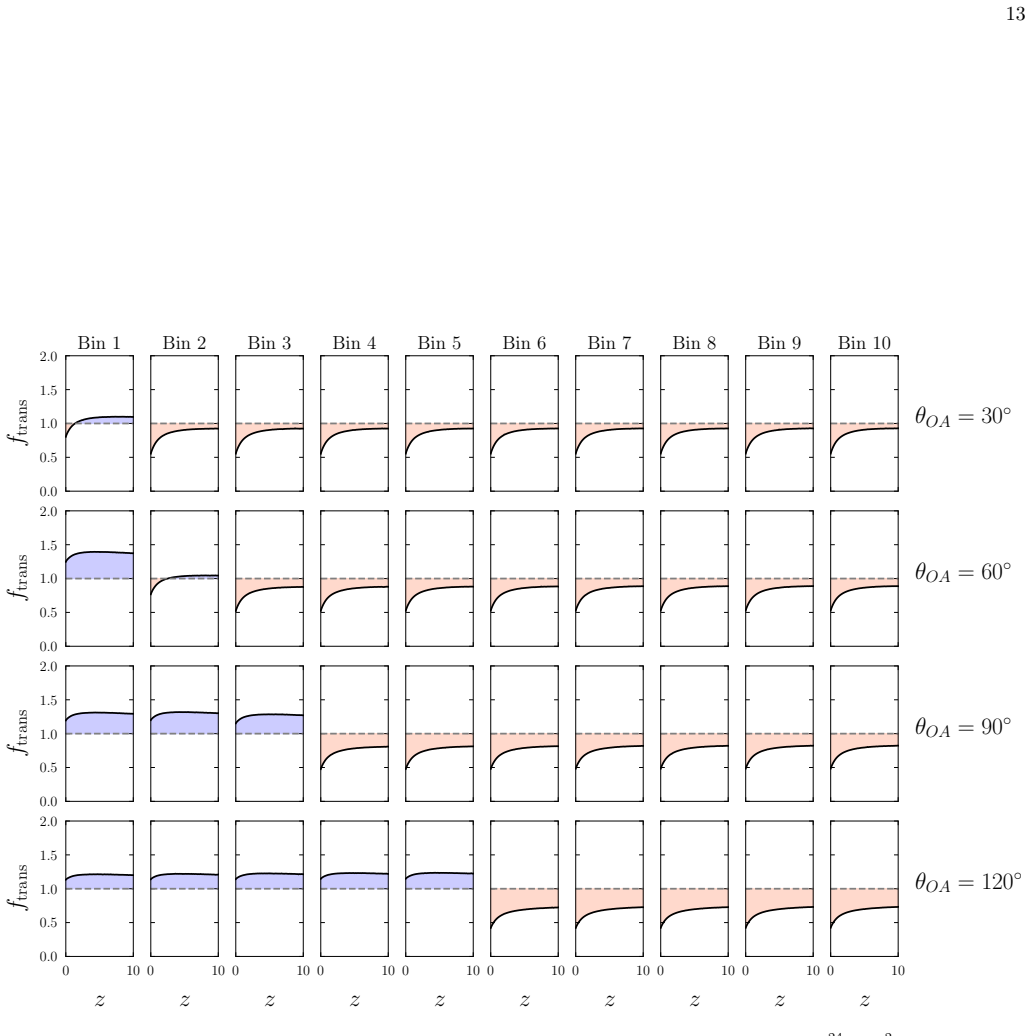
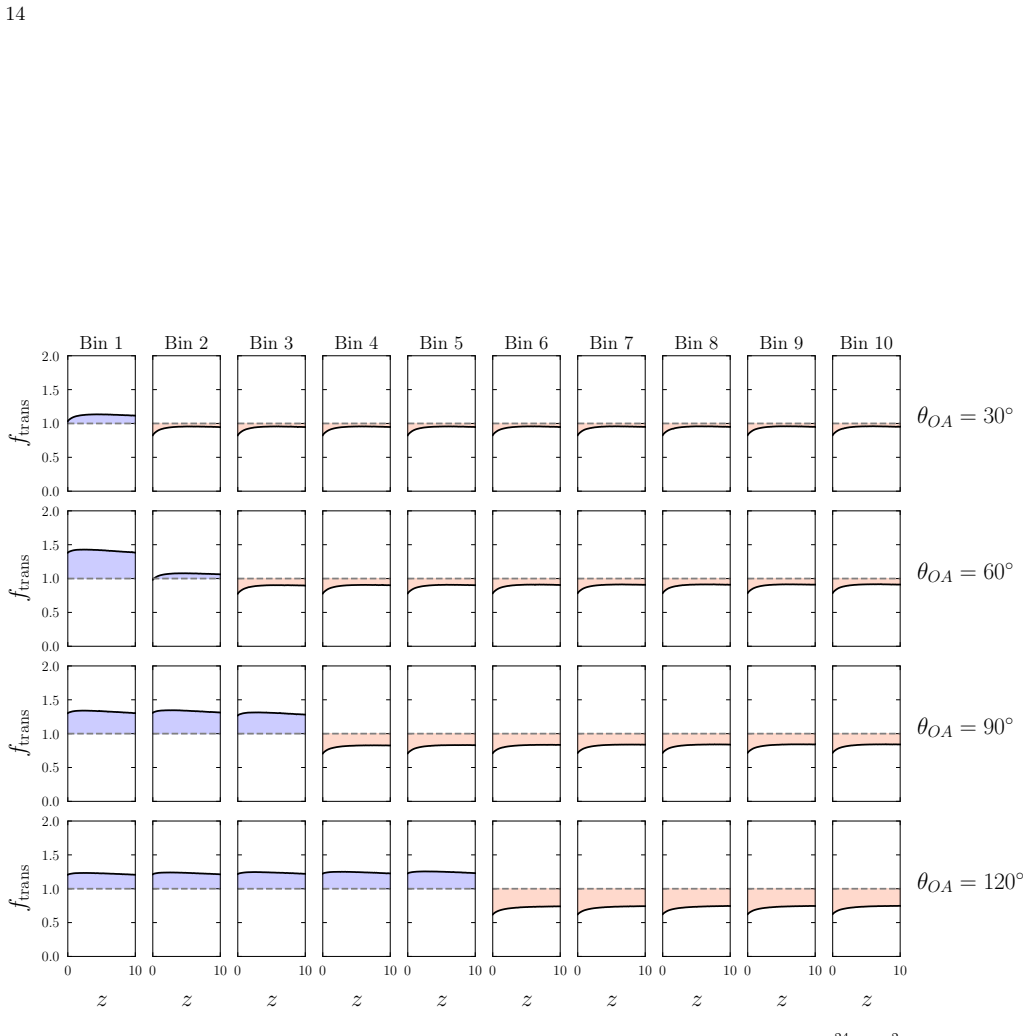
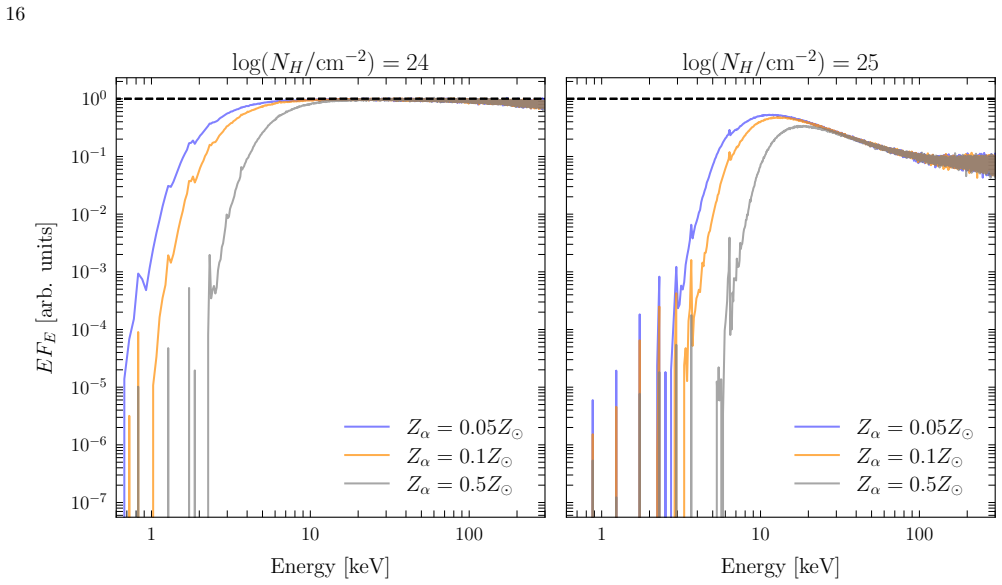
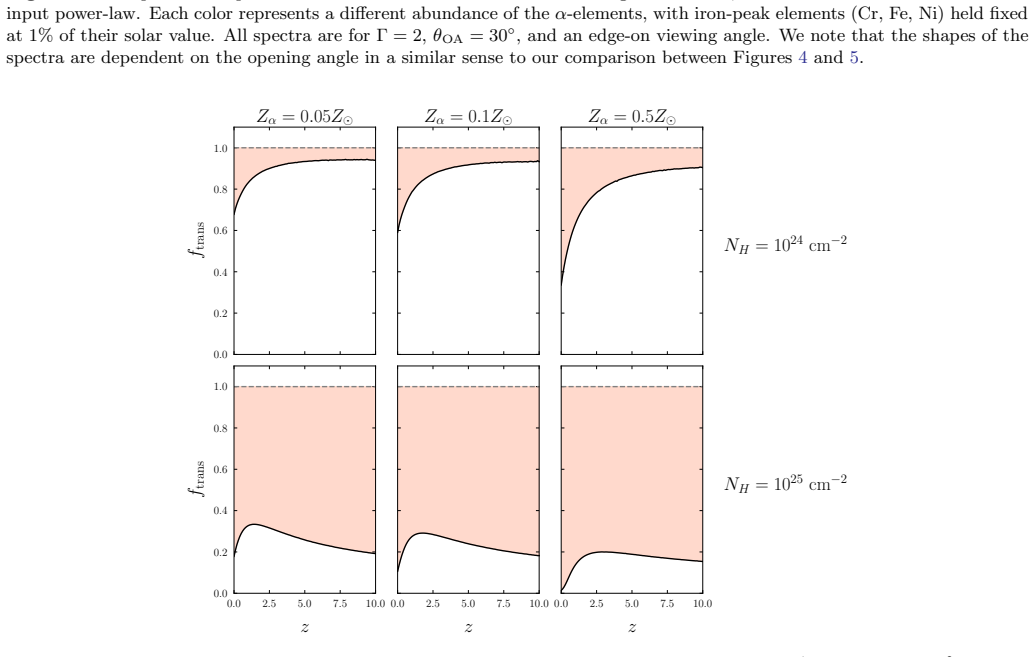
Decreased metallicity can significantly increase the fraction of X-ray photons that escape the torus, improving the prospects of detecting these very high-z AGNs. Monte Carlo radiative transfer calculations for Compton-thick columns of 10^24 to 10^25 cm^-2 show this effect as a function of metallicity, torus opening angle, and column density, with covering fraction producing geometric beaming that competes with isotropization from repeated scatterings.
What carries the argument
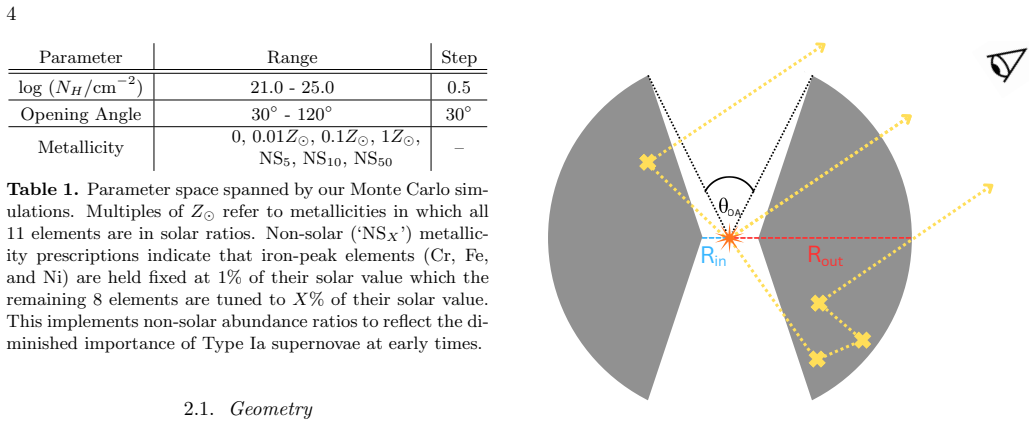
Monte Carlo radiative transfer of X-rays through a cold-gas torus with variable metallicity and opening angle
If this is right
- Higher X-ray escape fractions improve detection prospects for z=10 AGNs in next-generation high-angular-resolution surveys.
- Torus covering fraction produces geometric beaming that competes with isotropization from scatterings.
- Non-solar abundance ratios mimicking Type Ia supernova delay times alter the emergent X-ray spectrum in addition to overall metallicity reduction.
Where Pith is reading between the lines
- If the actual iron reduction at these redshifts exceeds the modeled values, even higher escape fractions could result.
- X-ray data on high-z AGNs could provide indirect constraints on early torus metallicity and geometry.
- The escape enhancement might extend to other high-redshift obscured sources beyond AGN tori.
Load-bearing premise
The torus geometry and the specific reduction in iron abundance at z greater than or equal to 10 are taken as given inputs motivated by expectations rather than measured.
What would settle it
X-ray spectra of confirmed z approximately 10 AGNs showing transmission fractions much lower than the modeled escape for reduced metallicity would falsify the central prediction.
Figures
read the original abstract
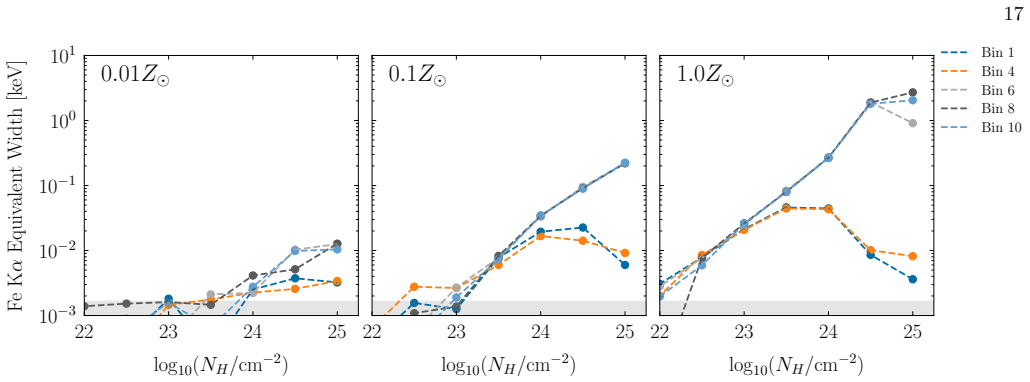
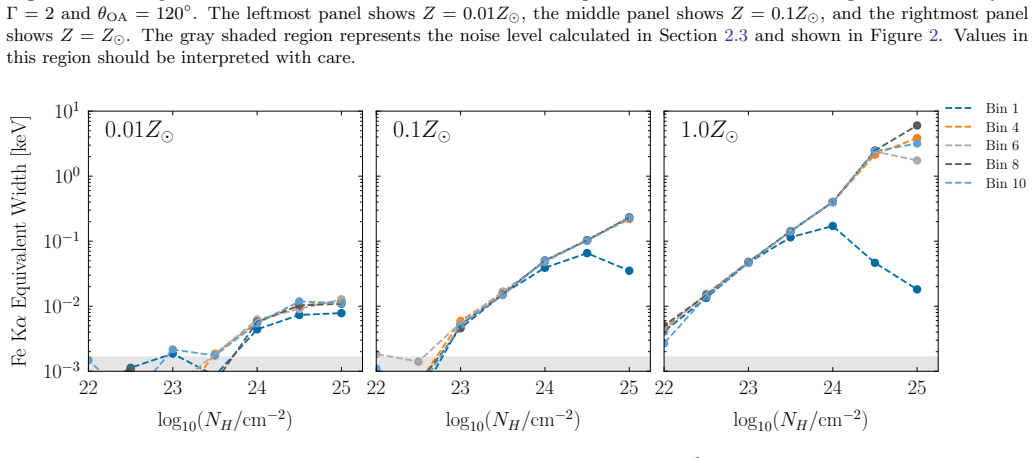
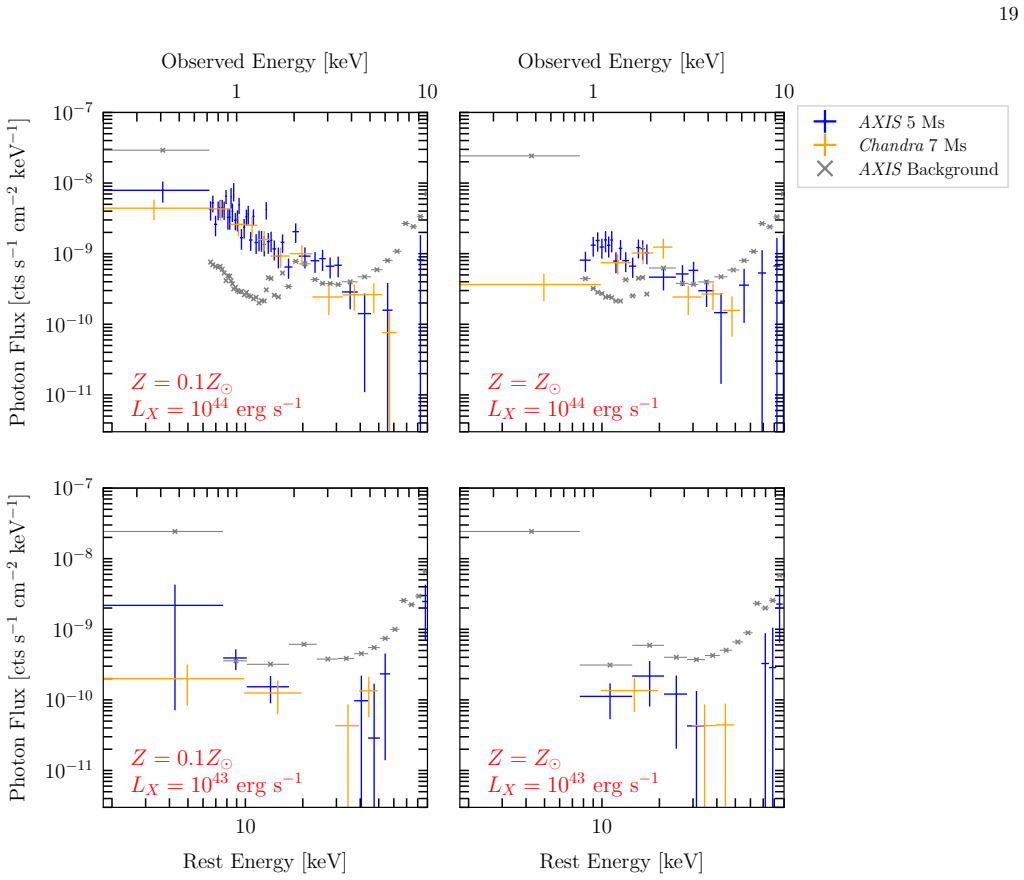
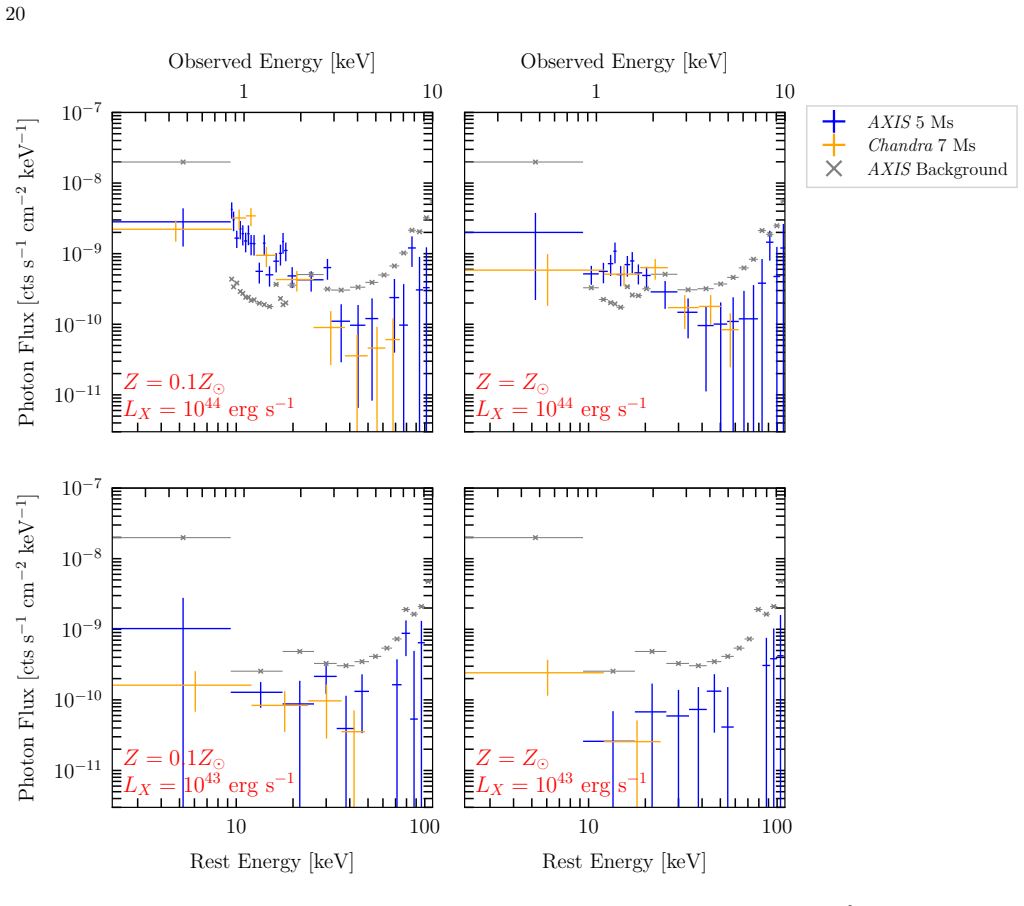
The James Webb Space Telescope has pushed the frontier of high-redshift galaxy and active galactic nucleus (AGN) observations firmly past $z=10$. Corresponding to the first 500 Myr after the Big Bang, this coincides with the epoch of supermassive black hole seeding and their early growth, much of which is likely to occur in highly obscured environments. In this work, we investigate the expected X-ray properties of these obscured AGNs focusing on the impact of the significantly lower iron abundance predicted at such early times. We use Monte Carlo methods to model the radiative transfer of X-rays from a central AGN through a surrounding torus of cold gas, characterizing the emergent X-ray spectrum as a function of the metallicity, opening angle of the torus, and column density. Motivated by expectations of high-$z$ systems, we focus on Compton-thick obscurers with columns $N_H=10^{24}-10^{25}\,{\rm cm}^{-2}$. We find that decreased metallicity can significantly increase the fraction of X-ray photons that escape the torus, improving the prospects of detecting these very high-$z$ AGNs. The covering fraction of the obscurer (i.e. torus opening angle) plays a complex role, with repeated scatterings across the interior of the torus (isotropizing the emission) competing with escape through the opening, producing geometric beaming. Additionally, we explore non-solar abundance ratios that mimic the delay-time distribution of Type Ia supernovae. We use our models to address the detectability of highly obscured $z=10$ AGNs in next-generation, high-angular resolution X-ray surveys.
Editorial analysis
A structured set of objections, weighed in public.
Referee Report
Summary. The manuscript uses Monte Carlo radiative transfer to model X-ray propagation through Compton-thick tori (N_H = 10^24-10^25 cm^-2) around high-redshift (z~10) AGNs. It reports that reduced metallicity, especially lower iron abundance, increases the escaping X-ray fraction, while torus opening angle produces competing effects of isotropization via scattering and geometric beaming; non-solar abundance patterns mimicking Type Ia supernova delay times are also explored, with implications for detectability in future high-resolution X-ray surveys.
Significance. If the modeled escape-fraction increase holds under the stated assumptions, the work supplies timely predictions for the X-ray visibility of the first generation of obscured AGNs, directly relevant to JWST discoveries and next-generation X-ray missions. The Monte Carlo treatment is a standard, well-suited tool for this problem, and the parameter exploration (metallicity scaling, opening angle, column density) is systematic.
major comments (2)
- [Introduction and model setup] The central claim that decreased metallicity significantly increases the X-ray escape fraction rests on the input assumption of substantially reduced iron abundance at z >= 10. This is motivated by expectations rather than measured values or detailed chemical-evolution calculations; if the actual high-z abundance pattern is closer to solar, the reported escape-fraction gain and improved detectability would not materialize. A dedicated sensitivity study varying the iron scaling factor should be added.
- [Results section on escape fractions] Table or figure presenting escape fractions (e.g., the quantitative results referenced in the abstract) should include direct comparisons to the solar-metallicity baseline case with the same torus parameters, plus uncertainty estimates from the Monte Carlo runs, to allow assessment of the magnitude and robustness of the metallicity effect.
minor comments (2)
- [Methods] Clarify the exact definition of 'escape fraction' (e.g., whether it is energy-integrated or band-specific) and ensure consistent notation for N_H and metallicity scaling throughout.
- [Methods] Add a brief statement on the number of Monte Carlo photons used per run and any convergence tests performed.
Simulated Author's Rebuttal
We thank the referee for their positive evaluation of the manuscript's significance and for the constructive major comments. We address each point below and will revise the manuscript accordingly.
read point-by-point responses
-
Referee: [Introduction and model setup] The central claim that decreased metallicity significantly increases the X-ray escape fraction rests on the input assumption of substantially reduced iron abundance at z >= 10. This is motivated by expectations rather than measured values or detailed chemical-evolution calculations; if the actual high-z abundance pattern is closer to solar, the reported escape-fraction gain and improved detectability would not materialize. A dedicated sensitivity study varying the iron scaling factor should be added.
Authors: We agree that the assumed reduction in iron abundance at z ≥ 10 is based on theoretical expectations from chemical-evolution models rather than direct measurements. To address this limitation and test the robustness of our conclusions, we will add a dedicated sensitivity study in the revised manuscript. This study will vary the iron scaling factor independently (while holding other abundances fixed) across a range of values and quantify its impact on the X-ray escape fraction. revision: yes
-
Referee: [Results section on escape fractions] Table or figure presenting escape fractions (e.g., the quantitative results referenced in the abstract) should include direct comparisons to the solar-metallicity baseline case with the same torus parameters, plus uncertainty estimates from the Monte Carlo runs, to allow assessment of the magnitude and robustness of the metallicity effect.
Authors: We will revise the relevant table(s) and/or figure(s) to include explicit side-by-side comparisons of escape fractions for the reduced-metallicity and solar-metallicity cases using identical torus parameters (N_H, opening angle). We will also add uncertainty estimates derived from the Monte Carlo runs to quantify the statistical robustness of the results. revision: yes
Circularity Check
Forward Monte Carlo radiative transfer simulation exhibits no circularity
full rationale
The paper conducts Monte Carlo simulations of X-ray radiative transfer through a parameterized torus, computing emergent spectra and escape fractions directly as functions of input parameters (metallicity, opening angle, column density). These outputs are not fitted to data, not self-defined, and do not reduce to the inputs by construction via any of the enumerated circular patterns. No load-bearing self-citations, uniqueness theorems, or ansatzes are invoked to force the central results. The derivation chain is self-contained as a forward modeling study.
Axiom & Free-Parameter Ledger
free parameters (3)
- metallicity scaling
- torus opening angle
- column density range
axioms (1)
- domain assumption Monte Carlo photon tracking through a cold-gas torus accurately captures Compton scattering and photoelectric absorption at X-ray energies.
Reference graph
Works this paper leans on
-
[1]
The Astrophysical Journal , keywords =
Tanimoto, Atsushi and Ueda, Yoshihiro and Odaka, Hirokazu and Kawaguchi, Toshihiro and Fukazawa, Yasushi and Kawamuro, Taiki , doi =. The Astrophysical Journal , keywords =. 2019 , bdsk-url-1 =
2019
-
[2]
Belmont, R. , doi =. Numerical computation of isotropic. A&A , language =. 2009 , bdsk-url-1 =
2009
-
[3]
Zhao, X. and Marchesi, S. and Ajello, M. and Cole, D. and Hu, Z. and Silver, R. and Torres-Alb. The properties of the. A&A , language =. 2021 , bdsk-url-1 =. doi:10.1051/0004-6361/202140297 , file =
-
[4]
Constraining
Li, Junyao and Shen, Yue , doi =. Constraining. ApJ , language =. 2023 , bdsk-url-1 =
2023
-
[5]
ApJ , language =
Ikeda, Shinya and Awaki, Hisamitu and Terashima, Yuichi , doi =. ApJ , language =. 2009 , bdsk-url-1 =
2009
-
[6]
and Alexander, David M
Hickox, Ryan C. and Alexander, David M. , doi =. Obscured. Annu. Rev. Astron. Astrophys. , keywords =. 2018 , bdsk-url-1 =
2018
-
[7]
and Yaqoob, Tahir , doi =
Murphy, Kendrah D. and Yaqoob, Tahir , doi =. An. Monthly Notices of the Royal Astronomical Society , keywords =. 2009 , bdsk-url-1 =
2009
-
[8]
Reynolds, C. S. and Fabian, A. C. and Makishima, K. and Fukazawa, Y. and Tamura, T. , doi =. The reflection-dominated. Monthly Notices of the Royal Astronomical Society , language =. 1994 , bdsk-url-1 =
1994
-
[9]
George, I. M. and Fabian, A. C. , doi =. X-ray reflection from cold matter in. Monthly Notices of the Royal Astronomical Society , keywords =. 1991 , bdsk-url-1 =
1991
-
[10]
and Lugaro, Maria , doi =
Kobayashi, Chiaki and Karakas, Amanda I. and Lugaro, Maria , doi =. The. ApJ , language =. 2020 , bdsk-url-1 =
2020
-
[11]
Evidence for heavy-seed origin of early supermassive black holes from a z ≈ 10
Bogd. Evidence for heavy-seed origin of early supermassive black holes from a z ≈ 10. Nature Astronomy , keywords =. 2024 , bdsk-url-1 =. doi:10.1038/s41550-023-02111-9 , file =
-
[12]
Kobayashi, Chiaki and Tsujimoto, Takuji and Nomoto, Ken'ichi , doi =. The. The Astrophysical Journal , keywords =. 2000 , bdsk-url-1 =
2000
-
[13]
and Ueda, Y
Ricci, C. and Ueda, Y. and Koss, M. J. and Trakhtenbrot, B. and Bauer, F. E. and Gandhi, P. , doi =. Compton-thick. The Astrophysical Journal , keywords =. 2015 , bdsk-url-1 =
2015
-
[14]
and Daoudi, S
Meddouh, K. and Daoudi, S. and Kahoul, A. and Sampaio, J. M. and Marques, J. P. and Parente, F. and Aylikci, N. Kup and Aylikci, V. and Kasri, Y. and Hamidani, A. , doi =. Average. Radiation Physics and Chemistry , keywords =. 2023 , bdsk-url-1 =
2023
-
[15]
and Palme, H
Lodders, K. and Palme, H. and Gail, H. -P. , doi =. Abundances of the. Landolt B. 2009 , bdsk-url-1 =
2009
-
[16]
Ricci, C. and Ueda, Y. and Ichikawa, K. and Paltani, S. and Boissay, R. and Gandhi, P. and Stalevski, M. and Awaki, H. , copyright =. The narrow. A&A , language =. 2014 , bdsk-url-1 =. doi:10.1051/0004-6361/201322701 , file =
-
[17]
Verner, D. A. and Yakovlev, D. G. and Band, I. M. and Trzhaskovskaya, M. B. , doi =. Subshell. Atomic Data and Nuclear Data Tables , month = nov, number =. 1993 , bdsk-url-1 =
1993
-
[18]
and Steidel, Charles C
Strom, Allison L. and Steidel, Charles C. and Rudie, Gwen C. and Trainor, Ryan F. and Pettini, Max , doi =. Measuring the. ApJ , language =. 2018 , bdsk-url-1 =
2018
-
[19]
Chru. Trading oxygen for iron. A&A , keywords =. 2024 , bdsk-url-1 =. doi:10.1051/0004-6361/202347602 , file =
-
[20]
and Koulouridis, E
Ranalli, P. and Koulouridis, E. and Georgantopoulos, I. and Fotopoulou, S. and Hsu, L.-T. and Salvato, M. and Comastri, A. and Pierre, M. and Cappelluti, N. and Carrera, F. J. and Chiappetti, L. and Clerc, N. and Gilli, R. and Iwasawa, K. and Pacaud, F. and Paltani, S. and Plionis, E. and Vignali, C. , doi =. The 2--10. A&A , month = jun, pages =. 2016 , ...
2016
-
[21]
Mersenne twister: a 623-dimensionally equidistributed uniform pseudo-random number generator , url =
Matsumoto, Makoto and Nishimura, Takuji , doi =. Mersenne twister: a 623-dimensionally equidistributed uniform pseudo-random number generator , url =. ACM Trans. Model. Comput. Simul. , month = jan, number =. 1998 , bdsk-url-1 =
1998
-
[22]
and McDowell, Jonathan C
Elvis, Martin and Wilkes, Belinda J. and McDowell, Jonathan C. and Green, Richard F. and Bechtold, Jill and Willner, S. P. and Oey, M. S. and Polomski, Elisha and Cutri, Roc , doi =. Atlas of. The Astrophysical Journal Supplement Series , keywords =. 1994 , bdsk-url-1 =
1994
-
[23]
and Pounds, K
Nandra, K. and Pounds, K. A. , doi =. Monthly Notices of the Royal Astronomical Society , month = may, note =. 1994 , bdsk-url-1 =
1994
-
[24]
Bisnovatyi-Kogan, G. S. and Blinnikov, S. I. , file =. Disk accretion onto a black hole at subcritical luminosity. , url =. Astronomy and Astrophysics , keywords =. 1977 , bdsk-url-1 =
1977
-
[25]
and Maraschi, L
Haardt, F. and Maraschi, L. , doi =. A. The Astrophysical Journal , keywords =. 1991 , bdsk-url-1 =
1991
-
[26]
Sensitivity of the
Odaka, Hirokazu and Yoneda, Hiroki and Takahashi, Tadayuki and Fabian, Andrew , doi =. Sensitivity of the. Monthly Notices of the Royal Astronomical Society , month = nov, number =. 2016 , bdsk-url-1 =
2016
-
[27]
and Heckman, Timothy M
Groves, Brent A. and Heckman, Timothy M. and Kauffmann, Guinevere , doi =. Emission-line diagnostics of low-metallicity active galactic nuclei , url =. Monthly Notices of the Royal Astronomical Society , keywords =. 2006 , bdsk-url-1 =
2006
-
[28]
and Hamilton, Donald , doi =
Steidel, Charles C. and Hamilton, Donald , doi =. Deep. The Astronomical Journal , keywords =. 1993 , bdsk-url-1 =
1993
-
[29]
and Rybicki, George B
Press, William H. and Rybicki, George B. and Schneider, Donald P. , doi =. Properties of. The Astrophysical Journal , keywords =. 1993 , bdsk-url-1 =
1993
-
[30]
Artymowicz, Pawel and Lin, D. N. C. and Wampler, E. J. , doi =. Star. The Astrophysical Journal , keywords =. 1993 , bdsk-url-1 =
1993
-
[31]
and Rawlings, Steve , doi =
Eales, Stephen A. and Rawlings, Steve , doi =. Infrared. The Astrophysical Journal , keywords =. 1993 , bdsk-url-1 =
1993
-
[32]
Oesch, P. A. and Brammer, G. and van Dokkum, P. G. and Illingworth, G. D. and Bouwens, R. J. and Labb. A. The Astrophysical Journal , keywords =. 2016 , bdsk-url-1 =. doi:10.3847/0004-637X/819/2/129 , file =
-
[33]
and Jakobsen, Peter and Witstok, Joris and Johnson, Benjamin D
Carniani, Stefano and Hainline, Kevin and D'Eugenio, Francesco and Eisenstein, Daniel J. and Jakobsen, Peter and Witstok, Joris and Johnson, Benjamin D. and Chevallard, Jacopo and Maiolino, Roberto and Helton, Jakob M. and Willott, Chris and Robertson, Brant and Alberts, Stacey and Arribas, Santiago and Baker, William M. and Bhatawdekar, Rachana and Boyet...
-
[34]
Baldwin, J. A. and Phillips, M. M. and Terlevich, R. , doi =. Classification parameters for the emission-line spectra of extragalactic objects. , url =. Publications of the Astronomical Society of the Pacific , keywords =. 1981 , bdsk-url-1 =
1981
-
[35]
Veilleux, Sylvain and Osterbrock, Donald E. , doi =. Spectral. The Astrophysical Journal Supplement Series , keywords =. 1987 , bdsk-url-1 =
1987
-
[36]
Juneau, St. A. The Astrophysical Journal , keywords =. 2011 , bdsk-url-1 =. doi:10.1088/0004-637X/736/2/104 , file =
-
[37]
and Newman, Jeffrey A
Yan, Renbin and Ho, Luis C. and Newman, Jeffrey A. and Coil, Alison L. and Willmer, Christopher N. A. and Laird, Elise S. and Georgakakis, Antonis and Aird, James and Barmby, Pauline and Bundy, Kevin and Cooper, Michael C. and Davis, Marc and Faber, S. M. and Fang, Taotao and Griffith, Roger L. and Koekemoer, Anton M. and Koo, David C. and Nandra, Kirpal ...
2011
-
[38]
Feuillet, L. Classifying. The Astrophysical Journal , keywords =. 2024 , bdsk-url-1 =. doi:10.3847/1538-4357/ad1a09 , file =
-
[39]
J., Groves, B., Kauffmann, G., & Heckman, T
Stasi. Semi-empirical analysis of. Monthly Notices of the Royal Astronomical Society , keywords =. 2006 , bdsk-url-1 =. doi:10.1111/j.1365-2966.2006.10732.x , file =
-
[40]
Kewley, L. J. and Heisler, C. A. and Dopita, M. A. and Lumsden, S. , doi =. Optical. The Astrophysical Journal Supplement Series , keywords =. 2001 , bdsk-url-1 =
2001
-
[41]
Mazzolari, Giovanni and. New. A&A , language =. 2024 , bdsk-url-1 =. doi:10.1051/0004-6361/202450407 , file =
-
[42]
Reynolds, Christopher S. and Kara, Erin A. and Mushotzky, Richard F. and Ptak, Andrew and Koss, Michael J. and Williams, Brian J. and Allen, Steven W. and Bauer, Franz E. and Bautz, Marshall and Bodaghee, Arash and Burdge, Kevin B. and Cappelluti, Nico and Cenko, Brad and Chartas, George and Chan, Kai-Wing and Corrales, L. Overview of the. 2023 , bdsk-url...
-
[43]
and White, Timothy R
Lightman, Alan P. and White, Timothy R. , doi =. Effects of. The Astrophysical Journal , keywords =. 1988 , bdsk-url-1 =
1988
-
[44]
and Ricci, C
Paltani, S. and Ricci, C. , doi =. A&A , language =. 2017 , bdsk-url-1 =
2017
-
[45]
Balokovi. New. ApJ , keywords =. 2018 , bdsk-url-1 =. doi:10.3847/1538-4357/aaa7eb , file =
-
[46]
Buchner, Johannes and Brightman, Murray and Nandra, Kirpal and Nikutta, Robert and Bauer, Franz E. , doi =. X-ray spectral and eclipsing model of the clumpy obscurer in active galactic nuclei , url =. A&A , keywords =. 2019 , bdsk-url-1 =
2019
-
[47]
Magdziarz, Pawel and Zdziarski, Andrzej A. , doi =. Angle-dependent. Monthly Notices of the Royal Astronomical Society , keywords =. 1995 , bdsk-url-1 =
1995
-
[48]
and O'Neill, P
Nandra, K. and O'Neill, P. M. and George, I. M. and Reeves, J. N. , doi =. An. Monthly Notices of the Royal Astronomical Society , keywords =. 2007 , bdsk-url-1 =
2007
-
[49]
Stuart and Lampton, Michael and Mack, John and de Mendonca, Fernando , doi =
Bowyer, C. Stuart and Lampton, Michael and Mack, John and de Mendonca, Fernando , doi =. Detection of. The Astrophysical Journal , month = jul, note =. 1970 , bdsk-url-1 =
1970
-
[50]
and Maccacaro, T
Elvis, M. and Maccacaro, T. and Wilson, A. S. and Ward, M. J. and Penston, M. V. and Fosbury, R. A. E. and Perola, G. C. , doi =. Seyfert galaxies as. Monthly Notices of the Royal Astronomical Society , keywords =. 1978 , bdsk-url-1 =
1978
-
[51]
and Nishina, T
Klein, O. and Nishina, T. , doi =. Zeitschrift fur Physik , month = nov, note =. 1929 , bdsk-url-1 =
1929
-
[52]
Hamann, Fred and Ferland, Gary , doi =. The. The Astrophysical Journal , keywords =. 1993 , bdsk-url-1 =
1993
-
[53]
and Lightman, Alan P
Rybicki, George B. and Lightman, Alan P. , keywords =. Radiative processes in astrophysics , url =. 1979 , bdsk-url-1 =
1979
-
[54]
and Kohmura, Takayoshi and Morita, Umeyo and Nagase, Fumiaki and Paerels, Frederik and Takahashi, Tadayuki , doi =
Watanabe, Shin and Sako, Masao and Ishida, Manabu and Ishisaki, Yoshitaka and Kahn, Steve M. and Kohmura, Takayoshi and Morita, Umeyo and Nagase, Fumiaki and Paerels, Frederik and Takahashi, Tadayuki , doi =. Detection of a. The Astrophysical Journal , keywords =. 2003 , bdsk-url-1 =
2003
-
[55]
Kaspi, Shai and Brandt, W. N. and George, Ian M. and Netzer, Hagai and Crenshaw, D. Michael and Gabel, Jack R. and Hamann, Frederick W. and Kaiser, Mary Elizabeth and Koratkar, Anuradha and Kraemer, Steven B. and Kriss, Gerard A. and Mathur, Smita and Mushotzky, Richard F. and Nandra, Kirpal and Peterson, Bradley M. and Shields, Joseph C. and Turner, T. J...
2002
-
[56]
and Matt, G
Bianchi, S. and Matt, G. and Fiore, F. and Fabian, A. C. and Iwasawa, K. and Nicastro, F. , doi =. Flux and spectral variations in the. Astronomy and Astrophysics , keywords =. 2002 , bdsk-url-1 =
2002
-
[57]
and Bianchi, S
Matt, G. and Bianchi, S. and Guainazzi, M. and Molendi, S. , doi =. The high energy emission line spectrum of. Astronomy and Astrophysics , keywords =. 2004 , bdsk-url-1 =
2004
-
[58]
Verner, D. A. and Yakovlev, D. G. , file =. Analytic fits for partial photoionization cross sections , volume =. Astronomy & Astrophysics Supplement Series , pages =
-
[59]
Arnaud, K. A. , date-modified =. ASPC , month = jan, note =. 1996 , bdsk-url-1 =
1996
-
[60]
Bluem, Jesse and Kaaret, Philip and Kuntz, K. D. and Jahoda, Keith M. and Koutroumpa, Dimitra and Hodges-Kluck, Edmund J. and Fuller, Chase A. and LaRocca, Daniel M. and Zajczyk, Anna , doi =. Widespread. The Astrophysical Journal , keywords =. 2022 , bdsk-url-1 =
2022
-
[61]
and Almy, R
McCammon, D. and Almy, R. and Apodaca, E. and Bergmann Tiest, W. and Cui, W. and Deiker, S. and Galeazzi, M. and Juda, M. and Lesser, A. and Mihara, T. and Morgenthaler, J. P. and Sanders, W. T. and Zhang, J. and Figueroa-Feliciano, E. and Kelley, R. L. and Moseley, S. H. and Mushotzky, R. F. and Porter, F. S. and Stahle, C. K. and Szymkowiak, A. E. , doi...
2002
-
[62]
and Shelton, Robin L
Henley, David B. and Shelton, Robin L. , doi =. An. The Astrophysical Journal , keywords =. 2013 , bdsk-url-1 =
2013
-
[63]
Thompson, Albert and Attwood, David and Gullikson, Eric and Howells, Malcolm and Kim, Kwang-Je and Kirz, Janos and Kortright, Jeffrey and Lindau, Ingolf and Liu, Yanwei and Pianetta, Piero and Robinson, Arthur and Scofield, James and Underwood, James and Williams, Gwyn and Winick, Herman , edition =. X-ray
-
[64]
The Origin of the Mass--Metallicity Relation: Insights from 53,000 Star-Forming Galaxies in the SDSS
Tremonti, Christy A. and Heckman, Timothy M. and Kauffmann, Guinevere and Brinchmann, Jarle and Charlot, St. The. The Astrophysical Journal , keywords =. 2004 , bdsk-url-1 =. doi:10.1086/423264 , file =
work page internal anchor Pith review doi:10.1086/423264 2004
-
[65]
and Nagao, T
Maiolino, R. and Nagao, T. and Grazian, A. and Cocchia, F. and Marconi, A. and Mannucci, F. and Cimatti, A. and Pipino, A. and Ballero, S. and Calura, F. and Chiappini, C. and Fontana, A. and Granato, G. L. and Matteucci, F. and Pastorini, G. and Pentericci, L. and Risaliti, G. and Salvati, M. and Silva, L. , doi =. Astronomy and Astrophysics , keywords =...
2008
-
[66]
Mennekens, N. and Vanbeveren, D. and Greve, J. P. De and Donder, E. De , copyright =. The delay-time distribution of. A&A , language =. 2010 , bdsk-url-1 =. doi:10.1051/0004-6361/201014115 , file =
-
[67]
and Pacifici, Camilla and Narayan, Gautham and Graur, Or , doi =
Strolger, Louis-Gregory and Rodney, Steven A. and Pacifici, Camilla and Narayan, Gautham and Graur, Or , doi =. Delay. ApJ , language =. 2020 , bdsk-url-1 =
2020
-
[68]
Nature 585(7825), 357–362 (2020) https://doi.org/10.1038/s41586-020-2649-2
Harris, Charles R. and Millman, K. Jarrod and van der Walt, St. Array programming with. Nature , keywords =. 2020 , bdsk-url-1 =. doi:10.1038/s41586-020-2649-2 , file =
-
[69]
Hunter, John D. , doi =. Matplotlib:. Computing in Science & Engineering , keywords =. 2007 , bdsk-url-1 =
2007
-
[70]
Virtanen, Pauli and Gommers, Ralf and Oliphant, Travis E. and Haberland, Matt and Reddy, Tyler and Cournapeau, David and Burovski, Evgeni and Peterson, Pearu and Weckesser, Warren and Bright, Jonathan and van der Walt, St. Nat Methods , keywords =. 2020 , bdsk-url-1 =. doi:10.1038/s41592-019-0686-2 , file =
-
[71]
ApJS , keywords =
Diemer, Benedikt , doi =. ApJS , keywords =. 2018 , bdsk-url-1 =
2018
-
[72]
The Astrophysical Journal , publisher =
The. The Astrophysical Journal , keywords =. 2022 , bdsk-url-1 =. doi:10.3847/1538-4357/ac7c74 , file =
work page internal anchor Pith review doi:10.3847/1538-4357/ac7c74 2022
-
[73]
and Della Valle, M
Mannucci, F. and Della Valle, M. and Panagia, N. , doi =. Two populations of progenitors for. Monthly Notices of the Royal Astronomical Society , keywords =. 2006 , bdsk-url-1 =
2006
-
[74]
and Belczynski, Krzysztof and Fryer, Chris , doi =
Ruiter, Ashley J. and Belczynski, Krzysztof and Fryer, Chris , doi =. Rates and. The Astrophysical Journal , keywords =. 2009 , bdsk-url-1 =
2009
-
[75]
Inayoshi, Kohei and Visbal, Eli and Haiman, Zolt. The. Annual Review of Astronomy and Astrophysics , keywords =. 2020 , bdsk-url-1 =. doi:10.1146/annurev-astro-120419-014455 , file =
-
[76]
Planck 2018 results. Astronomy and Astrophysics , keywords =. 2020 , bdsk-url-1 =. doi:10.1051/0004-6361/201833910 , file =
-
[77]
X-Ray and Gamma-Ray Telescopes and Instruments for Astronomy
Advanced CCD imaging spectrometer (ACIS) instrument on the Chandra X-ray Observatory. X-Ray and Gamma-Ray Telescopes and Instruments for Astronomy. , year = 2003, editor =. doi:10.1117/12.461599 , adsurl =
-
[78]
Trefoloni, Bartolomeo and Ji, Xihan and Maiolino, Roberto and D'Eugenio, Francesco and. The missing. A&A , language =. 2025 , bdsk-url-1 =. doi:10.1051/0004-6361/202452795 , file =
-
[79]
and Fujimoto, Seiji and Atek, Hakim and Brammer, Gabriel and Finkelstein, Steven L
Kokorev, Vasily and Chisholm, John and Naidu, Rohan P. and Fujimoto, Seiji and Atek, Hakim and Brammer, Gabriel and Finkelstein, Steven L. and Akins, Hollis B. and Berg, Danielle A. and Furtak, Lukas J. and Fei, Qinyue and Hsiao, Tiger Yu-Yang and Labb. The. 2025 , bdsk-url-1 =. doi:10.48550/arXiv.2511.07515 , file =
-
[80]
Chandra X-Ray Observatory (CXO):Overview
Chandra X-ray Observatory (CXO): overview. X-Ray Optics, Instruments, and Missions III , year = 2000, editor =. doi:10.1117/12.391545 , archivePrefix =. astro-ph/0004127 , primaryClass =
work page internal anchor Pith review Pith/arXiv arXiv doi:10.1117/12.391545 2000
discussion (0)
Sign in with ORCID, Apple, or X to comment. Anyone can read and Pith papers without signing in.