Predictions of Transiting Exoplanet Confirmations from Rubin LSST Surveys
Pith reviewed 2026-06-26 01:04 UTC · model grok-4.3
The pith
LSST's current survey design will confirm only a small number of transiting exoplanets, all hot planets around faint M stars in the Deep Drilling Fields, with none in the Wide Fast Deep survey.
A machine-rendered reading of the paper's core claim, the machinery that carries it, and where it could break.
Core claim
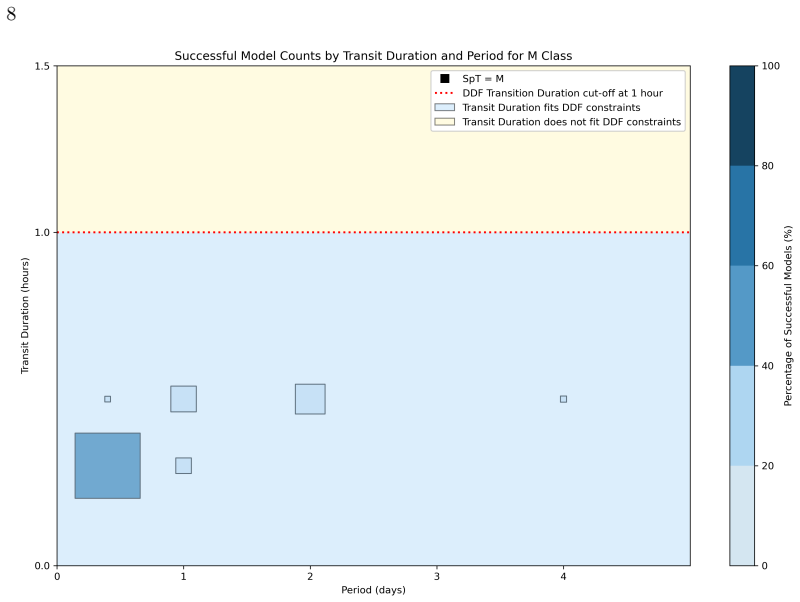
The simulations indicate a limited potential for exoplanet confirmations under the current survey design. Only a small number of hot planets orbiting faint M class main sequence stars will be confirmed in the DDF fields. The WFD survey is projected to produce no confirmations. These findings underscore the constraints imposed by the sparse, multi-band observing strategy, which prioritizes cosmology and extragalactic science over the continuous photometric coverage required for confirmations.
What carries the argument
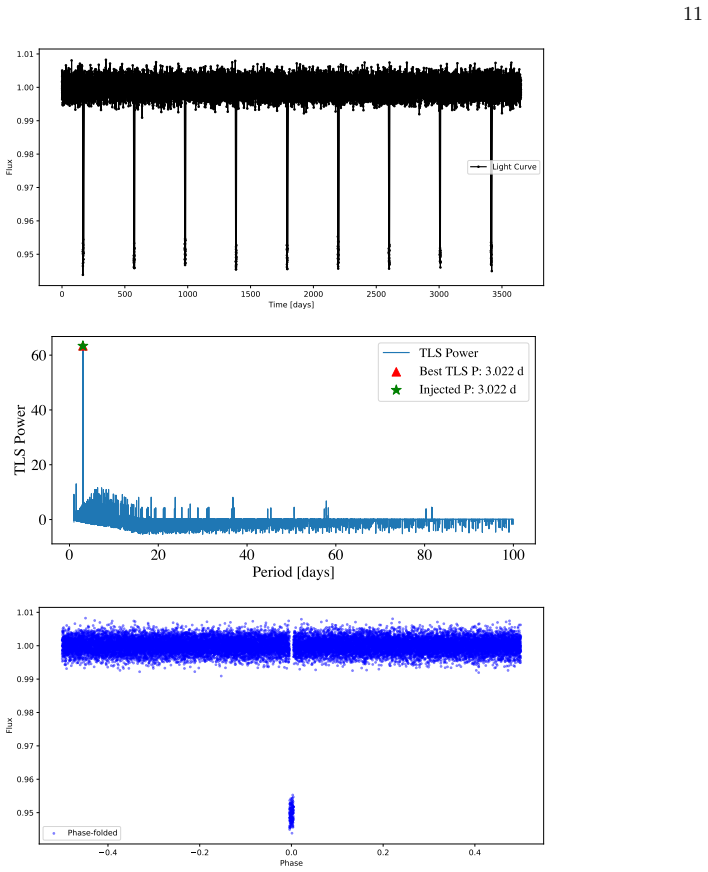
Simulation of light curves that combines Kepler-derived planet occurrence rates with the TRILEGAL Galactic structure model, then filters for full observation of at least three transits at adequate signal-to-noise ratio and validates candidates with the Transit Least Squares periodogram.
If this is right
- The sparse multi-band observing strategy imposes the principal limitations on transit confirmations.
- Only hot planets orbiting faint M class main sequence stars have any prospect of confirmation, and only in the DDF fields.
- The WFD survey produces no expected confirmations under the applied criteria.
- The survey cadence prioritizes cosmology and extragalactic science at the expense of continuous photometric coverage needed for exoplanet work.
Where Pith is reading between the lines
- Adjusting cadence in selected fields could raise the number of confirmable planets without altering the overall survey goals.
- Running the same simulation with updated occurrence rates from TESS or other missions would show how sensitive the zero and small-number predictions are to the input statistics.
- LSST data could itself be used to test whether the Kepler rates hold for the fainter M stars that dominate the predicted yield.
- Complementary methods such as radial-velocity follow-up on the same stars might recover planets that transit searches miss due to cadence gaps.
Load-bearing premise
The Kepler-derived planet occurrence rates and TRILEGAL galactic model must accurately describe the stellar and planetary populations that LSST will observe, and the chosen SNR and three-transit criteria must correctly predict detectability under the actual survey cadence.
What would settle it
Count the actual number of transiting exoplanet confirmations obtained from the completed ten-year LSST WFD and DDF datasets and compare it directly to the prediction of zero confirmations in WFD and only a small number in DDF.
Figures
read the original abstract
We assess the prospects for exoplanet transit observations in the 10-year Wide Fast Deep (WFD) and Deep Drilling Field (DDF) surveys within the Legacy Survey of Space and Time (LSST) mission of the Vera C. Rubin Observatory. We construct a framework for systematic assessment of expected exoplanet yields, highlighting the principal limitations imposed by the survey observing strategy and cadence. We simulate light curves with a wide range of exoplanetary system models derived from planet occurrence rates developed with data from the Kepler mission. Transit counts for the stellar population are calculated using the TRILEGAL Galactic structure model, incorporating telescope sensitivity and survey cadences. We apply the constraints that the full duration of at least three transits must be observed and that the signal-to-noise ratio will support detectability. The observations were then validated using the Transit Least Squares periodogram. Our findings indicate a limited potential for exoplanet confirmations under the current survey design. Only a small number of hot planets orbiting faint M class main sequence stars will be confirmed in the DDF fields. The WFD survey is projected to produce no confirmations. These findings underscore the constraints imposed by the sparse, multi-band observing strategy, which prioritizes cosmology and extragalactic science over the continuous photometric coverage required for confirmations.
Editorial analysis
A structured set of objections, weighed in public.
Referee Report
Summary. The manuscript simulates expected transiting exoplanet confirmations in the LSST WFD and DDF surveys by combining Kepler planet occurrence rates with the TRILEGAL stellar population model. Light curves are generated according to the survey cadences, and systems are counted as detectable only if at least three full transits are observed above an SNR threshold; these candidates are then validated with the Transit Least Squares periodogram. The principal result is that the WFD survey yields zero confirmations while the DDF fields yield only a small number of hot planets around faint M dwarfs.
Significance. Should the simulation framework prove accurate, the result would be significant for LSST planning, as it quantifies how the survey's emphasis on wide-area, multi-band, sparse sampling limits continuous photometric coverage needed for transit confirmation. The approach of using external occurrence rates and galactic models avoids circularity and provides falsifiable predictions for future observations.
major comments (2)
- [Simulation and Detectability Criteria] The conclusion that no confirmations are expected in WFD and only a handful in DDF depends critically on the chosen detectability criteria (three full transits + SNR threshold + TLS validation). The manuscript does not present tests showing that these criteria recover injected signals at the expected rate when the light curves are sampled with LSST's irregular, six-filter cadence; phase gaps and filter-dependent noise could lower the actual TLS significance, particularly for faint targets. This is load-bearing for the zero-yield claim in WFD.
- [Stellar and Planet Population Models] The applicability of Kepler-derived occurrence rates to the faint M-dwarf population targeted by LSST is assumed without additional justification or sensitivity tests; differences in metallicity or age distributions between Kepler and LSST fields could alter the predicted yields.
minor comments (2)
- The abstract would benefit from a quantitative statement of the expected number of confirmations rather than 'a small number'.
- Clarify how the SNR is computed across multiple bands and whether color-dependent transit depths are modeled.
Simulated Author's Rebuttal
We thank the referee for their detailed and constructive report. The comments highlight important aspects of our simulation framework that warrant further clarification and testing. Below we respond point-by-point to the major comments. We agree that additional validation will strengthen the manuscript and will incorporate the suggested analyses in a revised version.
read point-by-point responses
-
Referee: [Simulation and Detectability Criteria] The conclusion that no confirmations are expected in WFD and only a handful in DDF depends critically on the chosen detectability criteria (three full transits + SNR threshold + TLS validation). The manuscript does not present tests showing that these criteria recover injected signals at the expected rate when the light curves are sampled with LSST's irregular, six-filter cadence; phase gaps and filter-dependent noise could lower the actual TLS significance, particularly for faint targets. This is load-bearing for the zero-yield claim in WFD.
Authors: We agree that a quantitative injection-recovery analysis would strengthen confidence in the detectability criteria. Our current implementation generates light curves using the exact LSST cadence (including six-filter sampling and irregular timing) and applies the TLS periodogram to those sampled data, so the reported yields already incorporate the effects of phase gaps. Nevertheless, we did not perform a full suite of injection tests to measure completeness as a function of period, depth, and target brightness. In the revised manuscript we will add such tests: we will inject synthetic transits into the simulated light curves at a range of parameters, re-run the three-transit + SNR + TLS pipeline, and report recovery fractions. This will allow us to quantify any reduction in TLS significance due to filter-dependent noise or gaps and, if necessary, adjust the zero-yield conclusion for WFD. revision: yes
-
Referee: [Stellar and Planet Population Models] The applicability of Kepler-derived occurrence rates to the faint M-dwarf population targeted by LSST is assumed without additional justification or sensitivity tests; differences in metallicity or age distributions between Kepler and LSST fields could alter the predicted yields.
Authors: Kepler occurrence rates remain the most observationally grounded input for such forecasts, and the TRILEGAL model already supplies the appropriate stellar population for the LSST footprint. We recognize, however, that metallicity and age differences could affect M-dwarf planet occurrence. In the revised manuscript we will add a sensitivity section that perturbs the M-dwarf occurrence rates by factors of 0.5–2.0 (reflecting plausible variations) and recomputes the DDF yields. We will show that even under the most optimistic scaling the number of confirmations remains small (a few to at most a dozen hot planets), preserving the principal conclusion that LSST cadence limits transit confirmation. revision: yes
Circularity Check
No circularity; forward simulations use independent external Kepler rates and TRILEGAL model
full rationale
The paper's yield predictions are generated by forward-modeling light curves from Kepler-derived planet occurrence rates and TRILEGAL stellar populations, then applying fixed SNR and three-transit detectability cuts followed by TLS periodogram validation. These inputs are external and independent of the LSST survey data itself; no parameters are fitted to LSST observations, no self-citations form the load-bearing chain, and no result is defined in terms of itself. The derivation is therefore self-contained against external benchmarks.
Axiom & Free-Parameter Ledger
axioms (3)
- domain assumption Planet occurrence rates measured by Kepler apply to the stellar populations observed by LSST
- domain assumption TRILEGAL Galactic structure model correctly predicts the number and properties of stars in the survey fields
- domain assumption LSST WFD and DDF cadences and photometric sensitivities match the published survey design
Reference graph
Works this paper leans on
-
[1]
Baluev, R. V. 2008, MNRAS, 385, 1279, doi: 10.1111/j.1365-2966.2008.12689.x
-
[2]
Bianco, F. B., Ivezi´ c,ˇZ., Jones, R. L., et al. 2022, ApJS, 258, 1, doi: 10.3847/1538-4365/ac3e72
-
[3]
Borucki, W. J., Koch, D., Basri, G., et al. 2010, Science, 327, 977, doi: 10.1126/science.1185402
-
[4]
Bryson, S., Kunimoto, M., Kopparapu, R. K., et al. 2021, AJ, 161, 36, doi: 10.3847/1538-3881/abc418
-
[5]
Caceres, G. A., Feigelson, E. D., Jogesh Babu, G., et al. 2019a, AJ, 158, 58, doi: 10.3847/1538-3881/ab26ba —. 2019b, AJ, 158, 57, doi: 10.3847/1538-3881/ab26b8
-
[6]
Christian, D. J., Pollacco, D. L., Skillen, I., et al. 2006, MNRAS, 372, 1117, doi: 10.1111/j.1365-2966.2006.10913.x
-
[7]
Christiansen, J. L., McElroy, D. L., Harbut, M., et al. 2025, arXiv e-prints, arXiv:2506.03299, doi: 10.48550/arXiv.2506.03299 Collier Cameron, A., Pollacco, D., Street, R. A., et al. 2006, MNRAS, 373, 799, doi: 10.1111/j.1365-2966.2006.11074.x Dal Tio, P., Pastorelli, G., Mazzi, A., et al. 2022, ApJS, 262, 22, doi: 10.3847/1538-4365/ac7be6
-
[8]
Dressing, C. D., & Charbonneau, D. 2015, ApJ, 807, 45, doi: 10.1088/0004-637X/807/1/45
-
[9]
Feigelson, E. D., Bianco, F. B., & Bonito, R. 2023, ApJS, 268, 11, doi: 10.3847/1538-4365/ace616
-
[10]
2022, A&A, 665, A11, doi: 10.1051/0004-6361/202141640
Heller, R., Harre, J.-V., & Samadi, R. 2022, A&A, 665, A11, doi: 10.1051/0004-6361/202141640
-
[11]
2019a, A&A, 627, A66, doi: 10.1051/0004-6361/201935600
Heller, R., Hippke, M., & Rodenbeck, K. 2019a, A&A, 627, A66, doi: 10.1051/0004-6361/201935600
-
[12]
2019b, A&A, 625, A31, doi: 10.1051/0004-6361/201935276
Heller, R., Rodenbeck, K., & Hippke, M. 2019b, A&A, 625, A31, doi: 10.1051/0004-6361/201935276
-
[13]
2019, A&A, 623, A39, doi: 10.1051/0004-6361/201834672
Hippke, M., & Heller, R. 2019, A&A, 623, A39, doi: 10.1051/0004-6361/201834672
-
[14]
Howard, A. W., Marcy, G. W., Bryson, S. T., et al. 2012, ApJS, 201, 15, doi: 10.1088/0067-0049/201/2/15
-
[15]
Hsu, D. C., Ford, E. B., Ragozzine, D., & Ashby, K. 2019, AJ, 158, 109, doi: 10.3847/1538-3881/ab31ab Ivezi´ c,ˇZ., Tyson, J. A., Axelrod, T., et al. 2009, in American Astronomical Society Meeting
-
[16]
LSST: From Science Drivers to Reference Design and Anticipated Data Products , volume =
Abstracts, Vol. 213, American Astronomical Society Meeting Abstracts #213, 460.03 Ivezi´ c,ˇZ., Kahn, S. M., Tyson, J. A., et al. 2019, ApJ, 873, 111, doi: 10.3847/1538-4357/ab042c
-
[17]
Jacklin, S., Lund, M. B., Pepper, J., & Stassun, K. G. 2015, AJ, 150, 34, doi: 10.1088/0004-6256/150/1/34
-
[18]
Stassun, K. G. 2017, AJ, 153, 186, doi: 10.3847/1538-3881/aa64d1
-
[19]
M., Lee, J., Kurtz, C., et al
Jennewein, D. M., Lee, J., Kurtz, C., et al. 2023, in Practice and Experience in Advanced Research Computing, PEARC ’23 (New York,
2023
-
[20]
2002, A&A, 391, 369, doi: 10.1051/0004-6361:20020802 LSST Science Collaboration, Abell, P
NY, USA: Association for Computing Machinery), 296–301, doi: 10.1145/3569951.3597573 Kov´ acs, G., Zucker, S., & Mazeh, T. 2002, A&A, 391, 369, doi: 10.1051/0004-6361:20020802 LSST Science Collaboration, Abell, P. A.,
-
[21]
LSST Science Book, Version 2.0
Allison, J., et al. 2009, arXiv e-prints, arXiv:0912.0201, doi: 10.48550/arXiv.0912.0201
work page internal anchor Pith review Pith/arXiv arXiv doi:10.48550/arxiv.0912.0201 2009
-
[22]
Lund, M. B., Pepper, J., & Stassun, K. G. 2015, AJ, 149, 16, doi: 10.1088/0004-6256/149/1/16
-
[23]
Stassun, K. G. 2016, PASP, 128, 025002, doi: 10.1088/1538-3873/128/960/025002
-
[24]
Parsons, S. G., Brown, A. J., Casewell, S. L., et al. 2025, MNRAS, 537, 2112, doi: 10.1093/mnras/staf166 15
-
[25]
Petigura, E. A., Howard, A. W., & Marcy, G. W. 2013, Proceedings of the National Academy of Science, 110, 19273, doi: 10.1073/pnas.1319909110
-
[26]
Ross, G., Vanderburg, A., de Beurs, Z. L., et al. 2024, MNRAS, 528, 5160, doi: 10.1093/mnras/stad3857
-
[27]
Stellingwerf, R. F. 1978, ApJ, 224, 953, doi: 10.1086/156444
-
[28]
Sulis, S., Lendl, M., Cegla, H. M., et al. 2023, A&A, 670, A24, doi: 10.1051/0004-6361/202244223 The Rubin Observatory Survey Cadence Optimization Committee. 2025, Survey Cadence Optimization Committee’s Phase 3
-
[29]
VanderPlas, J. T. 2018, ApJS, 236, 16, doi: 10.3847/1538-4365/aab766
work page internal anchor Pith review doi:10.3847/1538-4365/aab766 2018
-
[30]
Weston, J. G., Young, D. R., Smartt, S. J., et al. 2025, arXiv e-prints, arXiv:2511.22634, doi: 10.48550/arXiv.2511.22634
-
[31]
Winn, J. N. 2010, in Exoplanets, ed. S. Seager (The University of Arizona Press), 55–77, doi: 10.48550/arXiv.1001.2010
work page internal anchor Pith review Pith/arXiv arXiv doi:10.48550/arxiv.1001.2010 2010
-
[32]
Zhang, M., Bakos, G. ´A., Penev, K., et al. 2016, PASP, 128, 035001, doi: 10.1088/1538-3873/128/961/035001
discussion (0)
Sign in with ORCID, Apple, or X to comment. Anyone can read and Pith papers without signing in.