Hunting for extreme high-energy-peaked BL Lacs: Rare to find and difficult to classify
Pith reviewed 2026-06-26 04:38 UTC · model grok-4.3
The pith
Ultra extreme high-energy-peaked BL Lacs turn out to be extremely rare, with most hard X-ray candidates reclassified as other active galactic nuclei.
A machine-rendered reading of the paper's core claim, the machinery that carries it, and where it could break.
Core claim
Of the ten candidate UEHBLs selected on hard X-ray spectral properties, seven are reclassified as line-emitting AGNs on the basis of optical and X-ray data, leaving at most two objects whose SEDs match the expected MeV-peaked BL Lac shape and one of those admits an alternative Galactic identification.
What carries the argument
X-ray spectral fitting plus multiwavelength SED construction applied to Swift/BAT-selected hard X-ray sources to test for the absence of emission lines and the presence of an MeV synchrotron peak.
If this is right
- Hard X-ray sources with weak or absent counterparts should be considered possible UEHBLs in addition to other AGN types.
- BL Lac classification requires both the lack of lines and a correctly placed synchrotron peak, making single-band selection insufficient.
- The overall population of extreme high-energy-peaked blazars may be smaller than earlier estimates suggested.
- Multiwavelength follow-up remains essential to separate true UEHBLs from misidentified Seyferts or QSOs.
Where Pith is reading between the lines
- Surveys that rely only on hard X-ray hardness ratios may systematically miss or mislabel the rarest blazars.
- If UEHBLs exist but are this scarce, models of blazar sequence and jet power must accommodate an even smaller tail at the highest energies.
- Deeper optical spectroscopy or MeV-band observations could provide a direct test for the two remaining candidates.
Load-bearing premise
The ten sources chosen from Swift/BAT catalogs on the basis of their hard X-ray spectra are reliable indicators of possible MeV-peaked BL Lacs.
What would settle it
A single confirmed UEHBL showing a clear MeV synchrotron peak, no optical emission lines, and a secure extragalactic counterpart would falsify the rarity conclusion.
Figures
read the original abstract
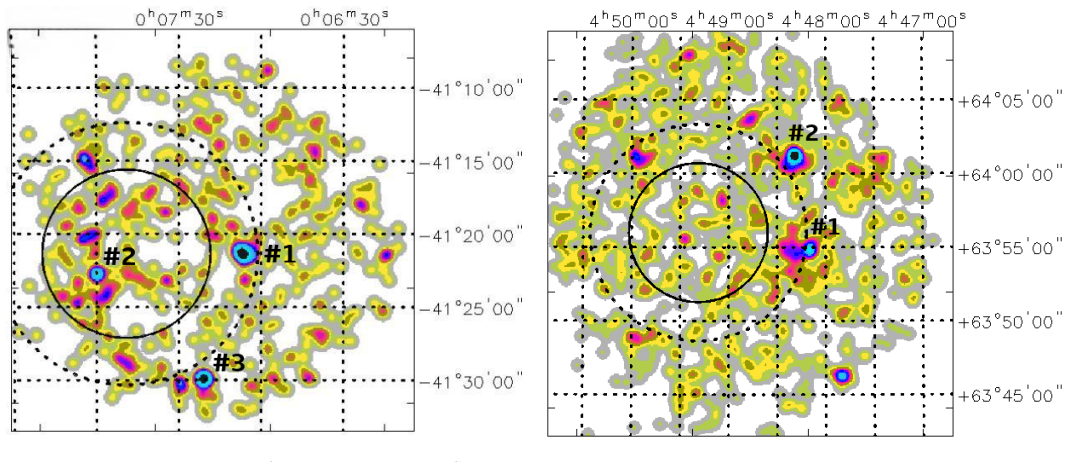
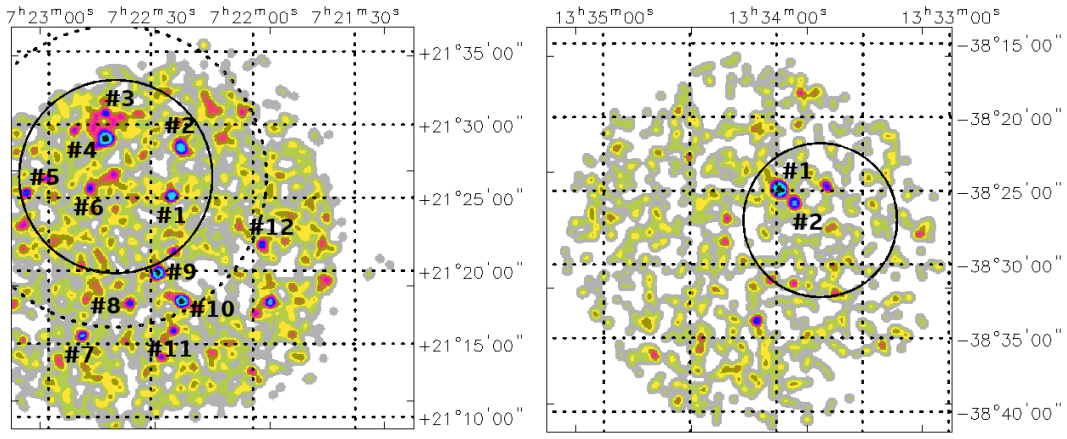
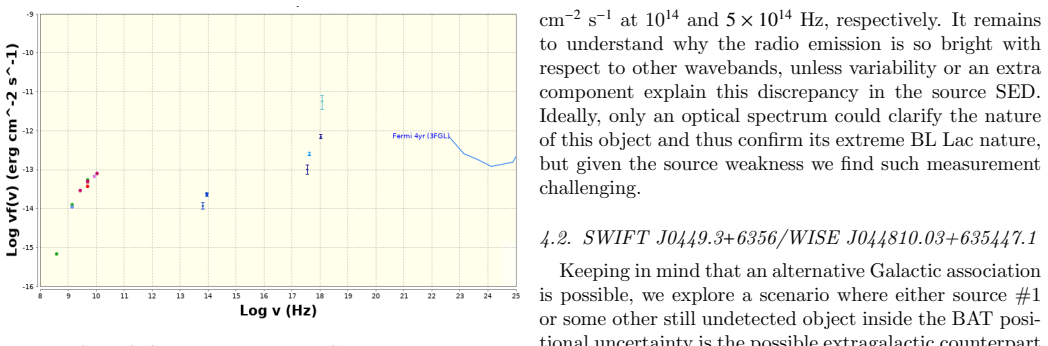
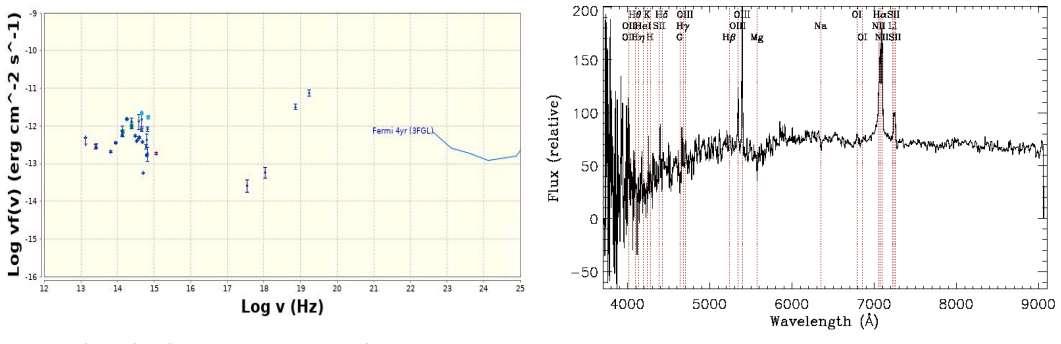
We explore the possible existence of a new population of BL Lacs, called ultra extreme high-energy-peaked BL Lacs (UEHBLs), whose synchrotron emission component peaks in the MeV band. In particular, we analysed Swift/XRT follow-up observations of a set of 10 hard X-ray sources from the Swift/BAT catalogues which were suggested to represent the first observational hints of this new blazar population on the basis of their spectral properties. We find that 6 of these candidate UEHBLs can be classified as line-emitting active galactic nuclei (AGNs), 4 of which are of type 2 and X-ray absorbed objects, while 2 are type 1 AGN and X-ray unabsorbed sources. In one more case, we find that the hard X-ray emission is probably the contribution of two line-emitting AGN, i.e. a Seyfert of type 1.9 and another of type 2. All these 7 classifications exclude the possibility that these hard X-ray sources are extreme BL Lacs. Of the remaining 3 UEHBL candidates, only 2 objects are found to have a spectral energy distribution (SED) compatible with those expected by MeV-peaked BL Lacs: however, in one of these 2 cases, an alternative Galactic association is also possible. The third source is instead likely associated with a more classical quasi-stellar object. Overall, we find that UEHBLs are extremely rare to find and probably very difficult to classify. Nevertheless, they represent a viable alternative classification for hard X-ray sources displaying no obvious or very weak counterparts.
Editorial analysis
A structured set of objections, weighed in public.
Referee Report
Summary. The paper explores the existence of ultra extreme high-energy-peaked BL Lacs (UEHBLs) with synchrotron peaks in the MeV band by analyzing Swift/XRT follow-up observations of 10 hard X-ray sources from Swift/BAT catalogs that were previously suggested as candidates based on their spectral properties. The analysis classifies 7 sources as line-emitting AGNs (4 type 2 absorbed, 2 type 1 unabsorbed, and 1 possibly two AGNs), excludes them as UEHBLs, and finds that only 2 of the remaining 3 have SEDs compatible with MeV-peaked BL Lacs (with one having a possible Galactic association), leading to the conclusion that UEHBLs are extremely rare and difficult to classify, though they remain a viable alternative for hard X-ray sources with no obvious counterparts.
Significance. If the classifications and selection hold, the result would indicate that UEHBLs are both rare in the population and challenging to identify via hard X-ray selection, with implications for blazar demographics and survey strategies. The work supplies concrete follow-up data on a set of candidates and illustrates common alternative classifications for such sources.
major comments (2)
- [Sample selection] The 10 sources were pre-selected from BAT catalogs as potential UEHBLs based on hard X-ray spectral properties, but the manuscript does not quantitatively validate that these criteria efficiently select for objects with synchrotron peaks above ~10^20 Hz or assess completeness and contamination rates; without this, the low yield of 2 compatible sources does not robustly support the claim of extreme rarity.
- [XRT observations and analysis] The abstract and results report classifications from XRT data (e.g., line-emitting AGNs, absorbed vs unabsorbed) but provide no details on the analysis methods, spectral fitting procedures, error handling, or exact criteria used to distinguish these from BL Lacs; these steps are load-bearing for excluding 7 sources as UEHBL candidates.
minor comments (1)
- Consider adding a table summarizing the classifications and key XRT parameters for the 10 sources to improve clarity.
Simulated Author's Rebuttal
We thank the referee for their constructive comments. We respond point-by-point to the major comments below.
read point-by-point responses
-
Referee: [Sample selection] The 10 sources were pre-selected from BAT catalogs as potential UEHBLs based on hard X-ray spectral properties, but the manuscript does not quantitatively validate that these criteria efficiently select for objects with synchrotron peaks above ~10^20 Hz or assess completeness and contamination rates; without this, the low yield of 2 compatible sources does not robustly support the claim of extreme rarity.
Authors: The 10 sources represent the complete set of candidates previously suggested in the literature as potential UEHBLs on the basis of their BAT spectral properties. This manuscript reports targeted XRT follow-up and SED analysis of those specific objects rather than a new selection or statistical survey. We agree that a quantitative assessment of selection efficiency, completeness, and contamination would require a larger parent sample and is outside the scope of the present work. In revision we have clarified the targeted nature of the study, softened the language around 'extreme rarity' to 'appear rare among the best current candidates', and added discussion of the implications for future selection strategies. revision: partial
-
Referee: [XRT observations and analysis] The abstract and results report classifications from XRT data (e.g., line-emitting AGNs, absorbed vs unabsorbed) but provide no details on the analysis methods, spectral fitting procedures, error handling, or exact criteria used to distinguish these from BL Lacs; these steps are load-bearing for excluding 7 sources as UEHBL candidates.
Authors: We acknowledge the omission. The revised manuscript will include an expanded methods section describing the Swift/XRT data reduction pipeline, spectral extraction, XSPEC fitting (absorbed power-law and additional components), error treatment, and the explicit criteria (presence/absence of emission lines, measured N_H, comparison with BL Lac template SEDs) used to classify sources as AGNs versus BL Lac candidates. revision: yes
Circularity Check
No circularity: direct observational classification with independent follow-up data
full rationale
The paper performs XRT follow-up spectroscopy and SED classification on 10 pre-selected BAT sources to test whether they match UEHBL expectations. No equations, fitted parameters, or derivations are present. The rarity conclusion follows from the observed classification yield (only 2/10 compatible) rather than any self-referential mapping or self-citation chain that reduces the result to its inputs by construction. The pre-selection is external (prior catalog suggestions) and the new data provide an independent test; no load-bearing step collapses to a fit or renamed input.
Axiom & Free-Parameter Ledger
axioms (1)
- standard math Standard assumptions in X-ray astronomy for source classification and SED construction from multi-wavelength data
Reference graph
Works this paper leans on
-
[1]
Ultra-extreme high-frequency-peaked BL Lacs: A potential population of MeV synchrotron blazars
Ultra extreme high-frequency-peaked BL Lacs: a potential population of MeV synchrotron blazars?. arXiv e-prints , keywords =. doi:10.48550/arXiv.2511.09420 , archivePrefix =. 2511.09420 , primaryClass =
work page internal anchor Pith review Pith/arXiv arXiv doi:10.48550/arxiv.2511.09420
-
[2]
doi:10.1007/s11214-005-5097-2 , eprint =
The Swift X-Ray Telescope. , keywords =. doi:10.1007/s11214-005-5097-2 , archivePrefix =. astro-ph/0508071 , primaryClass =
work page internal anchor Pith review Pith/arXiv arXiv doi:10.1007/s11214-005-5097-2
-
[3]
APS April Meeting Abstracts , year = 2004, series =
The Swift X-ray Telescope. APS April Meeting Abstracts , year = 2004, series =
2004
-
[4]
Astronomical Data Analysis Software and Systems V , year = 1996, editor =
XSPEC: The First Ten Years. Astronomical Data Analysis Software and Systems V , year = 1996, editor =
1996
-
[5]
Extra-Planar Gas , year = 2005, editor =
Extra-planar Gas in the Leiden/Argentine/Bonn HI Survey. Extra-Planar Gas , year = 2005, editor =
2005
-
[6]
The Swift Gamma-Ray Burst Mission
The Swift Gamma-Ray Burst Mission. , keywords =. doi:10.1086/422091 , archivePrefix =. astro-ph/0405233 , primaryClass =
work page internal anchor Pith review Pith/arXiv arXiv doi:10.1086/422091
-
[7]
arXiv , author =:2506.04109 , journal =
The 157 Month Swift/BAT All-sky Hard X-Ray Survey. , keywords =. doi:10.3847/1538-4357/ade676 , archivePrefix =. 2506.04109 , primaryClass =
-
[8]
1979, ApJ, 228, 939, doi: 10.1086/156922
Parameter estimation in astronomy through application of the likelihood ratio. , keywords =. doi:10.1086/156922 , adsurl =
-
[9]
The Parkes quarter-Jansky flat-spectrum sample. 2. New optical spectra and redshift measurements. , keywords =. doi:10.1051/0004-6361:20021803 , archivePrefix =. astro-ph/0212386 , primaryClass =
work page internal anchor Pith review Pith/arXiv arXiv doi:10.1051/0004-6361:20021803
-
[10]
Estimating Distances from Parallaxes. V. Geometric and Photogeometric Distances to 1.47 Billion Stars in Gaia Early Data Release 3. , keywords =. doi:10.3847/1538-3881/abd806 , archivePrefix =. 2012.05220 , primaryClass =
work page internal anchor Pith review Pith/arXiv arXiv doi:10.3847/1538-3881/abd806 2012
-
[11]
All-purpose, all-sky photometric redshifts for the Legacy Imaging Surveys Data Release 8. , keywords =. doi:10.1093/mnras/stac608 , archivePrefix =. 2203.01949 , primaryClass =
-
[12]
The VSOP 5 GHz Active Galactic Nucleus Survey. V. Imaging Results for the Remaining 140 Sources. , keywords =. doi:10.1086/525025 , archivePrefix =. 0710.5707 , primaryClass =
work page internal anchor Pith review Pith/arXiv arXiv doi:10.1086/525025
-
[13]
A multi-epoch VLBI survey of the kinematics of CJF sources. I. Model-fit parameters and maps. , keywords =. doi:10.1051/0004-6361:20052677 , archivePrefix =. 0802.4182 , primaryClass =
work page internal anchor Pith review Pith/arXiv arXiv doi:10.1051/0004-6361:20052677
-
[14]
Gigahertz Peaked Spectrum sources from the Jodrell Bank-VLA Astrometric Survey. I. Sources in the region 35degr <= delta <= 75degr. , keywords =. doi:10.1051/aas:1999450 , archivePrefix =. astro-ph/9811128 , primaryClass =
work page internal anchor Pith review Pith/arXiv arXiv doi:10.1051/aas:1999450
-
[15]
Connecting radio variability to the characteristics of gamma-ray blazars
Connecting radio variability to the characteristics of gamma-ray blazars. , keywords =. doi:10.1093/mnras/stt2412 , archivePrefix =. 1312.3634 , primaryClass =
work page internal anchor Pith review Pith/arXiv arXiv doi:10.1093/mnras/stt2412
-
[16]
Bimodal radio variability in OVRO-40m-monitored blazars
Bimodal radio variability in OVRO-40 m-monitored blazars. , keywords =. doi:10.1093/mnras/stx432 , archivePrefix =. 1702.05493 , primaryClass =
work page internal anchor Pith review Pith/arXiv arXiv doi:10.1093/mnras/stx432
-
[17]
CGRaBS: An All-Sky Survey of Gamma-Ray Blazar Candidates
CGRaBS: An All-Sky Survey of Gamma-Ray Blazar Candidates. , keywords =. doi:10.1086/523302 , archivePrefix =. 0709.1735 , primaryClass =
work page internal anchor Pith review Pith/arXiv arXiv doi:10.1086/523302
-
[18]
Giant radio galaxies in the LOFAR Two-metre Sky Survey. I. Radio and environmental properties. , keywords =. doi:10.1051/0004-6361/201935589 , archivePrefix =. 1904.00409 , primaryClass =
-
[19]
A Compton thick AGN in the barred spiral NGC 4785
A Compton-thick AGN in the barred spiral galaxy NGC 4785. , keywords =. doi:10.1093/mnras/stv344 , archivePrefix =. 1408.4453 , primaryClass =
work page internal anchor Pith review Pith/arXiv arXiv doi:10.1093/mnras/stv344
-
[20]
Tripling the Census of Dwarf AGN Candidates Using DESI Early Data. , keywords =. doi:10.3847/1538-4357/adb1dd , archivePrefix =. 2411.00091 , primaryClass =
-
[21]
Radio sources in the 6dFGS: local luminosity functions at 1.4 GHz for star-forming galaxies and radio-loud AGN. , keywords =. doi:10.1111/j.1365-2966.2006.11353.x , archivePrefix =. astro-ph/0612018 , primaryClass =
-
[22]
Photometric classification of emission line galaxies with Machine Learning methods
Photometric classification of emission line galaxies with machine-learning methods. , keywords =. doi:10.1093/mnras/stt1961 , archivePrefix =. 1310.2840 , primaryClass =
work page internal anchor Pith review Pith/arXiv arXiv doi:10.1093/mnras/stt1961
-
[23]
Part I - RA 0h to 6h
The 80th Name-List of Variable Stars. Part I - RA 0h to 6h. Information Bulletin on Variable Stars , keywords =
-
[24]
Spectral classification and composites of galaxies in LAMOST DR4
Spectral classification and composites of galaxies in LAMOST DR4. , keywords =. doi:10.1093/mnras/stx2798 , archivePrefix =. 1710.10611 , primaryClass =
work page internal anchor Pith review Pith/arXiv arXiv doi:10.1093/mnras/stx2798
-
[25]
BASS. XXII. The BASS DR2 AGN Catalog and Data. , keywords =. doi:10.3847/1538-4365/ac6c05 , archivePrefix =. 2207.12432 , primaryClass =
-
[26]
Disentangling cataclysmic variables in Gaia's HR diagram. , keywords =. doi:10.1093/mnrasl/slz181 , archivePrefix =. 1912.01531 , primaryClass =
-
[27]
The Wide-field Infrared Survey Explorer (WISE): Mission Description and Initial On-orbit Performance
The Wide-field Infrared Survey Explorer (WISE): Mission Description and Initial On-orbit Performance. , keywords =. doi:10.1088/0004-6256/140/6/1868 , archivePrefix =. 1008.0031 , primaryClass =
work page internal anchor Pith review Pith/arXiv arXiv doi:10.1088/0004-6256/140/6/1868
-
[28]
The Last of FIRST: The Final Catalog and Source Identifications
The Last of FIRST: The Final Catalog and Source Identifications. , keywords =. doi:10.1088/0004-637X/801/1/26 , archivePrefix =. 1501.01555 , primaryClass =
work page internal anchor Pith review Pith/arXiv arXiv doi:10.1088/0004-637x/801/1/26
-
[29]
LOFAR: The LOw-Frequency ARray
LOFAR: The LOw-Frequency ARray. , keywords =. doi:10.1051/0004-6361/201220873 , archivePrefix =. 1305.3550 , primaryClass =
work page internal anchor Pith review Pith/arXiv arXiv doi:10.1051/0004-6361/201220873
-
[30]
Reliable Identifications of AGN from the WISE, 2MASS and Rosat all-sky surveys
Reliable Identifications of Active Galactic Nuclei from the WISE, 2MASS, and ROSAT All-Sky Surveys. , keywords =. doi:10.1088/0004-637X/751/1/52 , archivePrefix =. 1203.1942 , primaryClass =
work page internal anchor Pith review Pith/arXiv arXiv doi:10.1088/0004-637x/751/1/52 1942
-
[31]
, archivePrefix = "arXiv", eprint =
The Imperial IRAS-FSC Redshift Catalogue. , keywords =. doi:10.1111/j.1365-2966.2009.15138.x , archivePrefix =. 0809.2016 , primaryClass =
-
[32]
A kinematic classification for early-type galaxies
Near-infrared spectra of Seyfert galaxies and line production mechanisms. , keywords =. doi:10.1111/j.1365-2966.2007.11467.x , archivePrefix =. astro-ph/0701384 , primaryClass =
-
[33]
Pan-STARRS Photometric and Astrometric Calibration. , keywords =. doi:10.3847/1538-4365/abb82a , archivePrefix =. 1612.05242 , primaryClass =
-
[34]
A Quick Look at the 3 GHz Radio Sky. I. Source Statistics from the Very Large Array Sky Survey. , keywords =. doi:10.3847/1538-4365/ac05c0 , archivePrefix =. 2102.11753 , primaryClass =
-
[35]
The Infrared Luminosity Function of AKARI 90$\mu$m Galaxies in the Local Universe
The infrared luminosity function of AKARI 90 m galaxies in the local Universe. , keywords =. doi:10.1093/mnras/stx3110 , archivePrefix =. 1712.01876 , primaryClass =
work page internal anchor Pith review Pith/arXiv arXiv doi:10.1093/mnras/stx3110
-
[36]
The Rapid ASKAP Continuum Survey V: Cataloguing the sky at 1 367.5 MHz and the second data release of RACS-mid. , keywords =. doi:10.1017/pasa.2023.60 , archivePrefix =. 2311.12369 , primaryClass =
-
[37]
The Rapid ASKAP Continuum Survey (RACS) VI: The RACS-high 1655.5 MHz images and catalogue. , keywords =. doi:10.1017/pasa.2025.2 , archivePrefix =. 2501.04978 , primaryClass =
-
[38]
The Karl G. Jansky Very Large Array Sky Survey (VLASS). Science Case and Survey Design. , keywords =. doi:10.1088/1538-3873/ab63eb , archivePrefix =. 1907.01981 , primaryClass =
-
[39]
Research in Astronomy and Astrophysics , year = 2012, month = sep, volume =
The Large Sky Area Multi-Object Fiber Spectroscopic Telescope (LAMOST). Research in Astronomy and Astrophysics , year = 2012, month = sep, volume =. doi:10.1088/1674-4527/12/9/003 , adsurl =
-
[40]
Sloan Digital Sky Survey IV: Mapping the Milky Way, Nearby Galaxies, and the Distant Universe
Sloan Digital Sky Survey IV: Mapping the Milky Way, Nearby Galaxies, and the Distant Universe. , keywords =. doi:10.3847/1538-3881/aa7567 , archivePrefix =. 1703.00052 , primaryClass =
work page internal anchor Pith review Pith/arXiv arXiv doi:10.3847/1538-3881/aa7567
-
[41]
From Active Stars to Black Holes: A Discovery Tool for Galactic X-Ray Sources. , keywords =. doi:10.1088/1538-3873/ad357c , archivePrefix =. 2401.09537 , primaryClass =
-
[42]
The LOFAR Two-metre Sky Survey: VII. Third Data Release. , keywords =. doi:10.1051/0004-6361/202557749 , archivePrefix =. 2602.15949 , primaryClass =
-
[43]
A Uniformly Selected, All-Sky, Optical AGN Catalog
A Uniformly Selected, All-sky, Optical AGN Catalog. , keywords =. doi:10.3847/1538-4357/aaffaf , archivePrefix =. 1902.03799 , primaryClass =
work page internal anchor Pith review Pith/arXiv arXiv doi:10.3847/1538-4357/aaffaf 1902
-
[44]
A Uniformly Selected, Southern-sky 6dF, Optical AGN Catalog. , keywords =. doi:10.3847/1538-4365/ac4157 , archivePrefix =. 2111.13217 , primaryClass =
-
[45]
WISE-PS1-STRM: neural network source classification and photometric redshifts for WISE PS1. , keywords =. doi:10.1093/mnras/stac1714 , adsurl =
-
[46]
, keywords =
An Optical and Radio Survey of the Nuclei of Bright Galaxies - Activity in the Normal Galactic Nuclei. , keywords =
-
[47]
Radio Sources in the Nearby Universe
Radio Sources in the Nearby Universe. , keywords =. doi:10.3847/1538-4357/ab0301 , archivePrefix =. 1901.10046 , primaryClass =
work page internal anchor Pith review Pith/arXiv arXiv doi:10.3847/1538-4357/ab0301 1901
-
[48]
Two new catalogs of blazar candidates in the WISE infrared sky
Two New Catalogs of Blazar Candidates in the WISE Infrared Sky. , keywords =. doi:10.3847/1538-4365/ab16f4 , archivePrefix =. 1903.11124 , primaryClass =
work page internal anchor Pith review Pith/arXiv arXiv doi:10.3847/1538-4365/ab16f4 1903
-
[49]
, archivePrefix = "arXiv", eprint =
The 6dF Galaxy Survey: final redshift release (DR3) and southern large-scale structures. , keywords =. doi:10.1111/j.1365-2966.2009.15338.x , archivePrefix =. 0903.5451 , primaryClass =
-
[50]
The Early Data Release of the Dark Energy Spectroscopic Instrument. , keywords =. doi:10.3847/1538-3881/ad3217 , archivePrefix =. 2306.06308 , primaryClass =
-
[51]
Classification parameters for the emission-line spectra of extragalactic objects. , keywords =. doi:10.1086/130766 , adsurl =
-
[52]
Using the ROSAT Catalogues to find counterparts for the second IBIS/ISGRI Survey Sources
Using the ROSAT catalogues to find counterparts for the second IBIS/ISGRI survey sources. , keywords =. doi:10.1051/0004-6361:20053958 , archivePrefix =. astro-ph/0509620 , primaryClass =
work page internal anchor Pith review Pith/arXiv arXiv doi:10.1051/0004-6361:20053958
-
[53]
arXiv , author =:2201.11184 , journal =
Incremental Fermi Large Area Telescope Fourth Source Catalog. , keywords =. doi:10.3847/1538-4365/ac6751 , archivePrefix =. 2201.11184 , primaryClass =
-
[54]
Unveiling Obscured Accretion in the Local Universe. , keywords =. doi:10.3847/1538-4357/ae3953 , archivePrefix =. 2509.21532 , primaryClass =
-
[55]
BASS. XXXV. The M _ BH - * Relation of 105 Month Swift-BAT Type 1 AGNs. , keywords =. doi:10.3847/1538-4357/acf11b , archivePrefix =. 2308.01800 , primaryClass =
-
[56]
X-ray absorption in INTEGRAL active galactic nuclei. Host galaxy inclination. , keywords =. doi:10.1051/0004-6361/202038014 , archivePrefix =. 2005.01028 , primaryClass =
-
[57]
Extreme synchrotron BL Lac objects
Extreme synchrotron BL Lac objects. Stretching the blazar sequence. , keywords =. doi:10.1051/0004-6361:20010412 , archivePrefix =. astro-ph/0103343 , primaryClass =
work page internal anchor Pith review Pith/arXiv arXiv doi:10.1051/0004-6361:20010412
-
[58]
Progress in unveiling extreme particle acceleration in persistent astrophysical jets. Nature Astronomy , keywords =. doi:10.1038/s41550-019-0988-4 , archivePrefix =. 2001.09222 , primaryClass =
-
[59]
Unraveling the Complex Behavior of Mrk 421 with Simultaneous X-Ray and VHE Observations during an Extreme Flaring Activity in 2013 April. , keywords =. doi:10.3847/1538-4365/ab89b5 , archivePrefix =. 2001.08678 , primaryClass =
-
[60]
Multi-year characterisation of the broad-band emission from the intermittent extreme BL Lac 1ES 2344+514. , keywords =. doi:10.1051/0004-6361/202347845 , archivePrefix =. 2310.03922 , primaryClass =
-
[61]
The Burst Alert Telescope (BAT) on the Swift MIDEX Mission
The Burst Alert Telescope (BAT) on the SWIFT Midex Mission. , keywords =. doi:10.1007/s11214-005-5096-3 , archivePrefix =. astro-ph/0507410 , primaryClass =
work page internal anchor Pith review Pith/arXiv arXiv doi:10.1007/s11214-005-5096-3
-
[62]
IBIS: The Imager on-board INTEGRAL. , keywords =. doi:10.1051/0004-6361:20031224 , adsurl =
-
[63]
Astroparticle Physics , year = 2019, volume = 111, pages =
Science with the Cherenkov Telescope Array. Astroparticle Physics , year = 2019, volume = 111, pages =
2019
-
[64]
2015, , 579, A101
Aladro, R., Martín, S., Riquelme, D., et al. 2015, , 579, A101
2015
discussion (0)
Sign in with ORCID, Apple, or X to comment. Anyone can read and Pith papers without signing in.