Domain-Informed Multi-View Self-Distillation for Astronomical Light-Curve Representation Learning with JEPA
Pith reviewed 2026-06-30 01:27 UTC · model grok-4.3
The pith
Domain-informed multi-view self-distillation with JEPA produces superior representations for irregular astronomical light curves.
A machine-rendered reading of the paper's core claim, the machinery that carries it, and where it could break.
Core claim
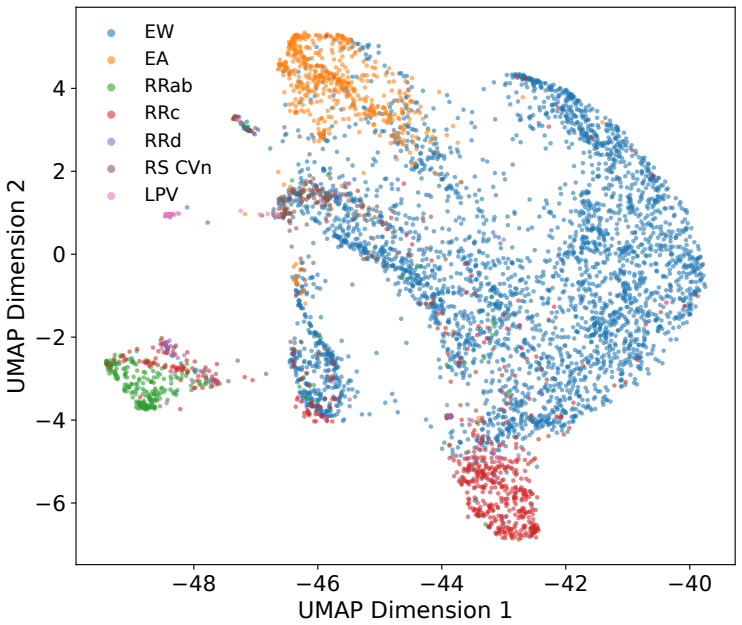
The central claim is that a JEPA-based encoder trained with domain-informed multi-view self-distillation learns representations that outperform hand-crafted features on StarEmbed classification and support downstream tasks such as similarity search, parameter estimation, and drift detection, while an adapted version matches or exceeds previous best results on five of twelve heterogeneous irregular time-series datasets from PYRREGULAR.
What carries the argument
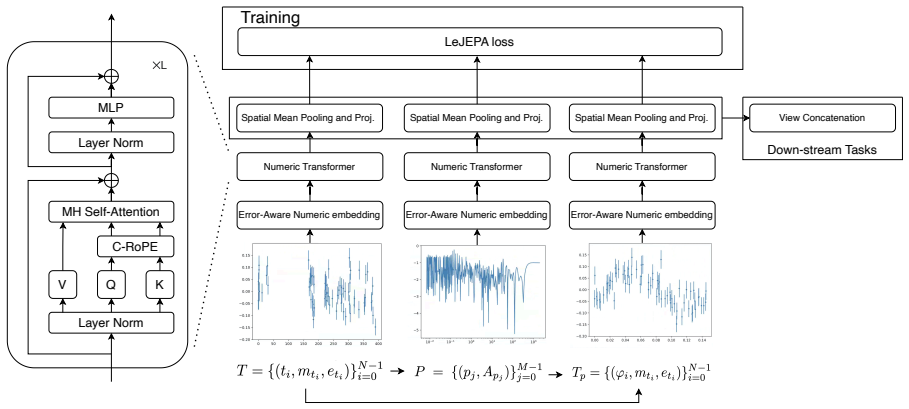
Joint-Embedding Predictive Architecture (JEPA) trained with multi-view self-distillation, semantics-preserving views, uncertainty-aware tokenization, and LeJEPA regularization
If this is right
- The learned representations improve few-shot linear probing macro-F1 to 42.56 with one sample per class and 63.58 with 100 samples per class on StarEmbed.
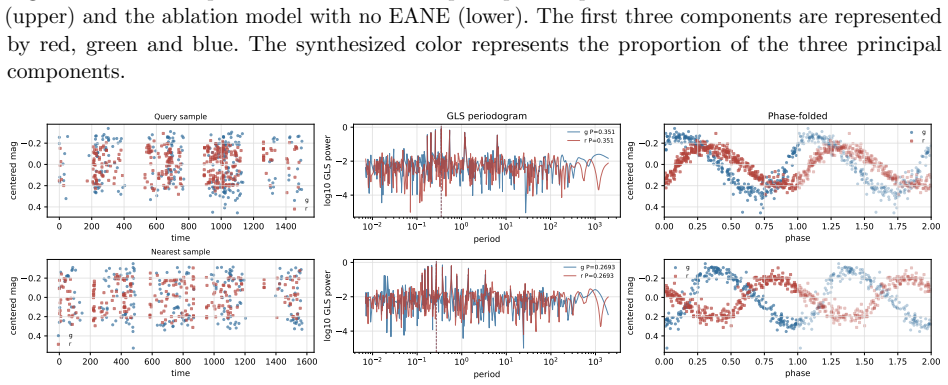
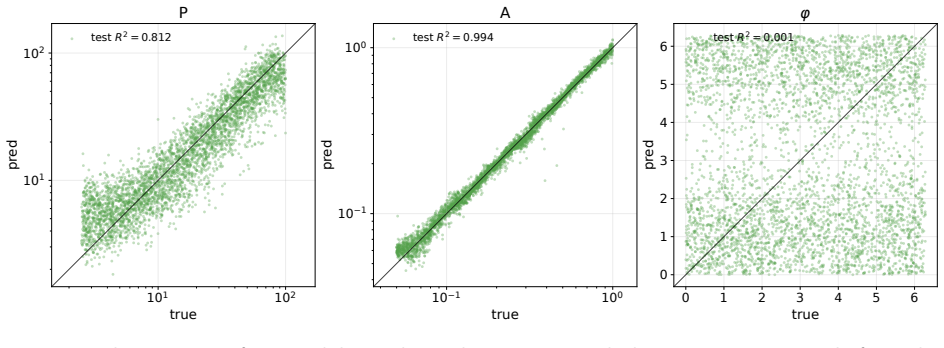
- The representations support similarity search, parameter estimation, and photometric zero-point drift detection in addition to classification.
- An adapted variant matches or exceeds prior state-of-the-art on five of twelve PYRREGULAR datasets while no single baseline wins on more than three.
- Domain-specific inductive biases are required for effective time-series representation learning rather than a universally optimal architecture.
Where Pith is reading between the lines
- The same view-generation and tokenization strategy could be tested on other scientific domains that produce irregularly sampled time series, such as particle physics or climate monitoring.
- If the representations encode physical timescales reliably, they might improve rare-event detection in upcoming wide-field surveys without task-specific retraining.
- The performance gap between the domain-informed model and general baselines suggests that future time-series foundation models may need modular domain adapters rather than single monolithic architectures.
Load-bearing premise
The chosen semantics-preserving views and uncertainty-aware tokenization preserve physically meaningful information without introducing domain-specific biases that would not generalize beyond the LEAVES training set and StarEmbed benchmark.
What would settle it
On a held-out astronomical light-curve dataset not seen during training or adaptation, the model fails to outperform hand-crafted features on a majority of classification metrics while other baselines succeed.
Figures
read the original abstract
Light curves describe temporal variations in the brightness of celestial objects. Learning robust representations of light curves is essential for large-scale automatic discovery in the dynamic universe, but existing time-series foundation models often struggle with the uneven sampling, complex noise, and wide range of physical timescales that characterize astronomical observations. We propose a domain-informed representation learning framework for irregular astronomical time series with Joint-Embedding predictive architecture (JEPA), combining semantics-preserving views, uncertainty-aware tokenization, and multi-view self-distillation. The encoders are trained with multi-view self-distillation using LeJEPA regularization on the LEAVES dataset and evaluated on the StarEmbed classification benchmark. On StarEmbed, our model outperforms hand-crafted features on 15 of 16 classification metrics. In few-shot linear probing, it achieves macro-F1 scores of 42.56 $\pm$ 7.21 with one sample per class and 63.58 $\pm$ 1.20 with 100 samples per class, consistently improving over hand-crafted features. Beyond variable-star classification, the learned representation supports similarity search, parameter estimation, and photometric zero-point drift detection. We further evaluate cross-domain adaptation on 12 heterogeneous irregular time-series datasets from PYRREGULAR, where the adapted variant matches or exceeds previous state-of-the-art performance on 5 datasets, compared with at most 3 wins by any single prior baseline. These results demonstrate that domain-informed multi-view self-distillation is an effective strategy for learning representations of irregular time series, while also highlighting that successful time-series representation learning requires domain-specific inductive biases rather than a universally optimal architecture.
Editorial analysis
A structured set of objections, weighed in public.
Referee Report
Summary. The paper proposes a domain-informed JEPA framework for irregular astronomical light-curve representation learning that combines semantics-preserving views, uncertainty-aware tokenization, and multi-view self-distillation. Trained on the LEAVES dataset, the model is evaluated on the StarEmbed classification benchmark (outperforming hand-crafted features on 15 of 16 metrics, with few-shot macro-F1 of 42.56 ± 7.21 at 1 sample/class and 63.58 ± 1.20 at 100 samples/class) and shows competitive cross-domain adaptation on 5 of 12 PYRREGULAR datasets.
Significance. If the empirical gains hold after proper controls, the work provides evidence that domain-specific inductive biases can improve self-supervised representations for unevenly sampled astronomical time series, supporting downstream tasks such as variable-star classification, similarity search, and drift detection. The reporting of concrete few-shot metrics with error bars is a positive aspect.
major comments (2)
- [Abstract and Methods] The central claim that domain-informed components (semantics-preserving views and uncertainty-aware tokenization) are responsible for the reported gains on StarEmbed and PYRREGULAR rests on an untested assumption; the manuscript provides no ablation that isolates their contribution from standard JEPA training or from post-hoc choices in view generation/tokenization rules. This is load-bearing for the headline results (15/16 metrics, 5/12 wins) because the training set (LEAVES) and primary benchmarks share similar cadence/noise properties, leaving open the possibility that gains arise from benchmark-specific artifacts rather than portable physical semantics.
- [Experimental Setup] No details are supplied on the training procedure, hyperparameter selection protocol, or any post-hoc data exclusions. Without these, the soundness of the few-shot linear-probing numbers (e.g., 42.56 ± 7.21) cannot be verified and the comparison to hand-crafted features is difficult to interpret.
minor comments (1)
- [Method] Notation for the multi-view self-distillation loss and LeJEPA regularization is introduced without an explicit equation reference, making it hard to trace how the uncertainty-aware tokenization enters the objective.
Simulated Author's Rebuttal
We thank the referee for the constructive feedback and for highlighting both the strengths and areas needing clarification in our work. We address each major comment below and commit to revisions that enhance the manuscript's rigor and reproducibility.
read point-by-point responses
-
Referee: [Abstract and Methods] The central claim that domain-informed components (semantics-preserving views and uncertainty-aware tokenization) are responsible for the reported gains on StarEmbed and PYRREGULAR rests on an untested assumption; the manuscript provides no ablation that isolates their contribution from standard JEPA training or from post-hoc choices in view generation/tokenization rules. This is load-bearing for the headline results (15/16 metrics, 5/12 wins) because the training set (LEAVES) and primary benchmarks share similar cadence/noise properties, leaving open the possibility that gains arise from benchmark-specific artifacts rather than portable physical semantics.
Authors: We agree that the absence of ablations isolating the domain-informed components constitutes a genuine limitation in the current manuscript, as the headline claims rely on the contribution of these elements. We will add a new ablation subsection in the revised Methods and Experiments that systematically compares the full model against (i) a standard JEPA baseline without domain-informed views or tokenization, (ii) a variant omitting semantics-preserving views, and (iii) a variant omitting uncertainty-aware tokenization. Results will be reported on StarEmbed using the same few-shot linear-probing protocol to directly test whether the observed gains (15/16 metrics) are attributable to the domain-specific inductive biases. revision: yes
-
Referee: [Experimental Setup] No details are supplied on the training procedure, hyperparameter selection protocol, or any post-hoc data exclusions. Without these, the soundness of the few-shot linear-probing numbers (e.g., 42.56 ± 7.21) cannot be verified and the comparison to hand-crafted features is difficult to interpret.
Authors: We acknowledge that the manuscript omits critical details on the training procedure, hyperparameter selection, and data handling, which limits independent verification of the reported metrics. In the revised version we will insert a dedicated Experimental Setup subsection that specifies the full training protocol (optimizer, learning-rate schedule, batch size, number of epochs), the hyperparameter search strategy (grid or random search ranges, validation criterion, and final selected values), and any post-hoc data exclusions or filtering rules applied to LEAVES and the evaluation benchmarks. This will also clarify how the hand-crafted feature baselines were computed for fair comparison. revision: yes
Circularity Check
No circularity in derivation chain; results are empirical benchmark comparisons
full rationale
The paper describes an empirical representation learning method (domain-informed JEPA with multi-view self-distillation, semantics-preserving views, and uncertainty-aware tokenization) trained on LEAVES and evaluated via linear probing and classification metrics on StarEmbed and PYRREGULAR. No equations, derivations, or self-citations are shown that reduce the reported F1 scores or outperformance claims to fitted inputs or definitions by construction. The method choices are presented as design decisions whose value is tested experimentally rather than assumed tautologically. This is the common case of a self-contained empirical ML paper with no load-bearing self-referential steps.
Axiom & Free-Parameter Ledger
Reference graph
Works this paper leans on
-
[1]
Langley , title =
P. Langley , title =. Proceedings of the 17th International Conference on Machine Learning (ICML 2000) , address =. 2000 , pages =
2000
-
[2]
T. M. Mitchell. The Need for Biases in Learning Generalizations. 1980
1980
-
[3]
M. J. Kearns , title =
-
[4]
Machine Learning: An Artificial Intelligence Approach, Vol. I. 1983
1983
-
[5]
R. O. Duda and P. E. Hart and D. G. Stork. Pattern Classification. 2000
2000
-
[6]
Suppressed for Anonymity , author=
-
[7]
Newell and P
A. Newell and P. S. Rosenbloom. Mechanisms of Skill Acquisition and the Law of Practice. Cognitive Skills and Their Acquisition. 1981
1981
-
[8]
A. L. Samuel. Some Studies in Machine Learning Using the Game of Checkers. IBM Journal of Research and Development. 1959
1959
-
[9]
LSST: from Science Drivers to Reference Design and Anticipated Data Products
LSST: From Science Drivers to Reference Design and Anticipated Data Products. , keywords =. doi:10.3847/1538-4357/ab042c , archivePrefix =. 0805.2366 , primaryClass =
work page internal anchor Pith review Pith/arXiv arXiv doi:10.3847/1538-4357/ab042c
-
[10]
Acta Astronomica Sinica , keywords =
Tianyu-Search for the Second Solar System and Explore the Dynamic Universe. Acta Astronomica Sinica , keywords =. doi:10.15940/j.cnki.0001-5245.2024.04.001 , archivePrefix =. 2404.07149 , primaryClass =
-
[11]
Architecture of the Tianyu Software: Relative Photometry as a Case Study. , keywords =. doi:10.1088/1538-3873/add6d9 , archivePrefix =. 2505.09107 , primaryClass =
-
[12]
The Zwicky Transient Facility: System Overview, Performance, and First Results
The Zwicky Transient Facility: System Overview, Performance, and First Results. , keywords =. doi:10.1088/1538-3873/aaecbe , archivePrefix =. 1902.01932 , primaryClass =
work page internal anchor Pith review Pith/arXiv arXiv doi:10.1088/1538-3873/aaecbe 1902
-
[13]
The GPU phase folding and deep learning method for detecting exoplanet transits. , keywords =. doi:10.1093/mnras/stae245 , archivePrefix =. 2312.02063 , primaryClass =
-
[14]
Implementation and Applications on Kepler Data
FALCO: Foundation Model of Astronomical Light Curves for Time Domain Astronomy. Implementation and Applications on Kepler Data. , keywords =. doi:10.3847/1538-3881/ae1467 , archivePrefix =. 2504.20290 , primaryClass =
-
[15]
Kepler Planet-Detection Mission: Introduction and First Results. Science , keywords =. doi:10.1126/science.1185402 , adsurl =
-
[16]
Journal of Astronomical Telescopes, Instruments, and Systems , year = 2015, month = jan, volume =
Transiting Exoplanet Survey Satellite (TESS). Space Telescopes and Instrumentation 2014: Optical, Infrared, and Millimeter Wave , year = 2014, editor =. doi:10.1117/12.2063489 , archivePrefix =. 1406.0151 , primaryClass =
work page internal anchor Pith review Pith/arXiv arXiv doi:10.1117/12.2063489 2014
-
[17]
TimeDART: A Diffusion Autoregressive Transformer for Self-Supervised Time Series Representation. arXiv e-prints , keywords =. doi:10.48550/arXiv.2410.05711 , archivePrefix =. 2410.05711 , primaryClass =
-
[18]
StarEmbed: Benchmarking Time Series Foundation Models on Astronomical Observations of Variable Stars. arXiv e-prints , keywords =. doi:10.48550/arXiv.2510.06200 , archivePrefix =. 2510.06200 , primaryClass =
-
[19]
RoFormer: Enhanced Transformer with Rotary Position Embedding
RoFormer: Enhanced Transformer with Rotary Position Embedding. arXiv e-prints , keywords =. doi:10.48550/arXiv.2104.09864 , archivePrefix =. 2104.09864 , primaryClass =
work page internal anchor Pith review Pith/arXiv arXiv doi:10.48550/arxiv.2104.09864
-
[20]
LeJEPA: Provable and Scalable Self-Supervised Learning Without the Heuristics
LeJEPA: Provable and Scalable Self-Supervised Learning Without the Heuristics. arXiv e-prints , keywords =. doi:10.48550/arXiv.2511.08544 , archivePrefix =. 2511.08544 , primaryClass =
work page internal anchor Pith review Pith/arXiv arXiv doi:10.48550/arxiv.2511.08544
-
[21]
2022 , month = jun, note =
A Path Towards Autonomous Machine Intelligence , author =. 2022 , month = jun, note =
2022
-
[22]
Learning Transferable Visual Models From Natural Language Supervision
Learning Transferable Visual Models From Natural Language Supervision. arXiv e-prints , keywords =. doi:10.48550/arXiv.2103.00020 , archivePrefix =. 2103.00020 , primaryClass =
work page internal anchor Pith review Pith/arXiv arXiv doi:10.48550/arxiv.2103.00020
-
[23]
The generalised Lomb-Scargle periodogram. A new formalism for the floating-mean and Keplerian periodograms. , keywords =. doi:10.1051/0004-6361:200811296 , archivePrefix =. 0901.2573 , primaryClass =
work page internal anchor Pith review Pith/arXiv arXiv doi:10.1051/0004-6361:200811296
-
[24]
2019 , month = feb, howpublished =
Language Models are Unsupervised Multitask Learners , author =. 2019 , month = feb, howpublished =
2019
-
[25]
BERT: Pre-training of Deep Bidirectional Transformers for Language Understanding
BERT: Pre-training of Deep Bidirectional Transformers for Language Understanding. arXiv e-prints , keywords =. doi:10.48550/arXiv.1810.04805 , archivePrefix =. 1810.04805 , primaryClass =
work page internal anchor Pith review Pith/arXiv arXiv doi:10.48550/arxiv.1810.04805
-
[26]
An Image is Worth 16x16 Words: Transformers for Image Recognition at Scale
An Image is Worth 16x16 Words: Transformers for Image Recognition at Scale. arXiv e-prints , keywords =. doi:10.48550/arXiv.2010.11929 , archivePrefix =. 2010.11929 , primaryClass =
work page internal anchor Pith review Pith/arXiv arXiv doi:10.48550/arxiv.2010.11929 2010
-
[27]
The Catalina Surveys Periodic Variable Star Catalog
The Catalina Surveys Periodic Variable Star Catalog. , keywords =. doi:10.1088/0067-0049/213/1/9 , archivePrefix =. 1405.4290 , primaryClass =
work page internal anchor Pith review Pith/arXiv arXiv doi:10.1088/0067-0049/213/1/9
-
[28]
The MACHO Project: Microlensing Detection Efficiency
The MACHO Project: Microlensing Detection Efficiency. , keywords =. doi:10.1086/322529 , archivePrefix =. astro-ph/0003392 , primaryClass =
work page internal anchor Pith review Pith/arXiv arXiv doi:10.1086/322529
-
[29]
Physical Parameters of 11,100 Short-period ASAS-SN Eclipsing Contact Binaries. , keywords =. doi:10.3847/1538-4365/ad226a , archivePrefix =. 2401.15986 , primaryClass =
-
[30]
FATS: Feature Analysis for Time Series
FATS: Feature Analysis for Time Series. arXiv e-prints , keywords =. doi:10.48550/arXiv.1506.00010 , archivePrefix =. 1506.00010 , primaryClass =
work page internal anchor Pith review Pith/arXiv arXiv doi:10.48550/arxiv.1506.00010
-
[31]
Astromer 2. arXiv e-prints , keywords =. doi:10.48550/arXiv.2502.02717 , archivePrefix =. 2502.02717 , primaryClass =
-
[32]
The Astrophysical Journal Supplement Series , abstract =
Fei, Ya and Yu, Ce and Li, Kun and Chen, Xiaodian and Zhang, Yajie and Cui, Chenzhou and Xiao, Jian and Xu, Yunfei and Tao, Yihan , title =. The Astrophysical Journal Supplement Series , abstract =. 2024 , month =. doi:10.3847/1538-4365/ad785b , url =
-
[33]
Chronos: Learning the Language of Time Series
Chronos: Learning the Language of Time Series. arXiv e-prints , keywords =. doi:10.48550/arXiv.2403.07815 , archivePrefix =. 2403.07815 , primaryClass =
work page internal anchor Pith review Pith/arXiv arXiv doi:10.48550/arxiv.2403.07815
-
[34]
UMAP: Uniform Manifold Approximation and Projection for Dimension Reduction
UMAP: Uniform Manifold Approximation and Projection for Dimension Reduction. arXiv e-prints , keywords =. doi:10.48550/arXiv.1802.03426 , archivePrefix =. 1802.03426 , primaryClass =
work page internal anchor Pith review Pith/arXiv arXiv doi:10.48550/arxiv.1802.03426
-
[35]
2026 , eprint=
AstroSkyFlow: an astronomical sky image flow simulator for time domain survey validation and machine learning , author=. 2026 , eprint=
2026
-
[36]
Proceedings of the IEEE/CVF Conference on Computer Vision and Pattern Recognition (CVPR) Findings , month =
Rui, Yicheng and Duan, Xiao-Wei and Deng, Licai and Yang, Fan and Dang, Zhengming and Du, Zhengjun and Peng, Junhao and Chu, Wenhao and Mahmut, Umut and Li, Kexin and Wu, Yiyun and Feng, Fabo , title =. Proceedings of the IEEE/CVF Conference on Computer Vision and Pattern Recognition (CVPR) Findings , month =. 2026 , pages =
2026
-
[37]
The Astronomical Journal , abstract =
Zheng, Shuyue and Feng, Fabo and Rui, Yicheng , title =. The Astronomical Journal , abstract =. 2026 , month =. doi:10.3847/1538-3881/ae2679 , url =
-
[38]
2026 , eprint=
PYRREGULAR: A Unified Framework for Irregular Time Series, with Classification Benchmarks , author=. 2026 , eprint=
2026
-
[39]
2025 , eprint=
Chronos-2: From Univariate to Universal Forecasting , author=. 2025 , eprint=
2025
-
[40]
A decoder-only foundation model for time-series forecasting
A decoder-only foundation model for time-series forecasting. arXiv e-prints , keywords =. doi:10.48550/arXiv.2310.10688 , archivePrefix =. 2310.10688 , primaryClass =
work page internal anchor Pith review Pith/arXiv arXiv doi:10.48550/arxiv.2310.10688
-
[41]
2024 , eprint=
TimeGPT-1 , author=. 2024 , eprint=
2024
-
[42]
2026 , eprint=
Moirai 2.0: When Less Is More for Time Series Forecasting , author=. 2026 , eprint=
2026
-
[43]
TS2Vec: Towards Universal Representation of Time Series. arXiv e-prints , keywords =. doi:10.48550/arXiv.2106.10466 , archivePrefix =. 2106.10466 , primaryClass =
-
[44]
2026 , eprint=
Time-Series Foundation Model Embeddings for Remaining Useful Life Estimation , author=. 2026 , eprint=
2026
-
[45]
and Pérez, Fernando and van der Walt, Stéfan , year=
Naul, Brett and Bloom, Joshua S. and Pérez, Fernando and van der Walt, Stéfan , year=. A recurrent neural network for classification of unevenly sampled variable stars , volume=. Nature Astronomy , publisher=. doi:10.1038/s41550-017-0321-z , number=
-
[46]
Teaching Time Series to See and Speak: Forecasting with Aligned Visual and Textual Perspectives. arXiv e-prints , keywords =. doi:10.48550/arXiv.2506.24124 , archivePrefix =. 2506.24124 , primaryClass =
-
[47]
Joint Embeddings Go Temporal. arXiv e-prints , keywords =. doi:10.48550/arXiv.2509.25449 , archivePrefix =. 2509.25449 , primaryClass =
-
[48]
Middlehurst, Matthew and Schäfer, Patrick and Bagnall, Anthony , year=. Bake off redux: a review and experimental evaluation of recent time series classification algorithms , volume=. Data Mining and Knowledge Discovery , publisher=. doi:10.1007/s10618-024-01022-1 , number=
-
[49]
Understanding the Lomb-Scargle Periodogram. , keywords =. doi:10.3847/1538-4365/aab766 , archivePrefix =. 1703.09824 , primaryClass =
work page internal anchor Pith review Pith/arXiv arXiv doi:10.3847/1538-4365/aab766
discussion (0)
Sign in with ORCID, Apple, or X to comment. Anyone can read and Pith papers without signing in.