Fuzzy Dark Matter Halo Mass Functions at Cosmic Dawn
Pith reviewed 2026-07-01 01:54 UTC · model grok-4.3
The pith
A new fitting formula for fuzzy dark matter halo mass functions at redshifts 6-11 shows weaker suppression than previous simulation results.
A machine-rendered reading of the paper's core claim, the machinery that carries it, and where it could break.
Core claim
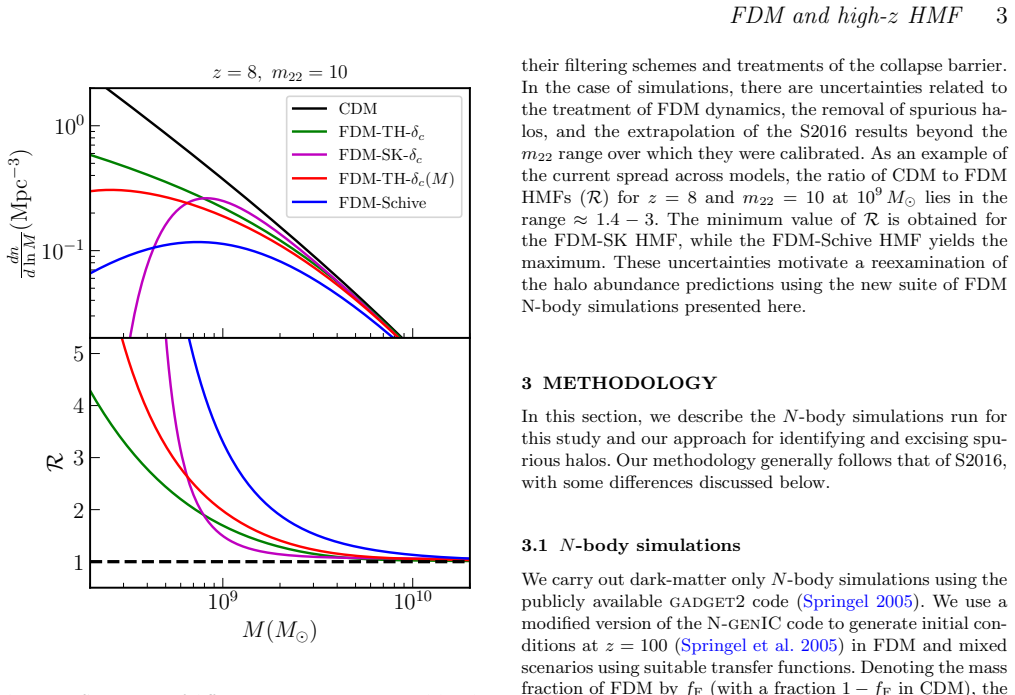
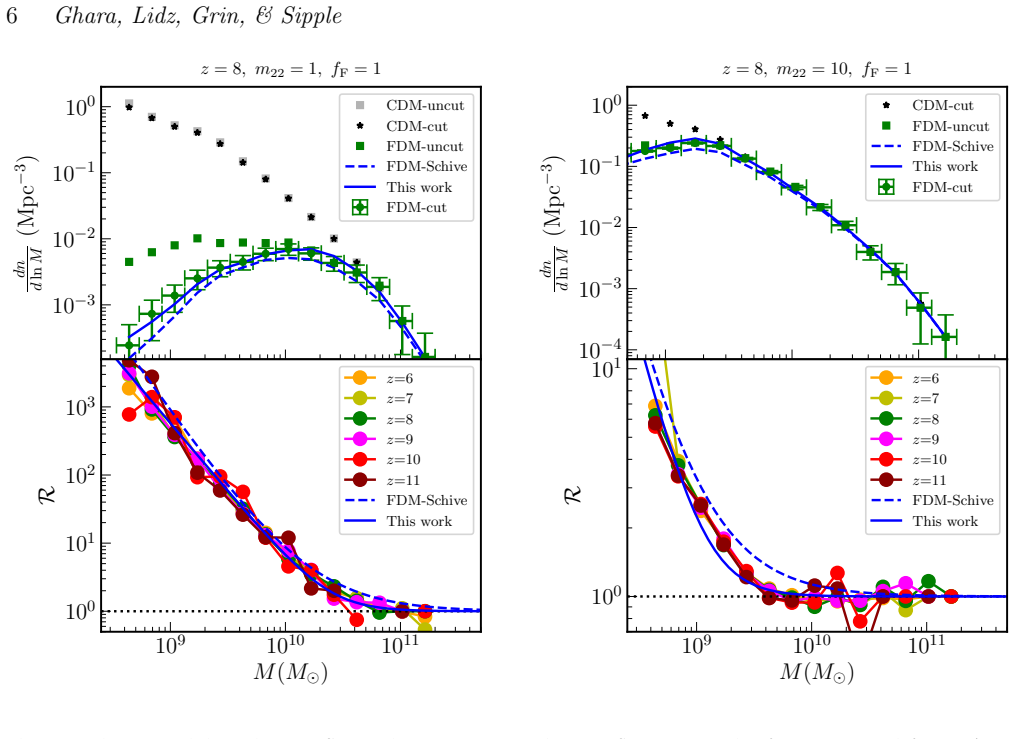
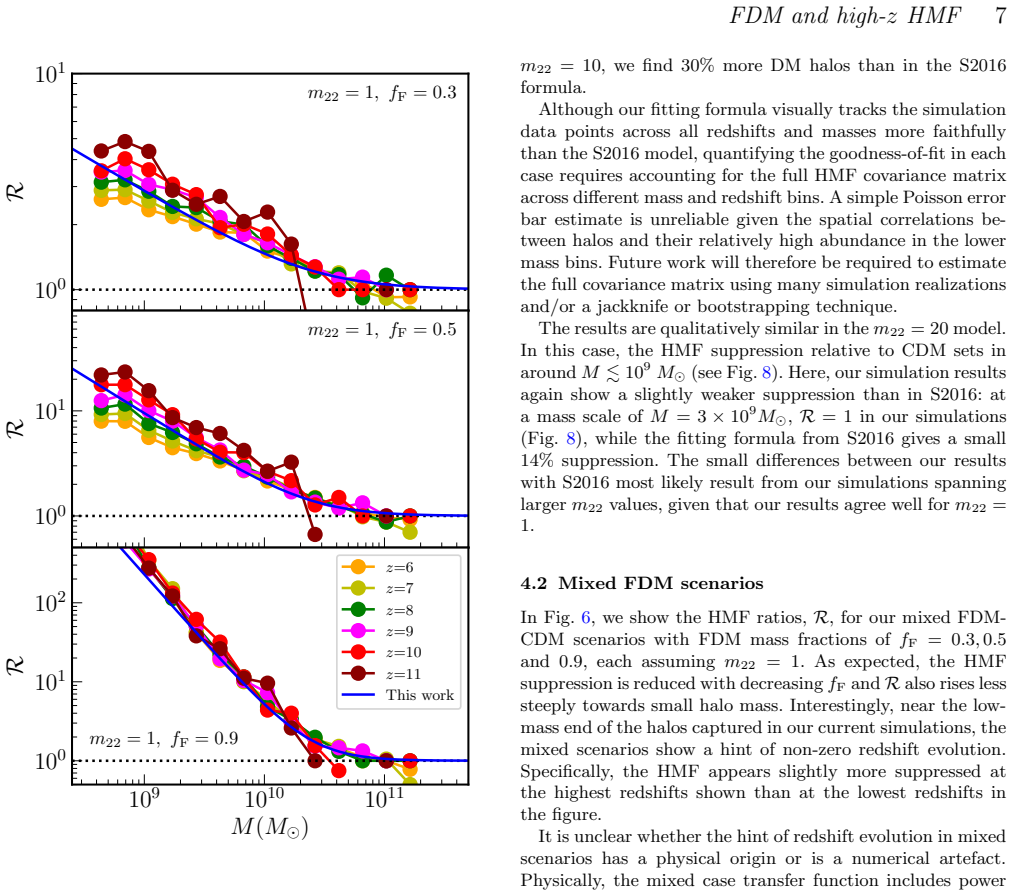
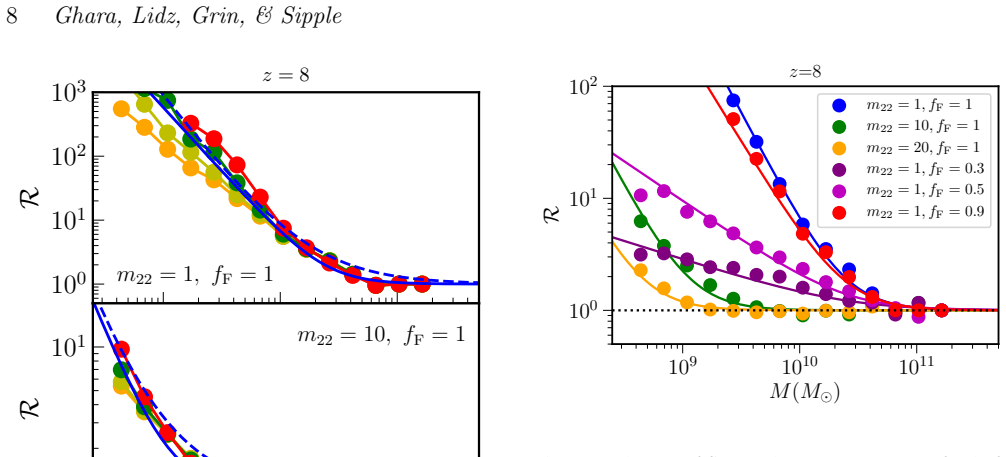
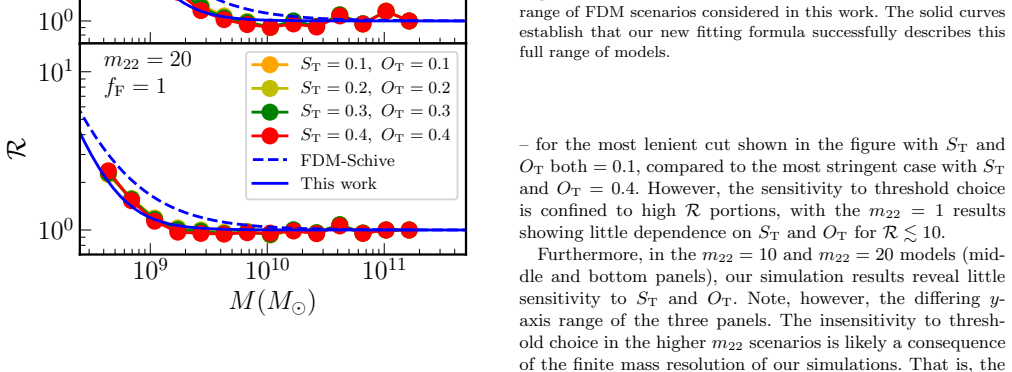
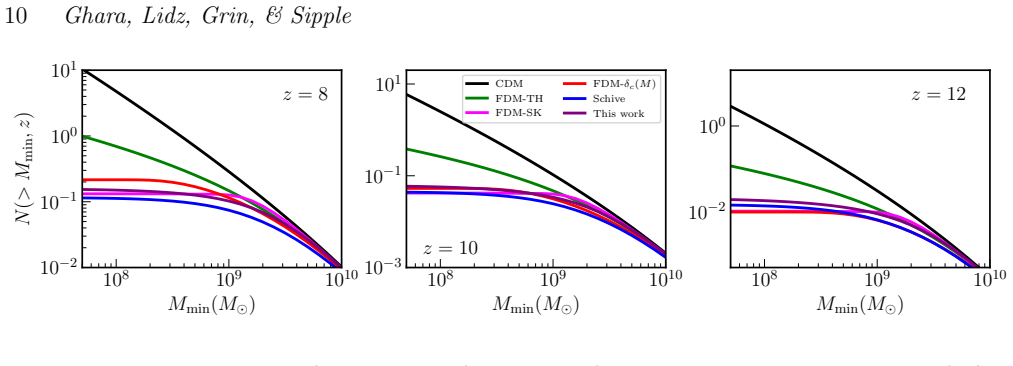
We provide a new halo mass function fitting formula, calibrated over z=6-11, applicable to pure FDM and mixed dark matter scenarios. For m c² = 10^{-21} eV and M ∼ 3 × 10^9 M_⊙ we find a ∼30% weaker suppression than earlier simulation-based formulas predict, which we attribute to their extrapolation beyond the m_FDM range previously simulated.
What carries the argument
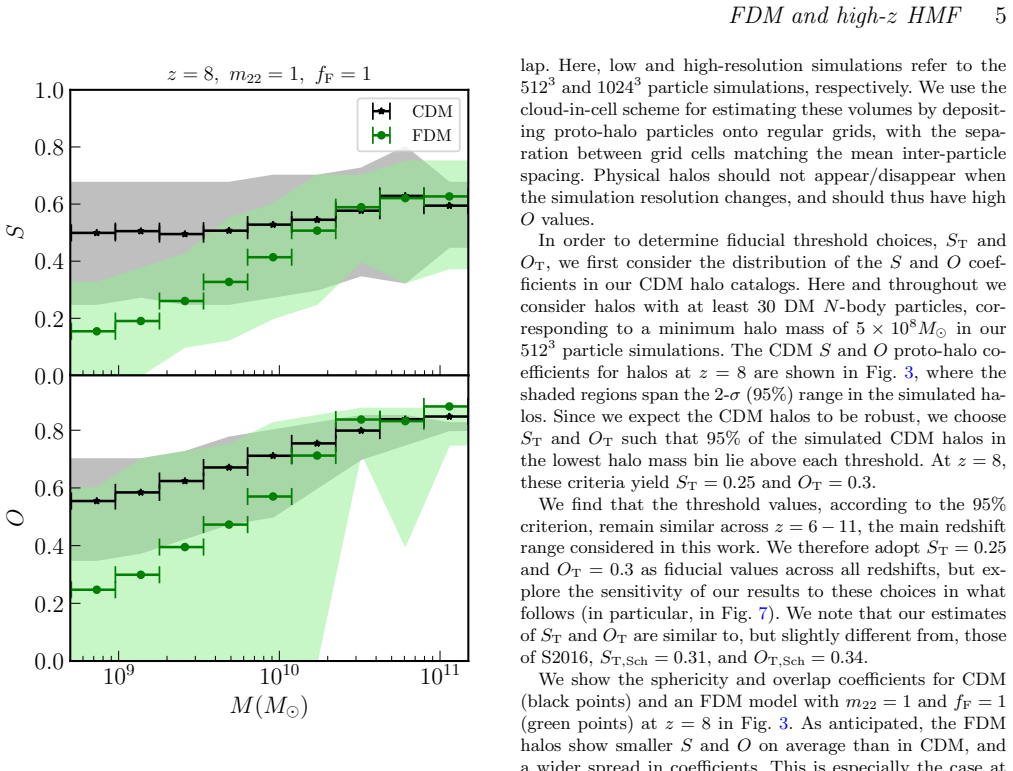
The new halo mass function fitting formula, obtained from N-body simulations after identifying and removing spurious halos due to discreteness noise.
If this is right
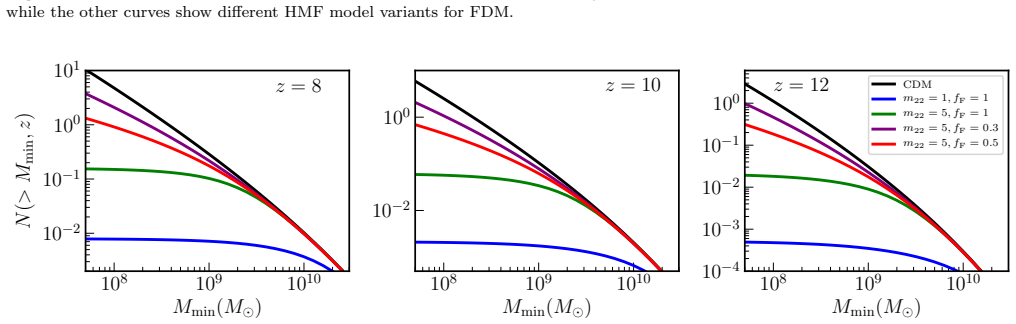
- The fitting formula applies to both pure fuzzy dark matter and mixed fuzzy-cold dark matter models.
- It shows better agreement with prior simulation-based formulas than with semi-analytic models.
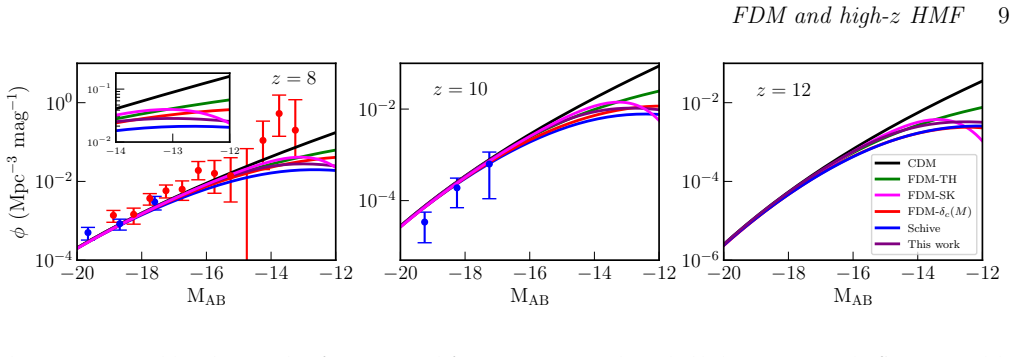
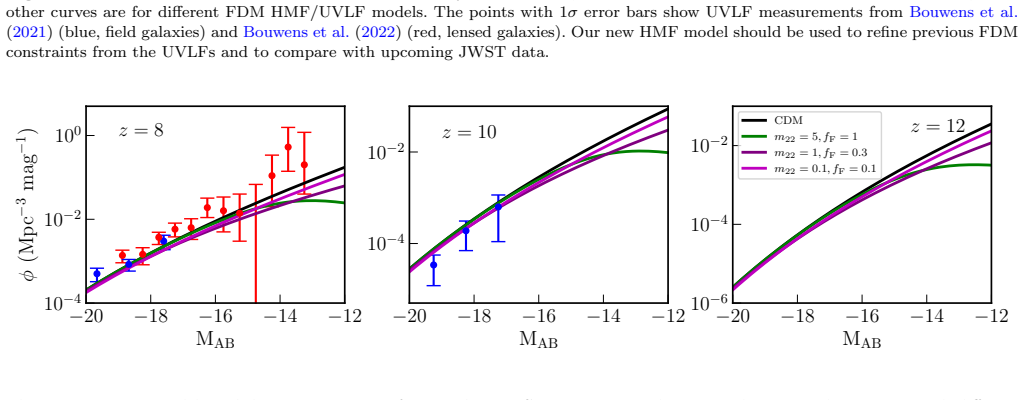
- Upcoming JWST observations of the UVLF probing M_UV ≳ -13 at z ≳ 10 will test these models.
- The formula can be used to model delayed galaxy formation during cosmic dawn in fuzzy dark matter cosmologies.
Where Pith is reading between the lines
- Extending the simulations to lower FDM masses or higher redshifts could further refine the formula.
- The weaker suppression might allow more early galaxies than previously modeled, affecting reionization timelines.
- Direct comparison with upcoming lensed galaxy counts could confirm or refute the 30% difference.
Load-bearing premise
The procedure for identifying and removing spurious halos accurately quantifies and corrects the systematic uncertainty without removing genuine halos.
What would settle it
Running higher-resolution simulations or comparing the predicted halo number densities directly against observed galaxy counts at z greater than 10 for halo masses around 3 times 10^9 solar masses.
Figures
read the original abstract
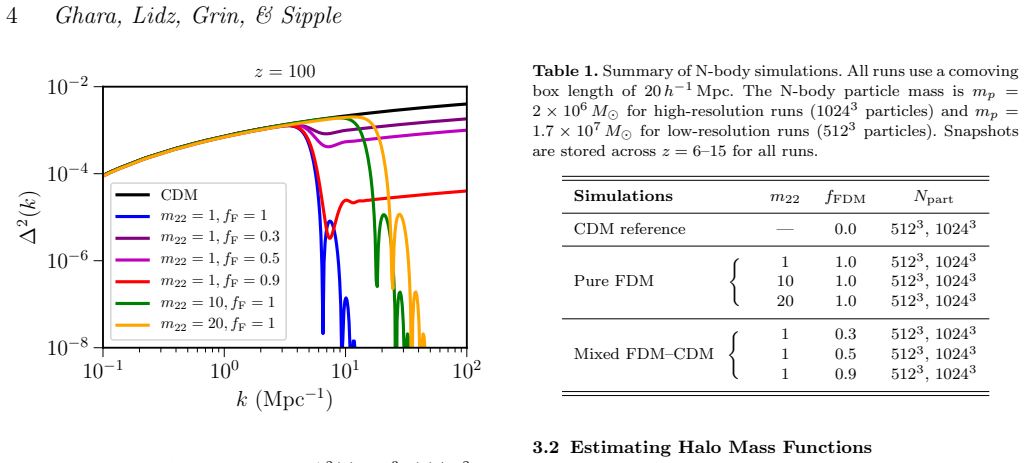
In fuzzy dark matter (FDM) cosmological models, wave effects impact astrophysical length scales, suppressing the abundance of small mass dark matter halos, and delaying the earliest phases of galaxy formation during Cosmic Dawn. Current and upcoming James Webb Space Telescope (JWST) measurements of the galaxy ultraviolet luminosity function (UVLF) will allow unprecedented tests of this suppression, yet significant uncertainties remain in theoretical models of the FDM halo mass function. We run a new suite of N-body simulations with FDM particle masses of $mc^{2}=10^{-22}\,{\rm eV} - 2 \times 10^{-21}$ eV and mixed FDM-cold dark matter (CDM) models with FDM mass fractions of $f_{\mathrm{F}} = 0.3-1$. We identify and remove spurious halos from discreteness noise and quantify the associated systematic uncertainty. We provide a new halo mass function fitting formula, calibrated over $z=6-11$, applicable to pure FDM and mixed dark matter scenarios. Our results are in better agreement with previous simulation-based fitting formulas than with current semi-analytic mass function models. Nevertheless, for $m c^{2} = 10^{-21}$ eV and $M \sim 3 \times 10^9 M_\odot$ we find a $\sim 30\%$ weaker suppression than earlier simulation-based formulas predict, which we attribute to their extrapolation beyond the $m_{\rm FDM}$ range previously simulated. Applying our fitting formula to the UVLF, we find that upcoming JWST observations behind foreground lensing clusters, probing $M_{\rm UV} \gtrsim -13$ at $z \gtrsim 10$, will provide a powerful test of FDM and mixed dark matter models.
Editorial analysis
A structured set of objections, weighed in public.
Referee Report
Summary. The manuscript runs new N-body simulations of pure FDM (mc² = 10^{-22}–2×10^{-21} eV) and mixed FDM-CDM models (f_F = 0.3–1), removes spurious halos from discreteness noise while quantifying the associated systematic uncertainty, and calibrates a new halo mass function fitting formula over z = 6–11. The formula is stated to apply to both pure and mixed scenarios; the authors report ~30% weaker suppression than earlier simulation-based formulas at mc² = 10^{-21} eV and M ∼ 3×10^9 M_⊙ (attributed to prior extrapolation), find better agreement with previous simulation-based fits than with semi-analytic models, and discuss implications for JWST UVLF constraints.
Significance. If the spurious-halo removal is shown to be robust, the work supplies a directly calibrated fitting formula for high-redshift FDM halo abundances that improves upon semi-analytic prescriptions and yields concrete, falsifiable predictions for lensed JWST UVLF measurements at M_UV ≳ −13 and z ≳ 10. The explicit quantification of cleaning systematics and the extension to mixed models are positive features.
major comments (2)
- [Abstract and §3] Abstract and §3 (halo identification): The headline numerical result—a ~30% weaker suppression at mc² = 10^{-21} eV, M ∼ 3×10^9 M_⊙—rests entirely on the post-cleaning catalog. No explicit criteria for flagging spurious halos, no resolution-convergence tests at the relevant mass and redshift, and no demonstration that genuine FDM halos remain untouched are provided; without these, it is impossible to assess whether the reported difference from earlier formulas is physical or an artifact of the removal step.
- [§4] §4 (comparison and fitting formula): The new fitting formula is calibrated directly to the cleaned simulations, yet the manuscript does not show the raw versus cleaned mass functions, the effect of varying the cleaning threshold on the 30% discrepancy, or how the quoted systematic uncertainty brackets residual contamination at the quoted mass and redshift.
minor comments (1)
- [Abstract] Abstract: the FDM mass range is written as 10^{-22} eV – 2×10^{-21} eV; confirm whether the bounds are inclusive and whether the mixed-model runs use the same particle masses.
Simulated Author's Rebuttal
We thank the referee for their thorough review and constructive comments. We address each major comment below and will revise the manuscript accordingly to strengthen the presentation of our methods and results.
read point-by-point responses
-
Referee: [Abstract and §3] Abstract and §3 (halo identification): The headline numerical result—a ~30% weaker suppression at mc² = 10^{-21} eV, M ∼ 3×10^9 M_⊙—rests entirely on the post-cleaning catalog. No explicit criteria for flagging spurious halos, no resolution-convergence tests at the relevant mass and redshift, and no demonstration that genuine FDM halos remain untouched are provided; without these, it is impossible to assess whether the reported difference from earlier formulas is physical or an artifact of the removal step.
Authors: We appreciate the referee highlighting the need for greater clarity on the halo-cleaning procedure. While §3 describes the removal of spurious halos due to discreteness noise and quantifies the associated systematic uncertainty, we agree that explicit flagging criteria, resolution-convergence tests at the relevant masses and redshifts, and explicit validation that genuine FDM halos are unaffected should be presented more directly. In the revised manuscript we will add these elements to demonstrate that the ~30% weaker suppression is physical rather than an artifact. revision: yes
-
Referee: [§4] §4 (comparison and fitting formula): The new fitting formula is calibrated directly to the cleaned simulations, yet the manuscript does not show the raw versus cleaned mass functions, the effect of varying the cleaning threshold on the 30% discrepancy, or how the quoted systematic uncertainty brackets residual contamination at the quoted mass and redshift.
Authors: We agree that direct comparisons would help readers evaluate the cleaning step. In the revised version we will include raw versus cleaned mass-function comparisons, examine the sensitivity of the reported 30% discrepancy to changes in the cleaning threshold, and clarify how the quoted systematic uncertainty encompasses possible residual contamination at the masses and redshifts of interest. revision: yes
Circularity Check
No significant circularity; derivation is self-contained calibration to new simulations
full rationale
The paper runs new N-body simulations for specified FDM masses and mixed models, removes spurious halos while quantifying systematic uncertainty, and calibrates a new fitting formula directly to those results over z=6-11. This is an explicit empirical calibration rather than any reduction by construction, self-definition, or load-bearing self-citation. The reported 30% difference is presented as a comparison to prior work (attributed to extrapolation range), with no equations or steps shown that equate outputs to inputs by definition. The derivation chain remains independent of the target result.
Axiom & Free-Parameter Ledger
free parameters (1)
- fitting coefficients in the new halo mass function formula
axioms (2)
- domain assumption N-body simulations with the chosen particle mass and force resolution correctly capture the suppression of small-scale structure due to FDM wave effects
- domain assumption The method used to identify and remove spurious halos removes only discreteness artifacts and leaves the true halo abundance unchanged within the quoted systematic uncertainty
Reference graph
Works this paper leans on
-
[1]
Armengaud E., Palanque-Delabrouille N., Y \`e che C., Marsh D. J. E., Baur J., 2017, @doi [ ] 10.1093/mnras/stx1870 , https://ui.adsabs.harvard.edu/abs/2017MNRAS.471.4606A 471, 4606
-
[2]
Arvanitaki A., Dimopoulos S., Dubovsky S., Kaloper N., March-Russell J., 2010, @doi [ ] 10.1103/PhysRevD.81.123530 , https://ui.adsabs.harvard.edu/abs/2010PhRvD..81l3530A 81, 123530
-
[3]
Atek H., et al., 2026, @doi [arXiv e-prints] 10.48550/arXiv.2604.23823 , https://ui.adsabs.harvard.edu/abs/2026arXiv260423823A p. arXiv:2604.23823
work page internal anchor Pith review Pith/arXiv arXiv doi:10.48550/arxiv.2604.23823 2026
-
[4]
Banik N., Bovy J., Bertone G., Erkal D., de Boer T. J. L., 2021, @doi [ ] 10.1088/1475-7516/2021/10/043 , https://ui.adsabs.harvard.edu/abs/2021JCAP...10..043B 2021, 043
-
[5]
Bar-Or B., Fouvry J.-B., Tremaine S., 2019, @doi [ ] 10.3847/1538-4357/aaf28c , https://ui.adsabs.harvard.edu/abs/2019ApJ...871...28B 871, 28
-
[6]
Baryakhtar M., Cyncynates D., Henry E., 2026, @doi [arXiv e-prints] 10.48550/arXiv.2602.23424 , https://ui.adsabs.harvard.edu/abs/2026arXiv260223424B p. arXiv:2602.23424
work page internal anchor Pith review Pith/arXiv arXiv doi:10.48550/arxiv.2602.23424 2026
-
[7]
Benson A. J., et al., 2013, @doi [ ] 10.1093/mnras/sts159 , https://ui.adsabs.harvard.edu/abs/2013MNRAS.428.1774B 428, 1774
-
[8]
Bouwens R. J., et al., 2021, @doi [ ] 10.3847/1538-3881/abf83e , https://ui.adsabs.harvard.edu/abs/2021AJ....162...47B 162, 47
-
[9]
Bouwens R. J., Illingworth G., Ellis R. S., Oesch P., Stefanon M., 2022, @doi [ ] 10.3847/1538-4357/ac86d1 , https://ui.adsabs.harvard.edu/abs/2022ApJ...940...55B 940, 55
-
[10]
Bouwens R., Illingworth G., Oesch P., Stefanon M., Naidu R., van Leeuwen I., Magee D., 2023, @doi [ ] 10.1093/mnras/stad1014 , https://ui.adsabs.harvard.edu/abs/2023MNRAS.523.1009B 523, 1009
-
[11]
Bozek B., Marsh D. J. E., Silk J., Wyse R. F. G., 2015, @doi [ ] 10.1093/mnras/stv624 , https://ui.adsabs.harvard.edu/abs/2015MNRAS.450..209B 450, 209
-
[12]
D., Ringwald A., 2012, @doi [J
Cicoli M., Goodsell M. D., Ringwald A., 2012, @doi [J. High Energy Phys.] 10.1007/JHEP10(2012)146 , https://ui.adsabs.harvard.edu/abs/2012JHEP...10..146C 2012, 146
-
[13]
Corasaniti P. S., Agarwal S., Marsh D. J. E., Das S., 2017, @doi [ ] 10.1103/PhysRevD.95.083512 , https://ui.adsabs.harvard.edu/abs/2017PhRvD..95h3512C 95, 083512
-
[14]
Dalal N., Bovy J., Hui L., Li X., 2021, @doi [ ] 10.1088/1475-7516/2021/03/076 , https://ui.adsabs.harvard.edu/abs/2021JCAP...03..076D 2021, 076
-
[15]
Dentler M., Marsh D. J. E., Hlo z ek R., Lagu \"e A., Rogers K. K., Grin D., 2022, @doi [ ] 10.1093/mnras/stac1946 , https://ui.adsabs.harvard.edu/abs/2022MNRAS.515.5646D 515, 5646
-
[16]
Dome T., May S., Lagu \"e A., Marsh D. J. E., Johnston S., Bose S., Tocher A., Fialkov A., 2025, @doi [ ] 10.1093/mnras/staf005 , https://ui.adsabs.harvard.edu/abs/2025MNRAS.537..252D 537, 252
-
[17]
Donnan C. T., et al., 2024, @doi [ ] 10.1093/mnras/stae2037 , https://ui.adsabs.harvard.edu/abs/2024MNRAS.533.3222D 533, 3222
-
[18]
Du X., Behrens C., Niemeyer J. C., 2017, @doi [ ] 10.1093/mnras/stw2724 , https://ui.adsabs.harvard.edu/abs/2017MNRAS.465..941D 465, 941
-
[19]
Eisenstein D. J., Hu W., 1998, @doi [ ] 10.1086/305424 , https://ui.adsabs.harvard.edu/abs/1998ApJ...496..605E 496, 605
-
[20]
Farahi A., Benson A. J., 2013, @doi [ ] 10.1093/mnras/stt987 , https://ui.adsabs.harvard.edu/abs/2013MNRAS.433.3428F 433, 3428
-
[21]
Ferreira E. G. M., 2021, @doi [ ] 10.1007/s00159-021-00135-6 , https://ui.adsabs.harvard.edu/abs/2021A&ARv..29....7F 29, 7
-
[22]
Harikane Y., et al., 2023, @doi [ ] 10.3847/1538-4365/acaaa9 , https://ui.adsabs.harvard.edu/abs/2023ApJS..265....5H 265, 5
-
[23]
R., et al., 2020, @doi [Nature] 10.1038/s41586-020-2649-2 , 585, 357
Harris C. R., et al., 2020, @doi [Nature] 10.1038/s41586-020-2649-2 , 585, 357
-
[24]
Hlo z ek R., Marsh D. J. E., Grin D., 2018, @doi [ ] 10.1093/mnras/sty271 , https://ui.adsabs.harvard.edu/abs/2018MNRAS.476.3063H 476, 3063
-
[25]
Hlozek R., Grin D., Marsh D. J. E., Ferreira P. G., 2015, @doi [ ] 10.1103/PhysRevD.91.103512 , https://ui.adsabs.harvard.edu/abs/2015PhRvD..91j3512H 91, 103512
-
[26]
Hu W., Barkana R., Gruzinov A., 2000, @doi [ ] 10.1103/PhysRevLett.85.1158 , https://ui.adsabs.harvard.edu/abs/2000PhRvL..85.1158H 85, 1158
-
[27]
Hui L., 2021, @doi [ ] 10.1146/annurev-astro-120920-010024 , https://ui.adsabs.harvard.edu/abs/2021ARA&A..59..247H 59, 247
-
[28]
P., Tremaine S., Witten E., 2017, @doi [Phys
Hui L., Ostriker J. P., Tremaine S., Witten E., 2017, @doi [Phys. Rev. D] 10.1103/PhysRevD.95.043541 , 95, 043541
-
[29]
D., 2007, @doi [Computing in Science & Engineering] 10.1109/MCSE.2007.55 , 9, 90
Hunter J. D., 2007, @doi [Computing in Science & Engineering] 10.1109/MCSE.2007.55 , 9, 90
-
[30]
Ir s i c V., Viel M., Haehnelt M. G., Bolton J. S., Becker G. D., 2017, @doi [ ] 10.1103/PhysRevLett.119.031302 , https://ui.adsabs.harvard.edu/abs/2017PhRvL.119c1302I 119, 031302
-
[31]
Halo mass functions in mixed cold and fuzzy dark matter models
Johnston S. C., et al., 2026, @doi [arXiv e-prints] 10.48550/arXiv.2606.06599 , https://ui.adsabs.harvard.edu/abs/2026arXiv260606599J p. arXiv:2606.06599
work page internal anchor Pith review Pith/arXiv arXiv doi:10.48550/arxiv.2606.06599 2026
-
[32]
Knollmann S. R., Knebe A., 2009, @doi [ ] 10.1088/0067-0049/182/2/608 , https://ui.adsabs.harvard.edu/abs/2009ApJS..182..608K 182, 608
-
[33]
Kobayashi T., Murgia R., De Simone A., Ir s i c V., Viel M., 2017, @doi [ ] 10.1103/PhysRevD.96.123514 , https://ui.adsabs.harvard.edu/abs/2017PhRvD..96l3514K 96, 123514
-
[34]
Kulkarni M., Ostriker J. P., 2022, @doi [ ] 10.1093/mnras/stab3520 , https://ui.adsabs.harvard.edu/abs/2022MNRAS.510.1425K 510, 1425
-
[35]
Lagu \"e A., et al., 2026, @doi [arXiv e-prints] 10.48550/arXiv.2606.06410 , https://ui.adsabs.harvard.edu/abs/2026arXiv260606410L p. arXiv:2606.06410
work page internal anchor Pith review Pith/arXiv arXiv doi:10.48550/arxiv.2606.06410 2026
-
[36]
Leo M., Baugh C. M., Li B., Pascoli S., 2018, @doi [ ] 10.1088/1475-7516/2018/04/010 , https://ui.adsabs.harvard.edu/abs/2018JCAP...04..010L 2018, 010
-
[37]
Li X., Hui L., Bryan G. L., 2019, @doi [ ] 10.1103/PhysRevD.99.063509 , https://ui.adsabs.harvard.edu/abs/2019PhRvD..99f3509L 99, 063509
-
[38]
Lidz A., Hui L., 2018, @doi [ ] 10.1103/PhysRevD.98.023011 , https://ui.adsabs.harvard.edu/abs/2018PhRvD..98b3011L 98, 023011
-
[39]
Linares Cede \ n o F. X., Gonz \'a lez-Morales A. X., Ure \ n a-L \'o pez L. A., 2021, @doi [ ] 10.1088/1475-7516/2021/01/051 , https://ui.adsabs.harvard.edu/abs/2021JCAP...01..051L 2021, 051
-
[40]
Liu R., Hu W., Grin D., 2025, @doi [ ] 10.1103/1z4c-1w7f , https://ui.adsabs.harvard.edu/abs/2025PhRvD.112b3513L 112, 023513
-
[41]
Lovell M. R., Frenk C. S., Eke V. R., Jenkins A., Gao L., Theuns T., 2014, @doi [ ] 10.1093/mnras/stt2431 , https://ui.adsabs.harvard.edu/abs/2014MNRAS.439..300L 439, 300
-
[42]
Marsh D. J. E., 2016a, @doi [arXiv e-prints] 10.48550/arXiv.1605.05973 , https://ui.adsabs.harvard.edu/abs/2016arXiv160505973M p. arXiv:1605.05973
work page internal anchor Pith review Pith/arXiv arXiv doi:10.48550/arxiv.1605.05973
-
[43]
Marsh D. J. E., 2016b, @doi [ ] 10.1016/j.physrep.2016.06.005 , https://ui.adsabs.harvard.edu/abs/2016PhR...643....1M 643, 1
-
[44]
Marsh D. J. E., Silk J., 2014, @doi [ ] 10.1093/mnras/stt2079 , https://ui.adsabs.harvard.edu/abs/2014MNRAS.437.2652M 437, 2652
-
[45]
May S., Springel V., 2021, @doi [ ] 10.1093/mnras/stab1764 , https://ui.adsabs.harvard.edu/abs/2021MNRAS.506.2603M 506, 2603
-
[46]
May S., Springel V., 2023, @doi [ ] 10.1093/mnras/stad2031 , https://ui.adsabs.harvard.edu/abs/2023MNRAS.524.4256M 524, 4256
-
[47]
Nadler E. O., et al., 2021, @doi [ ] 10.1103/PhysRevLett.126.091101 , https://ui.adsabs.harvard.edu/abs/2021PhRvL.126i1101N 126, 091101
-
[48]
Nadler E. O., An R., Gluscevic V., Benson A., Du X., 2025, @doi [ ] 10.3847/1538-4357/adceef , https://ui.adsabs.harvard.edu/abs/2025ApJ...986..127N 986, 127
-
[49]
Nebrin O., Ghara R., Mellema G., 2019, @doi [ ] 10.1088/1475-7516/2019/04/051 , https://ui.adsabs.harvard.edu/abs/2019JCAP...04..051N 2019, 051
-
[50]
Ni Y., Wang M.-Y., Feng Y., Di Matteo T., 2019, @doi [ ] 10.1093/mnras/stz2085 , https://ui.adsabs.harvard.edu/abs/2019MNRAS.488.5551N 488, 5551
-
[51]
Niemeyer J. C., 2020, @doi [Progress in Particle and Nuclear Physics] 10.1016/j.ppnp.2020.103787 , https://ui.adsabs.harvard.edu/abs/2020PrPNP.11303787N 113, 103787
-
[52]
Nori M., Murgia R., Ir s i c V., Baldi M., Viel M., 2019, @doi [ ] 10.1093/mnras/sty2888 , https://ui.adsabs.harvard.edu/abs/2019MNRAS.482.3227N 482, 3227
-
[53]
O'Hare C. A. J., 2024, @doi [arXiv e-prints] 10.48550/arXiv.2403.17697 , https://ui.adsabs.harvard.edu/abs/2024arXiv240317697O p. arXiv:2403.17697
-
[54]
Planck Collaboration et al., 2020, @doi [ ] 10.1051/0004-6361/201833910 , https://ui.adsabs.harvard.edu/abs/2020A&A...641A...6P 641, A6
-
[55]
Power C., Robotham A. S. G., Obreschkow D., Hobbs A., Lewis G. F., 2016, @doi [ ] 10.1093/mnras/stw1644 , https://ui.adsabs.harvard.edu/abs/2016MNRAS.462..474P 462, 474
-
[56]
Press W. H., Schechter P., 1974, @doi [ ] 10.1086/152650 , https://ui.adsabs.harvard.edu/abs/1974ApJ...187..425P 187, 425
-
[57]
Robertson B. E., Kravtsov A. V., Tinker J., Zentner A. R., 2009, @doi [ ] 10.1088/0004-637X/696/1/636 , https://ui.adsabs.harvard.edu/abs/2009ApJ...696..636R 696, 636
-
[58]
Rogers K. K., Peiris H. V., 2021, @doi [ ] 10.1103/PhysRevLett.126.071302 , https://ui.adsabs.harvard.edu/abs/2021PhRvL.126g1302R 126, 071302
-
[59]
K., Hlo z ek R., Lagu \"e A., Ivanov M
Rogers K. K., Hlo z ek R., Lagu \"e A., Ivanov M. M., Philcox O. H. E., Cabass G., Akitsu K., Marsh D. J. E., 2023, @doi [ ] 10.1088/1475-7516/2023/06/023 , https://ui.adsabs.harvard.edu/abs/2023JCAP...06..023R 2023, 023
-
[60]
Schive H.-Y., Chiueh T., Broadhurst T., 2014a, @doi [Nature Physics] 10.1038/nphys2996 , https://ui.adsabs.harvard.edu/abs/2014NatPh..10..496S 10, 496
-
[61]
Schive H.-Y., Liao M.-H., Woo T.-P., Wong S.-K., Chiueh T., Broadhurst T., Hwang W.-Y. P., 2014b, @doi [ ] 10.1103/PhysRevLett.113.261302 , https://ui.adsabs.harvard.edu/abs/2014PhRvL.113z1302S 113, 261302
-
[62]
Schive H.-Y., Chiueh T., Broadhurst T., Huang K.-W., 2016, @doi [ ] 10.3847/0004-637X/818/1/89 , https://ui.adsabs.harvard.edu/abs/2016ApJ...818...89S 818, 89
-
[63]
Schneider A., Smith R. E., Reed D., 2013, @doi [ ] 10.1093/mnras/stt829 , https://ui.adsabs.harvard.edu/abs/2013MNRAS.433.1573S 433, 1573
-
[64]
Schutz K., 2020, @doi [ ] 10.1103/PhysRevD.101.123026 , https://ui.adsabs.harvard.edu/abs/2020PhRvD.101l3026S 101, 123026
-
[65]
2002, MNRAS, 329, 355, doi: 10.1046/j.1365-8711.2002.04988.x
Sheth R. K., Tormen G., 2002, @doi [ ] 10.1046/j.1365-8711.2002.04950.x , https://ui.adsabs.harvard.edu/abs/2002MNRAS.329...61S 329, 61
-
[66]
Sipple J., Lidz A., Grin D., Sun G., 2025, @doi [ ] 10.1093/mnras/staf340 , https://ui.adsabs.harvard.edu/abs/2025MNRAS.538.1830S 538, 1830
-
[67]
Springel V., 2005, @doi [ ] 10.1111/j.1365-2966.2005.09655.x , https://ui.adsabs.harvard.edu/abs/2005MNRAS.364.1105S 364, 1105
-
[68]
Springel V., et al., 2005, @doi [ ] 10.1038/nature03597 , https://ui.adsabs.harvard.edu/abs/2005Natur.435..629S 435, 629
-
[69]
Wang J., White S. D. M., 2007, @doi [ ] 10.1111/j.1365-2966.2007.12053.x , https://ui.adsabs.harvard.edu/abs/2007MNRAS.380...93W 380, 93
-
[70]
Winch H., Rogers K. K., Hlo z ek R., Marsh D. J. E., 2024, @doi [ ] 10.3847/1538-4357/ad7a73 , https://ui.adsabs.harvard.edu/abs/2024ApJ...976...40W 976, 40
-
[71]
T., Su G.-M., Schive H.-Y., Chiueh T., Ostriker J
Yang H.-Y., Chiang B. T., Su G.-M., Schive H.-Y., Chiueh T., Ostriker J. P., 2024, @doi [ ] 10.1093/mnras/stae793 , https://ui.adsabs.harvard.edu/abs/2024MNRAS.530..129Y 530, 129
-
[72]
Zhang J., Hui L., 2006, @doi [ ] 10.1086/499802 , https://ui.adsabs.harvard.edu/abs/2006ApJ...641..641Z 641, 641
discussion (0)
Sign in with ORCID, Apple, or X to comment. Anyone can read and Pith papers without signing in.