Collinearly Improved Balitsky-Kovchegov Evolution of the Gluon Wigner Distribution
Pith reviewed 2026-07-01 04:37 UTC · model grok-4.3
The pith
Collinearly improved BK evolution moves the elliptic node in the gluon Wigner distribution rather than rescaling it.
A machine-rendered reading of the paper's core claim, the machinery that carries it, and where it could break.
Core claim
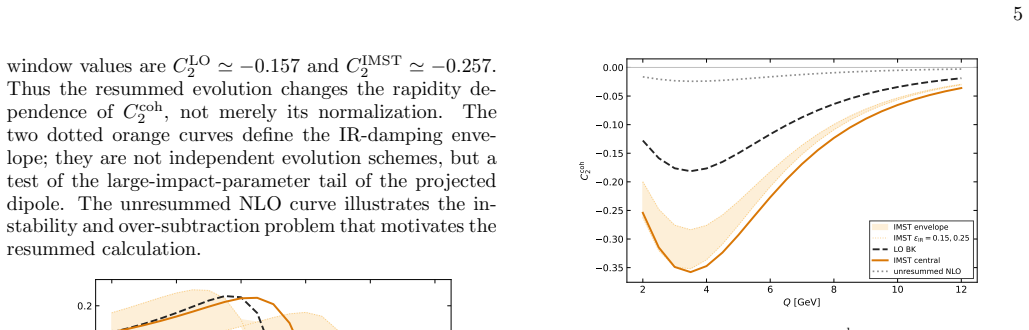
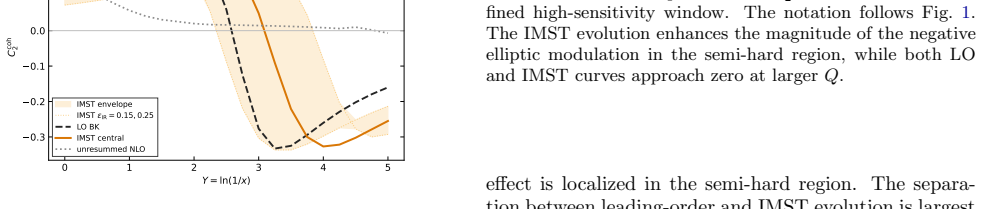
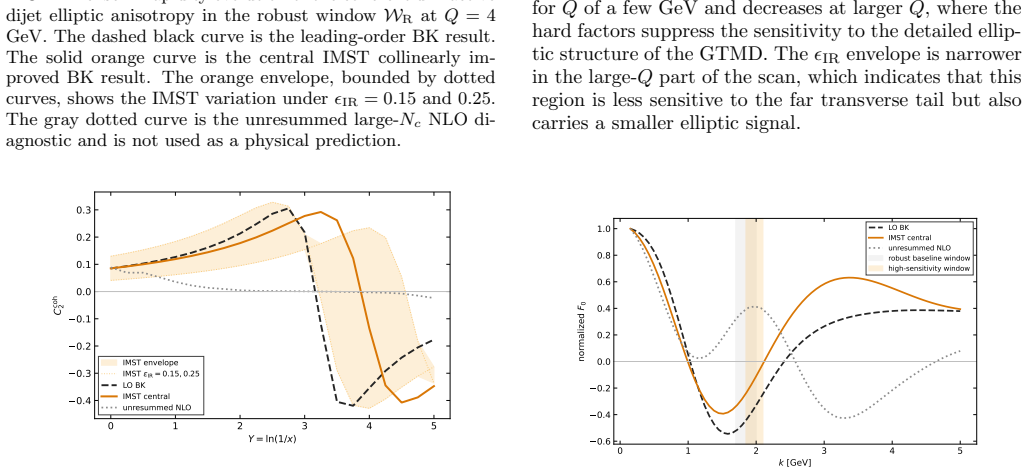
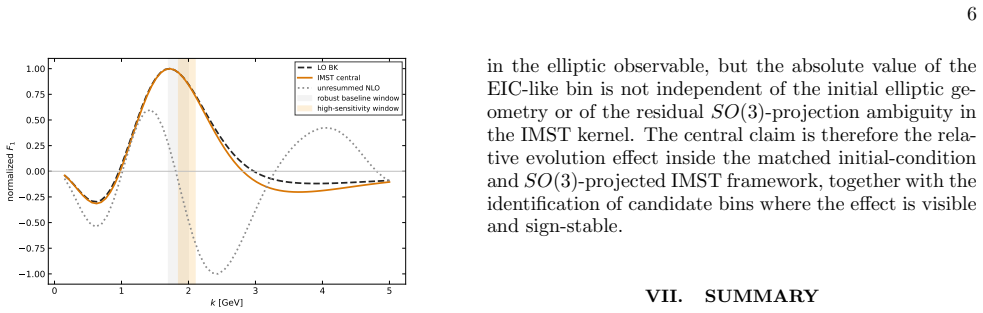
Within the SO(3)-projected framework, the resummed evolution moves the elliptic node and changes the rapidity and hard-scale dependence of C₂^coh=⟨cos2φ⟩, rather than acting as a simple normalization shift. The effect is largest in node-sensitive windows but remains visible in broader sign-stable bins. Direct daughter-coordinate RHS tests and direct (r,b,φ) evolution quantify the residual projection ambiguity and confirm the observed trend.
What carries the argument
Projection of the evolved dipole amplitude onto Wigner/GTMD harmonics after collinearly improved BK evolution starting from the SO(3)-symmetric Gubser initial condition
If this is right
- The change in node position and scale dependence alters predictions for the rapidity and hard-scale behavior of the coherent dijet asymmetry.
- Node-sensitive kinematic windows exhibit the largest modification while sign-stable bins still show a visible effect.
- Balanced high-Δ candidate bins provide a better compromise between elliptic signal strength and denominator weight than narrow bins with the largest ratio.
- Direct (r,b,φ) evolution and RHS tests bound the size of projection ambiguities that could affect the extracted trend.
Where Pith is reading between the lines
- If the node shift survives in full unprojected evolution, it would require re-fitting of initial conditions when extracting Wigner distributions from future EIC data.
- The distinction between normalization shift and node movement could be tested by comparing the ratio of C₂^coh in adjacent rapidity bins at fixed hard scale.
- Extending the comparison to other initial conditions beyond Gubser would clarify whether the observed change is tied to the SO(3) symmetry assumption.
Load-bearing premise
The SO(3)-symmetric Gubser initial condition together with the projection of the evolved dipole onto Wigner/GTMD harmonics faithfully captures the physics without large residual ambiguities.
What would settle it
A measurement showing that the position of the elliptic node in the cos2φ distribution remains unchanged when switching from LO BK to IMST collinearly improved evolution in dijet data.
Figures
read the original abstract
We study how collinearly improved small-$x$ evolution modifies the elliptic gluon Wigner distribution and its coherent diffractive dijet $\cos2\phi$ signal. Starting from the $SO(3)$-symmetric Gubser initial condition, we compare fixed-coupling leading-order (LO) BK evolution with the Iancu--Madrigal--Mueller--Soyez--Triantafyllopoulos (IMST) collinearly improved BK prescription, project the evolved dipole to Wigner/GTMD harmonics, and fold the result with photon wave-function hard factors. Within the $SO(3)$-projected framework, the resummed evolution moves the elliptic node and changes the rapidity and hard-scale dependence of $C_2^{\rm coh}=\langle\cos2\phi\rangle$, rather than acting as a simple normalization shift. The effect is largest in node-sensitive windows but remains visible in broader sign-stable bins. Direct daughter-coordinate RHS tests and direct $(r,b,\phi)$ evolution quantify the residual projection ambiguity and check the observed trend. Projection-level EIC-like finite-bin estimates show that balanced high-$\Delta$ candidate bins offer a better compromise between elliptic signal and denominator weight than the narrow bins with the largest ratio. The unresummed NLO curve is used only as a stability diagnostic; the physical comparison is between LO BK and IMST collinearly improved BK evolution.
Editorial analysis
A structured set of objections, weighed in public.
Referee Report
Summary. The manuscript studies the impact of collinearly improved small-x BK evolution (IMST prescription) versus fixed-coupling LO BK on the elliptic gluon Wigner distribution. Starting from the SO(3)-symmetric Gubser initial condition, the evolved dipole is projected onto Wigner/GTMD harmonics and convolved with photon wave-function hard factors. The central result is that, within the SO(3)-projected framework, resummed evolution shifts the elliptic node position and alters the rapidity and hard-scale dependence of C₂^coh=⟨cos2φ⟩, rather than producing only a normalization shift. Direct (r,b,φ) evolution and daughter-coordinate RHS tests are performed to quantify residual projection ambiguity, with additional EIC-like finite-bin estimates provided.
Significance. If the results hold, the work demonstrates that collinear resummation in BK evolution produces qualitative changes in angular-dependent small-x observables beyond normalization, with potential relevance for gluon tomography at the EIC. The explicit internal consistency checks on projection fidelity strengthen the analysis within the stated framework.
minor comments (2)
- [Abstract] Abstract: the role of the 'unresummed NLO curve' as a stability diagnostic should be stated more explicitly in the main text, including which quantities are compared and why it does not affect the LO-vs-IMST conclusion.
- The projection ambiguity quantification via direct (r,b,φ) tests is mentioned but would benefit from a dedicated paragraph or table summarizing the size of the residual effect on the reported node shift and on C₂^coh in the chosen bins.
Simulated Author's Rebuttal
We thank the referee for the positive assessment of the manuscript, the clear summary of our results, and the recommendation for minor revision. The report lists no specific major comments.
Circularity Check
No significant circularity
full rationale
The paper performs numerical small-x evolution of the dipole amplitude starting from an explicitly stated SO(3)-symmetric Gubser initial condition, using two independent evolution prescriptions (fixed-coupling LO BK versus the IMST collinearly improved BK). The central observable C₂^coh is obtained by projecting the evolved dipole onto Wigner/GTMD harmonics and folding with photon wave-function factors; the reported difference in node position and rapidity/hard-scale dependence is therefore a direct numerical output of the two distinct evolution kernels rather than a redefinition or fit of the input. Direct (r,b,φ) evolution and daughter-coordinate RHS tests are performed to quantify projection ambiguity, confirming that the comparison is not forced by construction. No self-citation chain, ansatz smuggling, or renaming of known results is invoked as load-bearing support for the main claim. The derivation chain is therefore self-contained against external benchmarks.
Axiom & Free-Parameter Ledger
axioms (2)
- domain assumption SO(3)-symmetric Gubser initial condition for the dipole amplitude
- domain assumption Projection of evolved dipole amplitude onto Wigner/GTMD harmonics is sufficiently accurate
Reference graph
Works this paper leans on
-
[1]
As an additional consistency check, we also solve low- resolution direct evolutions in the rotationally reduced variables (r, b, ϕ br)
Low-resolution direct(r, b, ϕ)evolution The RHS validation above tests the local kernel action. As an additional consistency check, we also solve low- resolution direct evolutions in the rotationally reduced variables (r, b, ϕ br). At each step the daughter dipoles (x,z) and (z,y) are mapped back to (r, b, ϕ br) and interpolated on the direct grid. The ev...
-
[2]
E. A. Kuraev, L. N. Lipatov, and V. S. Fadin, Sov. Phys. JETP45, 199 (1977)
1977
-
[3]
I. I. Balitsky and L. N. Lipatov, Sov. J. Nucl. Phys.28, 822 (1978)
1978
-
[4]
V. S. Fadin and L. N. Lipatov, Phys. Lett. B429, 127 (1998), arXiv:hep-ph/9802290
work page internal anchor Pith review Pith/arXiv arXiv 1998
-
[5]
Energy Scale(s) and Next-to-leading BFKL Equation
M. Ciafaloni and G. Camici, Phys. Lett. B430, 349 (1998), arXiv:hep-ph/9803389
work page internal anchor Pith review Pith/arXiv arXiv 1998
-
[6]
L. D. McLerran and R. Venugopalan, Phys. Rev. D49, 2233 (1994), arXiv:hep-ph/9309289
work page internal anchor Pith review Pith/arXiv arXiv 1994
-
[7]
L. D. McLerran and R. Venugopalan, Phys. Rev. D49, 3352 (1994), arXiv:hep-ph/9311205
work page internal anchor Pith review Pith/arXiv arXiv 1994
-
[8]
L. D. McLerran and R. Venugopalan, Phys. Rev. D50, 2225 (1994), arXiv:hep-ph/9402335
work page internal anchor Pith review Pith/arXiv arXiv 1994
-
[9]
The Color Glass Condensate and High Energy Scattering in QCD
E. Iancu and R. Venugopalan, Quark Gluon Plasma3, 249 (2004), arXiv:hep-ph/0303204
work page internal anchor Pith review Pith/arXiv arXiv 2004
-
[10]
F. Gelis, E. Iancu, J. Jalilian-Marian, and R. Venugopalan, Ann. Rev. Nucl. Part. Sci.60, 463 (2010), arXiv:1002.0333 [hep-ph]
work page internal anchor Pith review Pith/arXiv arXiv 2010
-
[11]
The BFKL Equation from the Wilson Renormalization Group
J. Jalilian-Marian, A. Kovner, A. Leonidov, and H. Weigert, Nucl. Phys. B504, 415 (1997), arXiv:hep-ph/9701284
work page internal anchor Pith review Pith/arXiv arXiv 1997
-
[12]
The Wilson renormalization group for low x physics: Gluon evolution at finite parton density
J. Jalilian-Marian, A. Kovner, and H. Weigert, Phys. Rev. D59, 014015 (1998), arXiv:hep-ph/9709432
work page internal anchor Pith review Pith/arXiv arXiv 1998
-
[13]
Relating different approaches to nonlinear QCD evolution at finite gluon density
A. Kovner, J. G. Milhano, and H. Weigert, Phys. Rev. D62, 114005 (2000), arXiv:hep-ph/0004014
work page internal anchor Pith review Pith/arXiv arXiv 2000
-
[14]
Nonlinear Gluon Evolution in the Color Glass Condensate: I
E. Iancu, A. Leonidov, and L. D. McLerran, Nucl. Phys. A692, 583 (2001), arXiv:hep-ph/0011241
work page internal anchor Pith review Pith/arXiv arXiv 2001
-
[15]
Nonlinear Gluon Evolution in the Color Glass Condensate: II
E. Ferreiro, E. Iancu, A. Leonidov, and L. D. McLerran, Nucl. Phys. A703, 489 (2002), arXiv:hep-ph/0109115
work page internal anchor Pith review Pith/arXiv arXiv 2002
-
[16]
Evolution at small x_bj: The Color Glass Condensate
H. Weigert, Prog. Part. Nucl. Phys.55, 461 (2005), arXiv:hep-ph/0501087
work page internal anchor Pith review Pith/arXiv arXiv 2005
-
[17]
Operator expansion for high-energy scattering
I. Balitsky, Nucl. Phys. B463, 99 (1996), arXiv:hep-ph/9509348
work page internal anchor Pith review Pith/arXiv arXiv 1996
-
[18]
Y. V. Kovchegov, Phys. Rev. D60, 034008 (1999), arXiv:hep-ph/9901281
work page internal anchor Pith review Pith/arXiv arXiv 1999
-
[19]
Y. V. Kovchegov, Phys. Rev. D61, 074018 (2000), arXiv:hep-ph/9905214
work page internal anchor Pith review Pith/arXiv arXiv 2000
-
[20]
K. J. Golec-Biernat and M. Wusthoff, Phys. Rev. D59, 014017 (1998), arXiv:hep-ph/9807513
work page internal anchor Pith review Pith/arXiv arXiv 1998
-
[21]
Saturation and BFKL dynamics in the HERA data at small x
E. Iancu, K. Itakura, and S. Munier, Phys. Lett. B590, 199 (2004), arXiv:hep-ph/0310338
work page internal anchor Pith review Pith/arXiv arXiv 2004
-
[22]
J. L. Albacete, N. Armesto, J. G. Milhano, P. Quiroga-Arias, and C. A. Salgado, Eur. Phys. J. C71, 1705 (2011), arXiv:1012.4408 [hep-ph]
work page internal anchor Pith review Pith/arXiv arXiv 2011
-
[23]
J. L. Albacete and C. Marquet, Prog. Part. Nucl. Phys.76, 1 (2014), arXiv:1401.4866 [hep-ph]
work page internal anchor Pith review Pith/arXiv arXiv 2014
-
[24]
Viewing the Proton Through "Color"-Filters
X. Ji, Phys. Rev. Lett.91, 062001 (2003), arXiv:hep-ph/0304037
work page internal anchor Pith review Pith/arXiv arXiv 2003
-
[25]
A. V. Belitsky, X. Ji, and F. Yuan, Phys. Rev. D69, 074014 (2004), arXiv:hep-ph/0307383
work page internal anchor Pith review Pith/arXiv arXiv 2004
-
[26]
Generalized Parton Distributions
M. Diehl, Phys. Rept.388, 41 (2003), arXiv:hep-ph/0307382
work page internal anchor Pith review Pith/arXiv arXiv 2003
-
[27]
Generalized parton correlation functions for a spin-1/2 hadron
S. Meissner, A. Metz, and M. Schlegel, JHEP2009(08), 056, arXiv:0906.5323 [hep-ph]
work page internal anchor Pith review Pith/arXiv arXiv
-
[28]
Quark Wigner Distributions and Orbital Angular Momentum
C. Lorce and B. Pasquini, Phys. Rev. D84, 014015 (2011), arXiv:1106.0139 [hep-ph]
work page internal anchor Pith review Pith/arXiv arXiv 2011
-
[29]
C. Lorce, B. Pasquini, and M. Vanderhaeghen, JHEP2011(05), 041, arXiv:1102.4704 [hep-ph]
work page internal anchor Pith review Pith/arXiv arXiv
-
[30]
P. J. Mulders and J. Rodrigues, Phys. Rev. D63, 094021 (2001), arXiv:hep-ph/0009343
work page internal anchor Pith review Pith/arXiv arXiv 2001
-
[31]
C. J. Bomhof, P. J. Mulders, and F. Pijlman, Phys. Lett. B596, 277 (2004), arXiv:hep-ph/0406099
work page internal anchor Pith review Pith/arXiv arXiv 2004
-
[32]
Universality of Unintegrated Gluon Distributions at small x
F. Dominguez, C. Marquet, B.-W. Xiao, and F. Yuan, Phys. Rev. D83, 105005 (2011), arXiv:1101.0715 [hep-ph]
work page internal anchor Pith review Pith/arXiv arXiv 2011
-
[33]
Wigner, Husimi and GTMD distributions in the Color Glass Condensate
Y. Hagiwara, Y. Hatta, and T. Ueda, Phys. Rev. D94, 094036 (2016), arXiv:1609.05773 [hep-ph]
work page internal anchor Pith review Pith/arXiv arXiv 2016
-
[34]
Probing the Small-$x$ Gluon Tomography in Correlated Hard Diffractive Dijet Production in DIS
Y. Hatta, B.-W. Xiao, and F. Yuan, Phys. Rev. Lett.116, 202301 (2016), arXiv:1601.01585 [hep-ph]
work page internal anchor Pith review Pith/arXiv arXiv 2016
-
[35]
F. Salazar and B. Schenke, Phys. Rev. D100, 034007 (2019), arXiv:1905.03763 [hep-ph]
-
[36]
Electron Ion Collider: The Next QCD Frontier - Understanding the glue that binds us all
A. Accardiet al., Eur. Phys. J. A52, 268 (2016), arXiv:1212.1701 [nucl-ex]
work page internal anchor Pith review Pith/arXiv arXiv 2016
-
[37]
Science Requirements and Detector Concepts for the Electron-Ion Collider: EIC Yellow Report
R. Abdul Khaleket al., Nucl. Phys. A1026, 122447 (2022), arXiv:2103.05419 [physics.ins-det]
work page internal anchor Pith review Pith/arXiv arXiv 2022
-
[38]
Accessing the gluon Wigner distribution in ultraperipheral $pA$ collisions
Y. Hagiwara, Y. Hatta, B.-W. Xiao, and F. Yuan, Phys. Rev. D96, 094029 (2017), arXiv:1706.01765 [hep-ph]
work page internal anchor Pith review Pith/arXiv arXiv 2017
- [39]
-
[40]
Y. V. Kovchegov and H. Weigert, Nucl. Phys. A784, 188 (2007), arXiv:hep-ph/0609090
work page internal anchor Pith review Pith/arXiv arXiv 2007
-
[41]
Quark contribution to the small-$x$ evolution of color dipole
I. Balitsky, Phys. Rev. D75, 014001 (2007), arXiv:hep-ph/0609105. 11
work page internal anchor Pith review Pith/arXiv arXiv 2007
-
[42]
NLO evolution of color dipoles
I. Balitsky and G. A. Chirilli, Phys. Rev. D77, 014019 (2008), arXiv:0710.4330 [hep-ph]
work page internal anchor Pith review Pith/arXiv arXiv 2008
-
[43]
G. A. Chirilli and Y. V. Kovchegov, JHEP2013(06), 055, arXiv:1305.1924 [hep-ph]
work page internal anchor Pith review Pith/arXiv arXiv 1924
-
[44]
Improving the kinematics for low-x QCD evolution equations in coordinate space
G. Beuf, Phys. Rev. D89, 074039 (2014), arXiv:1401.0313 [hep-ph]
work page internal anchor Pith review Pith/arXiv arXiv 2014
-
[45]
Resumming double logarithms in the QCD evolution of color dipoles
E. Iancu, J. D. Madrigal, A. H. Mueller, G. Soyez, and D. N. Triantafyllopoulos, Phys. Lett. B744, 293 (2015), arXiv:1502.05642 [hep-ph]
work page internal anchor Pith review Pith/arXiv arXiv 2015
-
[46]
Collinearly-improved BK evolution meets the HERA data
E. Iancu, J. D. Madrigal, A. H. Mueller, G. Soyez, and D. N. Triantafyllopoulos, Phys. Lett. B750, 643 (2015), arXiv:1507.03651 [hep-ph]
work page internal anchor Pith review Pith/arXiv arXiv 2015
-
[47]
T. Lappi and H. Mantysaari, Phys. Rev. D91, 074016 (2015), arXiv:1502.02400 [hep-ph]
work page internal anchor Pith review Pith/arXiv arXiv 2015
-
[48]
Next-to-leading order Balitsky-Kovchegov equation with resummation
T. Lappi and H. Mantysaari, Phys. Rev. D93, 094004 (2016), arXiv:1601.06598 [hep-ph]
work page internal anchor Pith review Pith/arXiv arXiv 2016
-
[49]
A characterization of representation infinite quiver settings
B. Ducloue, T. Lappi, and H. Mantysaari, Phys. Rev. D99, 114007 (2019), arXiv:1903.04849 [hep-ph]
work page internal anchor Pith review Pith/arXiv arXiv 2019
discussion (0)
Sign in with ORCID, Apple, or X to comment. Anyone can read and Pith papers without signing in.