Caught in the act: interaction-driven evolution in the nearby compact galaxy group Roberts Quartet (SCG0018-4854)
Pith reviewed 2026-07-01 03:57 UTC · model grok-4.3
The pith
The Roberts Quartet is a dynamically young compact group still assembling through gravitational interactions.
A machine-rendered reading of the paper's core claim, the machinery that carries it, and where it could break.
Core claim
The Roberts Quartet is a dynamically young system undergoing ongoing assembly, where interactions, gas exchange, and feedback processes are actively shaping galaxy evolution. The dynamical complexity of the group further suggests that its present configuration may involve more than four progenitor components.
What carries the argument
Spatially resolved UV-to-IR mapping that reveals disturbed stellar and gas kinematics together with non-parametric star-formation histories used to bound the interaction timescale at less than or equal to 500 Myr.
If this is right
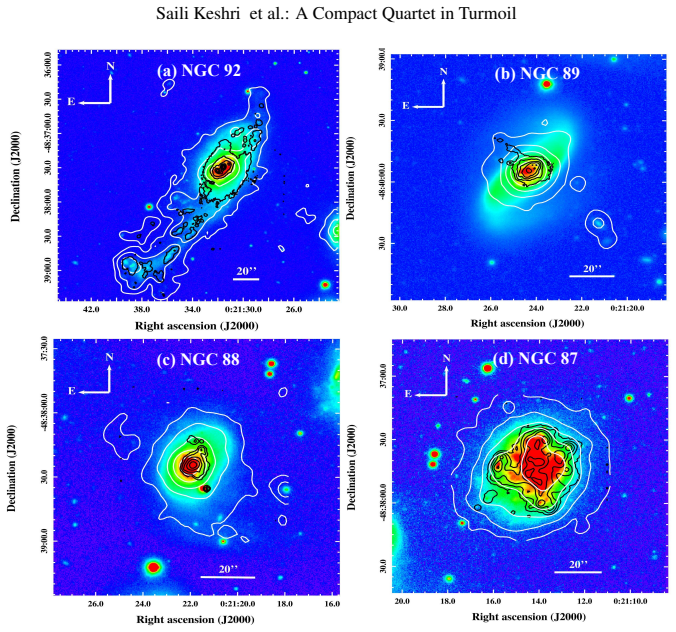
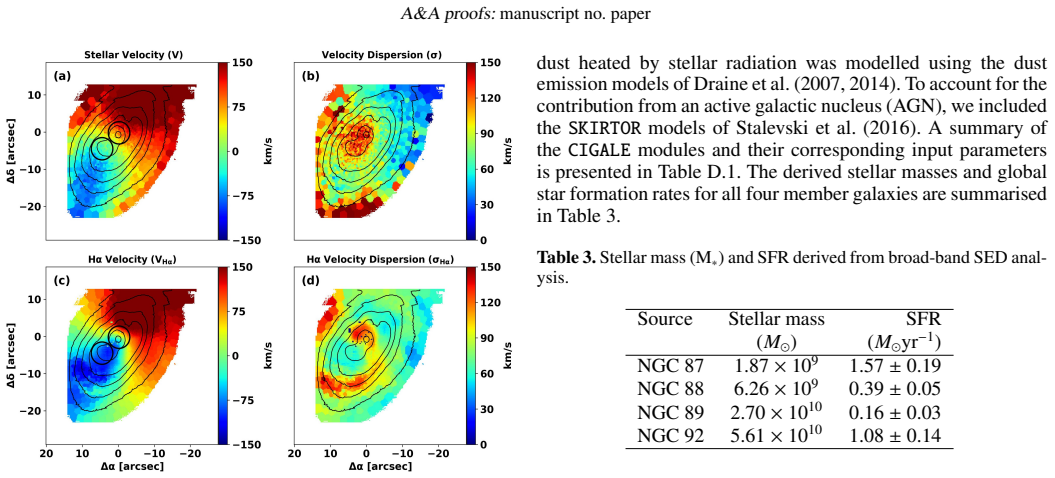
- All four galaxies display asymmetric structures and enhanced turbulence produced by repeated gravitational encounters.
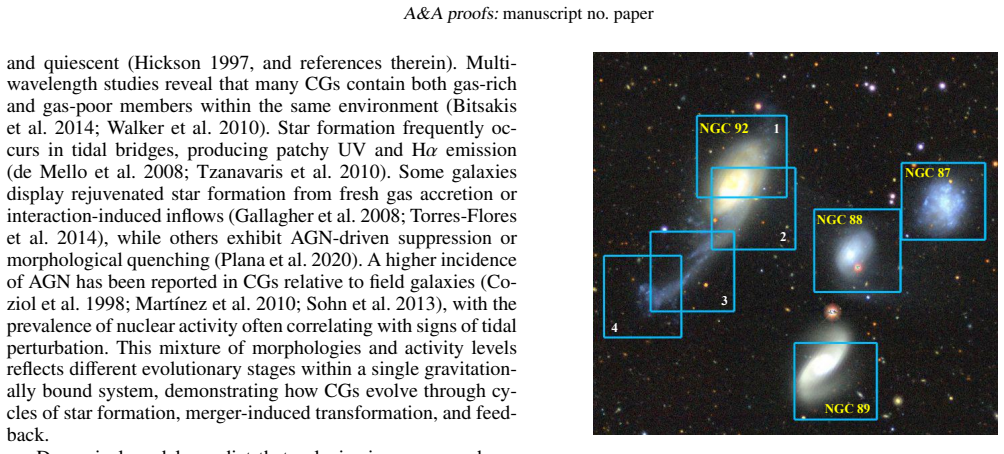
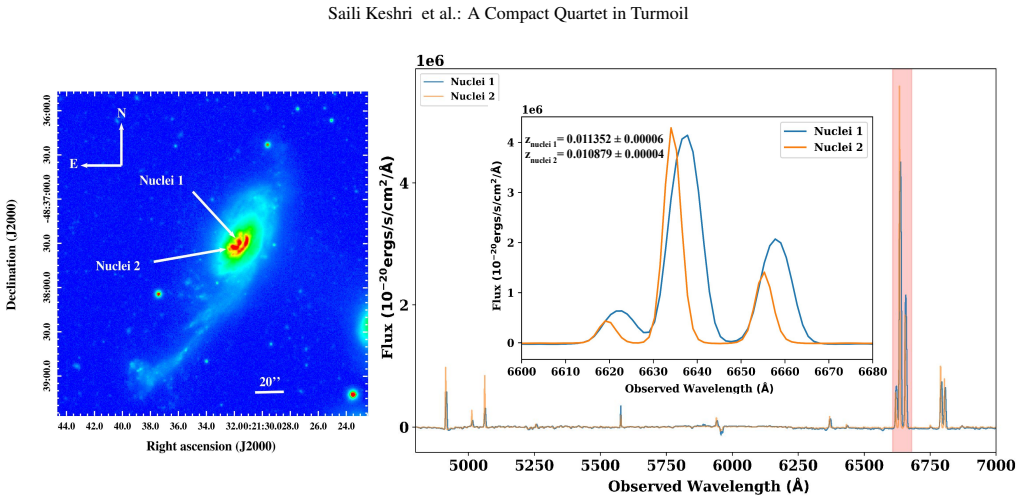
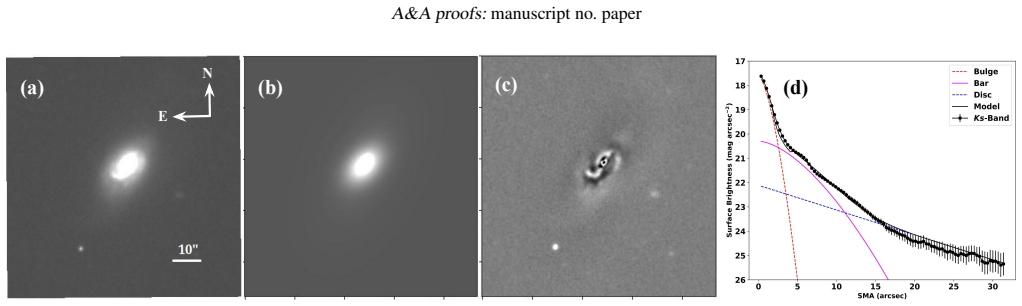
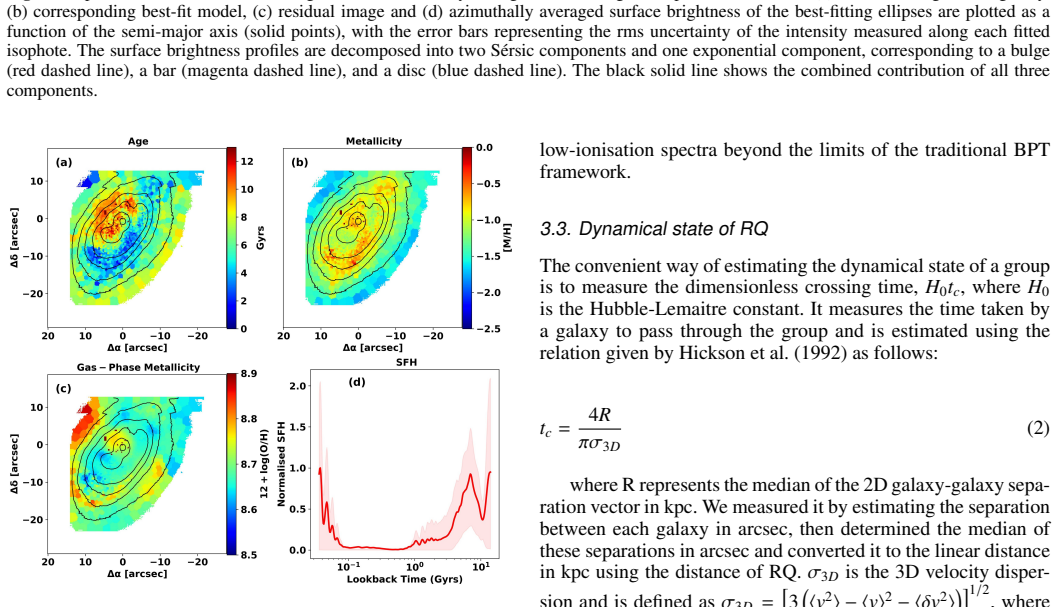
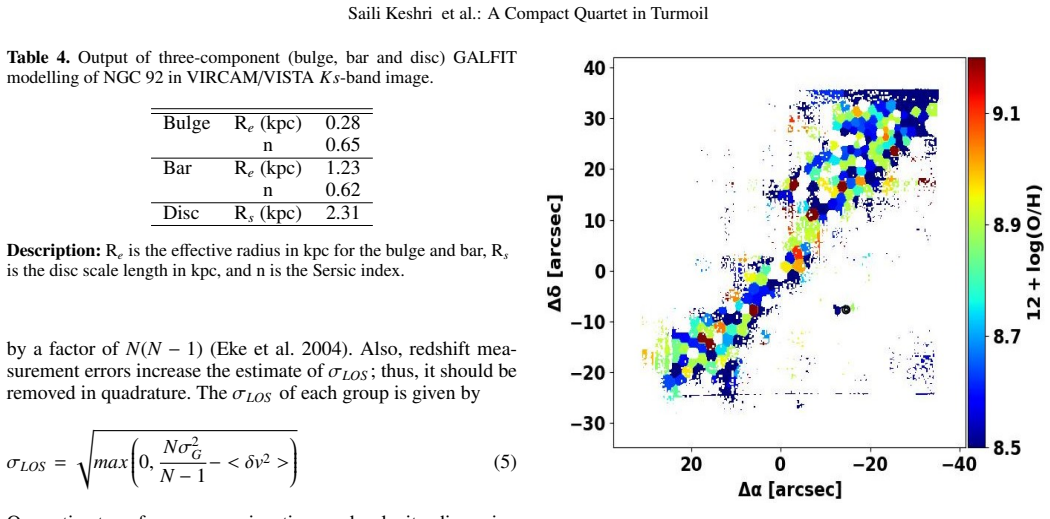
- The most massive member, NGC 92, has tidal tails, a bar, and ring-like star-forming regions fed by interaction-driven gas inflows.
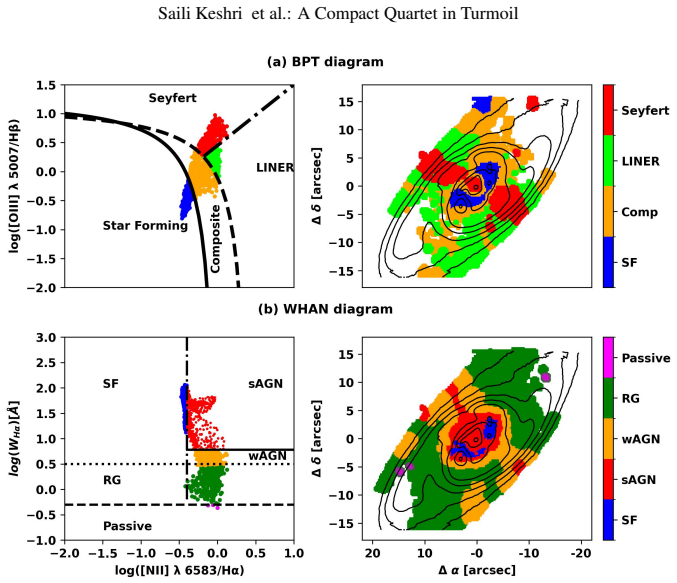
- NGC 89 shows reduced star formation accompanied by signatures of AGN-driven feedback.
- The two lower-mass members exhibit boosted star formation and stellar-gas kinematic decoupling consistent with recent gas accretion.
- The group's crossing time of 424 Myr matches the interaction timescale, reinforcing that assembly is still underway.
Where Pith is reading between the lines
- Compact groups observed at high redshift may likewise be products of multiple overlapping progenitors rather than simple pairwise mergers.
- Deeper integral-field spectroscopy could map any additional low-mass components that have not yet been counted among the four visible galaxies.
- The short interaction timescale supplies a local benchmark for testing how quickly feedback can quench or trigger star formation inside dense environments.
Load-bearing premise
The ultraviolet age estimates and non-parametric star-formation histories accurately record the timing of the most recent interactions without large systematic offsets from dust or modeling choices.
What would settle it
Finding that the dominant stellar populations in several galaxies formed more than 500 million years ago or that the group shows coherent rotation rather than repeated kinematic disturbances would undermine the young-assembly conclusion.
Figures
read the original abstract
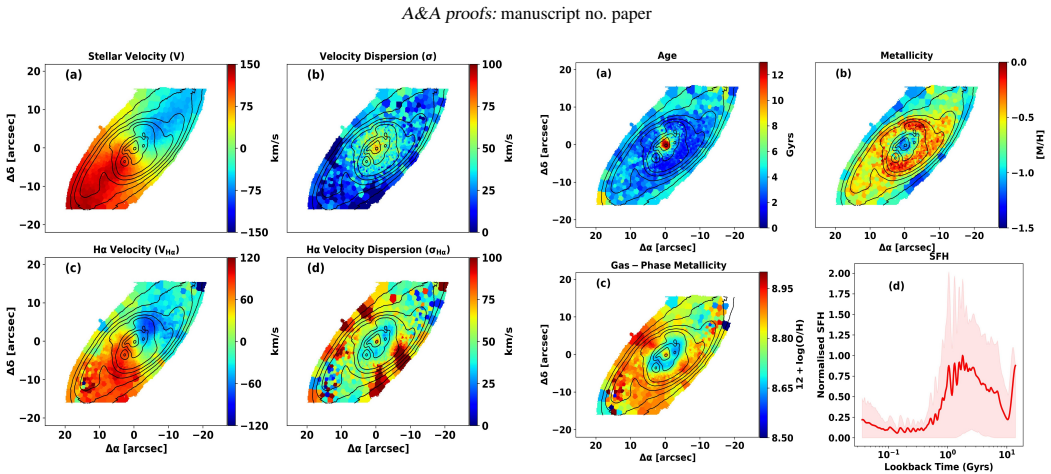
We present a spatially resolved multiwavelength study of the compact galaxy group Roberts Quartet (RQ, SCG0018-4854), aimed at understanding interaction-driven galaxy evolution in a dense environment. RQ comprises of four galaxies (NGC 87, NGC 88, NGC 89, and NGC 92) that span a range of masses and evolutionary states. Using UV-to-IR data from GALEX, DECaLS, MUSE/VLT (IFU), VISTA/VIRCAM, 2MASS, and WISE, we investigate the interplay between kinematics, star formation, and stellar populations across the group. The spatially resolved analysis reveals disturbed stellar and gas kinematics, enhanced turbulence, and asymmetric structures in all members, consistent with repeated gravitational interactions. The most massive galaxy, NGC 92, exhibits prominent tidal features, a bar, and ring-like star-forming structures, indicative of interaction-driven gas inflows. Another massive member, NGC 89, shows suppressed star formation and signatures of AGN-driven feedback, while the lower-mass galaxies NGC 88 and the dwarf galaxy NGC 87 display enhanced star formation and kinematic decoupling between stellar and gas component consistent with recent gas accretion. Combining UV age estimates with non-parametric star formation histories, we constrain the recent interaction timescale of the group to <= 500 Myr, whereas the crossing timescale is 424 Myr. These results indicate that RQ is a dynamically young system undergoing ongoing assembly, where interactions, gas exchange, and feedback processes are actively shaping galaxy evolution. The dynamical complexity of the group further suggests that its present configuration may involve more than four progenitor components. In this context, RQ provides a nearby analogue of compact, rapidly evolving groups observed at high redshift by recent JWST observations, offering a resolved view of the physical processes governing galaxy assembly in the early Universe.
Editorial analysis
A structured set of objections, weighed in public.
Referee Report
Summary. The manuscript presents a spatially resolved multiwavelength study of the compact galaxy group Roberts Quartet (SCG0018-4854) using UV-to-IR data from GALEX, DECaLS, MUSE/VLT IFU, VISTA/VIRCAM, 2MASS and WISE. It reports disturbed stellar and gas kinematics, asymmetric structures, enhanced turbulence, tidal features and ring-like star formation in NGC 92, suppressed SF with AGN feedback signatures in NGC 89, and enhanced SF with kinematic decoupling in the lower-mass members. Combining UV age estimates with non-parametric star formation histories, the authors constrain the recent interaction timescale to ≤500 Myr (crossing time 424 Myr) and conclude that RQ is a dynamically young system undergoing ongoing assembly, possibly involving more than four progenitors, and serves as a nearby analogue to high-redshift compact groups seen by JWST.
Significance. If the ≤500 Myr timescale holds, the work supplies a resolved, multiwavelength view of interaction-driven processes (gas exchange, feedback, kinematic disturbances) in a nearby compact group, directly relevant to interpreting JWST observations of high-redshift analogues. The combination of IFU kinematics with photometric SFHs is a methodological strength.
major comments (1)
- [Abstract] Abstract (timescale paragraph): the central claim that RQ is dynamically young and undergoing ongoing assembly within one crossing time rests on the interaction timescale being ≤500 Myr. The abstract supplies no error bars, dust-attenuation assumptions, SPS library choices, or quantitative SFH recovery details; without these, it is impossible to evaluate whether systematics in the non-parametric modeling could shift the most recent episode older than ~500 Myr and thereby weaken the dynamical-youth conclusion.
minor comments (2)
- [Abstract] Abstract: the statement that the present configuration 'may involve more than four progenitor components' is presented without citing the specific kinematic or morphological evidence (e.g., which galaxies show the decoupling or tidal features) that supports it.
- [Abstract] Abstract: quantitative measures such as velocity dispersion ratios, asymmetry indices, or SFR surface densities are not reported, making it difficult to gauge the strength of the 'enhanced turbulence' and 'disturbed kinematics' claims.
Simulated Author's Rebuttal
We thank the referee for their constructive feedback on our manuscript. We address the single major comment below and agree that revisions to the abstract will improve clarity and allow readers to better evaluate the central timescale claim.
read point-by-point responses
-
Referee: [Abstract] Abstract (timescale paragraph): the central claim that RQ is dynamically young and undergoing ongoing assembly within one crossing time rests on the interaction timescale being ≤500 Myr. The abstract supplies no error bars, dust-attenuation assumptions, SPS library choices, or quantitative SFH recovery details; without these, it is impossible to evaluate whether systematics in the non-parametric modeling could shift the most recent episode older than ~500 Myr and thereby weaken the dynamical-youth conclusion.
Authors: We agree that the abstract, as currently written, does not provide sufficient context on the uncertainties and modeling choices underlying the ≤500 Myr interaction timescale. The full manuscript contains the detailed non-parametric SFH analysis (including dust attenuation, SPS library, and recovery tests) that supports this constraint, but the abstract should be more self-contained to allow immediate evaluation of the dynamical-youth conclusion. We will revise the abstract to incorporate a concise statement on the estimated uncertainty range and key modeling assumptions while preserving length constraints. revision: yes
Circularity Check
No circularity in the derivation chain
full rationale
The paper is a purely observational multi-wavelength study of the Roberts Quartet. The central timescale bound (<=500 Myr interaction time from UV ages + non-parametric SFHs) is obtained by applying standard photometric fitting techniques to independent GALEX+optical+IR data; this quantity is not defined in terms of the dynamical-youth conclusion, nor is it a fitted parameter renamed as a prediction. The crossing time (424 Myr) is computed separately from kinematic data. No equations, self-citations, or ansatzes are shown that reduce any reported result to its own inputs by construction. The analysis is self-contained against external benchmarks.
Axiom & Free-Parameter Ledger
axioms (2)
- domain assumption Standard assumptions in UV-based stellar age dating and non-parametric star-formation-history reconstruction hold for the observed galaxies.
- domain assumption The observed kinematic disturbances and asymmetric structures are produced by gravitational interactions rather than internal processes or projection effects.
Reference graph
Works this paper leans on
-
[1]
and Accardo, M
Bacon, R. and Accardo, M. and Adjali, L. and Anwand, H. and Bauer, S. M. and Biswas, I. and Blaizot, J. and Boudon, D. and Brau-Nogue, S. and Caillier, P. and others , title =. Proc. SPIE , year =
-
[2]
Schlafly, E. F. and Finkbeiner, D. P. , title =. ApJ , year =
-
[3]
Schlegel, D. J. and Finkbeiner, D. P. and Davis, M. , title =. ApJ , year =
-
[4]
, title =
Hickson, P. , title =. ApJ , year =
-
[5]
and Mendes de Oliveira, C
Hickson, P. and Mendes de Oliveira, C. and Huchra, J. P. and Palumbo, G. G. , title =. ApJ , year =
-
[6]
Barnes, J. E. and Hernquist, L. , title =. Nature , year =
-
[7]
and Di Matteo, T
Springel, V. and Di Matteo, T. and Hernquist, L. , title =. MNRAS , year =
-
[8]
and Combes, F
Di Matteo, P. and Combes, F. and Melchior, A. L. and Semelin, B. , title =. A&A , year =
-
[9]
and Bournaud, F
Di Matteo, P. and Bournaud, F. and Martig, M. and Combes, F. and Melchior, A. L. and Semelin, B. , title =. A&A , year =
-
[10]
and Couch, W
Bekki, K. and Couch, W. J. , title =. MNRAS , year =
-
[11]
and Kaviraj, S
Scott, C. and Kaviraj, S. , title =. MNRAS , year =
-
[12]
and Charmandaris, V
Bitsakis, T. and Charmandaris, V. and da Cunha, E. and D. Compact groups of galaxies as laboratories of galaxy evolution , journal =. 2011 , volume =
2011
-
[13]
Weigel, A. K. and Schawinski, K. and Treister, E. and Trakhtenbrot, B. and Sanders, D. B. , title =. MNRAS , year =
-
[14]
and Yun, M
Verdes-Montenegro, L. and Yun, M. S. and Williams, B. A. and Huchtmeier, W. K. and Del Olmo, A. and Perea, J. , title =. A&A , year =
-
[15]
and Rosales-Ortega, F
Rodríguez-Baras, M. and Rosales-Ortega, F. F. and Díaz, A. I. and Sánchez, S. F. and Pasquali, A. , title =. MNRAS , year =
-
[16]
Bitsakis, T. and D. The mid-infrared view of compact groups of galaxies: evidence for accelerated evolution , journal =. 2014 , volume =
2014
-
[17]
Walker, L. M. and Johnson, K. E. and Gallagher, S. C. and Hibbard, J. E. and Hornschemeier, A. E. and Charlton, J. C. and Jarrett, T. H. and Reines, A. E. , title =. AJ , year =
-
[18]
de Mello, D. F. and Smith, L. J. and Sabbi, E. and Gallagher, J. S. and Mountain, M. and Harbeck, D. R. , title =. AJ , year =
-
[19]
and Gallagher, S
Tzanavaris, P. and Gallagher, S. C. and Hornschemeier, A. E. and Fedotov, K. and Basu-Zych, A. R. and Charlton, J. C. , title =. ApJ , year =
-
[20]
Gallagher, S. C. and Johnson, K. E. and Hornschemeier, A. E. and Charlton, J. C. and Hibbard, J. E. and Bastian, N. , title =. ApJ , year =
-
[21]
and Mendes de Oliveira, C
Torres-Flores, S. and Mendes de Oliveira, C. and Amram, P. and Plana, H. and Epinat, B. and Carignan, C. , title =. MNRAS , year =
-
[22]
and Amram, P
Plana, H. and Amram, P. and Mendes de Oliveira, C. and Torres-Flores, S. and Iglesias-Páramo, J. , title =. MNRAS , year =
-
[23]
and Ribeiro, A
Coziol, R. and Ribeiro, A. L. B. and de Carvalho, R. R. and Capelato, H. V. , title =. ApJ , year =
-
[24]
Martínez, M. A. and Del Olmo, A. and Coziol, R. and Perea, J. and Sulentic, J. W. and Verdes-Montenegro, L. , title =. AJ , year =
-
[25]
and Hwang, H
Sohn, J. and Hwang, H. S. and Lee, M. G. and Lee, G.-H. and Lee, J. C. and Lee, S.-K. , title =. ApJ , year =
-
[26]
The Calibration and Data Products of GALEX. , keywords =. doi:10.1086/520512 , archivePrefix =. 0706.0755 , primaryClass =
-
[27]
The Galaxy Evolution Explorer: A Space Ultraviolet Survey Mission
The Galaxy Evolution Explorer: A Space Ultraviolet Survey Mission. , keywords =. doi:10.1086/426387 , archivePrefix =. astro-ph/0411302 , primaryClass =
work page internal anchor Pith review Pith/arXiv arXiv doi:10.1086/426387
-
[28]
Overview of the DESI Legacy Imaging Surveys
Overview of the DESI Legacy Imaging Surveys. , keywords =. doi:10.3847/1538-3881/ab089d , archivePrefix =. 1804.08657 , primaryClass =
work page internal anchor Pith review Pith/arXiv arXiv doi:10.3847/1538-3881/ab089d
-
[29]
7735, Ground-based and Airborne Instrumentation for Astronomy III, ed
The MUSE second-generation VLT instrument. Ground-based and Airborne Instrumentation for Astronomy III , year = 2010, editor =. doi:10.1117/12.856027 , archivePrefix =. 2211.16795 , primaryClass =
-
[30]
The Two Micron All Sky Survey (2MASS). , keywords =. doi:10.1086/498708 , adsurl =
-
[31]
, archivePrefix = "arXiv", eprint =
The Wide-field Infrared Survey Explorer (WISE): Mission Description and Initial On-orbit Performance. , keywords =. doi:10.1088/0004-6256/140/6/1868 , archivePrefix =. 1008.0031 , primaryClass =
work page internal anchor Pith review Pith/arXiv arXiv doi:10.1088/0004-6256/140/6/1868
-
[32]
CIGALE: a python Code Investigating GALaxy Emission
CIGALE: a python Code Investigating GALaxy Emission. , keywords =. doi:10.1051/0004-6361/201834156 , archivePrefix =. 1811.03094 , primaryClass =
work page internal anchor Pith review Pith/arXiv arXiv doi:10.1051/0004-6361/201834156
-
[33]
Stellar population synthesis at the resolution of 2003. , keywords =. doi:10.1046/j.1365-8711.2003.06897.x , archivePrefix =. astro-ph/0309134 , primaryClass =
-
[34]
, year = 1955, month = jan, volume =
The Luminosity Function and Stellar Evolution. , year = 1955, month = jan, volume =. doi:10.1086/145971 , adsurl =
-
[35]
Dust Masses, PAH Abundances, and Starlight Intensities in the SINGS Galaxy Sample
Dust Masses, PAH Abundances, and Starlight Intensities in the SINGS Galaxy Sample. , keywords =. doi:10.1086/518306 , archivePrefix =. astro-ph/0703213 , primaryClass =
work page internal anchor Pith review Pith/arXiv arXiv doi:10.1086/518306
-
[36]
Andromeda's Dust. , keywords =. doi:10.1088/0004-637X/780/2/172 , archivePrefix =. 1306.2304 , primaryClass =
work page internal anchor Pith review Pith/arXiv arXiv doi:10.1088/0004-637x/780/2/172
-
[37]
The dust covering factor in active galactic nuclei
The dust covering factor in active galactic nuclei. , keywords =. doi:10.1093/mnras/stw444 , archivePrefix =. 1602.06954 , primaryClass =
work page internal anchor Pith review Pith/arXiv arXiv doi:10.1093/mnras/stw444
-
[38]
The Dust Content and Opacity of Actively Star-Forming Galaxies
The Dust Content and Opacity of Actively Star-forming Galaxies. , keywords =. doi:10.1086/308692 , archivePrefix =. astro-ph/9911459 , primaryClass =
work page internal anchor Pith review Pith/arXiv arXiv doi:10.1086/308692
-
[39]
The GIST pipeline: A multi-purpose tool for the analysis and visualisation of (integral-field) spectroscopic data. , keywords =. 2019. doi:10.1051/0004-6361/201935829 , archivePrefix =. 1906.04746 , primaryClass =
-
[40]
MNRAS submitted , eprint =
Full spectrum fitting with photometry in ppxf: non-parametric star formation history, metallicity and the quenching boundary from 3200 LEGA-C galaxies at redshift z 0.8. MNRAS submitted , eprint =
-
[41]
Parametric Recovery of Line-of-Sight Velocity Distributions from Absorption-Line Spectra of Galaxies via Penalized Likelihood. , keywords =. doi:10.1086/381875 , archivePrefix =. astro-ph/0312201 , primaryClass =
work page internal anchor Pith review Pith/arXiv arXiv doi:10.1086/381875
-
[42]
Improving the full spectrum fitting method: accurate convolution with Gauss-Hermite functions
Improving the full spectrum fitting method: accurate convolution with Gauss-Hermite functions. , keywords =. doi:10.1093/mnras/stw3020 , archivePrefix =. 1607.08538 , primaryClass =
work page internal anchor Pith review Pith/arXiv arXiv doi:10.1093/mnras/stw3020
-
[43]
Adaptive spatial binning of integral-field spectroscopic data using Voronoi tessellations. , keywords =. doi:10.1046/j.1365-8711.2003.06541.x , archivePrefix =. astro-ph/0302262 , primaryClass =
-
[44]
The SAURON project - V. Integral-field emission-line kinematics of 48 elliptical and lenticular galaxies. , keywords =. doi:10.1111/j.1365-2966.2005.09839.x , archivePrefix =. astro-ph/0511307 , primaryClass =
-
[45]
The SAURON project - VII. Integral-field absorption and emission-line kinematics of 24 spiral galaxy bulges. , keywords =. doi:10.1111/j.1365-2966.2006.10261.x , archivePrefix =. astro-ph/0603161 , primaryClass =
-
[46]
Galaxies within galaxies in the TIMER survey: stellar populations of inner bars are scaled replicas of main bars. , keywords =. doi:10.1051/0004-6361/202039505 , archivePrefix =. 2012.04661 , primaryClass =
-
[47]
Compact Groups of Galaxies. , keywords =. doi:10.1146/annurev.astro.35.1.357 , archivePrefix =. astro-ph/9710289 , primaryClass =
work page internal anchor Pith review Pith/arXiv arXiv doi:10.1146/annurev.astro.35.1.357
-
[48]
Dynamical Properties of Compact Groups of Galaxies. , keywords =. doi:10.1086/171932 , adsurl =
-
[49]
Systematic properties of compact groups of galaxies. , keywords =. doi:10.1086/159838 , adsurl =
-
[50]
The merger rate of galaxies in the Illustris simulation: a comparison with observations and semi-empirical models. , keywords =. doi:10.1093/mnras/stv264 , archivePrefix =. 1502.01339 , primaryClass =
work page internal anchor Pith review Pith/arXiv arXiv doi:10.1093/mnras/stv264
-
[51]
Modelling feedback from stars and black holes in galaxy mergers. , keywords =. doi:10.1111/j.1365-2966.2005.09238.x , archivePrefix =. astro-ph/0411108 , primaryClass =
-
[52]
Star Formation and AGN Activity in Interacting Galaxies: A Near-UV Perspective
Star formation and AGN activity in interacting galaxies: a near-UV perspective. , keywords =. doi:10.1093/mnras/stt2014 , archivePrefix =. 1310.5148 , primaryClass =
work page internal anchor Pith review Pith/arXiv arXiv doi:10.1093/mnras/stt2014
-
[53]
The fraction of AGN in major merger galaxies and its luminosity dependence
The fraction of AGNs in major merger galaxies and its luminosity dependence. , keywords =. doi:10.1093/mnras/sty383 , archivePrefix =. 1802.04277 , primaryClass =
work page internal anchor Pith review Pith/arXiv arXiv doi:10.1093/mnras/sty383
-
[54]
Formation of dwarf galaxies in tidal tails. , keywords =. doi:10.1038/360715a0 , adsurl =
-
[55]
Star formation efficiency in galaxy interactions and mergers: a statistical study
Star formation efficiency in galaxy interactions and mergers: a statistical study. , keywords =. doi:10.1051/0004-6361:20066959 , archivePrefix =. astro-ph/0703212 , primaryClass =
work page internal anchor Pith review Pith/arXiv arXiv doi:10.1051/0004-6361:20066959
-
[56]
On the frequency, intensity, and duration of starburst episodes triggered by galaxy interactions and mergers. , keywords =. doi:10.1051/0004-6361:200809480 , archivePrefix =. 0809.2592 , primaryClass =
work page internal anchor Pith review Pith/arXiv arXiv doi:10.1051/0004-6361:200809480
-
[57]
Dust emission and star formation in Stephan's Quintet
Dust Emission and Star Formation in Stephan's Quintet. , keywords =. doi:10.1088/0004-637X/725/1/955 , archivePrefix =. 1010.1227 , primaryClass =
work page internal anchor Pith review Pith/arXiv arXiv doi:10.1088/0004-637x/725/1/955
-
[58]
A study of the ionized gas in Stephan's Quintet from integral field spectroscopy observations
A study of the ionized gas in Stephan's Quintet from integral field spectroscopy observations★. , keywords =. doi:10.1093/mnras/stu851 , archivePrefix =. 1405.0880 , primaryClass =
work page internal anchor Pith review Pith/arXiv arXiv doi:10.1093/mnras/stu851
-
[59]
Gas dynamics in dwarf galaxies as testbeds for dark matter and galaxy evolution. Nature Astronomy , keywords =. doi:10.1038/s41550-021-01562-2 , archivePrefix =. 2201.11752 , primaryClass =
-
[60]
A Catalog of Neighboring Galaxies. , keywords =. doi:10.1086/382905 , adsurl =
-
[61]
Star Forming Dwarf Galaxies
Bergvall, Nils. Star Forming Dwarf Galaxies. Dwarf Galaxies: Keys to Galaxy Formation and Evolution. 2012
2012
-
[62]
The Star Formation Histories of Local Group Dwarf Galaxies. I. Hubble Space Telescope/Wide Field Planetary Camera 2 Observations. , keywords =. doi:10.1088/0004-637X/789/2/147 , archivePrefix =. 1404.7144 , primaryClass =
work page internal anchor Pith review Pith/arXiv arXiv doi:10.1088/0004-637x/789/2/147
-
[63]
The Star Formation Histories of Local Group Dwarf Galaxies. II. Searching For Signatures of Reionization. , keywords =. doi:10.1088/0004-637X/789/2/148 , archivePrefix =. 1405.3281 , primaryClass =
work page internal anchor Pith review Pith/arXiv arXiv doi:10.1088/0004-637x/789/2/148
-
[64]
Starbursts and Star Clusters in the Ultraviolet
Starbursts and Star Clusters in the Ultraviolet. , keywords =. doi:10.1086/117721 , archivePrefix =. astro-ph/9509038 , primaryClass =
work page internal anchor Pith review Pith/arXiv arXiv doi:10.1086/117721
-
[65]
SExtractor: Software for source extraction. , keywords =. doi:10.1051/aas:1996164 , adsurl =
-
[66]
Starburst99: Synthesis Models for Galaxies with Active Star Formation
Starburst99: Synthesis Models for Galaxies with Active Star Formation. , keywords =. doi:10.1086/313233 , archivePrefix =. astro-ph/9902334 , primaryClass =
work page internal anchor Pith review Pith/arXiv arXiv doi:10.1086/313233
-
[67]
The Relationship between Infrared, Optical, and Ultraviolet Extinction. , keywords =. doi:10.1086/167900 , adsurl =
-
[68]
Star Formation in Galaxies Along the Hubble Sequence
Star Formation in Galaxies Along the Hubble Sequence. , keywords =. doi:10.1146/annurev.astro.36.1.189 , archivePrefix =. astro-ph/9807187 , primaryClass =
work page internal anchor Pith review Pith/arXiv arXiv doi:10.1146/annurev.astro.36.1.189
-
[69]
The Star Formation Efficiency in Nearby Galaxies: Measuring Where Gas Forms Stars Effectively
The Star Formation Efficiency in Nearby Galaxies: Measuring Where Gas Forms Stars Effectively. , keywords =. doi:10.1088/0004-6256/136/6/2782 , archivePrefix =. 0810.2556 , primaryClass =
work page internal anchor Pith review Pith/arXiv arXiv doi:10.1088/0004-6256/136/6/2782
-
[70]
ISM excitation and metallicity of star-forming galaxies at z~3.3 from near-IR spectroscopy
ISM Excitation and Metallicity of Star-forming Galaxies at z ≃ 3.3 from Near-IR Spectroscopy. , keywords =. doi:10.3847/0004-637X/822/1/42 , archivePrefix =. 1602.02779 , primaryClass =
work page internal anchor Pith review Pith/arXiv arXiv doi:10.3847/0004-637x/822/1/42
-
[71]
GAMA/H-ATLAS: a meta-analysis of SFR indicators - comprehensive measures of the SFR-M _ * relation and cosmic star formation history at z < 0.4. , keywords =. doi:10.1093/mnras/stw1342 , archivePrefix =. 1606.06299 , primaryClass =
work page internal anchor Pith review Pith/arXiv arXiv doi:10.1093/mnras/stw1342
-
[72]
Dust-corrected Star Formation Rates of Galaxies. I. Combinations of H and Infrared Tracers. , keywords =. doi:10.1088/0004-637X/703/2/1672 , archivePrefix =. 0908.0203 , primaryClass =
work page internal anchor Pith review Pith/arXiv arXiv doi:10.1088/0004-637x/703/2/1672
-
[73]
Dust-corrected Star Formation Rates of Galaxies. II. Combinations of Ultraviolet and Infrared Tracers. , keywords =. doi:10.1088/0004-637X/741/2/124 , archivePrefix =. 1108.2837 , primaryClass =
work page internal anchor Pith review Pith/arXiv arXiv doi:10.1088/0004-637x/741/2/124
-
[74]
Dust Extinction of the Stellar Continua in Starburst Galaxies: The Ultraviolet and Optical Extinction Law. , keywords =. doi:10.1086/174346 , adsurl =
-
[75]
The HDUV Survey: A Revised Assessment of the Relationship between UV Slope and Dust Attenuation for High-redshift Galaxies. , keywords =. doi:10.3847/1538-4357/aaa3e7 , archivePrefix =. 1705.09302 , primaryClass =
work page internal anchor Pith review Pith/arXiv arXiv doi:10.3847/1538-4357/aaa3e7
-
[76]
Velocity Dispersion Profiles of Seven Dwarf Spheroidal Galaxies
Velocity Dispersion Profiles of Seven Dwarf Spheroidal Galaxies. , keywords =. doi:10.1086/521998 , archivePrefix =. 0708.0010 , primaryClass =
work page internal anchor Pith review Pith/arXiv arXiv doi:10.1086/521998
-
[77]
A Large Stellar Evolution Database for Population Synthesis Studies. I. Scaled Solar Models and Isochrones. , keywords =. doi:10.1086/422498 , archivePrefix =. astro-ph/0405193 , primaryClass =
work page internal anchor Pith review Pith/arXiv arXiv doi:10.1086/422498
-
[78]
A Large Stellar Evolution Database for Population Synthesis Studies. II. Stellar Models and Isochrones for an -enhanced Metal Distribution. , keywords =. doi:10.1086/501344 , archivePrefix =. astro-ph/0603721 , primaryClass =
work page internal anchor Pith review Pith/arXiv arXiv doi:10.1086/501344
-
[79]
A Large Stellar Evolution Database for Population Synthesis Studies. V. Stellar Models and Isochrones with CNONa Abundance Anticorrelations. , keywords =. doi:10.1088/0004-637X/697/1/275 , archivePrefix =. 0903.0825 , primaryClass =
work page internal anchor Pith review Pith/arXiv arXiv doi:10.1088/0004-637x/697/1/275
-
[80]
The BaSTI Stellar Evolution Database: models for extremely metal-poor and super-metal-rich stellar populations. , keywords =. doi:10.1051/0004-6361/201321950 , archivePrefix =. 1308.3850 , primaryClass =
work page internal anchor Pith review Pith/arXiv arXiv doi:10.1051/0004-6361/201321950
discussion (0)
Sign in with ORCID, Apple, or X to comment. Anyone can read and Pith papers without signing in.