Precision Solar System Dynamics for Ultralight Dark Matter Search
Pith reviewed 2026-07-02 18:53 UTC · model grok-4.3
The pith
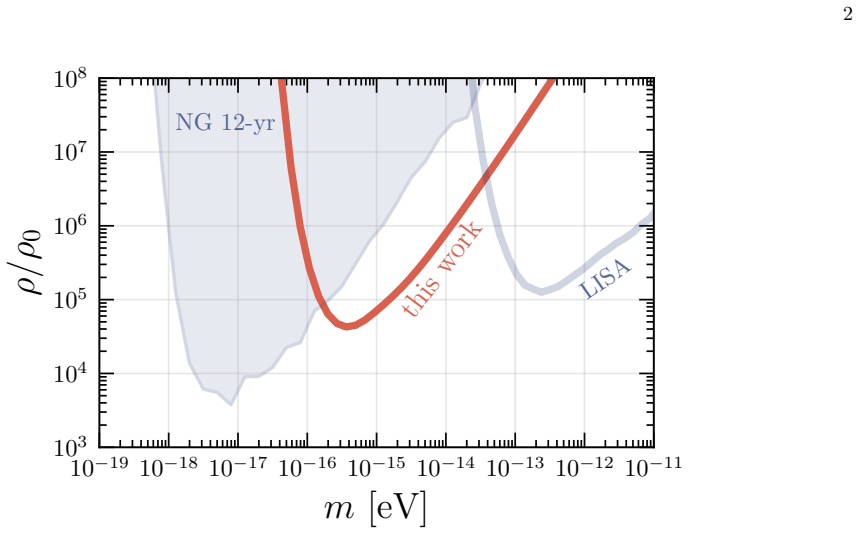
Precision radio range measurements can detect ultralight dark matter at masses of 10^{-15} eV if its density in the solar system is 10^5 times the local value.
A machine-rendered reading of the paper's core claim, the machinery that carries it, and where it could break.
Core claim
Ultralight dark matter exhibits order-one density fluctuations at the scale of its wavelength that interact gravitationally with stars and planets, perturbing their motion. The precision of current interplanetary radio range measurements can probe such dark matter at masses around 10^{-15} eV provided its density in the solar system is 10^5 times larger than the local dark matter density. This limit complements constraints from pulsar timing observations.
What carries the argument
Gravitational perturbations to solar system orbits from ultralight dark matter density fluctuations, measured via interplanetary radio ranging.
If this is right
- The method can set new constraints on ultralight dark matter in the 10^{-15} eV mass range under the stated density condition.
- It offers a complementary probe to pulsar timing array analyses.
- Existing range data already has the sensitivity for this search if the density enhancement holds.
- Such a detection would indicate significant local overdensities of ultralight dark matter.
Where Pith is reading between the lines
- Future higher-precision ranging could reduce the required density boost needed for detection.
- This technique might apply to other solar system objects like asteroids for additional sensitivity.
- Confirmation would require verifying that the density fluctuations are indeed order-one at the relevant scales.
- It connects solar system tests to broader questions of dark matter distribution in galaxies.
Load-bearing premise
That ultralight dark matter produces order-one density fluctuations at its wavelength scale which gravitationally perturb solar system bodies in a way that current radio range precision can detect.
What would settle it
Finding no anomalous residuals in the interplanetary range data at the amplitude predicted for the enhanced-density ultralight dark matter scenario at 10^{-15} eV.
Figures
read the original abstract
Ultralight dark matter exhibits an order-one density fluctuation at the scale of its wavelength. This density fluctuation exists across the entire dark matter halo and interacts with stars and planets, perturbing their motion via gravitational interactions. We investigate the possibility of using precision solar system dynamics to search for ultralight dark matter. We examine this possibility with interplanetary radio range measurements. We show that the precision of current range measurements can probe ultralight dark matter at masses around $10^{-15}\,$eV, had its density in the solar system been $10^5$ larger than the so-called local dark matter density. This limit complements other constraints, such as the one from analyses of pulsar timing observations.
Editorial analysis
A structured set of objections, weighed in public.
Referee Report
Summary. The paper claims that ultralight dark matter produces order-one density fluctuations on its de Broglie wavelength scale that gravitationally perturb solar-system bodies, and that current interplanetary radio ranging precision can therefore probe ULDM masses around 10^{-15} eV provided the local ULDM density is 10^5 times the galactic value. The result is presented as a conditional forward sensitivity estimate that complements pulsar-timing constraints.
Significance. If the underlying sensitivity calculation holds, the work would illustrate a novel use of existing solar-system data for ULDM searches. The conditional phrasing on the density enhancement, however, limits the result's immediate reach; the approach relies on standard ULDM fluctuation statistics but adds no new data or model-independent prediction.
major comments (2)
- [Abstract] Abstract: the sensitivity claim (m ~ 10^{-15} eV for 10^5 density enhancement) is stated without derivation, error propagation, or explicit mapping from range precision to ULDM parameters. This calculation is load-bearing for the central claim and must be supplied in the main text.
- [Main text (method/results)] The manuscript provides no quantitative estimate of the gravitational perturbation amplitude, the relevant orbital elements affected, or the statistical treatment of the ranging residuals under the assumed ULDM density field.
minor comments (1)
- [Abstract] The conditional phrasing in the abstract is clear but could be repeated in the introduction for emphasis.
Simulated Author's Rebuttal
We thank the referee for their careful review and for identifying the need for explicit derivations supporting the sensitivity claim. We agree that these calculations are central to the paper and will be added to the main text in revision.
read point-by-point responses
-
Referee: [Abstract] Abstract: the sensitivity claim (m ~ 10^{-15} eV for 10^5 density enhancement) is stated without derivation, error propagation, or explicit mapping from range precision to ULDM parameters. This calculation is load-bearing for the central claim and must be supplied in the main text.
Authors: We agree that the abstract presents the result without the supporting derivation. In the revised manuscript we will supply the full quantitative mapping in the main text, including the gravitational perturbation amplitude from order-one ULDM density fluctuations, the conversion from interplanetary range precision to ULDM mass and density, and the associated error propagation. This will be presented as an expanded methods section so that the sensitivity estimate is fully traceable. revision: yes
-
Referee: [Main text (method/results)] The manuscript provides no quantitative estimate of the gravitational perturbation amplitude, the relevant orbital elements affected, or the statistical treatment of the ranging residuals under the assumed ULDM density field.
Authors: We acknowledge that the current text does not contain these quantitative details. The revision will add explicit estimates of the perturbation amplitude induced by the ULDM density fluctuations, specify the orbital elements most directly constrained by radio ranging, and describe the statistical treatment of the residuals under the assumed density field. These additions will substantiate the conditional sensitivity result. revision: yes
Circularity Check
No significant circularity
full rationale
The paper's central result is a conditional forward sensitivity estimate: current interplanetary radio ranging precision would reach m ≈ 10^{-15} eV ULDM if the local density were 10^5 times the galactic value. This rests on the standard de Broglie-scale O(1) density fluctuation property of ULDM (λ_db = 2π ħ / (m v)) and Newtonian gravitational perturbation of solar-system orbits. No equation or claim reduces to a fitted parameter renamed as prediction, a self-definitional loop, or a load-bearing self-citation chain. The conditional phrasing explicitly avoids deriving the density enhancement. The derivation chain is therefore self-contained against external benchmarks and receives the default non-circularity finding.
Axiom & Free-Parameter Ledger
axioms (1)
- domain assumption Ultralight dark matter exhibits an order-one density fluctuation at the scale of its wavelength across the entire dark matter halo.
Reference graph
Works this paper leans on
-
[1]
x2Yss4Ao33VjZMGfP0SM+3UaJ/k=
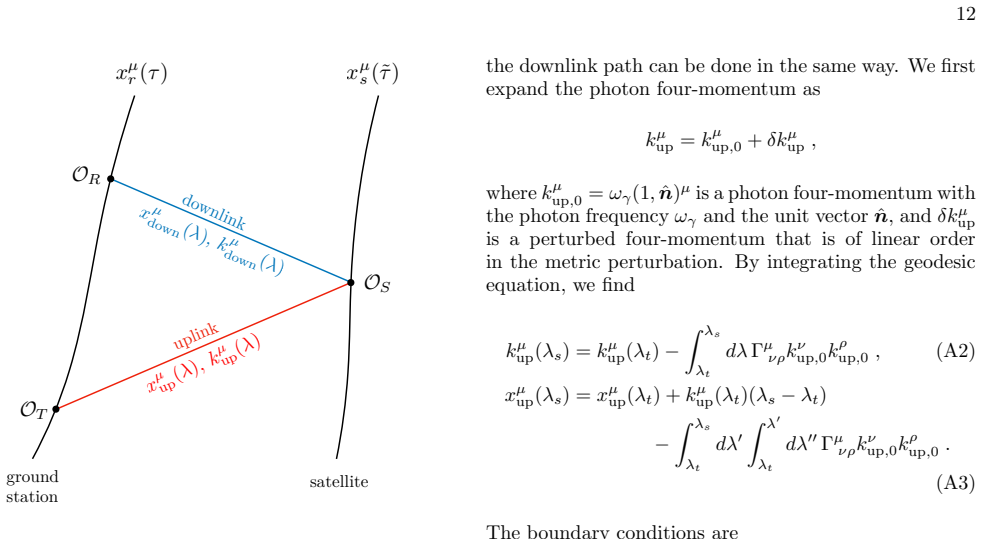
Signal Derivation Consider the following setup: a radio wave is trans- mitted at the ground station at its proper timeτ t. This proper time corresponds to coordinate timet t, and the affine parameter of the photonλ t. The radio wave reaches the satellite att s, and the transponder sends the signal back to the ground station. This downlink signal 12 uplink...
-
[2]
Repetition of the same computation for the downlink signal results in a similar expression for t−t s
We also used the boundary con- ditions (A4)–(A5). Repetition of the same computation for the downlink signal results in a similar expression for t−t s. Combining all terms, we find ∆L(τ) = ∆L O(τ) + ∆LS(τ) + ∆LE(τ),(A8) where each term represents the dark matter induced fluc- 13 tuations in the two-way range measurements: ∆LO = 1 2 ˆn· (xs(ts)−x r(tt)) + ...
-
[3]
Signal Spectrum In this subsection, we present detailed computations of the signal power spectrum. The goal of this Appendix is to characterize the signal in terms of a one-sided power spectrum, defined as g∆La(f)g∆L ∗ b(f ′) = 1 2 δ(f−f ′)Σab(f),(A12) where the subscriptaindexes different two-way range measurements. We will compute the signal power spec-...
-
[4]
For simplicity, we consider each planetary system (so, for example, Saturn and all its moons) as a single object, with the exception of Earth, where the moon is modeled separately
Solar System Dynamics The simulation accounts for the major solar system objects: the sun, the eight planets from Mercury to Nep- tune, and the Earth’s moon. For simplicity, we consider each planetary system (so, for example, Saturn and all its moons) as a single object, with the exception of Earth, where the moon is modeled separately. All objectsiare as...
-
[5]
Ultralight Dark Matter Let us now consider the ULDM fieldϕ(r, t) with mass mand velocity dispersionσas introduced at the begin- ning of Sec. II. Let us further introduce the corresponding wavelength asλ DM = 1/mσand momentum dispersion asσ k =mσ. We numerically compute the density across a three- dimensional grid of sizeN 3 and dimensionV=L 3. The dimensi...
-
[6]
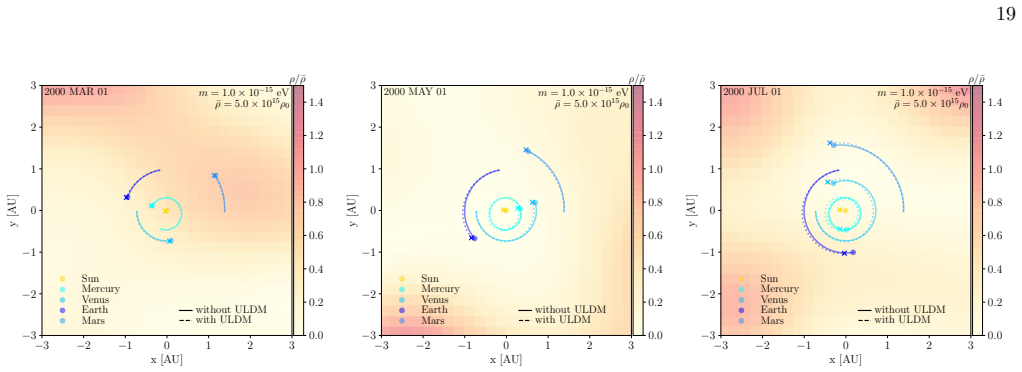
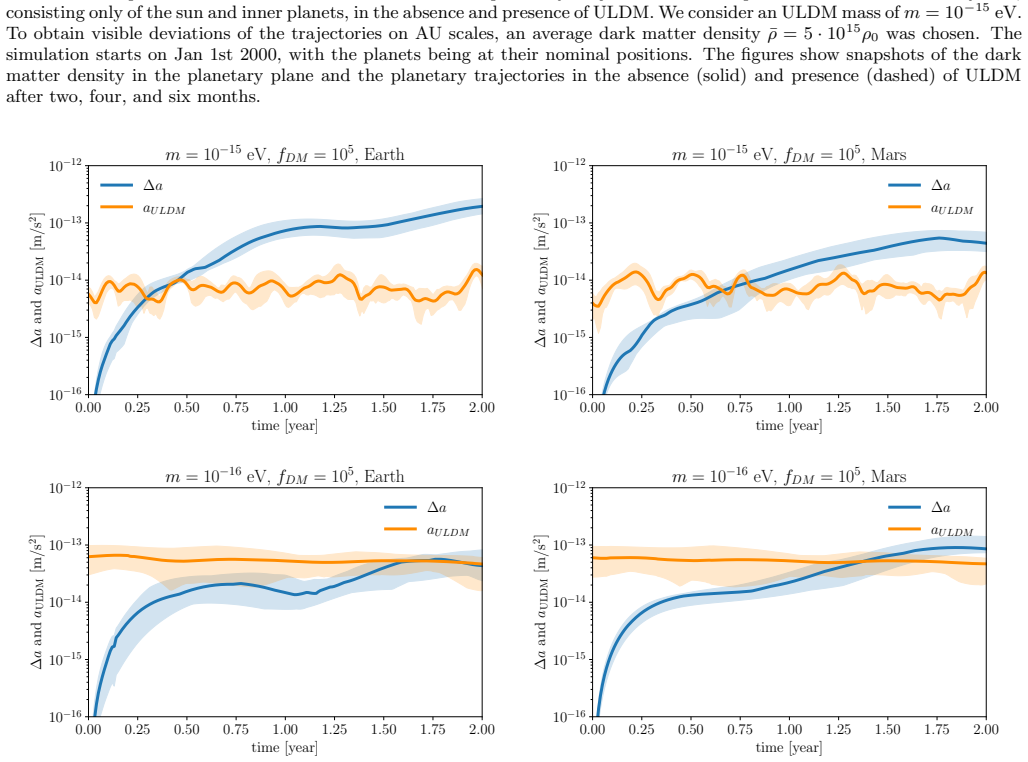
Simulation Results An example of planetary trajectories in the presence of ULDM obtained using the numerical simulation is shown in Fig. 5. Here we consider a ULDM candidate with mass m= 10 −15 eV and average densityρ= 5·10 15ρ0, and coefficients describing the initial state sampled according to their distributions. The color scale in the background shows...
-
[7]
The results for Earth-Venus, Earth-Jupiter, and Earth-Saturn agree with the analytic estimation at the relevant frequencies
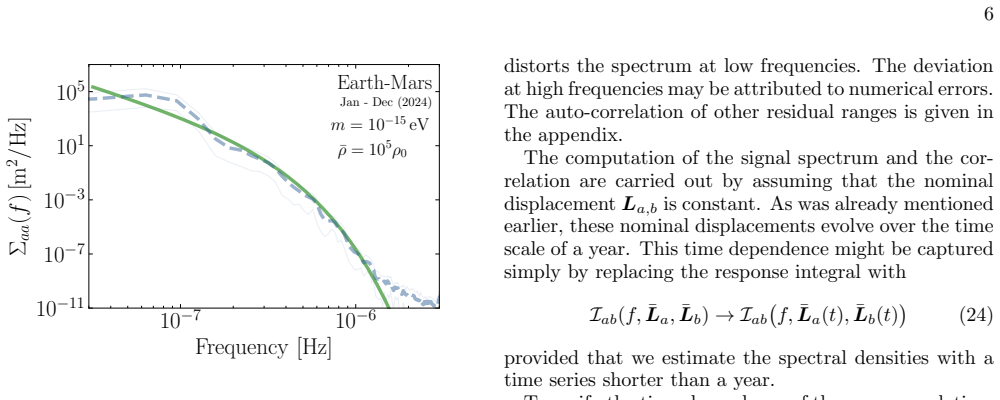
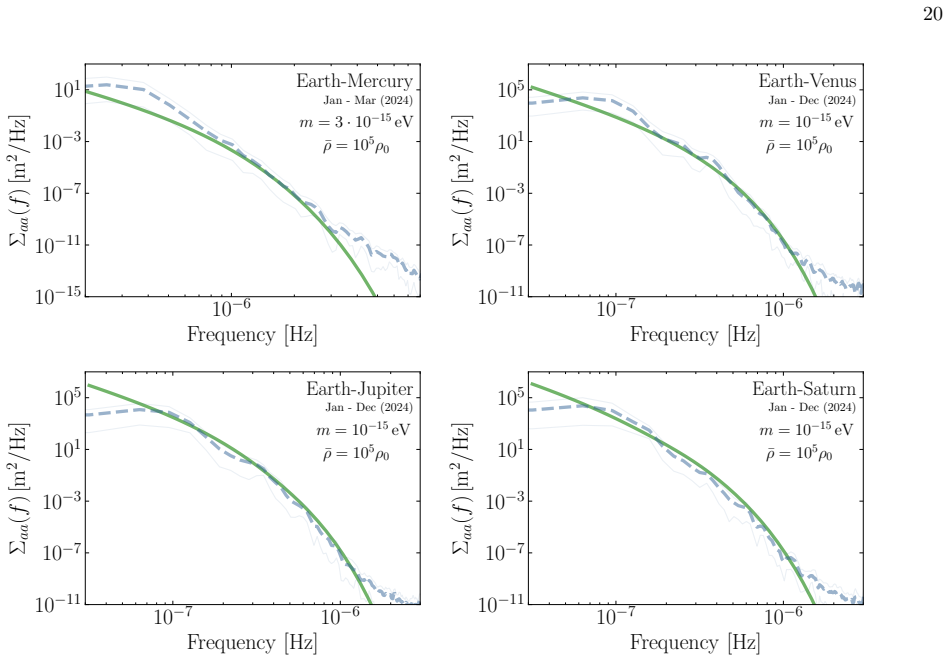
We follow the procedure described in the main text; we apply the window function withα= 4 to the residual range, detrend the series with a polynomial of degreen= 4, and construct the power spectrum from the discrete Fourier transformation of the resulting time series. The results for Earth-Venus, Earth-Jupiter, and Earth-Saturn agree with the analytic est...
2024
-
[8]
One of them represents the Earth, while the other two represent different planets
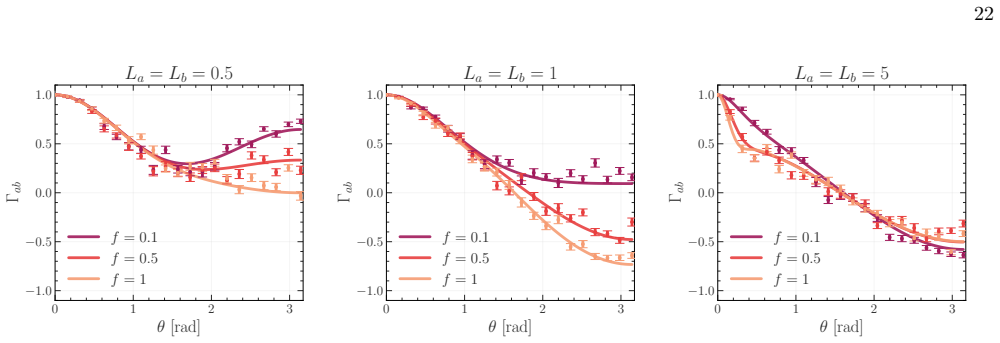
Free Particles We consider a simple scenario of three free particles. One of them represents the Earth, while the other two represent different planets. We refer to the one repre- 20 10−6 Frequency [Hz] 10−15 10−11 10−7 10−3 101 Σaa(f ) [m2/Hz] Earth-Mercury Jan - Mar (2024) m = 3 ·10−15 eV ¯ρ = 10 5ρ0 10−7 10−6 Frequency [Hz] 10−11 10−7 10−3 101 105 Σaa(...
2024
-
[9]
This is because the subtended angle constantly changes in time
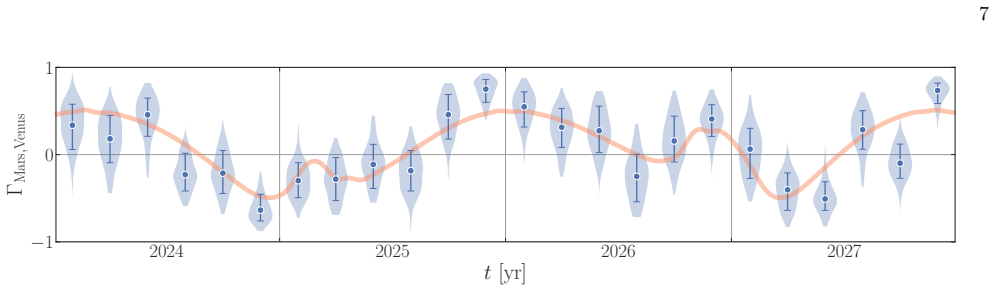
Orbiting Particles The systematic investigation of the correlation coef- ficient as a function of angle is cumbersome when the particles are orbiting around the Sun. This is because the subtended angle constantly changes in time. For this reason, in the main text, we present the correlation coef- ficient as a function of time, not as a function of angle. ...
2024
-
[10]
Small-scale structure of fuzzy and axion-like dark matter,
J. C. Niemeyer, “Small-scale structure of fuzzy and axion-like dark matter,”arXiv:1912.07064 [astro-ph.CO]
-
[11]
Hui,Wave Dark Matter,Annual Review of Astronomy and Astrophysics59(2021) 247 [2101.11735]
L. Hui, “Wave Dark Matter,”Ann. Rev. Astron. Astrophys.59(2021) 247–289,arXiv:2101.11735 [astro-ph.CO]
-
[12]
Cosmology of axion dark matter,
C. A. J. O’Hare, “Cosmology of axion dark matter,” PoSCOSMICWISPers(2024) 040, arXiv:2403.17697 [hep-ph]
-
[13]
Ultralight fuzzy dark matter review,
A. Eberhardt and E. G. M. Ferreira, “Ultralight fuzzy dark matter review,”arXiv:2507.00705 [astro-ph.CO]
-
[14]
Ultralight scalars as cosmological dark matter
L. Hui, J. P. Ostriker, S. Tremaine, and E. Witten, “Ultralight scalars as cosmological dark matter,”Phys. Rev. D95no. 4, (2017) 043541,arXiv:1610.08297 [astro-ph.CO]
work page internal anchor Pith review Pith/arXiv arXiv 2017
-
[15]
D. J. E. Marsh and J. C. Niemeyer, “Strong Constraints on Fuzzy Dark Matter from Ultrafaint Dwarf Galaxy Eridanus II,”Phys. Rev. Lett.123no. 5, (2019) 051103, arXiv:1810.08543 [astro-ph.CO]
-
[16]
Relaxation in a Fuzzy Dark Matter Halo
B. Bar-Or, J.-B. Fouvry, and S. Tremaine, “Relaxation in a Fuzzy Dark Matter Halo,”Astrophys. J.871no. 1, (2019) 28,arXiv:1809.07673 [astro-ph.GA]
work page internal anchor Pith review Pith/arXiv arXiv 2019
-
[17]
Assessing the Fornax globular cluster timing problem in different models of dark matter,
N. Bar, D. Blas, K. Blum, and H. Kim, “Assessing the Fornax globular cluster timing problem in different models of dark matter,”Phys. Rev. D104no. 4, (2021) 043021,arXiv:2102.11522 [astro-ph.GA]
-
[18]
N. Dalal and A. Kravtsov, “Excluding fuzzy dark matter with sizes and stellar kinematics of ultrafaint dwarf galaxies,”Phys. Rev. D106no. 6, (2022) 063517, 22 0 1 2 3 θ [rad] −1.0 −0.5 0.0 0.5 1.0 □ab La = Lb = 0.5 f = 0.1 f = 0.5 f = 1 0 1 2 3 θ [rad] −1.0 −0.5 0.0 0.5 1.0 □ab La = Lb = 1 f = 0.1 f = 0.5 f = 1 0 1 2 3 θ [rad] −1.0 −0.5 0.0 0.5 1.0 □ab La...
-
[19]
Ultralight dark matter simulations and stellar dynamics: Tension in dwarf galaxies for m<5×10-21 eV,
L. Teodori, A. Caputo, and K. Blum, “Ultralight dark matter simulations and stellar dynamics: Tension in dwarf galaxies for m<5×10-21 eV,”Phys. Rev. D113 no. 2, (2026) 023055,arXiv:2501.07631 [astro-ph.GA]
-
[20]
Gravitational interaction of ultralight dark matter with interferometers,
H. Kim, “Gravitational interaction of ultralight dark matter with interferometers,”JCAP12(2023) 018, arXiv:2306.13348 [hep-ph]
-
[21]
Stochastic ultralight dark matter fluctuations in pulsar timing arrays,
H. Kim and A. Mitridate, “Stochastic ultralight dark matter fluctuations in pulsar timing arrays,”Phys. Rev. D109no. 5, (2024) 055017,arXiv:2312.12225 [hep-ph]
-
[22]
Astrometric search for ultralight dark matter,
H. Kim, “Astrometric search for ultralight dark matter,”Phys. Rev. D110no. 8, (2024) 083031, arXiv:2406.03539 [hep-ph]
-
[23]
A. Eberhardt, Q. Liang, and E. G. M. Ferreira, “Simulations of Shapiro, Gravitational, and Doppler time delays in pulsar networks for ultralight dark matter,”Phys. Rev. D112no. 12, (2025) 123036, arXiv:2411.18051 [astro-ph.CO]
-
[24]
Pulsar timing detection of ultralight vector dark matter,
J. A. Dror and Q. Wei, “Pulsar timing detection of ultralight vector dark matter,”Phys. Rev. D112no. 7, (2025) 075024,arXiv:2505.22719 [hep-ph]. [16]NANOGravCollaboration, M. F. Alamet al., “The NANOGrav 12.5 yr Data Set: Observations and Narrowband Timing of 47 Millisecond Pulsars,” Astrophys. J. Suppl.252no. 1, (2021) 4, arXiv:2005.06490 [astro-ph.HE]
-
[25]
Stochastic ultralight dark matter fluctuations in pulsar timing arrays - model files for ptarcade,
H. Kim and A. Mitridate, “Stochastic ultralight dark matter fluctuations in pulsar timing arrays - model files for ptarcade,” Jan., 2024. https://doi.org/10.5281/zenodo.10534322
-
[26]
Probing Quadratically Coupled Ultralight Dark Matter with the Laser Interferometer Space Antenna (in preparation),
X. Gan, H. Kim, A.-M. Lemke, and A. Mitridate, “Probing Quadratically Coupled Ultralight Dark Matter with the Laser Interferometer Space Antenna (in preparation),”
-
[27]
Constraints on Dark Matter in the Solar System
N. P. Pitjev and E. V. Pitjeva, “Constraints on dark matter in the solar system,”Astron. Lett.39(2013) 141–149,arXiv:1306.5534 [astro-ph.EP]
work page internal anchor Pith review Pith/arXiv arXiv 2013
-
[28]
OSIRIS-REx constraints on local dark matter and cosmic neutrino profiles,
Y.-D. Tsai, J. Eby, J. Arakawa, D. Farnocchia, and M. S. Safronova, “OSIRIS-REx constraints on local dark matter and cosmic neutrino profiles,”JCAP02 (2024) 029,arXiv:2210.03749 [hep-ph]
-
[29]
Placing direct limits on the mass of earth-bound dark matter
S. L. Adler, “Placing direct limits on the mass of earth-bound dark matter,”J. Phys. A41(2008) 412002,arXiv:0808.0899 [astro-ph]
work page internal anchor Pith review Pith/arXiv arXiv 2008
-
[30]
A generic formation mechanism of ultralight dark matter solar halos,
D. Budker, J. Eby, M. Gorghetto, M. Jiang, and G. Perez, “A generic formation mechanism of ultralight dark matter solar halos,”JCAP12(2023) 021, arXiv:2306.12477 [hep-ph]
-
[31]
J. W. Foster, D. Blas, A. Bourgoin, A. Hees, M. Herrero-Valea, A. C. Jenkins, and X. Xue, “Prospects for gravitational wave and ultra-light dark matter detection with binary resonances beyond the secular approximation,”arXiv:2504.16988 [gr-qc]
-
[32]
The JPL Planetary and Lunar Ephemerides DE440 and DE441,
R. S. Park, W. M. Folkner, J. G. Williams, and D. H. Boggs, “The JPL Planetary and Lunar Ephemerides DE440 and DE441,” AJ161no. 3, (Mar., 2021) 105
2021
-
[33]
INPOP21a planetary ephemerides,
A. Fienga, P. Deram, A. Di Ruscio, V. Viswanathan, J. I. B. Camargo, L. Bernus, M. Gastineau, and J. Laskar, “INPOP21a planetary ephemerides,”Notes Scientifiques et Techniques de l’Institut de Mecanique Celeste110(June, 2021)
2021
-
[34]
Detecting dark matter waves with precision measurement tools
A. Derevianko, “Detecting dark-matter waves with a network of precision-measurement tools,”Phys. Rev. A 97no. 4, (2018) 042506,arXiv:1605.09717 [physics.atom-ph]
work page internal anchor Pith review Pith/arXiv arXiv 2018
-
[35]
Revealing the Dark Matter Halo with Axion Direct Detection,
J. W. Foster, N. L. Rodd, and B. R. Safdi, “Revealing the Dark Matter Halo with Axion Direct Detection,” Phys. Rev. D97no. 12, (2018) 123006, arXiv:1711.10489 [astro-ph.CO]
-
[36]
G. P. Centerset al., “Stochastic fluctuations of bosonic dark matter,”Nature Commun.12no. 1, (2021) 7321, arXiv:1905.13650 [astro-ph.CO]
-
[37]
Gravitational focusing of wave dark matter,
H. Kim and A. Lenoci, “Gravitational focusing of wave dark matter,”Phys. Rev. D105no. 6, (2022) 063032, arXiv:2112.05718 [hep-ph]
-
[38]
Quantum description of wave dark matter,
D. Y. Cheong, N. L. Rodd, and L.-T. Wang, “Quantum description of wave dark matter,”Phys. Rev. D111 no. 1, (2025) 015028,arXiv:2408.04696 [hep-ph]
-
[39]
Cosmic Structure as the Quantum Interference of a Coherent Dark Wave
H.-Y. Schive, T. Chiueh, and T. Broadhurst, “Cosmic Structure as the Quantum Interference of a Coherent Dark Wave,”Nature Phys.10(2014) 496–499, arXiv:1406.6586 [astro-ph.GA]
work page internal anchor Pith review Pith/arXiv arXiv 2014
-
[40]
Understanding the Core-Halo Relation of Quantum Wave Dark Matter, $\psi$DM, from 3D Simulations
H.-Y. Schive, M.-H. Liao, T.-P. Woo, S.-K. Wong, 23 T. Chiueh, T. Broadhurst, and W. Y. P. Hwang, “Understanding the Core-Halo Relation of Quantum Wave Dark Matter from 3D Simulations,”Phys. Rev. Lett.113no. 26, (2014) 261302,arXiv:1407.7762 [astro-ph.GA]
work page internal anchor Pith review Pith/arXiv arXiv 2014
-
[41]
The Use of Fast Fourier Transform for the Estimation of Power Spectra: A Method Based on Time Averaging Over Short, Modified Periodograms,
P. D. Welch, “The Use of Fast Fourier Transform for the Estimation of Power Spectra: A Method Based on Time Averaging Over Short, Modified Periodograms,” IEEE Transactions on AgriFood Electronics15(Jan.,
-
[42]
B. Allen and J. D. Romano, “Detecting a stochastic background of gravitational radiation: Signal processing strategies and sensitivities,”Phys. Rev. D59(1999) 102001,arXiv:gr-qc/9710117
work page internal anchor Pith review Pith/arXiv arXiv 1999
-
[43]
Maggiore,Gravitational Waves
M. Maggiore,Gravitational Waves. Vol. 1: Theory and Experiments. Oxford University Press, 2007
2007
-
[44]
Detection methods for stochastic gravitational-wave backgrounds: a unified treatment
J. D. Romano and N. J. Cornish, “Detection methods for stochastic gravitational-wave backgrounds: a unified treatment,”Living Rev. Rel.20no. 1, (2017) 2, arXiv:1608.06889 [gr-qc]
work page internal anchor Pith review Pith/arXiv arXiv 2017
-
[45]
DSN Telecommunications Link Design Handbook : 304 Frequency and Timing,
“DSN Telecommunications Link Design Handbook : 304 Frequency and Timing,” 2021.https://deepspace. jpl.nasa.gov/dsndocs/810-005/304/304C.pdf
2021
-
[46]
Bipm time department data base,
The Bureau International des Poids et Mesures (BIPM), “Bipm time department data base,” 2026. https://webtai.bipm.org/database/index.html
2026
-
[47]
Gravity Gradient Noise from Asteroids,
M. A. Fedderke, P. W. Graham, and S. Rajendran, “Gravity Gradient Noise from Asteroids,”Phys. Rev. D 103no. 10, (2021) 103017,arXiv:2011.13833 [gr-qc]
-
[48]
A new approach to determining asteroid masses from planetary range measurements,
P. Kuchynka and W. M. Folkner, “A new approach to determining asteroid masses from planetary range measurements,” Icarus222no. 1, (Jan., 2013) 243–253
2013
-
[49]
The Planetary and Lunar Ephemerides DE430 and DE431,
W. M. Folkner, J. G. Williams, D. H. Boggs, R. S. Park, and P. Kuchynka, “The Planetary and Lunar Ephemerides DE430 and DE431,”Interplanetary Network Progress Report42-196(Feb., 2014) 1–81
2014
-
[50]
C. L. Thornton and J. S. Border,Range and Doppler Tracking Observables, pp. 9–46. John Wiley & Sons, Ltd
-
[51]
Advanced Ranging Instrumentation,
M. Paik, J. Border, S. X. Esterhuizen, and D. K. Shin, “Advanced Ranging Instrumentation,” inAGU Fall Meeting Abstracts, vol. 2018 ofAGU Fall Meeting Abstracts, pp. P41F–3791. Dec., 2018
2018
-
[52]
A test of general relativity using radio links with the Cassini spacecraft,
B. Bertotti, L. Iess, and P. Tortora, “A test of general relativity using radio links with the Cassini spacecraft,” Nature425(2003) 374–376
2003
-
[53]
Constraints on MOND theory from radio tracking data of the Cassini spacecraft
A. Hees, W. M. Folkner, R. A. Jacobson, and R. S. Park, “Constraints on modified Newtonian dynamics theories from radio tracking data of the Cassini spacecraft,”Phys. Rev. D89(2014) 102002, arXiv:1402.6950 [gr-qc]
work page internal anchor Pith review Pith/arXiv arXiv 2014
-
[54]
Asteroids forµHz gravitational-wave detection,
M. A. Fedderke, P. W. Graham, and S. Rajendran, “Asteroids forµHz gravitational-wave detection,”Phys. Rev. D105no. 10, (2022) 103018,arXiv:2112.11431 [gr-qc]
-
[55]
Bridging theµHz Gap in the Gravitational-Wave Landscape with Binary Resonances,
D. Blas and A. C. Jenkins, “Bridging theµHz Gap in the Gravitational-Wave Landscape with Binary Resonances,”Phys. Rev. Lett.128no. 10, (2022) 101103,arXiv:2107.04601 [astro-ph.CO]
-
[56]
Close encounters of the primordial kind: A new observable for primordial black holes as dark matter,
T. X. Tran, S. R. Geller, B. V. Lehmann, and D. I. Kaiser, “Close encounters of the primordial kind: A new observable for primordial black holes as dark matter,”Phys. Rev. D110no. 6, (2024) 063533, arXiv:2312.17217 [astro-ph.CO]
-
[57]
L. Zwick, D. Soyuer, D. J. D’Orazio, D. O’Neill, A. Derdzinski, P. Saha, D. Blas, A. C. Jenkins, and L. Z. Kelley, “Bridging the micro-Hz gravitational wave gap via Doppler tracking with the Uranus Orbiter and Probe mission: Massive black hole binaries, early Universe signals, and ultralight dark matter,”Phys. Rev. D112no. 8, (2025) 083029,arXiv:2406.0230...
-
[58]
DiscoveringµHz gravitational waves and ultra-light dark matter with binary resonances,
J. W. Foster, D. Blas, A. Bourgoin, A. Hees, M. Herrero-Valea, A. C. Jenkins, and X. Xue, “DiscoveringµHz gravitational waves and ultra-light dark matter with binary resonances,” arXiv:2504.15334 [astro-ph.CO]
-
[59]
Analysis of First LIGO Science Data for Stochastic Gravitational Waves
L. Iess, “Gravity, Geodesy and Fundamental Physics with BepiColombo’s MORE Investigation,”Space Science Reviews217no. 1, (2021) 21. [52]LIGO ScientificCollaboration, B. Abbottet al., “Analysis of first LIGO science data for stochastic gravitational waves,”Phys. Rev. D69(2004) 122004, arXiv:gr-qc/0312088. [53]LIGO ScientificCollaboration, B. Abbottet al., ...
work page internal anchor Pith review Pith/arXiv arXiv 2021
-
[60]
Spiceypy: a pythonic wrapper for the spice toolkit,
A. M. Annex, B. Pearson, B. Seignovert, B. T. Carcich, H. Eichhorn, J. A. Mapel, J. L. F. von Forstner, J. McAuliffe, J. D. del Rio, K. L. Berry, K.-M. Aye, M. Stefko, M. de Val-Borro, S. Kulumani, and S.-y. Murakami, “Spiceypy: a pythonic wrapper for the spice toolkit,”Journal of Open Source Software5no. 46, (2020) 2050.https://doi.org/10.21105/joss.02050
-
[61]
Ancillary data services of nasa’s navigation and ancillary information facility,
C. H. Acton, “Ancillary data services of nasa’s navigation and ancillary information facility,”Planetary and Space Science44no. 1, (1996) 65–70. https://www.sciencedirect.com/science/article/ pii/0032063395001077. Planetary data system
-
[62]
A look towards the future in the handling of space science mission geometry,
C. Acton, N. Bachman, B. Semenov, and E. Wright, “A look towards the future in the handling of space science mission geometry,”Planetary and Space Science150 (2018) 9–12.https://www.sciencedirect.com/ science/article/pii/S0032063316303129. Enabling Open and Interoperable Access to Planetary Science and Heliophysics Databases and Tools
2018
-
[63]
SciPy 1.0: Fundamental Algorithms for Scientific Computing in Python,
P. Virtanen, R. Gommers, T. E. Oliphant, M. Haberland, T. Reddy, D. Cournapeau, E. Burovski, P. Peterson, W. Weckesser, J. Bright, S. J. van der Walt, M. Brett, J. Wilson, K. J. Millman, N. Mayorov, A. R. J. Nelson, E. Jones, R. Kern, E. Larson, C. J. 24 Carey, ˙I. Polat, Y. Feng, E. W. Moore, J. VanderPlas, D. Laxalde, J. Perktold, R. Cimrman, I. Henriks...
discussion (0)
Sign in with ORCID, Apple, or X to comment. Anyone can read and Pith papers without signing in.