The multiwavelength structure of post-starburst galaxies at 0.5 < z < 3 with JWST PRIMER: compact morphologies and residual disturbances
Pith reviewed 2026-07-02 18:19 UTC · model grok-4.3
The pith
Post-starburst galaxies show little change in structure across wavelengths but retain extra residual asymmetry at high redshift and high mass.
A machine-rendered reading of the paper's core claim, the machinery that carries it, and where it could break.
Core claim
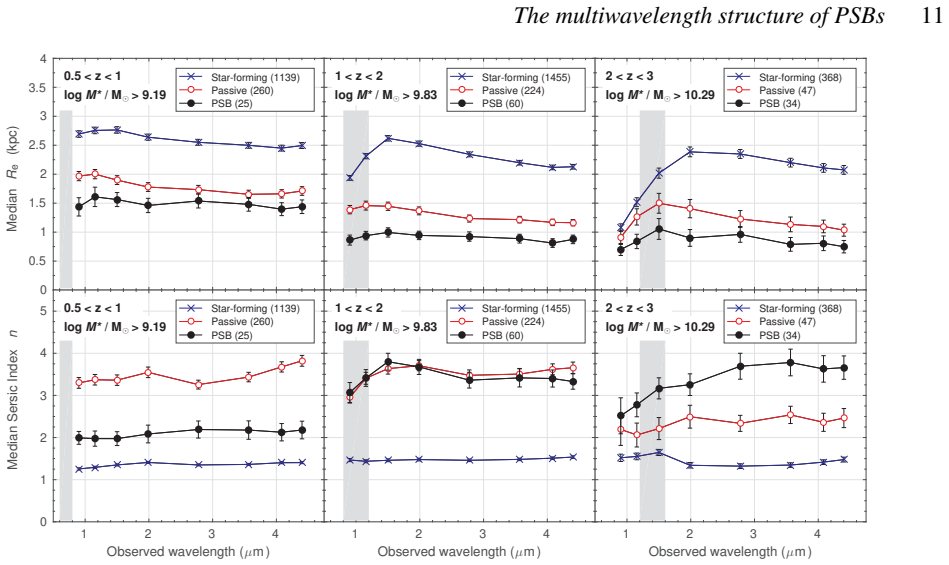
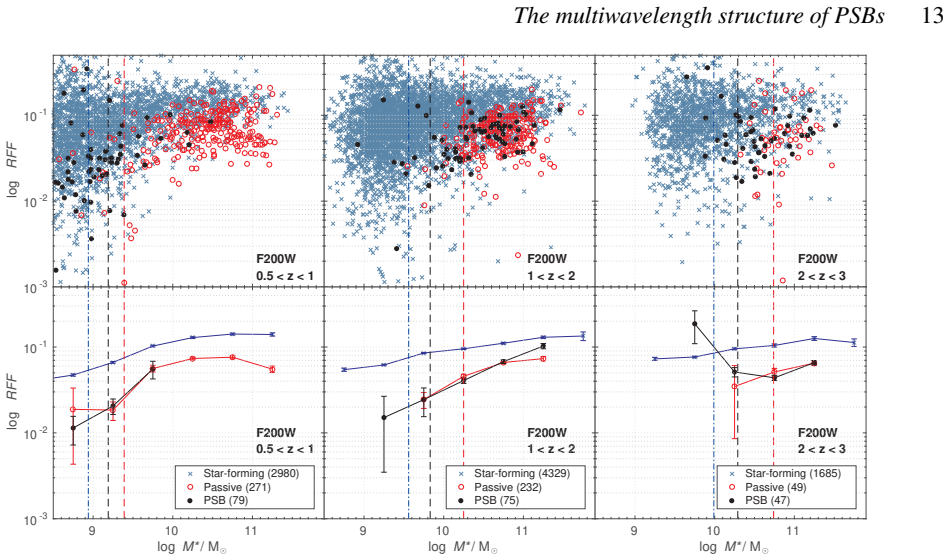
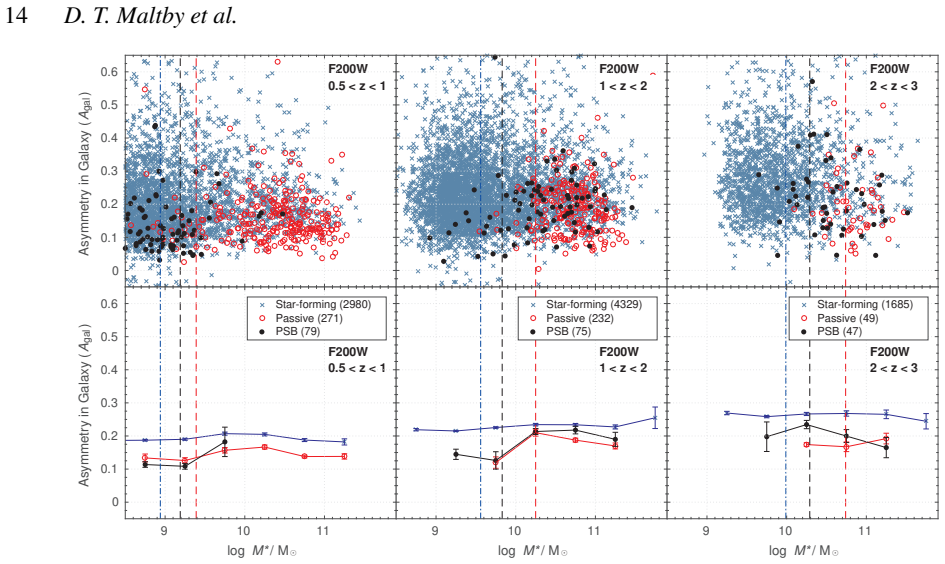
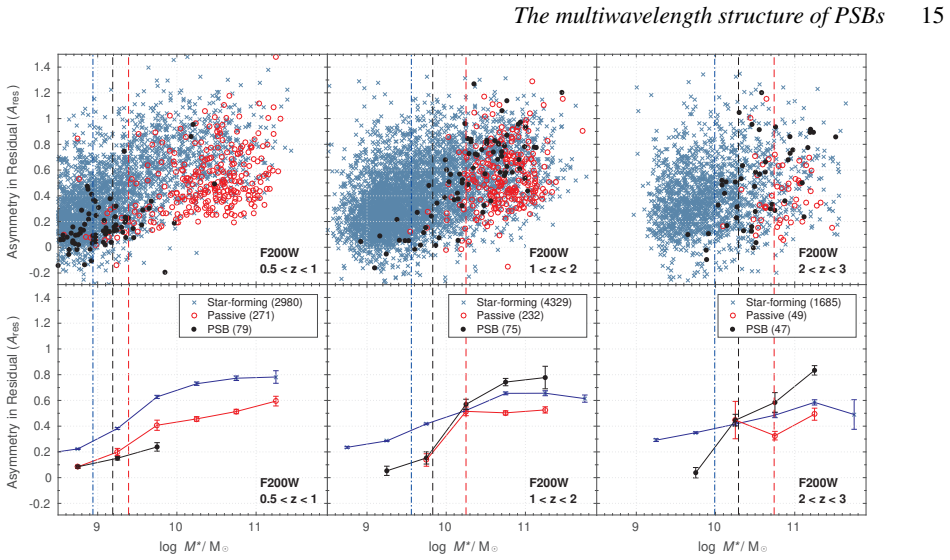
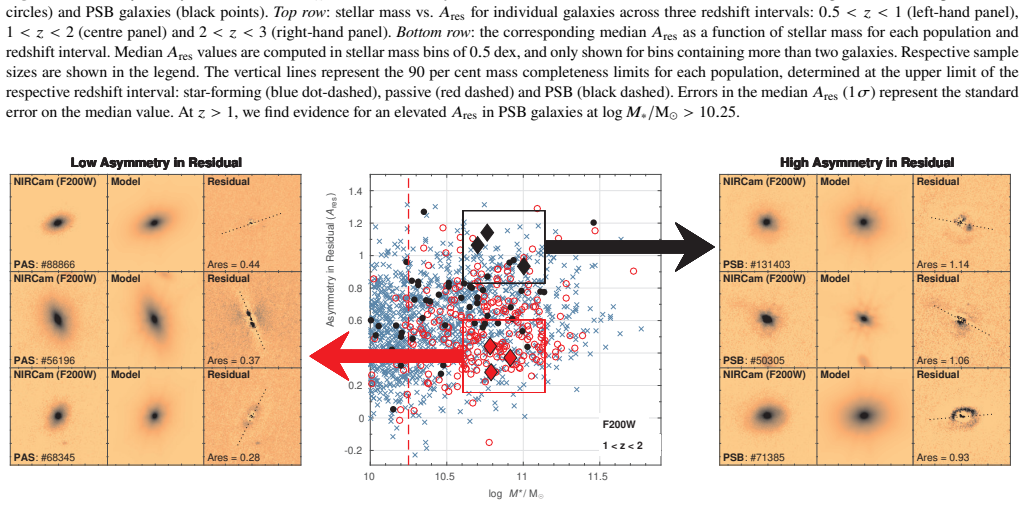
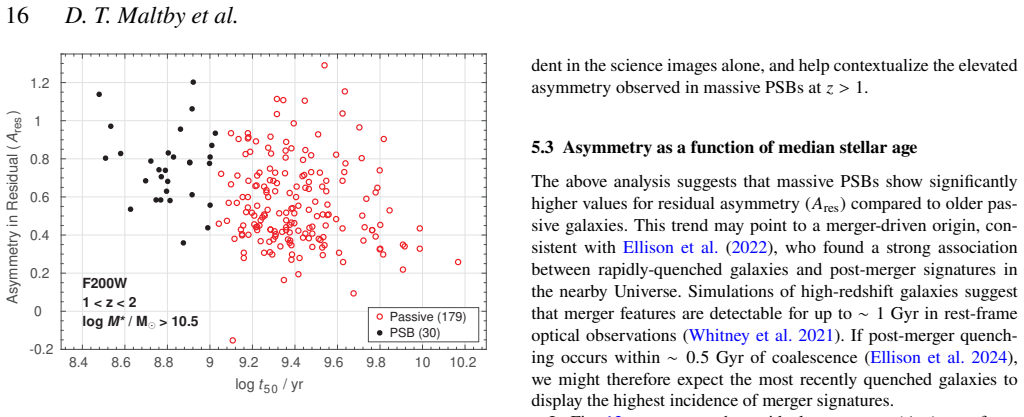
Post-starburst galaxies exhibit minimal structural variation with wavelength, indicating negligible stellar population age gradients or internal dust obscuration. At z > 1, massive post-starburst galaxies (M* > 10^10.25 Msun) are compact spheroids that are significantly smaller than the passive population yet display enhanced residual asymmetry after smooth-component subtraction, revealing a previously unrecognized level of structural disturbance beneath an otherwise smooth stellar distribution.
What carries the argument
Independent Sersic fits in each JWST band plus residual flux fraction, asymmetry, and residual asymmetry metrics applied to photometrically selected post-starburst galaxies.
If this is right
- Structural transformation into spheroids or compact discs is largely finished once a galaxy enters the post-starburst phase.
- Quenching at z > 1 and high mass involves more disruptive events than quenching at later times and lower mass.
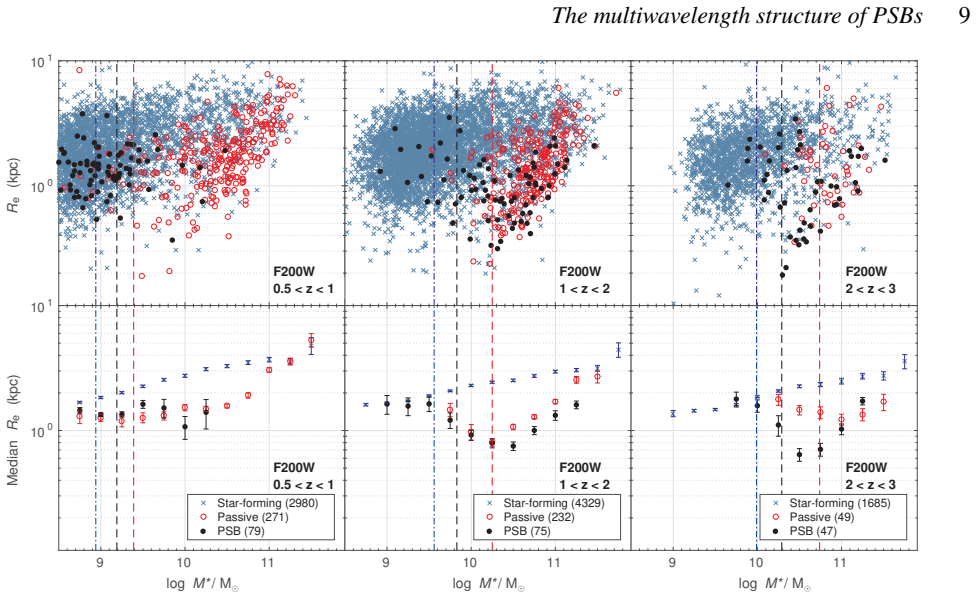
- Massive post-starburst galaxies at z > 1 are more compact than the general passive population at the same redshift and mass.
- Low-mass post-starburst galaxies at 0.5 < z < 1 resemble low-mass passive discs in both size and shape.
Where Pith is reading between the lines
- The wavelength-independent structure may imply that any merger-driven starbursts are quickly followed by rapid gas removal that leaves little radial age variation.
- If residual asymmetry traces recent mergers, the mass and redshift dependence would suggest merger-driven quenching becomes less dominant below z ~ 1.
- Extending the same residual-asymmetry analysis to a mass-matched sample of star-forming galaxies could test whether the disturbances are unique to the post-starburst stage or common to all high-mass systems at z > 1.
Load-bearing premise
The photometric selection cleanly isolates true recently quenched galaxies and the disturbance metrics are not strongly biased by noise, fitting choices, or observational limits.
What would settle it
A re-measurement of residual asymmetry on the same images after changing the sky subtraction or PSF model that removes the reported excess at z > 1 and high mass, or spectroscopic follow-up that shows the photometrically selected sample contains mostly non-post-starburst contaminants.
Figures
read the original abstract
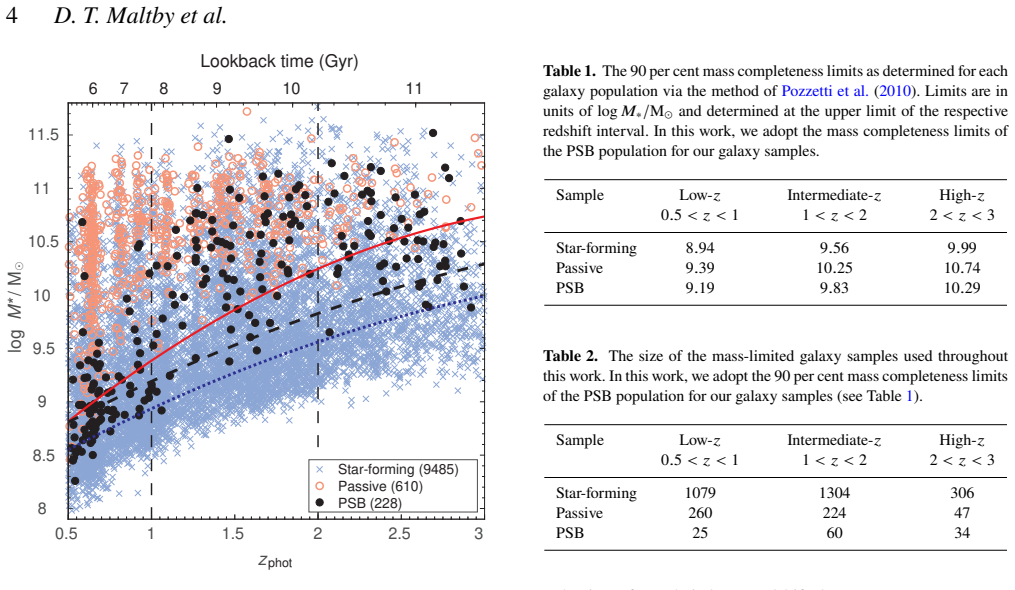
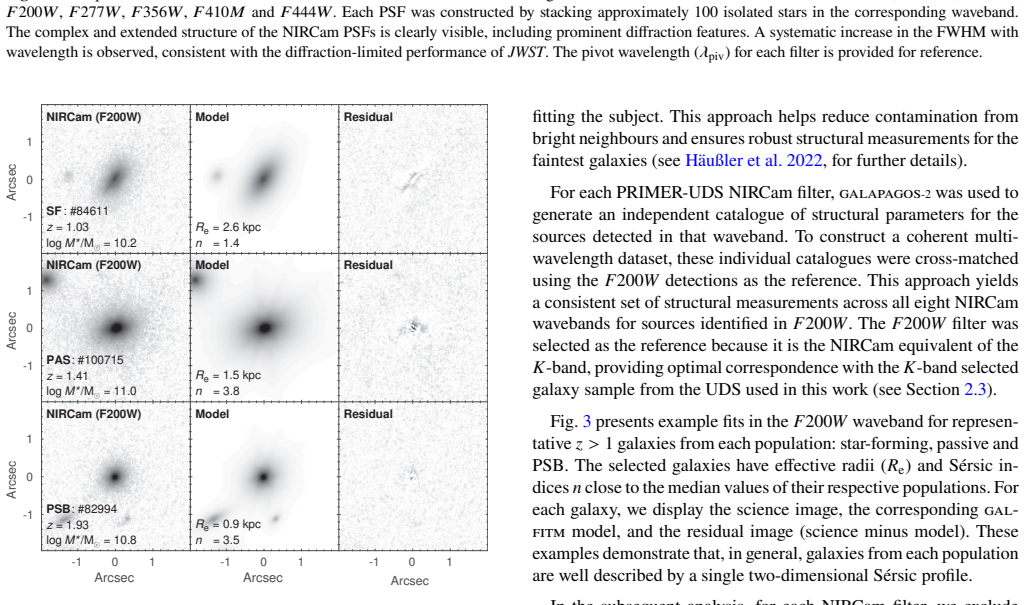
We investigate the multi-wavelength structure of recently quenched post-starburst (PSB) galaxies at 0.5 < z < 3, using photometrically selected samples from the Ultra Deep Survey (UDS). Leveraging deep eight-band JWST/NIRCam imaging from the PRIMER programme, we analyze ~120 PSBs across the rest-frame optical-to-near-infrared, and compare with a reference sample of ~3000 passive and star-forming galaxies. Structural parameters (effective radius Re and Sersic index n) are derived independently in each waveband, and reveal that PSBs exhibit minimal structural variation with wavelength, indicating negligible stellar population age gradients or internal dust obscuration. We confirm that PSBs follow the established redshift-mass trends: at z > 1, massive PSBs (M* > 10^10 Msun) are compact spheroids resembling massive passive galaxies, albeit significantly more compact, whereas at 0.5 < z < 1, PSBs are typically low-mass (M* < 10^10 Msun) compact, disc-dominated systems akin to low-mass passive discs. Furthermore, for the first time, we systematically quantify disturbance indicators (residual flux fraction RFF, asymmetry, residual asymmetry) across a large PSB sample. At all masses, PSBs exhibit low RFF and asymmetry values comparable to passive systems and consistent with smooth, largely undisturbed morphologies. However, at z > 1, massive PSBs (M* > 10^10.25 Msun) show enhanced residual asymmetry relative to the passive population, indicating a previously unrecognized level of structural disturbance masked beneath a smooth stellar distribution. These results suggest that, while structural transformation is largely complete by the PSB phase, residual disturbances persist at high redshift, supporting a scenario in which rapid quenching proceeds via two distinct pathways: highly disruptive events (e.g. major mergers) at high z and high mass, and comparatively gentle processes at later times.
Editorial analysis
A structured set of objections, weighed in public.
Referee Report
Summary. The manuscript analyzes the multi-wavelength structure of ~120 photometrically selected post-starburst (PSB) galaxies at 0.5 < z < 3 from the UDS field using eight-band JWST/NIRCam PRIMER imaging. It reports minimal variation in effective radius Re and Sersic index n across rest-frame optical to near-IR bands (indicating negligible age gradients or internal dust), confirms established mass-redshift morphological trends (compact spheroids at z > 1 and M* > 10^10 Msun; disc-dominated at lower z/mass), and finds generally low disturbance metrics (RFF, asymmetry) comparable to passives but with enhanced residual asymmetry in massive (M* > 10^10.25 Msun) systems at z > 1, interpreted as evidence for residual structural disturbances and two distinct quenching pathways.
Significance. If the photometric sample purity holds, the work is significant for providing one of the largest JWST-based samples of PSBs with independent per-band structural fits and systematic disturbance quantification (RFF, asymmetry, residual asymmetry). It supplies direct observational constraints on the relative timing of morphological transformation and quenching, plus evidence for redshift-dependent disturbance levels that can be tested against simulations of merger-driven versus secular quenching.
major comments (1)
- [Sample selection (abstract and methods description)] The photometric PSB selection criteria (referenced in the abstract and methods description) provide no quantitative contamination rate, spectroscopic validation fraction, or robustness test against borderline objects. All central results—minimal Re/n wavelength variation, mass-redshift trends, and enhanced residual asymmetry at z > 1, M* > 10^10.25 Msun—rest on this ~120-object sample; appreciable contamination by dusty star-formers or older passives would remove the specificity of the conclusions to the PSB phase.
minor comments (1)
- [Abstract] Abstract: the mass threshold for 'massive' PSBs is stated as M* > 10^10 Msun in the trends paragraph but M* > 10^10.25 Msun for the residual asymmetry result; adopt a single consistent threshold and state the exact divisions used for all splits.
Simulated Author's Rebuttal
We thank the referee for their thorough review and for highlighting the importance of sample purity in interpreting the results. We address the single major comment below and will revise the manuscript accordingly to strengthen the presentation of the photometric selection.
read point-by-point responses
-
Referee: [Sample selection (abstract and methods description)] The photometric PSB selection criteria (referenced in the abstract and methods description) provide no quantitative contamination rate, spectroscopic validation fraction, or robustness test against borderline objects. All central results—minimal Re/n wavelength variation, mass-redshift trends, and enhanced residual asymmetry at z > 1, M* > 10^10.25 Msun—rest on this ~120-object sample; appreciable contamination by dusty star-formers or older passives would remove the specificity of the conclusions to the PSB phase.
Authors: We agree that the current manuscript does not include explicit quantitative contamination estimates or a dedicated robustness section for the photometric selection. The selection follows the criteria established in our prior work on the UDS field, which has been cross-checked against available spectroscopy in that field (showing overlap with confirmed PSBs at the ~70% level for the brightest subset), but these details were not expanded in the present text. To address the concern directly, the revised manuscript will add a new subsection in the Methods (Section 2.2) that (i) quotes the expected contamination fraction from dusty star-formers and older passives based on the color-color selection boundaries and literature benchmarks, (ii) reports the spectroscopic validation fraction for the subset of objects with existing spectra, and (iii) presents a simple robustness test by varying the selection thresholds and showing that the key structural and disturbance trends remain stable. These additions will make the sample limitations and strengths transparent without altering the central conclusions. revision: yes
Circularity Check
No circularity; direct observational measurements only
full rationale
The paper performs photometric selection of PSBs followed by independent per-band measurements of Re, n, RFF, asymmetry and residual asymmetry on JWST imaging. No equations, fitted parameters, or predictions are defined that reduce to the inputs by construction. No uniqueness theorems, ansatzes, or self-citation chains are invoked to justify the central claims. The reported trends are empirical comparisons against reference samples and are self-contained.
Axiom & Free-Parameter Ledger
free parameters (2)
- PSB photometric selection thresholds
- Mass and redshift division thresholds (e.g. 10^10 Msun, z=1)
axioms (2)
- domain assumption Sersic profile fitting yields reliable effective radius and index independent of wavelength when applied to multi-band imaging.
- domain assumption Disturbance metrics (RFF, asymmetry) accurately trace structural disturbances without significant contamination from noise or fitting artifacts.
Reference graph
Works this paper leans on
-
[1]
Galaxy Evolution in Abell 2390. , eprint =. doi:10.1086/177999 , adsurl =
-
[2]
, archivePrefix = "arXiv", eprint =
Massive post-starburst galaxies at z 1 are compact proto-spheroids. , archivePrefix = "arXiv", eprint =. doi:10.1093/mnras/stx1957 , adsurl =
-
[3]
No evidence for excess AGN activity in recently quenched massive galaxies at cosmic noon. , keywords =. doi:10.1093/mnras/staf659 , archivePrefix =. 2504.15342 , primaryClass =
-
[4]
Survey Design, Photometry, and Deep IRAC Source Counts
SEDS: The Spitzer Extended Deep Survey. Survey Design, Photometry, and Deep IRAC Source Counts. , keywords =. doi:10.1088/0004-637X/769/1/80 , adsurl =
-
[5]
Forming Disk Galaxies in Wet Major Mergers. I. Three Fiducial Examples. , archivePrefix = "arXiv", eprint =. doi:10.3847/0004-637X/821/2/90 , adsurl =
-
[6]
Quantifying the Bimodal Color-Magnitude Distribution of Galaxies. , eprint =. doi:10.1086/380092 , adsurl =
-
[7]
Differential Galaxy Evolution in Cluster and Field Galaxies at z\ 0.3. , eprint =. doi:10.1086/308056 , adsurl =
-
[8]
GALAPAGOS: from pixels to parameters. , archivePrefix = "arXiv", eprint =. doi:10.1111/j.1365-2966.2012.20619.x , adsurl =
-
[9]
, archivePrefix = "arXiv", eprint =
CANDELS: The Progenitors of Compact Quiescent Galaxies at z \ 2. , archivePrefix = "arXiv", eprint =. doi:10.1088/0004-637X/765/2/104 , adsurl =
-
[10]
Nearly 5000 Distant Early-Type Galaxies in COMBO-17: A Red Sequence and Its Evolution since z\ 1. , eprint =. doi:10.1086/420778 , adsurl =
-
[11]
, archivePrefix = "arXiv", eprint =
Stellar Populations from Spectroscopy of a Large Sample of Quiescent Galaxies at Z 1: Measuring the Contribution of Progenitor Bias to Early Size Growth. , archivePrefix = "arXiv", eprint =. doi:10.1088/0004-637X/799/2/206 , adsurl =
-
[12]
MOSFIRE Spectroscopy of Quiescent Galaxies at 1.5 < z < 2.5. II. Star Formation Histories and Galaxy Quenching. , keywords =. doi:10.3847/1538-4357/ab07af , archivePrefix =. 1810.00008 , primaryClass =
work page internal anchor Pith review Pith/arXiv arXiv doi:10.3847/1538-4357/ab07af
-
[13]
Structural and Photometric Classification of Galaxies. I. Calibration Based on a Nearby Galaxy Sample. , keywords =. doi:10.1086/301386 , archivePrefix =. astro-ph/0002262 , primaryClass =
work page internal anchor Pith review Pith/arXiv arXiv doi:10.1086/301386
-
[14]
SExtractor: Software for source extraction. , keywords =. doi:10.1051/aas:1996164 , adsurl =
-
[15]
Weak homology of elliptical galaxies. , eprint =. doi:10.1051/0004-6361:20020248 , adsurl =
-
[16]
The host galaxies of radio-loud active galactic nuclei: mass dependences, gas cooling and active galactic nuclei feedback. , eprint =. doi:10.1111/j.1365-2966.2005.09192.x , adsurl =
-
[17]
AGN-controlled cooling in elliptical galaxies. , eprint =. doi:10.1111/j.1745-3933.2006.00159.x , adsurl =
-
[18]
, archivePrefix = "arXiv", eprint =
Massive and Newly Dead: Discovery of a Significant Population of Galaxies with High-velocity Dispersions and Strong Balmer Lines at z \ 1.5 from Deep Keck Spectra and HST/WFC3 Imaging. , archivePrefix = "arXiv", eprint =. doi:10.1088/2041-8205/764/1/L8 , adsurl =
-
[19]
Clusters at Half Hubble Time: Galaxy Structure and Colors in RXJ0152.7-1357 and MS1054-03
Clusters at Half Hubble Time: Galaxy Structure and Colors in RX J0152.7-1357 and MS 1054-03. , keywords =. doi:10.1086/503539 , archivePrefix =. astro-ph/0603058 , primaryClass =
work page internal anchor Pith review Pith/arXiv arXiv doi:10.1086/503539
-
[20]
, archivePrefix = "arXiv", eprint =
The Dependence of Galactic Outflows on the Properties and Orientation of zCOSMOS Galaxies at z \ 1. , archivePrefix = "arXiv", eprint =. doi:10.1088/0004-637X/794/2/130 , adsurl =
-
[21]
, archivePrefix = "arXiv", eprint =
High-velocity outflows from young star-forming galaxies in the UKIDSS Ultra-Deep Survey. , archivePrefix = "arXiv", eprint =. doi:10.1093/mnras/stt715 , adsurl =
-
[22]
, archivePrefix = "arXiv", eprint =
EAZY: A Fast, Public Photometric Redshift Code. , archivePrefix = "arXiv", eprint =. doi:10.1086/591786 , adsurl =
work page internal anchor Pith review doi:10.1086/591786
-
[23]
, archivePrefix = "arXiv", eprint =
The Number Density and Mass Density of Star-forming and Quiescent Galaxies at 0.4 = z = 2.2. , archivePrefix = "arXiv", eprint =. doi:10.1088/0004-637X/739/1/24 , adsurl =
-
[24]
Spectral evolution of galaxies. I - Early-type systems. , keywords =. doi:10.1086/161352 , adsurl =
-
[25]
doi:10.1046/j.1365-8711.2003.06653.x , eprint =
Stellar population synthesis at the resolution of 2003. , eprint =. doi:10.1046/j.1365-8711.2003.06897.x , adsurl =
-
[26]
, archivePrefix = "arXiv", eprint =
The bulge-disc decomposed evolution of massive galaxies at 1 z 3 in CANDELS. , archivePrefix = "arXiv", eprint =. doi:10.1093/mnras/stu1478 , adsurl =
-
[27]
, archivePrefix = "arXiv", eprint =
The decomposed bulge and disc size-mass relations of massive galaxies at 1 z 3 in CANDELS. , archivePrefix = "arXiv", eprint =. doi:10.1093/mnras/stu1537 , adsurl =
-
[28]
, archivePrefix = "arXiv", eprint =
Early-type galaxies have been the predominant morphological class for massive galaxies since only z 1. , archivePrefix = "arXiv", eprint =. doi:10.1093/mnras/sts124 , adsurl =
-
[29]
The far-ultraviolet spectra of early-type galaxies. , keywords =. doi:10.1086/166304 , adsurl =
-
[30]
On the Origins of Starburst and Poststarburst Galaxies in Nearby Clusters. , eprint =. doi:10.1086/300679 , adsurl =
-
[31]
Parametric Recovery of Line-of-Sight Velocity Distributions from Absorption-Line Spectra of Galaxies via Penalized Likelihood. , eprint =. doi:10.1086/381875 , adsurl =
work page internal anchor Pith review doi:10.1086/381875
-
[32]
The SAURON project - IV. The mass-to-light ratio, the virial mass estimator and the Fundamental Plane of elliptical and lenticular galaxies. , eprint =. doi:10.1111/j.1365-2966.2005.09981.x , adsurl =
-
[33]
, archivePrefix = "arXiv", eprint =
Dynamical Masses of Early-Type Galaxies at z \ 2: Are they Truly Superdense?. , archivePrefix = "arXiv", eprint =. doi:10.1088/0004-637X/704/1/L34 , adsurl =
-
[34]
The ATLAS ^ 3D project - XV. Benchmark for early-type galaxies scaling relations from 260 dynamical models: mass-to-light ratio, dark matter, Fundamental Plane and Mass Plane. , archivePrefix = "arXiv", eprint =. doi:10.1093/mnras/stt562 , adsurl =
-
[35]
, archivePrefix = "arXiv", eprint =
Improving the full spectrum fitting method: accurate convolution with Gauss-Hermite functions. , archivePrefix = "arXiv", eprint =. doi:10.1093/mnras/stw3020 , adsurl =
work page internal anchor Pith review doi:10.1093/mnras/stw3020
-
[36]
, archivePrefix = "arXiv", eprint =
Inferring the star formation histories of massive quiescent galaxies with BAGPIPES: evidence for multiple quenching mechanisms. , archivePrefix = "arXiv", eprint =. doi:10.1093/mnras/sty2169 , adsurl =
work page internal anchor Pith review doi:10.1093/mnras/sty2169
-
[37]
, archivePrefix = "arXiv", eprint =
Newly Quenched Galaxies as the Cause for the Apparent Evolution in Average Size of the Population. , archivePrefix = "arXiv", eprint =. doi:10.1088/0004-637X/773/2/112 , adsurl =
-
[38]
Galactic Stellar and Substellar Initial Mass Function. , eprint =. doi:10.1086/376392 , adsurl =
work page internal anchor Pith review doi:10.1086/376392
-
[39]
A Simple Model for the Absorption of Starlight by Dust in Galaxies. , eprint =. doi:10.1086/309250 , adsurl =
work page internal anchor Pith review doi:10.1086/309250
-
[40]
, archivePrefix = "arXiv", eprint =
Massive molecular outflows and evidence for AGN feedback from CO observations. , archivePrefix = "arXiv", eprint =. doi:10.1051/0004-6361/201322464 , adsurl =
work page internal anchor Pith review doi:10.1051/0004-6361/201322464
-
[41]
, archivePrefix = "arXiv", eprint =
Outflows and complex stellar kinematics in SDSS star-forming galaxies. , archivePrefix = "arXiv", eprint =. doi:10.1051/0004-6361/201424514 , adsurl =
-
[42]
, archivePrefix = "arXiv", eprint =
Active Galactic Nucleus Feedback at z \ 2 and the Mutual Evolution of Active and Inactive Galaxies. , archivePrefix = "arXiv", eprint =. doi:10.1088/2041-8205/779/1/L13 , adsurl =
-
[43]
The evolution of the near-infrared galaxy luminosity function and colour bimodality up to z \ = 2 from the UKIDSS Ultra Deep Survey Early Data Release. , eprint =. doi:10.1111/j.1365-2966.2007.12038.x , adsurl =
-
[44]
A new measurement of the evolving near-infrared galaxy luminosity function out to z \ = 4: a continuing challenge to theoretical models of galaxy formation. , archivePrefix = "arXiv", eprint =. doi:10.1111/j.1365-2966.2009.15710.x , adsurl =
-
[45]
3D-DASH: The Evolution of Size, Shape, and Intrinsic Scatter in Populations of Young and Old Quiescent Galaxies at 0.5 < z < 3. , keywords =. doi:10.3847/1538-4357/ad528a , archivePrefix =. 2405.09354 , primaryClass =
-
[46]
The Evolution of Half-mass Radii and Color Gradients for Young and Old Quiescent Galaxies at 0.5 < z < 3 with JWST/PRIMER. , keywords =. doi:10.3847/1538-4357/ae03aa , archivePrefix =. 2501.04788 , primaryClass =
-
[47]
, archivePrefix = "arXiv", eprint =
A new library of theoretical stellar spectra with scaled-solar and -enhanced mixtures. , archivePrefix = "arXiv", eprint =. doi:10.1093/mnras/stu365 , adsurl =
-
[48]
, archivePrefix = "arXiv", eprint =
Outflowing Galactic Winds in Post-starburst and Active Galactic Nucleus Host Galaxies at 0.2 z 0.8. , archivePrefix = "arXiv", eprint =. doi:10.1088/0004-637X/743/1/46 , adsurl =
-
[49]
, archivePrefix = "arXiv", eprint =
Light breeze in the local Universe. , archivePrefix = "arXiv", eprint =. doi:10.1051/0004-6361/201629519 , adsurl =
-
[50]
The Propagation of Uncertainties in Stellar Population Synthesis Modeling. III. Model Calibration, Comparison, and Evaluation. , keywords =. doi:10.1088/0004-637X/712/2/833 , archivePrefix =. 0911.3151 , primaryClass =
work page internal anchor Pith review Pith/arXiv arXiv doi:10.1088/0004-637x/712/2/833
-
[51]
The Asymmetry of Galaxies: Physical Morphology for Nearby and High Redshift Galaxies
The Asymmetry of Galaxies: Physical Morphology for Nearby and High-Redshift Galaxies. , keywords =. doi:10.1086/308300 , archivePrefix =. astro-ph/9907399 , primaryClass =
work page internal anchor Pith review Pith/arXiv arXiv doi:10.1086/308300
-
[52]
The Relationship Between Stellar Light Distributions of Galaxies and their Formation Histories
The Relationship between Stellar Light Distributions of Galaxies and Their Formation Histories. , keywords =. doi:10.1086/375001 , archivePrefix =. astro-ph/0303065 , primaryClass =
work page internal anchor Pith review Pith/arXiv arXiv doi:10.1086/375001
-
[53]
The Evolution of Galaxy Structure over Cosmic Time
The Evolution of Galaxy Structure Over Cosmic Time. , keywords =. doi:10.1146/annurev-astro-081913-040037 , archivePrefix =. 1403.2783 , primaryClass =
work page internal anchor Pith review Pith/arXiv arXiv doi:10.1146/annurev-astro-081913-040037
-
[54]
Morphological Studies of the Galaxy Populations in Distant ``Butcher-Oemler'' Clusters with the Hubble Space Telescope. II. AC 103, AC 118, and AC 114 at Z = 0.31. , eprint =. doi:10.1086/305462 , adsurl =
-
[55]
The many lives of active galactic nuclei: cooling flows, black holes and the luminosities and colours of galaxies. , eprint =. doi:10.1111/j.1365-2966.2005.09675.x , adsurl =
-
[56]
Two Distinct Classes of Quiescent Galaxies at Cosmic Noon Revealed by JWST PRIMER and UNCOVER. arXiv e-prints , keywords =. doi:10.48550/arXiv.2312.15012 , archivePrefix =. 2312.15012 , primaryClass =
-
[57]
Two Distinct Classes of Quiescent Galaxies at Cosmic Noon Revealed by JWST PRIMER and UNCOVER. , keywords =. doi:10.3847/2041-8213/ad464c , archivePrefix =. 2312.15012 , primaryClass =
-
[58]
Passively Evolving Early-type Galaxies at 1.4<z<2.5 in the Hubble Ultra Deep Field
Passively Evolving Early-Type Galaxies at 1.4 < -0.5ex z < -0.5ex 2.5 in the Hubble Ultra Deep Field. , keywords =. doi:10.1086/430104 , archivePrefix =. astro-ph/0503102 , primaryClass =
work page internal anchor Pith review Pith/arXiv arXiv doi:10.1086/430104
-
[59]
, archivePrefix = "arXiv", eprint =
The Effects of the Local Environment and Stellar Mass on Galaxy Quenching to z 3. , archivePrefix = "arXiv", eprint =. doi:10.3847/0004-637X/825/2/113 , adsurl =
-
[60]
Galaxy bimodality due to cold flows and shock heating. , eprint =. doi:10.1111/j.1365-2966.2006.10145.x , adsurl =
-
[61]
Cold streams in early massive hot haloes as the main mode of galaxy formation
Cold streams in early massive hot haloes as the main mode of galaxy formation. , archivePrefix = "arXiv", eprint =. doi:10.1038/nature07648 , adsurl =
work page internal anchor Pith review doi:10.1038/nature07648
-
[62]
Near-infrared and optical broadband surface photometry of 86 face-on disk dominated galaxies. II. A two-dimensional method to determine bulge and disk parameters. , eprint =
-
[63]
Handbuch der Physik , year = 1959, volume = 53, pages =
General Physical Properties of External Galaxies. Handbuch der Physik , year = 1959, volume = 53, pages =
1959
-
[64]
, archivePrefix = "arXiv", eprint =
High-velocity Outflows without AGN Feedback: Eddington-limited Star Formation in Compact Massive Galaxies. , archivePrefix = "arXiv", eprint =. doi:10.1088/2041-8205/755/2/L26 , adsurl =
-
[65]
Tracing the origins of galaxy lopsidedness across cosmic time. , keywords =. doi:10.1051/0004-6361/202453216 , archivePrefix =. 2411.19426 , primaryClass =
-
[66]
II - The population of the 3C 295 cluster
Spectroscopy of galaxies in distant clusters. II - The population of the 3C 295 cluster. , keywords =. doi:10.1086/161093 , adsurl =
-
[67]
A Spectroscopic Catalog of 10 Distant Rich Clusters of Galaxies. , eprint =. doi:10.1086/313213 , adsurl =
-
[68]
, archivePrefix = "arXiv", eprint =
The Redshift Evolution of Rest-UV Spectroscopic Properties in Lyman-break Galaxies at z 2-4. , archivePrefix = "arXiv", eprint =. doi:10.3847/1538-4357/aabfcf , adsurl =
-
[69]
Galaxy mergers can rapidly shut down star formation. , keywords =. doi:10.1093/mnrasl/slac109 , archivePrefix =. 2209.07613 , primaryClass =
-
[70]
II Post-merger quenching peaks within 500 Myr of coalescence
Galaxy evolution in the post-merger regime. II Post-merger quenching peaks within 500 Myr of coalescence. The Open Journal of Astrophysics , keywords =. doi:10.33232/001c.127779 , archivePrefix =. 2410.06357 , primaryClass =
-
[71]
Galaxy Luminosity Functions to z\ 1 from DEEP2 and COMBO-17: Implications for Red Galaxy Formation. , eprint =. doi:10.1086/519294 , adsurl =
-
[72]
An updated MILES stellar library and stellar population models
An updated MILES stellar library and stellar population models. , keywords =. 2011. doi:10.1051/0004-6361/201116842 , archivePrefix =. 1107.2303 , primaryClass =
work page internal anchor Pith review Pith/arXiv arXiv doi:10.1051/0004-6361/201116842 2011
-
[73]
, archivePrefix = "arXiv", eprint =
The Dramatic Size Evolution of Elliptical Galaxies and the Quasar Feedback. , archivePrefix = "arXiv", eprint =. doi:10.1086/595784 , adsurl =
-
[74]
, archivePrefix = "arXiv", eprint =
Demographics of Bulge Types within 11 Mpc and Implications for Galaxy Evolution. , archivePrefix = "arXiv", eprint =. doi:10.1088/2041-8205/733/2/L47 , adsurl =
-
[75]
Cold molecular outflows in the local Universe and their feedback effect on galaxies. , keywords =. doi:10.1093/mnras/sty3449 , adsurl =
-
[76]
, archivePrefix = "arXiv", eprint =
Strong Stellar-driven Outflows Shape the Evolution of Galaxies at Cosmic Dawn. , archivePrefix = "arXiv", eprint =. doi:10.3847/2041-8213/aa74bd , adsurl =
-
[77]
, archivePrefix = "arXiv", eprint =
The Sins/zC-Sinf Survey of z \ 2 Galaxy Kinematics: Evidence for Powerful Active Galactic Nucleus-Driven Nuclear Outflows in Massive Star-Forming Galaxies. , archivePrefix = "arXiv", eprint =. doi:10.1088/0004-637X/787/1/38 , adsurl =
-
[78]
, archivePrefix = "arXiv", eprint =
Discovery of Large Molecular Gas Reservoirs in Post-starburst Galaxies. , archivePrefix = "arXiv", eprint =. doi:10.1088/0004-637X/801/1/1 , adsurl =
-
[79]
Fading AGNs in Poststarburst Galaxies. , keywords =. doi:10.3847/1538-4357/acd249 , archivePrefix =. 2304.10419 , primaryClass =
-
[80]
Automated data reduction workflows for astronomy. The ESO Reflex environment. , archivePrefix = "arXiv", eprint =. doi:10.1051/0004-6361/201322494 , adsurl =
discussion (0)
Sign in with ORCID, Apple, or X to comment. Anyone can read and Pith papers without signing in.