Open-boundary integrable quantum circuits with different geometries
Pith reviewed 2026-07-03 04:02 UTC · model grok-4.3
The pith
Time-periodic quantum circuits with open boundaries are integrable for arbitrary geometries when bulk and boundary gates satisfy the Yang-Baxter equation and each bulk gate appears once per period.
A machine-rendered reading of the paper's core claim, the machinery that carries it, and where it could break.
Core claim
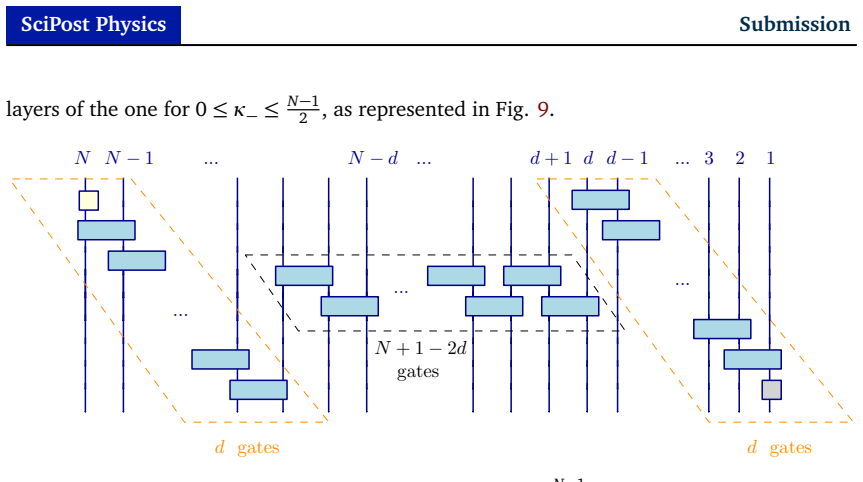
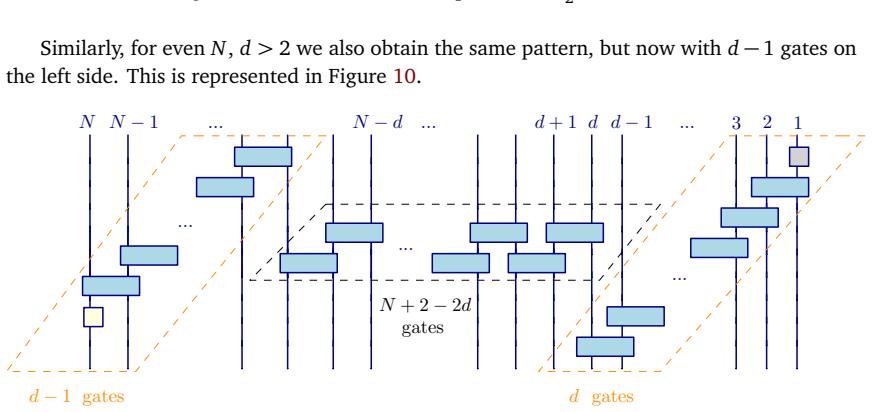
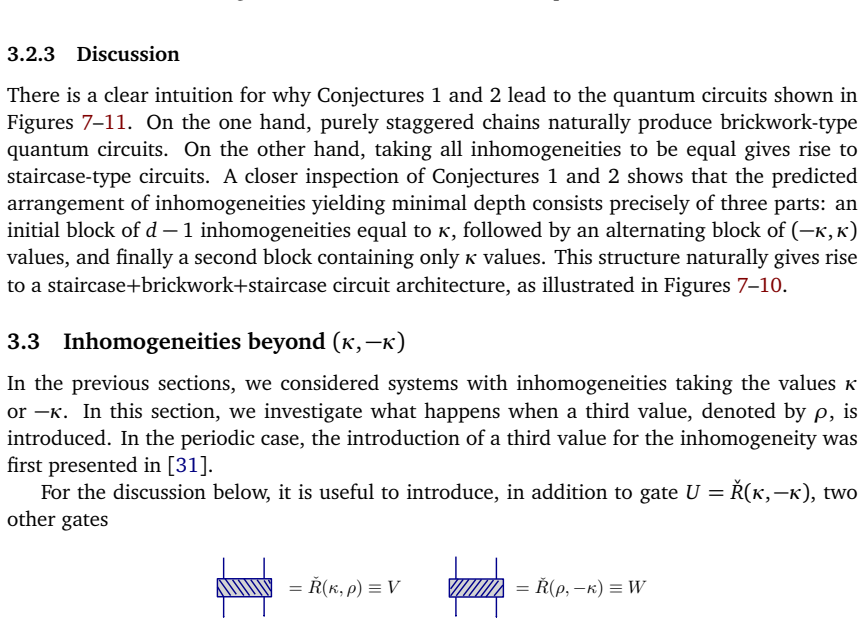
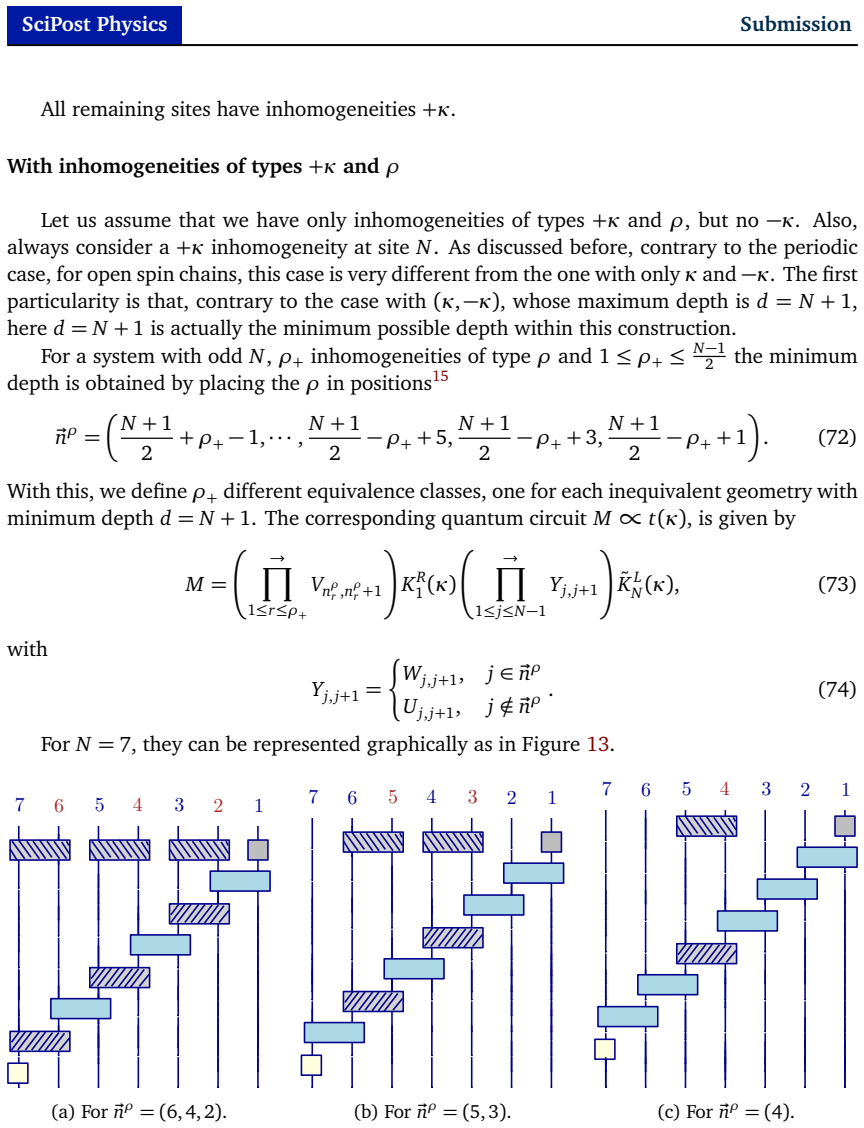
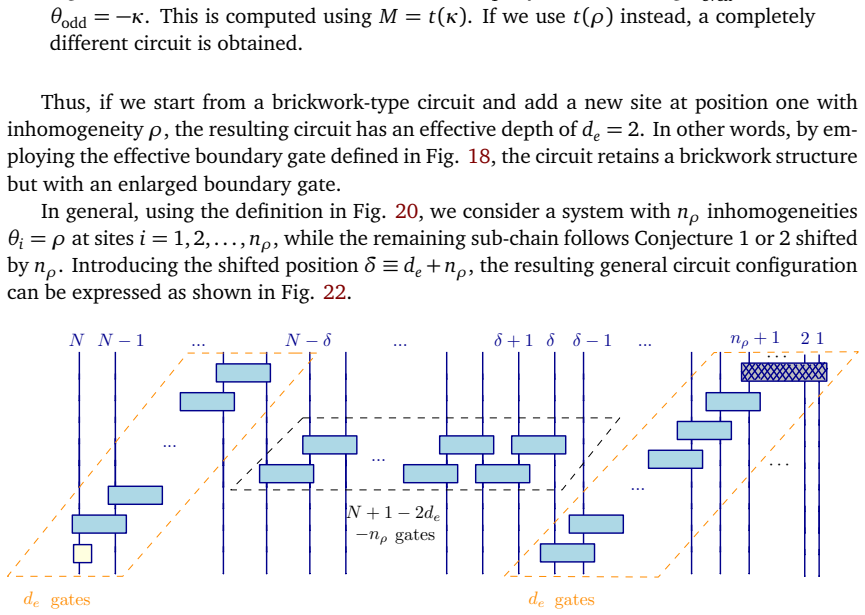
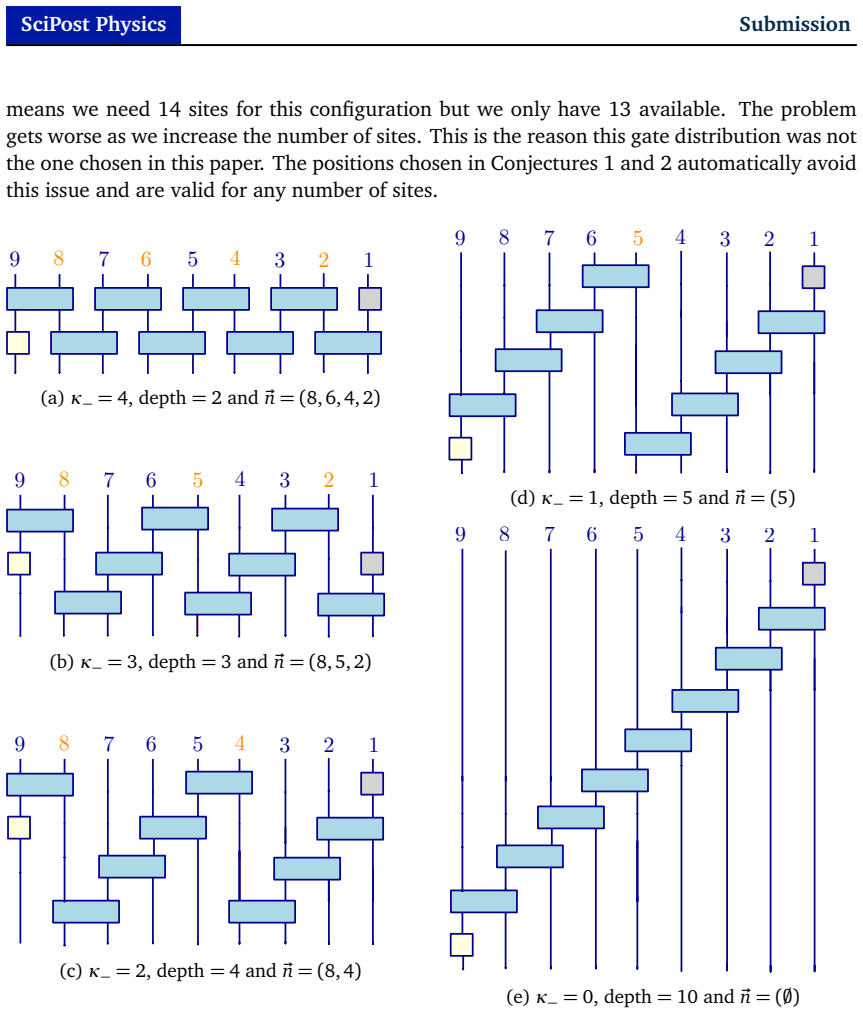
Starting from the standard transfer-matrix construction with two types of staggered inhomogeneities, a general mapping determines the arrangement of circuit gates in terms of the inhomogeneities and the system size. Time-periodic quantum circuits are conjectured to be integrable whenever the local bulk and boundary gates satisfy the Yang-Baxter equation and the same bulk gate is applied exactly once per period to every nearest-neighbor pair of spins. A third type of inhomogeneity denoted by rho is introduced, showing that the minimum possible circuit depth is four, and that rho-inhomogeneities at the endpoints allow boundary gates to be interpreted as single gates acting on multiple sites. T
What carries the argument
The mapping from staggered inhomogeneities in the transfer matrix to the positions and ordering of local bulk and boundary gates in the circuit.
If this is right
- An algorithm exists to detect Yang-Baxter integrability for circuits of arbitrary geometries.
- Integrable circuits can be built from six- and eight-vertex R-matrices of non-difference form together with their reflection matrices.
- Boundary operators can act on multiple consecutive sites when rho-inhomogeneities are placed at the endpoints.
- The shortest integrable open-boundary circuits have depth four.
Where Pith is reading between the lines
- The same inhomogeneity-to-gate mapping may generate new families of integrable circuits once the conjecture is verified for small sizes.
- Multi-site boundary gates obtained from rho-inhomogeneities could be used to introduce longer-range interactions while keeping the circuit integrable.
- The detection algorithm supplies a practical test that can be applied to any proposed circuit geometry without first solving the full spectrum.
Load-bearing premise
The standard transfer-matrix construction with two types of staggered inhomogeneities admits a general mapping to arbitrary circuit geometries while preserving integrability.
What would settle it
An explicit small-system circuit in which every bulk gate appears once per period, all gates satisfy the Yang-Baxter equation, yet the circuit possesses fewer independent conserved charges than required for integrability.
Figures

read the original abstract
We present a complete classification of integrable Yang-Baxter quantum circuits with open boundary conditions and arbitrary circuit geometries. Starting from the standard transfer-matrix construction with two types of staggered inhomogeneities, we derive a general mapping that determines the arrangement of circuit gates in terms of the inhomogeneities and the system size. We conjecture that time-periodic quantum circuits are integrable whenever the local bulk and boundary gates satisfy the Yang-Baxter equation and the same bulk gate is applied exactly once per period to every nearest-neighbor pair of spins. Our construction also provides an algorithm to detect Yang-Baxter integrability for circuits with arbitrary geometries. Furthermore, we introduce a third type of inhomogeneity, denoted by $\rho$, and demonstrate that the minimum possible circuit depth is four. We show that when these $\rho$-inhomogeneities are placed at the endpoints and in their immediate neighborhood, the resulting boundary gates can be interpreted as single gates acting on multiple sites. Our construction is fully general and applies to regular $R$-matrices, both of difference and non-difference type, together with their associated boundary matrices. As an application, we consider two-qubit gates corresponding to 6- and 8-vertex $R$-matrices of non-difference form satisfying the Yang-Baxter equation, and we construct the associated reflection matrices that generate integrable quantum circuits.
Editorial analysis
A structured set of objections, weighed in public.
Referee Report
Summary. The paper claims a complete classification of integrable open-boundary Yang-Baxter quantum circuits for arbitrary geometries. It starts from the standard transfer-matrix construction with two (later three) types of staggered inhomogeneities, derives a mapping to gate arrangements, conjectures that time-periodic circuits are integrable when local bulk/boundary gates satisfy the YBE and the same bulk gate appears exactly once per period on every nearest-neighbor pair, introduces a ρ-inhomogeneity to reach minimum depth four, interprets endpoint ρ-inhomogeneities as multi-site boundary gates, and applies the framework to 6- and 8-vertex R-matrices of non-difference form together with their reflection matrices.
Significance. If the central conjecture holds and the mapping preserves integrability, the work supplies a general algorithm for detecting Yang-Baxter integrability in open circuits of irregular geometry and a constructive method for generating new integrable models from known R-matrices; the explicit treatment of non-difference-form R-matrices and the ρ-inhomogeneity construction are concrete strengths.
major comments (3)
- [conjecture and mapping derivation] The classification rests on the unproven conjecture (abstract and main construction) that local YBE satisfaction plus the once-per-period bulk-gate condition is sufficient for global integrability under the derived mapping; no explicit verification is given that the monodromy or transfer-matrix commutation relations survive for non-ladder or irregular open-boundary geometries.
- [mapping from transfer matrix to circuit gates] The general mapping from staggered inhomogeneities (two types, then three with ρ) to arbitrary circuit geometries is stated to determine gate arrangements, but the manuscript does not demonstrate that the resulting family of operators commutes or generates conserved charges for geometries beyond the standard ladder case.
- [application section] In the application to 6- and 8-vertex R-matrices, the construction of reflection matrices is presented, yet no check is supplied that the full circuit Hamiltonians or transfer matrices obtained after the mapping indeed commute or satisfy the integrability condition beyond the local YBE.
minor comments (2)
- [ρ-inhomogeneity introduction] The definition and placement rules for the new ρ-inhomogeneity should be stated more explicitly, including how it differs from the two standard staggered types and why it forces minimum depth four.
- [boundary matrices] Notation for the boundary matrices and their relation to the reflection matrices could be clarified to avoid confusion with the bulk R-matrices.
Simulated Author's Rebuttal
We thank the referee for the careful reading and valuable comments on our manuscript. We address each major comment below, acknowledging where the work relies on a stated conjecture and offering clarifications or additions where appropriate.
read point-by-point responses
-
Referee: [conjecture and mapping derivation] The classification rests on the unproven conjecture that local YBE satisfaction plus the once-per-period bulk-gate condition is sufficient for global integrability under the derived mapping; no explicit verification is given that the monodromy or transfer-matrix commutation relations survive for non-ladder or irregular open-boundary geometries.
Authors: We explicitly present the integrability statement as a conjecture in the abstract and main text, derived from the transfer-matrix construction with staggered inhomogeneities. The mapping is obtained by identifying gate positions with inhomogeneity placements, so that the circuit evolution corresponds to the transfer-matrix action. While this ensures consistency with the YBE at the local level, we agree that direct verification of commutation relations for irregular geometries is not provided and would strengthen the presentation. We will add a clarifying remark on the conjectural nature and a small-system numerical check for an irregular geometry in the revision. revision: partial
-
Referee: [mapping from transfer matrix to circuit gates] The general mapping from staggered inhomogeneities to arbitrary circuit geometries is stated to determine gate arrangements, but the manuscript does not demonstrate that the resulting family of operators commutes or generates conserved charges for geometries beyond the standard ladder case.
Authors: The mapping is constructed directly from the transfer-matrix inhomogeneity pattern, which by design encodes the gate sequence for any geometry. Conserved charges are inherited from the commuting family of transfer matrices. We acknowledge that an independent demonstration of operator commutation for the mapped circuits in non-ladder cases is absent and relies on the conjecture. We will expand the derivation section to make this dependence explicit. revision: partial
-
Referee: [application section] In the application to 6- and 8-vertex R-matrices, the construction of reflection matrices is presented, yet no check is supplied that the full circuit Hamiltonians or transfer matrices obtained after the mapping indeed commute or satisfy the integrability condition beyond the local YBE.
Authors: The application focuses on constructing reflection matrices satisfying the boundary YBE for the chosen non-difference-form R-matrices; integrability of the resulting circuits then follows from the general framework. We agree that explicit commutation checks for the mapped transfer matrices in these examples are not included. We will add a brief verification for a small periodic circuit in the revised application section. revision: partial
- A general analytic proof that the mapping preserves monodromy commutation relations for arbitrary irregular open-boundary geometries (beyond the transfer-matrix derivation and the stated conjecture).
Circularity Check
No circularity: mapping derived from standard transfer-matrix; integrability stated as conjecture
full rationale
The paper starts from the established transfer-matrix construction with staggered inhomogeneities and derives a mapping to gate arrangements for arbitrary geometries. The central claim of integrability for time-periodic circuits is explicitly labeled a conjecture conditioned on local YBE satisfaction plus the once-per-period bulk-gate rule; it is not presented as a theorem that reduces to the paper's own inputs by construction. No self-citations appear as load-bearing steps, no parameters are fitted then relabeled as predictions, and no ansatz or uniqueness result is smuggled via prior author work. The algorithm for detection inherits the conjecture but does not create a definitional loop.
Axiom & Free-Parameter Ledger
axioms (2)
- domain assumption Local bulk and boundary gates satisfy the Yang-Baxter equation.
- domain assumption Standard transfer-matrix construction with staggered inhomogeneities extends to arbitrary circuit geometries via the derived mapping.
invented entities (1)
-
ρ-inhomogeneity
no independent evidence
Reference graph
Works this paper leans on
-
[1]
L. A. Takhtajan and L. D. Faddeev, The Quantum method of the inverse problem and the Heisenberg XYZ model , Russ. Math. Surveys 34(5), 11 (1979), [Usp. Mat. Nauk34,no.5,13(1979)]
1979
-
[2]
How Algebraic Bethe Ansatz works for integrable model
L. Faddeev, How algebraic Bethe ansatz works for integrable model (1996), https://arxiv. org/pdf/hep-th/9605187
work page internal anchor Pith review Pith/arXiv arXiv 1996
- [3]
-
[4]
S. J. van Tongeren, Introduction to the thermodynamic Bethe ansatz, J. Phys. A 49(32), 323005 (2016), doi:10.1088 /1751-8113/49/32/323005, https: //arxiv.org/abs/1606. 02951
2016
-
[5]
E. K. Sklyanin, Separation of variables: New trends , Progress of Theoretical Physics Supplement 118, 35 (1995), doi:10.1143 /PTPS.118.35, https: //academic.oup.com/ ptps/article-pdf/doi/10.1143/PTPS.118.35/5199964/118-35.pdf
-
[6]
Anharmonic oscillators, the thermodynamic Bethe ansatz, and nonlinear integral equations
P . Dorey and R. Tateo, Anharmonic oscillators, the thermodynamic Bethe ansatz, and nonlinear integral equations , J. Phys. A 32, L419 (1999), doi:10.1088 /0305- 4470/32/38/102, https: //arxiv.org/abs/hep-th/9812211
work page internal anchor Pith review Pith/arXiv arXiv 1999
-
[7]
D. Fioravanti and M. Rossi, On the origin of the correspondence between clas- sical and quantum integrable theories , Phys. Lett. B 838, 137706 (2023), doi:10.1016/j.physletb.2023.137706, https: //arxiv.org/abs/2106.07600
-
[8]
Quantum spectral curve for AdS_5/CFT_4
N. Gromov, V . Kazakov, S. Leurent and D. Volin, Quantum Spectral Curve for Pla- nar N = 4 Super-Yang-Mills Theory, Phys. Rev. Lett. 112(1), 011602 (2014), doi:10.1103/PhysRevLett.112.011602, https://arxiv.org/abs/1305.1939
work page internal anchor Pith review Pith/arXiv arXiv doi:10.1103/physrevlett.112.011602 2014
-
[9]
Levkovich-Maslyuk, A review of the AdS /CFT Quantum Spectral Curve , J
F . Levkovich-Maslyuk, A review of the AdS /CFT Quantum Spectral Curve , J. Phys. A 53(28), 283004 (2020), doi:10.1088/1751-8121/ab7137, https://arxiv.org/abs/1911. 13065
-
[10]
Boundary Perimeter Bethe Ansatz
R. Frassek, Boundary Perimeter Bethe Ansatz , J. Phys. A 50(26), 265202 (2017), doi:10.1088/1751-8121/aa7278, https: //arxiv.org/abs/1703.10842
work page internal anchor Pith review Pith/arXiv arXiv doi:10.1088/1751-8121/aa7278 2017
-
[11]
S. Belliard, N. A. Slavnov and B. Vallet, Modified Algebraic Bethe Ansatz: Twisted XXX Case, SIGMA 14, 054 (2018), doi:10.3842 /SIGMA.2018.054, https: //arxiv.org/abs/ 1804.00597
-
[12]
Integrable Trotterization: Local Conservation Laws and Boundary Driving
M. Vanicat, L. Zadnik and T . Prosen, Integrable Trotterization: Local Conser- vation Laws and Boundary Driving , Phys. Rev. Lett. 121(3), 030606 (2018), doi:10.1103/PhysRevLett.121.030606, https://arxiv.org/abs/1712.00431
work page internal anchor Pith review Pith/arXiv arXiv doi:10.1103/physrevlett.121.030606 2018
- [13]
-
[14]
Suzuki, Generalized Trotter’s Formula and Systematic Approximants of Exponential Operators and Inner Derivations with Applications to Many Body Problems , Commun
M. Suzuki, Generalized Trotter’s Formula and Systematic Approximants of Exponential Operators and Inner Derivations with Applications to Many Body Problems , Commun. Math. Phys. 51, 183 (1976), doi:10.1007 /BF01609348
1976
- [15]
-
[16]
A. Morvan et al., Formation of robust bound states of interacting microwave photons , Nature 612(7939), 240 (2022), doi:10.1038 /s41586-022-05348-y, https: //arxiv.org/ abs/2206.05254
-
[17]
K. Maruyoshi, T . Okuda, J. W . Pedersen, R. Suzuki, M. Yamazaki and Y. Yoshida,Conserved charges in the quantum simulation of integrable spin chains, Journal of Physics A: Math- ematical and Theoretical 56(16), 165301 (2023), doi:10.1088 /1751-8121/acc369, https://arxiv.org/abs/2208.00576. 53 SciPost Physics Submission
-
[18]
W . Zhao, Y. Zhang, Y. Guo, Y. Cui, Z. Wang and R.-D. Zhu,Effective noise mitigation via quantum circuit learning in quantum simulation of integrable spin chains (2026), https: //arxiv.org/pdf/2604.27648
work page internal anchor Pith review Pith/arXiv arXiv 2026
-
[19]
E. Rosenberg and et al. [Google Quantum A.I ], Dynamics of magnetization at infinite temperature in a heisenberg spin chain , Science 384 (2024) no.6691, adi7877 (2024), doi:10.1126/science.adi7877, https: //arxiv.org/abs/2306.09333
- [20]
-
[21]
E. Vernier, H.-C. Yeh, L. Piroli and A. Mitra, Strong Zero Modes in Integrable Quantum Circuits, Phys. Rev. Lett.133(5), 050606 (2024), doi:10.1103/PhysRevLett.133.050606, https://arxiv.org/abs/2401.12305
-
[22]
Gehrmann and F
S. Gehrmann and F . H. L. Essler, Exact strong zero modes in quantum circuits and spin chains with non-diagonal boundary conditions (2025), https: //arxiv.org/abs/2511. 05490
2025
-
[23]
A. Hutsalyuk, Y. Jiang, B. Pozsgay , H. Xu and Y. Zhang,Exact spin correlators of integrable quantum circuits from algebraic geometry (2024), https: //arxiv.org/abs/2405.16070
-
[24]
M. Lutz, L. Piroli, G. Styliaris and J. I. Cirac, Adiabatic quantum state preparation in integrable models, Quantum 10, 2032 (2026), doi:10.22331/q-2026-03-18-2032, https: //arxiv.org/abs/2503.21741
- [25]
- [26]
- [27]
-
[28]
D. Szász-Schagrin, D. Cristani, L. Piroli and E. Vernier, Construction and simulability of quantum circuits with free fermions in disguise , Quantum Sci. Technol. 11(1), 015044 (2026), doi:10.1088 /2058-9565/ae390d, https: //arxiv.org/abs/2509.22585
-
[29]
K. Fukai and B. Pozsgay ,Quantum circuits with free fermions in disguise, J. Phys. A58(17), 175202 (2025), doi:10.1088 /1751-8121/adcd18, https: //arxiv.org/abs/2402.02984
-
[30]
Integrable Floquet dynamics, generalized exclusion processes and "fused" matrix ansatz
M. Vanicat,Integrable Floquet dynamics, generalized exclusion processes and “fused” matrix ansatz, Nucl. Phys. B 929, 298 (2018), doi:10.1016 /j.nuclphysb.2018.02.007, https: //arxiv.org/abs/1711.08884
work page internal anchor Pith review Pith/arXiv arXiv 2018
-
[31]
C. Paletta, U. Duh, B. Pozsgay and L. Zadnik, Integrability and charge transport in asym- metric quantum-circuit geometries , J. Phys. A 58, 275001 (2025), doi:10.1088 /1751- 8121/ade483, https: //arxiv.org/abs/2503.04673
- [32]
-
[33]
Destri and H
C. Destri and H. J. de Vega, Light Cone Lattice Approach to Fermionic Theories in 2- D: The Massive Thirring Model , Nucl. Phys. B 290, 363 (1987), doi:10.1016 /0550- 3213(87)90193-3, https: //inspirehep.net/literature/247388
1987
-
[34]
Black Holes and Membranes in Higher Dimensional The- ories with Dilaton Fields
C. Destri and H. J. de Vega, Bethe-Ansatz and quantum groups: The Light cone lattice ap- proach. 1. Six vertex and SOS models, Nucl. Phys. B 374, 692 (1992), doi:10.1016/0550- 3213(92)90405-Z
-
[35]
C. Paletta and T . Prosen,Integrability of open boundary driven quantum circuits, SciPost Phys. 18(1), 027 (2025), doi:10.21468 /SciPostPhys.18.1.027, https: //arxiv.org/abs/ 2406.12695
-
[36]
Sklyanin, Boundary Conditions for Integrable Quantum Systems , J
E. Sklyanin, Boundary Conditions for Integrable Quantum Systems , J. Phys. A 21, 2375 (1988), doi:10.1088 /0305-4470/21/10/015
1988
-
[37]
Open XXZ spin chain: Nonequilibrium steady state and strict bound on ballistic transport
T . Prosen, Open XXZ Spin Chain: Nonequilibrium Steady State and a Strict Bound on Ballistic Transport , Phys. Rev. Lett. 106(21), 217206 (2011), doi:10.1103/PhysRevLett.106.217206, https://arxiv.org/abs/1103.1350
work page internal anchor Pith review Pith/arXiv arXiv doi:10.1103/physrevlett.106.217206 2011
-
[38]
Exterior integrability: Yang-Baxter form of nonequilibrium steady state density operator
T . Prosen, E. Ilievski and V . Popkov, Exterior integrability: Yang-Baxter form of non-equilibrium steady-state density operator , New J. Physi. 15(7), 073051 (2013), doi:10.1088/1367-2630/15/7/073051, https: //arxiv.org/abs/1304.7944
work page internal anchor Pith review Pith/arXiv arXiv doi:10.1088/1367-2630/15/7/073051 2013
-
[39]
V . Popkov and T . Prosen, Exact Nonequilibrium Steady State of XXZ Circuits Bound- ary Driven with Arbitrary Resets or Fields , Phys. Rev. Lett. 135(7), 070401 (2025), doi:10.1103/31p7-lcgh, https: //arxiv.org/abs/2502.06731
-
[40]
C. Paletta and T . Prosen,On the integrability structure of the deformed rule-54 reversible cellular automaton (2026), https: //arxiv.org/abs/2603.25424
-
[41]
Exact nonequilibrium steady states of boundary driven circuit with XYZ gates
X. Zhang, T . Prosen and V . Popkov,Exact nonequilibrium steady states of boundary driven circuit with XYZ gates (2026), 2605.17018
work page internal anchor Pith review Pith/arXiv arXiv 2026
-
[42]
Exact Nonequilibrium Steady State of an Open Hubbard Chain
T . Prosen, Exact Nonequilibrium Steady State of an Open Hubbard Chain , Phys. Rev. Lett. 112, 030603 (2014), doi:10.1103 /PhysRevLett.112.030603, https: //arxiv.org/ abs/1310.4420
work page internal anchor Pith review Pith/arXiv arXiv 2014
-
[43]
Infinitely dimensional Lax structure for one-dimensional Hubbard model
V . Popkov and T . Prosen, Infinitely Dimensional Lax Structure for the One- Dimensional Hubbard Model , Phys. Rev. Lett. 114(12), 127201 (2015), doi:10.1103/PhysRevLett.114.127201, https://arxiv.org/abs/1501.02230
work page internal anchor Pith review Pith/arXiv arXiv doi:10.1103/physrevlett.114.127201 2015
-
[44]
J. Bensa and M. Žnidari ˇc, Fastest local entanglement scrambler, multistage thermaliza- tion, and a non-hermitian phantom , Physical Review X 11(3), 031019 (2021), https: //journals.aps.org/prx/pdf/10.1103/PhysRevX.11.031019
-
[45]
I. V . Cherednik,Factorizing Particles on a Half Line and Root Systems, Theor. Math. Phys. 61, 977 (1984), doi:10.1007 /BF01038545
1984
-
[46]
H. J. de Vega and A. Gonzalez-Ruiz, Boundary K matrices for the XYZ, XXZ and XXX spin chains, J. Phys. A 27, 6129 (1994), doi:10.1088 /0305-4470/27/18/021, https: //arxiv.org/abs/hep-th/9306089
work page internal anchor Pith review Pith/arXiv arXiv 1994
-
[47]
M. de Leeuw, C. Paletta, A. Pribytok, A. L. Retore and P . Ryan, Classifying nearest- neighbour interactions and deformations of AdS, Phys. Rev. Lett. 125(3), 031604 (2020), doi:10.1103/PhysRevLett.125.031604, 2003.04332. 55 SciPost Physics Submission
-
[48]
M. de Leeuw, C. Paletta, A. Pribytok, A. L. Retore and P . Ryan, Yang-Baxter and the Boost: splitting the difference , SciPost Physics 11(3), 069 (2021), doi:10.21468/SciPostPhys.11.3.069, https://arxiv.org/abs/2010.11231
-
[49]
M. G. Fernández, C. Paletta and A. L. Retore,Supplemental Material for the article ‘Open- boundary integrable quantum circuits with different geometries’ (2026), https://doi.org/ 10.5281/zenodo.20763606
-
[50]
L. Mezincescu and R. I. Nepomechie, Integrability of open spin chains with quantum alge- bra symmetry, Int. J. Mod. Phys. A 6, 5231 (1991), doi:10.1142/S0217751X9200257X, [Addendum: Int.J.Mod.Phys.A 7, 5657–5659 (1992) ], https: //arxiv.org/abs/hep-th/ 9206047
-
[51]
Z. Bajnok, Equivalences between spin models induced by defects , Journal of Statistical Mechanics: Theory and Experiment 2006(06), P06010 (2006), doi:10.1088 /1742- 5468/2006/06/P06010, https: //arxiv.org/abs/hep-th/0601107
work page internal anchor Pith review Pith/arXiv arXiv 2006
-
[52]
Open-chain transfer matrices for AdS/CFT
R. Murgan and R. I. Nepomechie, Open-chain transfer matrices for AdS /CFT, JHEP 09, 085 (2008), doi:10.1088/1126-6708/2008/09/085, https://arxiv.org/abs/0808.2629
work page internal anchor Pith review Pith/arXiv arXiv doi:10.1088/1126-6708/2008/09/085 2008
-
[53]
A. De La Rosa Gomez, Symmetries of integrable open boundaries in the hubbard model and other spin chains, (PhD thesis (2017)), https: //etheses.whiterose.ac.uk/id/eprint/ 18795/1/Alejandro_de_la_Rosa_PhD_ThesisV4.pdf
2017
- [54]
-
[55]
M. De Leeuw, A. Pribytok and P . Ryan,Classifying two-dimensional integrable spin chains, J. Phys. A 52(50), 505201 (2019), doi:10.1088 /1751-8121/ab529f, https: //arxiv.org/ abs/1904.12005
-
[56]
G. Ferrando, J. Lamers, F . Levkovich-Maslyuk and D. Serban, Bethe Ansatz inside Calogero-Sutherland models , SciPost Phys. 18(1), 035 (2025), doi:10.21468/SciPostPhys.18.1.035, https://arxiv.org/abs/2308.16865
-
[57]
R. J. Baxter, Exactly solved models in statistical mechanics , ISBN 978-0-486-46271-4, doi:10.1142/9789814415255_0002 (1982)
-
[58]
Su and I
L. Su and I. Martin, Integrable nonunitary quantum circuits, Physical Review B 106(13), 134312 (2022)
2022
-
[59]
M. T . Batchelor, V . Fridkin, A. Kuniba and Y. K. Zhou,Solutions of the reflection equation for face and vertex models associated with A(n)(1), B(n)(1), C(n)(1), D(n)(1) and A(n)(2) , Phys. Lett. B 376, 266 (1996), doi:10.1016/0370-2693(96)00319-X, https://arxiv.org/ abs/hep-th/9601051
work page internal anchor Pith review Pith/arXiv arXiv doi:10.1016/0370-2693(96)00319-x 1996
-
[60]
B_{n}^{(1)} and A_{2n}^{(2)}reflection K-matrices
A. Lima-Santos, B(n)**(1)and A(2n)**(2) reflection K matrices, Nucl. Phys. B 654, 466 (2003), doi:10.1016 /S0550-3213(03)00042-7, https: //arxiv.org/abs/nlin/0210046
work page internal anchor Pith review Pith/arXiv arXiv 2003
-
[61]
$C_{n}^{(1)}$, $D_{n}^{(1)}$ and $A_{2n-1}^{(2)}$ reflection K-matrices
A. Lima-Santos and R. Malara, C**(1)(n), D**(1)(n) and A**(2)(2n-1) reflection K- matrices, Nucl. Phys. B 675, 661 (2003), doi:10.1016 /j.nuclphysb.2003.09.037, https: //arxiv.org/abs/nlin/0307046
work page internal anchor Pith review Pith/arXiv arXiv 2003
-
[62]
R. Malara and A. Lima-Santos, On A(n-1)(1), B(n)(1), C(n)(1), D(n)(1), A(2n)(2), A(2n-1)(2) and D(n +1)(2) reflection K-matrices, J. Stat. Mech. 0609, P09013 (2006), doi:10.1088/1742-5468/2006/09/P09013, https: //arxiv.org/abs/nlin/0412058. 56 SciPost Physics Submission
work page internal anchor Pith review Pith/arXiv arXiv doi:10.1088/1742-5468/2006/09/p09013 2006
-
[63]
Boundary S-Matrix and Boundary State in Two-Dimensional Integrable Quantum Field Theory
S. Ghoshal and A. B. Zamolodchikov, Boundary S matrix and boundary state in two- dimensional integrable quantum field theory , Int. J. Mod. Phys. A 9, 3841 (1994), doi:10.1142/S0217751X94001552, [Erratum: Int.J.Mod.Phys.A 9, 4353 (1994)], https: //arxiv.org/abs/hep-th/9306002
work page internal anchor Pith review Pith/arXiv arXiv doi:10.1142/s0217751x94001552 1994
-
[64]
R. I. Nepomechie and R. A. Pimenta,New D(2) n+1 K-matrices with quantum group symmetry, J. Phys. A 51(39), 39LT02 (2018), doi:10.1088/1751-8121/aad957, https://arxiv.org/ abs/1805.10144
work page internal anchor Pith review Pith/arXiv arXiv doi:10.1088/1751-8121/aad957 2018
-
[65]
Yangian symmetry and bound states in AdS/CFT boundary scattering
C. Ahn and R. I. Nepomechie, Yangian symmetry and bound states in AdS/CFT boundary scattering, JHEP 05, 016 (2010), doi:10.1007 /JHEP05(2010)016, https: //arxiv.org/ pdf/1003.3361
work page internal anchor Pith review Pith/arXiv arXiv 2010
-
[66]
de Leeuw and V
M. de Leeuw and V . Regelskis,Integrable boundaries in AdS/CFT: revisiting the Z=0 giant graviton and D7-brane, JHEP 03, 030 (2013), doi:10.1007 /JHEP03(2013)030, 1206. 4704
2013
- [67]
- [68]
-
[69]
Eigenvectors of open XXZ and ASEP models for a class of non-diagonal boundary conditions
N. Crampe, E. Ragoucy and D. Simon, Eigenvectors of open XXZ and ASEP models for a class of non-diagonal boundary conditions , J. Stat. Mech. 1011, P11038 (2010), doi:10.1088/1742-5468/2010/11/P11038, https: //arxiv.org/abs/1009.4119
work page internal anchor Pith review Pith/arXiv arXiv doi:10.1088/1742-5468/2010/11/p11038 2010
-
[70]
Frassek, The non-compact XXZ spin chain as stochastic particle process , J
R. Frassek, The non-compact XXZ spin chain as stochastic particle process , J. Phys. A 52(33), 335202 (2019), doi:10.1088 /1751-8121/ab2fb1, https: //arxiv.org/abs/1904. 02191
2019
-
[71]
H. Frahm and S. Gehrmann, Integrable boundary conditions for staggered vertex models , J. Phys. A 56(2), 025001 (2023), doi:10.1088 /1751-8121/acb29f, https: //arxiv.org/ abs/2209.06182
-
[72]
T . Gombor and A. Holguin,Boundary integrability from the fuzzy three sphere, Phys. Lett. B 872, 140078 (2026), doi:10.1016 /j.physletb.2025.140078, 2510.27463
-
[73]
R. S. Vieira, Solving and classifying the solutions of the Yang-Baxter equa- tion through a differential approach. Two-state systems , JHEP 10, 110 (2018), doi:10.1007/JHEP10(2018)110, https: //arxiv.org/abs/1712.02341
work page internal anchor Pith review Pith/arXiv arXiv doi:10.1007/jhep10(2018)110 2018
-
[74]
Inami and H
T . Inami and H. Konno, Integrable XYZ spin chain with boundaries , J. Phys. A 27, L913 (1994), doi:10.1088 /0305-4470/27/24/002, hep-th /9409138
1994
-
[75]
Pasquier and H
V . Pasquier and H. Saleur,Common Structures Between Finite Systems and Conformal Field Theories Through Quantum Groups, Nucl. Phys. B 330, 523 (1990), doi:10.1016 /0550- 3213(90)90122-T
1990
-
[76]
H. Fan, B.-y . Hou, K.-j. Shi and Z.-x. Yang, Algebraic Bethe ansatz for eight ver- tex model with general open boundary conditions , Nucl. Phys. B 478, 723 (1996), doi:10.1016/0550-3213(96)00398-7, hep-th /9604016
-
[77]
R. I. Nepomechie, Bethe ansatz solution of the open XXZ chain with nondiagonal boundary terms, J. Phys. A 37, 433 (2004), doi:10.1088/0305-4470/37/2/012, hep-th/0304092. 57 SciPost Physics Submission
work page internal anchor Pith review Pith/arXiv arXiv doi:10.1088/0305-4470/37/2/012 2004
-
[78]
Separation of Variables in the open XXX chain
H. Frahm, A. Seel and T . Wirth,Separation of Variables in the open XXX chain, Nucl. Phys. B 802, 351 (2008), doi:10.1016 /j.nuclphysb.2008.04.008, 0803.1776
work page internal anchor Pith review Pith/arXiv arXiv 2008
-
[79]
S. Faldella, N. Kitanine and G. Niccoli, The complete spectrum and scalar products for the open spin-1/2 XXZ quantum chains with non-diagonal boundary terms, J. Stat. Mech. 1401(1), P01011 (2014), doi:10.1088 /1742-5468/2014/01/P01011, 1307.3960. 58
work page internal anchor Pith review Pith/arXiv arXiv 2014
discussion (0)
Sign in with ORCID, Apple, or X to comment. Anyone can read and Pith papers without signing in.