REVIEW 2 major objections 66 references
Exclusive quark and gluon dijets factorize into GPDs and form factors, giving measurable EIC rates and matching HERA data at large β′.
Reviewed by Pith at T0; open to challenge. T0 means a machine referee read the full paper against a public rubric. the ladder, T0–T4 →
T0 review · grok-4.5
2026-07-11 18:49 UTC pith:4IQLUZJ5
load-bearing objection Solid LO extension of exclusive dijets as a GPD probe: new helicity, QED, and gluon-dijet amplitudes, honest HERA comparison, useful EIC projections with the usual LO caveats. the 2 major comments →
Exclusive Quark and Gluon Dijet Production as Probes of GPDs at Collider Energies
The pith
A machine-rendered reading of the paper's core claim, the machinery that carries it, and where it could break.
Core claim
At leading order in collinear factorization, the exclusive electroproduction of quark and gluon dijets is fully determined by a set of Compton form factors built from unpolarized and helicity GPDs (plus elastic form factors for the QED channel of quark dijets). The resulting differential cross sections, when evaluated with the Goloskokov-Kroll model, describe existing ZEUS data above β′ ≈ 0.5 and predict sizable, flavor- and channel-separated rates at EIC energies.
What carries the argument
The Compton form factors I (and their helicity and gluon analogues) that arise from convoluting the hard-scattering kernels with the GPD combinations Fqu, Fqh, Fgu, Fgh; these form factors enter every amplitude and cross-section formula and encode the non-perturbative input.
Load-bearing premise
The leading-order collinear calculation with a single hard scale remains quantitatively reliable once real-gluon radiation, jet reconstruction, and hadronization are included, even though the HERA data already disagree at small β′.
What would settle it
A high-statistics EIC measurement of dσ/dβ′ or dσ/dz for tagged light-quark versus gluon dijets that deviates systematically from the LO GPD-based predictions once the experimental cuts of the paper are applied.
Editorial analysis
A structured set of objections, weighed in public.
Referee Report
Summary. The paper derives LO collinear-factorization amplitudes and unpolarized differential cross sections for exclusive electroproduction of quark and gluon dijets, treating them as probes of GPDs (and, for the QED channel, elastic form factors). For quark dijets it extends prior work by including helicity GPDs and a leading-order electromagnetic (Bethe-Heitler-like) channel; for gluon dijets it provides new LO hard kernels that select C-odd quark GPDs. Analytic results for amplitudes (Sec. III), cross sections (Sec. IV, App. B), and continuity of first derivatives of gluon GPDs under LO evolution (App. A) are given. Phenomenology with the Goloskokov–Kroll model is compared to ZEUS HERA data and used to project EIC rates, emphasizing valence enhancement, gluon-dijet visibility, and sizable QED contributions at large β′.
Significance. If the LO framework remains a useful baseline, the work supplies the first complete set of LO hard kernels for both quark and gluon exclusive dijets (including helicity GPDs and the QED channel) and a concrete EIC phenomenology that can guide jet-tagging and flavor-separation strategies. Strengths include the explicit Feynman-diagram derivation of the hard parts, the analytic interference and pure-QED cross-section formulas in App. B, the evolution-continuity argument of App. A that underpins the double-pole gluon CFFs, and the honest HERA comparison that fails at low β′ for a physically motivated reason. The results are implemented in PARTONS and therefore reusable. The main limitation is that quantitative EIC claims rest on LO accuracy in a regime where the paper itself shows real-emission effects matter.
major comments (2)
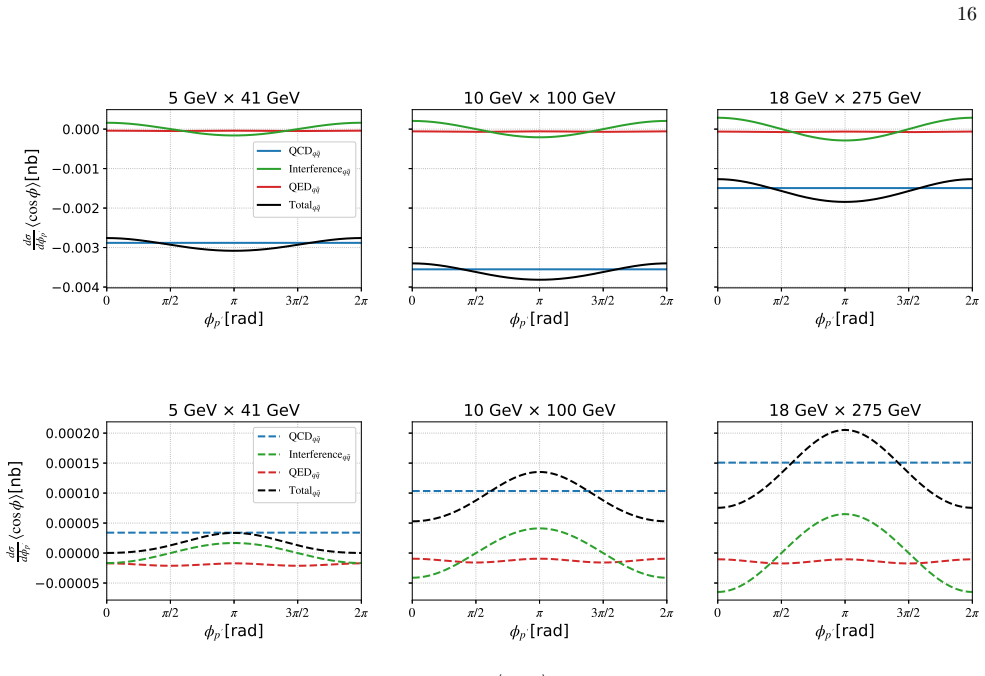
- Sec. V and Fig. 7: the LO+GK prediction matches ZEUS data only for β′ ≳ 0.5 and underpredicts at lower β′, which the text attributes to missing real-gluon radiation. The same large-M, moderate-Q^{2} kinematics still enter the EIC projections (Figs. 8–13) that advertise enhanced valence and QED contributions. Without a controlled estimate (or a hard cut that demonstrably removes the problematic region) of NLO/real-emission and hadronization corrections, the claimed measurability and the size of the valence/QED enhancements remain untested. A quantitative uncertainty band or an explicit β′ ≳ 0.5 baseline for all EIC plots is needed before the projections can be taken as reliable.
- Sec. V (scale choice) and the free-parameter list: the hard scale is fixed to μ_R^{2} = μ_F^{2} = m_q^{2} + q_⊥^{2} + z z-bar Q^{2} with no variation shown. Because α_s and the GPD evolution enter the absolute rates and the relative QED/QCD size (especially at large q_⊥^{2}, Fig. 10), a scale-variation band is a minimal robustness check for the EIC claims. Its absence leaves the central phenomenological conclusions under-constrained.
Circularity Check
No significant circularity: LO hard kernels are derived from Feynman diagrams and convolved with external GPD/FF inputs; HERA comparison is an external check, not a fit.
full rationale
The paper's central results are the LO amplitudes (Secs. III B–C) and differential cross sections (Sec. IV) for exclusive quark and gluon dijet electroproduction. These are obtained by evaluating the Feynman diagrams of Figs. 2–6, expressing the hard parts as Compton form factors (CFFs) that are convolutions of standard GPD definitions (Eqs. 15–16) or elastic form factors (Eq. 17) with the derived kernels (Eqs. 21, 24, 26, 33, 36). The CFFs are not fitted to the dijet data; they are evaluated with the external Goloskokov–Kroll model and standard elastic FFs. The HERA comparison (Fig. 7) is a genuine external benchmark that the calculation only partially describes (agreement only for β′ ≳ 0.5), and the EIC projections (Figs. 8–13) are forward predictions under the stated LO + GK assumptions. Appendix A verifies continuity of gluon GPD derivatives under LO evolution from the standard kernels, which is a consistency check rather than a circular definition. Self-references (PARTONS framework, prior DDVCS work) are infrastructural or comparative and do not force the hard kernels or the numerical results. The weakest points of the paper (scale choice, neglect of NLO/real emission/hadronization) are openly acknowledged and affect reliability, not circularity. Score 1 reflects only the minor, non-load-bearing self-citations.
Axiom & Free-Parameter Ledger
free parameters (3)
- μ_R^{2} = μ_F^{2} = m_q^{2} + q_⊥^{2} + z z-bar Q^{2}
- Goloskokov-Kroll GPD model parameters
- Kinematic cuts (y, t, q_⊥^{2}, Q^{2}, z, β′, …)
axioms (5)
- domain assumption Collinear factorization of exclusive dijet electroproduction at leading twist and LO in α_s holds in the kinematic region considered.
- domain assumption Transversity GPDs and E, E-tilde GPDs can be neglected for unpolarized targets and the observables shown.
- standard math First derivatives of gluon GPDs remain continuous at x = ±ξ under LO evolution, so double-pole CFFs are well-defined.
- domain assumption Nucleon mass can be neglected in the hard kinematics except where kept for heavy-flavor thresholds.
- ad hoc to paper Produced partons can be identified with reconstructed jets for the purpose of LO rate estimates (hadronization deferred).
read the original abstract
We study exclusive electroproduction of dijets in the collinear factorization framework as a probe of generalized parton distributions (GPDs). For quark dijet production, we extend previous analyses by including contributions from helicity GPDs and by assessing an additional leading-order electromagnetic channel governed by elastic nucleon form factors. Furthermore, we investigate exclusive gluon dijet production. We compare our prediction to HERA data and provide projections for measurements at the future Electron-Ion Collider.
Figures


Reference graph
Works this paper leans on
-
[1]
2: Exclusive electroproduction of quark dijet at LO: dominant contribution from quark GPDs
Contribution from quark GPDs q q1 q2 (a) (b) (c) (d) l l′ k1 k2 FIG. 2: Exclusive electroproduction of quark dijet at LO: dominant contribution from quark GPDs. At LO, the amplitude receives contributions shown in Fig. 2 and Fig. 3. The quarks are taken to be massless in this section: µ2 = Q2z ¯z. Note that the diagrams in Fig. 3 are similar to the pure D...
-
[2]
4: Exclusive electroproduction of quark dijet at LO: contribution from gluon GPDs
Contribution from gluon GPDs (a) (b) (c) k1 k2 q1 q2 k1 k2 k1 k2 k2 k1 k2 k1 (f ) k1 k2 (d) (e) ql l′ FIG. 4: Exclusive electroproduction of quark dijet at LO: contribution from gluon GPDs. At LO, the amplitude receives contributions shown in Fig. 4. Note that due to Bose symmetry, there is a double- counting when adding the crossed diagrams, we need to m...
-
[3]
M q ¯q,aa QCD 2
Contribution from elastic FFs q q1 q2 ∆ l l′ l l′ q2 q1 q ∆ ∆ l l ′ q2 q1 ∆ l q1 q2 l′ (a) ( b) ( c) ( d) FIG. 5: Exclusive electroproduction of quark dijet at LO: contribution from EFFs. The amplitude for this channel can be written as: M q ¯q QED = Σ f ef H α gαβ t + iϵ J β f , (27) 8 where H α denotes the hard scattering part, ef is the charge of the q...
2024
-
[4]
Gluon-in-gluon channel The gluon-in-gluon channel takes the following form [ 5]: d dlnµ Fgi(x, ξ) = Z 1 −1 dy n x1 y1 h x1 x1 − y1 ϑ0 11(x1, x1 − y1) i + + x2 y2 h x2 x2 − y2 ϑ0 11(x2, x2 − y2) i + + ∆K gg i (x1, x2 y1, y2) + 1 2 β0 CA + 2 δ(x − y) o Fgi(y, ξ), (A4) the plus distribution is defined as: h x1 x1 − y1 ϑ0 11(x1, x1 − y1) i + ≡ x1 x1 − y1 ϑ0 1...
-
[5]
Gluon-in-quark channel The leading-order gluon-in-quark evolution kernels in Eq. ( A1) take the following form [ 5]: K gq u (x1, x2 y1, y2) =CF (y1 − y2)ϑ0 111(x1, −x2, x1 − y1) + x1x2ϑ1 111(x1, −x2, x1 − y1) , K gq h (x1, x2 y1, y2) =CF (x1 − x2)ϑ0 111(x1, −x2, x1 − y1) + x1x2ϑ1 111(x1, −x2, x1 − y1) , (A16) the definition of ϑ1 111(x1, −x2, x1 − y1) can...
-
[6]
Conclusion Combining the above results, we find that the evolution of gluon GPDs won’t generate discontinuities for its first derivative at x = ξ: d(∂xFgi(ξ, ξ)) dlnµ ± = 0, (A18) for all types of GPDs ( i = u, h, T). The above analyses can be similarly performed for the point x = −ξ, with the assumption that ∂2Fgi(x, ξ)/∂2x is finite (can be discontinuou...
-
[7]
2Re M q ¯q QCDM q ¯q∗ QED We have 2Re M q ¯q QCDM q ¯q∗ QED = 2Re M q ¯q,u QCDM q ¯q∗ QED + 2Re M q ¯q,h QCDM q ¯q∗ QED , note that due to the existence of J α ⊥ in M q ¯q QED , Re M q ¯q,h QCDM q ¯q∗ QED is not zero for the unpolarized target. Their results read : 2Re M q ¯q,u QCDM q ¯q∗ QED = − 128π4α3 emαse2 q Q2t (µ2 + q2 ⊥)2 n Re h (2CF I q ¯q qu1 + ...
-
[8]
D. Müller, D. Robaschik, B. Geyer, F. M. Dittes, and J. Hořejši, Wave functions, evolution equations and evolution kernels from light ray operators of QCD, Fortsch. Phys. 42, 101 (1994) , arXiv:hep-ph/9812448
Pith/arXiv arXiv 1994
-
[9]
Ji, Deeply virtual Compton scattering, Phys
X.-D. Ji, Deeply virtual Compton scattering, Phys. Rev. D 55, 7114 (1997) , arXiv:hep-ph/9609381
Pith/arXiv arXiv 1997
-
[10]
A. V. Radyushkin, Nonforward parton distributions, Phys. Rev. D 56, 5524 (1997) , arXiv:hep-ph/9704207
Pith/arXiv arXiv 1997
-
[11]
Diehl, Generalized parton distributions, Phys
M. Diehl, Generalized parton distributions, Phys. Rept. 388, 41 (2003) , arXiv:hep-ph/0307382
Pith/arXiv arXiv 2003
-
[12]
A. V. Belitsky and A. V. Radyushkin, Unraveling hadron structure with generalized parton distributions, Phys. Rept. 418, 1 (2005) , arXiv:hep-ph/0504030
Pith/arXiv arXiv 2005
-
[13]
Ji, Gauge-Invariant Decomposition of Nucleon Spin, Phys
X.-D. Ji, Gauge-Invariant Decomposition of Nucleon Spin, Phys. Rev. Lett. 78, 610 (1997) , arXiv:hep-ph/9603249
Pith/arXiv arXiv 1997
-
[14]
Ji, A QCD analysis of the mass structure of the nucleon, Phys
X.-D. Ji, A QCD analysis of the mass structure of the nucleon, Phys. Rev. Lett. 74, 1071 (1995) , arXiv:hep-ph/9410274
Pith/arXiv arXiv 1995
-
[15]
M. V. Polyakov, Generalized parton distributions and strong forces inside nucleons and nuclei, Phys. Lett. B 555, 57 (2003), arXiv:hep-ph/0210165
Pith/arXiv arXiv 2003
-
[16]
J. C. Collins, L. Frankfurt, and M. Strikman, Factorization for hard exclusive electroproduction of mesons in QCD, Phys. Rev. D 56, 2982 (1997) , arXiv:hep-ph/9611433
Pith/arXiv arXiv 1997
-
[17]
J. C. Collins and A. Freund, Proof of factorization for deeply virtual Compton scattering in QCD, Phys. Rev. D 59, 074009 (1999), arXiv:hep-ph/9801262
Pith/arXiv arXiv 1999
-
[18]
J. Dudek et al. , Physics Opportunities with the 12 GeV Upgrade at Jefferson Lab, Eur. Phys. J. A 48, 187 (2012) , arXiv:1208.1244 [hep-ex]
Pith/arXiv arXiv 2012
-
[19]
A. Accardi et al. , Electron Ion Collider: The Next QCD Frontier: Understanding the glue that binds us all, Eur. Phys. J. A 52, 268 (2016) , arXiv:1212.1701 [nucl-ex]
Pith/arXiv arXiv 2016
-
[20]
R. Abdul Khalek et al. , Science Requirements and Detector Concepts for the Electron-Ion Collider: EIC Yellow Report, Nucl. Phys. A 1026, 122447 (2022) , arXiv:2103.05419 [physics.ins-det]
Pith/arXiv arXiv 2022
-
[21]
D. P. Anderle et al. , Electron-ion collider in China, Front. Phys. (Beijing) 16, 64701 (2021) , arXiv:2102.09222 [nucl-ex]
Pith/arXiv arXiv 2021
-
[22]
K. Kumerički and D. Mueller, Deeply virtual Compton scattering at small xB and the access to the GPD H, Nucl. Phys. B 841, 1 (2010) , arXiv:0904.0458 [hep-ph]
Pith/arXiv arXiv 2010
-
[23]
P. Kroll, H. Moutarde, and F. Sabatie, From hard exclusive meson electroproduction to deeply virtual Compton scattering, Eur. Phys. J. C 73, 2278 (2013) , arXiv:1210.6975 [hep-ph]
Pith/arXiv arXiv 2013
-
[24]
H. Moutarde, P. Sznajder, and J. Wagner, Border and skewness functions from a leading order fit to DVCS data, Eur. Phys. J. C 78, 890 (2018) , arXiv:1807.07620 [hep-ph]
Pith/arXiv arXiv 2018
-
[25]
K. Kumericki, S. Liuti, and H. Moutarde, GPD phenomenology and DVCS fitting: Entering the high-precision era, Eur. Phys. J. A 52, 157 (2016) , arXiv:1602.02763 [hep-ph]
Pith/arXiv arXiv 2016
-
[26]
H. Moutarde, P. Sznajder, and J. Wagner, Unbiased determination of DVCS Compton Form Factors, Eur. Phys. J. C 79, 614 (2019) , arXiv:1905.02089 [hep-ph] . 27
Pith/arXiv arXiv 2019
-
[27]
M. Čuić, K. Kumerički, and A. Schäfer, Separation of Quark Flavors Using Deeply Virtual Compton Scattering Data, Phys. Rev. Lett. 125, 232005 (2020) , arXiv:2007.00029 [hep-ph]
Pith/arXiv arXiv 2020
-
[28]
Ji, Parton Physics on a Euclidean Lattice, Phys
X. Ji, Parton Physics on a Euclidean Lattice, Phys. Rev. Lett. 110, 262002 (2013) , arXiv:1305.1539 [hep-ph]
Pith/arXiv arXiv 2013
-
[29]
Ji, Parton Physics from Large-Momentum Effective Field Theory, Sci
X. Ji, Parton Physics from Large-Momentum Effective Field Theory, Sci. China Phys. Mech. Astron. 57, 1407 (2014) , arXiv:1404.6680 [hep-ph]
Pith/arXiv arXiv 2014
-
[30]
X. Ji, Y.-S. Liu, Y. Liu, J.-H. Zhang, and Y. Zhao, Large-momentum effective theory, Rev. Mod. Phys. 93, 035005 (2021) , arXiv:2004.03543 [hep-ph]
Pith/arXiv arXiv 2021
-
[31]
A. V. Radyushkin, Quasi-parton distribution functions, momentum distributions, and pseudo-parton distribution functions, Phys. Rev. D 96, 034025 (2017) , arXiv:1705.01488 [hep-ph]
Pith/arXiv arXiv 2017
-
[32]
C. Alexandrou, K. Cichy, M. Constantinou, K. Hadjiyiannakou, K. Jansen, A. Scapellato, and F. Steffens, Unpolarized and helicity generalized parton distributions of the proton within lattice QCD, Phys. Rev. Lett. 125, 262001 (2020) , arXiv:2008.10573 [hep-lat]
Pith/arXiv arXiv 2020
-
[33]
H.-W. Lin, Nucleon Tomography and Generalized Parton Distribution at Physical Pion Mass from Lattice QCD, Phys. Rev. Lett. 127, 182001 (2021) , arXiv:2008.12474 [hep-ph]
Pith/arXiv arXiv 2021
-
[34]
S. Bhattacharya, K. Cichy, M. Constantinou, J. Dodson, X. Gao, A. Metz, S. Mukherjee, A. Scapellato, F. Steffens, and Y. Zhao, Generalized parton distributions from lattice QCD with asymmetric momentum transfer: Unpolarized quarks, Phys. Rev. D 106, 114512 (2022) , arXiv:2209.05373 [hep-lat]
Pith/arXiv arXiv 2022
-
[35]
K. Cichy, M. Constantinou, P. Sznajder, and J. Wagner, Nucleon tomography and total angular momentum of valence quarks from synergy between lattice QCD and elastic scattering data, Phys. Rev. D 110, 114025 (2024) , arXiv:2409.17955 [hep-ph]
Pith/arXiv arXiv 2024
-
[36]
M.-H. Chu, K. Cichy, M. Constantinou, P. Sznajder, and J. Wagner, A unified neural-network framework for nucleon imaging from numerical simulations of QCD, JHEP 05, 210 , arXiv:2509.15931 [hep-lat]
-
[37]
Y. Guo, F. P. Aslan, X. Ji, and M. G. Santiago, First Global Extraction of Generalized Parton Distributions from Ex- periment and Lattice Data with Next-to-Leading-Order Accuracy, Phys. Rev. Lett. 135, 261903 (2025) , arXiv:2509.08037 [hep-ph]
Pith/arXiv arXiv 2025
-
[38]
H. Abramowicz et al. (ZEUS), Production of exclusive dijets in diffractive deep inelastic scattering at HERA, Eur. Phys. J. C 76, 16 (2016) , arXiv:1505.05783 [hep-ex]
Pith/arXiv arXiv 2016
-
[39]
N. N. Nikolaev and B. G. Zakharov, Splitting the pomeron into two jets: A Novel process at HERA, Phys. Lett. B 332, 177 (1994) , arXiv:hep-ph/9403281
Pith/arXiv arXiv 1994
-
[40]
J. Bartels, C. Ewerz, H. Lotter, and M. Wusthoff, Azimuthal distribution of quark - anti-quark jets in DIS diffractive dissociation, Phys. Lett. B 386, 389 (1996) , arXiv:hep-ph/9605356
Pith/arXiv arXiv 1996
-
[41]
J. Bartels, H. Lotter, and M. Wüsthoff, Quark-antiquark production in DIS diffractive dissociation, Phys. Lett. B 379, 239 (1996) , [Erratum: Phys.Lett.B 382, 449–449 (1996)], arXiv:hep-ph/9602363
Pith/arXiv arXiv 1996
-
[42]
R. Boussarie, A. V. Grabovsky, L. Szymanowski, and S. Wallon, Towards a complete next-to-logarithmic description of forward exclusive diffractive dijet electroproduction at HERA: real corrections, Phys. Rev. D 100, 074020 (2019) , arXiv:1905.07371 [hep-ph]
Pith/arXiv arXiv 2019
-
[43]
B. Linek, M. Łuszczak, W. Schäfer, and A. Szczurek, Probing gluon GTMDs of the proton in deep inelastic diffractive dijet production at HERA, Phys. Rev. D 110, 054027 (2024) , arXiv:2403.15110 [hep-ph]
Pith/arXiv arXiv 2024
-
[44]
D. Boer and C. Setyadi, Probing gluon GTMDs through exclusive coherent diffractive processes, Eur. Phys. J. C 83, 890 (2023), arXiv:2301.07980 [hep-ph]
Pith/arXiv arXiv 2023
-
[45]
D. Boer and C. Setyadi, GTMD model predictions for diffractive dijet production at EIC, Phys. Rev. D 104, 074006 (2021), arXiv:2106.15148 [hep-ph]
Pith/arXiv arXiv 2021
-
[46]
Y. Hatta, B.-W. Xiao, and F. Yuan, Probing the Small- x Gluon Tomography in Correlated Hard Diffractive Dijet Pro- duction in Deep Inelastic Scattering, Phys. Rev. Lett. 116, 202301 (2016) , arXiv:1601.01585 [hep-ph]
Pith/arXiv arXiv 2016
-
[47]
X. Ji, F. Yuan, and Y. Zhao, Hunting the Gluon Orbital Angular Momentum at the Electron-Ion Collider, Phys. Rev. Lett. 118, 192004 (2017) , arXiv:1612.02438 [hep-ph]
Pith/arXiv arXiv 2017
-
[48]
S. Bhattacharya, R. Boussarie, and Y. Hatta, Signature of the Gluon Orbital Angular Momentum, Phys. Rev. Lett. 128, 182002 (2022) , arXiv:2201.08709 [hep-ph]
Pith/arXiv arXiv 2022
-
[49]
S. Bhattacharya, R. Boussarie, and Y. Hatta, Exploring orbital angular momentum and spin-orbit correlations for gluons at the Electron-Ion Collider, Phys. Rev. D 111, 034019 (2025) , arXiv:2404.04209 [hep-ph]
Pith/arXiv arXiv 2025
-
[50]
V. M. Braun and D. Y. Ivanov, Exclusive diffractive electroproduction of dijets in collinear factorization, Phys. Rev. D 72, 034016 (2005) , arXiv:hep-ph/0505263
Pith/arXiv arXiv 2005
-
[51]
T. J. Chall, M. Łuszczak, W. Schäfer, and A. Szczurek, Probing GPDs in exclusive electroproduction of dijets, Phys. Rev. D 113, 114012 (2026) , arXiv:2603.09686 [hep-ph]
Pith/arXiv arXiv 2026
-
[52]
B. Berthou et al., PARTONS: PARtonic Tomography Of Nucleon Software: A computing framework for the phenomenology of Generalized Parton Distributions, Eur. Phys. J. C 78, 478 (2018) , arXiv:1512.06174 [hep-ph]
Pith/arXiv arXiv 2018
-
[53]
K. Deja, V. Martinez-Fernandez, B. Pire, P. Sznajder, and J. Wagner, Phenomenology of double deeply virtual Compton scattering in the era of new experiments, Phys. Rev. D 107, 094035 (2023) , arXiv:2303.13668 [hep-ph]
Pith/arXiv arXiv 2023
-
[54]
L. Mankiewicz and G. Piller, Comments on exclusive electroproduction of transversely polarized vector mesons, Phys. Rev. D 61, 074013 (2000) , arXiv:hep-ph/9905287
Pith/arXiv arXiv 2000
-
[55]
A. V. Radyushkin, Double distributions and evolution equations, Phys. Rev. D 59, 014030 (1999) , arXiv:hep-ph/9805342
Pith/arXiv arXiv 1999
-
[56]
D. Mueller and A. Schafer, Complex conformal spin partial wave expansion of generalized parton distributions and distri- bution amplitudes, Nucl. Phys. B 739, 1 (2006) , arXiv:hep-ph/0509204. 28
Pith/arXiv arXiv 2006
-
[57]
Grammer, Jr
G. Grammer, Jr. and D. R. Yennie, Improved treatment for the infrared divergence problem in quantum electrodynamics, Phys. Rev. D 8, 4332 (1973)
1973
-
[58]
A. Pedrak, B. Pire, L. Szymanowski, and J. Wagner, Hard photoproduction of a diphoton with a large invariant mass, Phys. Rev. D 96, 074008 (2017) , [Erratum: Phys.Rev.D 100, 039901 (2019)], arXiv:1708.01043 [hep-ph]
Pith/arXiv arXiv 2017
-
[59]
A. Pedrak, B. Pire, L. Szymanowski, and J. Wagner, Electroproduction of a large invariant mass photon pair, Phys. Rev. D 101, 114027 (2020) , arXiv:2003.03263 [hep-ph]
Pith/arXiv arXiv 2020
-
[60]
O. Grocholski, B. Pire, P. Sznajder, L. Szymanowski, and J. Wagner, Collinear factorization of diphoton photoproduction at next to leading order, Phys. Rev. D 104, 114006 (2021) , arXiv:2110.00048 [hep-ph]
Pith/arXiv arXiv 2021
-
[61]
S. V. Goloskokov and P. Kroll, The Longitudinal cross-section of vector meson electroproduction, Eur. Phys. J. C 50, 829 (2007), arXiv:hep-ph/0611290
Pith/arXiv arXiv 2007
-
[62]
S. V. Goloskokov and P. Kroll, The Role of the quark and gluon GPDs in hard vector-meson electroproduction, Eur. Phys. J. C 53, 367 (2008) , arXiv:0708.3569 [hep-ph]
Pith/arXiv arXiv 2008
-
[63]
J. Bartels, H. Jung, and M. Wusthoff, Quark - anti-quark gluon jets in DIS diffractive dissociation, Eur. Phys. J. C 11, 111 (1999) , arXiv:hep-ph/9903265
Pith/arXiv arXiv 1999
-
[64]
H. Qu and L. Gouskos, ParticleNet: Jet Tagging via Particle Clouds, Phys. Rev. D 101, 056019 (2020) , arXiv:1902.08570 [hep-ph]
Pith/arXiv arXiv 2020
-
[65]
D. Guest, J. Collado, P. Baldi, S.-C. Hsu, G. Urban, and D. Whiteson, Jet Flavor Classification in High-Energy Physics with Deep Neural Networks, Phys. Rev. D 94, 112002 (2016) , arXiv:1607.08633 [hep-ex]
Pith/arXiv arXiv 2016
-
[66]
A. M. Sirunyan et al. (CMS), Identification of heavy-flavour jets with the CMS detector in pp collisions at 13 TeV, JINST 13 (05), P05011, arXiv:1712.07158 [physics.ins-det]
discussion (0)
Sign in with ORCID, Apple, or X to comment. Anyone can read and Pith papers without signing in.