Harrison.Rad 1.5 Technical Report: A radiology foundation model that can draft reports from images, priors and clinical context
Reviewed by Pith T0 review T1 audit T2 compute T3 formal T4 kernel 2026-07-08 21:43 UTCglm-5.2pith:KLNVJOK2record.jsonopen to challenge →
The pith
Radiology AI passes mock FRCR exam where all rivals fail
A machine-rendered reading of the paper's core claim, the machinery that carries it, and where it could break.
Core claim
The core discovery is that a radiology-specific foundation model, trained through staged domain adaptation, contrastive alignment, and instruction tuning on approximately 6.5 million studies, can pass a simulated version of a standardised radiologist certification examination (FRCR 2B Short Case) while all general-purpose and medical-domain models evaluated fail every exam sheet. The authors attribute this to radiology-specific training that spends model capacity on the distinctions that matter for image interpretation and reporting rather than on general-purpose breadth. A secondary contribution is the Findings-Diagnosis scoring methodology, which demonstrates that conventional report-level
What carries the argument
HR1.5 is a multimodal large language model built through a three-stage pipeline: (1) domain adaptation of a base LLM on radiology reports, (2) contrastive vision-encoder training with curriculum-based hard negatives on ~6 million image-report instances, and (3) visual-question-answering fine-tuning on ~18 million crafted multi-turn clinical conversations. The HR1.5+ configuration adds an agentic framework that consults task-appropriate models for higher-level tasks like report generation. The Findings-Diagnosis scoring framework extends RadGraph-XL entity extraction with ontology-based synonym matching and polarity-contradiction detection. The explainability engine uses activation steering (
If this is right
- If a radiology-specific model can pass a simulated certification exam, draft reports across multiple body parts, and integrate clinical priors, it could substantially reduce the time radiologists spend producing reports — the bottleneck driving reporting backlogs.
- The Findings-Diagnosis scoring methodology, if adopted by the community, could shift how radiology report generation is evaluated away from lexical-overlap metrics toward clinical-correctness metrics that penalise polarity contradictions.
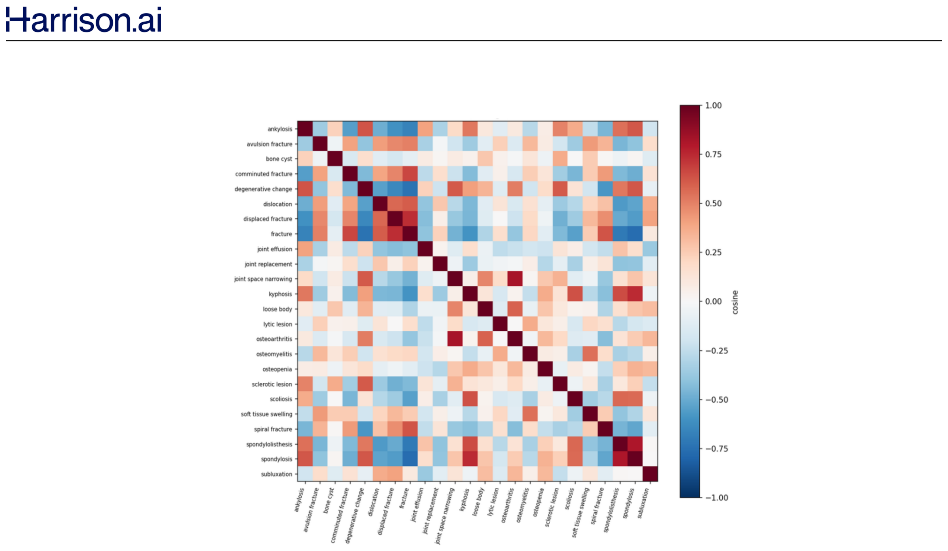
- The activation-steering analysis showing that concepts like pulmonary oedema, cardiomegaly, and fracture are bidirectionally controllable suggests that internal model representations could be used for monitoring and controlled intervention, not just passive observation.
- The confidence estimation approach — combining attention entropy, head disagreement, and representation-trajectory instability, corrected for attention sinks — offers a path toward giving clinicians a trust signal alongside each AI-generated answer, though the authors note it is not yet calibrated.
- The proposed C6 evaluation framework (Coverage, Correctness, Comprehensiveness, Care, Coherence, Conformity) would decompose report quality into interpretable axes, separating failure modes like over-calling from under-describing.
Where Pith is reading between the lines
- The fact that HR1.5+ regresses on the legacy FRCR Rapids format (15.7% vs HR1.5's 24.3%) because it tends to produce detailed responses penalised on normal cases suggests a fundamental tension: models optimised for thorough reporting may underperform on triage-style tasks that reward brevity, implying different clinical workflows may require different model configurations.
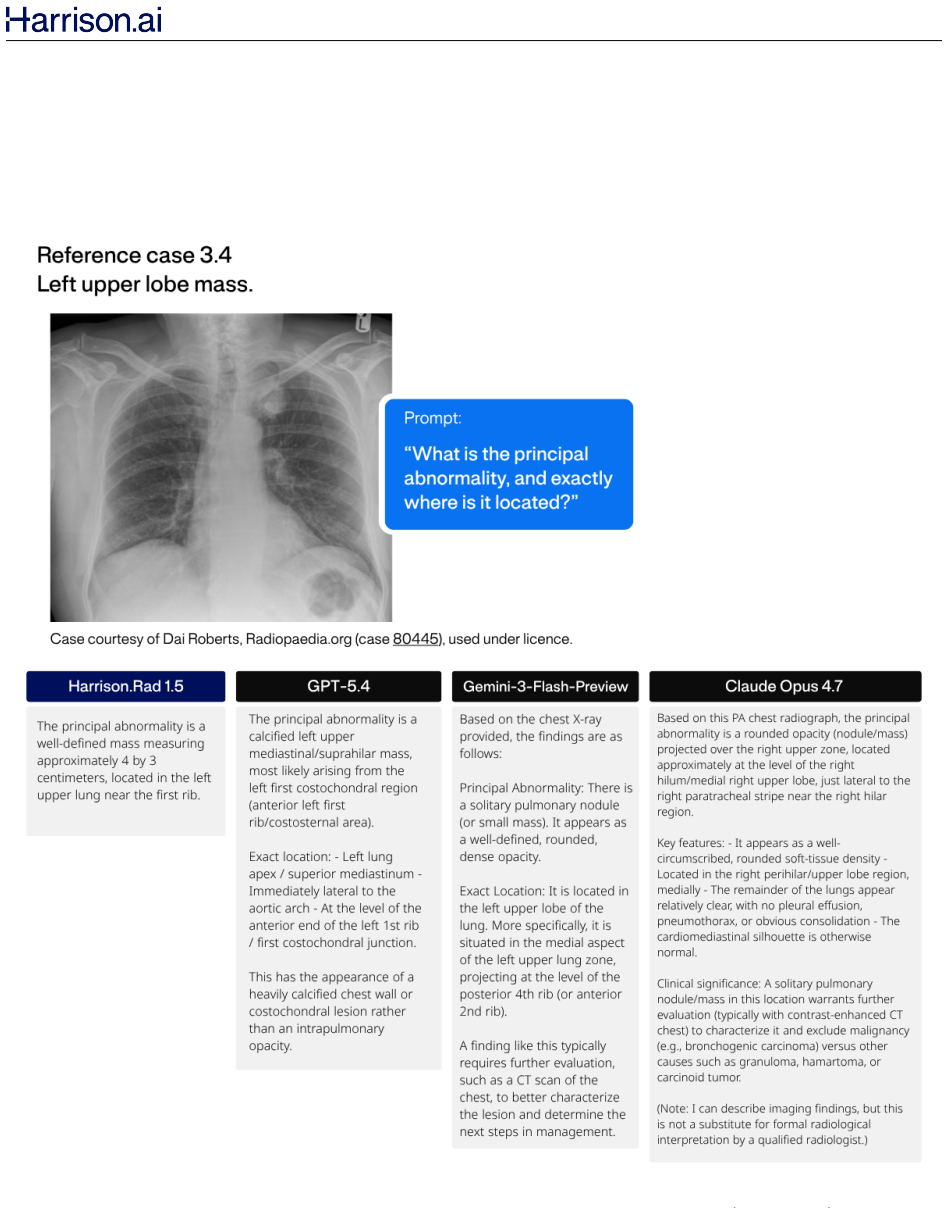
- The observation that the model maps an out-of-distribution input (a synthetic X-ray of an apple in a chest) onto the nearest learnt concept (breast prosthesis) with high confidence reveals that the confidence signal cannot detect conceptual novelty — only distributional unfamiliarity — which is a safety-critical distinction for clinical deployment.
- If the FRCR simulation's case selection, difficulty distribution, or scoring rubric diverges from the actual RCR exam, the headline passing claim may not generalise to the real certification setting — a question that could only be resolved by evaluation on official exam materials.
- The concept geometry analysis showing that acute fracture directions are anti-aligned with chronic degenerative directions (cosine similarity −0.76) raises the question of whether the model's internal representation space could be used to detect novel findings: a finding that does not align with any existing concept direction might flag a genuinely novel pathology.
Load-bearing premise
The simulated FRCR examination, the Angoff cut-off thresholds, and the internal evaluation datasets (RadBench, RadCoverage-VQA) were all constructed by the model's developers and have not been independently validated against the actual RCR examination or externally reviewed. If the case selection, difficulty distribution, or scoring rubric of this simulation diverges from the real FRCR exam, the headline passing claim may not generalise.
What would settle it
If HR1.5 were evaluated on official RCR FRCR 2B Short Case examination materials (or an independently constructed simulation with verified difficulty distribution and scoring), and its per-sheet pass rate fell below the Angoff cut-off, the central claim would be undermined. Similarly, if an independent multi-reader study found that radiologists rejected HR1.5's draft reports at rates comparable to the general-purpose models it outperforms on internal benchmarks, the claim of clinically superior reporting would weaken.
Figures






read the original abstract
Imaging demand is growing faster than the radiology workforce can expand, and reporting backlogs cannot be resolved through training and recruitment alone. The most direct opportunity is reducing the time and effort radiologists spend producing reports, a task that requires interpreting images, integrating clinical history and prior studies, and drafting structured findings. We present Harrison.Rad 1.5 (HR1.5), a radiology-specific multimodal large language model that accepts interleaved text and visual inputs and generates structured and unstructured text across plain-film radiology, spanning computed radiography, chest, musculoskeletal, abdominal, spine, and pelvic x-rays, and mammography. HR1.5 is trained through a three-stage pipeline: domain adaptation of a base language model on radiology reports, contrastive vision-encoder training with curriculum-based hard negatives on ~6 million image-report instances, and visual-question-answering fine-tuning on multi-turn conversations. We evaluate it with a Findings-Diagnosis scoring framework that extends RadGraph-XL entity extraction with ontology-based synonym matching and polarity-contradiction detection, benchmarked on RadBench, a simulated FRCR 2B Short Case examination scored against Angoff-method thresholds, ReXGradient, and internal multi-modality datasets. HR1.5 is the only system evaluated to meet the simulated FRCR passing standard and achieves the highest accuracy on closed-format clinical questions, across anatomical regions, on internal multi-body-part and mammography reporting, and on the primary clinically-aligned score for public chest reporting. We further examine explainability and model behaviour, including question-sensitive Grad-CAM heatmaps, attention analysis, and confidence estimation, to support responsible future evaluation toward clinical use, and a framework for clinically grounded assessment of report quality.
Editorial analysis
A structured set of objections, weighed in public.
Referee Report
Summary. This technical report presents Harrison.Rad 1.5 (HR1.5), a radiology-specific multimodal large language model that drafts reports from X-ray images, priors, and clinical context. The model is trained via a three-stage pipeline (domain adaptation, contrastive vision-encoder training with curriculum hard negatives, and VQA fine-tuning) on approximately 6.5 million studies. Evaluation spans a simulated FRCR 2B Short Case examination, closed- and open-format VQA benchmarks (RadBench, ReXGradient, RadCoverage-VQA, CBIS-DDSM mammography), and qualitative case comparisons against frontier general-purpose models. The central claim is that HR1.5 is the only system evaluated to meet the simulated FRCR passing standard and achieves the highest accuracy on closed-format clinical questions across anatomical regions. The report also introduces a Findings-Diagnosis scoring framework, an explainability engine (concept tracing, attention-based localisation, confidence estimation), and outlines a future C6 evaluation framework.
Significance. The paper tackles an important problem (radiology workload scaling) and presents a broad evaluation across multiple body parts and modalities, which is a genuine strength over the many chest-only systems in the literature. The Findings-Diagnosis scoring framework, with its polarity-contradiction detection and ontology-based synonym matching, is a reasonable attempt to address well-known limitations of lexical-overlap metrics, and Table 1 effectively illustrates these deficiencies. The concept-tracing analysis (§4.1) with causal steering tests is a commendable depth of mechanistic analysis for a technical report. The authors are also transparent about several limitations, including the RadBench sample-size issue and the regression of HR1.5+ on certain benchmarks. However, the headline FRCR claim rests on an internally constructed simulation with an LLM-as-a-judge scorer whose properties are underspecified, and the statistical evidence at the claimed passing threshold is fragile.
major comments (6)
- §2.2.1, FRCR 2B Short Case scoring: The headline claim that HR1.5+ is the only system to meet the FRCR passing standard (Table 4: 62.5% pass rate) depends on an LLM-as-a-judge scoring 400 cases on a 0–5 rubric. The paper does not specify which LLM serves as judge, the prompt or rubric anchor text, whether model identity is visible to the judge, or the inter-rater agreement between the LLM judge and qualified FRCR examiners. This matters because HR1.5+ is explicitly described as having 'a greater tendency to produce detailed, characterising responses' (§2.2.1), and LLM-as-a-judge methods are documented to exhibit length and verbosity bias (Gu et al., 2024, the very citation used). The paper should specify the judge model, prompt, and any blinding, and ideally report inter-rater agreement with human FRCR examiners on a subset of cases.
- §2.2.1, Tables 2–4 and the verbosity confound: The pattern of results is internally consistent with a judge that rewards response length. HR1.5+ passes more Short Case sheets (all abnormal, rewarded for detail) but regresses on legacy Rapids (half normal, penalised for over-calling: 15.7% vs HR1.5's 24.3%) and on RadCoverage-VQA (46.6% vs HR1.5's 66.6%). The paper attributes the Rapids regression to verbosity but does not test whether the Short Case advantage is driven by the same verbosity bias rather than clinical precision. A controlled analysis — e.g., length-normalised re-scoring, or human expert re-scoring of a sample where HR1.5+ passes and a shorter competitor fails — would substantially strengthen the central claim. Without this, the verbosity-confound alternative explanation for the headline result remains open.
- §2.2.1, Table 3: The statistical evidence for the FRCR 2B Short Case passing claim is fragile. HR1.5+ has a mean score of 74.8 (95% CI: 61.4–87.2) against a mean Angoff cut-off of 73.2; the lower bound of the CI is well below the cut-off. The per-sheet pass rate of 62.5% (10 of 16 sheets) yields a 95% binomial CI of approximately [35%, 85%]. The Angoff cut-offs themselves were 'estimated internally' and 'spot-checked and verified by internal expert radiologists' — the estimation procedure, number of radiologists, and their agreement should be reported. The paper should acknowledge the uncertainty in the headline claim more explicitly and temper the conclusion accordingly.
- §2.2.3, Table 9: RadCoverage-VQA is an internal held-out set whose composition cannot be independently verified. HR1.5+ scores substantially lower than HR1.5 (46.6% vs 66.6% overall), which the authors attribute to the multi-turn dialogue format. This is a large and unexplained regression for the agentic configuration that is presented as the superior system on the FRCR headline. The paper should clarify whether this regression reflects a genuine limitation of the agentic framework or an artefact of the scoring methodology, and should reconcile the narrative that HR1.5+ is the preferred configuration with this result. At minimum, the abstract and discussion should not present HR1.5+ as uniformly superior without noting this caveat.
- §2.1, Findings-Diagnosis scoring: The scoring framework is described at a conceptual level but key operational details are missing — the fuzzy token matching threshold, the ontology source, the generic descriptor filter list, and the normal/abnormal classification fallback logic are unspecified. The paper acknowledges the framework 'can still credit a report that misses a subtle finding or accept a vague but incorrect descriptor as a match' (§2.1), but does not quantify the false-positive or false-negative rate of the scorer against a human reference. Given that this scorer underpins RadCoverage-VQA, ReXGradient, and mammography results, a validation study (even on a small sample) comparing F-D verdicts to expert radiologist verdicts would strengthen the reliability of all downstream claims.
- §2.2.1, FRCR simulation validity: The FRCR examination simulations are internally constructed using external data, not the official RCR sittings. The paper states it made 'best effort to follow the published examination guidelines' but does not report the case selection criteria, difficulty distribution, or body-part distribution in detail, nor how closely the simulation matches the official exam in these respects. Since the headline claim is that HR1.5+ meets the 'simulated FRCR passing standard,' the paper should be more explicit that this is a simulation that has not been validated against official RCR sittings, and should avoid language that could be read as claiming official FRCR-level competence.
minor comments (12)
- §1.1: The training pipeline is described at a high conceptual level, with 'internal architecture, stage count, and scale intentionally omitted' (Fig. 1.2 caption). While the rationale is understandable, the complete absence of model size, training compute, or architecture details makes independent reproduction impossible and limits scholarly assessment. Consider providing at least parameter count and total training compute.
- §1.2: The hard-negative curriculum and crafted dialogue generation are described conceptually but no quantitative details (curriculum schedule, oversampling rates, generator models) are provided. Adding even approximate figures would strengthen the methodology section.
- §2.1, Table 1: The table is effective but the column headers could be clearer — 'GT acc.' and 'F-D' are abbreviated without a footnote. A brief caption note explaining each column would aid readability.
- §2.2.1: The Angoff cut-off estimation procedure is referenced but not described. A brief description of the standard-setting method and the number of expert radiologists involved should be specified.
- §2.2.2, Table 6: CheXOne and CheXagent appear only in the CXR column with dashes elsewhere. A footnote or table note explaining that these are CXR-only models would improve readability.
- §2.2.3, Table 8: The note about RexGradient's structured reports affecting the automated F-D score is important context but appears after the table. Consider flagging this limitation before presenting the results or highlighting it more prominently.
- §4.1, Tables 13–14: The steering results are interesting but the classification criteria (bidirectional vs. subtractive) are described in text but not in the table. Adding a brief note or colour-coding would aid interpretation.
- §4.3: The confidence feature combines three signals with weights (w_e, w_d, w_cv) but the weight values are not reported. Stating the current values or noting that they are untuned would aid interpretation.
- §4.4: The OOD example (synthetic apple X-ray) is qualitatively interesting but the claim that the error is 'reasonable' is subjective. Consider framing this more neutrally as a limitation to be addressed.
- §6.1: The C6 framework is presented as future work but is described at a level of detail that suggests it is already partially implemented. Clarifying its current status relative to the current evaluation would help readers calibrate expectations.
- The paper would benefit from a consolidated table of all benchmarks, models, and metrics, as results are currently spread across Tables 2–10 with varying model subsets and metric sets. A summary table or figure would help readers navigate the evaluation.
- Several references are to non-peer-reviewed sources (arXiv preprints, model documentation pages). Where peer-reviewed alternatives exist, they should be preferred. Ensure all URLs are properly cited and accessible.
Simulated Author's Rebuttal
We thank the referee for a careful and constructive review. The referee's comments are well-taken on several points, particularly regarding the underspecification of the LLM-as-a-judge scorer, the verbosity confound, the fragility of the statistical evidence at the FRCR passing threshold, and the need for validation of the Findings-Diagnosis scorer. We agree to revise the manuscript to address these. On the RadCoverage-VQA regression and the FRCR simulation validity, we agree that the manuscript needs to be more transparent and temper its claims. We provide point-by-point responses below.
read point-by-point responses
-
Referee: §2.2.1, FRCR 2B Short Case scoring: The headline claim depends on an LLM-as-a-judge scoring 400 cases on a 0–5 rubric. The paper does not specify which LLM serves as judge, the prompt or rubric anchor text, whether model identity is visible to the judge, or the inter-rater agreement between the LLM judge and qualified FRCR examiners. The paper should specify the judge model, prompt, and any blinding, and ideally report inter-rater agreement with human FRCR examiners on a subset of cases.
Authors: The referee is correct that these details are missing from the current manuscript. We will add them in the revision. Specifically, we will specify the judge model identity, the full rubric anchor text, and confirm that model identity was not visible to the judge (the judge received only the case image, the reference, and the candidate response, with no model identifiers). Regarding inter-rater agreement with human FRCR examiners: we agree this would substantially strengthen the claim. We have internal expert radiologists who verified a subset of the LLM judge's scores during development, and we will report the agreement rate on that subset. If the agreement data are sufficient for quantitative reporting (e.g., Cohen's kappa or percent agreement), we will include them; if not, we will at minimum report the qualitative validation procedure and its findings. We acknowledge that without formal inter-rater agreement data, the LLM-as-a-judge scoring remains a limitation that should be stated explicitly. revision: yes
-
Referee: §2.2.1, Tables 2–4 and the verbosity confound: The pattern of results is internally consistent with a judge that rewards response length. HR1.5+ passes more Short Case sheets but regresses on legacy Rapids and RadCoverage-VQA. The paper attributes the Rapids regression to verbosity but does not test whether the Short Case advantage is driven by the same verbosity bias. A controlled analysis — e.g., length-normalised re-scoring, or human expert re-scoring of a sample where HR1.5+ passes and a shorter competitor fails — would substantially strengthen the central claim.
Authors: This is a fair and important concern. We agree that the verbosity-confound alternative explanation is not currently ruled out by the evidence in the manuscript. We will address this in two ways in the revision. First, we will conduct a length-normalised re-scoring analysis on the FRCR 2B Short Case sheets, re-running the LLM judge with an explicit instruction to score based on clinical correctness regardless of response length, and report whether the pass rates change materially. Second, we will arrange for expert radiologist re-scoring of a sample of cases where HR1.5+ passes and a shorter competitor fails, to test whether the advantage holds under human judgement. If the re-scoring shows that the advantage is materially reduced or eliminated, we will temper the headline claim accordingly. If it holds, we will report the human validation alongside the LLM judge results. We acknowledge that as the manuscript currently stands, the verbosity confound remains an open alternative explanation, and we will state this limitation explicitly until the controlled analysis is completed. revision: yes
-
Referee: §2.2.1, Table 3: The statistical evidence for the FRCR 2B Short Case passing claim is fragile. HR1.5+ has a mean score of 74.8 (95% CI: 61.4–87.2) against a mean Angoff cut-off of 73.2; the lower bound of the CI is well below the cut-off. The per-sheet pass rate of 62.5% (10 of 16 sheets) yields a 95% binomial CI of approximately [35%, 85%]. The Angoff cut-offs themselves were 'estimated internally' and 'spot-checked and verified by internal expert radiologists' — the estimation procedure, number of radiologists, and their agreement should be reported. The paper should acknowledge the uncertainty in the headline claim more explicitly and temper the conclusion accordingly.
Authors: The referee's statistical assessment is correct. The 95% CI for HR1.5+'s mean score does include values below the Angoff cut-off, and the binomial CI on the pass rate is wide. We will revise the manuscript to (1) report the Angoff estimation procedure in more detail, including the number of radiologists involved and their level of agreement, (2) include the binomial CI on the per-sheet pass rate, and (3) temper the headline claim to acknowledge the statistical uncertainty. Specifically, we will revise the abstract and discussion to state that HR1.5+ meets the simulated passing standard on the majority of sheets but that the confidence intervals are wide and the result should be interpreted with appropriate caution. We will avoid language implying definitive FRCR-level competence. revision: yes
-
Referee: §2.2.3, Table 9: RadCoverage-VQA is an internal held-out set whose composition cannot be independently verified. HR1.5+ scores substantially lower than HR1.5 (46.6% vs 66.6% overall), which the authors attribute to the multi-turn dialogue format. This is a large and unexplained regression for the agentic configuration that is presented as the superior system on the FRCR headline. The paper should clarify whether this regression reflects a genuine limitation of the agentic framework or an artefact of the scoring methodology, and should reconcile the narrative that HR1.5+ is the preferred configuration with this result. At minimum, the abstract and discussion should not present HR1.5+ as uniformly superior without noting this caveat.
Authors: We agree that the manuscript currently presents HR1.5+ as superior without adequately flagging this regression, and that this is a genuine inconsistency in the narrative. The regression on RadCoverage-VQA is substantial and not fully explained. We believe it reflects a genuine limitation of the agentic configuration in the multi-turn dialogue setting — the agentic framework introduces additional processing steps that can degrade performance on certain dialogue-heavy tasks — but we cannot fully rule out a scoring methodology artefact. In the revision, we will (1) add a caveat to the abstract and discussion noting that HR1.5+ does not uniformly improve over HR1.5 and regresses on multi-turn dialogue evaluation, (2) provide additional analysis of the regression, and (3) present HR1.5+ as the preferred configuration for specific task types (e.g., structured report generation, single-pass examination-style reporting) rather than uniformly superior. We acknowledge that the internal nature of RadCoverage-VQA limits independent verification, and we will note this as well. revision: yes
-
Referee: §2.1, Findings-Diagnosis scoring: The scoring framework is described at a conceptual level but key operational details are missing — the fuzzy token matching threshold, the ontology source, the generic descriptor filter list, and the normal/abnormal classification fallback logic are unspecified. The paper acknowledges the framework 'can still credit a report that misses a subtle finding or accept a vague but incorrect descriptor as a match' but does not quantify the false-positive or false-negative rate of the scorer against a human reference. A validation study comparing F-D verdicts to expert radiologist verdicts would strengthen the reliability of all downstream claims.
Authors: The referee is correct that operational details are missing and that a validation study against expert radiologist verdicts would strengthen the reliability of downstream claims. We will add the operational details in the revision: the fuzzy token matching threshold, the ontology source (a radiology knowledge graph derived from standard radiology lexicons), the generic descriptor filter list (at least in summary form), and the normal/abnormal fallback logic. Regarding validation: we have internal data from radiologist review of F-D verdicts on a subset of cases (some of which is reflected in the GT-acceptable column of Table 1), and we will report the false-positive and false-negative rates of the F-D scorer against this human reference. If the validation sample is large enough, we will report quantitative agreement metrics; if not, we will report what we have and acknowledge the limitation. We agree that without this validation, the reliability of downstream claims resting on the F-D scorer is not fully established. revision: partial
-
Referee: §2.2.1, FRCR simulation validity: The FRCR examination simulations are internally constructed using external data, not the official RCR sittings. The paper states it made 'best effort to follow the published examination guidelines' but does not report the case selection criteria, difficulty distribution, or body-part distribution in detail, nor how closely the simulation matches the official exam. The paper should be more explicit that this is a simulation that has not been validated against official RCR sittings, and should avoid language that could be read as claiming official FRCR-level competence.
Authors: We agree. The manuscript already states that the simulations are internally constructed, but the language in the abstract and discussion could be read as implying a stronger claim than is warranted. We will revise to (1) add detail on case selection criteria, difficulty distribution, and body-part distribution, (2) explicitly state that the simulation has not been validated against official RCR sittings and that the official sittings are not publicly available, and (3) review all language referring to the FRCR to ensure it is consistently qualified as a simulation. We will ensure the abstract uses language such as 'simulated FRCR 2B Short Case examination' rather than language that could be read as claiming official FRCR-level competence. revision: yes
Circularity Check
No significant circularity found; central claims are evaluated against held-out data with externally-grounded scoring tools, though methodology concerns remain.
full rationale
Walking the paper's derivation chain, I find no step where a prediction or first-principles result reduces to its inputs by construction. The central claim — that HR1.5+ meets the simulated FRCR 2B Short Case passing standard (Table 4: 62.5%) — is evaluated on held-out exam sheets using an LLM-as-a-judge scoring rubric and Angoff-method thresholds. While the simulation, Angoff cut-offs, and expert verification are all internal to Harrison.ai (Section 2.2.1: 'We created a simulation of the FRCR examination, using external data that was not used for model training'), these are correctness/methodology risks (internal benchmark, unspecified judge model, small sample of 16 sheets), not circularity: the evaluation metric is not defined in terms of the model's output, and the model is not trained on the evaluation data. The Findings-Diagnosis scoring framework (Section 2.1) extends RadGraph-XL (Jain et al., 2021; Delbrouck et al., 2024) — an external tool — with ontology-based synonym matching and polarity-contradiction detection; it is a new evaluation metric, not a renaming of a known result or a self-definitional construct. RadBench and RadCoverage-VQA are internal datasets, but they are described as held-out evaluation sets, not training data repurposed as test data. The one self-citation (Harrison.ai, 2024) references prior HR1 results for context in the introduction and is not load-bearing for HR1.5's central claims. No uniqueness theorem is invoked, no ansatz is smuggled through self-citation, and no fitted parameter is renamed as a prediction. The concerns about LLM-as-a-judge verbosity bias, small confidence intervals, and internal benchmark construction are real but belong to correctness risk, not circularity.
Axiom & Free-Parameter Ledger
free parameters (7)
- Training data composition =
~6.5M studies, ~18M conversations
- Hard negative curriculum schedule =
Unspecified
- Contrastive decoding parameters =
Unspecified
- Angoff cut-off estimates =
Mean 73.2, range 69.3-77.3 per sheet
- Findings-Diagnosis scoring thresholds =
Unspecified
- Confidence feature weights (w_e, w_d, w_cv) =
Unspecified
- Sink detection threshold =
Unspecified
axioms (5)
- domain assumption RadGraph-XL entity extraction reliably extracts clinical entities (anatomy, observations, polarity) from both predicted and ground-truth radiology reports.
- domain assumption LLM-as-a-judge (Gu et al., 2024) provides a reliable adjudication of clinical correctness when automated finding-matching is insufficient.
- ad hoc to paper The internally constructed FRCR simulation faithfully represents the official RCR FRCR 2B Short Case examination in case selection, difficulty, and body-part distribution.
- ad hoc to paper The Angoff cut-off estimated internally is a valid passing threshold for the simulated exam.
- domain assumption Linear probe directions extracted from model activations correspond to clinically meaningful concepts that the model uses in its reasoning.
invented entities (4)
-
HR1.5+ agentic framework
no independent evidence
-
Findings-Diagnosis scoring framework
no independent evidence
-
C6 evaluation framework
no independent evidence
-
Confidence estimation engine with sink correction
no independent evidence
Reference graph
Works this paper leans on
-
[1]
A Vision-Language Foundation Model to Enhance Efficiency of Chest X-ray Interpretation
Chen, Zhihong and others , title =. 2024 , note =. 2401.12208 , archivePrefix =
work page internal anchor Pith review Pith/arXiv arXiv 2024
-
[2]
Advances in Neural Information Processing Systems (NeurIPS) , year =
Alayrac, Jean-Baptiste and others , title =. Advances in Neural Information Processing Systems (NeurIPS) , year =
-
[3]
International Conference on Machine Learning (ICML) , year =
Radford, Alec and others , title =. International Conference on Machine Learning (ICML) , year =
-
[4]
International Conference on Learning Representations (ICLR) , year =
Yuksekgonul, Mert and others , title =. International Conference on Learning Representations (ICLR) , year =
-
[5]
Selvaraju, Ramprasaath R. and others , title =. International Conference on Computer Vision (ICCV) , year =
-
[6]
Annual Meeting of the Association for Computational Linguistics (ACL) , year =
Abnar, Samira and Zuidema, Willem , title =. Annual Meeting of the Association for Computational Linguistics (ACL) , year =
-
[7]
Conference on Computer Vision and Pattern Recognition (CVPR) , year =
Chefer, Hila and Gur, Shir and Wolf, Lior , title =. Conference on Computer Vision and Pattern Recognition (CVPR) , year =
-
[8]
International Conference on Learning Representations (ICLR) , year =
Galil, Ido and others , title =. International Conference on Learning Representations (ICLR) , year =
-
[9]
arXiv preprint arXiv:2603.05498 , year =
Sun, Mingjie and others , title =. arXiv preprint arXiv:2603.05498 , year =
-
[10]
NeurIPS Datasets and Benchmarks , year =
Jain, Saahil and others , title =. NeurIPS Datasets and Benchmarks , year =
-
[11]
Findings of the Association for Computational Linguistics (ACL) , year =
Delbrouck, Jean-Benoit and others , title =. Findings of the Association for Computational Linguistics (ACL) , year =
-
[12]
Gu, Jiawei and others , title =. arXiv preprint arXiv:2411.15594 , year =
work page internal anchor Pith review Pith/arXiv arXiv
-
[13]
Conference on Empirical Methods in Natural Language Processing (EMNLP) , year =
Smit, Akshay and others , title =. Conference on Empirical Methods in Natural Language Processing (EMNLP) , year =
-
[14]
Text Summarization Branches Out, ACL Workshop , year =
Lin, Chin-Yew , title =. Text Summarization Branches Out, ACL Workshop , year =
-
[15]
Annual Meeting of the Association for Computational Linguistics (ACL) , year =
Papineni, Kishore and Roukos, Salim and Ward, Todd and Zhu, Wei-Jing , title =. Annual Meeting of the Association for Computational Linguistics (ACL) , year =
- [16]
-
[17]
Zhang, Xiaoman and others , title =. arXiv preprint arXiv:2505.00228 , year =
work page internal anchor Pith review Pith/arXiv arXiv
-
[18]
LLaVA-Med: Training a Large Language-and-Vision Assistant for Biomedicine in One Day
Li, Chunyuan and others , title =. arXiv preprint arXiv:2306.00890 , year =
work page internal anchor Pith review Pith/arXiv arXiv
-
[19]
Sellergren, Andrew and others , title =. arXiv preprint arXiv:2507.05201 , year =
work page internal anchor Pith review Pith/arXiv arXiv
- [20]
-
[21]
arXiv preprint arXiv:2604.00493 , year =
Zhang, Xiaoman and others , title =. arXiv preprint arXiv:2604.00493 , year =
-
[22]
Alain, Guillaume and Bengio, Yoshua , title =. ICLR Workshop , year =
-
[23]
Marks, Samuel and Tegmark, Max , title =. arXiv preprint arXiv:2310.06824 , year =
work page internal anchor Pith review Pith/arXiv arXiv
-
[24]
Steering Language Models With Activation Engineering
Turner, Alexander Matt and others , title =. arXiv preprint arXiv:2308.10248 , year =
work page internal anchor Pith review Pith/arXiv arXiv
-
[25]
Advances in Neural Information Processing Systems (NeurIPS) , year =
Li, Kenneth and others , title =. Advances in Neural Information Processing Systems (NeurIPS) , year =
-
[26]
Annual Meeting of the Association for Computational Linguistics (ACL) , year =
Rimsky, Nina and others , title =. Annual Meeting of the Association for Computational Linguistics (ACL) , year =
- [27]
-
[28]
Conference on Empirical Methods in Natural Language Processing (EMNLP) , year =
Wiegreffe, Sarah and Pinter, Yuval , title =. Conference on Empirical Methods in Natural Language Processing (EMNLP) , year =
-
[29]
International Conference on Learning Representations (ICLR) , year =
Xiao, Guangxuan and others , title =. International Conference on Learning Representations (ICLR) , year =
-
[30]
Language Models (Mostly) Know What They Know
Kadavath, Saurav and others , title =. arXiv preprint arXiv:2207.05221 , year =
work page internal anchor Pith review Pith/arXiv arXiv
-
[31]
International Conference on Machine Learning (ICML) , year =
Guo, Chuan and others , title =. International Conference on Machine Learning (ICML) , year =
-
[32]
Abedeen, Iftekharul and others , title =. Scientific Data , year =
-
[33]
European Conference on Computer Vision (ECCV) , year =
Boecking, Benedikt and others , title =. European Conference on Computer Vision (ECCV) , year =
-
[34]
Kundel, Harold L. and Nodine, Calvin F. and Carmody, Dennis , title =. Investigative Radiology , year =
- [35]
-
[36]
Journal of the American College of Radiology , year =
Projected. Journal of the American College of Radiology , year =
-
[37]
Krupinski, Elizabeth A. and others , title =. Journal of the American College of Radiology , volume =
-
[38]
Advances in Neural Information Processing Systems (NeurIPS) , year =
Vaswani, Ashish and others , title =. Advances in Neural Information Processing Systems (NeurIPS) , year =
-
[39]
International Conference on Learning Representations (ICLR) , year =
Dosovitskiy, Alexey and others , title =. International Conference on Learning Representations (ICLR) , year =
-
[40]
International Conference on Machine Learning (ICML) , year =
Li, Junnan and others , title =. International Conference on Machine Learning (ICML) , year =
-
[41]
Advances in Neural Information Processing Systems (NeurIPS) , year =
Liu, Haotian and others , title =. Advances in Neural Information Processing Systems (NeurIPS) , year =
-
[42]
arXiv preprint arXiv:2303.08774 , year =
work page internal anchor Pith review Pith/arXiv arXiv
-
[43]
Nature Biomedical Engineering , volume =
Tiu, Ekin and others , title =. Nature Biomedical Engineering , volume =. 2022 , url =
work page 2022
-
[44]
Zhang, Sheng and others , title =. arXiv preprint arXiv:2303.00915 , year =
work page internal anchor Pith review Pith/arXiv arXiv
-
[45]
Towards Generalist Foundation Model for Radiology by Leveraging Web-scale 2D&3D Medical Data
Wu, Chaoyi and others , title =. arXiv preprint arXiv:2308.02463 , year =
work page internal anchor Pith review Pith/arXiv arXiv
-
[46]
Xu, Shawn and others , title =. arXiv preprint arXiv:2308.01317 , year =
work page internal anchor Pith review Pith/arXiv arXiv
-
[47]
MAIRA-1: A specialised large multimodal model for radiology report generation
Hyland, Stephanie L. and others , title =. arXiv preprint arXiv:2311.13668 , year =
work page internal anchor Pith review Pith/arXiv arXiv
-
[48]
MAIRA-2: Grounded Radiology Report Generation
Bannur, Shruthi and others , title =. arXiv preprint arXiv:2406.04449 , year =
work page internal anchor Pith review Pith/arXiv arXiv
-
[49]
Capabilities of Gemini Models in Medicine
Saab, Khaled and others , title =. arXiv preprint arXiv:2404.18416 , year =
work page internal anchor Pith review Pith/arXiv arXiv
-
[50]
Advancing Multimodal Medical Capabilities of Gemini
Yang, Lin and others , title =. arXiv preprint arXiv:2405.03162 , year =
work page internal anchor Pith review Pith/arXiv arXiv
- [51]
- [52]
-
[53]
Annual Meeting of the Association for Computational Linguistics (ACL) , year =
Li, Xiang Lisa and others , title =. Annual Meeting of the Association for Computational Linguistics (ACL) , year =
-
[54]
Conference on Computer Vision and Pattern Recognition (CVPR) , year =
Leng, Sicong and others , title =. Conference on Computer Vision and Pattern Recognition (CVPR) , year =
-
[55]
Tschannen, Michael and others , title =. arXiv preprint arXiv:2502.14786 , year =
work page internal anchor Pith review Pith/arXiv arXiv
-
[56]
ACM Symposium on Operating Systems Principles (SOSP) , year =
Kwon, Woosuk and others , title =. ACM Symposium on Operating Systems Principles (SOSP) , year =
-
[57]
Qwen2-VL: Enhancing Vision-Language Model's Perception of the World at Any Resolution
Wang, Peng and others , title =. arXiv preprint arXiv:2409.12191 , year =
work page internal anchor Pith review Pith/arXiv arXiv
-
[58]
PaliGemma: A versatile 3B VLM for transfer
Beyer, Lucas and others , title =. arXiv preprint arXiv:2407.07726 , year =
work page internal anchor Pith review Pith/arXiv arXiv
-
[59]
American Journal of Roentgenology , year =
Hong, others , title =. American Journal of Roentgenology , year =
-
[60]
Healthcare AI Challenge --- Results , year =
- [61]
-
[62]
Radiology: Artificial Intelligence , volume =
Reyes, Mauricio and others , title =. Radiology: Artificial Intelligence , volume =. 2020 , doi =
work page 2020
-
[63]
Machine Learning for Healthcare (MLHC), PMLR 106 , year =
Tonekaboni, Sana and others , title =. Machine Learning for Healthcare (MLHC), PMLR 106 , year =
-
[64]
European Conference on Computer Vision (ECCV) , year =
Hendricks, Lisa Anne and others , title =. European Conference on Computer Vision (ECCV) , year =
-
[65]
2026 , howpublished =
work page 2026
-
[66]
2025 , howpublished =
work page 2025
- [67]
-
[68]
Annual Meeting of the Association for Computational Linguistics (ACL) , year =
Xie, Yiqing and others , title =. Annual Meeting of the Association for Computational Linguistics (ACL) , year =
-
[69]
Findings of the Association for Computational Linguistics (EMNLP) , year =
Ostmeier, Sophie and others , title =. Findings of the Association for Computational Linguistics (EMNLP) , year =
-
[70]
arXiv preprint arXiv:2604.24001 , year =
work page internal anchor Pith review Pith/arXiv arXiv
-
[71]
Medical Image Computing and Computer Assisted Intervention (MICCAI) , year =
Hamamci, Ibrahim Ethem and others , title =. Medical Image Computing and Computer Assisted Intervention (MICCAI) , year =
-
[72]
arXiv preprint arXiv:2406.07146 , year =
work page internal anchor Pith review Pith/arXiv arXiv
- [73]
discussion (0)
Sign in with ORCID, Apple, or X to comment. Anyone can read and Pith papers without signing in.