REVIEW 3 major objections 5 minor 102 references
Robots can expand incomplete world models by treating missing facts as uncertain hypotheses and verifying them while planning toward goals.
Reviewed by Pith at T0; open to challenge. T0 means a machine referee read the full paper against a public rubric. the ladder, T0–T4 →
T0 review · grok-4.5
2026-07-11 00:17 UTC pith:BQPE5SNB
load-bearing objection Solid systems paper: treating LLM model expansion as uncertain hypotheses and interleaving verification with classical planning is a clean, useful engineering move, with real-robot evidence that the ablations matter. the 3 major comments →
Hypothesis-driven Model Expansion under Uncertainty for Open-World Robot Planning
The pith
A machine-rendered reading of the paper's core claim, the machinery that carries it, and where it could break.
Core claim
Explicitly representing model expansion as a set of uncertain object-centric hypotheses, and integrating hypothesis verification into goal-reaching planning, restores solvability and substantially raises success rates under incomplete knowledge, for both formal PDDL planners and language-model planners, in simulation and on real robots.
What carries the argument
HUME (Hypothesis-driven Uncertainty-aware Model Expansion): foundation models generate factorized object-centric hypotheses; all-outcomes determinization plus cost penalties produce plans that interleave verification with task actions; verification feedback updates the symbolic model and triggers re-generation.
Load-bearing premise
The language model must generate correct hypotheses in a bounded number of tries, propose workable verification conditions, and judge them correctly from sensory observations; if it cannot, the expansion loop cannot close the model gap.
What would settle it
Run the same open-world household tasks with a language model that systematically invents wrong locations or attributes and mislabels verification images: if success collapses to the no-expansion baseline, the central claim fails.
Editorial analysis
A structured set of objections, weighed in public.
Referee Report
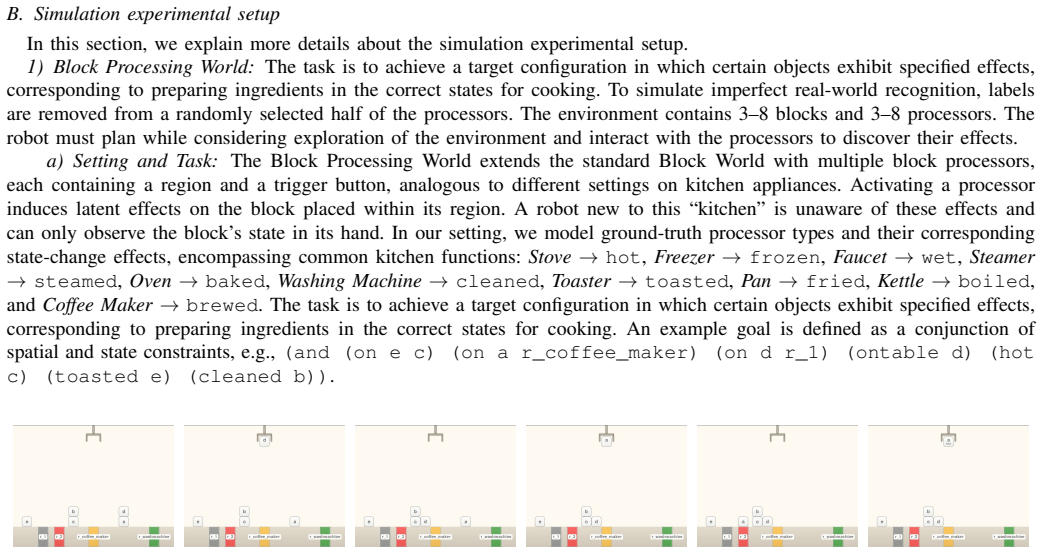
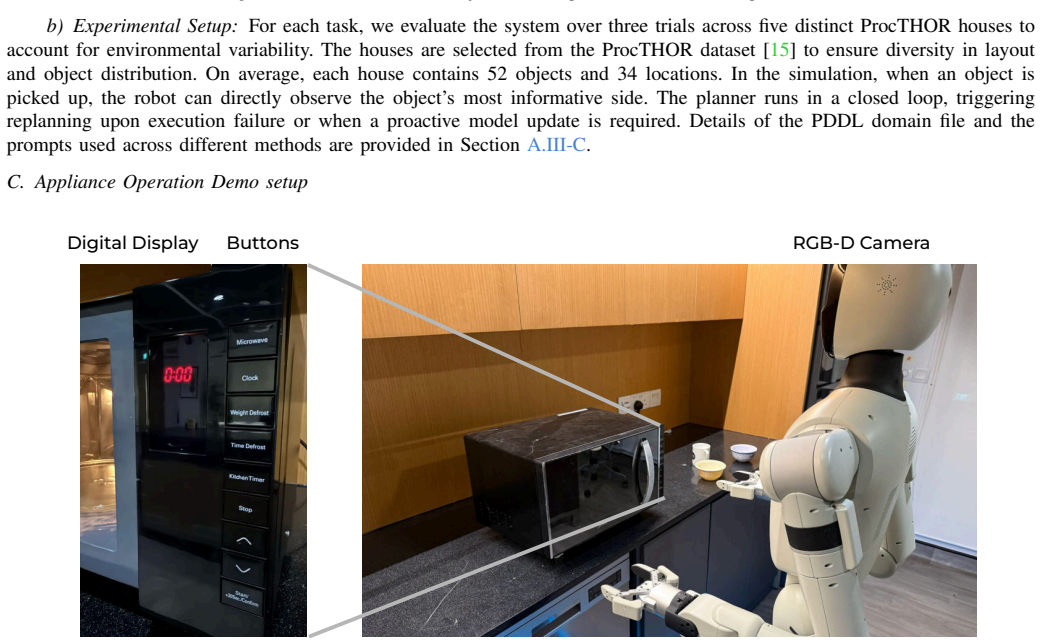
Summary. The paper proposes HUME, an open-world planning framework in which incomplete symbolic models are expanded by object-centric hypotheses (existence, attributes, action effects) generated by foundation models. Hypotheses are treated as uncertain latent variables; classical or LLM planners produce plans that interleave task actions with verification actions via all-outcomes determinization and cost bias, then update the model from VLM/perception feedback and replan (Alg. 1, §IV). Experiments in Block Processing World, AI2-THOR mobile manipulation, real Fetch household tasks, and a microwave appliance demo show that uncertainty-aware expansion substantially improves success rate and SPL over no-expansion and deterministic-expansion ablations for both PDDL and LLM planners.
Significance. If the empirical claims hold under the stated assumptions, the work offers a practical bridge between structured automated planning and unstructured foundation-model knowledge for household robots: model expansion is made explicit, uncertainty-aware, and actively verifiable inside goal-directed planning rather than treated as passive domain generation. Strengths include a clean six-way ablation (representation × inference), consistent gains across simulation and real hardware, dual support for formal and LLM planners, and an honest limitations discussion (§VI, App. A.IV). The hypothesis structure and verification-in-planning design are reusable engineering contributions for open-world service robotics.
major comments (3)
- [§IV.F, App. A.II-B/C, Figs. 6/8/10] §IV.F Assumption (3) and App. A.II-B: The iterative loop (Alg. 1) closes the model gap only if the LM generates correct hypotheses within I_max attempts, proposes sufficient verification_conditions, and the VLM correctly evaluates them. Residual real-world failures are already attributed to attribute misclassification and grasp-dependent visibility (App. A.II-C). The main results (Figs. 6, 8, 10) do not report hypothesis-generation success rates, verification accuracy, or how often regeneration was required. Without these metrics, the claimed advantage of uncertainty-aware expansion over deterministic expansion cannot be fully separated from the reliability of the particular gpt-4.1/VLM stack. Please add quantitative failure breakdowns for generation and verification, or qualify the autonomy claims accordingly.
- [§V.D, Abstract, §VII] §V.D Real-world protocol: Execution noise is mitigated by retrying skills until success and manually resetting invalid states (e.g., drops). This is reasonable for isolating planning, but the abstract and conclusion claim “autonomous knowledge expansion” and “effective operation” without reporting how often retries/resets occurred or how many trials would have failed without intervention. Please report intervention rates per task/planner or explicitly scope the real-world claims to planning performance under idealized low-level execution.
- [§IV.D, §III.B, §VI.a] §IV.D Determinization: Verification actions are all-outcomes-determinized and a_h−_verify is excluded so the planner is optimistic; negative outcomes are handled only by rejection and replanning. The paper frames the setting as Bayes-adaptive (§I, §III.B), yet ternary beliefs and branch-cut optimism do not reason about graded risk or irreversible verification side-effects (acknowledged in §VI.a and App. A.IV-D). This is acceptable as a design choice, but the Bayes-adaptive framing should be softened or the optimistic bias stated as a first-class limitation of the planning objective, not only of future work.
minor comments (5)
- [Fig. 3, §IV.B, App. A.III-A] Fig. 3 and hypothesis JSON examples: “object_existance” / “existance” should be “existence”; “Trigged” in domain listings should be “Triggered” for consistency with prose.
- [Fig. 4, §V.A] Fig. 4’s six-category taxonomy is useful but the caption and body (§V.A) could more explicitly map each bar group in Figs. 6/8/10 to the six named approaches to avoid reader cross-referencing.
- [§IV.D, App. A.III] Free parameters (verification penalty c ≫ 0, I_max, LLM sampling) are listed only implicitly; a short sensitivity note or fixed values in the appendix would aid reproducibility.
- [§II.B] Related work §II.B: Tru-POMDP [58] and Seeing-is-Believing [75] are close; a one-sentence contrast on whether verification actions are planned vs. manually specified would sharpen novelty.
- [§VI, Fig. 3] Typo: “preconditiaons” in §VI; “deks1” in Fig. 3 plan snippet; “wallmountedcontrolpanel1” style names are fine but ensure PDDL listings match figure labels.
Circularity Check
No significant circularity: empirical systems paper whose claims rest on external task success metrics, not on predictions forced by construction or self-citation chains.
full rationale
HUME is a method/systems paper that generates object-centric hypotheses via foundation models, augments a PDDL (or LLM) planning problem with verification actions under all-outcomes determinization, executes, and updates from sensory/VLM feedback (Alg. 1, §IV). The central claims are comparative success-rate and SPL gains of uncertainty-aware expansion over static and deterministic-expansion baselines (Figs. 6–8, 10; real-world T1–T5). These metrics are external environment outcomes, not quantities fitted then re-predicted. There is no self-definitional loop (hypotheses are not defined in terms of the success metric), no parameter fit re-labeled as prediction, no uniqueness theorem or ansatz imported from overlapping-author prior work that forces the result, and no renaming of a known empirical pattern. Stated assumptions (IV.F) about LM/VLM reliability are soft spots for correctness risk, not circularity. Self-citations, if any, are background; the load-bearing evidence is the new closed-loop experiments. Score 0 is therefore the honest finding.
Axiom & Free-Parameter Ledger
free parameters (3)
- verification penalty cost c ≫ 0
- I_max (max hypothesis-generation / replan iterations)
- LLM temperature / sampling settings (gpt-4.1)
axioms (5)
- domain assumption Atomic skills execute reliably under full observability once the symbolic state is correct (Task Scoping).
- domain assumption Task goals are expressible in structured logic and encode the abstraction of missing knowledge (Goal Requirements).
- domain assumption Foundation model can generate correct hypotheses in bounded attempts, propose verification conditions, and evaluate them from sensory data.
- domain assumption All-outcomes determinization plus optimistic branch-cut (exclude false outcomes) yields useful plans; negative outcomes handled by replan.
- standard math Classical PDDL / numeric planning (Fast Downward, ENHSP) correctly solves the augmented deterministic problems.
invented entities (1)
-
Object-centric hypothesis structure (id, type, content API, condition, verification_condition)
no independent evidence
read the original abstract
We consider an open-world planning setting in which service robots must operate in unknown environments with incomplete knowledge of objects and actions. Traditional closed-world approaches with pre-programmed knowledge bases fail when robots encounter unexpected situations and tasks, posing a fundamental challenge for autonomous knowledge expansion in human environments. In this work, we propose an open-world planning framework that enables robots to automatically generate, verify, and update hypotheses about their abstract world models. Our key insight is to explicitly maintain uncertainty-aware knowledge expansion and integrate hypothesis verification into goal-reaching planning. The framework leverages foundation models to generate initial hypotheses over states and transitions, and applies automated planning to produce action sequences that jointly address hypothesis verification and task execution. Through iterative execution and refinement, the robot expands its knowledge by incorporating verification feedback from the foundation models when hypotheses prove incorrect. Extensive experiments in simulated and real-world environments demonstrate that our framework enables autonomous knowledge expansion and effective operation in open-world settings. These results indicate that integrating uncertainty-aware model expansion from robot foundation models with planning advances the practical deployment of household service robots.
Figures






Reference graph
Works this paper leans on
-
[1]
Ashay Athalye, Nishanth Kumar, Tom Silver, Yichao Liang, Jiuguang Wang, Tom ´as Lozano-P ´erez, and Leslie Pack Kaelbling. From pixels to predicates: Learn- ing symbolic world models via pretrained vlms.IEEE Robotics and Automation Letters, 2026
work page 2026
-
[2]
Alper Aydemir, Andrzej Pronobis, Moritz G ¨obelbecker, and Patric Jensfelt. Active visual object search in unknown environments using uncertain semantics.IEEE Transactions on Robotics, 29(4):986–1002, 2013
work page 2013
-
[3]
Shuai Bai, Yuxuan Cai, Ruizhe Chen, Keqin Chen, Xionghui Chen, Zesen Cheng, Lianghao Deng, Wei Ding, Chang Gao, Chunjiang Ge, Wenbin Ge, Zhifang Guo, Qidong Huang, Jie Huang, Fei Huang, Binyuan Hui, Shu- tong Jiang, Zhaohai Li, Mingsheng Li, Mei Li, Kaixin Li, Zicheng Lin, Junyang Lin, Xuejing Liu, Jiawei Liu, Chenglong Liu, Yang Liu, Dayiheng Liu, Shixua...
-
[4]
URL https://arxiv.org/abs/2511.21631
work page internal anchor Pith review Pith/arXiv arXiv
-
[5]
Autogpt+ p: Affordance-based task plan- ning with large language models
Timo Birr, Christoph Pohl, Abdelrahman Younes, and Tamim Asfour. Autogpt+ p: Affordance-based task plan- ning with large language models. InRobotics: Science and Systems (RSS), 2024
work page 2024
-
[6]
Answer set programming at a glance
Gerhard Brewka, Thomas Eiter, and Mirosław Truszczy´nski. Answer set programming at a glance. Communications of the ACM, 54(12):92–103, 2011
work page 2011
-
[7]
Do as i can, not as i say: Grounding language in robotic affordances
Anthony Brohan, Yevgen Chebotar, Chelsea Finn, Karol Hausman, Alexander Herzog, Daniel Ho, Julian Ibarz, Alex Irpan, Eric Jang, Ryan Julian, et al. Do as i can, not as i say: Grounding language in robotic affordances. InConference on robot learning, pages 287–318. PMLR, 2023
work page 2023
-
[8]
Language-augmented symbolic planner for open-world task planning
Guanqi Chen, Lei Yang, Ruixing Jia, Zhe Hu, Yizhou Chen, Wei Zhang, Wenping Wang, and Jia Pan. Language-augmented symbolic planner for open-world task planning. InRobotics: Science and Systems (RSS), 2024
work page 2024
-
[9]
Situated bayesian reasoning framework for robots operating in diverse everyday environments
Sonia Chernova, Vivian Chu, Angel Daruna, Haley Gar- rison, Meera Hahn, Priyanka Khante, Weiyu Liu, and Andrea Thomaz. Situated bayesian reasoning framework for robots operating in diverse everyday environments. InRobotics Research: The 18th International Symposium ISRR, pages 353–369. Springer, 2020
work page 2020
-
[10]
Generalised do- main model acquisition from action traces
Stephen Cresswell and Peter Gregory. Generalised do- main model acquisition from action traces. InPro- ceedings of the international conference on automated planning and scheduling, volume 21, pages 42–49, 2011
work page 2011
-
[11]
Trust the proc3s: Solving long-horizon robotics problems with llms and constraint satisfaction
Aidan Curtis, Nishanth Kumar, Jing Cao, Tom ´as Lozano- P´erez, and Leslie Pack Kaelbling. Trust the proc3s: Solving long-horizon robotics problems with llms and constraint satisfaction. InConference on Robot Learning, 2024
work page 2024
-
[12]
Partially observable task and motion planning with uncertainty and risk awareness
Aidan Curtis, George Matheos, Nishad Gothoskar, Vikash Mansinghka, Joshua Tenenbaum, Tom´as Lozano- P´erez, and Leslie Pack Kaelbling. Partially observable task and motion planning with uncertainty and risk awareness. InRobotics: Science and Systems (RSS), 2024
work page 2024
-
[13]
Llm-guided probabilistic program induction for pomdp model estimation
Aidan Curtis, Hao Tang, Thiago Veloso, Kevin El- lis, Joshua B Tenenbaum, Tom ´as Lozano-P ´erez, and Leslie Pack Kaelbling. Llm-guided probabilistic program induction for pomdp model estimation. InConference on Robot Learning, pages 3137–3184. PMLR, 2025
work page 2025
-
[14]
Abhishek Das, Samyak Datta, Georgia Gkioxari, Stefan Lee, Devi Parikh, and Dhruv Batra. Embodied question answering. InProceedings of the IEEE conference on computer vision and pattern recognition, pages 1–10, 2018
work page 2018
-
[15]
Procthor: large-scale embodied ai using procedural generation
Matt Deitke, Eli Vander Bilt, Alvaro Herrasti, Luca Weihs, Jordi Salvador, Kiana Ehsani, Winson Han, Eric Kolve, Ali Farhadi, Aniruddha Kembhavi, et al. Procthor: large-scale embodied ai using procedural generation. In Proceedings of the 36th International Conference on Neural Information Processing Systems, pages 5982– 5994, 2022
work page 2022
-
[16]
Matt Deitke, Eli VanderBilt, Alvaro Herrasti, Luca Weihs, Kiana Ehsani, Jordi Salvador, Winson Han, Eric Kolve, Aniruddha Kembhavi, and Roozbeh Mottaghi. Procthor: Large-scale embodied ai using procedural gen- eration.Advances in Neural Information Processing Systems, 35:5982–5994, 2022
work page 2022
-
[17]
Automated generation of robotic planning do- mains from observations
Maximilian Diehl, Chris Paxton, and Karinne Ramirez- Amaro. Automated generation of robotic planning do- mains from observations. In2021 IEEE/RSJ Interna- tional Conference on Intelligent Robots and Systems (IROS), pages 6732–6738. IEEE, 2021
work page 2021
-
[18]
Yan Ding, Xiaohan Zhang, Saeid Amiri, Nieqing Cao, Hao Yang, Andy Kaminski, Chad Esselink, and Shiqi Zhang. Integrating action knowledge and llms for task planning and situation handling in open worlds.Au- tonomous Robots, 47(8):981–997, 2023
work page 2023
-
[19]
PaLM-E: An Embodied Multimodal Language Model
Danny Driess, Fei Xia, Mehdi SM Sajjadi, Corey Lynch, Aakanksha Chowdhery, Brian Ichter, Ayzaan Wahid, Jonathan Tompson, Quan Vuong, Tianhe Yu, et al. Palm- e: An embodied multimodal language model.arXiv preprint arXiv:2303.03378, 2023
work page internal anchor Pith review Pith/arXiv arXiv 2023
-
[20]
University of Massachusetts Amherst, 2002
Michael O’Gordon Duff.Optimal Learning: Computa- tional procedures for Bayes-adaptive Markov decision processes. University of Massachusetts Amherst, 2002
work page 2002
-
[21]
Maria Fox and Derek Long. Pddl2. 1: An extension to pddl for expressing temporal planning domains.Journal of artificial intelligence research, 20:61–124, 2003
work page 2003
-
[22]
Pddlstream: Integrating symbolic planners and blackbox samplers via optimistic adaptive planning
Caelan Reed Garrett, Tom ´as Lozano-P ´erez, and Leslie Pack Kaelbling. Pddlstream: Integrating symbolic planners and blackbox samplers via optimistic adaptive planning. InProceedings of the international conference on automated planning and scheduling, volume 30, pages 440–448, 2020
work page 2020
-
[23]
Online replanning in belief space for partially observable task and motion problems
Caelan Reed Garrett, Chris Paxton, Tom ´as Lozano-P´erez, Leslie Pack Kaelbling, and Dieter Fox. Online replanning in belief space for partially observable task and motion problems. In2020 IEEE International Conference on Robotics and Automation (ICRA), pages 5678–5684. IEEE, 2020
work page 2020
-
[24]
Caelan Reed Garrett, Rohan Chitnis, Rachel Holladay, Beomjoon Kim, Tom Silver, Leslie Pack Kaelbling, and Tom´as Lozano-P ´erez. Integrated task and motion plan- ning.Annual review of control, robotics, and autonomous systems, 4(1):265–293, 2021
work page 2021
-
[25]
Giorgio Grisetti, Cyrill Stachniss, and Wolfram Bur- gard. Improved techniques for grid mapping with rao- blackwellized particle filters.IEEE transactions on Robotics, 2007
work page 2007
-
[26]
Ros navigation: Concepts and tutorial
Rodrigo Longhi Guimar ˜aes, Andr ´e Schneider de Oliveira, Jo ˜ao Alberto Fabro, Thiago Becker, and Vin ´ıcius Amilgar Brenner. Ros navigation: Concepts and tutorial. InRobot Operating System (ROS) The Complete Reference (Volume 1), pages 121–160. Springer, 2016
work page 2016
-
[27]
The fast downward planning system
Malte Helmert. The fast downward planning system. Journal of Artificial Intelligence Research, 26:191–246, 2006
work page 2006
-
[28]
Vectorized Online POMDP Planning
Marcus Hoerger, Muhammad Sudrajat, and Hanna Kurni- awati. Vectorized online pomdp planning.arXiv preprint arXiv:2510.27191, 2025
work page internal anchor Pith review Pith/arXiv arXiv 2025
-
[29]
Language models as zero-shot planners: Extracting actionable knowledge for embodied agents
Wenlong Huang, Pieter Abbeel, Deepak Pathak, and Igor Mordatch. Language models as zero-shot planners: Extracting actionable knowledge for embodied agents. InInternational conference on machine learning, pages 9118–9147. PMLR, 2022
work page 2022
-
[30]
Inner monologue: Embodied reasoning through planning with language models
Wenlong Huang, Fei Xia, Ted Xiao, Harris Chan, Jacky Liang, Pete Florence, Andy Zeng, Jonathan Tompson, Igor Mordatch, Yevgen Chebotar, et al. Inner monologue: Embodied reasoning through planning with language models. InConference on Robot Learning, pages 1769–
-
[31]
$\pi_{0.5}$: a Vision-Language-Action Model with Open-World Generalization
Physical Intelligence, Kevin Black, Noah Brown, James Darpinian, Karan Dhabalia, Danny Driess, Adnan Es- mail, Michael Equi, Chelsea Finn, Niccolo Fusai, et al.π0. 5: a vision-language-action model with open-world generalization, 2025.URL https://arxiv. org/abs/2504.16054, 1(2):3
work page internal anchor Pith review Pith/arXiv arXiv 2025
-
[32]
Open-world reasoning for service robots
Yuqian Jiang, Nick Walker, Justin Hart, and Peter Stone. Open-world reasoning for service robots. InProceedings of the international conference on automated planning and scheduling, volume 29, pages 725–733, 2019
work page 2019
-
[33]
Vec-QMDP: Vectorized POMDP Planning on CPUs for Real-Time Autonomous Driving
Xuanjin Jin, Yanxin Dong, Bin Sun, Huan Xu, Zhihui Hao, XianPeng Lang, and Panpan Cai. Vec-qmdp: Vectorized pomdp planning on cpus for real-time au- tonomous driving.arXiv preprint arXiv:2602.08334, 2026
work page internal anchor Pith review Pith/arXiv arXiv 2026
-
[34]
Leslie Pack Kaelbling and Tom ´as Lozano-P ´erez. Inte- grated task and motion planning in belief space.The International Journal of Robotics Research, 32(9-10): 1194–1227, 2013
work page 2013
-
[35]
Alexander Kirillov, Eric Mintun, Nikhila Ravi, Hanzi Mao, Chloe Rolland, Laura Gustafson, Tete Xiao, Spencer Whitehead, Alexander C Berg, Wan-Yen Lo, et al. Segment anything. InProceedings of the IEEE/CVF International Conference on Computer Vision, 2023
work page 2023
-
[36]
AI2-THOR: An Interactive 3D Environment for Visual AI
Eric Kolve, Roozbeh Mottaghi, Winson Han, Eli Vander- Bilt, Luca Weihs, Alvaro Herrasti, Matt Deitke, Kiana Ehsani, Daniel Gordon, Yuke Zhu, et al. Ai2-thor: An interactive 3d environment for visual ai.arXiv preprint arXiv:1712.05474, 2017
work page internal anchor Pith review Pith/arXiv arXiv 2017
-
[37]
Open-world task and motion plan- ning via vision-language model generated constraints
Nishanth Kumar, William Shen, Fabio Ramos, Dieter Fox, Tom ´as Lozano-P ´erez, Leslie Pack Kaelbling, and Caelan Reed Garrett. Open-world task and motion plan- ning via vision-language model generated constraints. IEEE Robotics and Automation Letters, 2026
work page 2026
-
[38]
Kinodynamic task and motion planning using vlm-guided and interleaved sampling
Minseo Kwon and Young J Kim. Kinodynamic task and motion planning using vlm-guided and interleaved sampling. InIEEE International Conference on Robotics and Automation (ICRA), 2026
work page 2026
-
[39]
Code as policies: Language model programs for em- bodied control
Jacky Liang, Wenlong Huang, Fei Xia, Peng Xu, Karol Hausman, Brian Ichter, Pete Florence, and Andy Zeng. Code as policies: Language model programs for em- bodied control. In2023 IEEE International Conference on Robotics and Automation (ICRA), pages 9493–9500. IEEE, 2023
work page 2023
-
[40]
Visualpredicator: Learning abstract world models with neuro-symbolic predicates for robot planning
Yichao Liang, Nishanth Kumar, Hao Tang, Adrian Weller, Joshua B Tenenbaum, Tom Silver, Jo ˜ao F Hen- riques, and Kevin Ellis. Visualpredicator: Learning abstract world models with neuro-symbolic predicates for robot planning. InInternational Conference on Learning Representations (ICLR), 2025
work page 2025
-
[41]
Microsoft coco: Common objects in context
Tsung-Yi Lin, Michael Maire, Serge Belongie, James Hays, Pietro Perona, Deva Ramanan, Piotr Doll ´ar, and C Lawrence Zitnick. Microsoft coco: Common objects in context. InEuropean conference on computer vision, pages 740–755. Springer, 2014
work page 2014
-
[42]
LLM+P: Empowering Large Language Models with Optimal Planning Proficiency
Bo Liu, Yuqian Jiang, Xiaohan Zhang, Qiang Liu, Shiqi Zhang, Joydeep Biswas, and Peter Stone. Llm+ p: Em- powering large language models with optimal planning proficiency.arXiv preprint arXiv:2304.11477, 2023
work page internal anchor Pith review Pith/arXiv arXiv 2023
-
[43]
Learning compositional behaviors from demonstration and language
Weiyu Liu, Neil Nie, Ruohan Zhang, Jiayuan Mao, and Jiajun Wu. Learning compositional behaviors from demonstration and language. In8th Annual Conference on Robot Learning, 2024
work page 2024
-
[44]
Uncertainty quantification and confidence calibration in large language models: A survey
Xiaoou Liu, Tiejin Chen, Longchao Da, Chacha Chen, Zhen Lin, and Hua Wei. Uncertainty quantification and confidence calibration in large language models: A survey. InProceedings of the 31st ACM SIGKDD Conference on Knowledge Discovery and Data Mining V . 2, pages 6107–6117, 2025
work page 2025
-
[45]
Reflect: Summarizing robot experiences for failure explanation and correction
Zeyi Liu, Arpit Bahety, and Shuran Song. Reflect: Summarizing robot experiences for failure explanation and correction. InConference on Robot Learning, pages 3468–3484. PMLR, 2023
work page 2023
-
[46]
Andrea Micheli, Arthur Bit-Monnot, Gabriele R ¨oger, Enrico Scala, Alessandro Valentini, Luca Framba, Al- berto Rovetta, Alessandro Trapasso, Luigi Bonassi, Al- fonso Emilio Gerevini, Luca Iocchi, Felix Ingrand, Uwe K¨ockemann, Fabio Patrizi, Alessandro Saetti, Ivan Se- rina, and Sebastian Stock. Unified planning: Mod- eling, manipulating and solving ai p...
-
[47]
Scaling open-vocabulary object detection.Advances in Neural Information Processing Systems, 36, 2024
Matthias Minderer, Alexey Gritsenko, and Neil Houlsby. Scaling open-vocabulary object detection.Advances in Neural Information Processing Systems, 36, 2024
work page 2024
-
[48]
Petter ¨Ogren and Christopher I Sprague. Behavior trees in robot control systems.Annual Review of Control, Robotics, and Autonomous Systems, 5(1):81–107, 2022
work page 2022
-
[49]
SayPlan: Grounding Large Language Models using 3D Scene Graphs for Scalable Robot Task Planning
Krishan Rana, Jesse Haviland, Sourav Garg, Jad Abou- Chakra, Ian Reid, and Niko Suenderhauf. Say- plan: Grounding large language models using 3d scene graphs for scalable task planning.arXiv preprint arXiv:2307.06135, 2023
work page internal anchor Pith review Pith/arXiv arXiv 2023
-
[50]
Explore until confident: Efficient exploration for embodied question answering
Allen Z Ren, Jaden Clark, Anushri Dixit, Masha Itkina, Anirudha Majumdar, and Dorsa Sadigh. Explore until confident: Efficient exploration for embodied question answering. InRobotics: Science and Systems (RSS), 2024
work page 2024
-
[51]
Heuristics for numeric planning via subgoaling
Enrico Scala, Patrik Haslum, and Sylvie Thi ´ebaux. Heuristics for numeric planning via subgoaling. 2016
work page 2016
-
[52]
William Shen, Nishanth Kumar, Sahit Chintalapudi, Jie Wang, Christopher Watson, Edward Hu, Jing Cao, Di- nesh Jayaraman, Leslie Pack Kaelbling, and Tom ´as Lozano-P´erez. Tiptop: A modular open-vocabulary plan- ning system for robotic manipulation.arXiv preprint arXiv:2603.09971, 2026
-
[53]
Reflexion: Language Agents with Verbal Reinforcement Learning
Noah Shinn, Beck Labash, and Ashwin Gopinath. Re- flexion: an autonomous agent with dynamic memory and self-reflection.arXiv preprint arXiv:2303.11366, 2023
work page internal anchor Pith review Pith/arXiv arXiv 2023
-
[54]
Pddl planning with pretrained large language models
Tom Silver, Varun Hariprasad, Reece S Shuttleworth, Nishanth Kumar, Tom ´as Lozano-P ´erez, and Leslie Pack Kaelbling. Pddl planning with pretrained large language models. InNeurIPS 2022 Foundation Models for Deci- sion Making Workshop, 2022
work page 2022
-
[55]
Generalized Planning in PDDL Domains with Pretrained Large Language Models
Tom Silver, Soham Dan, Kavitha Srinivas, Joshua B Tenenbaum, Leslie Pack Kaelbling, and Michael Katz. Generalized planning in pddl domains with pretrained large language models.arXiv preprint arXiv:2305.11014, 2023
work page internal anchor Pith review Pith/arXiv arXiv 2023
-
[56]
Progprompt: Generating situated robot task plans using large language models
Ishika Singh, Valts Blukis, Arsalan Mousavian, Ankit Goyal, Danfei Xu, Jonathan Tremblay, Dieter Fox, Jesse Thomason, and Animesh Garg. Progprompt: Generating situated robot task plans using large language models. In2023 IEEE International Conference on Robotics and Automation (ICRA), pages 11523–11530. IEEE, 2023
work page 2023
-
[57]
Sadler, Wei-Lun Chao, and Yu Su
Chan Hee Song, Jiaman Wu, Clayton Washington, Brian M. Sadler, Wei-Lun Chao, and Yu Su. Llm- planner: Few-shot grounded planning for embodied agents with large language models. InProceedings of the IEEE/CVF International Conference on Computer Vision (ICCV), October 2023
work page 2023
-
[58]
Interactive planning using large language models for partially observable robotic tasks
Lingfeng Sun, Devesh K Jha, Chiori Hori, Siddarth Jain, Radu Corcodel, Xinghao Zhu, Masayoshi Tomizuka, and Diego Romeres. Interactive planning using large language models for partially observable robotic tasks. In2024 IEEE International Conference on Robotics and Automation (ICRA), pages 14054–14061. IEEE, 2024
work page 2024
-
[59]
Tru-pomdp: Task planning under uncertainty via tree of hypotheses and open-ended pomdps
Wenjing Tang, Xinyu He, Yongxi Huang, Yunxiao Xiao, Cewu Lu, and Panpan Cai. Tru-pomdp: Task planning under uncertainty via tree of hypotheses and open-ended pomdps. InAdvances in Neural Information Processing Systems, 2025
work page 2025
- [60]
-
[61]
Robot placement based on reachability inversion
Nikolaus Vahrenkamp, Tamim Asfour, and R ¨udiger Dill- mann. Robot placement based on reachability inversion. In2013 IEEE International Conference on Robotics and Automation, pages 1970–1975. IEEE, 2013
work page 1970
-
[62]
Chatgpt for robotics: Design principles and model abilities.Microsoft Auton
Sai Vemprala, Rogerio Bonatti, Arthur Bucker, and Ashish Kapoor. Chatgpt for robotics: Design principles and model abilities.Microsoft Auton. Syst. Robot. Res, 2:20, 2023
work page 2023
-
[63]
Multi-object search using object-oriented pomdps
Arthur Wandzel, Yoonseon Oh, Michael Fishman, Nis- hanth Kumar, Lawson LS Wong, and Stefanie Tellex. Multi-object search using object-oriented pomdps. In 2019 International Conference on Robotics and Automa- tion (ICRA), pages 7194–7200. IEEE, 2019
work page 2019
-
[64]
Zihao Wang, Shaofei Cai, Guanzhou Chen, Anji Liu, Xi- aojian Ma, Yitao Liang, and Team CraftJarvis. Describe, explain, plan and select: interactive planning with large language models enables open-world multi-task agents. InProceedings of the 37th International Conference on Neural Information Processing Systems, pages 34153– 34189, 2023
work page 2023
-
[65]
Zihao Wang, Shaofei Cai, Anji Liu, Yonggang Jin, Jin- bing Hou, Bowei Zhang, Haowei Lin, Zhaofeng He, Zilong Zheng, Yaodong Yang, et al. Jarvis-1: Open-world multi-task agents with memory-augmented multimodal language models.IEEE Transactions on Pattern Analysis and Machine Intelligence, 2024
work page 2024
-
[66]
Fetch and freight: Standard platforms for service robot applications
Melonee Wise, Michael Ferguson, Derek King, Eric Diehr, and David Dymesich. Fetch and freight: Standard platforms for service robot applications. InWorkshop on autonomous mobile service robots, volume 5, 2016
work page 2016
-
[67]
Manipulation-based active search for occluded objects
Lawson LS Wong, Leslie Pack Kaelbling, and Tom ´as Lozano-P´erez. Manipulation-based active search for occluded objects. In2013 IEEE International Conference on Robotics and Automation, pages 2814–2819. IEEE, 2013
work page 2013
-
[68]
Learning adaptive planning representations with natural language guidance
Lionel Wong, Jiayuan Mao, Pratyusha Sharma, Zachary S Siegel, Jiahai Feng, Noa Korneev, Joshua B Tenenbaum, and Jacob Andreas. Learning adaptive planning representations with natural language guidance. arXiv preprint arXiv:2312.08566, 2023
work page internal anchor Pith review Pith/arXiv arXiv 2023
-
[69]
Translating Natural Language to Planning Goals with Large-Language Models
Yaqi Xie, Chen Yu, Tongyao Zhu, Jinbin Bai, Ze Gong, and Harold Soh. Translating natural language to plan- ning goals with large-language models.arXiv preprint arXiv:2302.05128, 2023
work page internal anchor Pith review Pith/arXiv arXiv 2023
-
[70]
Guiding long- horizon task and motion planning with vision language models
Zhutian Yang, Caelan Garrett, Dieter Fox, Tom ´as Lozano-P´erez, and Leslie Pack Kaelbling. Guiding long- horizon task and motion planning with vision language models. In2025 IEEE International Conference on Robotics and Automation (ICRA), pages 16847–16853. IEEE, 2025
work page 2025
-
[71]
SkillWrapper: Generative Predicate Invention for Task-level Robot Planning
Ziyi Yang, Benned Hedegaard, Ahmed Jaafar, Yichen Wei, Skye Thompson, Shreyas S Raman, Haotian Fu, Stefanie Tellex, George Konidaris, David Paulius, et al. Skillwrapper: Generative predicate invention for skill abstraction.arXiv preprint arXiv:2511.18203, 2025
work page internal anchor Pith review Pith/arXiv arXiv 2025
-
[72]
Haoming Ye, Yunxiao Xiao, Cewu Lu, and Panpan Cai. Unidomain: Pretraining a unified pddl domain from real-world demonstrations for generalizable robot task planning. InThe Thirty-ninth Annual Conference on Neural Information Processing Systems
-
[73]
Haoming Ye, Yunxiao Xiao, Cewu Lu, and Panpan Cai. Uniplan: Vision-language task planning for mobile ma- nipulation with unified pddl formulation.arXiv preprint arXiv:2602.08537, 2026
-
[74]
Ff- replan: A baseline for probabilistic planning
Sung Wook Yoon, Alan Fern, and Robert Givan. Ff- replan: A baseline for probabilistic planning. InICAPS, volume 7, pages 352–359, 2007
work page 2007
-
[75]
Rational Inverse Reasoning: Few-Shot Imitation by Inferring Intent through Planning
Ben Zandonati, Tom ´as Lozano-P ´erez, and Leslie Pack Kaelbling. Rational inverse reasoning.arXiv preprint arXiv:2508.08983, 2025
work page internal anchor Pith review Pith/arXiv arXiv 2025
-
[76]
Seeing is Believing: Belief-Space Planning with Foundation Models as Uncertainty Estimators
Linfeng Zhao, Willie McClinton, Aidan Curtis, Nishanth Kumar, Tom Silver, Leslie Pack Kaelbling, and Law- son LS Wong. Seeing is believing: Belief-space planning with foundation models as uncertainty estimators.arXiv preprint arXiv:2504.03245, 2025
work page internal anchor Pith review Pith/arXiv arXiv 2025
-
[77]
Zirui Zhao, Wee Sun Lee, and David Hsu. Large language models as commonsense knowledge for large- scale task planning.Advances in Neural Information Processing Systems, 36, 2024
work page 2024
-
[78]
Language models can infer action semantics for symbolic planners from environment feedback
Wang Bill Zhu, Ishika Singh, Robin Jia, and Jesse Thomason. Language models can infer action semantics for symbolic planners from environment feedback. In Proceedings of the 2025 Conference of the Nations of the Americas Chapter of the Association for Computational Linguistics: Human Language Technologies (Volume 1: Long Papers), pages 8751–8773, 2025. AP...
work page 2025
-
[79]
Environments and Tasks:Our real-robot experiments were conducted in a real household environment comprising three rooms: a kitchen, a living room, and a meeting room. Figure 14 illustrates a top-down view of the experimental setup. The kitchen, located at the top right and serving as the primary workspace, is equipped with several functional areas, includ...
-
[80]
Real-World Robot System: a) Hardware Setup:We adopt the commercially available mobile manipulator Fetch [65]. Its base is a differential-drive mobile platform, and it is equipped with a 1-DOF torso, a 7-DOF arm with parallel-jaw gripper. The robot also includes an RGB-D camera mounted on its head and a LiDAR sensor on the base for localization. Given the ...
discussion (0)
Sign in with ORCID, Apple, or X to comment. Anyone can read and Pith papers without signing in.