REVIEW 1 major objections 7 minor 85 references
Reviewed by Pith at T0; open to challenge.
T0 means a machine referee read the full paper against a public rubric. The mark states how deep the mechanical check went, never who wrote it. the ladder, T0–T4 →
T0 review · glm-5.2
When AI confidently mislabels a new star, two kinds of doubt catch it
2026-07-10 01:03 UTC pith:FH6PAQ6Z
load-bearing objection The cross-family the 1 major comments →
Catching Disguised Transients with ASTRANet: Anomaly-Aware Spectroscopic Classification and Conformal Calibration
The pith
A machine-rendered reading of the paper's core claim, the machinery that carries it, and where it could break.
Core claim
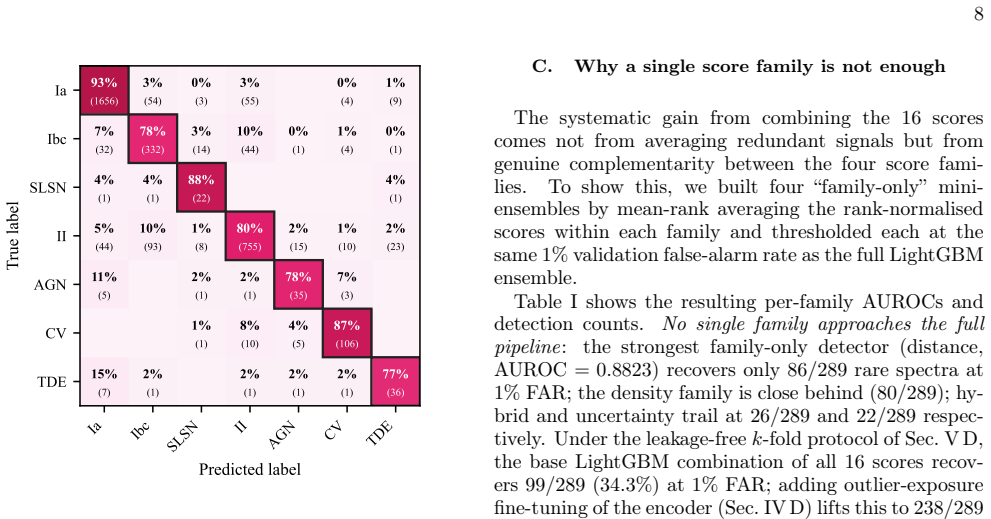
The paper's central object is the failure-mode taxonomy: five physically distinct regimes in which closed-set spectroscopic classifiers confidently misclassify rare transients. Two of these regimes, comprising about 43 percent of the rare-anomaly population, are recoverable only through non-linear cross-family combination of multiple anomaly scores, because no single score family fires above threshold on those spectra. This finding directly motivates the architecture: a gradient-boosted combiner integrating sixteen scores from four families (uncertainty, distance, density, hybrid) into a single anomaly probability, supplemented by a conformal calibration layer that provides distribution-free
What carries the argument
A hierarchical spectral classifier operating on observer-frame spectra without requiring host-galaxy redshift or spectral phase; sixteen embedding-space anomaly scores spanning four physically motivated families (uncertainty, distance, density, hybrid); a gradient-boosted non-linear combiner producing a single cross-family anomaly score; a conformal prediction layer with Mondrian calibration providing per-spectrum p-values and prediction sets; and an AD-stratified Mondrian variant that partitions the calibration set by both predicted class and anomaly-score quintile to achieve uniform conditional coverage across anomaly strata.
Load-bearing premise
The 289-spectrum rare-anomaly evaluation set, with some classes having as few as one or ten members, is assumed to represent the full physical diversity of rare transients. If the five failure-mode taxonomy is incomplete or the sample is biased toward particular astrophysical configurations, the necessity of cross-family combination may not generalize to rare classes not represented in this set.
What would settle it
A rare-anomaly class not represented in the evaluation set whose spectra are confidently misclassified by the classifier, produce weak signals in all sixteen anomaly scores including the non-linear combiner, and are structurally undetectable by the framework. Such a class would demonstrate that the five-regime taxonomy is incomplete and that cross-family combination is not sufficient for all failure modes.
If this is right
- Survey pipelines deploying only softmax confidence or only Mahalanobis distance silently lose roughly half of rare-anomaly populations by construction, since cross-family combination is necessary for the disguised-class regimes.
- The AD-stratified conformal calibration approach is generalizable: any anomaly score used as a stratification variable for Mondrian conformal prediction can recover uniform conditional coverage in the high-anomaly operational regime where marginal methods under-cover.
- The finding that classifier-internal UQ and embedding-based AD are structurally orthogonal suggests a three-way operational policy for survey triage: commit when both are low, abstain when UQ is high but AD is low, and alert when AD is high regardless of UQ.
- At LSST scale, every one percent improvement in confidence-aware triage corresponds to roughly one hundred peculiar transients per year that would otherwise be lost to routine classification.
Editorial analysis
A structured set of objections, weighed in public.
Referee Report
Summary. This manuscript presents ASTRANet, a confidence-aware framework for spectroscopic transient classification comprising three modules: a hierarchical classifier operating on observer-frame spectra without requiring redshift or phase, an anomaly detection layer (ASTRANet-Sentinel) combining 16 embedding-space scores via a gradient-boosted model, and a conformal uncertainty quantification layer (ASTRANet-CP) with a novel AD-stratified Mondrian conformal prediction scheme. The framework is validated on 289 rare/out-of-taxonomy spectra spanning 11 excluded classes. The central claims are: (1) closed-set classifier failure modes separate into five physically distinct regimes, (2) cross-family non-linear combination of anomaly scores is necessary to recover all five regimes, and (3) classifier-internal uncertainty and embedding-based anomaly detection are structurally complementary axes. The conformal coverage properties are empirically validated, and AD-MCP achieves uniform conditional coverage where vanilla Mondrian under-covers.
Significance. The work addresses a genuine and timely problem: spectroscopic triage at the scale of ZTF and LSST requires automated, calibrated confidence assessment, not just point-prediction classification. The redshift-free, phase-free observer-frame architecture is a practical advance for real-time deployment. The failure-mode taxonomy (Sec. II) is a useful conceptual contribution that connects physical regimes to specific anomaly-score signatures. The AD-MCP extension of atypicality-stratified conformal prediction to a learned cross-family ensemble is methodologically novel for astronomical spectroscopy. The leakage-free k-fold protocol (Sec. VD) and the empirical validation of conformal coverage within finite-sample error (Table IV, IX) are commendable. The structural complementarity argument between classifier-internal UQ and cross-family AD (Sec. VIF, Table VII) is well-supported by the population-scale analysis. The framework is being prepared for production integration with the ZTF BOOM broker, which lends practical credibility.
major comments (1)
- Sec. VC, Table I, and the claim that cross-family non-linear combination is 'necessary' (Contributions item 2, Sec. II.f): The key ablation comparing family-only mini-ensembles (86/289 at 1% FAR, no outlier exposure) against the full pipeline (238/289, with outlier exposure) confounds two variables: cross-family combination and outlier-exposure (OE) fine-tuning. OE reshapes the encoder embeddings that all 16 scores depend on (Sec. IVD), so the 137/238 spectra attributed to cross-family interaction may be partly or wholly recoverable by OE-enhanced single-family scores. The non-OE comparison (86 vs. 99, Table I) shows cross-family combination adds only 13 spectra over the best single family without OE — a modest gain that does not support the strong necessity claim. To establish that cross-family combination (rather than OE) drives the improvement, the authors should run OE-enhancedfamily
minor comments (7)
- Sec. IIIb: The rare-anomaly evaluation set includes classes with N<=10 (Ca-rich N=10, BL Lac N=1, Classical Nova N=8). Per-class recovery statistics for these classes (Table III) have large uncertainties. The authors acknowledge this in Sec. VIII (Limitations) but the headline recovery rates (e.g., '40.0%' for Ca-rich) are presented without error bars or confidence intervals. Adding bootstrap intervals for the smallest classes would set appropriate expectations.
- Table X caption: The regimes are labeled A/B/C in the table but I/V in the text (Sec. II, Sec. VII). This mismatch requires cross-referencing and could be unified.
- Sec. VIA: The statement 'the LightGBM-OOF score satisfies the exchangeability assumption conformal prediction requires' is an empirical observation, not a proof. The p-value ECDF being consistent with uniform (Fig. 4) is reassuring but does not formally guarantee exchangeability under arbitrary distribution shift. The authors should soften this language.
- Appendix C, feature importances: The top features (cosine, energy, mahal_global, mahal_within, mahal_class, gmm) span three of four families, which supports the cross-family design. However, the two lowest-ranked features (pca_recon, mrs) are from the density and hybrid families. If these contribute little, a 14-score combiner might perform comparably. An ablation over score count would strengthen the design justification.
- Sec. IVA: The claim that ASTRANet is 'the first fine-grained, multi-class classifier' to operate without redshift on observer-frame spectra should note SNIascore (Ref. 14) as a binary precedent, which it does, but the novelty claim would benefit from explicit comparison to any other redshift-free multi-class attempts if they exist.
- Table XIV: The 'Category' column uses 'SN CC (H)' and 'SN CC (SE)' but the coarse head (Sec. IVA) uses 'SN-CC' as a single superclass. The mapping between the three-way coarse partition and the finer category labels in Table XIV should be clarified.
- Sec. VIH: The AD-MCP fallback for cells with n_min < 10 uses the marginal class threshold. With 1,669 calibration samples and Q=5, this activates for sparse cells. The authors note this affects only rare-class extreme-quintile cells, but the fraction of test samples falling into fallback cells is not reported. This number would help assess the practical impact.
Circularity Check
No significant circularity; derivation is self-contained against external benchmarks and theory.
full rationale
The paper's derivation chain contains no circular steps. The conformal prediction guarantees (Eqs. 1-2, 6-7) rest on established distribution-free theory from Vovk et al. [67], Angelopoulos & Bates [68], and Romano et al. [69] — all external citations with independently verified theorems. The AD-MCP extension (Sec. VIH) applies this theory to a new stratification scheme; its conditional coverage guarantee (Eq. 7) follows from within-cell exchangeability, a standard conformal assumption, not from any result defined in this paper. The cross-family combination claim (Sec. VC) is empirically validated on held-out data under a leakage-free k-fold protocol — the LightGBM combiner is trained on validation data and evaluated on held-out folds, so no detection reduces to its own training input. The structural complementarity claim (Sec. VIF, Table VII) is an empirical observation on held-out test data, not a derived result. The five failure-mode taxonomy (Sec. II) is descriptive. Self-citations to companion works [16, 27, 28, 37] provide context, baselines, and infrastructure but are not load-bearing for any mathematical or methodological claim. The skeptic's concern that OE is confounded with cross-family combination in the ablation (Table I) is a validity concern, not circularity: the paper does not define a quantity in terms of what it claims to predict. Score 1 reflects the presence of non-load-bearing self-citations to companion works.
Axiom & Free-Parameter Ledger
free parameters (5)
- Loss weights (w_f, w_c, w_sc,f, w_sc,c, w_conf, w_H) =
1.5, 0.3, 0.03, 0.05, 0.5, 0.01
- LightGBM hyperparameters =
300 estimators, eta=0.05, num_leaves=31
- AD-MCP quintile bin edges =
5 equal-frequency bins on calibration set
- Outlier exposure margins (lambda_OE, lambda_emb) =
1.0, 1.0
- Confusion penalty pairs and weights =
(TDE->Ia, 0.5), (SLSN->Ibc, 0.3), (II->Ibc, 0.8)
axioms (4)
- domain assumption Exchangeability of calibration and test spectra
- domain assumption The 289-spectrum rare set spans the full physical diversity of rare anomalies
- standard math Supervised contrastive loss produces a metrically faithful embedding space
- domain assumption Within-cell exchangeability holds for AD-MCP
read the original abstract
Time-domain surveys discover thousands of transients per year, but the spectroscopic identification of rare and physically peculiar objects remains rate-limited by closed-set classifiers that confidently assign every input to a known class -- including spectra that genuinely belong to no known class. We present the \texttt{ASTRANet} framework, a confidence-aware infrastructure for spectroscopic transient classification built around three coupled modules: a hierarchical spectral classifier that operates directly on observer-frame spectra without requiring host-galaxy redshift or spectral phase as inputs; an anomaly detection layer (\texttt{ASTRANet-Sentinel}) that non-linearly combines $16$ embedding-space anomaly scores spanning four physically motivated families; and a conformal uncertainty quantification layer (\texttt{ASTRANet-CP}). We validate the framework on a held-out evaluation set of $289$ rare and out-of-taxonomy transients spanning $11$ classes deliberately excluded from training, chosen to span the full physical diversity of the rare-anomaly population: AGN-related outliers, GRB-related events, gap transients, novae, and peculiar supernovae. Through five astrophysically distinct failure modes of closed-set classifiers, we show that classifier-internal uncertainty and embedding-based anomaly detection are structurally complementary axes of confidence rather than alternative implementations of the same estimator. We further introduce AD-stratified Mondrian conformal prediction (AD-MCP) within \texttt{ASTRANet-CP}, achieving uniform conditional coverage across anomaly-score strata where vanilla Mondrian under-covers in the operational regime. This establishes the methodological infrastructure for confidence-aware spectroscopic discovery in the Vera C.\ Rubin Observatory era.
Figures



Reference graph
Works this paper leans on
-
[1]
A residual skip connection adds the block input to its output. Stochastic depth [79] with linearly increasing drop probability0→0.1provides implicit ensemble reg- ularisation. Cumulative receptive field:∼250samples. c. Metadata conditioning via FiLM.The metadata vectorc∈R 64 encodes three quantities: spectral phase ϕ(rest-frame days from maximum light, re...
-
[2]
with learning rateη0 = 3×10 −4, weight decay10−4, gradient clip1.0. The schedule uses a5-epoch linear warmup followed by cosine annealing with warm restarts [80],T 0 = 30,T mult = 2,η min = 0.05η 0. EMA [81] of model weights is maintained with decayα= 0.996and used for all validation/test evaluations. Early stopping usesvalidationmacrorecallwithpatience45...
-
[3]
over the test-set embeddings reaches86.8%five-fold accuracy – statistically indistinguishable from the full hi- erarchical classifier head (86.6%, Sec. VA). The class structure visible in the UMAP projection is therefore metrically faithful, not a visualization artifact. The same retrieval operates in two complementary regimes (Fig. 6). (ii) In-distributi...
-
[4]
E. C. Bellm, S. R. Kulkarni, M. J. Graham, R. Dekany, R. M. Smith, R. Riddle, F. J. Masci, G. Helou, T. A. Prince, S. M. Adams, C. Barbarino, T. Barlow, J. Bauer, R. Beck, J. Belicki, R. Biswas, N. Blagorodnova, D. Bodewits, B. Bolin, V. Brinnel, T. Brooke, B. Bue, M. Bulla, R. Burruss, S. B. Cenko, C.-K. Chang, A. Con- nolly, M. Coughlin, J. Cromer, V. C...
work page internal anchor Pith review Pith/arXiv arXiv 2019
-
[5]
F. J. Masci, R. R. Laher, B. Rusholme, D. L. Shupe, S. Groom, J. Surace, E. Jackson, S. Monkewitz, R. Beck, D. Flynn, S. Terek, W. Landry, E. Hacopians, V. Desai, J. Howell, T. Brooke, D. Imel, S. Wachter, Q.-Z. Ye, H.- W. Lin, S. B. Cenko, V. Cunningham, U. Rebbapragada, B.Bue, A.A.Miller, A.Mahabal, E.C.Bellm, M.T.Pat- terson, M. Jurić, V. Z. Golkhou, E...
work page internal anchor Pith review Pith/arXiv arXiv 2019
-
[6]
M. J. Graham, S. R. Kulkarni, E. C. Bellm, S. M. Adams, C. Barbarino, N. Blagorodnova, D. Bodewits, B. Bolin, P. R. Brady, S. B. Cenko, C.-K. Chang, M. W. Coughlin, K. De, G. Eadie, T. L. Farnham, U. Feindt, A. Franck- owiak, C. Fremling, S. Gezari, S. Ghosh, D. A. Gold- stein, V. Z. Golkhou, A. Goobar, A. Y. Q. Ho, D. Hup- penkothen, Ž. Ivezić, R. L. Jon...
work page internal anchor Pith review Pith/arXiv arXiv 2019
-
[7]
M. T. Pattersonet al., PASP131, 018001 (2019)
work page 2019
-
[8]
R. Dekany, R. M. Smith, R. Riddle, M. Feeney, M. Porter, D. Hale, J. Zolkower, J. Belicki, S. Kaye, J. Henning, R. Walters, J. Cromer, A. Delacroix, H. Ro- driguez, D. J. Reiley, P. Mao, D. Hover, P. Murphy, R. Burruss, J. Baker, M. Kowalski, K. Reif, P. Mueller, E. Bellm, M. Graham, and S. R. Kulkarni, PASP132, 038001 (2020), arXiv:2008.04923 [astro-ph.IM]
-
[9]
LSST: from Science Drivers to Reference Design and Anticipated Data Products
Ž. Ivezić, S. M. Kahn,et al., The Astrophysical Journal 873, 111 (2019), arXiv:0805.2366
work page internal anchor Pith review Pith/arXiv arXiv 2019
-
[10]
N. Blagorodnova, J. D. Neill, R. Walters, S. R. Kulkarni, C. Fremling, S. Ben-Ami, R. G. Dekany, J. R. Fucik, N. Konidaris, R. Nash, C.-C. Ngeow, E. O. Ofek, D. O. Sullivan, R. Quimby, A. Ritter, and K. E. Vyhmeister, PASP130, 035003 (2018)
work page 2018
-
[11]
A Fully Automated Integral Field Spectrograph Pipeline for the SEDMachine: pysedm
M. Rigault, J. D. Neill, N. Blagorodnova, A. Dugas, M. Feeney, R. Walters, V. Brinnel, Y. Copin, C. Frem- ling, J. Nordin, and J. Sollerman, A&A627, A115 (2019), arXiv:1902.08526 [astro-ph.IM]
work page internal anchor Pith review Pith/arXiv arXiv 2019
-
[12]
R. J. Foley, P. J. Challis, R. Chornock,et al., The Astro- physical Journal767, 57 (2013), arXiv:1212.2209
work page internal anchor Pith review Pith/arXiv arXiv 2013
-
[13]
H. B. Perets, A. Gal-Yam, P. A. Mazzali, D. Arnett, D. Kagan, A. V. Filippenko, W. Li, I. Arcavi, S. B. Cenko, D. B. Fox,et al., Nature465, 322 (2010), arXiv:0906.2003 [astro-ph.HE]
work page internal anchor Pith review Pith/arXiv arXiv 2010
-
[14]
M. R. Drout, R. Chornock, A. M. Soderberg, N. E. Sanders, R. McKinnon, A. Rest, R. J. Foley, D. Milisavl- jevic, R. Margutti, E. Berger,et al., The Astrophysical Journal794, 23 (2014), arXiv:1405.3668 [astro-ph.HE]
work page internal anchor Pith review Pith/arXiv arXiv 2014
-
[15]
A. Y. Q. Ho, D. A. Perley, A. Gal-Yam, R. Lunnan, J. Sollerman, S. Schulze, K. K. Das, D. Dobie, Y. Yao, C. Fremling, S. Adams, S. Anand, I. Andreoni, E. C. Bellm, R. J. Bruch, K. B. Burdge, A. J. Castro-Tirado, A. Dahiwale, K. De, R. Dekany, A. J. Drake, D. A. Duev, M. J. Graham, G. Helou, D. L. Kaplan, V. Karambelkar, M. M. Kasliwal, E. C. Kool, S. R. K...
work page 2023
-
[16]
T. A. Thompson, J. L. Prieto, K. Z. Stanek, M. D. Kistler, J. F. Beacom, and C. S. Kochanek, The As- trophysical Journal705, 1364 (2009), arXiv:0809.0510 [astro-ph]
work page internal anchor Pith review Pith/arXiv arXiv 2009
-
[17]
SNIascore: Deep Learning Classification of Low-Resolution Supernova Spectra
C. Fremling, X. J. Hall, M. W. Coughlin, A. S. Dahiwale, D. A. Duev, M. J. Graham, M. M. Kasliwal, E. C. Kool, A. A. Mahabal, A. A. Miller, J. D. Neill, D. A. Perley, M. Rigault, P. Rosnet, B. Rusholme, Y. Sharma, K. M. Shin, D. L. Shupe, J. Sollerman, and R. S. Walters, ApJL 917, L2 (2021), arXiv:2104.12980 [astro-ph.IM]
work page internal anchor Pith review Pith/arXiv arXiv 2021
-
[18]
Y. Sharma, A. A. Mahabal, J. Sollerman, C. Fremling, S. R. Kulkarni, N. Rehemtulla, A. A. Miller, M. Aubert, 29 T. X. Chen, M. W. Coughlin, M. J. Graham, D. Hale, M. M. Kasliwal, Y.-L. Kim, J. D. Neill, J. N. Pur- dum, B. Rusholme, A. Singh, and N. Sravan, PASP137, 034507 (2025)
work page 2025
-
[19]
M. Xu, A. Sasli, A. Junell, F. F. Nunes, Y.-J. Qin, C. Fremling, S. Rose, T. J. D. Laz, B. Border, A. L. Calloch, S. S. Chaudhary, H. Markoff, A. Raghuvan- shi, N. Rehemtulla, J. Sollerman, Y. Sharma, N. Sravan, J. Adler, T. X. Chen, R. Dekany, R. Riddle, M. M. Kasli- wal, M. J. Graham, and M. W. Coughlin, Applecider ii: Spectranet – a deep learning netwo...
-
[20]
W. F. Fortino, F. B. Bianco, P. Protopapas, D. Muthukr- ishna, and A. Brockmeier, Abc-sn: Attention based classifier for supernova spectra (2025), arXiv:2507.22106 [astro-ph.IM]
work page internal anchor Pith review Pith/arXiv arXiv 2025
- [21]
-
[22]
C. Guo, G. Pleiss, Y. Sun, and K. Q. Weinberger, in Proceedings of the 34th International Conference on Ma- chine Learning (ICML), Proceedings of Machine Learn- ing Research, Vol. 70 (PMLR, 2017) pp. 1321–1330, arXiv:1706.04599 [cs.LG]
work page internal anchor Pith review Pith/arXiv arXiv 2017
-
[23]
M. Hein, M. Andriushchenko, and J. Bitterwolf, inPro- ceedings of the IEEE/CVF Conference on Computer Vi- sion and Pattern Recognition (CVPR)(2019) pp. 41–50, arXiv:1812.05720 [cs.LG]
work page internal anchor Pith review Pith/arXiv arXiv 2019
-
[24]
V. A. Villar, M. Cranmer, E. Berger,et al., The As- trophysical Journal Supplement Series255, 24 (2021), arXiv:2103.12102
work page internal anchor Pith review Pith/arXiv arXiv 2021
-
[25]
M. V. Pruzhinskaya, K. L. Malanchev, M. V. Kornilov, et al., Monthly Notices of the Royal Astronomical Society 489, 3591 (2019), arXiv:1905.11516
work page internal anchor Pith review Pith/arXiv arXiv 2019
- [26]
-
[27]
Guptaet al., arXiv e-prints (2025),Update with ac- tual MCIF reference., 2503.00000
R. Guptaet al., arXiv e-prints (2025),Update with ac- tual MCIF reference., 2503.00000
- [28]
- [29]
-
[30]
T. J. du Laz, M. W. Coughlin, P. Bachant, J. E. Simones, T. Culino, A. L. Calloch, S. S. Chaudhary, X. J. Hall, T. Barna, D. Warshofsky, M. Graham, M. M. Kasliwal, A. Mahabal, J. S. Bloom, A. Palmese, F. J. Masci, S. L. Groom, R. Dekany, R. L. Riddle, and G. Helou, Boom and babamul: a real-time, multi-survey, optical alert bro- ker system operating at sca...
work page internal anchor Pith review Pith/arXiv arXiv 2025
-
[31]
A. Junell, A. Sasli, F. F. Nunes, M. Xu, B. Border, N. Re- hemtulla, M. Rizhko, Y.-J. Qin, T. J. D. Laz, A. L. Calloch, S. S. Chaudhary, S. Wu, J. Sollerman, N. Sra- van, S. L. Groom, D. Hale, M. M. Kasliwal, J. Purdum, A. Wold, M. J. Graham, and M. W. Coughlin, Apply- ing multimodal learning to classify transient detections early (applecider) i: Data set...
work page internal anchor Pith review Pith/arXiv arXiv 2025
-
[32]
Beyond Confidence: Reliable Models Should Also Consider Atypicality
M. Yuksekgonul, L. Zhang, J. Zou, and C. Guestrin, Be- yond confidence: Reliable models should also consider atypicality (2023), arXiv:2305.18262 [cs.LG]
work page internal anchor Pith review Pith/arXiv arXiv 2023
-
[33]
R. Margutti, B. D. Metzger, R. Chornock, I. Vurm, N. Roth, B. W. Grefenstette, V. Savchenko, R. Cartier, J. F. Steiner, G. Terreran,et al., The Astrophysical Jour- nal872, 18 (2019), arXiv:1810.10720 [astro-ph.HE]
work page internal anchor Pith review Pith/arXiv arXiv 2019
-
[34]
D. A. Perley, P. A. Mazzali, L. Yan, S. B. Cenko, S. Gezari, K. Taggart, N. Blagorodnova, C. Frem- ling, B. Mockler, A. Singh,et al., Monthly Notices of the Royal Astronomical Society484, 1031 (2019), arXiv:1808.00969 [astro-ph.HE]
work page internal anchor Pith review Pith/arXiv arXiv 2019
-
[35]
C. S. Kochanek, D. M. Szczygieł, and K. Z. Stanek, The Astrophysical Journal758, 142 (2012), arXiv:1202.0281 [astro-ph.SR]
work page internal anchor Pith review Pith/arXiv arXiv 2012
- [36]
-
[37]
C. Fremling, D. Perley, A. Y. Q. Ho, and ZTF Collabo- ration, GRB Coordinates Network31629, 1 (2022)
work page 2022
-
[38]
S. J. van der Walt, A. Crellin-Quick, and J. S. Bloom, Journal of Open Source Software4, 1247 (2019)
work page 2019
-
[39]
M. W. Coughlin, J. S. Bloom, G. Nir, S. Antier, T. J. du Laz, S. van der Walt, A. Crellin-Quick, T. Culino, D. A. Duev, D. A. Goldstein, B. F. Healy, V. Karam- belkar, J. Lilleboe, K. M. Shin, L. P. Singer, T. Ahu- mada, S. Anand, E. C. Bellm, R. Dekany, M. J. Graham, M. M. Kasliwal, I. Kostadinova, R. W. Kiendrebeogo, S. R. Kulkarni, S. Jenkins, N. LeBar...
work page internal anchor Pith review Pith/arXiv arXiv 2023
-
[40]
A. Sasli, IRIS: Identification and Reduction of Interest- ing Spectra,https://github.com/applecider-ml/IRIS (2026), spectral preprocessing pipeline for transient clas- sification
work page 2026
-
[41]
C. Fremling, A. A. Miller, Y. Sharma, A. Dugas, D. A. Perley, K. Taggart, J. Sollerman, A. Goobar, M. L. Gra- ham, J. D. Neill, J. Nordin, M. Rigault, R. Walters, I. Andreoni, A. Bagdasaryan, J. Belicki, C. Cannella, E. C. Bellm, S. B. Cenko, K. De, R. Dekany, S. Fred- erick, V. Z. Golkhou, M. J. Graham, G. Helou, A. Y. Q. Ho, M. M. Kasliwal, T. Kupfer, R...
work page internal anchor Pith review Pith/arXiv arXiv 2020
-
[42]
D. A. Perley, C. Fremling, J. Sollerman, A. A. Miller, A. S. Dahiwale, Y. Sharma, E. C. Bellm, R. Biswas, T. G. Brink, R. J. Bruch, K. De, R. Dekany, A. J. Drake, D. A. Duev, A. V. Filippenko, A. Gal-Yam, A. Goobar, M. J. Graham, M. L. Graham, A. Y. Q. Ho, I. Irani, M. M. Kasliwal, Y.-L. Kim, S. R. Kulkarni, A. Mahabal, F. J. Masci, S. Modak, J. D. Neill,...
work page 2020
-
[43]
N. Rehemtulla, A. A. Miller, T. Jegou Du Laz, M. W. Coughlin, C. Fremling, D. A. Perley, Y.-J. Qin, J. Sollerman, A. A. Mahabal, R. R. Laher, R. Riddle, B. Rusholme, and S. R. Kulkarni, ApJ972, 7 (2024), arXiv:2401.15167 [astro-ph.IM]
work page internal anchor Pith review Pith/arXiv arXiv 2024
-
[44]
The SED Machine: a robotic spectrograph for fast transient classification
N. Blagorodnova, J. D. Neill, R. Walters, S. R. Kulka- 30 rni, C. Fremling, S. Ben-Ami, R. G. Dekany, J. R. Fu- cik, N. Konidaris, R. Nash, C.-C. Ngeow, E. O. Ofek, D.O’Sullivan, R.Quimby, A.Ritter,andK.E.Vyhmeis- ter, PASP130, 035003 (2018), arXiv:1710.02917 [astro- ph.IM]
work page internal anchor Pith review Pith/arXiv arXiv 2018
-
[45]
Y. L. Kim, M. Rigault, J. D. Neill, M. Briday, Y. Copin, J. Lezmy, N. Nicolas, R. Riddle, Y. Sharma, M. Smith, J. Sollerman, and R. Walters, PASP134, 024505 (2022), arXiv:2203.01346 [astro-ph.IM]
work page internal anchor Pith review Pith/arXiv arXiv 2022
-
[46]
J. B. Oke, J. G. Cohen, M. Carr, J. Cromer, A. Din- gizian, F. H. Harris, S. Labrecque, R. Lucinio, W. Schaal, H. Epps, and J. Miller, Publications of the Astronomical Society of the Pacific107, 375 (1995)
work page 1995
-
[47]
S. M. Faber, A. C. Phillips, R. I. Kibrick, B. Alcott, S. L. Allen, J. Burrous, T. Cantrall, D. Clarke, A. L. Coil, D. J. Cowley, M. Davis, W. T. S. Deich, K. Di- etsch, D. K. Gilmore, C. A. Harper, D. F. Hilyard, J. P. Lewis, M.McVeigh, J.Newman, J.Osborne, R.Schiavon, R. J. Stover, D. Tucker, V. Wallace, M. Wei, G. Wirth, andC.A.Wright,inInstrument Desi...
work page 2003
-
[48]
R. L. Davies, J. R. Allington-Smith, P. Bettess, E. Chad- wick, R. Content, G. N. Dodsworth, R. Haynes, D. Lee, I. J. Lewis, J. Webster, E. Atad, S. M. Beard, M. El- lis, P. R. Hastings, P. R. Williams, T. Bond, D. Cramp- ton, T. J. Davidge, M. Fletcher, B. Leckie, C. L. Mor- bey, R. G. Murowinski, S. Roberts, L. K. Saddlemyer, J. Sebesta, J. R. Stilburn,...
work page 1997
-
[49]
R. W. e. a. Pogge, inSPIE, Vol. 7735 (2010)
work page 2010
-
[50]
M. M. Kasliwal, C. Fremling, L. Yan, K. Das, F. Verdi, J. Zmudzinas, C. Martin, E. Kirby, S. Xue, L. Ho, G. Herczeg, X. Wu, Z. Hu, H. Ji, M. Matuszewski, R. Bertz, D. Hale, H. Rodriguez, A. Boden, R. Dekany, R. Smith, D. Reiley, R. Nash, J. Milburn, D. Neill, J. Brugger, R. Zarzaca, B. Weber, and C. Shapiro, Tran- sient Name Server AstroNote340, 1 (2024)
work page 2024
-
[51]
Abdurro’uf, K. Accetta, C. Aerts, V. Silva Aguirre, R. Ahumada, N. Ajgaonkar, N. Filiz Ak, S. Alam, C. Allende Prieto, A. Almeida, F. Anders, S. F. An- derson, B. H. Andrews, B. Anguiano, E. Aquino-Ortíz, A. Aragón-Salamanca, M. Argudo-Fernández, M. Ata, M. Aubert, V. Avila-Reese, C. Badenes, R. H. Barbá, K. Barger, J. K. Barrera-Ballesteros, R. L. Beaton...
-
[52]
DESI Collaboration, A. G. Adame, J. Aguilar, S. Ahlen, S. Alam, G. Aldering, D. M. Alexander, R. Alfarsy, C. Allende Prieto, M. Alvarez, O. Alves, A. Anand, F. Andrade-Oliveira, E. Armengaud, J. Asorey, S. Avila, A.Aviles, S.Bailey, A.Balaguera-Antolínez, O.Ballester, C. Baltay, A. Bault, J. Bautista, J. Behera, S. F. Beltran, S. BenZvi, L. Beraldo e Silv...
work page internal anchor Pith review Pith/arXiv arXiv 2024
-
[53]
M. M. Kasliwal, C. Cannella, A. Bagdasaryan, T. Hung, U. Feindt, L. P. Singer, M. Coughlin, C. Fremling, R. Walters, D. Duev, R. Itoh, and R. M. Quimby, PASP 131, 038003 (2019)
work page 2019
-
[54]
D. A. Coulter, D. O. Jones, P. McGill, R. J. Foley, P. D. Aleo, M. J. Bustamante-Rosell, D. Chatterjee, K. W. Davis, C. Dickinson, A. Engel, A. Gagliano, W. V. Jacobson-Galán, C. D. Kilpatrick, J. Kutcka, X. K. Le Saux, K. Malanchev, Y. C. Pan, P. J. Quiñonez, C. Rojas-Bravo, M. R. Siebert, K. Taggart, S. Tinyanont, and Q. Wang, PASP135, 064501 (2023), ar...
work page internal anchor Pith review Pith/arXiv arXiv 2023
-
[55]
S. Bai, J. Z. Kolter, and V. Koltun, arXiv preprint arXiv:1803.01271 (2018)
work page internal anchor Pith review Pith/arXiv arXiv 2018
-
[56]
M. Ilse, J. M. Tomczak, and M. Welling, inInternational Conference on Machine Learning (ICML)(PMLR, 2018) pp. 2127–2136
work page 2018
- [57]
-
[58]
T.-Y. Lin, P. Goyal, R. Girshick, K. He, and P. Dollár, inProceedings of the IEEE International Conference on Computer Vision (ICCV)(2017) pp. 2980–2988
work page 2017
-
[59]
I. Loshchilov and F. Hutter, inInternational Conference on Learning Representations (ICLR)(2019)
work page 2019
- [60]
-
[61]
Y. Cui, M. Jia, T.-Y. Lin, Y. Song, and S. Belongie, inProceedings of the IEEE/CVF Conference on Com- puter Vision and Pattern Recognition (CVPR)(2019)pp. 9268–9277
work page 2019
-
[62]
Simple and Scalable Predictive Uncertainty Estimation using Deep Ensembles
B. Lakshminarayanan, A. Pritzel, and C. Blundell, in Advances in Neural Information Processing Systems 30 (NIPS 2017)(2017) pp. 6402–6413, arXiv:1612.01474 [stat.ML]
work page internal anchor Pith review Pith/arXiv arXiv 2017
-
[63]
Enhancing The Reliability of Out-of-distribution Image Detection in Neural Networks
S. Liang, Y. Li, and R. Srikant, Enhancing the reliability of out-of-distribution image detection in neural networks (2020), arXiv:1706.02690 [cs.LG]
work page internal anchor Pith review Pith/arXiv arXiv 2020
-
[64]
W. Liu, X. Wang, J. Owens, and Y. Li, NeurIPS (2020)
work page 2020
- [65]
-
[66]
F. T. Liu, K. M. Ting, and Z.-H. Zhou, inProceedings of the 8th IEEE International Conference on Data Mining (ICDM)(IEEE Computer Society, 2008) pp. 413–422
work page 2008
-
[67]
M. M. Breunig, H.-P. Kriegel, R. T. Ng, and J. Sander, inProceedings of the 2000 ACM SIGMOD International Conference on Management of Data(ACM, 2000) pp. 93–104
work page 2000
-
[68]
G. Ke, Q. Meng, T. Finley, T. Wang, W. Chen, W. Ma, Q. Ye, and T.-Y. Liu, inAdvances in Neural Informa- tion Processing Systems 30 (NIPS 2017)(2017)pp.3146– 3154
work page 2017
-
[69]
Deep Anomaly Detection with Outlier Exposure
D. Hendrycks, M. Mazeika, and T. Dietterich, inInterna- tional Conference on Learning Representations (ICLR) (2019) arXiv:1812.04606
work page internal anchor Pith review Pith/arXiv arXiv 2019
-
[70]
V. Vovk, A. Gammerman, and G. Shafer,Algorith- mic Learning in a Random World(Springer, New York, 2005)
work page 2005
-
[71]
A. N. Angelopoulos and S. Bates, Foundations and Trends in Machine Learning16, 494 (2023)
work page 2023
-
[72]
Classification with Valid and Adaptive Coverage
Y. Romano, M. Sesia, and E. J. Candès, inAdvances in Neural Information Processing Systems (NeurIPS) (2020) arXiv:2006.02544
work page internal anchor Pith review Pith/arXiv arXiv 2020
-
[73]
M.L.Li, A.Y.Q.Ho, G.Ryan, D.A.Perley, G.P.Lamb, A. J. Nayana, I. Andreoni, G. C. Anupama, E. C. Bellm, E. Berger, J. S. Bloom, E. Burns, I. Caiazzo, P. Chandra, M. W. Coughlin, K. El-Badry, M. J. Graham, M. Kasli- wal, G. K. Keating, S. R. Kulkarni, H. Kumar, F. J. Masci, R.A.Perley, J.Purdum, R.Rao, A.C.Rodriguez, B. Rusholme, N. Sarin, J. Sollerman, G. ...
work page internal anchor Pith review Pith/arXiv arXiv 2025
- [74]
-
[75]
4MOST Consortium Survey 10: The Time-Domain Extragalactic Survey (TiDES)
E. Swann, M. Sullivan, D. Carollo,et al., The Messenger 175, 58 (2019), arXiv:1903.02476
work page internal anchor Pith review Pith/arXiv arXiv 2019
-
[76]
C. Frohmaier, M. Sullivan, K. Maguire,et al., inProceed- ings of SPIE, Vol. 13096 (2024) p. 130963X
work page 2024
-
[77]
P. Schipani, S. Campana, R. Claudi,et al., inProceedings of SPIE, Vol. 11447 (2020) p. 1144709
work page 2020
- [78]
- [79]
- [80]
discussion (0)
Sign in with ORCID, Apple, or X to comment. Anyone can read and Pith papers without signing in.