REVIEW 4 minor 300 references
A poly-time algorithm exactly recovers the hidden matching of high-dimensional correlated Gaussians at constant correlation ρ²>√α by counting wide trees.
Reviewed by Pith at T0; open to challenge. T0 means a machine referee read the full paper against a public rubric. the ladder, T0–T4 →
T0 review · grok-4.5
2026-07-10 05:42 UTC pith:AD2AWTC7
load-bearing objection First poly-time exact recovery for high-d Procrustes matching at constant correlation, via a carefully engineered wide-tree signature and Weingarten moment control.
High-Dimensional Procrustes Matching via Tree Counts
The pith
A machine-rendered reading of the paper's core claim, the machinery that carries it, and where it could break.
Core claim
Whenever d≥polylog(n) and ρ²>√α (α≈0.338 Otter’s constant), a polynomial-time tree-counting algorithm recovers the unknown permutation exactly with high probability. The same algorithm, after a seeded-boosting step, upgrades almost-exact recovery to exact recovery under the slightly weaker condition ρ²≧C max{log n/d,1/√log n}.
What carries the argument
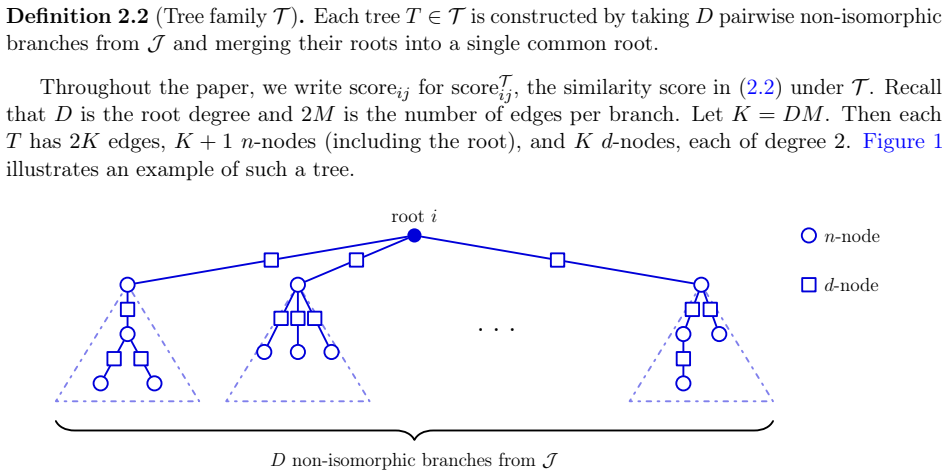
Similarity scores formed from weighted counts of a family of “wide” bipartite trees (Definition 2.2): each tree consists of D≈K/log K non-isomorphic degree-2 branches of size M=K/D attached to a common high-degree root, with K=Θ(log n). Mean separation and variance of these scores are controlled by Weingarten calculus on alternating circuit decompositions of the trees’ n-unions; the scores are approximated in poly(n,d) time by color coding.
Load-bearing premise
The asymptotic formula for Weingarten functions is used under the standing hypothesis that dimension d grows faster than a fixed power of log n (specifically d>12(2K)^{7/2} with K=Θ(log n)); if that growth fails, the mean/variance analysis and the polynomial-time claim no longer hold.
What would settle it
For concrete parameters n=2^{20}, d=(log n)^{C} with C large enough that the Weingarten hypothesis holds, and ρ² just above √α, run the color-coding tree-counting procedure and check whether the recovered matching equals the planted permutation with high probability over many independent draws; failure on a non-vanishing fraction of trials would falsify the main theorem.
Editorial analysis
A structured set of objections, weighed in public.
Referee Report
Summary. The paper studies high-dimensional Procrustes matching: recover an unknown permutation that aligns two n-point Gaussian clouds in R^d that are related by a latent orthogonal transformation and correlation ρ. Prior high-d guarantees required ρ o1. The main algorithmic result (Thm 1.1 / 2.1–2.2) is a polynomial-time exact-recovery procedure that succeeds for constant correlation ρ^{2}>√α (α≈0.338 Otter’s constant) once d≥polylog(n). The method builds similarity scores from weighted counts of a specially designed family of wide bipartite trees (Defs 2.1–2.2) whose d-nodes all have degree 2; the scores are approximated in poly time by color coding (Alg 2 / Prop 2.1) and then boosted from almost-exact to exact recovery by a seeded geometric matching step (Alg 3 / Thm 2.2). An improved information-theoretic guarantee via the quadratic-assignment estimator (Thm 2.3) shows exact recovery is possible for ρ^{2}≳max{log n/d,√(log n/n)}, and a low-degree calculation (Thm 10.1) indicates that √α is essentially optimal inside the tree-counting framework.
Significance. The work closes a long-standing gap: constant-correlation, polynomial-time exact matching in the high-dimensional Procrustes / geometric-graph-alignment model. The technical contribution is substantial—joint-moment analysis via Weingarten calculus on alternating circuit decompositions of decorated union graphs, a carefully engineered wide-tree family that simultaneously controls mean separation and variance, and a clean color-coding + seeding pipeline. The information-theoretic improvement and the matching low-degree barrier for tree polynomials further strengthen the contribution. The results are derived with explicit error terms under stated hypotheses; Otter’s constant enters as a classical combinatorial fact rather than a fitted parameter. If the claims hold, the paper will be a standard reference for high-dimensional matching and for the use of tree polynomials in geometric models.
minor comments (4)
- The standing hypothesis d>12(2K)^{7/2} for the Weingarten asymptotic (Lemma 4.4) is used throughout Sections 4–6; while it is absorbed into the polylog assumption of the main theorems, a short explicit remark in Section 2.4 that C2 is chosen large enough to satisfy this inequality would make the parameter hierarchy fully self-contained.
- In the variance decomposition (Lemma 6.2 and Props 6.1–6.2) the geometric-series bounds rely on several “poly(K)/min{d,n}<1/2” conditions; collecting these numerical requirements once (e.g., after (2.9)) would improve readability.
- Figure 1 and the schematic Figures 2–3 are helpful; adding a short caption sentence that explicitly marks the root degree D and branch size M would make the parameter choices easier to track.
- A few minor typos appear (e.g., “wheneverd”, “Notethat”). A light copy-edit pass would remove them.
Circularity Check
No significant circularity: threshold and guarantees are derived from classical combinatorial enumeration, external moment tools, and self-contained variance analysis under explicit hypotheses.
full rationale
The central algorithmic claim (exact recovery for ho^{2}>\sqrtα when d mid polylog(n)) is obtained by constructing wide trees whose branch count is governed by Otter’s classical asymptotic |J| mid( mid+o(1))^{-M} (Definition 2.1, citing [Ott48]), then verifying mean separation (Proposition 3.1 via Weingarten/Isserlis, Theorem 4.1) and variance bounds (Proposition 3.2) that force the same ho^{4}> mid condition for concentration. These moment calculations rest on the external asymptotic for the Weingarten function (Lemma 4.4 from [CM17]) under the paper’s explicit standing hypothesis d>12(2K)^{7}/^{2} with K= mid(log n); the hypothesis is already the operating regime of Theorems 2.1–2.2 and is not smuggled. The low-degree calculation (Theorem 10.1) independently recovers the same mid-barrier for any tree polynomial, confirming necessity within the tree-counting class rather than importing a uniqueness claim. Color-coding approximation and seeded exact-recovery boost inherit the same parameters without fitting or redefinition. No step reduces a claimed prediction to a fitted input, a self-definitional identity, or a load-bearing self-citation whose content is the target result. The derivation is therefore self-contained against external classical facts and standard probabilistic tools.
Axiom & Free-Parameter Ledger
free parameters (2)
- Tree parameters (K=C1 log n, D=c1 K/log K)
- Score threshold τ=c|T|n^K d^K ρ^{2K}, c∈(1/4,3/4)
axioms (6)
- standard math Otter’s asymptotic: number of unlabeled trees on k edges is (α+o(1))^{-k} with α≈0.338
- standard math Weingarten calculus asymptotic for Haar orthogonal moments (Collins–Matsumoto)
- standard math Isserlis/Wick theorem for Gaussian moments
- standard math Color-coding counts colorful tree copies in poly time (Alon–Yuster–Zwick / Alon et al.)
- domain assumption Data model: Xi~N(0,Id), Yi=ρ Q X_π(i)+√(1−ρ²)Zi, Q Haar on Od, π uniform
- ad hoc to paper d>12(2K)^{7/2} for Weingarten error control
invented entities (1)
-
Wide tree family T (Defs. 2.1–2.2)
no independent evidence
read the original abstract
Suppose we observe two sets of $n$ Gaussian vectors in $\mathbb{R}^d$, with the promise that, after applying a permutation of $[n]$ and a rotation of $\mathbb{R}^d$, the two sets are $\rho$-correlated. The Procrustes matching problem asks us to recover the unknown permutation of $[n]$ that aligns the two sets. The problem is well-studied in the low-dimensional regime $d=O(\log n)$, but the high-dimensional regime $d\gg \log n$ has remained largely uncharted: prior matching guarantees require nearly perfect correlation $\rho=1-o(1)$, even for information-theoretic recovery. Our main result is a polynomial-time algorithm for exact recovery at constant correlation. The algorithm works by computing and comparing weighted counts of a specially chosen family of ``wide'' trees. So long as $d\ge \mathrm{polylog}(n)$, the algorithm succeeds with high probability for any $\rho^2>\sqrt{\alpha}$, where $\alpha\approx 0.338$ is Otter's tree-counting constant. We complement this algorithmic result with an improved information-theoretic guarantee, showing that exact recovery is possible when $\rho^2 \gtrsim \max\{\log n/d,\sqrt{\log n/n}\}$. We also carry out a low-degree advantage calculation, which suggests that the condition $\rho^2 > \sqrt{\alpha}$ is necessary for any tree-counting algorithm.
Figures


Reference graph
Works this paper leans on
-
[1]
Biennial International Conference on Information Processing in Medical Imaging , pages=
The softassign procrustes matching algorithm , author=. Biennial International Conference on Information Processing in Medical Imaging , pages=. 1997 , organization=
work page 1997
-
[2]
ISAAC Congress (International Society for Analysis, its Applications and Computation) , pages=
Notes on computational hardness of hypothesis testing: Predictions using the low-degree likelihood ratio , author=. ISAAC Congress (International Society for Analysis, its Applications and Computation) , pages=. 2019 , organization=
work page 2019
-
[3]
Computational Complexity of Statistics: New Insights from Low-Degree Polynomials
Computational complexity of statistics: New insights from low-degree polynomials , author=. arXiv preprint arXiv:2506.10748 , year=
work page internal anchor Pith review Pith/arXiv arXiv
-
[4]
Biomolecular network motif counting and discovery by color coding , author=. Bioinformatics , volume=. 2008 , publisher=
work page 2008
-
[5]
Journal of the ACM (JACM) , volume=
Color-coding , author=. Journal of the ACM (JACM) , volume=. 1995 , publisher=
work page 1995
-
[6]
Annals of Mathematics , volume=
The number of trees , author=. Annals of Mathematics , volume=. 1948 , publisher=
work page 1948
-
[7]
The Umeyama algorithm for matching correlated Gaussian geometric models in the low-dimensional regime , author=. arXiv preprint arXiv:2402.15095 , year=
work page internal anchor Pith review Pith/arXiv arXiv
-
[8]
Conference on Learning Theory , pages=
Random graph matching in geometric models: the case of complete graphs , author=. Conference on Learning Theory , pages=. 2022 , organization=
work page 2022
-
[9]
Proceedings of the 4th ACM international symposium on Mobile ad hoc networking & computing , pages=
Localization from mere connectivity , author=. Proceedings of the 4th ACM international symposium on Mobile ad hoc networking & computing , pages=
-
[10]
Geometric graph matching and similarity: A probabilistic approach , author=. Proceedings of the 26th International Conference on Scientific and Statistical Database Management , pages=
-
[11]
L. Proc. 3DOR , volume=
-
[12]
The 22nd International Conference on Artificial Intelligence and Statistics , pages=
Unsupervised alignment of embeddings with wasserstein procrustes , author=. The 22nd International Conference on Artificial Intelligence and Statistics , pages=. 2019 , organization=
work page 2019
-
[13]
SIAM Journal on Optimization , volume=
Exact recovery with symmetries for procrustes matching , author=. SIAM Journal on Optimization , volume=. 2017 , publisher=
work page 2017
-
[14]
ACM Transactions on Graphics (TOG) , volume=
Point registration via efficient convex relaxation , author=. ACM Transactions on Graphics (TOG) , volume=. 2016 , publisher=
work page 2016
-
[15]
Recovery thresholds in the sparse planted matching problem , author=. Physical Review E , volume=. 2020 , publisher=
work page 2020
-
[16]
2020 IEEE International Symposium on Information Theory (ISIT) , pages=
Achievability of nearly-exact alignment for correlated Gaussian databases , author=. 2020 IEEE International Symposium on Information Theory (ISIT) , pages=. 2020 , organization=
work page 2020
-
[17]
Proceedings of the 2nd Mathematical and Scientific Machine Learning Conference , pages =
Sharp threshold for alignment of graph databases with Gaussian weights , author =. Proceedings of the 2nd Mathematical and Scientific Machine Learning Conference , pages =. 2022 , volume =
work page 2022
-
[18]
13th Innovations in Theoretical Computer Science Conference (ITCS 2022) , year=
Correlation Detection in Trees for Planted Graph Alignment , author=. 13th Innovations in Theoretical Computer Science Conference (ITCS 2022) , year=
work page 2022
-
[19]
From tree matching to sparse graph alignment
From tree matching to sparse graph alignment , author=. arXiv preprint arXiv:2002.01258 , year=
work page internal anchor Pith review Pith/arXiv arXiv 2002
-
[20]
Advances in Neural Information Processing Systems , pages=
(Nearly) Efficient Algorithms for the Graph Matching Problem on Correlated Random Graphs , author=. Advances in Neural Information Processing Systems , pages=
-
[21]
Probability Theory and Related Fields , volume=
Efficient random graph matching via degree profiles , author=. Probability Theory and Related Fields , volume=. 2021 , publisher=
work page 2021
-
[22]
Partial Recovery in the Graph Alignment Problem
Partial Recovery in the Graph Alignment Problem , author=. arXiv preprint arXiv:2007.00533 , year=
work page internal anchor Pith review Pith/arXiv arXiv 2007
-
[23]
Wu, Yihong and Xu, Jiaming and Yu, Sophie H. , journal=. Settling the Sharp Reconstruction Thresholds of Random Graph Matching , year=
-
[24]
Probability Theory and Related Fields , volume =
Mao, Cheng and Rudelson, Mark and Tikhomirov, Konstantin , title =. Probability Theory and Related Fields , volume =. 2023 , doi =
work page 2023
-
[25]
Proceedings of Thirty Fourth Conference on Learning Theory , pages =
Random Graph Matching with Improved Noise Robustness , author =. Proceedings of Thirty Fourth Conference on Learning Theory , pages =. 2021 , volume =
work page 2021
-
[26]
Jian Ding and Zongming Ma and Yihong Wu and Jiaming Xu , Month =. 2020 , journal =
work page 2020
-
[27]
Bulletin of the EATCS , number=
The computer science and physics of community detection: Landscapes, phase transitions, and hardness , author=. Bulletin of the EATCS , number=
-
[28]
Proceedings of the 35th ACM SIGMOD-SIGACT-SIGAI Symposium on Principles of Database Systems , pages=
Reconciling graphs and sets of sets , author=. Proceedings of the 35th ACM SIGMOD-SIGACT-SIGAI Symposium on Principles of Database Systems , pages=. 2018 , organization=
work page 2018
-
[29]
On the privacy of anonymized networks , author=. Proceedings of the 17th ACM SIGKDD international conference on Knowledge discovery and data mining , pages=. 2011 , organization=
work page 2011
-
[30]
Cullina, Daniel and Kiyavash, Negar and Mittal, Prateek and Poor, H Vincent , journal=. Partial Recovery of
-
[31]
Slashdot social network , Month =
-
[32]
Boyd, Stephen and Parikh, Neal and Chu, Eric and Peleato, Borja and Eckstein, Jonathan , Journal =. Distributed optimization and statistical learning via the alternating direction method of multipliers , Volume =
-
[33]
Exact distribution of the max/min of two
Nadarajah, Saralees and Kotz, Samuel , Journal =. Exact distribution of the max/min of two
-
[34]
Some inequalities relating to the partial sum of binomial probabilities , Url =
Okamoto, Masashi , Date-Added =. Some inequalities relating to the partial sum of binomial probabilities , Url =. Annals of the Institute of Statistical Mathematics , Month =. 1959 , Bdsk-Url-1 =. doi:10.1007/BF02883985 , Issn =
-
[35]
Estimation in the Spiked Wigner Model: A Short Proof of the Replica Formula , Year =
Alaoui, Ahmed El and Krzakala, Florent , Journal =. Estimation in the Spiked Wigner Model: A Short Proof of the Replica Formula , Year =
-
[36]
Finite Size Corrections and Likelihood Ratio Fluctuations in the Spiked Wigner Model , Year =
Alaoui, Ahmed El and Krzakala, Florent and Jordan, Michael I , Journal =. Finite Size Corrections and Likelihood Ratio Fluctuations in the Spiked Wigner Model , Year =
-
[37]
Tensor SVD: Statistical and Computational Limits , Year =
Zhang, Anru and Xia, Dong , Journal =. Tensor SVD: Statistical and Computational Limits , Year =
-
[38]
Boaz Barak and Samuel B. Hopkins and Jonathan A. Kelner and Pravesh Kothari and Ankur Moitra and Aaron Potechin , Booktitle =. A
-
[39]
Phase transitions and optimal algorithms in high-dimensional Gaussian mixture clustering
Thibault Lesieur and Caterina De Bacco and Jess Banks and Florent Krzakala and Cris Moore and Lenka Zdeborov. Arxiv preprint arxiv:1610.02918 , Title =
work page internal anchor Pith review Pith/arXiv arXiv
-
[40]
Rate-optimal graphon estimation , Volume =
Gao, Chao and Lu, Yu and Zhou, Harrison H , Date-Added =. Rate-optimal graphon estimation , Volume =. The Annals of Statistics , Number =
-
[41]
Rates of Convergence of Spectral Methods for Graphon Estimation , Year =
Jiaming Xu , Booktitle =. Rates of Convergence of Spectral Methods for Graphon Estimation , Year =
-
[42]
Oracle inequalities for network models and sparse graphon estimation
Klopp, Olga and Tsybakov, Alexandre B and Verzelen, Nicolas , Date-Added =. arXiv preprint arXiv:1507.04118 , Title =
work page internal anchor Pith review Pith/arXiv arXiv
-
[43]
Optimal graphon estimation in cut distance
Klopp, Olga and Verzelen, Nicolas , Date-Added =. arXiv preprint arXiv:1703.05101 , Title =
work page internal anchor Pith review Pith/arXiv arXiv
-
[44]
Optimal Estimation and Completion of Matrices with Biclustering Structures , Volume =
Gao, Chao and Lu, Yu and Ma, Zongming and Zhou, Harrison H , Date-Added =. Optimal Estimation and Completion of Matrices with Biclustering Structures , Volume =. Journal of Machine Learning Research , Number =
-
[45]
Reducibility and Computational Lower Bounds for Problems with Planted Sparse Structure , Year =
Matthew Brennan and Guy Bresler and Wasim Huleihel , Date-Added =. Reducibility and Computational Lower Bounds for Problems with Planted Sparse Structure , Year =
-
[46]
Tensor principal component analysis via sum-of-square proofs
Hopkins, Samuel B and Shi, Jonathan and Steurer, David , Booktitle =. Tensor principal component analysis via sum-of-square proofs. , Year =
-
[47]
Statistical and computational phase transitions in spiked tensor estimation , Year =
Thibault Lesieur and L. Statistical and computational phase transitions in spiked tensor estimation , Year =
-
[48]
and Lim, Lek-Heng , Date-Added =
Hillar, Christopher J. and Lim, Lek-Heng , Date-Added =. Most Tensor Problems Are NP-Hard , Volume =. J. ACM , Month = nov, Number =
-
[49]
A Statistical Model for Tensor PCA , Year =
Montanari, Andrea and Richard, Emile , Booktitle =. A Statistical Model for Tensor PCA , Year =
-
[50]
Lesieur, Thibault and Krzakala, Florent and Zdeborov. Phase transitions in sparse. IEEE International Symposium on Information Theory , Date-Added =
-
[51]
Fundamental limits of symmetric low-rank matrix estimation , Volume =
Marc Lelarge and L. Fundamental limits of symmetric low-rank matrix estimation , Volume =. Proceedings of the 2017 Conference on Learning Theory , Editor =
work page 2017
-
[52]
Benaych-Georges, Florent and Nadakuditi, Raj Rao , Date-Added =. The eigenvalues and eigenvectors of finite, low rank perturbations of large random matrices , Volume =. Advances in Mathematics , Number =
-
[53]
The largest eigenvalue of small rank perturbations of Hermitian random matrices , Volume =
P. The largest eigenvalue of small rank perturbations of Hermitian random matrices , Volume =. Probability Theory and Related Fields , Number =
-
[54]
Phase transition of the largest eigenvalue for nonnull complex sample covariance matrices , Year =
Baik, Jinho and Ben Arous, G. Phase transition of the largest eigenvalue for nonnull complex sample covariance matrices , Year =. Annals of Probability , Pages =
-
[55]
Y. Deshpande and A. Montanari , Booktitle =. Information-theoretically optimal sparse. 2014 , Bdsk-Url-1 =. doi:10.1109/ISIT.2014.6875223 , Month =
- [56]
-
[57]
Amelia Perry and Alexander S. Wein and Afonso S. Bandeira and Ankur Moitra , Date-Added =. Optimality and Sub-optimality of
-
[58]
Amelia Perry and Alexander S. Wein and Afonso S. Bandeira , Date-Added =. Statistical limits of spiked tensor models , Year =
-
[59]
Extremal cuts of sparse random graphs , Volume =
Dembo, Amir and Montanari, Andrea and Sen, Subhabrata , Date-Added =. Extremal cuts of sparse random graphs , Volume =. The Annals of Probability , Number =
-
[60]
On the Liapunoff limit of error in the theory of probability
C.-G. Esseen , Date-Added =. "On the Liapunoff limit of error in the theory of probability" , Volume =. Arkiv f
-
[61]
The dynamics of message passing on dense graphs, with applications to compressed sensing , Volume =
Bayati, Mohsen and Montanari, Andrea , Journal =. The dynamics of message passing on dense graphs, with applications to compressed sensing , Volume =
-
[62]
Javanmard, Adel and Montanari, Andrea , Journal =. State evolution for general approximate message passing algorithms, with applications to spatial coupling , Volume =
-
[63]
Probability and measure , Year =
Billingsley, Patrick , Publisher =. Probability and measure , Year =
-
[64]
Kailath, Thomas , Date-Added =. The divergence and. IEEE transactions on communication technology , Number =
-
[65]
B. Hajek and Y. Wu and J. Xu , Booktitle =. Information Limits for recovering a Hidden Community , Year =
-
[66]
Learning the graph of epidemic cascades , Volume =
Netrapalli, Praneeth and Sanghavi, Sujay , Booktitle =. Learning the graph of epidemic cascades , Volume =
-
[67]
Bruce Hajek and Sewoong Oh and J. Xu , Booktitle =. Minimax-optimal Inference from Partial Rankings , Year =
-
[68]
Budget-optimal task allocation for reliable crowdsourcing systems , Volume =
Karger, David R and Oh, Sewoong and Shah, Devavrat , Date-Added =. Budget-optimal task allocation for reliable crowdsourcing systems , Volume =. Operations Research , Number =
-
[69]
Beyond Spectral: Tight Bounds for Planted Gaussians , Year =
Ravi Kannan and Santosh Vempala , Date-Added =. Beyond Spectral: Tight Bounds for Planted Gaussians , Year =
-
[70]
Emmanuel Abbe and Colin Sandon , Date-Added =. Detection in the stochastic block model with multiple clusters: proof of the achievability conjectures, acyclic
-
[71]
Information-theoretic thresholds for community detection in sparse networks , Year =
Jess Banks and Cristopher Moore and Joe Neeman and Praneeth Netrapalli , Booktitle =. Information-theoretic thresholds for community detection in sparse networks , Year =
-
[72]
Convexified Modularity Maximization for Degree-corrected Stochastic Block Models
Y. Chen and X. Li and J. Xu , Date-Added =. Convexified Modularity Maximization for Degree-corrected Stochastic Block Models , Year =. 1512.08425 , Month =
work page internal anchor Pith review Pith/arXiv arXiv
-
[73]
Yun and Alexandre Proutiere , Date-Added =
S. Yun and Alexandre Proutiere , Date-Added =. Optimal Cluster Recovery in the Labeled Stochastic Block Model , Year =
-
[74]
V. Jog and P.-L. Loh , Date-Modified =. Information-theoretic bounds for exact recovery in weighted stochastic block models using the
-
[75]
Information Theory: Coding Theorems for Discrete Memoryless Systems , Year =
Imre Csisz. Information Theory: Coding Theorems for Discrete Memoryless Systems , Year =
-
[76]
Yury Polyanskiy and Yihong Wu , Date-Modified =
-
[77]
Large deviations techniques and applications , Year =
Dembo, Amir and Zeitouni, Ofer , Publisher =. Large deviations techniques and applications , Year =
-
[78]
The Hidden Subgraph Problem , Year =
Hamid Javadi and Andrea Montanari , Date-Added =. The Hidden Subgraph Problem , Year =
-
[79]
Phase Transitions in Semidefinite Relaxations , Year =
Adel Javanmard and Andrea Montanari and Federico Ricci-Tersenghi , Date-Added =. Phase Transitions in Semidefinite Relaxations , Year =
-
[80]
H. Chernoff , Date-Added =. A measure of asymptotic efficiency for tests of a hypothesis based on the sum of observations , Year =. The Annals of Mathematical Statistics , Pages =
discussion (0)
Sign in with ORCID, Apple, or X to comment. Anyone can read and Pith papers without signing in.