REVIEW 3 major objections 5 minor 33 references
Knowledge distillation works by sparsifying complex word interactions in student LLMs while keeping teacher-aligned simple ones.
Reviewed by Pith at T0; open to challenge. T0 means a machine referee read the full paper against a public rubric. the ladder, T0–T4 →
T0 review · grok-4.5
2026-07-13 08:02 UTC pith:A2NUGNC7
load-bearing objection Clean empirical story that multiple KD methods sparsify complex interactions (with teacher-aligned simple ones retained), plus a cheap CIP regularizer that reliably lifts six baselines; the v(x) choice is a soft spot but not fatal. the 3 major comments →
A Unified Approach to Interpreting Knowledge Distillation for Large Language Models via Interactions
The pith
A machine-rendered reading of the paper's core claim, the machinery that carries it, and where it could break.
Core claim
The shared mechanism of diverse knowledge-distillation methods for LLMs is sparsification of interactions: after distillation a student relies on fewer high-effect interactions and drives the rest near zero, preferentially retaining teacher-aligned simple interactions and discarding complex ones as noise. A method yields higher performance precisely when it produces higher sparsity of complex interactions together with higher student–teacher overlap among the remaining complex interactions.
What carries the argument
AND (Harsanyi) interactions: the model output score on any masked input equals the sum of interaction effects I_S, each I_S quantifying the nonlinear contribution of a particular subset of input words when all of them are present. Complexity of an interaction is simply its order |S|; Gini coefficient and entropy of the |I_S| measure sparsity, and top-k overlap with the teacher measures alignment.
Load-bearing premise
The argument rests on treating a particular scalar—log-odds of the length-normalized geometric mean of ground-truth token probabilities—together with its complete AND-interaction decomposition as a faithful record of the inference logic that distillation actually transfers.
What would settle it
If student models whose complex-interaction Gini and teacher-overlap rise under CIP (or under a stronger distiller) nevertheless fail to improve ROUGE-L or GPT-judge scores on held-out instruction sets, or if the same sparsity/alignment pattern appears under ordinary supervised fine-tuning without any distillation, the claimed mechanism is refuted.
Editorial analysis
A structured set of objections, weighed in public.
Referee Report
Summary. The paper claims that diverse knowledge-distillation (KD) methods for LLMs share a common mechanism of sparsifying interactions (especially complex ones of high order |S|) extracted from a scalar output v(x) = log(¯p/(1-¯p)), where ¯p is the length-normalized geometric-mean probability of the ground-truth sequence, while preferentially retaining teacher-aligned salient simple interactions. Performance differences among KD methods are attributed to how effectively they sparsify and align complex interactions (positive Pearson correlations ~0.81). Motivated by this, the authors introduce a plug-and-play Complex Interaction Penalty (CIP) that samples and penalizes the magnitude of complex interactions (Eqs. 5–7, with m≤3 partition approximation), and show that adding CIP improves ROUGE-L and GPT-5 scores for six KD baselines across GPT-2/OPT/LLaMA families on in-domain Dolly and OOD SelfInst/Vicuna/SNI benchmarks.
Significance. If the interaction-based account is correct, the work supplies a unified, game-theoretic explanation for why KD works (sparsification akin to Occam’s razor) that goes beyond prior theoretical or representation analyses, and yields a practical, low-overhead regularizer that consistently lifts multiple existing KD methods. Strengths include the rigorous invocation of the universal-matching property (Theorem 3.1, proven in App. D.1), clean definitions of Gini/entropy/Overlap@k metrics on simple/complex partitions, extensive multi-family multi-size experiments with SFT/Base controls, λ-sensitivity and CIP-sparsity ablations (Fig. 9, Table 6), and robustness checks for β (App. G.3). The CIP intervention itself is falsifiable and empirically useful even if the full mechanistic story is incomplete.
major comments (3)
- [Section 3 and Appendix C] Section 3 + Appendix C: the entire mechanistic diagnosis (sparsity rise in Figs. 2–3, simple-vs-complex ΔGini in Fig. 4, Overlap@k gaps in Fig. 5, and the ~0.81 vs ~0.34 Pearson correlations with ROUGE-L in Figs. 6–7/15–18) is computed exclusively on the scalar v(x) = log(¯p/(1-¯p)) with ¯p the geometric mean of ground-truth token probabilities. Theorem 3.1 guarantees an exact AND decomposition for any scalar, so the reported patterns are properties of this particular functional. No ablation is provided with alternative scalars that more directly reflect the soft next-token distributions or teacher–student KL that KD actually optimizes (e.g., average log-prob of the full vocabulary, token-level logits, or teacher soft labels). Without such checks the claim that sparsification of complex interactions is the common mechanism of KD (rather than a description of this v) remains unvalidated a
- [Section 4.1 and Appendix E] Section 4.1 and Appendix E: interaction extraction is restricted to a fixed n=13 meaningful words drawn only from the “Instruction” segment (system prompt and remaining tokens held as unmasked background). While computationally necessary, this choice means the reported sparsification and teacher-overlap statistics capture only a narrow slice of the input; it is unclear whether the same simple/complex patterns hold when variables are taken from the full prompt or from student-generated outputs used by ImitKD/MiniLLM/GKD. A sensitivity check with variable n or full-sequence masking would be required to support the generality of the “common mechanism.”
- [Section 5, Eqs. (5)–(7)] Section 5, Eqs. (5)–(7) and Appendix D.2: CIP is approximated by randomly partitioning into m≤3 subsets and averaging absolute interaction effects over non-empty unions. The paper shows that CIP raises complex-interaction Gini and improves most (but not all) ROUGE-L/GPT-5 entries in Table 5/Fig. 8. However, there is no direct verification that the sampled L'_CIP correlates with the true (intractable) sum over Ω_complex, nor an ablation that replaces the complex-only penalty with a simple-only or all-interaction penalty. Without these controls it remains possible that any magnitude penalty on higher-order terms would produce similar gains, weakening the claim that the benefit specifically tracks the complex-interaction sparsity diagnosed earlier.
minor comments (5)
- [Figure 1] Figure 1 caption and surrounding text: the visualization of “fading color of the bars” is described but the actual figure (as rendered) does not make the pre-/post-distillation contrast or the red-box teacher alignment quantitatively readable; adding numerical effect values or a side-by-side density plot would help.
- [Table 1] Table 1 and Table 4: Overlap@k is reported only for k∈{0.05,0.1,0.15}; a continuous curve or AUC-style summary would make the alignment claim easier to compare across methods and model sizes.
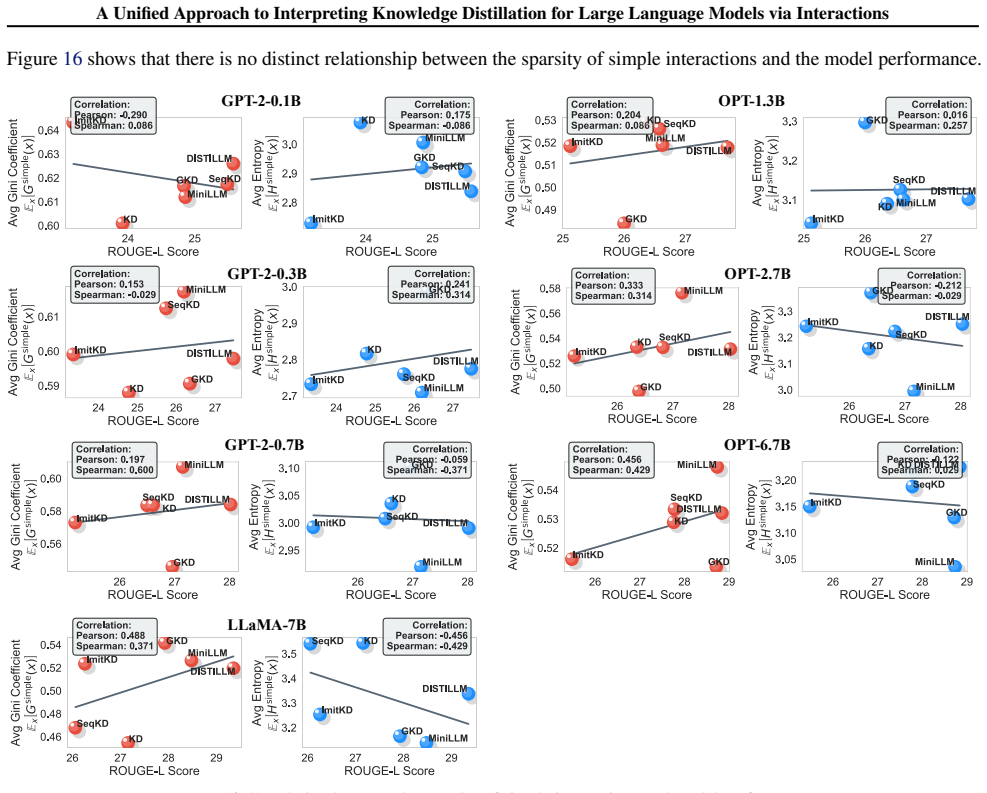
- [Appendix C] Appendix C: the clipping ϵ=10^{-7} and the log-odds transform are stated, but the numerical stability of the Möbius inversion for I_S when many masked v(x_T) approach the extremes is not discussed; a short note on conditioning or regularization would be useful.
- Throughout: the terms “salient interactions,” “dross,” and “essential” are used rhetorically; defining them strictly via the top-k absolute-effect sets already introduced would improve precision.
- [Section 2] References: several recent KD works on f-divergences and speculative sampling are cited, but the interaction literature (e.g., earlier Harsanyi-value papers) could be more completely linked to the LLM-specific citations already present.
Circularity Check
No definitional or predictive circularity; post-hoc interaction statistics on frozen models motivate an independent regularizer whose gains are measured on external benchmarks.
full rationale
The derivation chain is observational then interventional, not self-referential. Theorem 3.1 (universal matching via Möbius inversion of any scalar v) is a mathematical identity proven in Appendix D.1 and independent of KD; interactions are extracted from already-trained models by the fixed formula I_S = sum (-1)^{|S|-|S'|} v(x_{S'}). Sparsity (Gini/entropy), simple/complex partition, and teacher overlap are measured after the fact on Base/SFT/KD students (Figs. 2–7, Tables 1,4). The correlation with ROUGE-L is empirical, not forced. CIP (Eq. 5–7) is a new sampling-based penalty on |I_S| for complex S; it is added to existing L_KD, and the paper reports that the same sparsity metrics rise while ROUGE-L/GPT-5 scores improve on held-out sets (Fig. 8, Tables 5–6). Self-citations to the authors’ prior interaction papers supply only the analytical toolkit and the interpretive claim that simple interactions are more generalizable; they do not define the KD mechanism or the CIP objective by construction. No parameter is fitted to a subset and then ‘predicted’ on a related quantity, and no uniqueness theorem is invoked to forbid alternatives. The choice of scalar v(x) (log-odds of geometric-mean GT probability) is an unvalidated modeling assumption, but that is a validity concern, not circularity. Score 1 reflects only the minor, non-load-bearing self-citation of the interaction framework.
Axiom & Free-Parameter Ledger
free parameters (4)
- λ (CIP weight)
- β (simple/complex threshold)
- n (number of input variables)
- m (partition size for CIP sampling)
axioms (4)
- domain assumption Universal matching property: any LLM scalar output v(x_T) equals the sum of AND-interaction effects I_S for S⊆T (Theorem 3.1 / Li & Zhang 2023).
- ad hoc to paper v(x) = log(¯p/(1-¯p)) where ¯p is the geometric mean of ground-truth token probabilities (Appendix C).
- domain assumption Simple interactions encode generalizable knowledge while most complex interactions are non-generalizable noise (Zhou et al. 2024).
- domain assumption Masking a word with a dedicated [MASK] token cleanly removes its contribution without introducing out-of-distribution artifacts.
invented entities (2)
-
Complex Interaction Penalty (CIP)
no independent evidence
-
Interaction sparsity / alignment metrics (Gini, entropy, Overlap@k on simple vs complex partitions)
no independent evidence
read the original abstract
Despite the success of knowledge distillation (KD) in Large Language Models (LLMs), the underlying mechanism behind its efficacy remains unclear. In this paper, we propose a unified approach to explore the common mechanism of various KD methods using interactions. Specifically, we decompose the output score of the LLM into the sum of numerous interactions. Each interaction represents a nonlinear relationship involving a set of input variables (e.g., words). Based on the decomposed interactions, we discover that the common mechanism underlying various KD methods is the sparsification of interactions, i.e., student models retain fewer interactions for inference while suppressing other interactions to zero effects. Furthermore, we discover that the performance variance across different KD methods arises from their capabilities in handling complex interactions. A KD method typically yields better performance if it enables the student model to achieve higher sparsity of complex interactions. Motivated by these insights, we propose a plug-and-play loss function called Complex Interaction Penalty (CIP) to explicitly enforce the sparsity of complex interactions during the distillation process. Extensive experiments demonstrate that integrating CIP consistently improves the performance of diverse KD methods on both in-domain and out-of-distribution benchmarks.
Figures




Reference graph
Works this paper leans on
-
[1]
Allen-Zhu, Z. and Li, Y . Towards understanding ensem- ble, knowledge distillation and self-distillation in deep learning.arXiv preprint arXiv:2012.09816,
Pith/arXiv arXiv 2012
-
[2]
Defining and extracting generalizable interaction primitives from dnns
Chen, L., Lou, S., Huang, B., and Zhang, Q. Defining and extracting generalizable interaction primitives from dnns. arXiv preprint arXiv:2401.16318,
-
[3]
E., et al
Chiang, W.-L., Li, Z., Lin, Z., Sheng, Y ., Wu, Z., Zhang, H., Zheng, L., Zhuang, S., Zhuang, Y ., Gonzalez, J. E., et al. Vicuna: An open-source chatbot impressing gpt-4 with 90%* chatgpt quality.See https://vicuna. lmsys. org (accessed 14 April 2023), 2(3):6,
2023
-
[4]
Covert, I., Lundberg, S., and Lee, S.-I. Feature removal is a unifying principle for model explanation methods.arXiv preprint arXiv:2011.03623,
Pith/arXiv arXiv 2011
-
[5]
Minillm: Knowl- edge distillation of large language models
Gu, Y ., Dong, L., Wei, F., and Huang, M. Minillm: Knowl- edge distillation of large language models. InThe Twelfth International Conference on Learning Representations, 2024a. Gu, Y ., Zhou, H., Meng, F., Zhou, J., and Huang, M. Mini- plm: Knowledge distillation for pre-training language models.arXiv preprint arXiv:2410.17215, 2024b. Hinton, G., Vinyals,...
-
[6]
Tinybert: Distilling bert for natural language understanding
Jiao, X., Yin, Y ., Shang, L., Jiang, X., Chen, X., Li, L., Wang, F., and Liu, Q. Tinybert: Distilling bert for natural language understanding. InFindings of the association for computational linguistics: EMNLP 2020, pp. 4163– 4174,
2020
-
[7]
Promptkd: Distilling student-friendly knowledge for generative language mod- els via prompt tuning
Kim, G., Jang, D., and Yang, E. Promptkd: Distilling student-friendly knowledge for generative language mod- els via prompt tuning. InFindings of the Association for Computational Linguistics: EMNLP 2024, pp. 6266– 6282,
2024
-
[8]
and Rush, A
Kim, Y . and Rush, A. M. Sequence-level knowledge distilla- tion. InProceedings of the 2016 conference on empirical 10 A Unified Approach to Interpreting Knowledge Distillation for Large Language Models via Interactions methods in natural language processing, pp. 1317–1327,
2016
-
[9]
Distillm-2: A contrastive approach boosts the distillation of llms.arXiv preprint arXiv:2503.07067,
Ko, J., Chen, T., Kim, S., Ding, T., Liang, L., Zharkov, I., and Yun, S.-Y . Distillm-2: A contrastive approach boosts the distillation of llms.arXiv preprint arXiv:2503.07067,
-
[10]
Homodistil: Homotopic task-agnostic distillation of pre-trained transformers
Liang, C., Jiang, H., Li, Z., Tang, X., Yin, B., and Zhao, T. Homodistil: Homotopic task-agnostic distillation of pre-trained transformers. 2023a. Liang, C., Zuo, S., Zhang, Q., He, P., Chen, W., and Zhao, T. Less is more: Task-aware layer-wise distillation for lan- guage model compression. InInternational Conference on Machine Learning, pp. 20852–20867. ...
2020
-
[11]
Defining and quantifying the emergence of sparse concepts in dnns
Ren, J., Li, M., Chen, Q., Deng, H., and Zhang, Q. Defining and quantifying the emergence of sparse concepts in dnns. InProceedings of the IEEE/CVF conference on computer vision and pattern recognition, pp. 20280–20289, 2023a. Ren, J., Zheng, X., Liu, J., Lizarraga, A., Wu, Y . N., Lin, L., and Zhang, Q. Monitoring primitive inter- actions during the trai...
-
[12]
Shen, W., Cheng, L., Yang, Y ., Li, M., and Zhang, Q. Can the inference logic of large language models be disentangled into symbolic concepts?arXiv preprint arXiv:2304.01083,
-
[13]
Patient knowledge distillation for bert model compression
Sun, S., Cheng, Y ., Gan, Z., and Liu, J. Patient knowledge distillation for bert model compression. InProceedings of the 2019 Conference on Empirical Methods in Natu- ral Language Processing and the 9th International Joint Conference on Natural Language Processing (EMNLP- IJCNLP), pp. 4323–4332,
2019
-
[14]
Tenney, I., Wexler, J., Bastings, J., Bolukbasi, T., Coenen, A., Gehrmann, S., Jiang, E., Pushkarna, M., Radebaugh, C., Reif, E., et al. The language interpretability tool: Extensible, interactive visualizations and analysis for nlp models.arXiv preprint arXiv:2008.05122,
Pith/arXiv arXiv 2008
-
[15]
Llama: Open and efficient foundation lan- guage models.arXiv preprint arXiv:2302.13971,
Touvron, H., Lavril, T., Izacard, G., Martinet, X., Lachaux, M.-A., Lacroix, T., Rozi`ere, B., Goyal, N., Hambro, E., Azhar, F., et al. Llama: Open and efficient foundation lan- guage models.arXiv preprint arXiv:2302.13971,
-
[16]
doi: 10.18653/v1/ 2023.acl-long.605
Associ- ation for Computational Linguistics. doi: 10.18653/v1/ 2023.acl-long.605. URL https://aclanthology. org/2023.acl-long.605/. Wu, C., Lubana, E. S., Mlodozeniec, B. K., Kirk, R., and Krueger, D. What mechanisms does knowledge distil- lation distill? InProceedings of UniReps: the First Workshop on Unifying Representations in Neural Models, pp. 60–75. PMLR,
doi:10.18653/v1/ 2023
-
[17]
Interpreting and boosting dropout from a game-theoretic view
Zhang, H., Li, S., Ma, Y ., Li, M., Xie, Y ., and Zhang, Q. Interpreting and boosting dropout from a game-theoretic view. InInternational Conference on Learning Represen- tations, 2020a. Zhang, Q., Wang, X., Cao, R., Wu, Y . N., Shi, F., and Zhu, S.-C. Extraction of an explanatory graph to interpret a cnn.IEEE transactions on pattern analysis and machine ...
-
[18]
More recent approaches have explored contrastive representation distillation (Tian et al.,
or compressing specific architectures like BERT using layer-wise strategies, as seen in Patient-KD (Sun et al., 2019), MobileBERT (Sun et al., 2020), and TinyBERT (Jiao et al., 2020). More recent approaches have explored contrastive representation distillation (Tian et al.,
2019
-
[19]
Others have proposed homotopic distillation for pre-trained transformers (Liang et al., 2023a) or utilized Wasserstein distance to match feature distributions (Lv et al., 2024)
and task-aware layer-wise distillation (Liang et al., 2023b). Others have proposed homotopic distillation for pre-trained transformers (Liang et al., 2023a) or utilized Wasserstein distance to match feature distributions (Lv et al., 2024). While standard KD minimizes the KL divergence, numerous studies have sought to refine this objective. Fundamental ana...
2024
-
[20]
and the Teacher Assistant strategy (Mirzadeh et al., 2020). To address optimization challenges, researchers have proposed multi-level logit distillation (Jin et al., 2023), logit standardization (Sun et al., 2024), and transformed teacher matching (Zheng & Y ANG, 2024). In the context of large language models and sequence generation, recent works have inv...
2020
-
[21]
Furthermore, distillation is applied to critical safety tasks, such as the detection and mitigation of hallucinations in large language models (Zhou et al., 2025)
utilizes prompt tuning to distill student-friendly knowledge. Furthermore, distillation is applied to critical safety tasks, such as the detection and mitigation of hallucinations in large language models (Zhou et al., 2025). B. Masking Strategies of Input Variables In attribution method research, it is common to employ a specific token or embedding to ma...
2025
-
[22]
The selection of a masking approach is complex, as each method has its weakness
and use changes in network outputs on the masked samples to estimate attributions of different input variables. The selection of a masking approach is complex, as each method has its weakness. For example, replacing input variables with the mean baseline value (the average of all samples) or the zero baseline value can introduce out-of-distribution signal...
2017
-
[23]
He is a green hand,
as the masked state removes high-frequency signals but fails to eliminate low-frequency signals (Covert et al., 2020; Sturmfels et al., 2020). Given these challenges, we adopt a token replacement strategy, which is standard for the text domain. This involves substituting the target input word with a dedicated [MASK] token at the embedding level. For examp...
2020
-
[24]
Instruction
Considering all the cases, the complete derivation of the sum of AND interactions is as follows. X S⊆T,S̸=∅ IAND S = X S⊆T,S̸=∅ X L⊆S (−1)|S|−|L|vand(xL) = X L⊆T X S:L⊆S⊆T (−1)|S|−|L|vand(xL)−v and(x∅) =v and(xT )| {z } L=T + X L⊆T,L̸=T vand(xL)· X|T|−|L| m=0 C m |T|−|L| (−1)m | {z } =0 −vand(x∅) =vand(xT )−v(x ∅) (10) Therefore, we have proved that ∀∅ ̸=...
2023
-
[25]
It utilizes a mixed dataset and proposes an adaptive off-policy method to selectively incorporate SGOs based on validation loss, thereby filtering out noisy generated data
introduces the Skew KL (or Skew RKL) divergence to stabilize training. It utilizes a mixed dataset and proposes an adaptive off-policy method to selectively incorporate SGOs based on validation loss, thereby filtering out noisy generated data. 17 A Unified Approach to Interpreting Knowledge Distillation for Large Language Models via Interactions F. Implem...
2024
-
[26]
Instruction
corpus. The checkpoints of each student are selected by the ROUGE-L scores on the validation set. To ensure the effectiveness of CIP, specifically when employing Student-Generated Outputs (SGO), we calculate CIP based on the ground truth from the fixed dataset. Furthermore, we only calculated CIP for samples where the number of input variables in the “Ins...
2024
-
[27]
[[rating]]
For GPT-5 feedback, we use a popular prompt introduced in Zheng et al. (2023) which is illustrated in Figure 11, the prompt asking GPT-5 to compare model-generated responses with the ground truth answers and give 1-10 scores for both responses. We report the ratio of the total score of model responses and ground truth answers by following Ko et al. (2024)...
2023
-
[28]
What", "is
• Self-Instruct(Wang et al., 2023): SelfInstruct is a framework designed to enhance the language model’s instruction- following capabilities by leveraging the model’s own outputs to generate a vast set of instructional data. It consists of 52k instructions and 82k instance inputs/outputs for fine-tuning, supplemented by 252 expert-written tasks for practi...
2023
-
[29]
GPT-2 Family Top 5% GPT-2 Family Top 15% GPT-2 Family Top 10% OPT Family Top 5% OPT Family Top 10% LLaMA Family Top 5% OPT Family Top 15% LLaMA Family Top 10% LLaMA Family Top 15% Figure 17.Correlation between the student-teacher overlap rate of complex interactions and model performance. 27 A Unified Approach to Interpreting Knowledge Distillation for La...
arXiv 1933
-
[30]
Table 7.Instruction-following cases from thedatabricks-dolly-15kdataset
We find that the KD methods with CIP generate more detailed and accurate responses compared with the baselines. Table 7.Instruction-following cases from thedatabricks-dolly-15kdataset. Model Type Content Case #1 InstructionName some famous rock bands from the 1960s InputNone Ground-truth The 1960s had a number of famous rock bands including The Beatles, T...
1960
-
[31]
Patrick’s
Cappamore were the defending champions, however, they were defeated by St. Patrick’s. On 29 September 1957, Claughaun won the championship after a 7-07 to 3-02 defeat of St. Patrick’s in the final. It was their sixth championship title overall and their first championship title since
1957
-
[32]
w/ CIP Claughaun won the 57th edition of the Limerick Senior hurling championship after defeating St
KD w/o CIP Claughaun won the championship on 29 September 1957 after a 7-07 TO 3-02 defeat of in the final. w/ CIP Claughaun won the 57th edition of the Limerick Senior hurling championship after defeating St. Patrick’s by 7-01 to 3-02 in the final. SeqKD w/o CIP Claughaun won the championship by 7-07 to 3-02. w/ CIP Claughaun won the championship followi...
1957
-
[33]
MiniLLM w/o CIP Claughaun won the 63rd staging an went on to win the next four senior hurling championships
w/ CIP Claughaun won the championship. MiniLLM w/o CIP Claughaun won the 63rd staging an went on to win the next four senior hurling championships. w/ CIP Claughaun won the Limerick Senior Hurting Championship on 29 September 1957, after a 7-07-3 victory over St. Patrick’s. GKD w/o CIP Claughaun w/ CIP Claughaun won the championship on 29 September 1957 a...
1957
discussion (0)
Sign in with ORCID, Apple, or X to comment. Anyone can read and Pith papers without signing in.