REVIEW 4 major objections 6 minor 23 references
Language models turn threat reports into class prototypes so malware classifiers can recognize new families without any labeled samples of them.
Reviewed by Pith at T0; open to challenge. T0 means a machine referee read the full paper against a public rubric. the ladder, T0–T4 →
T0 review · grok-4.5
2026-07-14 14:28 UTC pith:GGGSJ6ZN
load-bearing objection Solid cyber/tabular GZSL pipeline with real gains and code; the 10.8-point headline is inflated by heterogeneous baseline protocols, but the work still deserves a referee. the 4 major comments →
SMETA-ZSL:Semantic Meta-Alignment for Zero-Shot Threat Classification
The pith
A machine-rendered reading of the paper's core claim, the machinery that carries it, and where it could break.
Core claim
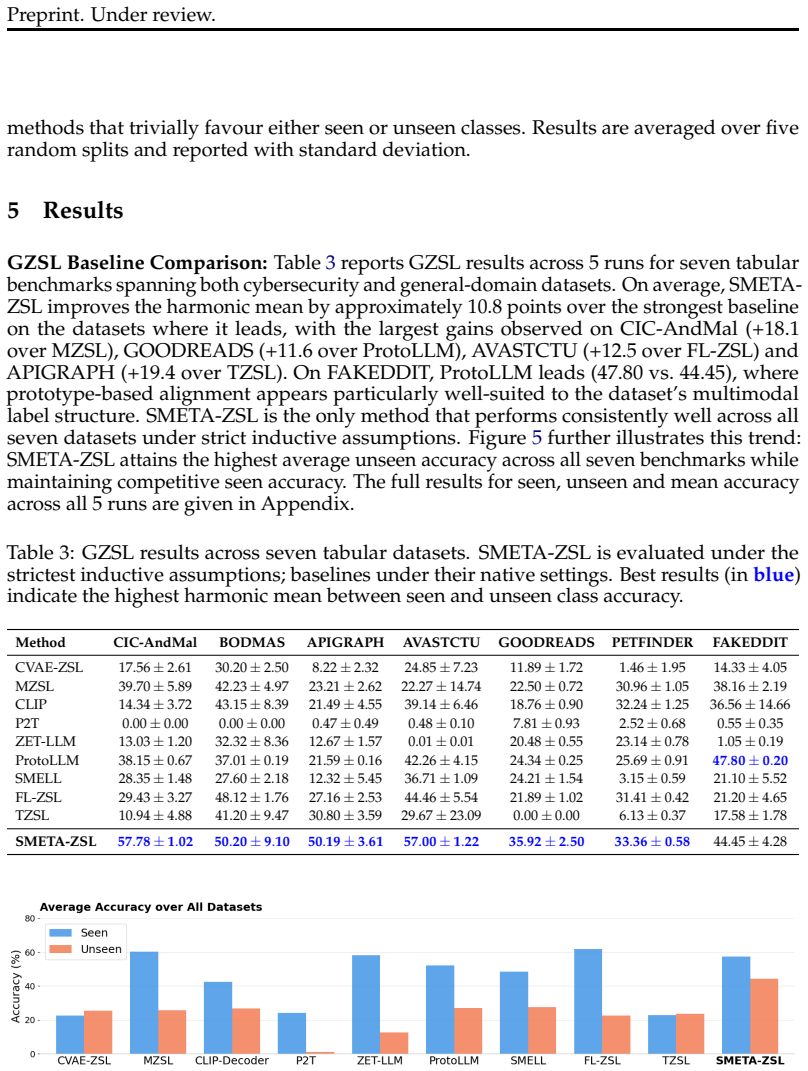
Under open-set, class-inductive, instance-inductive generalized zero-shot learning, a contrastively fine-tuned LLM that produces CTI prototypes, combined with episodic meta-alignment of behavioral features and a Z-score confidence gate, yields the strongest overall harmonic-mean accuracy among compared methods on seven tabular datasets, averaging a 10.8-point gain and peaking at 18.1 points.
What carries the argument
SMETA-ZSL: contrastive + isotropy fine-tuning of an LLM for discriminative semantic prototypes from overlapping CTI, episodic meta-knowledge distillation that simulates unseen classes during training, and a parameter-free Z-score gate that routes each sample to seen or unseen prototypes.
Load-bearing premise
The approach assumes that CTI text—real or LLM-augmented—can be made sufficiently class-discriminative by contrastive fine-tuning so that the later alignment and routing steps still work for truly novel families never seen in training.
What would settle it
Hold out malware families whose real CTI reports share almost no lexical or ATT&CK overlap with the training set, build prototypes only from those real reports, and check whether unseen accuracy and harmonic mean collapse relative to the reported tables.
Editorial analysis
A structured set of objections, weighed in public.
Referee Report
Summary. The paper proposes SMETA-ZSL for generalized zero-shot threat classification under a strict class- and instance-inductive open-set setting. An LLM is contrastively fine-tuned (with isotropy regularization) to produce class prototypes from overlapping CTI text; a behavioral projection network is trained by episodic meta-learning with knowledge distillation to align tabular features to those prototypes; and a Z-score gate on seen-class cosine similarities routes each test instance to seen or unseen prototype matching. Across seven tabular benchmarks (four cybersecurity, three general-domain), the method is reported to achieve the strongest overall harmonic mean under the strictest inductive assumptions, with an average gain of 10.8 points and peaks up to 18.1 over prior methods, supported by ablations, a synthetic-CTI control, hyperparameter sensitivity, and released code.
Significance. If the ranking and component claims hold under a uniform protocol, the work is practically significant: it targets a realistic cyber-defense regime (no labeled or unlabeled unseen samples, unknown unseen cardinality, only CTI text as the bridge) that most GZSL and few-shot tabular methods do not fully address. Strengths include a clear problem formulation (CIII open-set), multi-dataset evaluation with five-run means and standard deviations, systematic ablations (Table 6), a synthetic-CTI control for unseen prototypes (Table 7), hyperparameter sensitivity (Table 9), and a public code/checkpoint release. The combination of contrastive LLM prototyping, episodic meta-alignment, and a simple statistical gate is a coherent and useful pipeline for language-to-behavior transfer in security.
major comments (4)
- [Abstract, §4–§5, Tables 1 and 3] The headline claim of a 10.8-point average gain (abstract, §5, Table 3) is not computed under a uniform protocol. Table 1 and §4 state that baselines are run under their native (often weaker) assumptions—several require unlabelled unseen instances or architectural modification, and only a subset support open-set—while SMETA-ZSL alone is held to pure CIII open-set (no Tu, no unlabelled U, unknown |U|). The average therefore mixes heterogeneous comparisons. Please either (i) re-evaluate every baseline that can run under the same CIII open-set constraints and recompute the average under that common protocol, or (ii) replace the single 10.8 figure with a clearly stratified comparison (strict-CIII-capable methods vs. methods that need extra assumptions) and revise the abstract/§5 wording accordingly.
- [Tables 3, 4, 6, 11, 16] Reported SMETA-ZSL harmonic means are inconsistent across tables for the same datasets. Table 3 gives BODMAS H = 50.20±9.10 and APIGRAPH H = 50.19±3.61; Table 4 appears to swap those two columns (BODMAS 50.19±3.61, APIGRAPH 50.20±9.10); Table 6 and Table 16 report BODMAS full/zero-shot H = 59.10. CIC-AndMal also drifts slightly (57.78 in Table 3 vs. 56.7 in Tables 4–6). These discrepancies are load-bearing for the ranking claim and for the ablation deltas. Please reconcile all tables to a single set of five-run means (with seeds), and state whether Table 6/16 used a different split, seed set, or hyperparameter configuration.
- [§3.4, Eqs. (6)–(7), Figure 4] §3.4 presents the Z-score gate as requiring “no additional learned parameters” and as operating purely on cosine scores, but the routing threshold τ is optimized on the validation set to maximize the harmonic mean of seen and unseen accuracy. That is standard practice, yet it is not parameter-free in the decision sense and can overfit the seen/unseen balance on small validation sets. Please (i) report sensitivity of H to τ (or a fixed rule such as a percentile of validation Zi), (ii) clarify that τ is a tuned hyperparameter, and (iii) if possible show that the gate still helps under a τ chosen without access to unseen labels (e.g., from seen-class validation only).
- [Table 3, Table 11, §5] BODMAS variance is very high (50.20±9.10 in Table 3; per-run H in Table 11 ranges ~42–62). With only four unseen families and large run-to-run swings, the claim of consistent superiority on this benchmark is fragile. Please either increase the number of random unseen splits / seeds, report median and min–max, or qualify BODMAS results as unstable and de-emphasize them in the average-gain narrative.
minor comments (6)
- [Figure 1] Figure 1 is useful but the caption alone does not quantify lexical/embedding overlap; a simple cosine or Jaccard statistic between the two families would strengthen the motivation.
- [§3.2–§3.4] Notation reuses τ for both SupCon temperature (§3.2) and the Z-score routing threshold (§3.4). Rename one of them.
- [§3.3, Eq. (4)] In Eq. (4), the KL arguments use si,c and ˆsi,c; the text says ˆsi,c are the teacher’s logits, but the student projection is ˆzi. Clarify teacher vs. student symbols consistently.
- [§4, Table 2] Table 2 “Semantic Source” for general-domain sets is clear; for malware sets, briefly state how many real CTI reports per family were available before synthetic augmentation.
- [Throughout / title page] Minor typos and formatting: “A V ASTCTU” spacing in tables; “finetuning” vs. “fine-tuning”; arXiv date line “10 Jul 2026” looks like a placeholder.
- [Appendix Table 8, §5–§6] Fully supervised ceilings (Table 8) are informative; a short discussion of the remaining gap to the ceiling on cybersecurity sets would help readers judge practical readiness.
Circularity Check
No significant circularity: empirical GZSL method whose performance numbers are measured on held-out splits under stated protocols, not derived by construction from fitted constants or self-referential definitions.
full rationale
SMETA-ZSL is a standard empirical ML paper. Its core claims (abstract, §5, Table 3) are measured harmonic means of seen/unseen accuracy on held-out test splits across seven benchmarks, obtained after training the contrastive LLM encoder (Eq. 2–3), the meta-distillation projection (Eq. 4–5), and the parameter-free Z-score gate (Eq. 6–7). The sole fitted scalar is the routing threshold τ, chosen on validation to maximize H; this is ordinary hyper-parameter selection and does not force the reported test numbers. No equation reduces a claimed prediction to its own input by definition; no uniqueness theorem or ansatz is imported via self-citation to forbid alternatives; the single author-overlapping citation (Sanchez et al. 2025) appears only as related work on contrastive embeddings and is not load-bearing. Protocol asymmetry between SMETA-ZSL (strict CIII open-set) and baselines (native settings) is an evaluation-design issue, not circularity. The derivation chain is therefore self-contained against external benchmarks.
Axiom & Free-Parameter Ledger
free parameters (6)
- query-loss weight λ
- isotropy coefficient γ
- Z-score routing threshold τ
- distillation temperature T
- contrastive temperature τ (SupCon)
- LoRA / 4-bit LLM fine-tuning settings
axioms (4)
- domain assumption Natural-language CTI reports (real or LLM-augmented from MITRE ATT&CK) contain enough class-discriminative signal to serve as zero-shot prototypes for behavioral malware features.
- domain assumption The Class-Inductive Instance-Inductive (CIII) open-set protocol—no access to Tu or unlabeled unseen instances during training—is the correct and fairest evaluation setting for real cyber deployment.
- ad hoc to paper Episodic random partitioning of seen classes into support/query sufficiently simulates true open-set emergence for meta-generalization.
- ad hoc to paper Per-sample Z-score of max seen-class cosine similarity is a reliable, parameter-free indicator of seen vs unseen membership.
invented entities (1)
-
SMETA-ZSL two-tower + adaptive Z-score gate architecture
no independent evidence
read the original abstract
Cybersecurity systems must adapt rapidly to emerging threats. However, labeled data for new threat categories is unavailable when those threats first appear. Generalized zero-shot learning offers a natural solution by enabling recognition of unseen classes through auxiliary semantic knowledge rather than labeled examples. Large language models are particularly promising in this setting because they can convert unstructured CTI reports into semantic prototypes for emerging threats. However, applying language-driven zero-shot learning to cybersecurity is difficult due to strong semantic overlap between threat descriptions, heterogeneity between behavioral attributes and text, severe class imbalance, and open-set conditions where unseen threats are unknown during training. We propose SMETA-ZSL, that learns semantic prototypes from overlapping language descriptions through contrastive finetuning, aligns behavioral features through episodic meta-learning and knowledge distillation, and performs adaptive routing for generalization across seen-unseen classes. Across 7 benchmarks, SMETA-ZSL delivers the strongest overall generalized zero-shot performance under the strictest inductive setting, surpassing prior methods by 10.8 points on average, with gains up to 18.1 points. Github:https://github.com/Security-And-Intelligence-Lab-UTEP/SMETA-ZSL
Figures


Reference graph
Works this paper leans on
-
[1]
Evaluating llm generated detection rules in cybersecurity.arXiv preprint arXiv:2509.16749,
Anna Bertiger, Bobby Filar, Aryan Luthra, Stefano Meschiari, Aiden Mitchell, Sam Scholten, and Vivek Sharath. Evaluating llm generated detection rules in cybersecurity.arXiv preprint arXiv:2509.16749,
-
[2]
Avast-ctu public cape dataset.arXiv preprint arXiv:2209.03188,
Branislav Boˇsansk`y, Daniel Kouba, Ondˇrej Manhal, Tom´aˇs Sick, Viliam Lisy, Jakub Kroustek, and Petr Somol. Avast-ctu public cape dataset.arXiv preprint arXiv:2209.03188,
-
[3]
CCCS-CIC-AndMal-2020 Dataset
Canadian Institute for Cybersecurity (CIC) and Canadian Centre for Cyber Security (CCCS). CCCS-CIC-AndMal-2020 Dataset. https://www.unb.ca/cic/datasets/andmal2020.html,
2020
-
[4]
10 Preprint. Under review. Arjun Chakraborty, Sandra Ho, Adam Cook, and Manuel Mel´endez. Cti-realm: Benchmark to evaluate agent performance on security detection rule generation capabilities.arXiv preprint arXiv:2603.13517,
-
[5]
Zhuo Chen, Yufeng Huang, Jiaoyan Chen, Yuxia Geng, Wen Zhang, Yin Fang, Jeff Z Pan, and Huajun Chen
doi: 10.1145/2939672.2939785. Zhuo Chen, Yufeng Huang, Jiaoyan Chen, Yuxia Geng, Wen Zhang, Yin Fang, Jeff Z Pan, and Huajun Chen. Duet: Cross-modal semantic grounding for contrastive zero-shot learning. InProceedings of the AAAI conference on artificial intelligence, volume 37, pp. 405–413,
-
[6]
Clip-driven zero-shot learning with ambiguous labels.arXiv preprint arXiv:2603.05053,
Jinfu Fan, Jiangnan Li, Xiaowen Yan, Xiaohui Zhong, Wenpeng Lu, and Linqing Huang. Clip-driven zero-shot learning with ambiguous labels.arXiv preprint arXiv:2603.05053,
-
[7]
Zero-shot learning on semantic class prototype graph.IEEE transactions on pattern analysis and machine intelligence, 40(8):2009–2022,
Zhenyong Fu, Tao Xiang, Elyor Kodirov, and Shaogang Gong. Zero-shot learning on semantic class prototype graph.IEEE transactions on pattern analysis and machine intelligence, 40(8):2009–2022,
2009
-
[8]
Naveen Gill et al. Llm-fs: Zero-shot feature selection for effective and interpretable malware detection.arXiv preprint arXiv:2602.09634,
-
[9]
Chris Johnson, Lee Badger, David Waltermire, Julie Snyder, Clem Skorupka, et al
URL https: //arxiv.org/abs/2207.01848. Chris Johnson, Lee Badger, David Waltermire, Julie Snyder, Clem Skorupka, et al. Guide to cyber threat information sharing.NIST special publication, 800(150):35,
-
[10]
Adrian Shuai Li, Arun Iyengar, Ashish Kundu, and Elisa Bertino. Revisiting concept drift in windows malware detection: Adaptation to real drifted malware with minimal samples. arXiv preprint arXiv:2407.13918, 2024a. Yapeng Li, Yong Luo, Zengmao Wang, and Bo Du. Improving generalized zero-shot learning by exploring the diverse semantics from external class...
-
[11]
Shaswata Mitra, Azim Bazarov, Martin Duclos, Sudip Mittal, Aritran Piplai, Md Rayhanur Rahman, Edward Zieglar, and Shahram Rahimi. Falcon: Autonomous cyber threat intelligence mining with llms for ids rule generation.arXiv preprint arXiv:2508.18684,
-
[12]
Haojie Pan, Chengyu Wang, Minghui Qiu, Yichang Zhang, Yaliang Li, and Jun Huang
Accessed: 2026-03-31. Haojie Pan, Chengyu Wang, Minghui Qiu, Yichang Zhang, Yaliang Li, and Jun Huang. Meta-kd: A meta knowledge distillation framework for language model compression across domains. InProceedings of the 59th Annual Meeting of the Association for Computational Linguistics and the 11th International Joint Conference on Natural Language Proc...
2026
-
[13]
doi: 10.48550/arXiv.2102.04351. Zhijie Rao, Jingcai Guo, Xiaocheng Lu, Jingming Liang, Jie Zhang, Haozhao Wang, Kang Wei, and Xiaofeng Cao. Dual expert distillation network for generalized zero-shot learning. arXiv preprint arXiv:2404.16348,
-
[14]
Under review
12 Preprint. Under review. Yuval Schwartz, Lavi Ben-Shimol, Dudu Mimran, Yuval Elovici, and Asaf Shabtai. Llmcloud- hunter: Harnessing llms for automated extraction of detection rules from cloud-based cti. InProceedings of the ACM on Web Conference 2025, pp. 1922–1941,
2025
-
[15]
Vinay Kumar Verma, Dhanajit Brahma, and Piyush Rai
Accessed: 2026-03-31. Vinay Kumar Verma, Dhanajit Brahma, and Piyush Rai. Meta-learning for generalized zero-shot learning. InProceedings of the AAAI conference on artificial intelligence, volume 34, pp. 6062–6069,
2026
-
[16]
Fine-grained spoiler detection from large-scale review corpora.arXiv preprint arXiv:1905.13416,
Mengting Wan, Rishabh Misra, Ndapa Nakashole, and Julian McAuley. Fine-grained spoiler detection from large-scale review corpora.arXiv preprint arXiv:1905.13416,
Pith/arXiv arXiv 1905
-
[17]
Peng Wang, Dongsheng Wang, He Zhao, Hangting Ye, Dandan Guo, and Yi Chang. Llm empowered prototype learning for zero and few-shot tasks on tabular data.arXiv preprint arXiv:2508.09263, 2025a. Ping Wang, Hao-Cyuan Li, Hsiao-Chung Lin, Wen-Hui Lin, and Nian-Zu Xie. A transduc- tive zero-shot learning framework for ransomware detection using malware knowledg...
-
[18]
Yulun Wu and Doron L. Bergman. Zero-shot meta-learning for tabular prediction tasks with adversarially pre-trained transformer. InProceedings of the 42nd International Conference on Machine Learning. PMLR, 2025a. URLhttps://arxiv.org/abs/2502.04573. ICML. Yulun Wu and Doron L Bergman. Zero-shot meta-learning for tabular prediction tasks with adversarially...
-
[19]
Under review
13 Preprint. Under review. Xueqiang Zhang, Yating Zhang, Ming Zhong, Dandan Ding, Yinzhi Cao, Yin Zhang, Min Zhang, and Min Yang. Enhancing state-of-the-art classifiers with api semantics to detect evolved android malware. InProceedings of the 2020 ACM SIGSAC Conference on Computer and Communications Security, pp. 757–770,
2020
-
[20]
Each method is trained and evaluated on all classes with full label access, representing the upper bound that zero-shot methods aspire to approach
A Appendix Table 8: Fully supervised ceiling performance across seven tabular benchmarks. Each method is trained and evaluated on all classes with full label access, representing the upper bound that zero-shot methods aspire to approach. Results are mean ± standard deviation over five runs. Method CIC-AndMal-2020 BODMAS APIGRAPH A V ASTCTU GOODREADS PETFI...
2020
-
[21]
Under review
54.4 62.4 33.4 14 Preprint. Under review. Table 10: GZSL results on CIC-AndMal-2020. Seen = Seen Acc (%), Unseen = Unseen Acc (%), Mean = H-Mean (%). Best Mean inbold. Class CV AE-ZSL MZSL CLIP-Decoder P2T ZET-LLM ProtoLLM SMELL FL-ZSL TZSL SMETA-ZSL Run 1 (Seed
2020
-
[22]
Seen 25.25 91.94 63.25 3.50 86.50 71.29 32.01 63.56 42.13 74.31Unseen 32.17 34.83 34.83 0.00 24.83 25.00 25.17 37.67 32.50 29.67Mean 28.2950.5244.93 0.00 38.59 37.02 28.18 47.30 36.69 42.40 Average±Std Seen 27.74±3.08 92.06±0.80 61.64±2.84 3.46±0.0885.75±0.63 71.79±1.11 36.40±9.2164.28±0.57 45.91±7.08 78.04±4.43Unseen 33.27±2.19 27.57±4.34 34.20±10.21 0.0...
-
[23]
K= 0 is the zero-shot setting; S = Seen Acc (%),U= Unseen Acc (%),H= Harmonic Mean (%)
Seen 0.00 25.23 32.85 34.18 25.78 23.98 52.98 43.58 4.30 29.27Unseen 50.27 38.02 30.53 1.01 21.75 25.59 1.69 24.14 10.03 38.24Mean 0.00 30.33 31.65 1.95 23.60 24.76 3.28 31.07 6.0233.16 Average±Std Seen 0.76 ±1.01 30.81±4.49 32.82±1.55 32.63±3.4026.34±0.77 25.80±1.82 52.29±1.0844.17±0.35 3.87±0.35 28.94±1.26Unseen 49.51±0.67 32.10±3.57 31.81±2.53 1.32±0.3...
arXiv 2020
discussion (0)
Sign in with ORCID, Apple, or X to comment. Anyone can read and Pith papers without signing in.