REVIEW 2 major objections 6 minor 1 cited by
Open-AoE argues that 2,000 hours of everyday smartphone video can be turned into structured robot-training data via an open pipeline that adds hand poses, camera trajectories, and action labels.
Reviewed by Pith at T0; open to challenge. T0 means a machine referee read the full paper against a public rubric. the ladder, T0–T4 →
T0 review · deepseek-v4-flash
2026-08-02 03:20 UTC pith:XB3AJXZE
load-bearing objection A genuinely useful open dataset and toolchain for egocentric manipulation, with one central soft spot: the geometric annotations are never quantitatively validated. the 2 major comments →
Open-AoE: An Open Egocentric Manipulation Dataset and Toolchain for Embodied Learning
The pith
A machine-rendered reading of the paper's core claim, the machinery that carries it, and where it could break.
Core claim
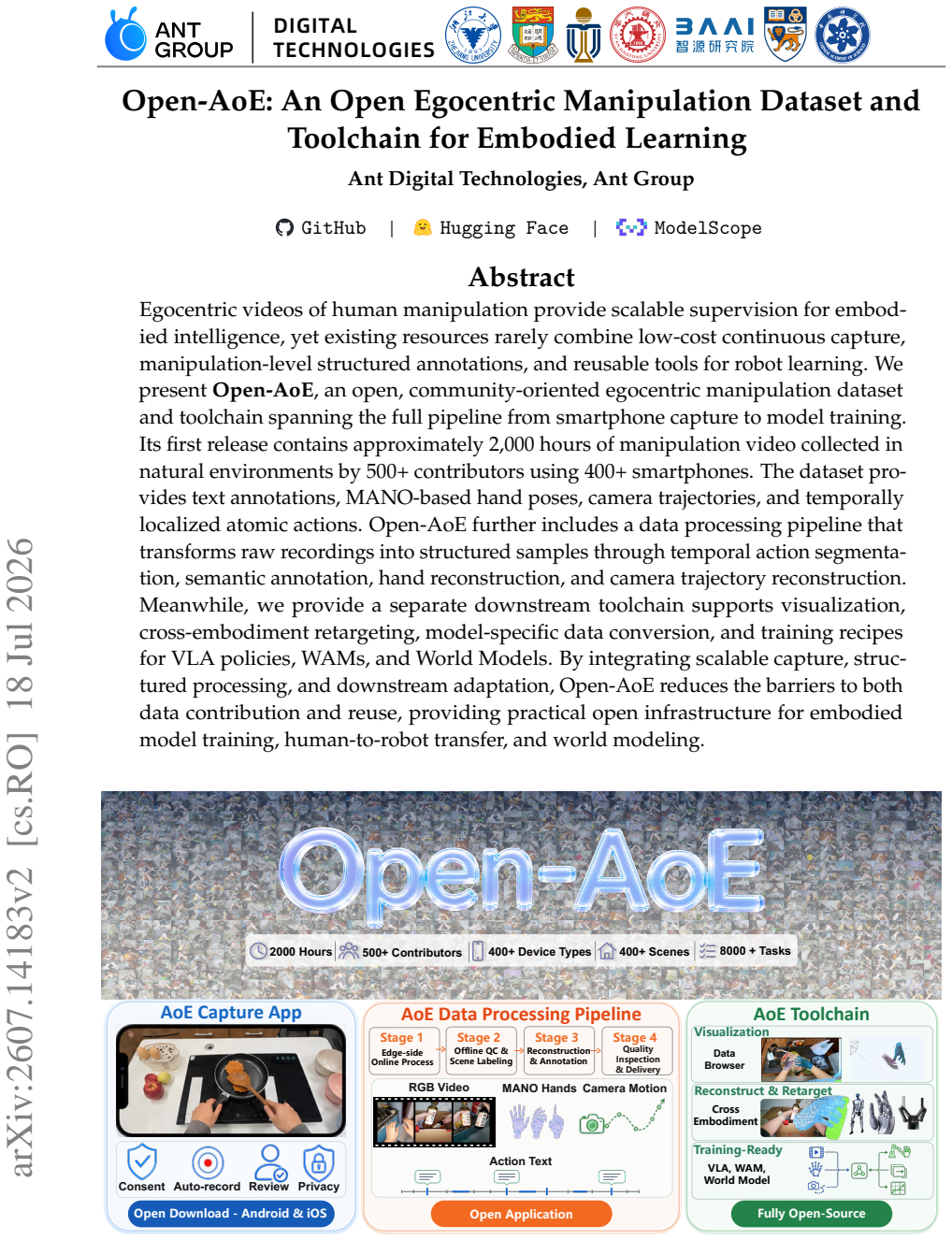
The central claim is that the full data-production loop for embodied learning—capture, curation, reconstruction, annotation, and model adaptation—can be run on commodity-smartphone data at scale. The paper reports that its first release contains about 2,000 hours of real egocentric manipulation video from 500+ contributors and 400+ device models, covering 8,000+ tasks and 400+ scenes; every accepted segment is aligned on one timeline with undistorted RGB, camera intrinsics and metric 6-DoF trajectories, bilateral MANO hand meshes and 21-joint keypoints, validity masks, and English atomic-action annotations. It further claims that this production is made possible by a processing pipeline that
What carries the argument
The load-bearing object is the 'AoE sample': one timeline on which undistorted RGB, camera intrinsics and camera trajectories, bilateral MANO hand meshes with 21-joint keypoints, validity masks, and atomic action segments are aligned. The alignment is produced by a joint reconstruction stage that combines a monocular hand-motion reconstructor with a robust SLAM backend, plus sliding-window optimization and global bundle adjustment to place hands and camera in one metric world frame. The training-ready side is a representation spectrum spanning dense MANO states (110-dimensional per-frame), wrist-fingertip targets, robot-facing joint interfaces, and compact ego-action vectors, so the same evi
Load-bearing premise
The released MANO hand reconstructions and camera trajectories are accurate enough for downstream robot learning, but no ground-truth accuracy benchmark is reported—the quality gates are qualitative thresholds, so systematic bias under motion blur or severe ego-motion would undermine the geometric supervision.
What would settle it
Run the released reconstruction pipeline on a sample of clips recorded with a motion-capture glove or optical hand tracker and a ground-truth camera pose system, then compute wrist and joint mean error in millimeters and trajectory drift. If hand-mesh errors are large relative to typical robot gripper tolerances (say 1–2 cm at the wrist) or camera drift exceeds a small fraction of path length, the toolchain's geometric supervision would be too coarse for the downstream uses claimed.
If this is right
- If the quality gates perform, everyday smartphone users become viable data contributors, removing the need for teleoperation rigs or specialized head-mounted capture hardware.
- A single corpus can be converted into training signals for VLA policies, world action models, and world models, so downstream teams can skip building their own post-processing stack.
- Because hand and camera trajectories are reconstructed jointly, the toolchain can separate hand motion from camera ego-motion, which is a prerequisite for controllable world modeling.
- The reported 97.8% history-future window yield implies most footage converts into fixed-context training samples, so annotation boundaries do not waste data.
- Cross-embodiment retargeting from the same MANO trajectories and validity masks preserves reach-contact-release structure across multiple robot embodiments.
Where Pith is reading between the lines
- The paper explicitly flags that the downstream benefit of its camera-domain diversity is a hypothesis pending controlled ablations; a concrete test is to hold out one phone model's clips and measure how much policy or world-model performance degrades when evaluating on that model.
- All reported distribution statistics come from a single random 100-hour subset; extrapolating them to the full 2,000-hour release remains an assumption that a full-corpus audit could confirm or revise.
- The quality gates use thresholds on valid-frame ratio, IK failure rate, and trajectory smoothness rather than measured geometric error; quantifying them against motion-capture ground truth would extend the paper's claims from qualitative to quantitative.
- If the toolchain is as modular as described, it should accept other calibrated egocentric sources beyond Open-AoE's own smartphone captures, which would test the generality of the infrastructure.
Editorial analysis
A structured set of objections, weighed in public.
Referee Report
Summary. Open-AoE is a dataset and toolchain paper. It releases approximately 2,000 hours of egocentric manipulation video collected by 500+ contributors using 400+ smartphone models, together with text annotations, MANO hand poses, camera trajectories, and temporally localized atomic actions. The paper also describes a four-stage processing pipeline (on-device capture gating, offline QC and scene labeling, reconstruction and annotation, and quality inspection) and a downstream toolchain for visualization, 4D hand-object reconstruction, cross-embodiment retargeting, and training adapters for VLA policies, WAMs, and world models. To support the resource, the authors compare Open-AoE with OpenEgo, EgoDex, and EgoXtreme on CLIP-based visual diversity, semantic/temporal annotation coverage, image-annotation consistency, and training-window retention. The analysis is carefully scoped in places: distributional statistics are computed on the same random 100-hour subsample, and §3.6 explicitly labels downstream benefit as a training hypothesis. The central gap is that the geometric supervision (MANO hand poses and camera trajectories) is never quantitatively validated against ground truth.
Significance. If the released artifacts are as described, Open-AoE would be a substantial community resource. It is one of the largest egocentric manipulation corpora with jointly available language, hand, camera, and action supervision, and its smartphone-based device diversity is unusual. The open toolchain is a genuine contribution because it lowers the barrier from raw video to model training and makes the dataset directly consumable by several embodied-learning paradigms. The paper also does several things well: it scopes diversity claims to a 100-hour random sample, uses balanced repeated sampling for the CLIP metrics, and provides quantitative comparisons against existing datasets with a shared evaluator. The main unsecured pillar is geometric supervision: no per-frame joint error, reprojection error, or trajectory accuracy is reported, and the three quality gates in §3.5 do not establish metric correctness. Since the abstract and Table 1 promise MANO hand poses and camera trajectories as dataset supervision, this validation gap must be addressed before those modalities can be relied upon for robot learning.
major comments (2)
- [§3.4–3.5] The central geometric supervision—MANO hand poses and camera trajectories—is never validated against ground truth. §3.4 describes HaWoR and DROID-W with re-tuned kernels, sliding-window refinement, and global bundle adjustment, but no quantitative error metrics are reported. §3.5's three quality gates (valid-frame ratio, IK failure rate, smooth/continuous trajectory) are necessary but not sufficient: a smoothly drifting or globally mis-scaled SLAM trajectory can pass the consistency gate, and a high valid-frame ratio does not bound per-joint MANO error. Because the abstract and Table 1 explicitly promise these modalities as dataset supervision for embodied learning, this is a load-bearing gap. Please add a held-out validation (e.g., HOT3D, synthetic smartphone-video renderings, or a manually annotated subset) reporting per-frame hand joint error, reprojection error, and trajectory ATE/RP
- [§3.4 and §5.3] Temporal action localization is another core deliverable, but boundary accuracy is never measured. Atomic-action slicing is described as model-generated with human-in-the-loop correction (§3.4), and §5.3 audits image-text consistency with Idefics2; however, consistency is not boundary correctness. With a mean segment duration of 9.64 s and 13.97 segments/min, small boundary shifts can materially change the training labels used by the window-retention analysis in §5.4. Please report boundary precision/recall and duration error against a random human-annotated subset, or explicitly state that boundary accuracy is not yet benchmarked.
minor comments (6)
- [§1] Grammar: 'we provide a separate downstream toolchain supports visualization' should read 'we provide a separate downstream toolchain that supports visualization'.
- [§2.1] The sentence 'Open-AoE [9] complements these efforts...' cites the AoE capture-framework paper rather than a description of the present dataset. Please rephrase as 'building on AoE [9]' or cite the current release appropriately.
- [§3.6] The sentence 'These values supersede the interval and vocabulary counts from an earlier preprocessing snapshot' is unclear and should be removed or made precise; it reads as an internal note rather than a scientific statement.
- [§5.1 / Figure 6] The CLIP diversity results are reported as means over 3,000 balanced trials, but no error bars or confidence intervals are shown in Figure 6. Given the authors' claim of ranking first in all six metrics, reporting variability or rank frequencies would strengthen the analysis.
- [§5.1] The analysis depends on several hyperparameters (K=50 codebook cells, τ=5 coverage threshold, k=20 neighbors). Please justify these choices or include a sensitivity analysis, since some conclusions may be sensitive to them.
- [Abstract / Table 1] The abstract and Table 1 report 2,000 hours and 400+ device types, while the distributional evidence in §3.6 is computed on a 100-hour sample. The paper should clarify whether the full-release metadata confirms these counts or whether they are inferred from the sample.
Circularity Check
No significant circularity; the dataset/release claims are descriptive and externally checkable, with only non-load-bearing self-citation.
full rationale
Open-AoE's central claims are a released corpus, a processing pipeline, and a training toolchain rather than a derived prediction, so there is no fitted-parameter/predicted-quantity chain that could reduce to its inputs by construction. The only self-citations, e.g. "Open-AoE builds on the AoE consumer-smartphone collection framework [9]" (Sec. 1) and the edge-side capture mechanics of Sec. 3.2, document provenance of the capture app and are not used to derive the dataset's properties. The evaluation sections are descriptive audits using external models (CLIP, Idefics2) and explicitly defined formulas (Eqs. 1-6) that compute diversity, coverage, and window yield from the released data; none of these quantities is fitted and then re-reported as a prediction. The paper even states a downstream benefit remains a training hypothesis (Sec. 3.6), and the Sec. 3.5 quality gates are selection criteria, not evidence that the geometric reconstructions are accurate. The absence of quantitative MANO/SLAM error benchmarks is a validation gap, which is a correctness risk rather than a circularity. No load-bearing argument reduces to a self-citation chain.
Axiom & Free-Parameter Ledger
free parameters (5)
- Three-gate QC thresholds
- CLIP codebook size K =
50
- kNN neighborhood size k =
20
- Meaningful-coverage threshold τ =
5
- History/future/stride windows =
h=f=Δ=2s
axioms (6)
- domain assumption MANO hand model sufficiently represents real hand articulation
- domain assumption Smartphone egocentric video is sufficient for accurate HaWoR and DROID-W reconstruction
- domain assumption The 100-hour random sample represents the full 2,000-hour release
- domain assumption CLIP embeddings capture visual diversity relevant to manipulation
- domain assumption Idefics2 scores are a valid proxy for annotation-vision consistency
- domain assumption Anonymization and local review are sufficient to prevent re-identification
read the original abstract
Egocentric videos of human manipulation provide scalable supervision for embodied intelligence, yet existing resources rarely combine low-cost continuous capture, manipulation-level structured annotations, and reusable tools for robot learning. We present Open-AoE, an open, community-oriented egocentric manipulation dataset and toolchain spanning the full pipeline from smartphone capture to model training. Its first release contains approximately 2,000 hours of manipulation video collected in natural environments by 500+ contributors using 400+ smartphones. The dataset provides text annotations, MANO-based hand poses, camera trajectories, and temporally localized atomic actions. Open-AoE further includes a data processing pipeline that transforms raw recordings into structured samples through temporal action segmentation, semantic annotation, hand reconstruction, and camera trajectory reconstruction. Meanwhile, we provide a separate downstream toolchain supports visualization, cross-embodiment retargeting, model-specific data conversion, and training recipes for VLA policies, WAMs, and World Models. By integrating scalable capture, structured processing, and downstream adaptation, Open-AoE reduces the barriers to both data contribution and reuse, providing practical open infrastructure for embodied model training, human-to-robot transfer, and world modeling.
Figures


Forward citations
Cited by 1 Pith paper
-
Data Pyramid for Embodied Manipulation
Embodied training data form a five-layer pyramid—real-robot, UMI, ego/exo, simulation, general V–L—ordered by the trade-off between scale and robot alignment, and model capabilities track how those layers are mixed.
Reference graph
Works this paper leans on
-
[1]
Ego4D: Around the world in 3,000 hours of egocentric video
Kristen Grauman et al. Ego4D: Around the world in 3,000 hours of egocentric video. In Proceedings of the IEEE/CVF Conference on Computer Vision and Pattern Recognition,
-
[2]
Rescaling egocentric vision: Collection, pipeline and challenges for EPIC-KITCHENS-
Dima Damen, Hazel Doughty, Giovanni Maria Farinella, Antonino Furnari, Evangelos Kazakos, Jian Ma, Davide Moltisanti, Jonathan Munro, Toby Perrett, Will Price, and Michael Wray. Rescaling egocentric vision: Collection, pipeline and challenges for EPIC-KITCHENS-
-
[3]
Yoon, Mouli Sivapurapu, and Jian Zhang
Ryan Hoque, Peide Huang, David J. Yoon, Mouli Sivapurapu, and Jian Zhang. EgoDex: Learning dexterous manipulation from large-scale egocentric video. arXiv preprint arXiv:2505.11709, 2025. URLhttps://arxiv.org/abs/2505.11709
Pith/arXiv arXiv 2025
-
[4]
EgoLive: A large-scale egocentric dataset from real-world human tasks
Yihang Li, Xuelong Wei, Jingzhou Luo, Yingjing Xiao, Yibo Bai, Guangyuan Zhou, Teng Zou, Chenguang Gui, Jiajun Wen, He Zhang, Kangliang Chen, Xing Pan, Shuaiyan Liu, Daming Wang, Tao An, Jiayi Li, Shibo Jin, Wanwan Zhang, Tianyu Wang, Boren Wei, Zhixuan Huang, Fangsheng Liu, Ruodai Li, Hui Zhang, Anson Li, Yicheng Gong, Peng Cao, Jiaming Liang, and Liang ...
Pith/arXiv arXiv 2026
-
[5]
OpenEgo: A large-scale multimodal egocentric dataset for dexterous manipulation
Ahad Jawaid and Yu Xiang. OpenEgo: A large-scale multimodal egocentric dataset for dexterous manipulation. arXiv preprint arXiv:2509.05513, 2025. URL https://arxiv.or g/abs/2509.05513
Pith/arXiv arXiv 2025
-
[6]
EgoScale: Scaling dexterous manipulation with diverse egocentric human data
Ruijie Zheng, Dantong Niu, Yuqi Xie, Jing Wang, Mengda Xu, Yunfan Jiang, Fernando Castañeda, Fengyuan Hu, You Liang Tan, Letian Fu, Trevor Darrell, Furong Huang, Yuke Zhu, Danfei Xu, and Linxi Fan. EgoScale: Scaling dexterous manipulation with diverse egocentric human data. arXiv preprint arXiv:2602.16710, 2026. URL https://arxiv.or g/abs/2602.16710
arXiv 2026
-
[8]
DROID: A large-scale in-the-wild robot manipulation dataset
Alexander Khazatsky et al. DROID: A large-scale in-the-wild robot manipulation dataset. arXiv preprint arXiv:2403.12945, 2024. URLhttps://arxiv.org/abs/2403.12945
Pith/arXiv arXiv 2024
-
[9]
AoE: Always-on egocentric human video collection for embodied AI
Bowen Yang, Zishuo Li, Yang Sun, Changtao Miao, Yifan Yang, Man Luo, Xiaotong Yan, Feng Jiang, Jinchuan Shi, Yankai Fu, Ning Chen, Junkai Zhao, Pengwei Wang, Guocai Yao, Shanghang Zhang, Hao Chen, Zhe Li, and Kai Zhu. AoE: Always-on egocentric human video collection for embodied AI. In Proceedings of the IEEE/CVF Conference on Computer Vision and Pattern ...
2026
-
[10]
HOI4D: A 4d egocentric dataset for category-level human- object interaction
Yunze Liu, Yun Liu, Che Jiang, Kangbo Lyu, Weikang Wan, Hao Shen, Boqiang Liang, Zhoujie Fu, He Wang, and Li Yi. HOI4D: A 4d egocentric dataset for category-level human- object interaction. In Proceedings of the IEEE/CVF Conference on Computer Vision and Pattern Recognition, pages 21013–21022, 2022. URL https://arxiv.org/abs/2203.0 1577. 20
2022
-
[11]
HOT3D: Hand and object tracking in 3d from egocentric multi-view videos
Prithviraj Banerjee, Sindi Shkodrani, Pierre Moulon, Shreyas Hampali, Shangchen Han, Fan Zhang, Linguang Zhang, Jade Fountain, Edward Miller, Selen Basol, Richard Newcombe, Robert Wang, Jakob Julian Engel, and Tomas Hodan. HOT3D: Hand and object tracking in 3d from egocentric multi-view videos. In Proceedings of the IEEE/CVF Conference on Computer Vision ...
Pith/arXiv arXiv 2025
-
[12]
EgoMimic: Scaling imitation learning via egocentric video
Simar Kareer, Dhruv Patel, Ryan Punamiya, Pranay Mathur, Shuo Cheng, Chen Wang, Judy Hoffman, and Danfei Xu. EgoMimic: Scaling imitation learning via egocentric video. arXiv preprint arXiv:2410.24221, 2024. URLhttps://arxiv.org/abs/2410.24221
Pith/arXiv arXiv 2024
-
[13]
Ha- WoR: World-space hand motion reconstruction from egocentric videos
Jinglei Zhang, Jiankang Deng, Chao Ma, and Rolandos Alexandros Potamias. Ha- WoR: World-space hand motion reconstruction from egocentric videos. arXiv preprint arXiv:2501.02973, 2025. URLhttps://arxiv.org/abs/2501.02973
Pith/arXiv arXiv 2025
-
[14]
Qian, Podshara Chanrungmaneekul, and Kaiyu Hang
Gaotian Wang, Kejia Ren, Andrew Morgan, Yiting Chen, Howard H. Qian, Podshara Chanrungmaneekul, and Kaiyu Hang. EgoInfinity: A web-scale 4d hand-object interaction data engine for any-view robot retargeting and video-to-action robot learning. arXiv preprint arXiv:2606.17385, 2026. URLhttps://arxiv.org/abs/2606.17385
Pith/arXiv arXiv 2026
-
[15]
EgoAERO: Learning dexterous manipulation from a single egocentric video without object assets
Yichen Niu, Haoran Lv, Xinrui Zhang, Xueyao Wan, Shiyu Gao, Ying Ai, Hui Xu, Yongqi Hu, Hengyi Zhang, Yang Xie, Zhaxizhuoma, Yue Zhao, Zhenshan Bing, Yan Ding, and Jianxing Liu. EgoAERO: Learning dexterous manipulation from a single egocentric video without object assets. arXiv preprint arXiv:2606.08057, 2026. URL https://arxiv.org/ abs/2606.08057
Pith/arXiv arXiv 2026
-
[17]
Phantom: Training robots without robots using only human videos
Marion Lepert, Jiaying Fang, and Jeannette Bohg. Phantom: Training robots without robots using only human videos. arXiv preprint arXiv:2503.00779, 2025. URL https: //arxiv.org/abs/2503.00779
Pith/arXiv arXiv 2025
-
[18]
Being-H0.5: Scaling human-centric robot learning for cross-embodiment generalization
Hao Luo, Ye Wang, Wanpeng Zhang, Sipeng Zheng, Ziheng Xi, Chaoyi Xu, Haiweng Xu, Haoqi Yuan, Chi Zhang, Yiqing Wang, Yicheng Feng, and Zongqing Lu. Being-H0.5: Scaling human-centric robot learning for cross-embodiment generalization. arXiv preprint arXiv:2601.12993, 2026. URLhttps://arxiv.org/abs/2601.12993
arXiv 2026
-
[19]
EgoMI: Learn- ing active vision and whole-body manipulation from egocentric human demonstrations
Justin Yu, Yide Shentu, Di Wu, Pieter Abbeel, Ken Goldberg, and Philipp Wu. EgoMI: Learn- ing active vision and whole-body manipulation from egocentric human demonstrations. arXiv preprint arXiv:2511.00153, 2025. URLhttps://arxiv.org/abs/2511.00153
arXiv 2025
-
[20]
ZeroWBC: Learning natural whole-body humanoid interaction from human egocentric data
Haoran Yang, Jiacheng Bao, Yucheng Xin, Haoming Song, Yuyang Tian, Bin Zhao, Dong Wang, and Xuelong Li. ZeroWBC: Learning natural whole-body humanoid interaction from human egocentric data. arXiv preprint arXiv:2603.09170, 2026. URL https://arxi v.org/abs/2603.09170
Pith/arXiv arXiv 2026
-
[21]
EgoHumanoid: Unlocking in-the-wild loco-manipulation with robot-free egocentric demonstration
Modi Shi, Shijia Peng, Jin Chen, Haoran Jiang, Tianyu Li, Di Huang, Ping Luo, Hongyang Li, and Li Chen. EgoHumanoid: Unlocking in-the-wild loco-manipulation with robot-free egocentric demonstration. arXiv preprint arXiv:2602.10106, 2026. URL https://arxiv. org/abs/2602.10106. 21
Pith/arXiv arXiv 2026
-
[22]
Being-H0: Vision-language-action pretraining from large-scale human videos
Hao Luo, Yicheng Feng, Wanpeng Zhang, Sipeng Zheng, Ye Wang, Haoqi Yuan, Jiazheng Liu, Chaoyi Xu, Qin Jin, and Zongqing Lu. Being-H0: Vision-language-action pretraining from large-scale human videos. arXiv preprint arXiv:2507.15597, 2025. URL https: //arxiv.org/abs/2507.15597
Pith/arXiv arXiv 2025
-
[23]
EgoVLA: Learning vision-language-action models from egocentric human videos
Ruihan Yang, Qinxi Yu, Yecheng Wu, Rui Yan, Borui Li, An-Chieh Cheng, Xueyan Zou, Yunhao Fang, Xuxin Cheng, Ri-Zhao Qiu, Hongxu Yin, Sifei Liu, Song Han, Yao Lu, and Xiaolong Wang. EgoVLA: Learning vision-language-action models from egocentric human videos. arXiv preprint arXiv:2507.12440, 2025. URL https://arxiv.org/abs/2507.1 2440
Pith/arXiv arXiv 2025
-
[25]
Latent action learning requires supervision in the presence of distractors
Alexander Nikulin, Ilya Zisman, Denis Tarasov, Nikita Lyubaykin, Andrei Polubarov, Igor Kiselev, and Vladislav Kurenkov. Latent action learning requires supervision in the presence of distractors. arXiv preprint arXiv:2502.00379, 2025. URL https://arxiv.or g/abs/2502.00379
Pith/arXiv arXiv 2025
-
[26]
LaWAM: Latent world action models for efficient dynamics-aware robot policies
Jialei Chen, Kai Wang, Kang Chen, Shuaihang Chen, Feng Gao, Wenhao Tang, Zhiyuan Li, Weilin Liu, Zhuyu Yao, Boxun Li, Yuanbo Xu, and Chao Yu. LaWAM: Latent world action models for efficient dynamics-aware robot policies. arXiv preprint arXiv:2606.15768, 2026. URLhttps://arxiv.org/abs/2606.15768
arXiv 2026
-
[27]
World action models are zero- shot policies
Seonghyeon Ye, Yunhao Ge, Kaiyuan Zheng, Shenyuan Gao, Sihyun Yu, George Kurian, Suneel Indupuru, You Liang Tan, Chuning Zhu, Jiannan Xiang, Ayaan Malik, Kyungmin Lee, William Liang, Nadun Ranawaka, Jiasheng Gu, Yinzhen Xu, Guanzhi Wang, Fengyuan Hu, Avnish Narayan, Johan Björck, Jing Wang, Gwanghyun Kim, Dantong Niu, Ruijie Zheng, Yuqi Xie, Jimmy Wu, Qi ...
Pith/arXiv arXiv 2026
-
[29]
iVideoGPT: Interactive videogpts are scalable world models
Jialong Wu, Shaofeng Yin, Ningya Feng, Xu He, Dong Li, Jianye Hao, and Mingsheng Long. iVideoGPT: Interactive videogpts are scalable world models. arXiv preprint arXiv:2405.15223, 2024. URLhttps://arxiv.org/abs/2405.15223
Pith/arXiv arXiv 2024
-
[31]
DROID-SLAM in the wild
Moyang Li, Zihan Zhu, Marc Pollefeys, and Daniel Barath. DROID-SLAM in the wild. In Proceedings of the IEEE/CVF Conference on Computer Vision and Pattern Recognition,
-
[32]
Javier Romero, Dimitrios Tzionas, and Michael J. Black. Embodied hands: Modeling and capturing hands and bodies together. ACM Transactions on Graphics, 36(6), 2017. doi: 10.1145/3130800.3130883
arXiv 2017
-
[33]
Do as i do: Dexterous manipulation data from everyday human videos
Bhawna Paliwal, Haritheja Etukuru, William Liang, Pieter Abbeel, Nur Muhammad Mahi Shafiullah, and Jitendra Malik. Do as i do: Dexterous manipulation data from everyday human videos. arXiv preprint arXiv:2606.19333, 2026. URL https://arxiv.org/abs/ 2606.19333
Pith/arXiv arXiv 2026
-
[34]
URLhttps://arxiv.org/abs/2602.06949
-
[35]
SPIDER: Scalable physics- informed dexterous retargeting
Chaoyi Pan, Changhao Wang, Haozhi Qi, Zixi Liu, Homanga Bharadhwaj, Akash Sharma, Tingfan Wu, Guanya Shi, Jitendra Malik, and Francois Hogan. SPIDER: Scalable physics- informed dexterous retargeting. arXiv preprint arXiv:2511.09484, 2025. URL https: //arxiv.org/abs/2511.09484
arXiv 2025
-
[36]
LeRobot: An open-source library for end-to-end robot learning
Remi Cadene, Simon Aliberts, Francesco Capuano, Michel Aractingi, Adil Zouitine, Pepijn Kooijmans, Jade Choghari, Martino Russi, Caroline Pascal, Steven Palma, Mustafa Shukor, Jess Moss, Alexander Soare, Dana Aubakirova, Quentin Lhoest, Quentin Gallouedec, and Thomas Wolf. LeRobot: An open-source library for end-to-end robot learning. arXiv preprint arXiv...
arXiv 2026
-
[37]
URLhttps://arxiv.org/abs/2510.10125. 22
-
[38]
Develop humanoid robot policies end-to-end with NVIDIA Isaac GR00T
Edith Llontop and Brandon Neel. Develop humanoid robot policies end-to-end with NVIDIA Isaac GR00T. NVIDIA Technical Blog, July 2026. URL https://developer.nv idia.com/blog/develop-humanoid-robot-policies-end-to-end-with-nvidi a-isaac-gr00t/. Official GR00T N1.7 workflow and model overview
2026
-
[39]
URLhttps://arxiv.org/abs/2603.19076
-
[41]
Causal world modeling for robot control
Lin Li, Qihang Zhang, Yiming Luo, Shuai Yang, Ruilin Wang, Fei Han, Mingrui Yu, Zelin Gao, Nan Xue, Xing Zhu, Yujun Shen, and Yinghao Xu. Causal world modeling for robot control. arXiv preprint arXiv:2601.21998, 2026. URL https://arxiv.org/abs/2601.2 1998. 23
Pith/arXiv arXiv 2026
-
[42]
AnyTeleop: A general vision-based dexterous robot arm-hand teleoperation system
Yuzhe Qin, Wei Yang, Binghao Huang, Karl Van Wyk, Hao Su, Xiaolong Wang, Yu-Wei Chao, and Dieter Fox. AnyTeleop: A general vision-based dexterous robot arm-hand teleoperation system. In Robotics: Science and Systems, 2023. URL https://github.c om/dexsuite/dex-retargeting
2023
-
[43]
EgoXtreme: A dataset for robust object pose estimation in egocentric views under extreme conditions
Taegyoon Yoon, Yegyu Han, Seojin Ji, Jaewoo Park, Sojeong Kim, Taein Kwon, and Hyung- Sin Kim. EgoXtreme: A dataset for robust object pose estimation in egocentric views under extreme conditions. arXiv preprint arXiv:2603.25135, 2026. URL https://arxiv.org/ abs/2603.25135
arXiv 2026
-
[44]
Learning transferable visual models from natural language supervision
Alec Radford, Jong Wook Kim, Chris Hallacy, Aditya Ramesh, Gabriel Goh, Sandhini Agarwal, Girish Sastry, Amanda Askell, Pamela Mishkin, Jack Clark, Gretchen Krueger, and Ilya Sutskever. Learning transferable visual models from natural language supervision. In Proceedings of the 38th International Conference on Machine Learning, volume 139 of Proceedings o...
2021
-
[45]
H-RDT: Human manipulation enhanced bimanual robotic manipulation
Hongzhe Bi, Lingxuan Wu, Tianwei Lin, Hengkai Tan, Zhizhong Su, Hang Su, and Jun Zhu. H-RDT: Human manipulation enhanced bimanual robotic manipulation. arXiv preprint arXiv:2507.23523, 2025. URLhttps://arxiv.org/abs/2507.23523
Pith/arXiv arXiv 2025
-
[47]
SmolVLA: A vision-language- action model for affordable and efficient robotics
Mustafa Shukor, Dana Aubakirova, Francesco Capuano, Pepijn Kooijmans, Steven Palma, Adil Zouitine, Michel Aractingi, Caroline Pascal, Martino Russi, Andres Marafioti, Simon Alibert, Matthieu Cord, Thomas Wolf, and Remi Cadene. SmolVLA: A vision-language- action model for affordable and efficient robotics. arXiv preprint arXiv:2506.01844, 2025. URLhttps://...
Pith/arXiv arXiv 2025
-
[49]
URLhttps://arxiv.org/abs/2409.06445
-
[51]
AdaWorld: Learning adaptable world models with latent actions
Shenyuan Gao, Siyuan Zhou, Yilun Du, Jun Zhang, and Chuang Gan. AdaWorld: Learning adaptable world models with latent actions. In Proceedings of the 42nd International Conference on Machine Learning, volume 267 of Proceedings of Machine Learning Research, pages 18744–18771. PMLR, 2025. URL https://proceedings.mlr. press/v267/gao25u.html
2025
-
[54]
Hugo Laurençon, Léo Tronchon, Matthieu Cord, and Victor Sanh. What matters when building vision-language models? In Advances in Neural Information Processing Systems, volume 37, 2024. doi: 10.52202/079017-2789. URL https://proceedings.neurips.cc /paper_files/paper/2024/hash/a03037317560b8c5f2fb4b6466d4c439-Abstr act-Conference.html. 24 Appendix Privacy an...
-
[100]
International Journal of Computer Vision, 130(1):33–55, 2022
2022
-
[2022]
URL https://openaccess.thecvf.com/content/CVPR2022/html/Grauman_ Ego4D_Around_the_World_in_3000_Hours_of_Egocentric_Video_CVPR_2022_p aper.html
-
[2024]
URLhttps://arxiv.org/abs/2410.18647
-
[2025]
URLhttps://arxiv.org/abs/2510.21571
-
[2026]
URLhttps://arxiv.org/abs/2606.12604
discussion (0)
Sign in with ORCID, Apple, or X to comment. Anyone can read and Pith papers without signing in.