REVIEW 3 major objections 5 minor 61 references
Dissipative motion alone can drive a moiré bilayer into a BCS paired steady state—no attractive interaction is needed, provided the engineered losses are local on the superlattice scale.
Reviewed by Pith at T0; open to challenge. T0 means a machine referee read the full paper against a public rubric. the ladder, T0–T4 →
T0 review · deepseek-v4-flash
2026-08-01 23:55 UTC pith:N37IVHYJ
load-bearing objection A genuinely new moiré-platform proposal for dissipative BCS pairing, but Eq. (16)'s hierarchy is self-contradictory, so the microscopic-to-Lindblad step is currently unsupported. the 3 major comments →
Driven-dissipative superconductivity in moir\'e heterostructure without attraction
The pith
A machine-rendered reading of the paper's core claim, the machinery that carries it, and where it could break.
Core claim
The paper establishes that the Lindblad dynamics with jump operators T_{r,σ} = Σ_{r'} f†_{r',−σ} δ_{⟨R_{r',−σ},R_{r,σ}⟩} f_{r,σ} has the BCS paired state projected to fixed pair number, |BCS,N⟩, as its unique dark state. Because dark states are stationary states of the Lindblad equation and uniqueness guarantees convergence from any initial state, the driven-dissipative evolution steers the system to a superconducting state even when the Hamiltonian is set to zero. The mechanism works by constructing Bogoliubov operators whose vacuum is the BCS state and showing that the jump operators annihilate this vacuum; the pairing wavefunction is quasilocal, supported on nearest-neighbor inter-sublatt
What carries the argument
The central object is the jump operator T_{r,σ} built from a local, pseudospin-preserving annihilation part and a nearest-neighbor, pseudospin-flipping creation part. This structure forces the dark state to be a coherent superposition of pairs with opposite pseudospins on neighboring sites, i.e., a BCS state. The other load-bearing piece is the dissipation matrix Υ(R), which must be effectively local (Υ(R) ≈ δ_{R,0}) so that the jumps do not interfere and the dark state remains unique; the paper shows that nearly nondispersive hyperbolic phonon-polaritons in hBN provide this locality.
Load-bearing premise
The entire scheme relies on the hyperbolic phonon-polariton mediated dissipation matrix Υ(R) being effectively local on the moiré superlattice scale, i.e., Υ(R) ≈ δ_{R,0}; if the HPP modes retain significant dispersion or the orbital width is too small relative to the moiré period, nonlocal tails will create extra dark states and destroy the BCS steady state.
What would settle it
A direct calculation of the HPP-mediated dissipation matrix Υ(R) using the parameters in the paper (a_M ≈ 10 nm, a_W ≈ 2 nm, d ≈ 5 nm, ν near ν_LO) that yields appreciable values at nearest-neighbor or next-nearest-neighbor distances would falsify the locality assumption and thus the uniqueness of the BCS dark state. Alternatively, a numerical solution of the full Lindblad equation on larger lattices (e.g., 24 or more sites) with realistic parameters showing the steady-state overlap with |BCS,N⟩ decaying with system size would challenge the claim.
If this is right
- If the scheme works at realistic parameters, one can prepare superconducting order in a solid-state device purely by engineering dissipation, removing the need for attractive interactions.
- The steady state is pure, providing a nonequilibrium analogue of a zero-temperature state; the dissipative gap ∼Γ gives a robustness scale against small perturbations.
- The same heterostructure can be switched to a collective-dissipation regime, producing an early-time superradiant burst, unifying two seemingly distinct many-body phenomena under a single tunable parameter (interference in dissipation).
- The Lamb-shift Hamiltonian induced in the implementation has the dark state as an eigenstate and therefore does not disturb the steady state.
- Experimental probes of the state, such as HPP emission intensity and optical conductivity, can signal stationary superconductivity and superfluid stiffness.
Where Pith is reading between the lines
- The locality requirement is delicate: if residual nonlocality in Υ(R) at realistic parameters (a_M ≈ 10 nm, a_W ≈ 2 nm) is significant, extra dark states appear and the convergent BCS steady state is lost—so the scheme's feasibility hinges on quantitative estimates of HPP dispersion and mode profiles.
- The pairing structure is not a pure singlet or triplet because momentum and pseudospin transform jointly under lattice symmetries; this suggests the method could be adapted to prepare other unconventional pairing symmetries by choosing different pseudospin textures in the jump operators.
- The connection between steady-state pairing and superradiance hints that interference in dissipation could serve as a general control knob for preparing different quantum orders, possibly extending beyond superconductivity to topological or fractionalized states.
- One testable extension is to compute the full Lindblad spectrum on larger lattices with realistic HPP parameters and check whether the dissipative gap remains nonzero; a positive result would strengthen confidence in thermodynamic-limit convergence.
Editorial analysis
A structured set of objections, weighed in public.
Referee Report
Summary. The paper proposes a driven-dissipative protocol to prepare a BCS-type superconducting steady state in a moiré TMD/hBN heterostructure without relying on attractive electron-electron interactions. The central mechanism is a set of engineered local Lindblad jump operators (Eq. 7) whose unique dark state is the BCS paired state |BCS,N⟩. The authors derive an effective Lindblad master equation (Eq. 17) from a microscopic Hamiltonian describing HPPs in hBN coupled to moiré electrons, and they argue that the HPP-mediated dissipation is effectively local, suppressing interference between jump operators. They support the uniqueness of the dark state with small-system numerics (up to 18 sites, up to 6 fermions) and a cited mean-field dissipative-gap argument. In the opposite collective-dissipation limit, they predict transient superradiance.
Significance. If the claims hold, this would be a concrete solid-state platform for dissipative preparation of superconducting order without attractive interactions, connecting moiré materials, hyperbolic phonon polaritons, and engineered dissipation. The manuscript combines analytical derivation, numerical trajectory simulations, and a specific experimental platform, which is a strength. The connection between steady-state pairing and transient superradiance controlled by the locality of dissipation is conceptually appealing. However, the validity of the derivation and the thermodynamic-limit uniqueness are not yet sufficiently established.
major comments (3)
- [Eq. (16) / Supplementary Note 2, Eq. (23)] The stated validity hierarchy is algebraically inconsistent: no positive parameter set satisfies it. Let a=|E|/|Ω|, b=gΦ√(2ε0ν_n), c=|E|/|Δ|, d=|Ω|/|Δ|. The hierarchy a ≪ b ≪ c,d together with d ≪ 1 and c=ad implies a ≪ b ≪ ad, hence d > 1, contradicting d ≪ 1. This same hierarchy appears in Supplementary Note 2 Eq. (23). Since Eq. (16) is the stated condition for the polaron transformation, adiabatic elimination, and Born-Markov integration leading to the Lindblad equation (17), the microscopic derivation of the effective model is unjustified as written. The authors must correct the hierarchy (e.g., the first ratio may be inverted) and re-derive the suppression of the dropped terms.
- [Steady state SC with local dissipation / Methods: Uniqueness of dark state] The uniqueness of the dark state, and hence the claim that the dissipative dynamics prepares |BCS,N⟩ in a 2D moiré heterostructure, is verified numerically only for lattices up to 18 sites and up to 6 fermions (Fig. 3(a), Extended Data Fig. 1). The extrapolation to the thermodynamic limit is supported by a mean-field dissipative-gap argument that is cited (Ref. [30]) but not derived. Because the central claim concerns a macroscopic 2D system, the possibility of additional dark states at larger sizes or fillings remains open. A rigorous argument for uniqueness of the zero mode of Σ T†T, or a clear statement that the preparation claim is limited to the numerically accessible regime, is needed.
- [Eq. (18), Fig. 2(b), 'Steady state SC with local dissipation'] The locality of Υ(R) is essential: the paper itself notes that nonlocal dissipation creates extra dark states and destroys unique BCS preparation. The argument for Υ(R)≈δ_{R,0} relies on the HPPs being nondispersive over a wide momentum window, but the quantitative support in Fig. 2(b) is a plot for a few a_M/a_W values. For the quoted realistic parameters a_M≈10 nm, a_W≈2 nm (ratio 5), the residual off-site Υ(R≠0) may not be negligible. Please quantify Υ(R) at the actual parameters and show that the resulting dark-state degeneracy remains absent in the thermodynamic limit.
minor comments (5)
- [Abstract] Typo: 'we show to arises naturally' should be 'we show to arise naturally'.
- [Eq. (16) / Supplementary Note 2] The combination gΦ_{n,σ}(r)√(2ε0ν_n) is used as a dimensionless small parameter, but the units of Φ are not stated. Please define the dimensionless coupling explicitly.
- [Methods / Supplementary Note 2] The phrase 'adiabatically eliminated' is used for both the auxiliary lattice and the bath. The bath is integrated out via Born-Markov, not adiabatic elimination; rephrase for clarity.
- [Supplementary Note 4] Typo: 'wiht' should be 'with'.
- [General] Some sentences are grammatically awkward, e.g., 'while giving only negligible contribution to the interlayer ones due to their differences in the distance between the optically excited electron and hole.' Please edit for clarity.
Circularity Check
No significant circularity: the BCS steady state is deliberately engineered as the dark state, and the substantive platform claim is backed by an independent microscopic derivation; the Eq. (16) hierarchy problem is a correctness issue, not circularity.
full rationale
The paper is not claiming to derive BCS pairing from independent first-principles dynamics; it explicitly sets out to engineer jump operators with the BCS state as their dark state: 'Our specific goal is to design T_{r,\sigma} such that |D> corresponds to the BCS superconducting state' (Eqs. (3)-(7)). With u=1 and v=i\sigma_y \delta_{NN}, Eq. (7) annihilates the corresponding |BCS,N> by construction; the numerical time evolution (Fig. 3) and the zero-eigenvalue spectrum check (Extended Data Fig. 1) are consistency checks that this designed dissipator has a unique steady state equal to the target. This is an intentional design/verification loop, not a fitted parameter renamed as a prediction, and therefore not circular in the sense used here. The load-bearing physical claim—that a moir\'e TMD/hBN device can realize these local jump operators—is derived in Supplementary Note 2 from the microscopic Hamiltonian (8), with J(R) and \Upsilon(R) computed from HPP mode functions and parameters (Eqs. (18)-(19), Supplementary Note 3). The author-overlapping citations (e.g., Refs. [10,11,15,22]) supply context or empirical hBN parameters but do not carry the derivation. I therefore find no circular step. Separately, the validity hierarchy in Eq. (16) appears algebraically inconsistent: with a=|E|/|\Omega|, b=g\Phi\sqrt{2\epsilon_0\nu}, c=|E|/|\Delta|, d=|\Omega|/|\Delta|, the chain a << b << c = a d plus d << 1 implies d > 1, contradicting d << 1. I flag this as a serious regime-of-validity/correctness concern for the microscopic derivation, but it is not a circularity and does not raise the circularity score.
Axiom & Free-Parameter Ledger
free parameters (2)
- Drive amplitudes E, Ω and detunings Δ =
not specified
- Fermion–HPP vertex g =
not specified
axioms (5)
- domain assumption Born–Markov approximation and adiabatic elimination of conduction-band and HPP degrees of freedom are valid under the hierarchy Eq. (16).
- domain assumption The l=0 HPP mode is effectively nondispersive over the relevant momentum window q∥ ≳ 2π/d and that this yields local dissipation Υ(R) ≈ δ_{R,0}.
- ad hoc to paper Unique dark state of the Lindblad dynamics in the thermodynamic limit, extrapolated from ≤18-site lattices and few fermions.
- domain assumption Fermions are spinless (one spin species gapped by a perpendicular magnetic field) and only first moiré conduction/valence bands are relevant.
- domain assumption Off-site electron–electron interactions are suppressed by metallic gates; on-site interband attraction V_B only provides spectral separation.
read the original abstract
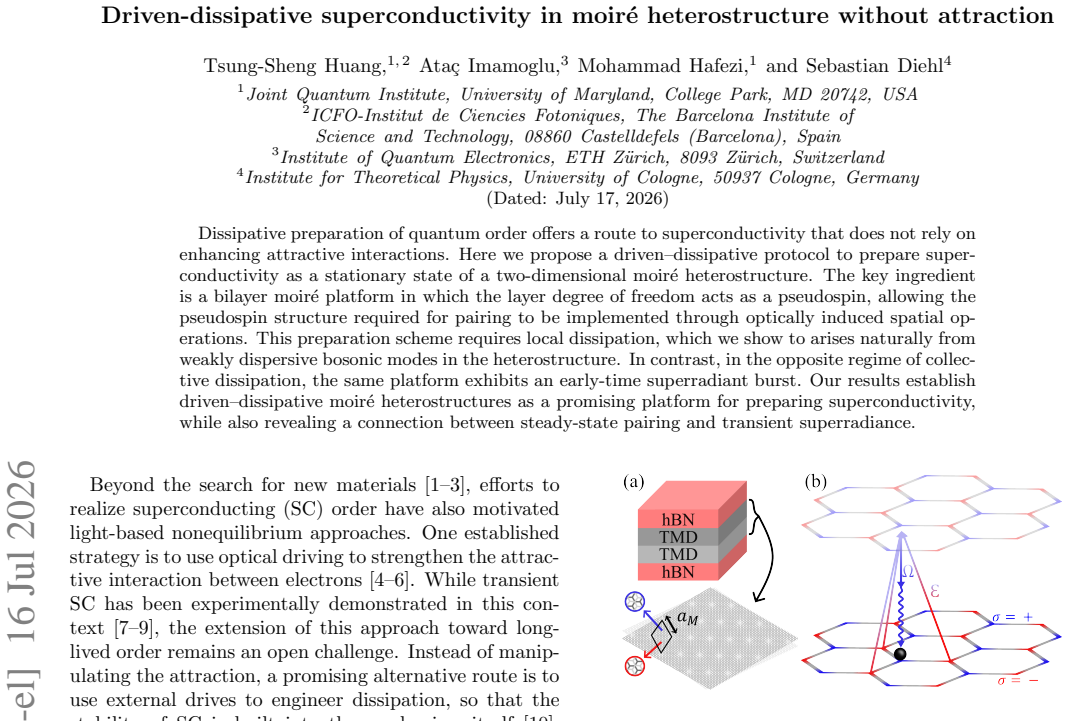
Dissipative preparation of quantum order offers a route to superconductivity that does not rely on enhancing attractive interactions. Here we propose a driven-dissipative protocol to prepare superconductivity as a stationary state of a two-dimensional moir\'e heterostructure. The key ingredient is a bilayer moir\'e platform in which the layer degree of freedom acts as a pseudospin, allowing the pseudospin structure required for pairing to be implemented through optically induced spatial operations. This preparation scheme requires local dissipation, which we show to arises naturally from weakly dispersive bosonic modes in the heterostructure. In contrast, in the opposite regime of collective dissipation, the same platform exhibits an early-time superradiant burst. Our results establish driven-dissipative moir\'e heterostructures as a promising platform for preparing superconductivity, while also revealing a connection between steady-state pairing and transient superradiance.
Figures


Reference graph
Works this paper leans on
-
[1]
Dagotto, Correlated electrons in high-temperature superconductors, Reviews of Modern Physics66, 763 (1994)
E. Dagotto, Correlated electrons in high-temperature superconductors, Reviews of Modern Physics66, 763 (1994)
1994
-
[2]
Orenstein and A
J. Orenstein and A. Millis, Advances in the physics of high-temperature superconductivity, Science288, 468 (2000)
2000
-
[3]
P. A. Lee, N. Nagaosa, and X.-G. Wen, Doping a mott in- sulator: Physics of high-temperature superconductivity, Reviews of modern physics78, 17 (2006)
2006
-
[4]
M. A. Sentef, A. Kemper, A. Georges, and C. Kollath, Theory of light-enhanced phonon-mediated superconduc- tivity, Physical Review B93, 144506 (2016)
2016
-
[5]
D. M. Kennes, E. Y. Wilner, D. R. Reichman, and A. J. Millis, Transient superconductivity from electronic squeezing of optically pumped phonons, Nature Physics 13, 479 (2017)
2017
-
[7]
Fausti, R
D. Fausti, R. Tobey, N. Dean, S. Kaiser, A. Dienst, M. C. Hoffmann, S. Pyon, T. Takayama, H. Takagi, and A. Cavalleri, Light-induced superconductivity in a stripe- ordered cuprate, science331, 189 (2011)
2011
-
[8]
Mitrano, A
M. Mitrano, A. Cantaluppi, D. Nicoletti, S. Kaiser, A. Perucchi, S. Lupi, P. Di Pietro, D. Pontiroli, M. Ricco, S. R. Clark,et al., Possible light-induced superconductiv- ity in k3c60 at high temperature, Nature530, 461 (2016)
2016
-
[9]
Budden, T
M. Budden, T. Gebert, M. Buzzi, G. Jotzu, E. Wang, T. Matsuyama, G. Meier, Y. Laplace, D. Pontiroli, M. Ricc` o,et al., Evidence for metastable photo-induced superconductivity in k3c60, Nature Physics17, 611 (2021)
2021
-
[10]
Diehl, W
S. Diehl, W. Yi, A. Daley, and P. Zoller, Dissipation- induced d-wave pairing of fermionic atoms in an optical lattice, Physical review letters105, 227001 (2010)
2010
-
[11]
Diehl, A
S. Diehl, A. Micheli, A. Kantian, B. Kraus, H. P. B¨ uchler, and P. Zoller, Quantum states and phases in driven open quantum systems with cold atoms, Nat. Phys.4, 878 (2008)
2008
-
[12]
Verstraete, M
F. Verstraete, M. Wolf, and J. Ignacio Cirac, Quantum computation and quantum-state engineering driven by dissipation, Nature Physics5, 633 (2009)
2009
-
[13]
Weimer, M
H. Weimer, M. M¨ uller, I. Lesanovsky, P. Zoller, and H. P. B¨ uchler, A rydberg quantum simulator, Nature Physics 6, 382–388 (2010)
2010
-
[14]
J. T. Barreiro, M. M¨ uller, P. Schindler, D. Nigg, T. Monz, M. Chwalla, M. Hennrich, C. F. Roos, P. Zoller, and R. Blatt, An open-system quantum simulator with trapped ions, Nature470, 486 (2011)
2011
-
[15]
Diehl, E
S. Diehl, E. Rico, M. A. Baranov, and P. Zoller, Topology by dissipation in atomic quantum wires, Nature Physics 7, 971 (2011)
2011
-
[16]
Krauter, C
H. Krauter, C. A. Muschik, K. Jensen, W. Wasilewski, J. M. Petersen, J. I. Cirac, and E. S. Polzik, Entangle- ment generated by dissipation and steady state entangle- ment of two macroscopic objects, Phys. Rev. Lett.107, 080503 (2011)
2011
-
[17]
P. M. Harrington, E. J. Mueller, and K. W. Murch, Engi- neered dissipation for quantum information science, Na- ture Reviews Physics4, 660 (2022)
2022
-
[18]
X. Mi, A. Michailidis, S. Shabani, K. Miao, P. Klimov, J. Lloyd, E. Rosenberg, R. Acharya, I. Aleiner, T. Ander- sen,et al., Stable quantum-correlated many-body states through engineered dissipation, Science383, 1332 (2024)
2024
-
[19]
Leisgang, S
N. Leisgang, S. Shree, I. Paradisanos, L. Sponfeldner, C. Robert, D. Lagarde, A. Balocchi, K. Watanabe, T. Taniguchi, X. Marie,et al., Giant stark splitting of an exciton in bilayer mos2, Nature nanotechnology15, 901 (2020)
2020
-
[20]
Barr´ e, O
E. Barr´ e, O. Karni, E. Liu, A. L. O’Beirne, X. Chen, H. B. Ribeiro, L. Yu, B. Kim, K. Watanabe, T. Taniguchi,et al., Optical absorption of interlayer exci- tons in transition-metal dichalcogenide heterostructures, Science376, 406 (2022)
2022
-
[21]
Karni, E
O. Karni, E. Barr´ e, V. Pareek, J. D. Georgaras, M. K. Man, C. Sahoo, D. R. Bacon, X. Zhu, H. B. Ribeiro, A. L. O’Beirne,et al., Structure of the moir´ e exciton captured by imaging its electron and hole, Nature603, 247 (2022)
2022
-
[23]
B. Gao, M. Ghafariasl, M. J. Mehrabad, T.-S. Huang, L. Zhang, D. Session, P. Upadhyay, R. Ma, G. Alsha- lan, D. G. S. Forero,et al., Probing quantum anomalous hall states in twisted bilayer wse2 via attractive polaron spectroscopy, arXiv preprint arXiv:2504.11530 (2025)
Pith/arXiv arXiv 2025
-
[24]
F. Wu, T. Lovorn, E. Tutuc, I. Martin, and A. MacDon- ald, Topological insulators in twisted transition metal dichalcogenide homobilayers, Physical review letters122, 086402 (2019)
2019
-
[25]
Thompson, K
E. Thompson, K. T. Chu, F. Mesple, X.-W. Zhang, C. Hu, Y. Zhao, H. Park, J. Cai, E. Anderson, K. Watan- abe,et al., Microscopic signatures of topology in twisted mote2, Nature Physics21, 1224 (2025)
2025
-
[26]
Zhang, N
F. Zhang, N. Morales-Dur´ an, Y. Li, W. Yao, J.-J. Su, Y.- C. Lin, C. Dong, X. Liu, F.-X. R. Chen, H. Kim,et al., Experimental signature of layer skyrmions and implica- tions for band topology in twisted wse2 bilayers, Nature Physics21, 1217 (2025)
2025
-
[27]
T.-S. Huang, A. Grankin, Y.-X. Wang, and M. Hafezi, Optical engineering and detection of magnetism in moir\’e semiconductors, arXiv preprint arXiv:2504.13758 (2025)
Pith/arXiv arXiv 2025
-
[28]
Keren, T
I. Keren, T. A. Webb, S. Zhang, J. Xu, D. Sun, B. S. Kim, D. Shin, S. S. Zhang, J. Zhang, G. Pereira,et al., Cavity- altered superconductivity, Nature650, 864 (2026)
2026
-
[29]
A. J. Daley, Quantum trajectories and open many-body quantum systems, Advances in Physics63, 77 (2014)
2014
-
[30]
Bardyn, M
C.-E. Bardyn, M. A. Baranov, C. V. Kraus, E. Rico, A. ˙Imamo˘ glu, P. Zoller, and S. Diehl, Topology by dissi- pation, New Journal of Physics15, 085001 (2013)
2013
-
[31]
S. J. Masson and A. Asenjo-Garcia, Universality of dicke superradiance in arrays of quantum emitters, Nature 8 Communications13, 2285 (2022)
2022
-
[32]
Huang, Y.-X
T.-S. Huang, Y.-X. Wang, Y.-Q. Wang, D. Chang, M. Hafezi, and A. Grankin, Collective optical properties of moir´ e excitons, Physical Review Letters134, 176901 (2025)
2025
-
[33]
Kumlin, A
J. Kumlin, A. Srivastava, and T. Pohl, Superradiance of strongly interacting dipolar excitons in moir´ e quantum materials, Physical Review Letters134, 126901 (2025)
2025
-
[34]
G. Lagnese, L. Brunner, L. Rossi, D. Chang, M. Schmitt, and Z. Lenarˇ ciˇ c, Neural network modeling of many- body super-and sub-radiant dynamics, arXiv preprint arXiv:2605.04640 (2026)
Pith/arXiv arXiv 2026
-
[35]
Y. Xia, Z. Han, K. Watanabe, T. Taniguchi, J. Shan, and K. F. Mak, Superconductivity in twisted bilayer wse2, Nature637, 833 (2025)
2025
-
[36]
Y. Guo, J. Pack, J. Swann, L. Holtzman, M. Cothrine, K. Watanabe, T. Taniguchi, D. G. Mandrus, K. Barmak, J. Hone,et al., Superconductivity in 5.0°twisted bilayer wse2, Nature637, 839 (2025)
2025
-
[37]
Qin, W.-X
W. Qin, W.-X. Qiu, and F. Wu, Topological chiral super- conductivity mediated by intervalley antiferromagnetic fluctuations in twisted bilayer wse 2, Physical Review Letters135, 246002 (2025)
2025
-
[38]
A. V. Chubukov, D. Pines, and J. Schmalian, A spin fluctuation model for d-wave superconductivity, inSu- perconductivity: Conventional and Unconventional Su- perconductors(Springer, 2008) pp. 1349–1413
2008
-
[39]
F. Xu, Z. Sun, J. Li, C. Zheng, C. Xu, J. Gao, T. Jia, Y. Su, K. Watanabe, T. Taniguchi,et al., Signa- tures of unconventional superconductivity near reentrant and fractional quantum anomalous hall insulators, arXiv preprint arXiv:2504.06972 (2025)
Pith/arXiv arXiv 2025
-
[40]
Divic, V
S. Divic, V. Cr´ epel, T. Soejima, X.-Y. Song, A. J. Millis, M. P. Zaletel, and A. Vishwanath, Anyon superconduc- tivity from topological criticality in a hofstadter–hubbard model, Proceedings of the National Academy of Sciences 122, e2426680122 (2025)
2025
-
[41]
Z. D. Shi and T. Senthil, Superconductivity and non- fermi liquid metals in a charge-1/3 anyon fluid, arXiv preprint arXiv:2606.20403 (2026)
Pith/arXiv arXiv 2026
-
[42]
Fontaine, D
Q. Fontaine, D. Squizzato, F. Baboux, I. Amelio, A. Lema ˆ ıtre, M. Morassi, I. Sagnes, L. Le Gratiet, A. Harouri, M. Wouters, I. Carusotto, A. Amo, M. Richard, A. Minguzzi, L. Canet, S. Ravets, and J. Bloch, Kardar–parisi–zhang universality in a one- dimensional polariton condensate, Nature608, 687 (2022)
2022
-
[43]
Widmann, S
S. Widmann, S. Dam, J. D¨ ureth, C. G. Mayer, R. Daviet, C. P. Zelle, D. Laibacher, M. Emmerling, M. Kamp, S. Diehl, S. Betzold, S. Klembt, and S. H¨ ofling, Observa- tion of kardar–parisi–zhang universal scaling in two di- mensions, Science392, 221 (2026)
2026
-
[44]
M. A. Sentef, A. F. Kemper, A. Georges, and C. Kollath, Theory of light-enhanced phonon-mediated superconduc- tivity, Phys. Rev. B93, 144506 (2016)
2016
-
[45]
C. J. Eckhardt, S. Chattopadhyay, D. M. Kennes, E. A. Demler, M. A. Sentef, and M. H. Michael, Theory of res- onantly enhanced photo-induced superconductivity, Na- ture Communications15, 2300 (2024)
2024
-
[46]
D. M. Kennes, E. Y. Wilner, D. R. Reichman, and A. J. Millis, Transient superconductivity from electronic squeezing of optically pumped phonons, Nature Physics 13, 479–483 (2017)
2017
-
[47]
O. K. Diessel, S. Sachdev, and P. M. Bonetti, Steady- states and response functions of the periodically driven o(n) scalar field theory, Reports on Progress in Physics 89, 038001 (2026)
2026
-
[48]
C. Su, E. Janzen, M. He, C. Li, A. Zettl, J. D. Cald- well, J. H. Edgar, and I. Aharonovich, Fundamentals and emerging optical applications of hexagonal boron nitride: a tutorial, Advances in Optics and Photonics16, 229 (2024)
2024
-
[49]
A. J. Giles, S. Dai, I. Vurgaftman, T. Hoffman, S. Liu, L. Lindsay, C. T. Ellis, N. Assefa, I. Chatzakis, T. L. Reinecke,et al., Ultralow-loss polaritons in isotopically pure boron nitride, Nature materials17, 134 (2018)
2018
-
[50]
ˆC † k,σ ˆAk,σ # ≡ r 2 N X r eik·Rσ(r) ˆC † r,σ e−ik·Rσ(r) ˆAr,σ = X σ′
H. Herzig Sheinfux, L. Orsini, M. Jung, I. Torre, M. Cec- canti, S. Marconi, R. Maniyara, D. Barcons Ruiz, A. H¨ otger, R. Bertini,et al., High-quality nanocavities through multimodal confinement of hyperbolic polari- tons in hexagonal boron nitride, Nature materials23, 499 (2024). 9 METHODS Properties of HPPs in hBN In this section, we review the propert...
2024
-
[51]
(12): High order term from polaron transformation to the undriven sector of the Hamiltonian∼ |gΦσ(r)|2 2ϵ0
Eq. (12): High order term from polaron transformation to the undriven sector of the Hamiltonian∼ |gΦσ(r)|2 2ϵ0 . The leading correction captures the density-density interaction between the fermions∼ ˆf † r,σ ˆfr,σ ˆf † r′,σ′ ˆfr′,σ′ me- diated by HPPs in the absence of external drive
-
[52]
(13): Similar to above but from the interlayer drive∼ |gΦσ(r)|2 2ϵ0 |E| νn
Eq. (13): Similar to above but from the interlayer drive∼ |gΦσ(r)|2 2ϵ0 |E| νn
-
[53]
(14): Similar to above but from the intralayer drive∼ |gΦσ(r)|2 2ϵ0 |Ω| νn
Eq. (14): Similar to above but from the intralayer drive∼ |gΦσ(r)|2 2ϵ0 |Ω| νn
-
[54]
The corresponding process describes a fermion that under- goes interlayer transition twice, thereby contribute as∼ ˆf † r′,σ′ ˆfr,σ
Additional term from adiabatic elimination∼ |E| 2 ∆ . The corresponding process describes a fermion that under- goes interlayer transition twice, thereby contribute as∼ ˆf † r′,σ′ ˆfr,σ
-
[55]
The corresponding process captures a fermion that is locally removed and restored, each coupled to an HPP
Another extra term from adiabatic elimination∼ |gΩΦσ(r)|2 2ϵ0νn∆ . The corresponding process captures a fermion that is locally removed and restored, each coupled to an HPP. Thus, this process contribute as∼ ˆf † r,σ ˆfr,σ ˆα† n ˆαn′. Some of them are suppressed because they can be made small compared to the target term Eq. (20), which scale as∼ 2E ∗Ω ∆ g...
-
[56]
Suppression due to small scales To see how the aforementioned terms can be suppressed by comparing the scales, we first review the assumptions on them that have been made so far: •|∆| ≪ |VB +ν|: This resolution of frequency is required to distinguish the two drives in Eq. (10). •γ n ≪ν n: We assume this in section A to obtain an anti-Hermitian generator f...
-
[57]
Such a locality eventually eliminates terms 1 and 5 listed in section E
Suppression due to locality As we will demonstrate in the main text, the combination of HPP modes withν≃ν n that couples to fermions are essentially local. Such a locality eventually eliminates terms 1 and 5 listed in section E. Specifically, the correction 1, is a density-density interaction∼ ˆf † r,σ ˆfr,σ ˆf † r′,σ′ ˆfr′,σ′ with the scaling with respec...
-
[58]
Kinetic theory of semiconductors with low mobility,
IG Lang and Yu A Firsov, “Kinetic theory of semiconductors with low mobility,” Sov. Phys. JETP16, 1301 (1963)
1963
-
[59]
Jie-Cheng Feng, Johannes Eberle, Sambuddha Chattopadhyay, Johannes Kn¨ orzer, Eugene Demler, and Ata¸ c ˙Imamo˘ glu, “Color centers and hyperbolic phonon polaritons in hexagonal boron nitride: A new platform for quantum optics,” (2026), arXiv:2602.05736 [cond-mat.mes-hall]
arXiv 2026
-
[60]
Quantum theory of spontaneous and stimulated emission of surface plasmons,
Alexandre Archambault, Fran¸ cois Marquier, Jean-Jacques Greffet, and Christophe Arnold, “Quantum theory of spontaneous and stimulated emission of surface plasmons,” Physical Review B—Condensed Matter and Materials Physics82, 035411 (2010)
2010
-
[61]
Light–matter interactions with photonic quasiparticles,
Nicholas Rivera and Ido Kaminer, “Light–matter interactions with photonic quasiparticles,” Nature Reviews Physics2, 538–561 (2020)
2020
-
[62]
Collective optical properties of moir´ e excitons,
Tsung-Sheng Huang, Yu-Xin Wang, Yan-Qi Wang, Darrick Chang, Mohammad Hafezi, and Andrey Grankin, “Collective optical properties of moir´ e excitons,” Physical Review Letters134, 176901 (2025)
2025
-
[63]
Mott-moir´ e exci- tons,
Tsung-Sheng Huang, Yang-Zhi Chou, Christopher L Baldwin, Fengcheng Wu, and Mohammad Hafezi, “Mott-moir´ e exci- tons,” Physical Review B107, 195151 (2023)
2023
discussion (0)
Sign in with ORCID, Apple, or X to comment. Anyone can read and Pith papers without signing in.