REVIEW 3 major objections 4 minor 87 references
A reinforcement-learned meta-policy can decide when to plan by watching a cheap uncertainty signal, and it beats fixed strategies that always react or always plan.
Reviewed by Pith at T0; open to challenge. T0 means a machine referee read the full paper against a public rubric. the ladder, T0–T4 →
T0 review · deepseek-v4-flash
2026-08-01 20:58 UTC pith:DTZBFXYX
load-bearing objection Competent empirical study of RL-based arbitration between reactive control and planning; the mechanism claim is plausible but the uncertainty signal needs calibration before the joint-training result can be taken at face value. the 3 major comments →
When to Plan: Learning to Select Between Reactive Control and Deliberative Planning
The pith
A machine-rendered reading of the paper's core claim, the machinery that carries it, and where it could break.
Core claim
The central claim is that a model-free RL meta-policy can learn adaptive computation allocation—deciding at each moment whether to emit a fast reactive action or invoke a slower planner—using only a task-agnostic uncertainty signal from the reactive policy together with distance-to-goal, previous action, and a short history. The uncertainty signal is the disagreement of an ensemble of behavior-cloned networks: variance of predicted action means for continuous control, entropy of the averaged action distribution for discrete control. On all five environments the learned meta-policy achieves higher average return than always-reactive, always-short-plan, always-medium-plan, and always-long-plan
What carries the argument
The carrying mechanism is the meta-MDP with options: a meta-policy selects among a one-step reactive option and three planning options of fixed horizon, each converted to a common time-based reward (a cost of -1 per action, plus -αk for a plan of length k). The meta-observation is built from the reactive policy's ensemble-disagreement score u(s)—variance across an ensemble of M behavior-cloned networks for continuous actions, or entropy of the averaged categorical distribution for discrete actions—plus distance to goal, previous meta-action, and a history of recent observations. This uncertainty score is what lets the meta-policy estimate reactive competence without search and without the ra
Load-bearing premise
The load-bearing premise is that the ensemble-disagreement score u(s) is a valid, task-agnostic proxy for when the reactive policy is incompetent; the paper does not calibrate it against actual reactive value loss, so if high disagreement does not align with out-of-distribution states where planning helps, the meta-policy's advantage should not transfer.
What would settle it
Compute, on held-out tasks in any of the five environments, the rank correlation between the ensemble-disagreement score and the suboptimality gap V*(s) - V^{πr}(s). If the correlation is weak or negative, the mechanism the paper attributes to uncertainty is not operating. Alternatively, replacing u(s) with a random scalar in the meta-observation and showing performance barely changes would falsify the claim that the uncertainty signal carries the adaptive behavior.
If this is right
- If the central claim holds, autonomous systems can deploy a fast learned policy most of the time and reserve expensive planning for the states where it matters, reducing average time-to-goal without sacrificing reliability.
- Because the meta-observation is computed without search, the method imposes only a small overhead on the reactive baseline.
- The joint-training result implies that planning can be used as a data generator to improve the reactive policy, and the meta-policy will automatically reallocate computation as competence grows.
- The same framing applies wherever a cheap policy and an expensive deliberative routine coexist, including language-model reasoning and cloud-robot control, since the tradeoff is time versus quality.
- The ablations imply that a history of uncertainty and progress is needed, not just instantaneous values, so meta-decisions are made from short trends rather than a single snapshot.
Where Pith is reading between the lines
- Editorial inference: the method assumes the planner is reliable everywhere; with a learned world model, the planner's own uncertainty would need to enter the meta-observation, and the same ensemble trick could be applied to the world model.
- Editorial inference: because the uncertainty score is only a proxy, tasks with high aleatoric noise but good reactive actions might waste compute planning; adding a calibration step against actual reactive returns would test whether the score can be trusted beyond these five domains.
- Editorial inference: the joint-training loop suggests a self-improvement curriculum—planning in out-of-distribution states generates the very data that makes planning unnecessary—which could be studied as a general mechanism for reducing deliberation over an agent's lifetime.
- Editorial inference: the paper leaves open whether the meta-policy can track a worsening reactive policy; capacity limits or catastrophic forgetting are plausible failure modes that would require the meta-policy to relearn when to plan.
Editorial analysis
A structured set of objections, weighed in public.
Referee Report
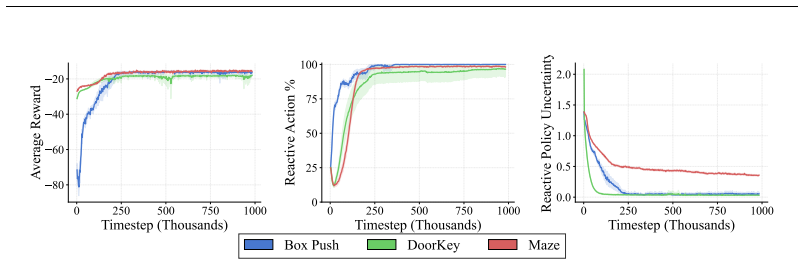
Summary. The paper studies meta-reasoning in goal-reaching tasks: a PPO-trained meta-policy chooses at each meta-step between a fast reactive policy and several planning options of different horizons, with planning incurring a time cost. The meta-observation is the ensemble-disagreement uncertainty of the reactive policy, distance to goal, previous meta-action, and a short history of these features. Experiments on five motion-planning/navigation domains compare against fixed-compute baselines (always react, always short/medium/long plan), ablate observation components, vary planning cost, in-distribution proportion, and stochasticity, and finally study joint training in which the reactive policy is trained online from planner rollouts. The paper reports that the meta-policy outperforms all fixed baselines in all five domains, that uncertainty and history are the most critical observation components, and that an uncertainty-conditioned meta-policy shifts toward fully reactive control as the reactive policy improves.
Significance. If the results hold, this is a useful empirical contribution to adaptive computation allocation. The options-MDP formulation with an explicit time-based planning cost is clean, and the experimental protocol is solid: 30 seeds, 300 evaluation episodes per seed, bootstrap confidence intervals, ablations, and sensitivity sweep. The central novelty—an RL meta-policy conditioned on an ensemble-disagreement uncertainty score—is timely and relevant to the broader compute-allocation literature. The principal limitations are the unvalidated link between ensemble disagreement and reactive-policy incompetence, and the use of a perfect world model; both are acknowledged or implicit in the text but need to be addressed before the mechanism claims can be accepted at face value.
major comments (3)
- [Section 5, Eqs. for u(s); Section 6.6] The load-bearing premise is that the ensemble-disagreement score u(s) is a valid, task-agnostic proxy for reactive-policy incompetence. The paper asserts that 'high uncertainty corresponds to out-of-distribution inputs where planning may be beneficial,' but it never calibrates u(s) against the actual advantage of planning, e.g., V*(s)-V^{pi_r}(s) or the expected return difference between reactive and planning options. This is especially important because the central claim attributes the meta-policy's success to conditioning on this signal. Please add a calibration analysis (correlation or ranking of u(s) against measured planning advantage on held-out ID/OOD states) and, ideally, an oracle-ablation where the meta-policy receives the true competence signal, to establish that the uncertainty score is adding the intended information rather than a generic novelty signal.
- [Section 6.4, Table 3] The summary 'the two most important components are history and uncertainty scores' is not supported by the reported numbers. In Doorkey, removing distance causes the largest degradation (-34.3 vs -25.1), while removing history has almost no effect (-26.1). In Box Push, removing distance improves return (-20.9 vs -24.3), contradicting the idea that distance is a helpful component. In Maze, removing uncertainty degrades from -19.3 to -25.0, which is substantial, yet the text says there is no substantial drop-off without uncertainty in the 'other three environments.' Please re-analyze Table 3 with per-environment pairwise comparisons and correct the text; the current selective summary misrepresents which observation components matter and in which environments.
- [Section 6.6, Figure 4] The joint-training experiment is confounded with the training procedure. The reactive policy is trained only on state-action pairs collected from planning options, so ensemble disagreement is mechanically reduced as those specific states are fit, regardless of whether the reactive policy has actually become competent in a broader sense. The paper concludes that the uncertainty signal 'reflects the strength of the reactive policy,' but the experiment as reported cannot separate genuine competence improvement from distribution fitting. Please add a control condition—for example, training the same reactive policy on an equal number of ID-only or random states—and report the reactive policy's actual success/value on held-out ID and OOD states. This would clarify whether the meta-policy is tracking true competence or merely a decreasing ensemble-variance artifact.
minor comments (4)
- [Section 6.1/Table 4] The text says planning horizons are 15%, 30%, and 50% of the task horizon, but the table values correspond to approximately 16-17%, 32-33%, and 50% for most environments. Please say 'approximately' or reconcile the fractions.
- [Table 1 caption] The caption states that bold entries overlap in CI with the best performer, but no boldface is visible in the provided text. Please render the bold in the final version.
- [Section 6.4] The phrase 'model-free uncertainty' is confusing; the uncertainty score comes from an ensemble, not from model-free RL. Consider renaming to 'reactive-policy ensemble uncertainty'.
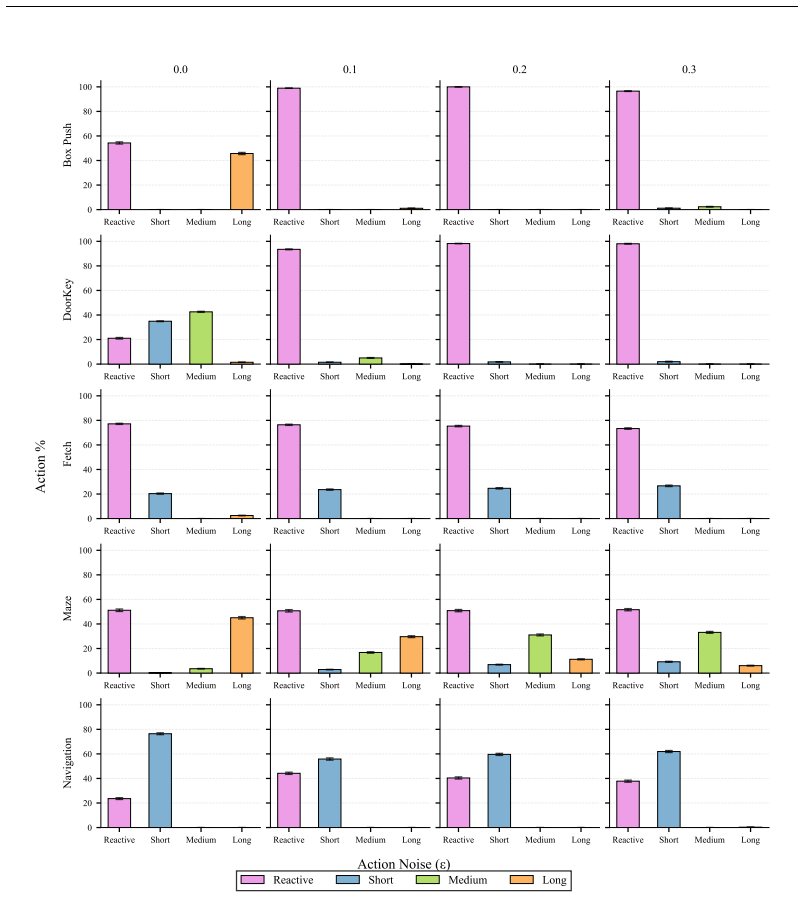
- [Section 6.5] In the stochasticity experiment, the text says the ratio of plan lengths remains roughly constant as alpha increases, but the accompanying figure shows some shifts; a quantitative statement or per-environment figure would help.
Circularity Check
No significant circularity: results are empirical comparisons against external fixed-compute baselines; the uncertainty proxy is an assumption, not a circular reduction.
full rationale
The paper's central claims are established by direct RL training and evaluation against fixed-compute baselines (Table 1), not by fitting parameters to the target and then 'predicting' it. The uncertainty score u(s) is an input feature computed from an ensemble of reactive networks; the load-bearing premise that high ensemble disagreement indicates states where planning helps is an explicit design assumption (Section 5), supported by ablations (Table 3), not a circular reduction. In the joint-training experiment (Section 6.6), the reactive policy is trained on planner rollouts, so a drop in ensemble disagreement is expected; however, the meta-policy's shift toward reactive control is a learned behavior under the RL reward, not an identity forced by the definition of u(s). The only self-citation (Hanna & Corrado 2025) appears in Related Work and is not load-bearing. Limitations such as the perfect world model assumption are external-validity concerns, not circularity. No equation-level reduction between input and output was found.
Axiom & Free-Parameter Ledger
free parameters (4)
- Plan cost scaling alpha =
0.5 (default), swept over {0.1, 0.5, 1, 5}
- Planning horizons as fractions of task horizon =
15% / 30% / 50% of task horizon (e.g., 5/10/15 for Box Push)
- Ensemble size M =
4
- Meta-observation history length n =
4
axioms (4)
- domain assumption A perfect, accurate world model is available for planning.
- domain assumption The reactive policy is near-optimal on in-distribution states and poor on out-of-distribution states.
- domain assumption Ensemble disagreement (variance or entropy) is a valid proxy for reactive-policy incompetence.
- domain assumption A* with a fixed search-depth limit returns a near-optimal action sequence for the chosen horizon.
read the original abstract
It has long been recognized that humans have the ability to switch between fast, reactive decision-making and slower, deliberative planning. In this paper, we study the question of how to learn this ability, known as meta-reasoning, in artificial agents. We model reactive decision-making as a policy that directly maps state observations to actions. Such policies can be trained with reinforcement learning (RL) or imitation learning, but may generalize poorly outside of their training distribution. Alternatively, model-based decision-time planning is more likely to produce good actions across a broader set of states but requires additional computation time, which delays acting. In this work, we introduce an RL method for training a meta-reasoning policy that allocates computation by conditioning on a reactive-policy uncertainty score. This score enables it to predict when the reactive policy is likely to perform poorly and when planning is needed. We conduct an empirical study on motion planning and navigation environments, showing that this design enables the meta-reasoning policy to learn when the reactive policy provides a good-enough action versus when decision-time planning is needed. Additionally, we show that our design enables the meta-agent to shift toward fully reactive control as the reactive policy improves.
Figures




Reference graph
Works this paper leans on
-
[1]
Philosophical Transactions of the Royal Society B: Biological Sciences , author =
Cortical mechanisms of action selection: the affordance competition hypothesis , volume =. Philosophical Transactions of the Royal Society B: Biological Sciences , author =. 2007 , pages =. doi:10.1098/rstb.2007.2054 , abstract =
arXiv 2007
-
[2]
Hay, Nicholas and Russell, Stuart and Tolpin, David and Shimony, Solomon Eyal , month = aug, year =. Selecting. doi:10.48550/arXiv.1408.2048 , abstract =
-
[3]
Lakshminarayanan, Balaji and Pritzel, Alexander and Blundell, Charles , month = nov, year =. Simple and. doi:10.48550/arXiv.1612.01474 , abstract =
-
[4]
Booch, Grady and Fabiano, Francesco and Horesh, Lior and Kate, Kiran and Lenchner, Jon and Linck, Nick and Loreggia, Andrea and Murugesan, Keerthiram and Mattei, Nicholas and Rossi, Francesca and Srivastava, Biplav , month = dec, year =. Thinking. doi:10.48550/arXiv.2010.06002 , abstract =
work page internal anchor Pith review Pith/arXiv arXiv doi:10.48550/arxiv.2010.06002 2010
-
[5]
Li, Zhong-Zhi and Zhang, Duzhen and Zhang, Ming-Liang and Zhang, Jiaxin and Liu, Zengyan and Yao, Yuxuan and Xu, Haotian and Zheng, Junhao and Wang, Pei-Jie and Chen, Xiuyi and Zhang, Yingying and Yin, Fei and Dong, Jiahua and Li, Zhiwei and Bi, Bao-Long and Mei, Ling-Rui and Fang, Junfeng and Liang, Xiao and Guo, Zhijiang and Song, Le and Liu, Cheng-Lin ...
-
[6]
Lee, Sang Wan and Shimojo, Shinsuke and O’Doherty, John P. , month = feb, year =. Neural. Neuron , publisher =. doi:10.1016/j.neuron.2013.11.028 , language =
-
[7]
2011 , publisher=
Thinking, fast and slow , author=. 2011 , publisher=
2011
-
[8]
arXiv preprint arXiv:2302.04840 , year=
What are the mechanisms underlying metacognitive learning? , author=. arXiv preprint arXiv:2302.04840 , year=
-
[9]
Rodrigo de Lazcano and Kallinteris Andreas and Jun Jet Tai and Seungjae Ryan Lee and Jordan Terry , title =
-
[10]
CoRR , volume =
Maxime Chevalier-Boisvert and Bolun Dai and Mark Towers and Rodrigo de Lazcano and Lucas Willems and Salem Lahlou and Suman Pal and Pablo Samuel Castro and Jordan Terry , title =. CoRR , volume =
-
[11]
Journal of Machine Learning Research , year =
Antonin Raffin and Ashley Hill and Adam Gleave and Anssi Kanervisto and Maximilian Ernestus and Noah Dormann , title =. Journal of Machine Learning Research , year =
-
[12]
The quarterly journal of economics , pages=
A behavioral model of rational choice , author=. The quarterly journal of economics , pages=. 1955 , publisher=
1955
-
[13]
British Journal of Psychology , volume=
Heuristic and analytic processes in reasoning , author=. British Journal of Psychology , volume=. 1984 , publisher=
1984
-
[14]
Paglieri, Davide and Cupiał, Bartłomiej and Cook, Jonathan and Piterbarg, Ulyana and Tuyls, Jens and Grefenstette, Edward and Foerster, Jakob Nicolaus and Parker-Holder, Jack and Rocktäschel, Tim , month = sep, year =. Learning. doi:10.48550/arXiv.2509.03581 , abstract =
-
[15]
Current Opinion in Behavioral Sciences , author =
The structure of reinforcement-learning mechanisms in the human brain , volume =. Current Opinion in Behavioral Sciences , author =. 2015 , pages =. doi:10.1016/j.cobeha.2014.10.004 , abstract =
-
[16]
Deployable Reinforcement Learning with Variable Control Rate
Wang, Dong and Beltrame, Giovanni , month = apr, year =. Deployable. doi:10.48550/arXiv.2401.09286 , abstract =
work page internal anchor Pith review Pith/arXiv arXiv doi:10.48550/arxiv.2401.09286
-
[17]
Hanna, Josiah P. and Corrado, Nicholas E. , month = oct, year =. When. doi:10.48550/arXiv.2506.17124 , abstract =
-
[18]
Sheikhnezhad Fard, Farzaneh and Trappenberg, Thomas P. , month = jul, year =. A. Frontiers in Neurorobotics , publisher =. doi:10.3389/fnbot.2019.00052 , abstract =
arXiv 2019
-
[19]
Psychological Science , author =
The. Psychological Science , author =. 2013 , pages =. doi:10.1177/0956797612463080 , abstract =
-
[20]
Fard, Farzaneh S. and Trappenberg, Thomas P. , month = jul, year =. Mixing. 2018. doi:10.1109/IJCNN.2018.8489122 , abstract =
arXiv 2018
-
[21]
Surprisal-Triggered Conditional Computation with Neural Networks
Lugosch, Loren and Nowrouzezahrai, Derek and Meyer, Brett H. , month = jun, year =. Surprisal-. doi:10.48550/arXiv.2006.01659 , abstract =
work page internal anchor Pith review Pith/arXiv arXiv doi:10.48550/arxiv.2006.01659 2006
-
[22]
Journal of Cognitive Neuroscience , author =
Planning. Journal of Cognitive Neuroscience , author =. 2018 , keywords =. doi:10.1162/jocn_a_01263 , abstract =
-
[23]
Liao, Baohao and Xu, Yuhui and Dong, Hanze and Li, Junnan and Monz, Christof and Savarese, Silvio and Sahoo, Doyen and Xiong, Caiming , month = jun, year =. Reward-. doi:10.48550/arXiv.2501.19324 , abstract =
-
[24]
Fang, Gongfan and Ma, Xinyin and Wang, Xinchao , month = jun, year =. Thinkless:. doi:10.48550/arXiv.2505.13379 , abstract =
-
[25]
Ong, Isaac and Almahairi, Amjad and Wu, Vincent and Chiang, Wei-Lin and Wu, Tianhao and Gonzalez, Joseph E. and Kadous, M. Waleed and Stoica, Ion , month = feb, year =. doi:10.48550/arXiv.2406.18665 , abstract =
-
[26]
Yoo, Jaehyun and Molin, Adam and Jafarian, Matin and Esen, Hasan and Dimarogonas, Dimos V. and Johansson, Karl H. , month = dec, year =. Event-triggered model predictive control with machine learning for compensation of model uncertainties , url =. 2017. doi:10.1109/CDC.2017.8264468 , abstract =
arXiv 2017
-
[27]
Predictive compensator based event-triggered model predictive control with nonlinear disturbance observer for unmanned surface vehicle under cyber-attacks , volume =. Ocean Engineering , author =. 2022 , keywords =. doi:10.1016/j.oceaneng.2022.111868 , abstract =
arXiv 2022
-
[28]
IEEE Transactions on Cybernetics , author =
Learning-. IEEE Transactions on Cybernetics , author =. 2025 , keywords =. doi:10.1109/TCYB.2025.3536606 , abstract =
arXiv 2025
-
[29]
Event-based model predictive control for nonlinear systems with dynamic disturbance , volume =. Automatica , author =. 2022 , keywords =. doi:10.1016/j.automatica.2022.110533 , abstract =
arXiv 2022
-
[30]
IEEE/ASME Transactions on Mechatronics , author =
Tracking of. IEEE/ASME Transactions on Mechatronics , author =. 2020 , keywords =. doi:10.1109/TMECH.2019.2962099 , abstract =
arXiv 2020
-
[31]
Chen, Jun and Meng, Xiangyu and Li, Zhaojian , month = jun, year =. Reinforcement. 2022. doi:10.23919/ACC53348.2022.9867347 , abstract =
arXiv 2022
-
[32]
IEEE Transactions on Intelligent Vehicles , author =
Event-. IEEE Transactions on Intelligent Vehicles , author =. 2024 , keywords =. doi:10.1109/TIV.2023.3329785 , abstract =
arXiv 2024
-
[33]
Callaway, Frederick and Gul, Sayan and Krueger, Paul M. and Griffiths, Thomas L. and Lieder, Falk , month = aug, year =. Learning to select computations , url =. doi:10.48550/arXiv.1711.06892 , abstract =
-
[34]
and Xia, Jerry and Chung, Stephen and Greenwald, Amy , month = apr, year =
Wang, Kevin A. and Xia, Jerry and Chung, Stephen and Greenwald, Amy , month = apr, year =. Dynamic
-
[35]
Manvi, Rohin and Hong, Joey and Seyde, Tim and Labonne, Maxime and Lechner, Mathias and Levine, Sergey , month = dec, year =. Zero-. doi:10.48550/arXiv.2512.01457 , abstract =
-
[36]
PLoS computational biology , author =
Speed/accuracy trade-off between the habitual and the goal-directed processes , volume =. PLoS computational biology , author =. 2011 , keywords =. doi:10.1371/journal.pcbi.1002055 , abstract =
-
[37]
Proceedings of the AAAI Conference on Artificial Intelligence , author =
Stop!. Proceedings of the AAAI Conference on Artificial Intelligence , author =. 2024 , keywords =. doi:10.1609/aaai.v38i18.29983 , abstract =
-
[38]
The European Journal of Neuroscience , author =
Adaptive. The European Journal of Neuroscience , author =. 2025 , pages =. doi:10.1111/ejn.70024 , abstract =
-
[39]
Ackerman, Rakefet and Thompson, Valerie A. , month = aug, year =. Meta-. Trends in Cognitive Sciences , publisher =. doi:10.1016/j.tics.2017.05.004 , language =
-
[40]
Gläscher, Jan and Daw, Nathaniel and Dayan, Peter and O'Doherty, John P. , month = may, year =. States versus. Neuron , publisher =. doi:10.1016/j.neuron.2010.04.016 , language =
-
[41]
Wu, Yangzhen and Sun, Zhiqing and Li, Shanda and Welleck, Sean and Yang, Yiming , month = mar, year =. Inference. doi:10.48550/arXiv.2408.00724 , abstract =
-
[42]
Snell, Charlie and Lee, Jaehoon and Xu, Kelvin and Kumar, Aviral , month = aug, year =. Scaling. doi:10.48550/arXiv.2408.03314 , abstract =
-
[43]
Heuristic and analytic processes in reasoning* -
-
[44]
Kaplan, Jared and McCandlish, Sam and Henighan, Tom and Brown, Tom B. and Chess, Benjamin and Child, Rewon and Gray, Scott and Radford, Alec and Wu, Jeffrey and Amodei, Dario , month = jan, year =. Scaling. doi:10.48550/arXiv.2001.08361 , abstract =
-
[45]
OpenAI and Jaech, Aaron and Kalai, Adam and Lerer, Adam and Richardson, Adam and El-Kishky, Ahmed and Low, Aiden and Helyar, Alec and Madry, Aleksander and Beutel, Alex and Carney, Alex and Iftimie, Alex and Karpenko, Alex and Passos, Alex Tachard and Neitz, Alexander and Prokofiev, Alexander and Wei, Alexander and Tam, Allison and Bennett, Ally and Kumar...
-
[46]
Nature , author =. 2025 , note =. doi:10.1038/s41586-025-09422-z , abstract =
-
[47]
Sensors (Basel, Switzerland) , author =
A. Sensors (Basel, Switzerland) , author =. 2024 , pages =. doi:10.3390/s24154808 , abstract =
-
[48]
Baniodeh, Mustafa and Goel, Kratarth and Ettinger, Scott and Fuertes, Carlos and Seff, Ari and Shen, Tim and Gulino, Cole and Yang, Chenjie and Jerfel, Ghassen and Choe, Dokook and Wang, Rui and Charrow, Benjamin and Kallem, Vinutha and Casas, Sergio and Al-Rfou, Rami and Sapp, Benjamin and Anguelov, Dragomir , month = sep, year =. Scaling. doi:10.48550/a...
-
[49]
doi:10.48550/arXiv.1812.03079 , abstract =
Bansal, Mayank and Krizhevsky, Alex and Ogale, Abhijit , month = dec, year =. doi:10.48550/arXiv.1812.03079 , abstract =
-
[50]
and Tirumala, Dhruva and Wulfmeier, Markus and Humplik, Jan and Tunyasuvunakool, Saran and Siegel, Noah Y
Haarnoja, Tuomas and Moran, Ben and Lever, Guy and Huang, Sandy H. and Tirumala, Dhruva and Wulfmeier, Markus and Humplik, Jan and Tunyasuvunakool, Saran and Siegel, Noah Y. and Hafner, Roland and Bloesch, Michael and Hartikainen, Kristian and Byravan, Arunkumar and Hasenclever, Leonard and Tassa, Yuval and Sadeghi, Fereshteh and Batchelor, Nathan and Cas...
-
[51]
Transportation Research Part F: Traffic Psychology and Behaviour , author =
Driving on familiar roads:. Transportation Research Part F: Traffic Psychology and Behaviour , author =. 2013 , keywords =. doi:10.1016/j.trf.2013.03.008 , abstract =
-
[52]
Schulman, John and Wolski, Filip and Dhariwal, Prafulla and Radford, Alec and Klimov, Oleg , month = aug, year =. Proximal. doi:10.48550/arXiv.1707.06347 , abstract =
-
[53]
Botea, Adi and Müller, Martin and Schaeffer, Jonathan , editor =. Using. Computers and. 2003 , pages =. doi:10.1007/978-3-540-40031-8_24 , abstract =
-
[54]
Nicolò De and Sumers, Theodore R
Sabbata, C. Nicolò De and Sumers, Theodore R. and AlKhamissi, Badr and Bosselut, Antoine and Griffiths, Thomas L. , month = jun, year =. Rational. doi:10.48550/arXiv.2410.05563 , abstract =
-
[55]
Biological Cybernetics , author =
Path planning versus cue responding: a bio-inspired model of switching between navigation strategies , volume =. Biological Cybernetics , author =. 2010 , keywords =. doi:10.1007/s00422-010-0400-z , abstract =
-
[56]
Hafez, Muhammad Burhan and Weber, Cornelius and Kerzel, Matthias and Wermter, Stefan , month = jul, year =. Curious. 2019. doi:10.1109/IJCNN.2019.8852254 , abstract =
arXiv 2019
-
[57]
Kästner, Linh and Cox, Johannes and Buiyan, Teham and Lambrecht, Jens , month = sep, year =. All-in-. doi:10.48550/arXiv.2109.11636 , abstract =
work page internal anchor Pith review Pith/arXiv arXiv doi:10.48550/arxiv.2109.11636
-
[60]
Qu, Xiaoye and Li, Yafu and Su, Zhaochen and Sun, Weigao and Yan, Jianhao and Liu, Dongrui and Cui, Ganqu and Liu, Daizong and Liang, Shuxian and He, Junxian and Li, Peng and Wei, Wei and Shao, Jing and Lu, Chaochao and Zhang, Yue and Hua, Xian-Sheng and Zhou, Bowen and Cheng, Yu , month = mar, year =. A. doi:10.48550/arXiv.2503.21614 , abstract =
-
[61]
The best of both worlds:. Cognition , author =. 2022 , keywords =. doi:10.1016/j.cognition.2022.105118 , abstract =
arXiv 2022
-
[62]
Current Opinion in Behavioral Sciences , author =
Doing more with less: meta-reasoning and meta-learning in humans and machines , volume =. Current Opinion in Behavioral Sciences , author =. 2019 , pages =. doi:10.1016/j.cobeha.2019.01.005 , language =
-
[63]
Lieder, Falk and Griffiths, Thomas L. , year =. Strategy selection as rational metareasoning , volume =. Psychological Review , publisher =. doi:10.1037/rev0000075 , abstract =
-
[64]
Gershman, Samuel J. and Markman, Arthur B. and Otto, A. Ross , year =. Retrospective revaluation in sequential decision making:. Journal of Experimental Psychology: General , publisher =. doi:10.1037/a0030844 , abstract =
-
[65]
Artificial Intelligence , author =
Between. Artificial Intelligence , author =. 1999 , keywords =. doi:10.1016/S0004-3702(99)00052-1 , abstract =
-
[66]
Javed, Khurram and Sutton, Richard S , year=. The
-
[67]
Young, Kenny and Ramesh, Aditya and Kirsch, Louis and Schmidhuber, Jürgen , month = jul, year =. The. doi:10.48550/arXiv.2211.02222 , abstract =
-
[68]
Artificial Intelligence Review , author =
Monte. Artificial Intelligence Review , author =. 2023 , keywords =. doi:10.1007/s10462-022-10228-y , abstract =
-
[69]
Computation and action under bounded resources / , abstract =
Horvitz, Eric , year =. Computation and action under bounded resources / , abstract =
-
[70]
Artificial Intelligence , author =
Principles of metareasoning , volume =. Artificial Intelligence , author =. 1991 , pages =. doi:10.1016/0004-3702(91)90015-C , abstract =
-
[71]
He, Ruiqi and Jain, Yash Raj and Lieder, Falk , month = jan, year =. Have. doi:10.48550/arXiv.2201.00764 , abstract =
work page internal anchor Pith review Pith/arXiv arXiv doi:10.48550/arxiv.2201.00764
-
[72]
Measuring and modelling how people learn how to plan and how people adapt their planning strategies to the structure of the environment , abstract =
-
[73]
Rupam and Jagersand, Martin and Tosatto, Samuele , month = oct, year =
Karimi, Amirmohammad and Jin, Jun and Luo, Jun and Mahmood, A. Rupam and Jagersand, Martin and Tosatto, Samuele , month = oct, year =. Dynamic. 2023. doi:10.1109/IROS55552.2023.10342408 , abstract =
arXiv 2023
-
[74]
Honda, Kohei and Yonetani, Ryo and Nishimura, Mai and Kozuno, Tadashi , month = may, year =. When to. 2024. doi:10.1109/ICRA57147.2024.10611474 , abstract =
arXiv 2024
-
[75]
Sharma, Vishnu Dutt and Lee, Jeongran and Andrews, Matthew and Hadžic, Ilija , year =. Hybrid
-
[76]
Proceedings of the Annual Meeting of the Cognitive Science Society , author =
Enhancing metacognitive reinforcement learningusing reward structures and feedback , volume =. Proceedings of the Annual Meeting of the Cognitive Science Society , author =
-
[77]
Rational metareasoning and the plasticity of cognitive control , doi =
Lieder, Falk and Shenhav, Amitai and Musslick, Sebastian and Griffiths, Thomas , month = feb, year =. Rational metareasoning and the plasticity of cognitive control , doi =
-
[78]
How do people learn how to plan? , url =
Jain, Yash Raj and Gupta, Sanit and Rakesh, Vasundhara and Dayan, Peter and Callaway, Frederick and Lieder, Falk , year =. How do people learn how to plan? , url =. 2019. doi:10.32470/CCN.2019.1313-0 , abstract =
arXiv 2019
-
[79]
Chung, Stephen and Du, Wenyu and Fu, Jie , month = may, year =. Thinker:. doi:10.48550/arXiv.2505.21097 , abstract =
-
[80]
Proceedings of the AAAI Conference on Artificial Intelligence , author =
Dynamic. Proceedings of the AAAI Conference on Artificial Intelligence , author =. 2017 , keywords =. doi:10.1609/aaai.v31i1.10918 , abstract =
-
[81]
Metelli, Alberto Maria and Mazzolini, Flavio and Bisi, Lorenzo and Sabbioni, Luca and Restelli, Marcello , month = nov, year =. Control. Proceedings of the 37th
-
[82]
Orenstein, Adrian and Chen, Jessica and Santos, Gwyneth Anne Delos and Sapara, Bayley and Bowling, Michael , month = oct, year =. Toward. doi:10.48550/arXiv.2510.22833 , abstract =
discussion (0)
Sign in with ORCID, Apple, or X to comment. Anyone can read and Pith papers without signing in.