REVIEW 2 major objections 4 minor 33 references
The paper introduces MissionBench and claims that state-of-the-art multimodal LLMs, evaluated zero-shot as closed-loop drone agents, complete fewer than 35% of missions compared to 84.4% human performance, and that mission-level competence
Reviewed by Pith at T0; open to challenge. T0 means a machine referee read the full paper against a public rubric. the ladder, T0–T4 →
T0 review · deepseek-v4-flash
2026-08-01 06:02 UTC pith:NLZY6X4T
load-bearing objection MissionBench is a genuinely new closed-loop aerial benchmark with a solid empirical core, but the headline 34.8% success rate is softer than it looks because reporting missions are judged by an LLM that tolerates minor character errors. the 2 major comments →
Zero-Shot Mission-Level Evaluation for Aerial MLLM Agents
The pith
A machine-rendered reading of the paper's core claim, the machinery that carries it, and where it could break.
Core claim
MissionBench shows that frozen, off-the-shelf MLLMs, evaluated zero-shot as aerial agents, succeed on at most 34.8% of 30 mission-level tasks, compared to 84.4% human performance with continuous control and 70.0% when humans are forced through the same text/image interface. The oracle success rate—whether the agent ever reaches the target—exceeds the success rate for several models, meaning agents often navigate to the right place but then fail to complete the mission through misidentification, premature termination, or drift. Scaling within model families consistently improves mission progress but does not close the human-model gap, and single-frame perception proxy scores correlate only mo
What carries the argument
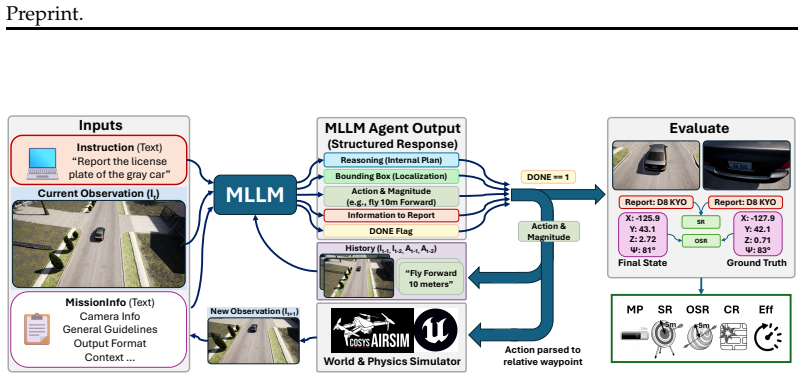
The central object is MissionBench itself: 120 missions across five simulated 3D environments and four task families (reporting, inspection, manipulation, patrol), plus a closed-loop protocol in which the agent receives an egocentric image, emits a structured response (bounding box, reasoning, action with magnitude, report, and a DONE flag), the simulator executes the action, and the loop repeats until DONE or budget exhaustion. It introduces mission-level success criteria—spatial thresholds for inspection and manipulation, soft LLM-judged matching for reporting, IoU over buffered trajectories for patrol—and diagnostic metrics (Success Rate, Oracle Success Rate, Mission Progress, Collision R
Load-bearing premise
Reporting missions are graded by an LLM judge that treats reports differing by one or two characters or numbers as successes (90% similarity threshold); if exact string matching is used instead, the best model's success rate drops from 34.8% to 19.1% (Appendix C.6).
What would settle it
Re-run MissionBench's 30-mission test split with a newer or larger MLLM; if any model exceeds 84.4% success, the central gap claim collapses. More locally, recompute success rates using exact string matching for reporting missions: the paper already reports this drops the best model from 34.8% to 19.1%, so the headline 'fewer than 35%' depends on the soft judge.
If this is right
- If the 35% ceiling is real, general-purpose MLLMs are not yet reliable as zero-shot drone operators in simulated missions.
- The consistent scaling trend suggests larger models will keep improving mission-level ability without task-specific training, which the paper flags as both an opportunity and a safety risk.
- The OSR-SR gap implies that improving final reporting and termination decisions—knowing when to stop and what to report—may matter as much as navigation.
- Closed-loop evaluation surfaces failure modes invisible to static perception benchmarks, so future embodied AI evaluations should adopt this protocol.
- Existing mission-level benchmarks that decompose tasks into isolated subgoals cannot reveal these compounding failures; whole-mission evaluation is necessary.
Where Pith is reading between the lines
- A direct extension: re-running the 30-mission test split with an explicit instruction to 'if you are close but cannot read the target, move closer before reporting' may lift SR for models with OSR > SR, isolating whether the bottleneck is policy or perception.
- The LLM-as-judge's 90% similarity threshold is the most sensitive design choice; a public leaderboard reporting both soft and exact-match success rates would make the headline claim robust.
- Because patrol missions reward 20m-buffer IoU against a human trajectory, a coverage-based metric (area actually swept) might change model rankings on route-following.
- MissionBench missions start with the target partially visible, so results may understate the difficulty of pure search; extending to missions with no initial cue would test search ability separately.
Editorial analysis
A structured set of objections, weighed in public.
Referee Report
Summary. MissionBench introduces a benchmark and closed-loop evaluation protocol for frozen, off-the-shelf MLLMs acting as zero-shot aerial mission agents. The benchmark contains 120 missions across five Unreal Engine 5 / Cosys-AirSim environments and four task families (reporting, inspection, manipulation, patrol). Each agent receives a single natural-language instruction, an egocentric RGB image stream, pose/action history, and must output structured reasoning, bounding box, an action with continuous magnitude, an optional report, and a DONE flag. The paper evaluates 22 open- and closed-source MLLMs and reports that the strongest model, Gemini 3.1 Pro, succeeds on 34.8% of missions versus 84.4% for human keyboard control and 70.0% for humans using the same constrained VLM interface. Additional analyses compare success rate with oracle success rate, mission progress, collision rate, step efficiency, and a single-frame perception proxy, and ablate temperature, resolution, history length, and required output fields. The central claims are that mission-level aerial capability is far from human-level, that scaling improves zero-shot embodied performance, and that mission-level success requires capabilities beyond spatial perception.
Significance. If the measurement is accepted, MissionBench is a valuable contribution: it is, to my knowledge, the first aerial benchmark to combine continuous 4-DoF control, mission-level success criteria, and explicit reporting in a single closed-loop episode, and it evaluates a broad and current set of MLLMs. The paper's methodological strengths are considerable: human baselines under both natural keyboard control and the exact constrained MLLM interface; three runs per model with standard deviations reported in Appendix B.2; an LLM-as-judge validated against 150 human-annotated reporting cases; task-specific success criteria beyond simple distance thresholds; and a reserved held-out split for future fine-tuning. The failure-mode taxonomy and the weak correlation between a static perception proxy and mission-level performance support the paper's argument that closed-loop, mission-level evaluation reveals failures invisible to single-frame perception benchmarks. However, the headline quantitative claim is sensitive to the reporting success criterion, and the main results table contains an aggregation inconsistency that must be resolved before the numbers can be taken at face value.
major comments (2)
- [C.6 / Table C6 / Table 3 / Abstract] The abstract's central claim that the strongest model 'succeeds on fewer than 35% of missions' is materially determined by the LLM-as-judge soft-matching rule for reporting missions. The paper itself states that replacing the judge with exact string matching drops Gemini 3.1 Pro's SR from 34.8% to 19.1%. The judge prompt in Table C6 explicitly permits 'if one or two numbers/letters differ' to count as success. For license-plate and street-name reporting, a one-character error is not a formatting artifact; it is a change in the task's correctness criterion. The 150-sample human validation (precision 1.00, recall 0.94 vs exact-match recall 0.44) is a genuine and commendable check, but it is not broken down by mission type or output-string length, and the human baselines in Table 3 are not reported under the exact-match criterion. Since reporting missions are 17/30 of the Test split, the he
- [Table 3 / §4.1] The stated protocol is three runs per mission on a 30-mission test split, so each mission's success count is 0, 1, 2, or 3 out of 3, and the overall SR should be a multiple of 1/90 ≈ 1.11%. Several reported SR values cannot arise from this granularity: GPT-5.4 SR=2.0%±0.0, GPT-5.4 Mini SR=1.0%±2.2, and Gemini 3.1 Flash Lite SR=6.9%±0.0 are not integer multiples of 1/90. If the aggregation is per-mission (e.g., a mission counts as successful if any run succeeds, or if a majority succeeds), that convention must be stated explicitly; if the table reports averages of per-mission success rates, the granularity is different and the standard deviations need corresponding correction. This is not a cosmetic issue: the headline 34.8% and the per-model rankings are the core empirical payload of the paper.
minor comments (4)
- [D.3, system prompt] Typos: 'angel' should be 'angle' in the line 'max_angle_step = 3 x {max_step_size}', and 'direclty' should be 'directly' in the format-reminder block. There is also 'in termns of' later in the per-step prompt.
- [§4.3 / Table B1] The perception proxy is measured on a 10-mission Proxy split, all in the Neighborhood environment and with mixed mission types, while the mission-level metrics used for correlation come from the 30-mission Test split with different environments and composition. Reporting confidence intervals or per-environment correlations would make the conclusion 'perception is not the primary bottleneck' more robust.
- [A.1 / Conclusion] Appendix A.1 appropriately acknowledges the limited scale and sim-to-real gap, but the main text and abstract do not qualify the 'fewer than 35%' claim with the soft-match caveat. A one-sentence qualification in the abstract or conclusion would align the headline with the evidence.
- [Table B5] Patrol and manipulation rows rest on only 3 missions each. For example, the human keyboard patrol SR of 88.9% corresponds to 8 of 9 episodes across 3 missions. The small per-type sample size should be noted in the main text when discussing task-family differences.
Circularity Check
No significant circularity: MissionBench's headline SR is measured against human-collected ground truth with a validated LLM-as-judge; the exact-match sensitivity is an evaluation-threshold effect, not a fitted input renamed as a prediction.
full rationale
The paper's central claims are empirical measurements, not derivations whose inputs include the outputs. Success Rate for reporting missions uses an LLM-as-judge with a 90% similarity threshold (Sec. C.6), and the paper transparently reports that exact string matching lowers Gemini 3.1 Pro's SR from 34.8% to 19.1%. This is a hand-set evaluation criterion, not a parameter fitted to reproduce the headline result; the judge is independently validated against 150 human-annotated comparisons (precision 1.00, recall 0.94). Inspection, manipulation, and patrol success are rule-based against human-collected ground-truth poses and trajectories (Secs. 3.3-3.4). The perception-proxy analysis (Sec. 4.3) uses a disjoint Proxy split rather than the Test split, so the correlation with mission performance is not an artifact of shared data. No self-citation is load-bearing: the cited simulator, benchmarks, and prior works are external and do not supply the paper's conclusions. The limitations section appropriately flags the simulated setting, scale, and task imbalance. No equation defines a predicted quantity in terms of itself, and no fitted parameter is relabeled as a prediction. The skeptical concern about threshold-dependence is a correctness/robustness issue, not a circularity issue.
Axiom & Free-Parameter Ledger
free parameters (5)
- dmax: per-mission max step size =
one quarter of start-to-final pose distance (mission-dependent)
- Success thresholds (tau_d=5m, tau_psi=15deg, patrol buffer=20m, IoU>0.5) =
5 m, 15°, 20 m, 0.5
- Tmax action budget =
20 steps (50 for patrol)
- LLM-as-judge similarity threshold =
90% similarity for alphanumeric reports
- Sampling temperature =
0.7
axioms (4)
- domain assumption Cosys-AirSim/UE5 simulation is a faithful enough proxy for real aerial mission difficulty
- domain assumption The MLLM's structured output is parsed unambiguously into executable waypoints
- domain assumption Human reference trajectories and terminal states are valid ground truth for mission success
- ad hoc to paper Fixed start poses that make the target partially visible are an appropriate difficulty control
read the original abstract
Multimodal Large Language Models (MLLMs) are emerging as core reasoning modules for embodied agents, yet it remains unclear how well general-purpose models can solve long-horizon embodied tasks from a single high-level instruction. We introduce MissionBench, a benchmark for mission-level evaluation of MLLMs in aerial 3D environments. It comprises 120 missions across five simulated 3D environments and four task families. Agents must autonomously plan, navigate, and report outcomes using only egocentric observations and its action history, without aerial-specific fine-tuning. Across 22 open- and closed-source MLLMs, the strongest model succeeds on fewer than 35% of missions compared to 84.4% human performance, highlighting the difficulty of multi-step embodied tasks. Despite large variations between model families, we observe gains from scaling, indicating that larger general-purpose models possess stronger zero-shot embodied capabilities. Our analysis shows that mission-level competence requires coordinating multiple capabilities beyond spatial perception, including multi-step planning and adaptive reasoning. This motivates closed-loop evaluation and highlights both the promise and risk of scaling-driven improvements for embodied AI.
Figures


Reference graph
Works this paper leans on
-
[1]
Do as i can, not as i say: Grounding language in robotic affordances
Michael Ahn, Anthony Brohan, Noah Brown, Yevgen Chebotar, Omar Cortes, Byron David, Chelsea Finn, Chuyuan Fu, Keerthana Gopalakrishnan, Karol Hausman, et al. Do as i can, not as i say: Grounding language in robotic affordances. arXiv preprint arXiv:2204.01691, 2022
Pith/arXiv arXiv 2022
-
[2]
Vision-and-language navigation: Interpreting visually-grounded navigation instructions in real environments
Peter Anderson, Qi Wu, Damien Teney, Jake Bruce, Mark Johnson, Niko S \"u nderhauf, Ian Reid, Stephen Gould, and Anton Van Den Hengel. Vision-and-language navigation: Interpreting visually-grounded navigation instructions in real environments. In Proceedings of the IEEE conference on computer vision and pattern recognition, pp.\ 3674--3683, 2018
2018
-
[3]
Objectnav revisited: On evaluation of embodied agents navigating to objects
Dhruv Batra, Aaron Gokaslan, Aniruddha Kembhavi, Oleksandr Maksymets, Roozbeh Mottaghi, Manolis Savva, Alexander Toshev, and Erik Wijmans. Objectnav revisited: On evaluation of embodied agents navigating to objects. arXiv preprint arXiv:2006.13171, 2020
Pith/arXiv arXiv 2006
-
[4]
Neusis: A compositional neuro-symbolic framework for autonomous perception, reasoning, and planning in complex uav search missions
Zhixi Cai, Cristian Rojas Cardenas, Kevin Leo, Chenyuan Zhang, Kal Backman, Hanbing Li, Boying Li, Mahsa Ghorbanali, Stavya Datta, Lizhen Qu, et al. Neusis: A compositional neuro-symbolic framework for autonomous perception, reasoning, and planning in complex uav search missions. IEEE Robotics and Automation Letters, 2025
2025
-
[5]
Typefly: Flying drones with large language model
Guojun Chen, Xiaojing Yu, Neiwen Ling, and Lin Zhong. Typefly: Flying drones with large language model. arXiv preprint arXiv:2312.14950, 2023
Pith/arXiv arXiv 2023
-
[6]
Navila: Legged robot vision-language-action model for navigation
An-Chieh Cheng, Yandong Ji, Zhaojing Yang, Zaitian Gongye, Xueyan Zou, Jan Kautz, Erdem B y k, Hongxu Yin, Sifei Liu, and Xiaolong Wang. Navila: Legged robot vision-language-action model for navigation. arXiv preprint arXiv:2412.04453, 2024 a
Pith/arXiv arXiv 2024
-
[7]
Spatialrgpt: Grounded spatial reasoning in vision-language models
An-Chieh Cheng, Hongxu Yin, Yang Fu, Qiushan Guo, Ruihan Yang, Jan Kautz, Xiaolong Wang, and Sifei Liu. Spatialrgpt: Grounded spatial reasoning in vision-language models. Advances in Neural Information Processing Systems, 37: 0 135062--135093, 2024 b
2024
-
[8]
Palm-e: An embodied multimodal language model
Danny Driess, Fei Xia, Mehdi SM Sajjadi, Corey Lynch, Aakanksha Chowdhery, Brian Ichter, Ayzaan Wahid, Jonathan Tompson, Quan Vuong, Tianhe Yu, et al. Palm-e: An embodied multimodal language model. arXiv preprint arXiv:2303.03378, 2023
Pith/arXiv arXiv 2023
-
[9]
Unreal engine, 2019
Epic Games . Unreal engine, 2019. URL https://www.unrealengine.com
2019
-
[10]
Aerial vision-and-dialog navigation
Yue Fan, Winson Chen, Tongzhou Jiang, Chun Zhou, Yi Zhang, and Xin Wang. Aerial vision-and-dialog navigation. In Findings of the Association for Computational Linguistics: ACL 2023, pp.\ 3043--3061, 2023
2023
-
[11]
Openfly: A comprehensive platform for aerial vision-language navigation
Yunpeng Gao, Chenhui Li, Zhongrui You, Junli Liu, Zhen Li, Pengan Chen, Qizhi Chen, Zhonghan Tang, Liansheng Wang, Penghui Yang, et al. Openfly: A comprehensive platform for aerial vision-language navigation. arXiv preprint arXiv:2502.18041, 2025
arXiv 2025
-
[12]
Bedi: A comprehensive benchmark for evaluating embodied agents on uavs
Mingning Guo, Mengwei Wu, Jiarun He, Shaoxian Li, Haifeng Li, and Chao Tao. Bedi: A comprehensive benchmark for evaluating embodied agents on uavs. ISPRS Journal of Photogrammetry and Remote Sensing, 232: 0 910--936, 2026
2026
-
[13]
See, point, fly: A learning-free vlm framework for universal unmanned aerial navigation
Chih Yao Hu, Yang-Sen Lin, Yuna Lee, Chih-Hai Su, Jie-Ying Lee, Shr-Ruei Tsai, Chin-Yang Lin, Kuan-Wen Chen, Tsung-Wei Ke, and Yu-Lun Liu. See, point, fly: A learning-free vlm framework for universal unmanned aerial navigation. In Conference on Robot Learning, pp.\ 4697--4708. PMLR, 2025
2025
-
[14]
Cosys-airsim: a real-time simulation framework expanded for complex industrial applications
Wouter Jansen, Erik Verreycken, Anthony Schenck, Jean-Edouard Blanquart, Connor Verhulst, Nico Huebel, and Jan Steckel. Cosys-airsim: a real-time simulation framework expanded for complex industrial applications. Annual Modeling and Simulation Conference (ANNSIM), 2023
2023
-
[15]
Citynav: A large-scale dataset for real-world aerial navigation
Jungdae Lee, Taiki Miyanishi, Shuhei Kurita, Koya Sakamoto, Daichi Azuma, Yutaka Matsuo, and Nakamasa Inoue. Citynav: A large-scale dataset for real-world aerial navigation. In Proceedings of the IEEE/CVF International Conference on Computer Vision, pp.\ 5912--5922, 2025
2025
-
[16]
Aerialvln: Vision-and-language navigation for uavs
Shubo Liu, Hongsheng Zhang, Yuankai Qi, Peng Wang, Yanning Zhang, and Qi Wu. Aerialvln: Vision-and-language navigation for uavs. In Proceedings of the IEEE/CVF International Conference on Computer Vision, pp.\ 15384--15394, 2023
2023
-
[17]
Unmanned aerial vehicles (uavs): Practical aspects, applications, open challenges, security issues, and future trends
Syed Agha Hassnain Mohsan, Nawaf Qasem Hamood Othman, Yanlong Li, Mohammed H Alsharif, and Muhammad Asghar Khan. Unmanned aerial vehicles (uavs): Practical aspects, applications, open challenges, security issues, and future trends. Intelligent service robotics, 16 0 (1): 0 109--137, 2023
2023
-
[18]
Flysearch: Exploring how vision-language models explore
Adam Pardyl, Dominik Matuszek, Mateusz Przebieracz, Marek Cygan, et al. Flysearch: Exploring how vision-language models explore. NeurIPS Datasets and Benchmarks, 2025
2025
-
[19]
Unrealcv: Virtual worlds for computer vision
Weichao Qiu, Fangwei Zhong, Yi Zhang, Siyuan Qiao, Zihao Xiao, Tae Soo Kim, and Yizhou Wang. Unrealcv: Virtual worlds for computer vision. In Proceedings of the 25th ACM international conference on Multimedia, pp.\ 1221--1224, 2017
2017
-
[20]
Airsim: High-fidelity visual and physical simulation for autonomous vehicles
Shital Shah, Debadeepta Dey, Chris Lovett, and Ashish Kapoor. Airsim: High-fidelity visual and physical simulation for autonomous vehicles. In Field and service robotics: Results of the 11th international conference, pp.\ 621--635. Springer, 2017
2017
-
[21]
Unmanned aerial vehicles (uavs): A survey on civil applications and key research challenges
Hazim Shakhatreh, Ahmad H Sawalmeh, Ala Al-Fuqaha, Zuochao Dou, Eyad Almaita, Issa Khalil, Noor Shamsiah Othman, Abdallah Khreishah, and Mohsen Guizani. Unmanned aerial vehicles (uavs): A survey on civil applications and key research challenges. IEEE access, 7: 0 48572--48634, 2019
2019
-
[22]
Alfred: A benchmark for interpreting grounded instructions for everyday tasks
Mohit Shridhar, Jesse Thomason, Daniel Gordon, Yonatan Bisk, Winson Han, Roozbeh Mottaghi, Luke Zettlemoyer, and Dieter Fox. Alfred: A benchmark for interpreting grounded instructions for everyday tasks. In Proceedings of the IEEE/CVF conference on computer vision and pattern recognition, pp.\ 10740--10749, 2020
2020
-
[23]
UAVs meet LLMs : Overviews and perspectives toward agentic low-altitude mobility, 2025
Yonglin Tian, Fei Lin, Yiduo Li, Tengchao Zhang, Qiyao Zhang, Xuan Fu, Jun Huang, Xingyuan Dai, Yutong Wang, Chunwei Tian, Bai Li, Yisheng Lv, Levente Kovács, and Fei-Yue Wang. UAVs meet LLMs : Overviews and perspectives toward agentic low-altitude mobility, 2025
2025
-
[24]
Cambrian-1: A fully open, vision-centric exploration of multimodal llms
Shengbang Tong, Ellis Brown, Penghao Wu, Sanghyun Woo, Manoj Middepogu, Sai C Akula, Jihan Yang, Shusheng Yang, Adithya Iyer, Xichen Pan, et al. Cambrian-1: A fully open, vision-centric exploration of multimodal llms. Advances in Neural Information Processing Systems, 37: 0 87310--87356, 2024
2024
-
[25]
Towards realistic uav vision-language navigation: Platform, benchmark, and methodology
Xiangyu Wang, Donglin Yang, Ziqin Wang, Hohin Kwan, Jinyu Chen, Wenjun Wu, Hongsheng Li, Yue Liao, and Si Liu. Towards realistic uav vision-language navigation: Platform, benchmark, and methodology. International Conference on Learning Representations (ICLR), 2025
2025
-
[26]
Chain-of-thought prompting elicits reasoning in large language models
Jason Wei, Xuezhi Wang, Dale Schuurmans, Maarten Bosma, brian ichter, Fei Xia, Ed Chi, Quoc V Le, and Denny Zhou. Chain-of-thought prompting elicits reasoning in large language models. In Advances in Neural Information Processing Systems, volume 35, 2022
2022
-
[27]
Uav-on: A benchmark for open-world object goal navigation with aerial agents
Jianqiang Xiao, Yuexuan Sun, Yixin Shao, Boxi Gan, Rongqiang Liu, Yanjin Wu, Weili Guan, and Xiang Deng. Uav-on: A benchmark for open-world object goal navigation with aerial agents. In Proceedings of the 33rd ACM International Conference on Multimedia, pp.\ 13023--13029, 2025
2025
-
[28]
Fanglong Yao, Yuanchang Yue, Youzhi Liu, Xian Sun, and Kun Fu. Aeroverse: Uav-agent benchmark suite for simulating, pre-training, finetuning, and evaluating aerospace embodied world models. arXiv preprint arXiv:2408.15511, 2024
arXiv 2024
-
[29]
Esarbench: A benchmark for agentic uav embodied search and rescue
Daoxuan Zhang, Ping Chen, Jianyi Zhou, and Shuo Yang. Esarbench: A benchmark for agentic uav embodied search and rescue. arXiv preprint arXiv:2605.01371, 2026
Pith/arXiv arXiv 2026
-
[30]
Navid: Video-based vlm plans the next step for vision-and-language navigation
Jiazhao Zhang, Kunyu Wang, Rongtao Xu, Gengze Zhou, Yicong Hong, Xiaomeng Fang, Qi Wu, Zhizheng Zhang, and He Wang. Navid: Video-based vlm plans the next step for vision-and-language navigation. arXiv preprint arXiv:2402.15852, 2024
Pith/arXiv arXiv 2024
-
[31]
Is your vlm sky-ready? a comprehensive spatial intelligence benchmark for uav navigation
Lingfeng Zhang, Yuchen Zhang, Hongsheng Li, Haoxiang Fu, Yingbo Tang, Hangjun Ye, Long Chen, Xiaojun Liang, Xiaoshuai Hao, and Wenbo Ding. Is your vlm sky-ready? a comprehensive spatial intelligence benchmark for uav navigation. arXiv preprint arXiv:2511.13269, 2025
arXiv 2025
-
[32]
Towards learning a generalist model for embodied navigation
Duo Zheng, Shijia Huang, Lin Zhao, Yiwu Zhong, and Liwei Wang. Towards learning a generalist model for embodied navigation. In Proceedings of the IEEE/CVF Conference on Computer Vision and Pattern Recognition, pp.\ 13624--13634, 2024
2024
-
[33]
Navgpt-2: Unleashing navigational reasoning capability for large vision-language models
Gengze Zhou, Yicong Hong, Zun Wang, Xin Eric Wang, and Qi Wu. Navgpt-2: Unleashing navigational reasoning capability for large vision-language models. In European Conference on Computer Vision, pp.\ 260--278. Springer, 2024
2024
discussion (0)
Sign in with ORCID, Apple, or X to comment. Anyone can read and Pith papers without signing in.