REVIEW 2 major objections 4 minor 194 references
R-paraparticles defined by involutive R-matrix commutation relations form a consistent, exactly solvable, locally indistinguishable quantum theory whose exchange statistics are observably distinct from fermions and bosons in any spatial dim
Reviewed by Pith at T0; open to challenge. T0 means a machine referee read the full paper against a public rubric. the ladder, T0–T4 →
T0 review · deepseek-v4-flash
2026-08-01 00:04 UTC pith:M34C34RH
load-bearing objection The algebraic core of this R-parastatistics foundation is careful and mostly solid, but the paper's own explicit defect observable violates its locality definition for the simple R-matrices where the claims matter; the observability bridge is currently broken. the 2 major comments →
On R-parastatistics I: Foundation
The pith
A machine-rendered reading of the paper's core claim, the machinery that carries it, and where it could break.
Core claim
The central claim is that R-paraparticles, defined by the involutive R-matrix commutation relations (24), give a second-quantized theory whose exchange statistics are not equivalent to ordinary fermions or bosons with extra internal degrees of freedom. The paper proves that the local observable algebra is well-defined, that special point defects can probe the otherwise hidden internal index, and that pair creation is possible for a classified class of R-matrices. The classification theorem (Thm. IV.1) shows that for a unitary, involutive, simple R-matrix admitting a nonzero pair-creation tensor α, α is unique up to normalization and invertible, α^T = να with ν = ±1 the Frobenius-Schur indica
What carries the argument
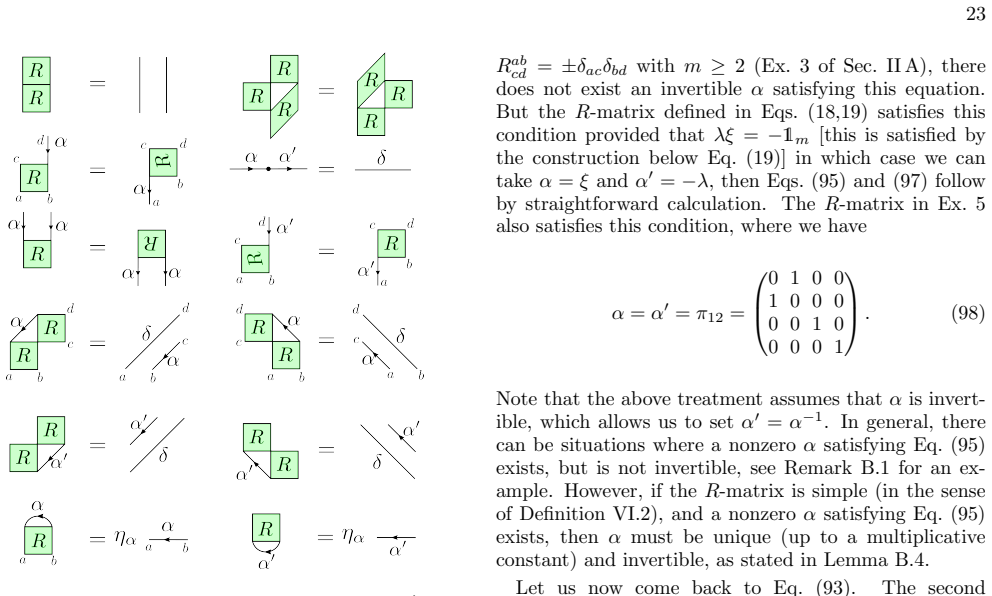
The central object is an involutive R-matrix — a four-index tensor R^{ab}_{cd} satisfying R^2 = 1 and the constant Yang-Baxter equation — which replaces the scalar exchange sign of fermions and bosons with a unitary rotation of the internal indices. It enters the commutation relations (24), the physical exchange operator (82), the locality condition for pair creation (95), and the simplicity condition (trivial diagonal commutant) that controls local indistinguishability. The classification theorem for self-dual pair creation turns the tensor α into the Frobenius-Schur indicator, forces R to be dual-unitary, and extracts the topological twist factor θ, thereby pinning down the single-mode Hil
Load-bearing premise
The observability program rests on Assumption III.1 — that there exist two special points o and s where a paraparticle's internal index can be locally measured (Eq. 83) and unitarily rotated (Eq. 85) — and the construction of one of those observables is deferred to part II; if such point defects cannot be realized in any physical system, the claimed experimental distinction from fermions and bosons with a hidden index is not yet demonstrated.
What would settle it
The most direct test: in a solvable spin model realizing the set-theoretical R-matrix of Eq. (20), place two paraparticles at two point defects, prepare definite internal states (a, b), exchange them, and measure the final internal states. If the correlation R^{b'a'}_{ab} of Eq. (22) does not appear — i.e., the indices simply travel with the particles so that a' = a and b' = b for all inputs — then the claimed observable nontrivial exchange statistics fail. Alternatively, a direct calculation of Tr1[R] for any unitary involutive simple R-matrix admitting a nonzero α satisfying Eq. (95) that yi
If this is right
- If R-paraparticles are correct, particle statistics is not limited to fermions and bosons: there exist consistent, locally indistinguishable particle types in any spatial dimension whose exchange statistics are observably distinct.
- Two separated parties holding R-paraparticles could secretly exchange information or generate long-distance entanglement merely by exchanging their positions, with the information transfer bounded by 2 log D_R for systems described by symmetric fusion categories.
- Free R-paraparticle Hamiltonians, including U(1)-breaking pair-creation terms, are exactly solvable: the many-body spectrum follows from diagonalizing a 2N × 2N Bogoliubov-type matrix, and a generalized Wick's theorem applies.
- For simple self-dual R-paraparticles, the topological twist factor and Frobenius-Schur indicator are well-defined invariants, and the single-mode partition function is fixed by θ, making these quantities calculable and potentially measurable.
- R-paraparticles beyond symmetric fusion categories, such as the R = −1 case of Ex. 3, would violate the conjectured information-transfer bound and are therefore argued to be unlikely realizable in 2D or 3D gapped topological phases.
Where Pith is reading between the lines
- Beyond the paper: if the special point defects (black defects) can be physically realized, a single two-particle exchange experiment in a solvable spin model would certify non-fermionic, non-bosonic statistics in any dimension without requiring global braiding or topological loops.
- Beyond the paper: the pair-creation formalism suggests that R-paraparticle analogs of superconductivity and of Klein-Gordon fields could be engineered in synthetic quantum matter platforms where U(1)-breaking pairing terms are controlled externally.
- Beyond the paper: the categorical description in terms of possibly non-rigid symmetric tensor categories with infinitely many simple objects indicates that some R-paraparticle types lie outside the symmetric-fusion-category framework; detecting them would require new many-body machinery, and the conjectured bound on information transfer offers a practical diagnostic.
- Beyond the paper: the paper leaves the explicit construction of one key defect observable (O'_s and F'^{a,b}_s) to part II; until that construction is completed, the experimentally demonstrated distinction from fermions or bosons with a hidden index rests on an assumption rather than a proven microscopic realization.
Editorial analysis
A structured set of objections, weighed in public.
Referee Report
Summary. This paper develops the theoretical foundations of R-parastatistics, a second-quantized framework for particles whose exchange statistics are determined by an involutive unitary R-matrix. It constructs local observables, a Fock-space representation, generalized exclusion statistics, mutual parastatistics, weak equivalence, exact solutions for bilinear Hamiltonians, a Wick theorem, and a description of hidden Hopf-algebra symmetries. The central physical claim is that R-paraparticles form a consistent, locally defined, exactly solvable quantum theory whose exchange statistics are observably distinct from those of fermions and bosons with hidden flavor. The paper's main constructive additions are the general local-observable theory, the pair-creation classification theorem (Thm. IV.1), and the hidden-symmetry framework leading to local-indistinguishability criteria.
Significance. If the central claims hold, this is a substantial contribution: it provides a coherent algebraic framework for particle statistics beyond the fermion/boson dichotomy, with exact solvability, a Fock-space construction, a classification theorem for pair creation, and a categorical/hidden-symmetry description. Strengths include the explicit derivations of the CRs (24), orthonormality of the Fock basis (42), the gl_N Lie-algebra structure (31), the Bogoliubov-type exact solution in Sec. V B, and the structural theorems on hidden symmetries and local indistinguishability in Sec. VI. The paper is also careful to label its assumptions and defer some constructions to part II. However, the observable-distinction claim is currently not established: the explicit defect probe O_o in Eq. (84) is not local under the paper's own Definition II.2 for the simple R-matrices on which the nontrivial exchange statistics rely. The significance is therefore conditional until that locality obstruction is removed.
major comments (2)
- [Sec. III C, Eq. (84); Definition II.2; Cor. VI.5] The proposed defect observable O_o = \sum_a a \hat\psi^+_{o,a} \hat\psi^-_{o,a} is not a local observable under Definition II.2 for the unitary simple R-matrices on which the nontrivial exchange claim rests. Writing O_o = \hat e^\kappa_{oo} with \kappa = diag(1,\ldots,m), the locality condition for quadratic operators, Eq. (34), requires \kappa \in D'[R]. By Cor. VI.5, for simple R (e.g., Exs. 3, 5, 6) one has D'[R] = C\cdot 1, so \kappa \notin D'[R] for m>1. Hence [O_o, \hat\psi^-_{k,b}] \neq 0 for k \neq o, and the statement below Eq. (84) that introducing O_o does not break locality is incorrect. This is load-bearing because the exchange-statistics readout and the quantum-information applications in Sec. III D use O_o as the local probe of the internal index. The deferred construction of O'_s in part II cannot repair the explicit failure of O_o; the revision should either provide a ge
- [Sec. III C; Assumption III.1; Secs. III D and VII] The entire observability program—exchange-statistics readout, secret communication, and entanglement generation—rests on Assumption III.1, which postulates the existence of two special points o,s where a paraparticle's internal index can be locally measured and unitarily rotated. The construction of O'_s and F'^{a,b}_s is deferred to part II, and the one explicit construction that is given, O_o in Eq. (84), is not local for the simple R-matrices considered. Thus the paper's abstract and Sec. III C present the experimental distinction from fermions/bosons as an established feature, but it is currently an assumption-dependent claim whose consistency with the local-observable algebra is not demonstrated. The revision should state clearly that the observable distinction is conditional on the existence of black defects, and should either prove that such defects can be consistently incorporate
minor comments (4)
- [Eq. (32)] The displayed formula for \hat n_i uses i as the summation index: \hat n_i = \sum_{i=1}^m \hat\psi^+_{i,a} \hat\psi^-_{i,a}. It should be \sum_{a=1}^m, with a as the internal index.
- [Sec. II D 2, Eq. (52)] The statement that the explicit matrix representation in Eq. (52) satisfies the CRs (24) is deferred to part II. Since this representation underlies the Fock-space construction, it would strengthen the present paper to include at least a sketch of the verification or to state explicitly that the proof is postponed.
- [Sec. IV A 3 a, Thm. IV.1] The proof of Thm. IV.1 is said to be in App. B, but the review copy does not contain the full appendix. Please ensure the submitted version includes the complete proof, since this theorem supports the pair-creation classification and the definitions of the Frobenius-Schur indicator and topological twist factor.
- [Sec. III D 3] The upper bound in Eq. (88) is stated with the proof deferred to part II. In the meantime, the sentence immediately below Eq. (88) should make clear that this is a claimed result rather than a theorem proved in this paper, particularly because Sec. III D 4 uses it to argue against the realizability of beyond-SFC paraparticles.
Circularity Check
Mathematical core is self-contained; the observability claim has a self-definitional gap at the defect probe (Eq. 84 vs. Def. II.2).
specific steps
-
self definitional
[Sec. III C, Eq. (84), with Def. II.2 and Cor. VI.5]
"The observable ˆOo in Eq. (83) can be simply constructed as ˆOo = P a a ψ^+_{o,a}ψ^-_{o,a}. ... Importantly, for any local observable ˆOS defined in Definition II.2 away from o ..., we have [ ˆOo, ˆOS] = 0 [which follows from Eq. (27)], therefore, introducing the “extra” local observable ˆOo only at o does not break the locality of the quantum theory."
For a quadratic operator e^κ_{oo}, Eq. (34) makes locality equivalent to κ ∈ D′[R]. For the simple unitary R-matrices used for nontrivial exchange (e.g., Exs. 3, 5, 6), Cor. VI.5 states D′[R] = C1, so κ = diag(1,…,m) is excluded. Thus O_o is not a local observable under the paper’s own Def. II.2; its ability to read out the internal index is not derived from the local-observable algebra but is an extra redefinition (Assumption III.1). The observability conclusion is therefore built into the assumed status of O_o rather than obtained from the theory, and the deferred construction of O′_s in part II cannot repair this specific locality failure at o.
full rationale
The paper contains no data fitting or fitted-parameter predictions; the core mathematical chain (CRs Eq. (24) → Fock basis → Hilbert series → exact solution → Thm. IV.1 → hidden symmetries → simplicity/local-indistinguishability theorems) is proved from stated definitions and has independent content. The serious issue is the observational bridge: Eq. (84) presents O_o as a local observable at a defect, but the paper’s own locality criterion (Def. II.2 and Eq. (34), with D′[R]=C1 for simple R by Cor. VI.5) excludes the required κ=diag(1,…,m). Hence the claimed ability to measure the internal index and thereby observe the exchange R-matrix is not a consequence of the local-observable theory; it is an extra postulate (Assumption III.1) whose o-defect half is not actually constructed. The paper labels this as an assumption and defers O′_s and F′^{a,b}_s to part II, so this is partly an acknowledged limitation rather than a hidden circularity; nevertheless the displayed “construction” makes the observability claim self-referential: the readout observable is asserted to be local rather than shown to satisfy the definition. The mathematical classification and exact-solution results do not depend on this step, so the overall circularity is partial (score 3), not pervasive.
Axiom & Free-Parameter Ledger
free parameters (4)
- quantum dimension m
- R-matrix tensor R
- pair-creation tensor α
- mode count N and Hamiltonian coefficients
axioms (8)
- domain assumption The second-quantization algebra with R-matrix commutation relations (Eq. 24) defines what an R-paraparticle is
- domain assumption Existence of a unique vacuum |0⟩ annihilated by all ψ⁻_{i,a}, with the spectrum of n̂ bounded from below
- domain assumption Unitarity of the R-matrix for the physically natural normalization and for Thm IV.1
- domain assumption Simplicity of R (D′[R] = C1) for the classification theorem
- ad hoc to paper Assumption III.1: black defects o, s exist where internal indices are locally measurable and unitarily rotatable
- domain assumption Eq. (52) indeed defines a representation of the CRs (24)
- domain assumption Single-mode partition functions factorize as products over modes (Eq. 55)
- standard math Background: representation theory of S_N, constant Yang-Baxter solutions, triangular Hopf algebras, symmetric tensor categories
invented entities (4)
-
R-paraparticles
no independent evidence
-
Black defects (o, s)
no independent evidence
-
Fundamental bialgebra/Hopf hidden symmetry A_R
no independent evidence
-
R-parastatistical Majorana fermions χ̂_{jζa}
no independent evidence
read the original abstract
Parastatistics is an exotic type of exchange statistics beyond fermions and bosons. Paraparticles transform in higher dimensional representations of the exchange symmetry group, analogous to non-Abelian anyons, yet consistently defined in any dimension. Although paraparticles have long been proposed, they were widely believed to be physically equivalent to fermions or bosons. Nevertheless, a recent paper proposed a different theory, called $R$-parastatistics, and demonstrated that nontrivial $R$-paraparticles can emerge as quasiparticles in condensed matter systems, and are observably distinct from both fermions and bosons. This paper develops the theoretical foundation and several extensions of $R$-parastatistics, with particular emphasis on its observable consequences. Central to this paper is a general theory of local observables extending the basic family introduced before. First, we define local observables that distinguish particle types. Second, we formulate local observables at special point defects that probe the internal indices of $R$-paraparticles, crucial for observing $R$-parastatistics and for the proposed applications in quantum information. Third, we introduce local observables that create or annihilate particle-antiparticle pairs, important for building a relativistic quantum field theory for $R$-paraparticles. We further introduce generalized hidden symmetries that act on internal indices of $R$-paraparticles while preserving the local observable algebra, providing a basis for proving local indistinguishability and for connecting to a categorical description of $R$-paraparticles. This work sets a solid theoretical foundation for understanding the fundamental physical properties of $R$-paraparticles and pave the way for finding them in nature.
Figures



Reference graph
Works this paper leans on
-
[1]
ConstructingR-matrices from triangular Hopf algebras A common way to construct solutions to the constant Yang-Baxter equation (14) is through quasitriangular Hopf algebras [42–45, 136]. A quasitriangular Hopf al- gebraAis a Hopf algebra equipped with a universalR- matrixR ∈ A ⊗ Asatisfying the algebraic Yang-Baxter equation (along with some other axioms w...
-
[2]
VI.1 on the existence of a basic bialgebra symmetry of anR-paraparticle system
F undamental Hopf symmetry of an R-paraparticle system In the following we prove Thm. VI.1 on the existence of a basic bialgebra symmetry of anR-paraparticle system. The basic idea is simple: we construct the basic bialgebra symmetryAas the algebra generated by{v pq|1≤p, q≤ m}, where we definev pq directly via its action on the state space, using Eq. (188...
-
[3]
realization
Green’s theory of parastatistics Green’s parastatistics [1, 9, 11–13, 15] is defined by a set oftrilinearCRs (rather thanbilinearCRs used to defineR-parastatistics) between paraparticle creation and annihilation operators h ˆψ† i , ˆψj i ± , ˆψl − =−2δ il ˆψj, h ˆψi, ˆψj i ± , ˆψl − = 0, (C1) where [ ˆA, ˆB]± = ˆA ˆB± ˆB ˆA, andi, j, lare mode indices. Th...
-
[4]
Note that no relation is imposed on products of creation operators, in contrast toR-parastatistics
Infinite statistics and quons Quons were introduced by Greenberg [149] as a defor- mation of Bose and Fermi statistics, with annihilation and creation operators satisfying ˆψk ˆψ† l −q ˆψ† l ˆψk =δ kl,(C3) where−1≤q≤1, andq=±1 recover ordinary bosons (+) and fermions (−), respectively, whileq= 0 gives infinite statistics [150]. Note that no relation is im...
-
[5]
T ranstatistics Ref. [151] developed a theory of generalized quan- tum statistics under the name of transtatistics, which is closely related toR-parastatistics, but using a funda- mentally different approach. They started with a differ- ent set of assumptions: instead of postulating a second- quantized operator algebra, they assume that single- particle d...
-
[6]
In this section we mention some interesting families of particle statistics that are limited to 1D, includingq- deformed bosons (Sec
Generalized statistics in 1D Up to now we have been discussing particle statistics that are consistently defined in any spatial dimension. In this section we mention some interesting families of particle statistics that are limited to 1D, includingq- deformed bosons (Sec. C 4 a), parafermions (Sec. C 4 b), and 1D Abelian anyons (Sec. C 4 c). Then in Sec. ...
-
[7]
We now mention some no- table families of quantum statistics that are studied with- out using a second quantization formalism
Other theories Up to now we have discussed various second quantized theories of quantum particle statistics that generalize or- dinary fermions and bosons. We now mention some no- table families of quantum statistics that are studied with- out using a second quantization formalism. In spatial dimensions higher than two, topological phases can contain exte...
-
[8]
H. S. Green, A generalized method of field quantization, Phys. Rev.90, 270 (1953)
1953
-
[9]
Doplicher, R
S. Doplicher, R. Haag, and J. E. Roberts, Local observ- ables and particle statistics I, Commun. Math. Phys.23, 199 (1971); Local observables and particle statistics II, Commun. Math. Phys.35, 49 (1974)
1971
-
[10]
Doplicher and J
S. Doplicher and J. E. Roberts, Fields, statistics and non-abelian gauge groups, Commun. Math. Phys.28, 331 (1972)
1972
-
[11]
Wang and K
Z. Wang and K. R. A. Hazzard, Particle exchange statistics beyond fermions and bosons, Nature637, 314 (2025)
2025
-
[12]
Wang, Parastatistics and a secret communication challenge, Phys
Z. Wang, Parastatistics and a secret communication challenge, Phys. Rev. Res.8, L022056 (2026)
2026
-
[13]
Z. Wang, Secret communication games and a hier- archy of quasiparticle statistics in 3+1D topologi- cal phases, ArXiv Prepr. ArXiv251011818 (2025), arXiv:2510.11818
arXiv 2025
-
[14]
Buchholz and K
D. Buchholz and K. Fredenhagen, Locality and the structure of particle states, Commun. Math. Phys.84, 1 (1982)
1982
-
[15]
J. B. Hartle and J. R. Taylor, Quantum mechanics of paraparticles, Phys. Rev.178, 2043 (1969)
2043
-
[16]
Araki, On the connection of spin and commutation relations between different fields, J
H. Araki, On the connection of spin and commutation relations between different fields, J. Math. Phys.2, 267 (1961)
1961
-
[17]
O. W. Greenberg, Spin and Unitary-Spin Independence in a Paraquark Model of Baryons and Mesons, Phys. Rev. Lett.13, 598 (1964)
1964
-
[18]
O. W. Greenberg and A. M. L. Messiah, Selection rules for parafields and the absence of para particles in nature, Phys. Rev.138, B1155 (1965)
1965
-
[19]
P. V. Landshoff and H. P. Stapp, Parastatistics and a unified theory of identical particles, Ann. Phys.45, 72 (1967)
1967
-
[20]
Dr¨ uhl, R
K. Dr¨ uhl, R. Haag, and J. E. Roberts, On parastatistics, Commun. Math. Phys.18, 204 (1970)
1970
-
[21]
R. H. Stolt and J. R. Taylor, Classification of paraparti- cles, Phys. Rev. D1, 2226 (1970)
1970
-
[22]
R. H. Stolt and J. R. Taylor, Correspondence between the first- and second-quantized theories of paraparticles, Nucl. Phys. B19, 1 (1970)
1970
-
[23]
V. N. Tolstoy, Once more on parastatistics, Physics of Particles and Nuclei Letters11, 933 (2014)
2014
-
[24]
D. J. Baker, H. Halvorson, and N. Swanson, The con- ventionality of parastatistics, Br. J. Philos. Sci.66, 929 (2015)
2015
-
[25]
Doplicher and J
S. Doplicher and J. E. Roberts, Why there is a field al- gebra with a compact gauge group describing the super- selection structure in particle physics, Commun. Math. Phys.131, 51 (1990)
1990
-
[26]
R. F. Streater and A. S. Wightman, PCT, Spin and Statistics, and All That (Princeton University Press, 2001)
2001
-
[27]
Haag, Local Quantum Physics: Fields, Particles, Algebras (Springer-Verlag, Berlin, Heidelberg, 1996)
R. Haag, Local Quantum Physics: Fields, Particles, Algebras (Springer-Verlag, Berlin, Heidelberg, 1996)
1996
-
[28]
H. Halvorson and M. M¨ uger, Algebraic quantum field theory, ArXiv Prepr Math-Ph0602036 (2006), 52 arXiv:math-ph/0602036
Pith/arXiv arXiv 2006
-
[29]
J. M. Leinaas and J. Myrheim, On the theory of iden- tical particles, Nuovo Cim. B37, 1 (1977)
1977
-
[30]
Wilczek, Magnetic flux, angular momentum, and statistics, Phys
F. Wilczek, Magnetic flux, angular momentum, and statistics, Phys. Rev. Lett.48, 1144 (1982); Quantum mechanics of fractional-spin particles, Phys. Rev. Lett. 49, 957 (1982)
1982
-
[31]
Wilczek, Fractional Statistics and Anyon Superconductivity (WORLD SCIENTIFIC, Singapore, 1990)
F. Wilczek, Fractional Statistics and Anyon Superconductivity (WORLD SCIENTIFIC, Singapore, 1990)
1990
-
[32]
Nayak, S
C. Nayak, S. H. Simon, A. Stern, M. Freedman, and S. Das Sarma, Non-Abelian anyons and topologi- cal quantum computation, Rev. Mod. Phys.80, 1083 (2008)
2008
-
[33]
Stern, Anyons and the quantum Hall effect–A peda- gogical review, Ann
A. Stern, Anyons and the quantum Hall effect–A peda- gogical review, Ann. Phys.323, 204 (2008)
2008
-
[34]
For example, under the exchange of particles 1 and 3, the state should multiply by the matrixR 1R2R1
Note that we only need to specify the behavior of the state under exchange of particles with adjacent labels, since exchange of particles with nonadjacent labels can always be decomposed into a series of adjacent ex- changes. For example, under the exchange of particles 1 and 3, the state should multiply by the matrixR 1R2R1
-
[35]
Kassel and V
C. Kassel and V. Turaev, Braid Groups, Graduate Texts in Mathematics, Vol. 247 (Springer New York, 2008)
2008
-
[36]
Witten, Quantum field theory and the Jones polyno- mial, Commun
E. Witten, Quantum field theory and the Jones polyno- mial, Commun. Math. Phys.121, 351 (1989)
1989
-
[37]
Moore and N
G. Moore and N. Read, Nonabelions in the fractional quantum Hall effect, Nucl. Phys. B360, 362 (1991)
1991
-
[38]
Kitaev, Fault-tolerant quantum computation by anyons, Ann
A.Yu. Kitaev, Fault-tolerant quantum computation by anyons, Ann. Phys.303, 2 (2003)
2003
-
[39]
Kitaev, Anyons in an exactly solved model and be- yond, Ann
A. Kitaev, Anyons in an exactly solved model and be- yond, Ann. Phys. January Special Issue,321, 2 (2006)
2006
-
[40]
X. G. Wen, Colloquium: Zoo of quantum- topological phases of matter, Rev. Mod. Phys. 89, 10.1103/RevModPhys.89.041004 (2017)
-
[41]
Fredenhagen, K.-H
K. Fredenhagen, K.-H. Rehren, and B. Schroer, Supers- election sectors with braid group statistics and exchange algebras, Commun. Math. Phys.125, 201 (1989)
1989
-
[42]
M. Mekonnen, T. D. Galley, and M. P. M¨ uller, Invari- ance under quantum permutations rules out parastatis- tics, Nat Commun 10.1038/s41467-026-73064-6 (2026)
-
[43]
quantum permutation symme- try
In some sense, Ref. [35] rules outG-protected indistin- guishable paraparticles, whereG=S n (the symmetric group) is the particle exchange symmetry itself, or more generally, the so called “quantum permutation symme- try” [35]. In condensed matter and high energy physics, we normally do not treat particle exchange symmetry as a fundamental symmetry of a p...
-
[44]
Kohno, Monodromy representations of braid groups and Yang-Baxter equations, in Ann Inst
T. Kohno, Monodromy representations of braid groups and Yang-Baxter equations, in Ann Inst. Fourier, Vol. 37 (1987) pp. 139–160
1987
-
[45]
Wenzl, Representations of braid groups and the quantum Yang-Baxter equation., Pac
H. Wenzl, Representations of braid groups and the quantum Yang-Baxter equation., Pac. J. Math.145, 153 (1990)
1990
-
[46]
Zhang, M
R. Zhang, M. Gould, and A. Bracken, From representa- tions of the braid group to solutions of the Yang-Baxter equation, Nucl. Phys. B354, 625 (1991)
1991
-
[47]
V. G. Turaev, The Yang-Baxter equation and invariants of links, Invent. Math.92, 527 (1988)
1988
-
[48]
L. H. Kauffman, Knots and Physics, 3rd ed. (WORLD SCIENTIFIC, Singapore, 2001)
2001
-
[49]
V. G. Drinfeld, Quantum groups, Proc Int Congr Math Berkeley 1986155, 18 (1986)
1986
-
[50]
Majid, Quasitriangular Hopf Algebras and Yang- Baxter equations, Int
S. Majid, Quasitriangular Hopf Algebras and Yang- Baxter equations, Int. J. Mod. Phys. A05, 1 (1990)
1990
-
[51]
Klimyk and K
A. Klimyk and K. Schm¨ udgen, Quantum Groups and Their Representations (Springer-Verlag, Berlin, Heidelberg, 1997)
1997
-
[52]
Kassel, Quantum Groups, Vol
C. Kassel, Quantum Groups, Vol. 155 (Springer, New York, 1995)
1995
-
[53]
L. H. Kauffman and S. J. Lomonaco, Quantum entan- glement and topological entanglement, New J. Phys.4, 73 (2002)
2002
-
[54]
Dye, Unitary solutions to the Yang–Baxter equa- tion in dimension four, Quantum Inf
HA. Dye, Unitary solutions to the Yang–Baxter equa- tion in dimension four, Quantum Inf. Process.2, 117 (2003)
2003
-
[55]
JIMBO, Introduction to the Yang-Baxter equation, Int
MICHIO. JIMBO, Introduction to the Yang-Baxter equation, Int. J. Mod. Phys. A04, 3759 (1989)
1989
-
[56]
Faddeev, How algebraic Bethe ansatz works for in- tegrable model, ArXiv Prepr
LD. Faddeev, How algebraic Bethe ansatz works for in- tegrable model, ArXiv Prepr. Hep-Th9605187 (1996), arXiv:hep-th/9605187
Pith/arXiv arXiv 1996
-
[57]
V. E. Korepin, N. M. Bogoliubov, and A. G. Izergin, Quantum Inverse Scattering Method and Correlation Functions, Cambridge Monographs on Mathematical Physics (Cambridge University Press, Cambridge, 1993)
1993
-
[58]
R. J. Baxter, Exactly Solved Models in Statistical Mechanics (Dover Publications, 2013)
2013
-
[59]
Etingof, T
P. Etingof, T. Schedler, and A. Soloviev, Set-theoretical solutions to the quantum Yang-Baxter equation, Duke Math. J.100, 169 (1999)
1999
-
[60]
Hietarinta, All solutions to the constant quantum Yang-Baxter equation in two dimensions, Phys
J. Hietarinta, All solutions to the constant quantum Yang-Baxter equation in two dimensions, Phys. Lett. A165, 245 (1992)
1992
-
[61]
Rump, Braces, radical rings, and the quantum Yang–Baxter equation, J
W. Rump, Braces, radical rings, and the quantum Yang–Baxter equation, J. Algebra307, 153 (2007)
2007
-
[62]
Ced´ o, E
F. Ced´ o, E. Jespers, and A. Del Rio, Involutive Yang- Baxter groups, Trans. Amer. Math. Soc.362, 2541 (2010)
2010
-
[63]
Ced´ o, E
F. Ced´ o, E. Jespers, and J. Okni´ nski, Braces and the Yang–Baxter equation, Commun. Math. Phys.327, 101 (2014)
2014
-
[64]
Guarnieri and L
L. Guarnieri and L. Vendramin, Skew braces and the Yang–Baxter equation, Math. Comp.86, 2519 (2017)
2017
-
[65]
Smoktunowicz and A
A. Smoktunowicz and A. Smoktunowicz, Set-theoretic solutions of the Yang–Baxter equation and new classes of R-matrices, Linear Algebra Its Appl.546, 86 (2018)
2018
-
[66]
Lechner, U
G. Lechner, U. Pennig, and S. Wood, Yang-Baxter rep- resentations of the infinite symmetric group, Adv. Math. 355, 106769 (2019)
2019
-
[67]
(19) is satisfied ifξ=λ ∗ is unitary
Form= 2, Eq. (19) is satisfied ifξ=λ ∗ is unitary. This does leads to a unitaryR-matrix, but its exclusion statisticsz R(x) = 1 +mx+x 2 = (1 +x) 2 is trivial
-
[68]
Giaquinto and J
A. Giaquinto and J. Zhang, Quantum weyl algebras, J. Algebra176, 861 (1995)
1995
-
[69]
A. B. Zamolodchikov and A. B. Zamolodchikov, Factor- ized S-matrices in two dimensions as the exact solutions of certain relativistic quantum field theory models, An- 53 nals of Physics120, 253 (1979)
1979
-
[70]
E. K. Sklyanin and L. D. Faddeev, Quantum-mechanical approach to completely integrable field theory mod- els, in Fifty Years of Mathematical Physics, World Sci- entific Series in 21st Century Mathematics, Vol. Volume 2 (WORLD SCIENTIFIC, 2011) pp. 290–292
2011
-
[71]
Lechner and C
G. Lechner and C. Scotford, Fock representations of ZF algebras and R-matrices, Lett Math Phys110, 1623 (2020)
2020
-
[72]
Lechner, Algebraic Constructive Quan- tum Field Theory: Integrable Mod- els and Deformation Techniques, in Advances in Algebraic Quantum Field Theory, edited by R
G. Lechner, Algebraic Constructive Quan- tum Field Theory: Integrable Mod- els and Deformation Techniques, in Advances in Algebraic Quantum Field Theory, edited by R. Brunetti, C. Dappiaggi, K. Fredenhagen, and J. Yngvason (Springer International Publishing, Cham,
-
[73]
Sotiriadis, D
S. Sotiriadis, D. Fioretto, and G. Mussardo, Zamolodchikov–Faddeev algebra and quantum quenches in integrable field theories, J. Stat. Mech. 2012, P02017 (2012)
2012
-
[74]
S. B. Priddy, Koszul Resolutions, Trans. Am. Math. Soc. 152, 39 (1970), 1995637
1970
-
[75]
Polishchuk and L
A. Polishchuk and L. Positselski, Quadratic Algebras, Vol. 37 (American Mathematical Society, 2005)
2005
-
[76]
N. M. S´ anchez and B. Daki´ c, Reconstruction of Quan- tum Fields: CCR, CAR and Transfields, ArXiv Prepr. ArXiv251216775 (2025), arXiv:2512.16775
Pith/arXiv arXiv 2025
-
[77]
Wang and K
Z. Wang and K. R. A. Hazzard, Tightening the Lieb- Robinson Bound in Locally Interacting Systems, PRX Quantum1, 010303 (2020)
2020
-
[78]
E. H. Lieb and D. W. Robinson, The finite group ve- locity of quantum spin systems, Commun. Math. Phys. 28, 251 (1972)
1972
-
[79]
M. B. Hastings and T. Koma, Spectral gap and ex- ponential decay of correlations, Commun. Math. Phys. 265, 781 (2006)
2006
-
[80]
Nachtergaele and R
B. Nachtergaele and R. Sims, Lieb-Robinson bounds and the exponential clustering theorem, Commun. Math. Phys.265, 119 (2006)
2006
discussion (0)
Sign in with ORCID, Apple, or X to comment. Anyone can read and Pith papers without signing in.