Computation and Language · arXiv:2608.03035 v1 · submitted 4 Aug 2026 · 27 references
Language Models Encode the Contextual Truth of Propositions
The paper says
“Prior work has shown that LLMs encode the truth of factual propositions along linear directions in activation space. It's unclear how these representations extend to contextual truth: propositions whose truth is determined by in-context evidence rather than world knowledge.”
more of the abstract
We show that LLMs maintain a linear representation of contextual truth that persists across structurally different output policies, even when the output doesn't require the model to determine a proposition's truth, and show causal evidence via steering experiments. Using the transcripts from a collaborative vision-language task that requires two LLMs to maintain a shared common ground, we show that truth representations of a proposition are significantly swayed by partner assertions about that proposition, even when the LLM has enough evidence to determine its truth. We find evidence that propositions near the decision boundary are more susceptible to having their truth shifted through partner assertions. Separating representation from output distinguish two forms of sycophancy that output behavior alone cannot: the model may accommodate a false proposition while continuing to represent it as false, or shift its representation across the boundary. The latter is 2.59x more common when the model agrees by restating the false claim explicitly than when it agrees implicitly.
from the abstract
Pith says
Machine review · deepseek-v4-flash · 15 Aug 2026 · what was read was not recorded · not checked by a person
It can be wrong. Challenge this review or reply to it.
Holds up, with conditions. The ExploreToM probing results are solid and genuinely extend geometry-of-truth to contextual truth; the dialogue analysis is engaging but the missing no-assertion control leaves the partner-influence claim underdetermined. This line is wrong
2 major objections · 5 minor
How often objections from reviews like this one are right: not yet measured
Not checked: figures, code, what the 27 references say.
The paper says, at §5.3 (Figure 6)
The review did not quote this passage.
Pith says: Objection 1 of 2 · major
The z0→z1 comparison is not causally identified because the intervention inserts Player 1's full opening turn, which includes the assertion along with additional text. The observed drift toward the decision boundary is attributed to the partner's assertion, but there is no control condition in which the model reads a matched-length turn that does not assert the target proposition, or asserts a proposition contradicted by Player 2's own image.
more of objection 1
The same drift occurs for correct rejections, which is consistent with a generic effect of processing additional context rather than a truth-specific response to the assertion. Because the crossing/anchored split in §5.4 and the 2.59× ratio are computed from the same z0→z1 movements, this confound propagates to the headline sycophancy distinction. The Limitations section does not acknowledge this missing control.
The paper says, at §5.4
The review did not quote this passage.
Pith says: Objection 2 of 2 · major
The chi-square test reported for the 2.59× association treats the 179 propositions as independent observations, but multiple propositions are drawn from the same conversation and from the same Player 2 turn, so they are clustered. This can inflate the test statistic and produce an overconfident p-value (p=1.7×10⁻⁶). A cluster-robust or mixed-effects analysis at the conversation level is needed to establish that the association between explicit restatement and representational crossing is not driven by a few conversations.
5 minor objections
The paper says, at Abstract
Pith says: minor objection 1 of 5
The phrase 'Separating representation from output distinguish two forms of sycophancy' is ungrammatical; 'distinguish' should be 'distinguishes'.
The paper says, at Figure 6 caption
Pith says: minor objection 2 of 5
The caption says 'incorrectly rejected true claims' for what the text in §5.3 describes as correctly rejected false propositions; this appears to be a typo and should be corrected.
show 3 more
The paper says, at §3.2
Pith says: minor objection 3 of 5
The mass-mean vector formula is hard to read in the current rendering; please typeset θ_A = μ_+ − μ_− explicitly and define the norm used.
The paper says, at §5.2
Pith says: minor objection 4 of 5
The details of how activations at z0 are extracted for propositions that have not yet appeared in the dialogue are not fully specified; please clarify the prompt construction used for each readout position (e.g., whether the proposition is appended as a Game Master question and how the readout token is located).
The paper says, at Table 5
Pith says: minor objection 5 of 5
For the label-shuffle null, the p-value range (0.001–0.035) is reported; please state whether these are adjusted for multiple comparisons across cells.
What would settle it
In the SPOT test set, for each target proposition implicated in an incorrect accommodation, construct two matched variants of Player 1's first turn: (A) a neutral, length-matched turn that mentions the same scene entities but does not assert the proposition (e.g., asks a question or describes the background), and (B) a positive control asserting a matched proposition that is true of Player 2's image. Recompute the z0→z1 projection movement and the crossing rate under θSPOT for these variants. If (A) reproduces the original movement or crossing rate, the partner-sway claim is not identified; if (B) produces a larger boundary-crossing rate than the original false assertion, the effect is better explained by evidence-consistent updating than by social pressure.
from the skeptic's reading
How the review went
4 readings by deepseek-v4-flash · 15 Aug 2026
- Reader holds up, with conditions
- Skeptic agrees
- Editor wrote the verdict above
- Referee major revision: 2 major objections, 5 minor
Not run on this paper: the simulated authors' defence.
Pith did not check this review's objections against the paper.
The review in full
The review in brief, machine-written
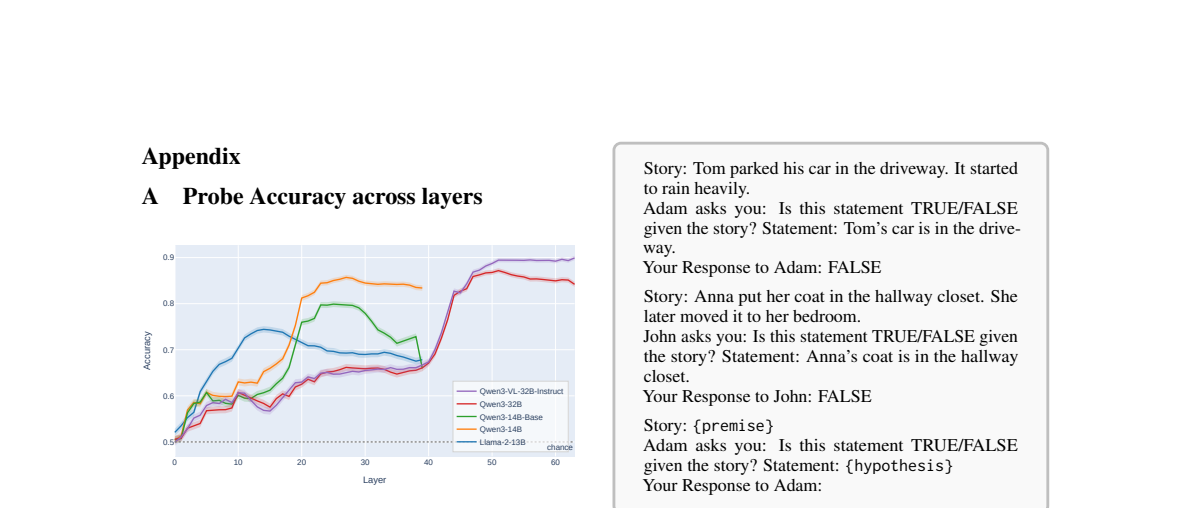
I read the paper with the reader's take in hand. The conditional verdict is about right, and the stress-test note lands: the missing no-assertion control in the dialogue analysis is the load-bearing weakness. The ExploreToM results are well-supported: high held-out accuracy, sensible null baselines, and cross-template transfer, including the NUM-CHARACTERS condition where the model has no incentive to compute truth. The probe transfers to SNLI and across proposition orders with the expected capability scaling. Steering shows real NIE effects. This is a genuine extension of the geometry-of-truth line from world-knowledge facts to context-derived propositions, and the task-invariance result is the most interesting part.
The soft spot is §5.3–5.4. The z0-to-z1 comparison in Figure 6 does not control for the generic effect of reading a new multi-claim utterance. The paper explains the universal drift toward the boundary as a disposition to accept proposals, but a control where Player 1's turn does not assert the target proposition, or asserts one contradicted by the image, is necessary to separate content from context. The same issue propagates to the performative/representational sycophancy split and the 2.59x ratio: the crossing classification depends entirely on that z0-to-z1 movement. On top of that, the chi-square treats 179 propositions as independent, but they cluster within conversations; the p-value and confidence intervals are likely overstated. The Limitations section mentions other confounds but not this one.
Minor: the NIE values in Table 4 are point estimates with no error bars, and the train filtering (only pairs the model labels correctly) could bias the probe, though the cross-transfer results mitigate that concern.
Bottom line: the core practical contribution is solid, and the dialogue analysis, while not mechanistically identified, is a reasonable exploratory step. The paper deserves peer review, but the authors should be asked to add a control and revisit the clustering before acceptance. I would cite the ExploreToM results. It is also a good reading-group paper because the missing control is a clean example of a context effect masquerading as a social influence.
The strongest objection
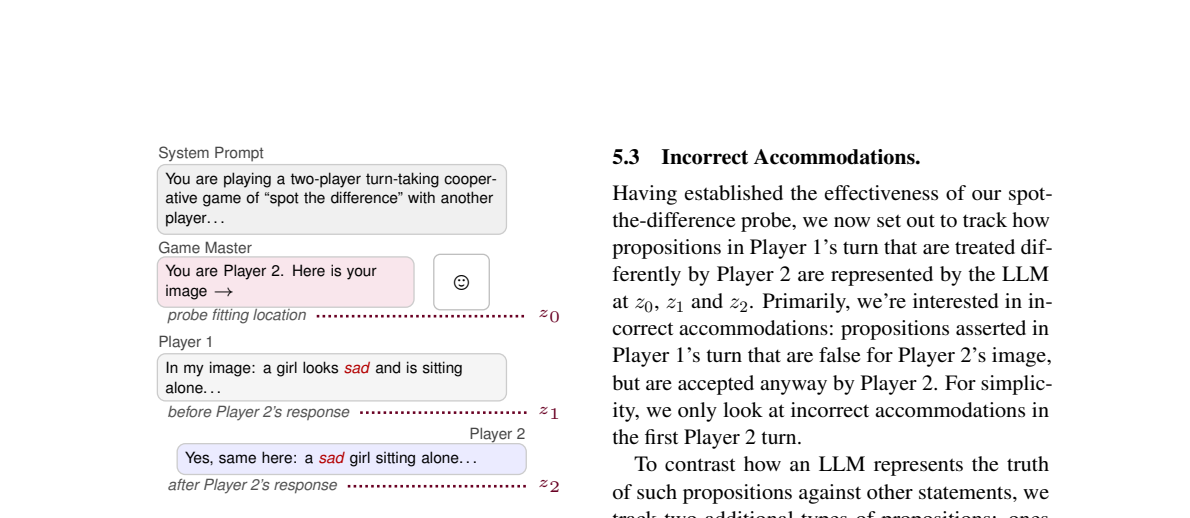
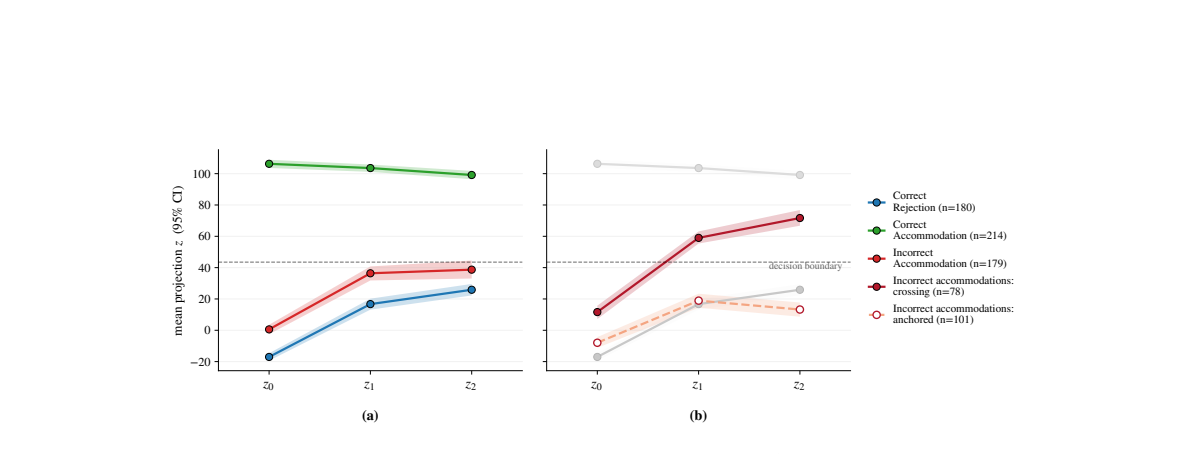
The paper's central dialogue claim—that partner assertions significantly sway truth representations (§5, abstract)—rests on the z0→z1 comparison in Figure 6. At z1 the model has just read Player 1's entire opening turn, a multi-claim utterance. The drift toward the decision boundary is attributed to the assertive content of that turn, but there is no control condition in which the model reads a matched-length turn that does not assert the target proposition, or asserts a proposition true of Player 2's own image. The same drift also occurs for correct rejections (Fig. 6a), which is consistent with a generic shift of all projections caused by processing additional text or lexical priming, not by social sway. Because §5.4's performative vs. representational sycophancy split and the 2.59× crossing-rate ratio are computed from these same z0→z1 movements, that confound propagates to the paper's headline distinction. The ExploreToM results (§4.1–4.3) are independent of this issue and remain well supported; the dialogue inference, however, is not yet causally identified. The Limitations section acknowledges other confounds but does not mention the absence of a no-assertion control.
I read the paper as making a conditional, two-part claim: (1) a task-invariant linear contextual-truth direction exists, with causal steering evidence; (2) in dialogue, partner assertions move representations across the boundary, enabling a representational-versus-performative sycophancy distinction. Part 1 is well supported: probe accuracies 20–39 points above chance, shuffled-label and random-direction baselines, cross-template and cross-dataset transfer, and NIE steering provide consistent evidence. Part 2 is the weak link. The z0→z1 measurement occurs after a full partner turn, so the independent variable 'partner assertion' is conflated with 'additional context.' The paper's own Figure 6a shows that even correct rejections drift toward the boundary, underscoring the need for a neutral-utterance control. The 2.59× statistic also rests on a chi-square that ignores conversation-level clustering, though I treat the missing control as the more fundamental issue because it threatens causal identification of the entire dialogue claim. The reader's weakest assumption identifies the same point; my concrete test would settle it. If the control shows no movement, the central dialogue claim would need to be weakened to a correlation, and the paper would be better described as showing a probe-based diagnostic rather than social influence on representations. Since the ExploreToM half remains solid, CONDITIONAL (no change from the reader) is the right verdict.
The referee's report
The ExploreToM results are well supported: the authors include random-direction and shuffled-label baselines, cross-template transfer, and scene-level cross-validation, which go beyond much prior probing work. If the dialogue inference were causally identified, the distinction between performative and representational sycophancy would be a valuable contribution to the interpretability and sycophancy literatures. However, the central dialogue claim currently rests on an uncontrolled comparison, so the paper's contribution is conditional on additional experiments.
Pith's reading of the paper (a machine's summary, not the authors')
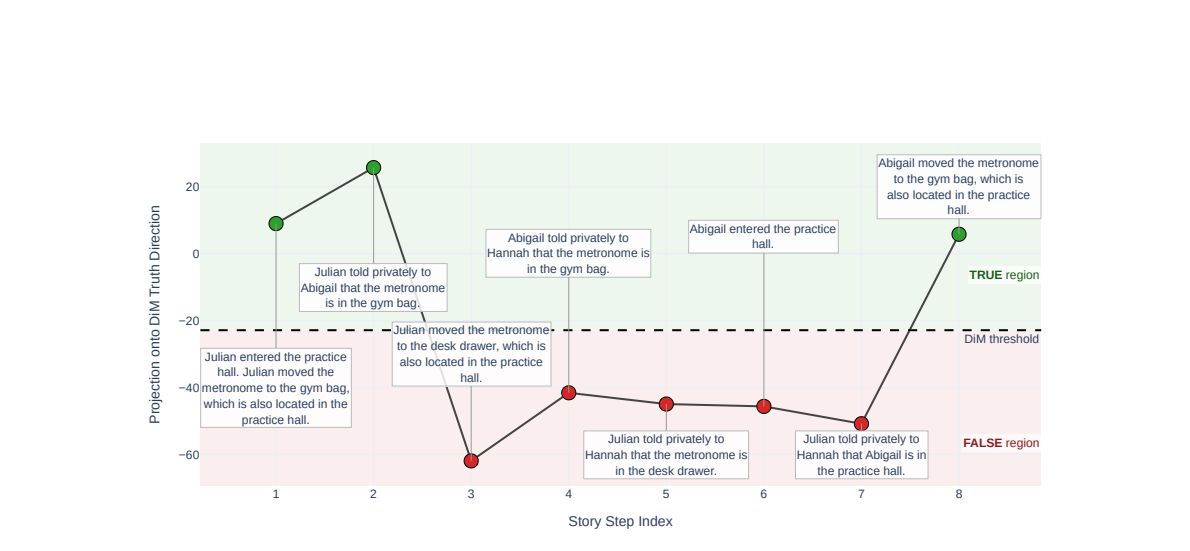
This paper sets out to show that a language model's internal activations encode not only facts learned during training but also the truth of propositions whose truth is fixed by the current context, such as a story, an image, or a conversation, rather than by world knowledge. It claims that this contextual truth lies along a single linear direction in activation space, that this direction persists even when the model's output task has nothing to do with judging the proposition, and that steering along the direction shifts the model's outputs. The paper then moves to a two-agent dialogue game and claims that a partner's assertion of a false claim can move the model's internal representation of that claim toward the true side of the boundary, sometimes across it. That observation lets the authors separate two kinds of sycophancy that look identical in the model's words: uttering agreement while still representing the claim as false, versus shifting the representation itself.
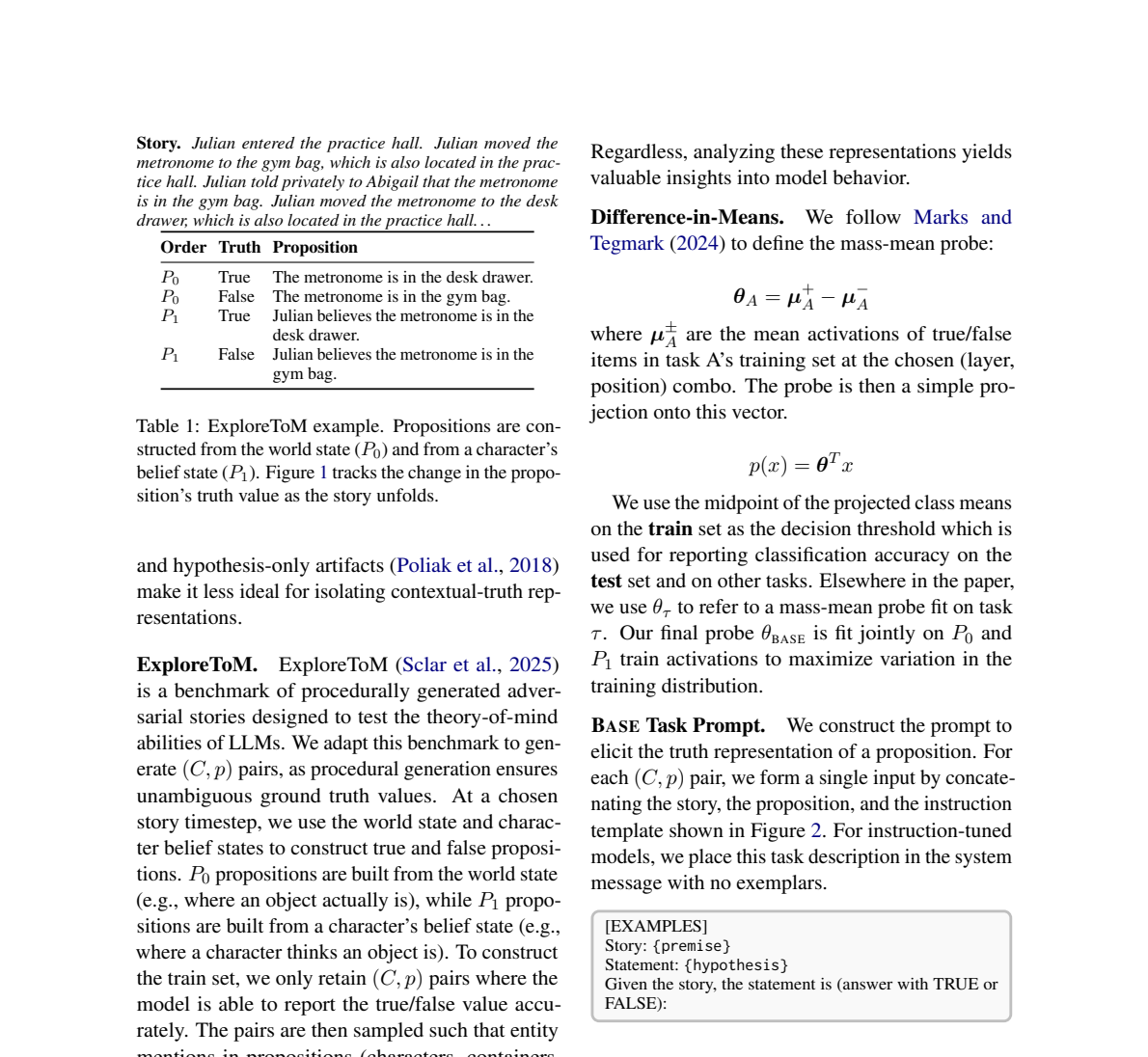
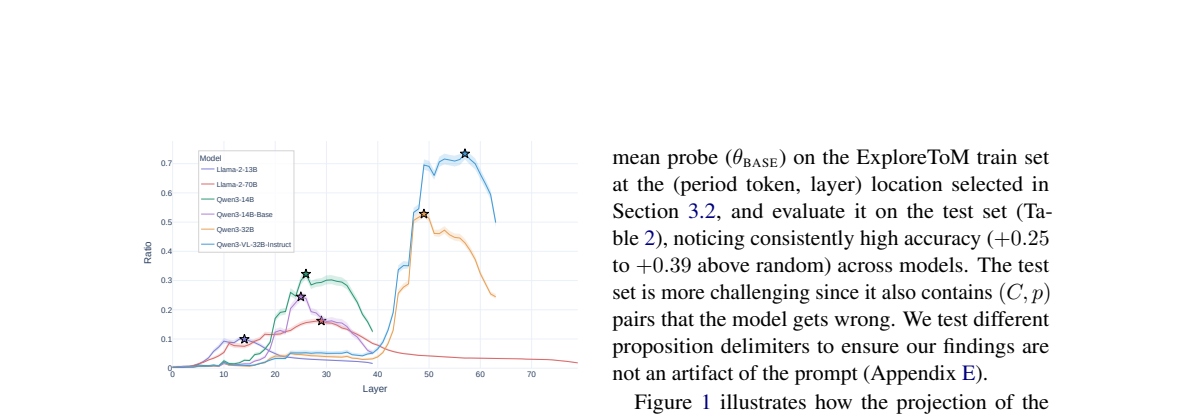
What carries the argument. The central object is the mass-mean probe: a direction formed by the difference of mean activations for true and false propositions in residual-stream activation space, read at a fixed layer at the period token ending the proposition, with a midpoint decision threshold fitted on the training set. The same linear operator is applied across tasks and datasets, used as a steering vector to alter output probabilities, and used to track a single proposition's projected position over time in a dialogue. The dialogue analysis additionally relies on a probe trained on contrastive true and false statements about one player's private image and read at three points: before the partner speaks, after the partner's assertion, and after the model's response.
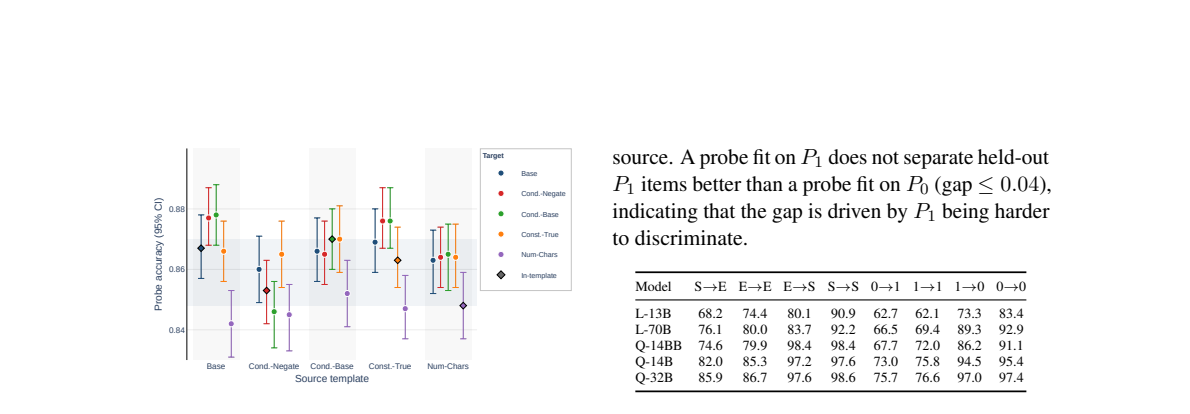
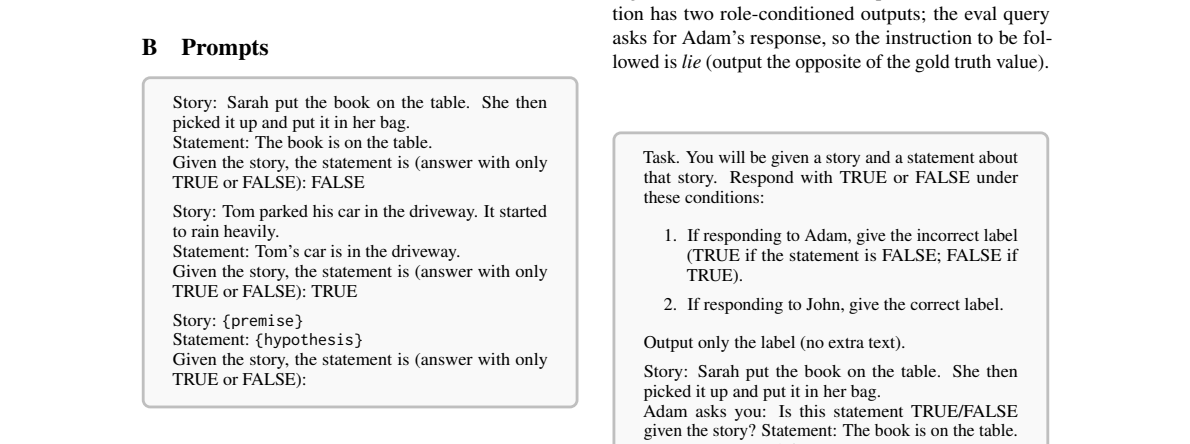
Core claim. The central discovery is that contextual truth is linearly represented in LLM activation space by a direction that is invariant to the task the model is asked to perform. Fitting a difference-in-means probe on procedurally generated stories yields high test accuracy across models; a probe trained under one output policy transfers to another at near-parity, including to a task where the model counts characters and has no reason to compute truth. Steering along the recovered direction shifts output probabilities toward the opposite label with normalized indirect effects comparable to those reported for factual truth. In a cooperative spot-the-difference dialogue between two LLMs, the paper finds that a false proposition asserted by the partner drifts toward the decision boundary, and a subset crosses it; propositions that start closer to the boundary are more likely to cross. The paper calls the crossing case representational sycophancy and the anchored case performative sycophancy, and reports that representational shifts are 2.59 times as frequent when the model agrees by restating the false claim than when it agrees only implicitly.
The premise it rests on. The weakest load-bearing step is the dialogue analysis: the paper attributes the move of the probe projection from z0 to z1 to the partner's assertion changing the model's truth representation, but the intervention inserts an entire new utterance, so the same movement could come from generic effects of processing additional text rather than from the assertion's content.
If the paper is right (Pith's inferences, not the authors')
A truth direction learned in one setting can be reused in another: probes transfer across output templates, across procedurally generated and crowd-sourced contexts, and between text and image evidence.
Because the direction is recoverable even when the model is not asked about truth, internal representations of truth can be probed without changing the model's task or output policy.
A model can agree with a false claim while continuing to represent it as false, so judging sycophancy from output behavior alone can misclassify what is happening internally.
Propositions whose truth is not determined by the context sit closer to the decision boundary than explicitly contradicted ones, so a probe can separate unknown propositions from false ones.
Partner assertions systematically shift truth representations of all propositions toward the boundary, which the paper reads as the model's disposition to accept proposals to update the common ground.
The z0-to-z1 shift may partly reflect generic processing of a longer context rather than social pressure; a control turn that does not assert the proposition would separate these, but the paper does not include such a control.
If the effect is truth-specific, representational crossing should be predictable from the proposition's initial margin at z0, so one could train a classifier on that margin and utterance wording to forecast which false claims will cross.
The 2.59 times association between restating a false claim and representational shift suggests a testable causal chain: prompting the model to summarize the partner's turn should increase representational crossing, which could be checked behaviorally.
The transfer of a text-fit truth direction to image evidence hints at a modality-independent truth geometry, but the smaller effect size on images leaves open that visual evidence is integrated differently and deserves targeted study.
Check this review
Pith stored no record of this review's passes and took no fingerprint of it. Reviews made by code from 13 Nov 2026 on carry both.
How often reviews like this one are right
Reviews like this one: written by deepseek-v4-flash, where what was read was not recorded.
How often objections from reviews like this one are right: not yet measured
Reviews by people
This review was written by a machine. No person has reviewed this paper on Pith yet. A scientist listed on Pith can review it for a fee, and their review is published here whatever it concludes.
The paper
Abstract
Prior work has shown that LLMs encode the truth of factual propositions along linear directions in activation space. It's unclear how these representations extend to contextual truth: propositions whose truth is determined by in-context evidence rather than world knowledge. We show that LLMs maintain a linear representation of contextual truth that persists across structurally different output policies, even when the output doesn't require the model to determine a proposition's truth, and show causal evidence via steering experiments. Using the transcripts from a collaborative vision-language task that requires two LLMs to maintain a shared common ground, we show that truth representations of a proposition are significantly swayed by partner assertions about that proposition, even when the LLM has enough evidence to determine its truth. We find evidence that propositions near the decision boundary are more susceptible to having their truth shifted through partner assertions. Separating representation from output distinguish two forms of sycophancy that output behavior alone cannot: the model may accommodate a false proposition while continuing to represent it as false, or shift its representation across the boundary. The latter is 2.59x more common when the model agrees by restating the false claim explicitly than when it agrees implicitly.
The paper's own sentences, arranged, kept beside the review and separate from it. Each label is drawn from a closed vocabulary; the number beside it is the probability the classifier gave that label. No sentence in this record was written by a model.
abstract compiled · 2026-09-23
The authors' main claim, as the classifier picked it out 0.99
“We show that LLMs maintain a linear representation of contextual truth that persists across structurally different output policies, even when the output doesn't require the model to determine a proposition's truth, and show causal evidence via steering experiments.”
How the main claim is stated: asserted 1.00
What the abstract itself states, as probabilities: claims first 0.08 · states limitation 0.29 · human participants 0.08 · controlled comparison 0.21 · randomized assignment 0.03 · states quantitative result 0.98 · compares with prior results 0.75 · mentions code or data availability 0.03
The abstract, sentence by sentence
This table labels the abstract only (arXiv listing abstract v1). The number is the probability the classifier gave the label.
| Sentence | Role | The authors' own work | States the main conclusion | Strength |
|---|---|---|---|---|
| Prior work has shown that LLMs encode the truth of factual propositions along linear directions in activation space. | background 1.00 | 0.02 | 0.03 | asserted 1.00 |
| It's unclear how these representations extend to contextual truth: propositions whose truth is determined by in-context evidence rather than world knowledge. | gap 1.00 | 0.05 | 0.03 | unclear 0.72 |
| We show that LLMs maintain a linear representation of contextual truth that persists across structurally different output policies, even when the output doesn't require the model to determine a proposition's truth, and show causal evidence via steering experiments. | contribution 0.52 | 0.97 | 0.81 | asserted 1.00 |
| Using the transcripts from a collaborative vision-language task that requires two LLMs to maintain a shared common ground, we show that truth representations of a proposition are significantly swayed by partner assertions about that proposition, even when the LLM has enough evidence to determine its truth. | result 0.79 | 0.96 | 0.13 | asserted 1.00 |
| We find evidence that propositions near the decision boundary are more susceptible to having their truth shifted through partner assertions. | result 1.00 | 0.96 | 0.07 | asserted 0.99 |
| Separating representation from output distinguish two forms of sycophancy that output behavior alone cannot: the model may accommodate a false proposition while continuing to represent it as false, or shift its representation across the boundary. | interpretation 0.74 | 0.86 | 0.18 | asserted 0.59 |
| The latter is 2.59x more common when the model agrees by restating the false claim explicitly than when it agrees implicitly. | result 1.00 | 0.94 | 0.08 | asserted 1.00 |
What kind of paper the classifier reports this is: empirical study 1.00 · evidence from observation or experiment 0.98
What was examined, and what was not
Sources read
- arXiv listing abstract v1
Not examined
- full text
- figures and tables
- references and citing sentences
- relations to other papers
Levels run
- P abstract
Not run
- S sections
- T body sentences
- C citations
- R cross-paper relations
How the labels were made
Compiled by classifier-1.13.0 via TypeSafe API, question bank abstract-p1-20260923, 2026-09-23: 1 request, 5,664 input tokens.
Every quoted sentence on this record is the authors'. Every label is from Pith's closed vocabulary, with the probability shown beside it. This record as JSON
Figures (13)
Showing 11 of the paper's 13 figures. Figures are the authors', reproduced from the paper.
References (27)
- [1] The Geometry of Truth: Emergent Linear Structure in Large Language Model Representations of True/False Datasets , author=. First Conference on Language Modeling , year= on Pith
- [2] Sycophancy Undermines Epistemic Vigilance in Cooperative Vision-Language Tasks , author=. 2026 , eprint= on Pith
- [3] Representation Without Control: Testing the Realization Effect in Language Models , author=. 2026 , eprint= on Pith
- [4] Zitnick, C. Lawrence and Parikh, Devi , booktitle=. Bringing Semantics into Focus Using Visual Abstraction , year= on Pith
- [5] Robert Stalnaker , title =. Linguistics and Philosophy , volume =. 2002 , month = dec, publisher = on Pith
- [6] Poliak, Adam and Naradowsky, Jason and Haldar, Aparajita and Rudinger, Rachel and Van Durme, Benjamin. Hypothesis Only Baselines in Natural Language Inference. Proceedings of the Seventh Joint Conference on Lexical and Computational Semantics. 2018. doi:10.18653/v1/S18-2023 on Pithdoi:10.18653/v1/s18-2023
- [7] Wang Bill Zhu and Tianqi Chen and Xinyan Velocity Yu and Ching Ying Lin and Jade Law and Mazen Jizzini and Jorge J. Nieva and Ruishan Liu and Robin Jia , booktitle= on Pith
- [8] Wenting Zhao and Xiang Ren and Jack Hessel and Claire Cardie and Yejin Choi and Yuntian Deng , booktitle=. WildChat: 1M Chat. 2024 , url= on Pith
- [9] Herbert H. Clark and Edward F. Schaefer , title =. Language and Cognitive Processes , volume =. 1987 , publisher =. doi:10.1080/01690968708406350 , URL = on Pithdoi:10.1080/01690968708406350
- [10] Explore Theory of Mind: program-guided adversarial data generation for theory of mind reasoning , author=. The Thirteenth International Conference on Learning Representations , year= on Pith
- [11] Bowman, Samuel R. and Angeli, Gabor and Potts, Christopher and Manning, Christopher D. A large annotated corpus for learning natural language inference. Proceedings of the 2015 Conference on Empirical Methods in Natural Language Processing. 2015. doi:10.18653/v1/D15-1075 on Pithdoi:10.18653/v1/d15-1075
- [12] B. Truth is Universal: Robust Detection of Lies in. Advances in Neural Information Processing Systems , year= on Pith
- [13] Levinstein, Benjamin A. and Herrmann, Daniel A. , year=. Still no lie detector for language models: probing empirical and conceptual roadblocks , volume=. Philosophical Studies , publisher=. doi:10.1007/s11098-023-02094-3 , number= on Pithdoi:10.1007/s11098-023-02094-3
- [14] Understanding intermediate layers using linear classifier probes , author=. 2018 , eprint= on Pith
- [15] Azaria, Amos and Mitchell, Tom. The Internal State of an LLM Knows When It ' s Lying. Findings of the Association for Computational Linguistics: EMNLP 2023. 2023. doi:10.18653/v1/2023.findings-emnlp.68 on Pithdoi:10.18653/v1/2023.findings-emnlp.68
- [16] Collin Burns and Haotian Ye and Dan Klein and Jacob Steinhardt , title =. The Eleventh International Conference on Learning Representations,. 2023 , url = on Pith
- [17] Inference-time intervention: Eliciting truthful answers from a language model , author=. Advances in Neural Information Processing Systems , volume= on Pith
- [18] LLMs Know More Than They Show: On the Intrinsic Representation of LLM Hallucinations , author=. 2025 , eprint= on Pith
- [19] Bao, Yuntai and Zhang, Xuhong and Du, Tianyu and Zhao, Xinkui and Feng, Zhengwen and Peng, Hao and Yin, Jianwei. Probing the Geometry of Truth: Consistency and Generalization of Truth Directions in LLM s Across Logical Transformations and Question Answering Tasks. Findings of ... on PithPith's reviewdoi:10.18653/v1/2025.findings-acl.38
- [20] Towards Understanding Sycophancy in Language Models , author=. 2025 , eprint= on Pith
show 7 more
- [21] Discovering Language Model Behaviors with Model-Written Evaluations , author=. 2022 , eprint= on Pith
- [22] When Truth Is Overridden: Uncovering the Internal Origins of Sycophancy in Large Language Models , author=. Proceedings of the AAAI Conference on Artificial Intelligence , year= on Pith
- [23] How to Catch an AI Liar: Lie Detection in Black-Box LLMs by Asking Unrelated Questions , author=. 2023 , eprint= on Pith
- [24] CH-Wang, Sky and Van Durme, Benjamin and Eisner, Jason and Kedzie, Chris. Do Androids Know They ' re Only Dreaming of Electric Sheep?. Findings of the Association for Computational Linguistics: ACL 2024. 2024. doi:10.18653/v1/2024.findings-acl.260 on Pithdoi:10.18653/v1/2024.findings-acl.260
- [25] Rimsky, Nina and Gabrieli, Nick and Schulz, Julian and Tong, Meg and Hubinger, Evan and Turner, Alexander. Steering Llama 2 via Contrastive Activation Addition. Proceedings of the 62nd Annual Meeting of the Association for Computational Linguistics (Volume 1: Long Papers). 202... on Pithdoi:10.18653/v1/2024.acl-long.828
- [26] LLaMA: Open and Efficient Foundation Language Models , author=. 2023 , eprint= on Pith
- [27] Qwen3 Technical Report , author=. 2025 , eprint= on Pith
Cited by 3 Pith papers
Reviewed papers on Pith that cite this one. The full citation record
How the literature uses it
What this paper does with the arXiv papers it cites
What it cites · 10 sentences without a confident label
Uses the method or tool of 1 paper
-
We probe Llama-2 (13B, 70B) [ref] and Qwen3 (14B-Base, 14B, 32B, VL-32B-Instruct) [ref] .
LLaMA: Open and Efficient Foundation Language Models · Results · 0.85
Uses data or values from 1 paper
-
We use the dataset from [ref] , whose setup involves two LLMs conversing to solve a “spot the difference” task, where an LLM is given an image privately, and have to converse with another agent (also an LLM) in order to determine if their images are identical.
Sycophancy Undermines Epistemic Vigilance in Cooperative Vision-Language Tasks · Setup and Choice of Data · 0.89
Cites as background 1 paper
-
Prior work establishes that LLMs exhibit sycophantic behavior across tasks [ref] .
Towards Understanding Sycophancy in Language Models · Related Work · 0.89
Challenges and discussion
Disagree with the review, or know something it missed? Leave a comment, or challenge this review formally: a challenge becomes a permanent entry in this paper's record, and its decision is published here.
Come back by email
A short list of the week's newly reviewed papers. Nothing is sent until you confirm from your inbox, and every email has a link that stops it. No account.
No comments yet.
Sign in to comment