Computation and Language · arXiv:2610.35694 v1 · submitted 26 Oct 2026 · 44 references
Not One Belief: Answer Payloads, Persistence, and Dissociated Confidence Signals in Conversational Question Answering
The paper says
“Conversational QA systems should fix errors when users push back and signal which answers to trust.”
more of the abstract
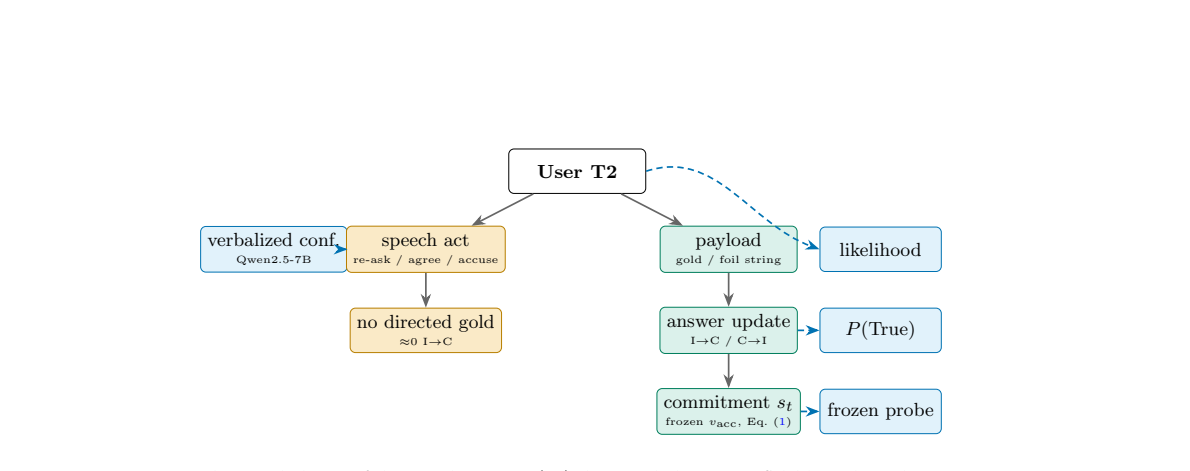
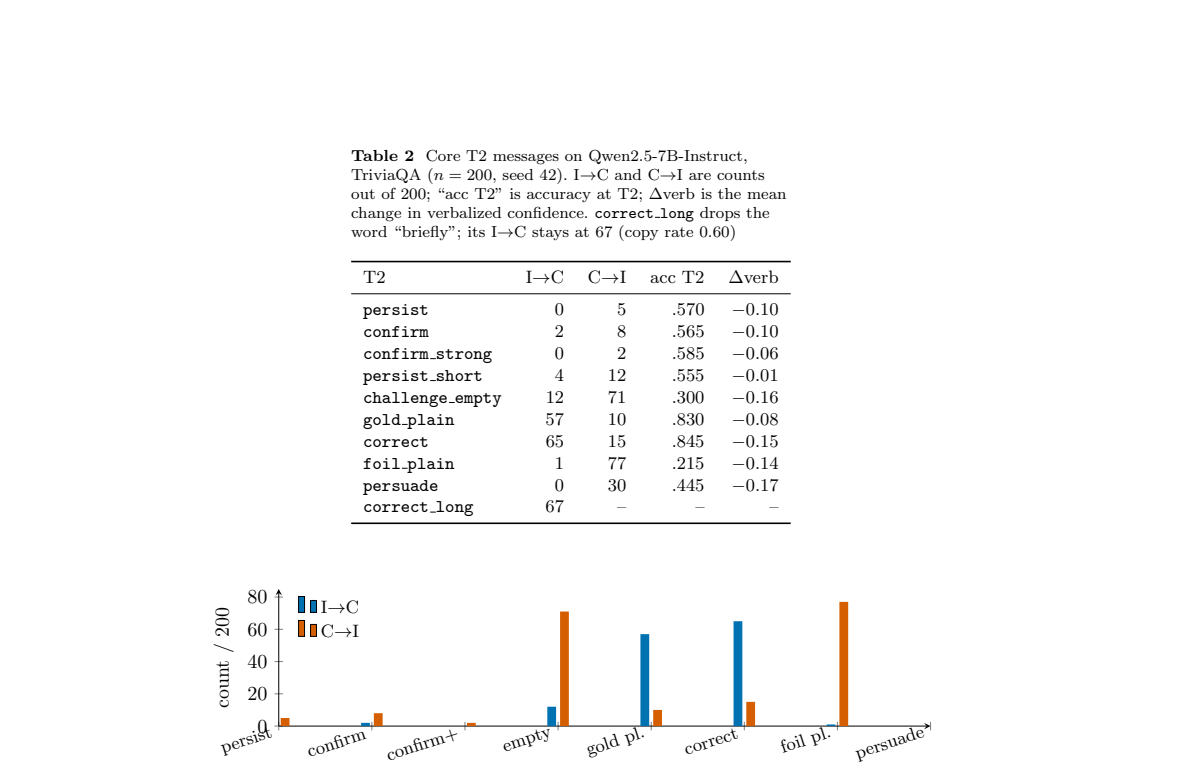
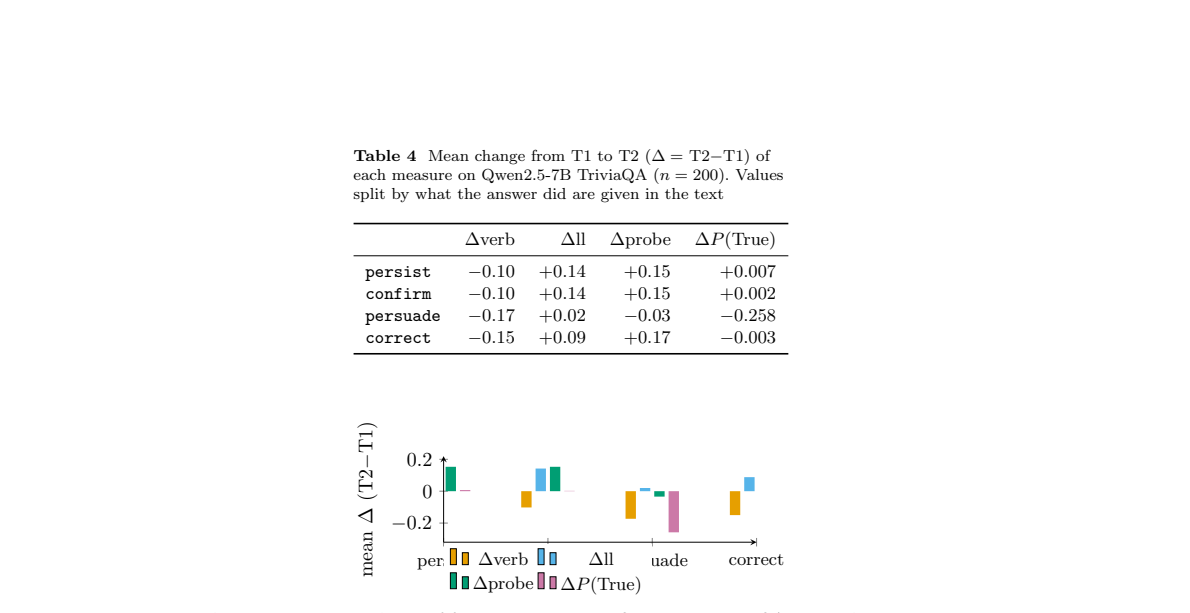
We split each follow-up into its speech act (re-ask, agree, or challenge) and its payload (an answer string, correct or not), and measure four confidence signals on the same transcripts: verbalized confidence, length-normalized likelihood, a frozen hidden-state probe, and P(True). Answers change when the user supplies an answer string and almost never under the speech act alone: in every retained full-size cell, the correct answer converts at least four times as many wrong answers as re-asking or agreement. The four signals disagree. On Qwen2.5-7B the frozen probe rises with answer persistence rather than truth; this holds on held-out questions, with Llama-3-8B (cleaned answers) as support, but not on four other models. Among 81 Qwen2.5-7B errors that survive one re-ask, re-asking, a fresh chat, or abstain repair almost none, while a gold answer repairs 75-95%. In two preregistered replications, every repair rate without an answer string stays below 0.15; a larger post-hoc rerun excludes 0.15 except for the empty elicit. With BM25 TriviaQA evidence, sentences that contain the answer repair 67-76% of persistent errors versus at most 12% when they do not. An end-to-end contain-gate cuts harm on TriviaQA, but a deployable gate that does not know the gold answer repairs few errors.
from the abstract
Pith says
Machine review · deepseek-v4-flash · 27 Oct 2026 · what was read was not recorded · not checked by a person
It can be wrong. Challenge this review or reply to it.
A careful, honestly limited empirical study showing that in conversational QA the stated answer string—not the speech act—drives answer updates, with a real matcher-robustness question that needs artifacts to resolve. This line is wrong
the referee pass did not run
How often objections from reviews like this one are right: not yet measured
Not checked: figures, code, what the 44 references say.
What would settle it
On Qwen2.5-7B TriviaQA, Llama-3-8B TriviaQA, and Mistral-7B TriviaQA (n=200 each), strip the user T2 message from every transcript for the four core arms persist/confirm/persuade/correct. Two independent annotators, blind to condition, label the T1 and T2 answers correct/incorrect against the dataset gold (kappa target ≥0.9, disagreements adjudicated). Recompute I→C and C→I under these condition-blind labels, and recompute the ratio I→C(correct) / max(I→C(persist), I→C(confirm)) after removing items whose T1 answer the annotators label correct. If the ratio stays at/above 4 and correct-arm I→C remains large, the central claim survives; if it falls below ~2 or drops to re-ask levels, the asymmetry is largely a matcher artifact.
from the skeptic's reading
How the review went
3 readings by deepseek-v4-flash · 27 Oct 2026
- Reader holds up, with conditions
- Skeptic agrees
- Editor wrote the verdict above
Not run on this paper: the referee, the simulated authors' defence.
Pith did not check this review's objections against the paper.
The review in full
The review in brief, machine-written
Read this one if you work on multi-turn calibration or sycophancy. It is an empirical mapping paper, not a method paper, and it is genuinely useful. The new piece is the factorial split: each follow-up turn is decomposed into speech act (re-ask, agree, challenge) and payload (gold or foil string), with all four confidence measures computed on the same transcripts. The headline result—"the string, not the speech act, moves the answer"—survives the internal checks I can see: fixed T1 with only T2 varied, 27 paraphrases of the core messages, gold-plain versus templated correct, bare foil versus persuade, empty challenge as a scatter control, and replication across models and datasets. The refusal of re-asks and agreement to repair errors is consistent and the contrast with gold-string repair is large.
The four-measure dissociation is the second real contribution. Verbalized confidence, likelihood, the frozen probe, and P(True) move apart on identical turns, and the paper shows this in raw deltas and in ECE. That is a useful corrective to papers that report one of these as "the" confidence signal. The frozen-probe persistence result is also handled honestly: fitted at T1, never refitted, shown to rise on stay-wrong and I-to-C items on Qwen2.5-7B with held-out-question and shuffled-label controls, and explicitly limited to that model with Llama-3-8B as support. The authors state what they do not claim, which is refreshing.
The soft spots are real but not fatal. The primary scorer is a contain matcher with a known weakness—it credits answers that name the gold only to reject it. The LLM judge missed its preregistered validation bar, and post hoc human labels cover only 300 rows. The stress-test worry that the correct-arm I-to-C counts are partly inflated by copying plus T1 false negatives does land: the correct turn inserts a gold alias, so a T2 copy is automatically scored correct, while persist and confirm can never benefit. That can inflate the fourfold ratio. It does not, however, explain away the qualitative claim, because the foil arm produces large C-to-I flips and gold-plain converts without any accusation, neither of which is a matcher artifact. So I read this as a robustness question about effect size, not a load-bearing flaw.
The biggest practical problem is that no code, data, or supplementary outputs are shipped; everything is "available from the corresponding author on reasonable request." For a paper built on controlled generations and fragile string matching, that is not adequate for independent verification.
This deserves a serious referee. Send it to peer review, and make artifacts and a matcher-robustness analysis a condition of acceptance. If you work on multi-turn calibration, cite it.
The strongest objection
The most load-bearing condition for the first central claim (Section 4, Tables 2–3) is that contain-matcher labels are accurate enough at both turns. The correct arm inserts a gold alias into the user message; any T2 answer copying or quoting that alias is automatically scored correct, while persist/confirm arms contain no gold token and cannot benefit from this. If T1 answers include false negatives (paraphrases or aliases the gold list misses, or answers that merely mention the gold to reject it), then I→C under correct is inflated and I→C under re-ask/agree is suppressed at once. The fourfold ratio is exactly the ratio of two matcher-dependent counts, so the asymmetry could be partly a labeling artifact. Section 3.5 concedes the matcher credits rejected gold mentions, that the LLM judge failed its validation bar, and that human labels cover only 300 V2 rows; the negation-regex screen for non-Mistral models is not validated. The paper reports these weaknesses honestly, but they remain unresolved for the grid-wide repair claim: the LLM judge is failed, the human sample is small, and the model-read labels are not independent. The copy-rate and gold-plain ablations support "the string moves the answer," but not the stronger claim that the large I→C counts are real repairs rather than matcher false negatives plus copying.
I agree with the reader: the weakest assumption is the scoring. My attack adds one precision: the asymmetry is not merely "labels may be noisy"; the contain matcher is structurally asymmetric across arms because the correct arm's user message contains the gold alias. The paper's own alternative-label checks are incomplete for this purpose—the LLM judge failed validation, the human sample is 300 rows, and the condition-blind requirement is unmet. The proposed test is the minimal check that would decide whether the grid-wide "at least four times" claim is about real repairs. A secondary concern about post hoc cell retention is disclosed with reasons and is less load-bearing. Therefore the CONDITIONAL verdict stands; no adjustment.
Pith's reading of the paper (a machine's summary, not the authors')
This paper tries to establish that in short-answer conversational question answering, what determines whether a model changes its answer is the content the user supplies — a correct (gold) or wrong (foil) answer string — while the speech act itself (re-asking, agreeing, or saying 'you are wrong') does almost nothing. Across every retained full-size model–dataset cell, a stated gold answer converted at least four times as many initially wrong answers as re-asking or agreement did, and a bare re-ask almost never repaired an error. The paper also argues that four confidence signals used as if interchangeable — verbalized confidence, length-normalized sequence likelihood, a frozen hidden-state probe, and the self-evaluation probability P(True) — react to different parts of the same user turn and disagree on the same transcripts, so they cannot all estimate one latent conversational confidence. The practical upshot for deployed assistants is that re-asking, resetting the chat, or offering abstention will not fix persistent errors: a supplied gold string repairs 75–95% of them, and retrieved evidence repairs them only when it literally contains the answer.
What carries the argument. The load-bearing design is a factorial split of every user follow-up into a speech act (re-ask, agree, or challenge) and a payload (a gold or foil answer string), run on identical first turns, with each item tracked as stay-correct, stay-wrong, I→C, or C→I under a containment matcher against gold aliases. The other central object is the persistence readout $s_t=\sigma(v_{\mathrm{acc}}^{\top}\tilde{h}_t)$: a logistic linear probe on mean-pooled last-layer hidden states, fitted once on unique first-turn answers and then frozen, so later movement in $s_t$ reflects what the user's turn does to the answer state rather than a refitted map. Four confidence signals measured on the same turns — verbalized confidence, length-normalized likelihood, the frozen probe, and P(True) — carry the dissociation argument, and the retrieval study uses BM25-ranked TriviaQA sentences to test whether real evidence repairs persistent errors. The frozen probe carries the argument: a readout that rises both on stay-wrong items and on I→C items, and falls on C→I items, cannot be a truth signal.
Core claim. The central claim is that the answer string, not the speech act, moves the answer, and that the confidence measures used in multi-turn calibration studies are not interchangeable. On the same transcripts, verbalized confidence falls as the user keeps talking even when accuracy is flat or rising, sequence likelihood rises on the same turns, P(True) barely moves except collapsing under foil persuasion, and a linear probe on hidden states — fitted once on first-turn answers and then frozen — rises both on answers that stay wrong and on answers that switch to the correct one. On Qwen2.5-7B the frozen probe therefore tracks answer persistence, not truth: it rises on stay-wrong items and on I→C items and falls when a correct answer is pulled away, and the paper shows this survives scoring on held-out questions, with Llama-3-8B on cleaned answers as support, while four other models fail it on held-out questions. The paper frames the whole contribution as a map of interventions and their effects rather than a new method, and it offers one design heuristic: before relying on retrieved evidence to correct a model, check that the evidence contains the answer.
The premise it rests on. Every headline count — how often a re-ask converts a wrong answer, how often a gold string repairs one — is computed with the contain matcher plus gold aliases, and the paper concedes in Section 3.5 that this matcher credits an answer that names the gold only to reject it, that its LLM judge failed the preregistered validation bar, and that post hoc human labels cover only 300 rows; if scoring errors are uneven across speech-act and payload conditions, the claimed string-vs-stance asymmetry could be partly a labeling artifact.
If the paper is right (Pith's inferences, not the authors')
Multi-turn calibration studies must state which measure they score: on one transcript, verbalized ECE fell while likelihood ECE nearly doubled and P(True) ECE stayed flat, so a calibration result for one measure is not evidence about another.
System designers cannot use re-asks, chat resets, or abstention options to undo persistent errors: on the paper's central 81-item set these repair two, zero, and zero items, while a gold answer string at the next turn repairs 75–95%.
Retrieval-augmented assistants should gate corrections on whether the evidence contains the candidate answer: a BM25 sentence containing the answer repaired 67–76% of stay-wrong errors, one without it at most 12% (16% under model-read labels), and it can break up to 70% of correct answers.
A frozen first-turn probe that rises on stay-wrong answers undercuts the reading of hidden-state truth probes in dialogue: after the user speaks, the probe on Qwen2.5-7B becomes a worse readout of truth and a better readout of answer persistence.
My inference: the ≥4× asymmetry suggests a cheap intervention worth testing in deployment — when a user message names an answer string, treat it as candidate evidence and verify it rather than re-prompting; the paper itself stops short of validating any gate end to end.
My inference: the dissociation result implies that a single 'conversational confidence' score on a leaderboard conflates at least three distinct quantities — fluency (likelihood), commitment or persistence (the probe), and reaction to contradiction (P(True)) — so two published calibration numbers agree only if the same measure was scored.
My inference: because the model abstains on 94% of stay-wrong items when offered the option, abstention-based guardrails will refuse precisely the answers that most need repair; pairing abstention with an answer-containment check may do better than either mechanism alone.
My inference: the string-vs-stance asymmetry is the paper's most load-bearing and most testable claim, while the persistence readout is model-specific; a natural extension is the same factorial battery on long-form reasoning and on larger models with accessible hidden states.
Check this review
Pith stored no record of this review's passes and took no fingerprint of it. Reviews made by code from 13 Nov 2026 on carry both.
How often reviews like this one are right
Reviews like this one: written by deepseek-v4-flash, where what was read was not recorded.
How often objections from reviews like this one are right: not yet measured
Reviews by people
This review was written by a machine. No person has reviewed this paper on Pith yet. A scientist listed on Pith can review it for a fee, and their review is published here whatever it concludes.
The paper
Abstract
Conversational QA systems should fix errors when users push back and signal which answers to trust. We split each follow-up into its speech act (re-ask, agree, or challenge) and its payload (an answer string, correct or not), and measure four confidence signals on the same transcripts: verbalized confidence, length-normalized likelihood, a frozen hidden-state probe, and P(True). Answers change when the user supplies an answer string and almost never under the speech act alone: in every retained full-size cell, the correct answer converts at least four times as many wrong answers as re-asking or agreement. The four signals disagree. On Qwen2.5-7B the frozen probe rises with answer persistence rather than truth; this holds on held-out questions, with Llama-3-8B (cleaned answers) as support, but not on four other models. Among 81 Qwen2.5-7B errors that survive one re-ask, re-asking, a fresh chat, or abstain repair almost none, while a gold answer repairs 75-95%. In two preregistered replications, every repair rate without an answer string stays below 0.15; a larger post-hoc rerun excludes 0.15 except for the empty elicit. With BM25 TriviaQA evidence, sentences that contain the answer repair 67-76% of persistent errors versus at most 12% when they do not. An end-to-end contain-gate cuts harm on TriviaQA, but a deployable gate that does not know the gold answer repairs few errors.
The paper's own sentences, arranged, kept beside the review and separate from it. Each label is drawn from a closed vocabulary; the number beside it is the probability the classifier gave that label. No sentence in this record was written by a model.
abstract compiled · 2026-10-27
The authors' main claim, as the classifier picked it out 0.99
“Answers change when the user supplies an answer string and almost never under the speech act alone: in every retained full-size cell, the correct answer converts at least four times as many wrong answers as re-asking or agreement.”
How the main claim is stated: asserted 1.00
What the abstract itself states, as probabilities: claims first 0.05 · states limitation 0.89 · human participants 0.16 · controlled comparison 0.86 · randomized assignment 0.04 · states quantitative result 0.99 · compares with prior results 0.77 · mentions code or data availability 0.04
The abstract, sentence by sentence
This table labels the abstract only (arXiv listing abstract v1). The number is the probability the classifier gave the label.
| Sentence | Role | The authors' own work | States the main conclusion | Strength |
|---|---|---|---|---|
| Conversational QA systems should fix errors when users push back and signal which answers to trust. | background 0.93 | 0.06 | 0.12 | asserted 0.68 |
| We split each follow-up into its speech act (re-ask, agree, or challenge) and its payload (an answer string, correct or not), and measure four confidence signals on the same transcripts: verbalized confidence, length-normalized likelihood, a frozen hidden-state probe, and P(True). | method 0.97 | 0.96 | 0.05 | asserted 0.97 |
| Answers change when the user supplies an answer string and almost never under the speech act alone: in every retained full-size cell, the correct answer converts at least four times as many wrong answers as re-asking or agreement. | result 1.00 | 0.94 | 0.59 | asserted 1.00 |
| The four signals disagree. | result 1.00 | 0.89 | 0.09 | asserted 1.00 |
| On Qwen2.5-7B the frozen probe rises with answer persistence rather than truth; this holds on held-out questions, with Llama-3-8B (cleaned answers) as support, but not on four other models. | result 1.00 | 0.93 | 0.11 | asserted 0.99 |
| Among 81 Qwen2.5-7B errors that survive one re-ask, re-asking, a fresh chat, or abstain repair almost none, while a gold answer repairs 75-95%. | result 1.00 | 0.94 | 0.18 | asserted 1.00 |
| In two preregistered replications, every repair rate without an answer string stays below 0.15; a larger post-hoc rerun excludes 0.15 except for the empty elicit. | result 1.00 | 0.95 | 0.14 | asserted 1.00 |
| With BM25 TriviaQA evidence, sentences that contain the answer repair 67-76% of persistent errors versus at most 12% when they do not. | result 1.00 | 0.88 | 0.10 | asserted 1.00 |
| An end-to-end contain-gate cuts harm on TriviaQA, but a deployable gate that does not know the gold answer repairs few errors. | result 0.88 | 0.87 | 0.15 | asserted 1.00 |
What kind of paper the classifier reports this is: empirical study 1.00 · evidence from observation or experiment 0.99
What was examined, and what was not
Sources read
- arXiv listing abstract v1
Not examined
- full text
- figures and tables
- references and citing sentences
- relations to other papers
Levels run
- P abstract
Not run
- S sections
- T body sentences
- C citations
- R cross-paper relations
How the labels were made
Compiled by classifier-1.13.0 via TypeSafe API, question bank abstract-p1-20260923, 2026-10-27: 1 request, 7,140 input tokens.
Every quoted sentence on this record is the authors'. Every label is from Pith's closed vocabulary, with the probability shown beside it. This record as JSON
Figures (3)
Figures are the authors', reproduced from the paper.
References (44)
- [1] Zhang, C., Yang, R., Zhu, X., Li, C., Hu, T., Dong, Y.R., Yang, D., Collier, N.: Confidence estimation for LLMs in multi-turn interactions. In: Findings of the Association for Computational Linguistics: ACL 2026, pp. 25661–25676. Association for Computational Linguistics, San ... on Pithdoi:10.18653/v1/2026.findings-acl.1280
- [2] Zhang, Z., Li, C., Liu, X., Shen, C., Liu, Z., Patras, I.: Confidence should be calibrated more than one turn deep. In: Proceedings of the 64th Annual Meet- ing of the Association for Computational Linguistics (Volume 1: Long Papers), pp. 38578–38594. Association for Computati... on Pithdoi:10.18653/v1/2026.acl-long.1787
- [3] Kumaran, D.: Reported Confidence in LLMs Tracks Commitment More Than Correctness. arXiv preprint arXiv:2606.29490 (2026). https://arxiv.org/abs/ 2606.29490 on PithPith's reviewarXiv
- [4] Kadavath, S., Conerly, T., Askell, A., Henighan, T., Drain, D., Perez, E., Schiefer, N., Hatfield-Dodds, Z., DasSarma, N., Mann, E., et al.: Language models (mostly) know what they know. arXiv preprint arXiv:2207.05221 (2022) on PithPith's reviewarXiv
- [5] Miao, M.M., Ungar, L.: Closing the Confidence-Faithfulness Gap in Large Lan- guage Models. arXiv preprint arXiv:2603.25052 (2026). https://arxiv.org/abs/ 2603.25052 on PitharXiv
- [6] Perez, E., Ringer, S., Lukoˇ si¯ ut˙ e, K., Nguyen, K., Chen, E., Heiner, S., Pettit, C., Olsson, C., Kundu, S., Kadavath, S.,et al.: Discovering language model 21 behaviors with model-written evaluations. In: Findings of the Association for Computational Linguistics: ACL 2023 (2023) on Pith
- [7] Sharma, M., Tong, M., Korbak, T., Duvenaud, D., Askell, A., Bowman, S.R., Cheng, N., Durmus, E., Hatfield-Dodds, Z., Johnston, S.R.,et al.: Towards understanding sycophancy in language models. In: International Conference on Learning Representations (ICLR) (2024) on Pith
- [8] Wei, J., Huang, D., Lu, Y., Zhou, D., Le, Q.V.: Simple synthetic data reduces sycophancy in large language models. arXiv preprint arXiv:2308.03958 (2023) on PithPith's reviewarXiv
- [9] Laban, P., Murakhovs’ka, L., Xiong, C., Wu, C.-S.: Are you sure? challenging LLMs leads to performance drops in the FlipFlop experiment. arXiv preprint arXiv:2311.08596 (2023) on PithPith's reviewarXiv
- [10] Xie, Q., Wang, Z., Feng, Y., Xia, R.: Ask again, then fail: Large language models’ vacillations in judgment. In: Proceedings of the 62nd Annual Meet- ing of the Association for Computational Linguistics (Volume 1: Long Papers). Association for Computational Linguistics, Bangko... on Pithdoi:10.18653/v1/2024.acl-long.577
- [11] Wang, B., Yue, X., Sun, H.: Can ChatGPT defend its belief in truth? evaluating LLM reasoning via debate. In: Findings of the Association for Computational Linguistics: EMNLP 2023 (2023) on Pith
- [12] Huang, J., Chen, X., Mishra, S., Zheng, H.S., Yu, A.W., Song, X., Zhou, D.: Large language models cannot self-correct reasoning yet. In: International Conference on Learning Representations (ICLR) (2024) on Pith
- [13] Laban, P., Hayashi, H., Zhou, Y., Neville, J.: LLMs get lost in multi-turn conver- sation. In: International Conference on Learning Representations (ICLR) (2026). https://arxiv.org/abs/2505.06120 on PithPith's reviewarXiv
- [14] Lin, S., Hilton, J., Evans, O.: Teaching models to express their uncertainty in words. Transactions on Machine Learning Research (2022) on Pith
- [15] Xiong, M., Hu, Z., Lu, X., Li, Y., Fu, J., He, J., Hooi, B.: Can LLMs express their uncertainty? an empirical evaluation of confidence elicitation in LLMs. In: International Conference on Learning Representations (ICLR) (2024) on Pith
- [16] Tian, K., Mitchell, E., Zhou, A., Sharma, A., Rafailov, R., Yao, H., Finn, C., Man- ning, C.D.: Just ask for calibration: Strategies for eliciting calibrated confidence scores from language models fine-tuned with human feedback. In: Proceedings of the 2023 Conference on Empiri... on Pith
- [17] Geng, J., Cai, F., Wang, Y., Koeppl, H., Nakov, P., Gurevych, I.: A survey of 22 confidence estimation and calibration in large language models. In: Proceedings of the 2024 Conference of the North American Chapter of the Association for Computational Linguistics (NAACL) (2024) on Pith
- [18] Guo, C., Pleiss, G., Sun, Y., Weinberger, K.Q.: On calibration of modern neural networks. In: Proceedings of the 34th International Conference on Machine Learn- ing. Proceedings of Machine Learning Research, vol. 70, pp. 1321–1330. PMLR, Sydney, Australia (2017) on Pith
- [19] Azaria, A., Mitchell, T.: The internal state of an LLM knows when it’s lying. In: Findings of the Association for Computational Linguistics: EMNLP 2023 (2023) on Pith
- [20] Marks, S., Tegmark, M.: The geometry of truth: Emergent linear structure in large language model representations of true/false datasets. In: Conference on Language Modeling (COLM) (2024) on Pith
show 24 more
- [21] Burns, C., Ye, H., Klein, D., Steinhardt, J.: Discovering latent knowledge in language models without supervision. In: International Conference on Learning Representations (ICLR) (2023) on Pith
- [22] Orgad, H., Toker, M., Gekhman, Z., Reichart, R., Szpektor, I., Kotek, H., Belinkov, Y.: LLMs know more than they show: On the intrinsic representation of LLM hallucinations. In: International Conference on Learning Representations (ICLR) (2025) on Pith
- [23] Hewitt, J., Liang, P.: Designing and interpreting probes with control tasks. In: Proceedings of the 2019 Conference on Empirical Methods in Natural Language Processing (EMNLP) (2019) on Pith
- [24] Sarkar, R., Ramu, P., Rudinger, R.: Language Models Encode the Contextual Truth of Propositions. arXiv preprint arXiv:2608.03035 (2026). https://arxiv.org/ abs/2608.03035 on PithPith's reviewarXiv
- [25] Longpre, S., Perisetla, K., Chen, A., Ramesh, N., DuBois, C., Singh, S.: Entity- based knowledge conflicts in question answering. In: Proceedings of the 2021 Conference on Empirical Methods in Natural Language Processing (EMNLP) (2021) on Pith
- [26] Xie, J., Zhang, K., Chen, J., Lou, R., Su, Y.: Adaptive chameleon or stubborn sloth: Revealing the behavior of large language models in knowledge conflicts. In: International Conference on Learning Representations (ICLR) (2024) on Pith
- [27] Joren, H., Zhang, J., Ferng, C.-S., Juan, D.-C., Taly, A., Rashtchian, C.: Sufficient context: A new lens on retrieval augmented generation systems. In: International Conference on Learning Representations (ICLR) (2025) on Pith
- [28] Lathkar, A.B.: Anchored Confabulation: Partial Evidence Non-Monotonically 23 Amplifies Confident Hallucination in LLMs. arXiv preprint arXiv:2604.25931 (2026). https://arxiv.org/abs/2604.25931 on PithPith's reviewarXiv
- [29] Kuhn, L., Gal, Y., Farquhar, S.: Semantic uncertainty: Linguistic invariances for uncertainty estimation in natural language generation. In: International Conference on Learning Representations (ICLR) (2023) on Pith
- [30] Joshi, M., Choi, E., Weld, D.S., Zettlemoyer, L.: TriviaQA: A large scale distantly supervised challenge dataset for reading comprehension. In: Proceedings of the Annual Meeting of the Association for Computational Linguistics (ACL 2017) (2017) on Pith
- [31] Qwen Team: Qwen2.5 technical report. arXiv preprint arXiv:2412.15115 (2024) on PithPith's reviewarXiv
- [32] Qwen Team: Qwen3 technical report. arXiv preprint arXiv:2505.09388 (2025) on PithPith's reviewarXiv
- [33] Grattafiori, A., et al.: The Llama 3 herd of models. arXiv preprint arXiv:2407.21783 (2024) on PithPith's reviewarXiv
- [34] Jiang, A.Q., et al.: Mistral 7B. arXiv preprint arXiv:2310.06825 (2023) on PithPith's reviewarXiv
- [35] Abdin, M., et al.: Phi-4 technical report. arXiv preprint arXiv:2412.08905 (2024) on PithPith's reviewarXiv
- [36] Kwiatkowski, T., Palomaki, J., Redfield, O., Collins, M., Parikh, A., Alberti, C., Epstein, D., Polosukhin, I., Devlin, J., Lee, K.,et al.: Natural questions: A benchmark for question answering research. Transactions of the Association for Computational Linguistics7, 452–466 (2019) on Pith
- [37] Yang, Z., Qi, P., Zhang, S., Bengio, Y., Cohen, W.W., Salakhutdinov, R., Man- ning, C.D.: HotpotQA: A dataset for diverse, explainable multi-hop question answering. In: Proceedings of the 2018 Conference on Empirical Methods in Natural Language Processing (EMNLP) (2018) on Pith
- [38] Lin, S., Hilton, J., Evans, O.: TruthfulQA: Measuring how models mimic human falsehoods. In: Proceedings of the Annual Meeting of the Association for Computational Linguistics (ACL 2022) (2022) on Pith
- [39] Berant, J., Chou, A., Frostig, R., Liang, P.: Semantic parsing on Freebase from question-answer pairs. In: Proceedings of the 2013 Conference on Empirical Methods in Natural Language Processing (EMNLP) (2013) on Pith
- [40] Cobbe, K., Kosaraju, V., Bavarian, M., Chen, M., Jun, H., Kaiser, L., Plappert, M., Tworek, J., Hilton, J., Nakano, R., et al.: Training verifiers to solve math word problems. arXiv preprint arXiv:2110.14168 (2021) on PithPith's reviewarXiv
- [41] Tran, D.V.: Pilot Preregistration: Multi-turn Confidence Geometry. Frozen 2026- 09-19 09:43 UTC, before generation. H2 failed; H1 inconclusive; locked verdict CONTINUE. Supplementary file PREREG.md (Online Resource 2). (2026) 24 on Pith
- [42] Tran, D.V.: Preregistration: T3 Replication of Stay-Wrong Persistence. Frozen before generation, with two pre-generation amendments. Supplementary file PREREG T3REP.md (Online Resource 2). (2026) on Pith
- [43] Tran, D.V.: Preregistration: Judge Rescoring, Larger T3 Samples, Retrieval with Real Evidence, and a 32B Model. Frozen before generation and judging, with five dated post-hoc notes. Supplementary file PREREG TMLR.md (Online Resource 2). (2026) on Pith
- [44] Robertson, S., Zaragoza, H.: The probabilistic relevance framework: BM25 and beyond. Foundations and Trends in Information Retrieval3(4), 333–389 (2009) 25 on Pith
Challenges and discussion
Disagree with the review, or know something it missed? Leave a comment, or challenge this review formally: a challenge becomes a permanent entry in this paper's record, and its decision is published here.
Come back by email
A short list of the week's newly reviewed papers. Nothing is sent until you confirm from your inbox, and every email has a link that stops it. No account.
No comments yet.
Sign in to comment