REVIEW 3 major objections 5 minor 59 references
Geo-Embed beats all 15 compared baseline models across 45 urban tasks, the paper reports.
Reviewed by Pith at T0; open to challenge. T0 means a machine referee read the full paper against a public rubric. the ladder, T0–T4 →
GeoMEB unifies 45 urban embedding tasks into a ranking protocol, and Geo-Embed, an instruction-conditioned vision-language embedder fine-tuned on it, tops the leaderboard.
T0 review reviewed 2026-08-05 challenge →
load-bearing objection A genuinely useful 45-task urban embedding benchmark, but the headline model comparison is unfair: Geo-Embed is fine-tuned on the benchmark's own training data while all baselines are zero-shot. the 3 major comments →
Geo-Embed: Towards Unified Multimodal Embeddings for Urban Understanding
The pith
A machine-rendered reading of the paper's core claim, the machinery that carries it, and where it could break.
The reading
Core claim
The central discovery claimed is that a single instruction-conditioned vision-language embedding model, fine-tuned on urban query-target pairs, outperforms every compared CLIP-style, instruction-tuned, and embedding-specialized model on a unified 45-task urban benchmark. Geo-Embed treats retrieval, visual question answering, classification, grounding, and change detection all as matching an instructed query to candidates in a task-specific pool, using the same backbone for both sides. It reaches first place on classification, retrieval, and grounding, and second on VQA and change detection. The paper also reports that the gains are uneven across task types: image-caption matching and land-co
What carries the argument
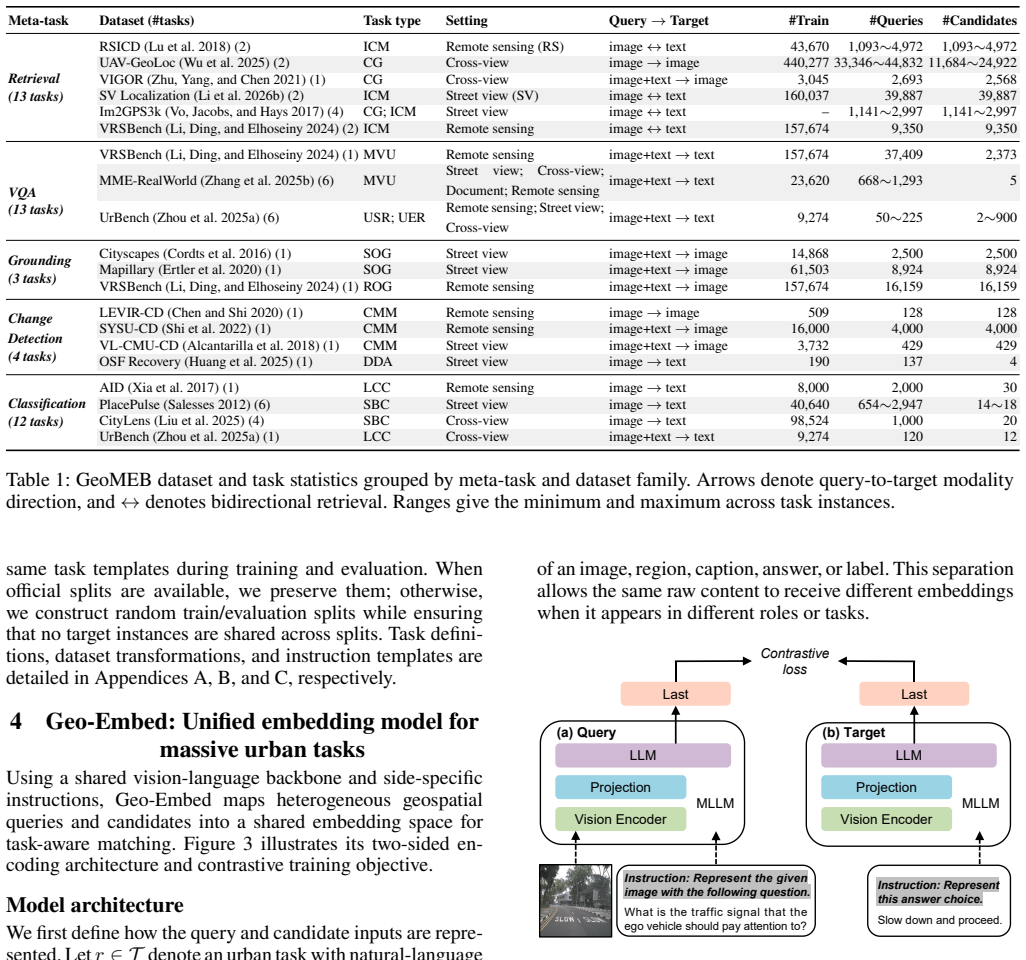
The load-bearing mechanism is instruction-conditioned query-target matching. Every query and every candidate is serialized with its own side-specific instruction, then encoded by a shared vision-language backbone; the last-layer hidden state of the final token, after L2 normalization, becomes the embedding, and ranking is done by cosine similarity. Training uses the InfoNCE contrastive objective with in-batch negatives. Side-specific instructions let the same raw content receive different embeddings when it plays different roles—query versus candidate, or in one task relation versus another—and this is what lets one model handle single images, multiple images, text, regions, and masks within
Load-bearing premise
The headline ranking assumes that a task-count-weighted average—giving each task equal weight regardless of how many queries or candidates it has—is a meaningful measure of overall model quality.
What would settle it
Recompute the overall score with query-count weighting, macro-median, or bootstrap confidence intervals from the per-task scores in Appendix Tables 8–12; if Geo-Embed's lead over Qwen3-VL-Embedding-8B disappears or reverses, the strongest-performance claim is unsupported. A second check: evaluate all models on a held-out set of urban query-target tasks not in GeoMEB and see whether the same ranking holds.
If this is right
- A single embedding interface could serve city-scale applications that currently need separate models: urban search, geo-localization, disaster monitoring, and socioeconomic sensing.
- Generic multimodal ability does not guarantee strong urban retrieval; instruction-tuned VLMs score low unless they are trained for retrieval.
- Multi-task supervision is not automatically additive: grounding performance can drop when retrieval or VQA data is mixed in, suggesting interference between structurally different query-target relations.
- The hard task types—cross-view geolocalization, score-binning urban perception, region grounding, and change-mask matching—are concrete stress tests for future geospatial embedding models.
- Training and evaluation should be organized around explicit query-target relations rather than generic image-text alignment.
Where Pith is reading between the lines
- Not tested in the paper: because the headline average weighs each task equally regardless of query count (for example OSF Recovery has 137 queries and 4 candidates, while CityLens tasks have 1,000), the 15.3% margin may shrink or flip under query-count weighting or per-task confidence intervals; a bootstrap re-analysis of Appendix Tables 8–12 would settle this.
- The instruction-conditioned ranking protocol is not inherently urban; the same standardization could be applied to medical imaging, embodied navigation, or document grounding, with GeoMEB as a template.
- The observed interference between grounding and retrieval suggests a possible curriculum or mixture-weighting strategy that the paper does not explore.
- Future work could test whether Geo-Embed's gains persist on urban tasks constructed after the benchmark's release, or whether it partly overfits GeoMEB's template distribution.
Editorial analysis
A structured set of objections, weighed in public.
Referee Report
Summary. The paper introduces GeoMEB, a geospatial multimodal embedding benchmark standardizing 45 urban tasks—retrieval, visual question answering, change detection, classification, and visual grounding—into an instruction-conditioned ranking protocol, with 1.32M training examples and 286K evaluation queries. It also presents Geo-Embed, initialized from Qwen3-VL-Embedding-2B and LoRA-fine-tuned with an InfoNCE objective, encoding queries and candidates with side-specific instructions into a shared space. The main empirical claim is that Geo-Embed achieves the strongest overall performance on GeoMEB (25.48 vs. 22.09 for Qwen3-VL-Embedding-8B, a 15.3% relative improvement), with ablations on sub-batch sampling, task-modality interactions, instruction-induced embedding shifts, LoRA rank, and batch size.
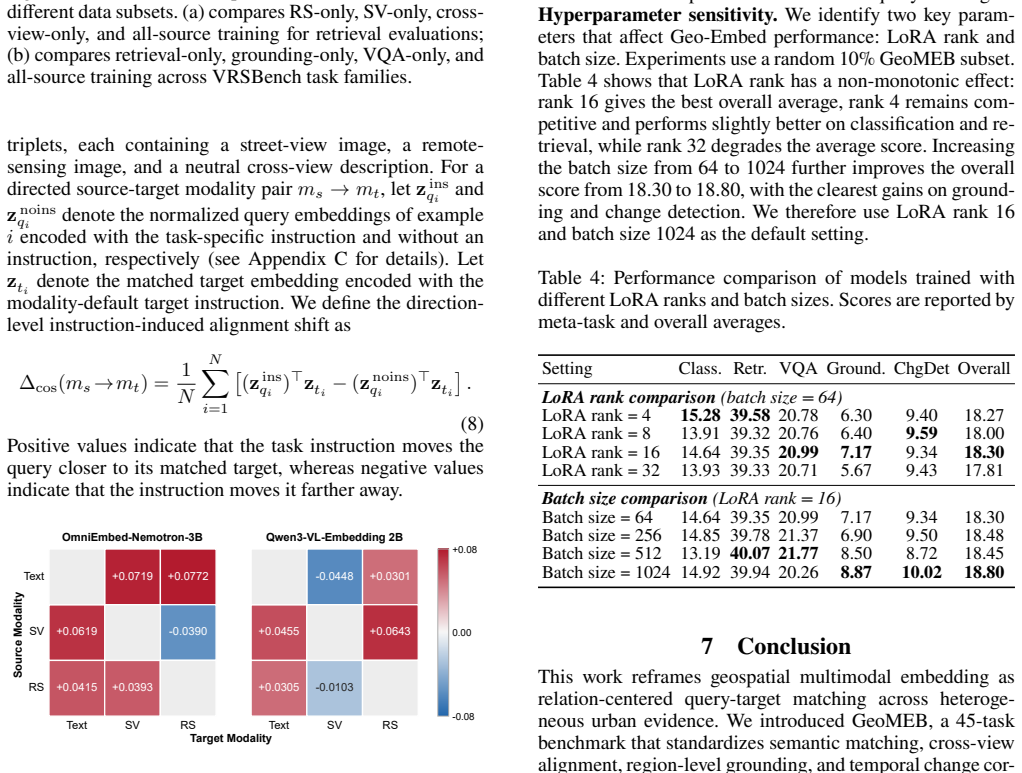
Significance. The benchmark and the instruction-conditioned query-target formulation are potentially useful contributions: GeoMEB covers under-studied geospatial relations (cross-view, temporal, region-level) and is assembled from diverse public datasets; the task taxonomy and standardized ranking protocol could support future comparisons. The paper also provides unusually broad baseline coverage and a genuinely informative instruction-shift analysis (Fig. 6) that shows instructions do not uniformly improve alignment. However, the central performance claim is currently under-supported: Geo-Embed is fine-tuned on training splits of the same datasets used for evaluation, while all baselines are evaluated zero-shot, and the aggregate metric used for the headline number is sensitive to benchmark design choices. The contribution would be significant if the comparison were made symmetric and the aggregate ranking shown to be robust.
major comments (3)
- [§5, Table 2, Appendix E] The headline comparison is asymmetric. Geo-Embed is initialized from Qwen3-VL-Embedding-2B and LoRA-fine-tuned on GeoMEB's 1.32M training collection (§4, Appendix E), which is drawn from the same datasets as the 45 evaluation tasks (Table 1: UAV-GeoLoc, VRSBench, SV Localization, CityLens, etc.). No baseline is fine-tuned on that training data, and the paper does not state this asymmetry in the main-results section. The claim that Geo-Embed 'achieves the strongest overall performance among representative multimodal embedders' therefore conflates training-data access with model/method quality. The load-bearing comparison must include an equally trained baseline (e.g., Qwen3-VL-Embedding-2B or -8B fine-tuned on the same GeoMEB training collection under the same protocol), or at minimum a zero-shot evaluation of Geo-Embed before fine-tuning. Without this, the 15.3% margin does not support t
- [Table 2, Table 1] The aggregate metric is not robust enough to carry the headline claim. The 'Overall Avg' column is an unweighted mean of the five meta-task means, not a 45-task mean; this gives the 7 grounding+change-detection tasks the same aggregate weight as the 26 retrieval+VQA tasks. Recomputing from Appendix Tables 8–12, a simple 45-task mean shrinks the margin substantially. In addition, OSF Recovery has only 137 evaluation queries and a 4-candidate pool (Table 1) yet contributes a large share of the change-detection meta-average (Table 11: e.g., 42.34 for Seed1.6-Embedding, 37.96 for Geo-Embed). With such small query counts and tiny candidate pools, the ranking differences may reflect noise or benchmark design rather than embedding quality. The paper should report query-weighted or per-task-level aggregates, confidence intervals or significance tests, and show that the overall ranking is stable
- [§6, Fig. 6] The instruction-conditioned query-target design is not isolated as the cause of the gains. The paper's motivation emphasizes side-specific instructions, but the main comparison varies both the method and the training data; no ablation trains a strong baseline without instructions, or trains Geo-Embed without side-specific instructions. Fig. 6 shows that instruction-induced shifts are not uniformly target-oriented (e.g., Qwen3-VL-Embedding-2B Text→SV is -0.0448, RS→SV is -0.0103), which weakens the claim that instructions per se drive the improvement. A controlled ablation that fixes the training data and varies only the instruction design is needed to support the central architectural claim.
minor comments (5)
- [Table 11] The handling of '–' (counted as 0 in change-detection averages) penalizes CLIP-family models that cannot accept multi-image inputs. This is a modeling limitation, but reporting it as 0 in the same aggregate as models that support multi-image inputs may distort the ranking; consider reporting separate averages or a footnote in Table 2.
- [Figure 4] The caption says the fine-tuned panel is 'after VRSBench fine-tuning', while the main model is trained on the full GeoMEB collection. Clarify which checkpoint is visualized.
- [Eq. (5), Appendix Table 7] The temperature τ is a key hyperparameter (set to 0.02) but is not included in the hyperparameter sensitivity study. At minimum, state whether results are stable across reasonable τ values.
- [Appendix B] The provenance of the Im2GPS3k caption annotations and SV Localization captions should be described more precisely: were they human-annotated, generated, or adapted from prior work? This matters for the benchmark's reliability.
- [Table 2 caption] The caption says 'task-count-weighted averages over fine-grained task types and meta-task groups', but the Overall Avg column is an unweighted mean of the five meta-task averages. The wording should be changed to avoid ambiguity.
Circularity Check
No significant circularity: Geo-Embed's results are empirical evaluations, not derivations reducing to their inputs.
full rationale
Geo-Embed is a contrastively fine-tuned embedding model; its performance on GeoMEB is measured on held-out evaluation queries after training on a disjoint 1.32M-example collection. The paper contains no derivation chain in which a prediction is defined in terms of the fitted parameter or in which the claimed result is equivalent by construction to the benchmark definition. The closest self-referential elements are (i) GeoMEB is introduced by the same authors and Geo-Embed is evaluated on it, and (ii) the SV Localization task derives from the authors' prior Unified Urban Tuning work (Li et al. 2026b) and is used as both training and evaluation data. These are data/benchmark construction choices, not load-bearing circular arguments: the benchmark's protocol (instruction-conditioned ranking) does not by itself guarantee Geo-Embed's ranking, and the model's advantage over zero-shot baselines remains an empirical, potentially confounded observation. The asymmetry that Geo-Embed is fine-tuned on GeoMEB training data while baselines are evaluated zero-shot is a fairness/correctness concern for the 15.3% headline, but it is not circularity because the outcome is not forced by construction. No self-citation supplies an unverified premise that the paper's conclusions depend on.
Axiom & Free-Parameter Ledger
free parameters (4)
- InfoNCE temperature tau =
0.02
- LoRA rank =
16 (alpha 32)
- Batch size =
1024
- Learning rate / weight decay / warmup ratio =
2e-5 / 0.1 / 0.05
axioms (4)
- domain assumption Ranking over a task-specific candidate pool with cosine similarity preserves the semantics of VQA, grounding, change detection, and classification.
- domain assumption The 45 tasks and the task-count-weighted average are a valid aggregate measure of urban embedding quality.
- domain assumption Train/evaluation splits prevent target-instance leakage.
- domain assumption Instruction templates correctly specify the query-target relation for each task.
Cite this review
Pith. "Pith review of Geo-Embed: Towards Unified Multimodal Embeddings for Urban Understanding." pith.science (2026). https://pith.science/paper/CPSVVGWY
@misc{pith2026260803826,
  author       = {Pith},
  title        = {Pith review of: Geo-Embed: Towards Unified Multimodal Embeddings for Urban Understanding},
  year         = {2026},
  howpublished = {\url{https://pith.science/paper/CPSVVGWY}},
  note         = {Machine review of arXiv:2608.03826}
}
read the original abstract
Geospatial and urban applications increasingly require models to compare heterogeneous evidence across street-view imagery, remote-sensing observations, text descriptions, region proposals, and temporal change cues. However, existing multimodal embedding models and benchmarks are still largely designed and evaluated around general-purpose image-text matching, leaving unclear whether unified embedding space can support heterogeneous geospatial tasks involving spatial relationships, fine-grained semantics, and temporal changes. To address this gap, we make three key contributions. First, we introduce GeoMEB, a large-scale multimodal embedding benchmark that standardizes 45 urban evaluation tasks across retrieval, visual question answering, change detection, classification, and visual grounding, together with training collections comprising 1.32M examples and 286K evaluation queries. Second, we present Geo-Embed, a unified embedding model that adapts a shared vision-language backbone to instruction-conditioned query-target matching over heterogeneous geospatial inputs, including single images, multiple images, text, regions, and masks. On GeoMEB, Geo-Embed achieves the strongest overall performance among representative multimodal embedders, with a 15.3% relative improvement over the strongest baseline. These results motivate future geospatial embedders that organize training and evaluation around explicit query-target relations, including semantic, cross-view, region-level, and temporal correspondence.
Figures






Reference graph
Works this paper leans on
-
[1]
Illuminating Visual Identity in Universal Multimodal Embeddings , booktitle =
Cao, Jiawei and Feng, Junyi and Hua, Jiashen and Huang, Ziheng and Deng, Bing and Wu, Kaijie and Gu, Chaochen and Ye, Jieping , year = 2026, pages =. Illuminating Visual Identity in Universal Multimodal Embeddings , booktitle =
work page 2026
-
[2]
Huang, Haohang and Lu, Xuan and Su, Mingyi and Zhang, Xuan and Jiang, Ziyan and Nie, Ping and Zou, Kai and Pfister, Tomas and Chen, Wenhu and Zhang, Wei and Shen, Xiaoyu and Meng, Rui , year = 2026, number =. 2604.23321 , primaryclass =
Pith/arXiv arXiv 2026
-
[3]
Jiang, Ziyan and Meng, Rui and Yang, Xinyi and Yavuz, Semih and Zhou, Yingbo and Chen, Wenhu , year = 2024, language =. The
work page 2024
-
[4]
Liu, Tianhui and Pang, Hetian and Zhang, Xin and Ouyang, Tianjian and Zhang, Zhiyuan and Feng, Jie and Li, Yong and Hui, Pan , year = 2025, language =. The
work page 2025
-
[5]
Meng, Rui and Jiang, Ziyan and Liu, Ye and Su, Mingyi and Yang, Xinyi and Fu, Yuepeng and Qin, Can and Thirukovalluru, Raghuveer and Zhang, Xuan and Chen, Zeyuan and Xu, Ran and Xiong, Caiming and Zhou, Yingbo and Chen, Wenhu and Yavuz, Semih , year = 2025, journal =
work page 2025
-
[6]
Xiao, Chenghao and Chung, Isaac and Kerboua, Imene and Stirling, Jamie and Zhang, Xin and Kardos, M. Proceedings of the
-
[7]
Zhou, Junjie and Liu, Ze and Xiong, Lei and Yao, Jin-Ge and Wang, Yueze and Xiao, Shitao and Lin, Fenfen and Chen, Miguel Hu and Dou, Zhicheng and Bao, Siqi and Lian, Defu and Xiong, Yongping and Liu, Zheng , year = 2025, number =. 2509.26378 , primaryclass =
arXiv 2025
-
[8]
Brown, Christopher F. and Kazmierski, Michal R. and Pasquarella, Valerie J. and Rucklidge, William J. and Samsikova, Masha and Zhang, Chenhui and Shelhamer, Evan and Lahera, Estefania and Wiles, Olivia and Ilyushchenko, Simon and Gorelick, Noel and Zhang, Lihui Lydia and Alj, Sophia and Schechter, Emily and Askay, Sean and Guinan, Oliver and Moore, Rebecc...
Pith/arXiv arXiv 2025
-
[9]
and Burns, Benjamin and
Chen, Ziru and Chen, Shijie and Ning, Yuting and Zhang, Qianheng and Wang, Boshi and Yu, Botao and Li, Yifei and Liao, Zeyi and Wei, Chen and Lu, Zitong and Dey, Vishal and Xue, Mingyi and Baker, Frazier N. and Burns, Benjamin and. The
- [10]
-
[11]
Li, Mingxin and Zhang, Yanzhao and Long, Dingkun and Chen, Keqin and Song, Sibo and Bai, Shuai and Yang, Zhibo and Xie, Pengjun and Yang, An and Liu, Dayiheng and Zhou, Jingren and Lin, Junyang , year = 2026, number =. Qwen3-. 2601.04720 , primaryclass =
Pith/arXiv arXiv 2026
-
[12]
Shanbhogue, Madhuri and Li, Zhe and Zhang, Shanfeng and. Gemini. arXiv , language =:2605.27295 , primaryclass =
- [13]
-
[14]
Zhou, Junjie and Xiong, Yongping and Liu, Zheng and Liu, Ze and Xiao, Shitao and Wang, Yueze and Zhao, Bo and Zhang, Chen Jason and Lian, Defu , editor =. Proceedings of the 63rd
-
[15]
Zhou, Dewei and Huang, Xinyu and Wang, Xun and Xie, Ji and Zhang, Yabo and Li, Liang and Li, Kunchang and Yang, Zongxin and Yang, Yi , year = 2026, publisher =
work page 2026
-
[16]
Cui, Xuanming and Cheng, Jianpeng and Chen, Hong-You and Shukla, Satya Narayan and Awasthi, Abhijeet and Pan, Xichen and Ahuja, Chaitanya and Mishra, Shlok Kumar and Tian, Taipeng and Guo, Qi and Lim, Ser-Nam and Singh, Aashu and Fan, Xiangjun , year = 2025, language =. Think. The
work page 2025
-
[17]
He, Chenwei and Hao, Xiangzhao and Yang, Tianyu and Ma, Yuxiang and Jia, Yuheng and Wu, Lingxiang and Zhao, Chaoyang and Guo, Haiyun and Wang, Jinqiao , year = 2026, number =. 2604.02073 , primaryclass =
Pith/arXiv arXiv 2026
-
[18]
Jiang, Haonan and Wang, Yuji and Zhu, Yongjie and Lu, Xin and Qin, Wenyu and Wang, Meng and Wan, Pengfei and Tang, Yansong , year = 2026, number =. Embed-. 2602.13823 , primaryclass =
arXiv 2026
-
[19]
Lan, Zhibin and Niu, Liqiang and Meng, Fandong and Zhou, Jie and Su, Jinsong , year = 2025, language =. The
work page 2025
-
[20]
Wang, Yuchi and Yu, Haiyang and Bian, Weikang and Long, Jiefeng and Liang, Xiao and Feng, Chao and Li, Hongsheng , year = 2026, number =. 2604.06156 , primaryclass =
Pith/arXiv arXiv 2026
-
[21]
Wu, Peixi and Mei, Ke and Ma, Feipeng and Chai, Bosong and Lan, Zhibin and Zhao, Chenxi and Yan, Shannan and Chen, Jie and Hu, Zhangchi and Peng, Yansong and Lin, Bo and Zhou, Junjie and Yin, Dacheng and Wang, Tianyi and Rao, Fengyun and Lyu, Jing and Li, Hebei and Sun, Xiaoyan , year = 2026, number =. Beyond. 2604.22280 , primaryclass =
Pith/arXiv arXiv 2026
-
[22]
Zhang, Longxiang and Dai, Weilong and Zhang, Guanghao and Jiang, Hao and Huang, Pipei , year = 2026, number =. Think. 2605.14448 , primaryclass =
work page internal anchor Pith review Pith/arXiv arXiv 2026
-
[23]
Radford, Alec and Kim, Jong Wook and Hallacy, Chris and Ramesh, Aditya and Goh, Gabriel and Agarwal, Sandhini and Sastry, Girish and Askell, Amanda and Mishkin, Pamela and Clark, Jack and Krueger, Gretchen and Sutskever, Ilya , year = 2021, pages =. Learning. Proceedings of the 38th
work page 2021
-
[24]
Street-View Change Detection with Deconvolutional Networks , author =. Autonomous Robots , volume =
-
[25]
Bai, Shuai and Cai, Yuxuan and Chen, Ruizhe and Chen, Keqin and Chen, Xionghui and Cheng, Zesen and Deng, Lianghao and Ding, Wei and Gao, Chang and Ge, Chunjiang and Ge, Wenbin and Guo, Zhifang and Huang, Qidong and Huang, Jie and Huang, Fei and Hui, Binyuan and Jiang, Shutong and Li, Zhaohai and Li, Mingsheng and Li, Mei and Li, Kaixin and Lin, Zicheng a...
Pith/arXiv arXiv 2025
-
[26]
Chen, Hao and Shi, Zhenwei , year = 2020, journal =. A
work page 2020
-
[27]
Cordts, Marius and Omran, Mohamed and Ramos, Sebastian and Rehfeld, Timo and Enzweiler, Markus and Benenson, Rodrigo and Franke, Uwe and Roth, Stefan and Schiele, Bernt , year = 2016, pages =. The. Proceedings of the
work page 2016
-
[28]
Hu, Edward J and Shen, Yelong and Wallis, Phillip and. Lora:. Iclr , volume =
-
[29]
Built Environment Disparities Are Amplified during Extreme Weather Recovery , author =. Nature , volume =
-
[30]
Jia, Pengyue and Liu, Yiding and Li, Xiaopeng and Zhao, Xiangyu and Wang, Yuhao and Du, Yantong and Han, Xiao and Wei, Xuetao and Wang, Shuaiqiang and Yin, Dawei , year = 2024, language =. G3:. The
work page 2024
-
[31]
Kuckreja, Kartik and Danish, Muhammad Sohail and Naseer, Muzammal and Das, Abhijit and Khan, Salman and Khan, Fahad Shahbaz , year = 2024, pages =. Proceedings of the
work page 2024
-
[32]
Li, Xiang and Ding, Jian and Elhoseiny, Mohamed , year = 2024, journal =
work page 2024
-
[33]
Liu, Fan and Chen, Delong and Guan, Zhangqingyun and Zhou, Xiaocong and Zhu, Jiale and Ye, Qiaolin and Fu, Liyong and Zhou, Jun , year = 2024, journal =
work page 2024
- [34]
-
[35]
van den Oord, Aaron and Li, Yazhe and Vinyals, Oriol , year = 2019, number =. Representation. 1807.03748 , primaryclass =
Pith/arXiv arXiv 2019
-
[36]
Salesses, Mark Philip , year = 2012, eprint =. Place
work page 2012
-
[37]
Shi, Qian and Liu, Mengxi and Li, Shengchen and Liu, Xiaoping and Wang, Fei and Zhang, Liangpei , year = 2022, journal =. A
work page 2022
-
[38]
Tschannen, Michael and Gritsenko, Alexey and Wang, Xiao and Naeem, Muhammad Ferjad and Alabdulmohsin, Ibrahim and Parthasarathy, Nikhil and Evans, Talfan and Beyer, Lucas and Xia, Ye and Mustafa, Basil and H. 2502.14786 , primaryclass =
-
[39]
Vo, Nam and Jacobs, Nathan and Hays, James , year = 2017, pages =. Revisiting. Proceedings of the
work page 2017
-
[40]
Wang, Zhecheng and Prabha, Rajanie and Huang, Tianyuan and Wu, Jiajun and Rajagopal, Ram , year = 2024, journal =
work page 2024
-
[41]
Wu, Rouwan and Deng, Jiacheng and Mou, Mingyu and He, Xingyi and Zhang, Maojun and Liu, Yu and Yan, Shen , year = 2025, journal =
work page 2025
-
[42]
Xia, Gui-Song and Hu, Jingwen and Hu, Fan and Shi, Baoguang and Bai, Xiang and Zhong, Yanfei and Zhang, Liangpei and Lu, Xiaoqiang , year = 2017, journal =
work page 2017
-
[43]
Ertler, Christian and Mislej, Jerneja and Ollmann, Tobias and Porzi, Lorenzo and Neuhold, Gerhard and Kuang, Yubin , year = 2020, pages =. The
work page 2020
- [44]
-
[45]
Xu, Mengyao and Zhou, Wenfei and Babakhin, Yauhen and Moreira, Gabriel and Ak, Ronay and Osmulski, Radek and Liu, Bo and Oldridge, Even and Schifferer, Benedikt , year = 2025, number =. Omni-. 2510.03458 , primaryclass =
arXiv 2025
-
[46]
Zhang, Zilun and Zhao, Tiancheng and Guo, Yulong and Yin, Jianwei , year = 2024, journal =
work page 2024
-
[47]
Zhang, YiFan and Zhang, Huanyu and Tian, Haochen and Fu, Chaoyou and Zhang, Shuangqing and Wu, Junfei and Li, Feng and Wang, Kun and Wen, Qingsong and Zhang, Zhang and Wang, Liang and Jin, Rong , year = 2025, journal =
work page 2025
-
[48]
Zhou, Baichuan and Yang, Haote and Chen, Dairong and Ye, Junyan and Bai, Tianyi and Yu, Jinhua and Zhang, Songyang and Lin, Dahua and He, Conghui and Li, Weijia , year = 2025, journal =
work page 2025
-
[49]
Zhu, Sijie and Yang, Taojiannan and Chen, Chen , year = 2021, pages =. 2021
work page 2021
-
[50]
Built on Seed1.6-Flash, Seed-1.6-Embedding Launched , author =. 2025 , month = jun, day =
work page 2025
-
[51]
ObjEmbed: Towards Universal Multimodal Object Embeddings
Fu, Shenghao and Su, Yukun and Rao, Fengyun and Lyu, Jing and Xie, Xiaohua and Zheng, Wei-Shi , year = 2026, number =. 2602.01753 , primaryclass =
work page internal anchor Pith review Pith/arXiv arXiv 2026
-
[52]
Relational Visual Similarity , booktitle =
Nguyen, Thao and Mo, Sicheng and Singh, Krishna Kumar and Wang, Yilin and Shi, Jing and Kolkin, Nicholas and Shechtman, Eli and Lee, Yong Jae and Li, Yuheng , year = 2026, pages =. Relational Visual Similarity , booktitle =
work page 2026
-
[53]
Tang, Changli and Xiao, Qinfan and Mei, Ke and Wang, Tianyi and Rao, Fengyun and Zhang, Chao , year = 2025, language =. The
work page 2025
-
[54]
The Many Senses of Visual Similarity: A Text-Prompted Image Perceptual Metric
Wang, Sheng-Yu and Nitzan, Yotam and Hertzmann, Aaron and Zhu, Jun-Yan and Shechtman, Eli and Efros, Alexei A. and Zhang, Richard , year = 2026, number =. The. 2607.18237 , primaryclass =
work page internal anchor Pith review Pith/arXiv arXiv 2026
-
[55]
Wei, Yiyang and Song, Tingyu and Zhang, Siyue and Zhao, Yilun , editor =. A. Proceedings of the 64th
-
[56]
Weller, Orion and Boratko, Michael and Naim, Iftekhar and Lee, Jinhyuk , year = 2025, language =. On the. The
work page 2025
-
[57]
Bringing Agentic Search to Earth Observation Data Discovery
Yu, Minghan and Sun, Youran and Yi, Chugang and Wen, Yixin and Yang, Haizhao , year = 2026, number =. Bringing. 2607.02387 , primaryclass =
work page internal anchor Pith review Pith/arXiv arXiv 2026
-
[58]
Yunzeliu/Awesome-Unified-Embedding , author =
-
[59]
Proceedings of the IEEE/CVF Conference on Computer Vision and Pattern Recognition , pages=
Unified Urban Tuning: Co-Enhancing Satellite and Street View Reasoning with a Progressive Tuning Framework , author=. Proceedings of the IEEE/CVF Conference on Computer Vision and Pattern Recognition , pages=
This paper was first reviewed by deepseek-v4-flash on August 5, 2026.
discussion (0)
Sign in with ORCID, Apple, or X to comment. Anyone can read and Pith papers without signing in.