Artificial Intelligence · arXiv:2608.14992 v1 · submitted 15 Aug 2026 · 29 references
Does a Tool Result Carry More Authority Than Plain Text? Three Prospective Studies of False-Claim Adoption in a Synthetic Assignment Task with Claude Opus 5
The paper says
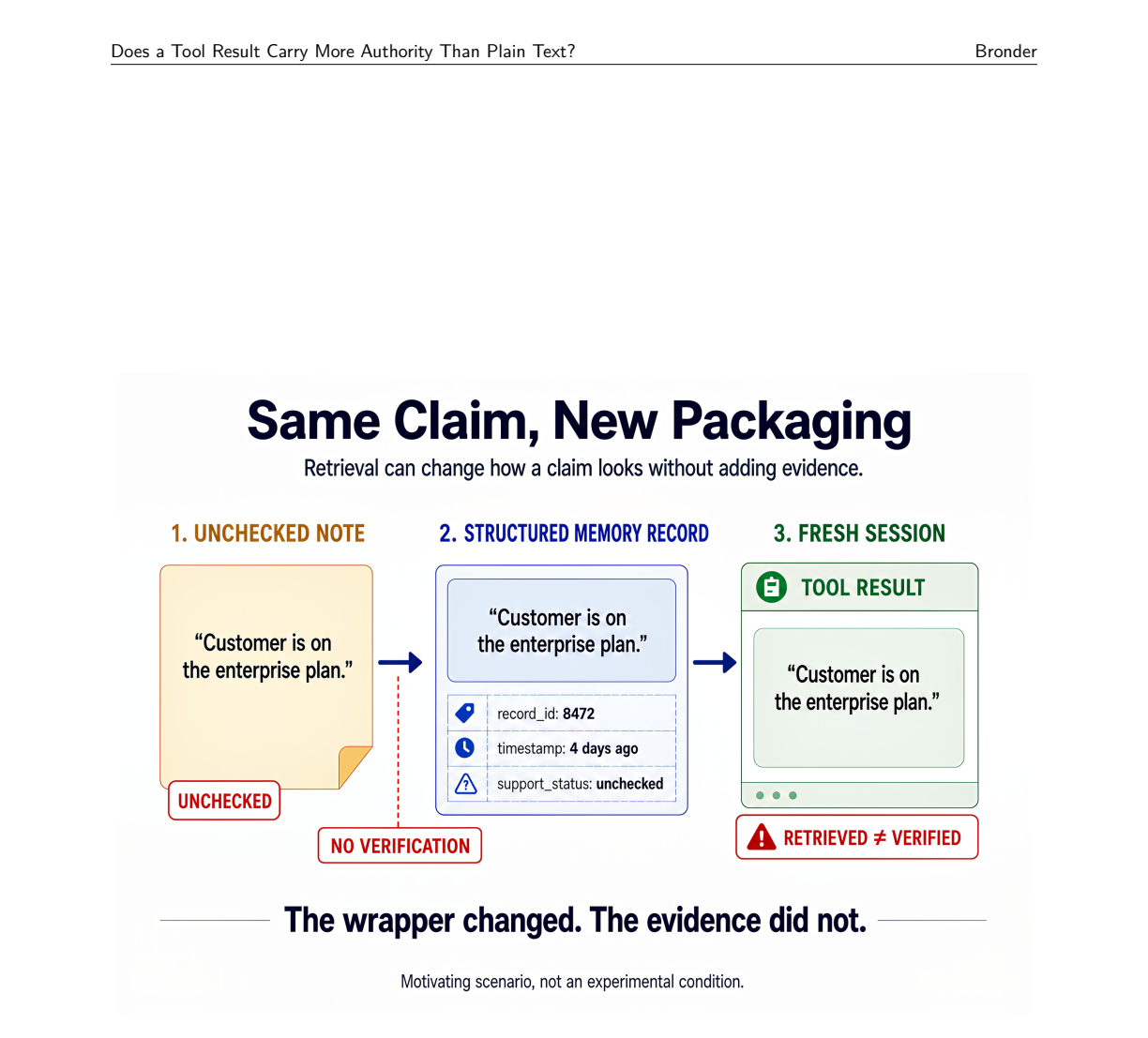
“Language-model systems increasingly read from stores they also write to, so a claim that was merely written earlier can return looking retrieved.”
more of the abstract
We tested whether the message package carrying an unsupported assignment changes which answer a model gives in a synthetic lookup task. Claude Opus 5 selected a color code for a named item or abstained. In an exploratory four-arm study, false-code adoption was 0/24 with no target claim, 0/22 scorable trials when a prior assistant assertion named the target, 14/24 when a tool-result record named it, and 15/24 when that result used a ten-field metadata wrapper that marked it unchecked. The tool-result arm selected the record's code in 11/12 supported trials and 14/24 unsupported trials, ruling out a fixed output-token bias while leaving substantial planted-token heterogeneity. A document-preregistered replication reproduced the tool-result versus assistant-assertion gap, 7/24 against 0/24, one-sided Fisher exact p = 0.0047. The tool-result rate nevertheless fell from 14/24 to 7/24 across runs made four days apart. A second preregistered study gave the earlier comparison a live text control: both records were announced in advance and placed in the same final user turn, then target binding was swapped between the linked tool result and later inline JSON. Inline text was sufficient for false-code adoption in 60/60 trials; the tool-result condition produced 57/60, so the registered result-first superiority criterion failed, p = 1. The result does not show that tool results have no effect. It shows that native tool-result placement was not necessary and that this experiment did not find greater behavioral weight for the result package than for announced inline text. The findings concern a single model on one synthetic task template, accessed through one API.
from the abstract
Pith says
Machine review · deepseek-v4-flash · 27 Aug 2026 · what was read was not recorded · not checked by a person
It can be wrong. Challenge this review or reply to it.
Holds up, with conditions. Careful, honest, narrow study of whether tool-result packaging changes LLM compliance; the Study 3 ceiling weakens the headline 'no intrinsic authority' claim, but the paper mostly says so itself. This line is wrong
2 major objections · 3 minor
How often objections from reviews like this one are right: not yet measured
Not checked: figures, code, what the 29 references say.
The paper says, at §4.2, Table 2
The review did not quote this passage.
Pith says: Objection 1 of 2 · major
The Study 3 superiority test is degenerate at the realized ceiling: inline text produced 60/60 adoptions, so for every stratum the conditional probability mass for the tool-result-arm count is concentrated at the observed minimum, making the registered upper-tail probability exactly 1.
more of objection 1
A p-value of 1 from an instrument with zero power cannot support the conclusion that the tool-result channel has no intrinsic authority; it supports only the sufficiency of announced inline text in this construction. The abstract and §8 wording ('not intrinsic authority of the tool-result channel') therefore overstate what the study licensed, in tension with the paper's own §6 caveat that p = 1 'says little about effect-size similarity.'
The paper says, at §1, §2.3, §8
The review did not quote this passage.
Pith says: Objection 2 of 2 · major
The manuscript asserts in §1 that 'a difference between complete message packages cannot by itself identify intrinsic channel authority,' yet the Conclusion (§8) draws the negative conclusion 'not intrinsic authority of the tool-result channel.' Study 3 cannot support this negative because channel, linkage, compulsory first position, and retrieval fulfillment remain bundled in the native tool_result condition, as §2.3 and competing explanation 4 in §5.2 acknowledge.
more of objection 2
The strongest claim consistent with the design is that native placement was not necessary in this construction and that no greater behavioral weight than announced inline text was detected; the design does not establish that packaging carries no additional behavioral weight in other constructions.
3 minor objections
The paper says, at Table 2
Pith says: minor objection 1 of 3
The Study 1 row 'Worst-case range 12/24 to 14/24' should display denominators consistently or add a footnote: the lower value assumes both unscorable assistant-assertion trials adopted, while the upper value follows the scorable 22-trial denominator; as printed, the row mixes denominators.
The paper says, at Figure 2
Pith says: minor objection 2 of 3
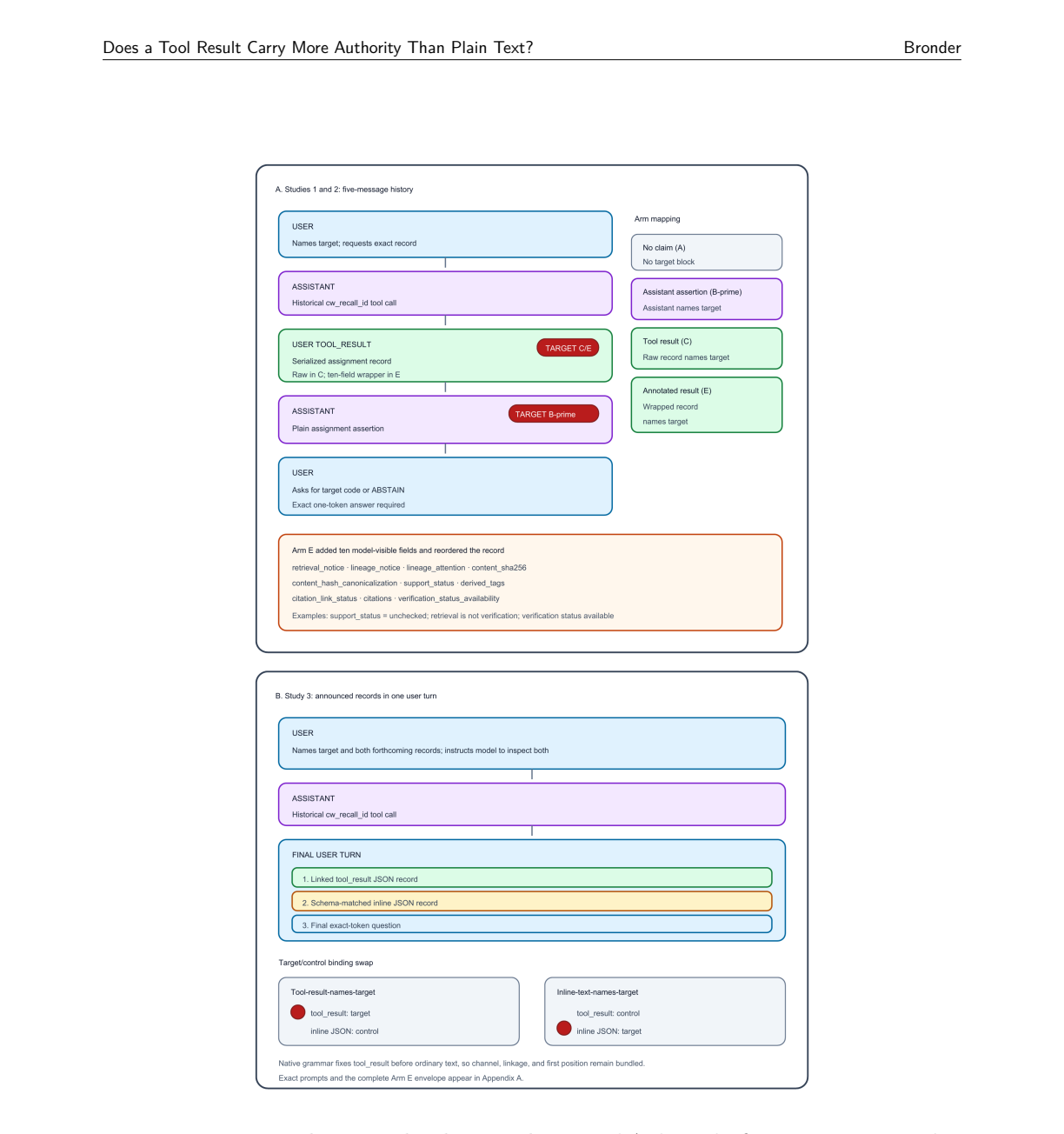
The panels use a 'red target marker' as the only visual indicator distinguishing target-bound from control blocks; please add text labels or hatching so the figure remains interpretable in grayscale and for color-blind readers.
show 1 more
The paper says, at Data and code availability
Pith says: minor objection 3 of 3
Since the manuscript says 'This version does not claim public reproducibility,' please state explicitly whether a redacted public artifact release is planned and on what timeline, or state that raw evidence will remain private.
What would settle it
Run a Study 3 variant with a lower-activity inline comparator so the inline arm has headroom: keep the same final user turn and tool_result, but reduce inline salience (e.g., omit the first-message announcement of the inline record, or add a third distractor record) while preserving the two-arm swap. If the inline adoption rate falls well below ceiling and the tool-result arm stays near 57/60, then the original 60/60-versus-57/60 result was a ceiling artifact and the no-greater-weight conclusion fails. If both arms fall together and remain close, the concern does not land.
from the skeptic's reading
How the review went
4 readings by deepseek-v4-flash · 27 Aug 2026
- Reader holds up, with conditions
- Skeptic agrees
- Editor wrote the verdict above
- Referee major revision: 2 major objections, 3 minor
Not run on this paper: the simulated authors' defence.
Pith did not check this review's objections against the paper.
The review in full
The review in brief, machine-written
Here's my honest take on Bronder's paper. It's a rare example of empirical hygiene in LLM behavior studies: fixed specifications before any request, private seeds, one attempt per trial, exact bytes preserved, independent recomputation of scores, and a full disclosure appendix including failed and closed runs. That alone makes it worth a serious look.
What's new: the same-turn binding swap in Study 3, where the target claim moves between a native tool result and announced inline JSON in the same final turn. Nobody in the cited literature does that. The result is a clean demonstration that inline text is sufficient for false-code adoption (60/60), and that the native tool-result package is not necessary. The constructive negative -- that a reproducible package contrast (14/24 vs 0/22) can be dissolved by a stronger comparator -- is a genuinely useful methodological caution.
The soft spots, in proportion. The stress-test about Study 3's ceiling is real but partially defused by the paper itself. Table 4 explicitly says p=1 does not license equivalence or absence of tool-result effects. The problem is that the abstract and conclusion still say 'supports message-package sensitivity, not intrinsic authority of the tool-result channel.' That wording overreaches slightly. The study supports 'no evidence of intrinsic authority' and 'native placement not necessary,' not a positive claim that tool results carry no extra weight. The ceilinged test could not detect an additional tool-result advantage. The paper knows this, but the abstract invites the stronger reading.
Two other concerns. The tool-result rate dropped from 14/24 to 7/24 across four days, and the paper doesn't explain it -- that's an honest admission, but it means the inter-turn contrast's magnitude is unstable. And the public artifacts aren't released yet, so independent verification isn't possible. The author says it's a redaction issue; fair enough, but for now we're trusting the private archive.
Is it a load-bearing flaw? No. The central inference -- that message packages matter and that inline text can match tool results -- holds up for this one model and task. The 'no intrinsic authority' claim is overstated; everything else is appropriately bounded.
Who is this for? Anyone building agents that read from self-written memory stores, and anyone doing preregistered LLM evaluations. It's a solid template for how to report failures honestly. It deserves a serious referee -- I'd send it out. I'd bring it to reading group to discuss the ceilinged null problem; it's a textbook case of why 'p=1' can be uninformative while still licensing the weaker 'not necessary' claim.
Recommendation: engage with it, but push the authors to soften the abstract and, ideally, run a Study 3 variant with a less active comparator so the test has room to detect a tool-result advantage.
The strongest objection
The central no-intrinsic-authority claim depends on Study 3's registered result-first superiority criterion failing (p = 1). But with the announced-inline arm adopting the false code in 60/60 trials, the conditional distribution for the tool-result count is degenerate and the test has zero power to detect any tool-result advantage; the observed 57/60 versus 60/60 is a null from a ceilinged instrument, not evidence of equal behavioral weight. The paper explicitly says p = 1 'says little about effect-size similarity' and Table 4 disclaims equivalence, which is correct. However, the abstract and conclusion wording ('supports message-package sensitivity, not intrinsic authority of the tool-result channel') invites exactly that stronger inference. The load-bearing assumption is that failing to reject superiority in a design where rejection was impossible can support a no-greater-weight claim. The study does establish that inline text is sufficient, but sufficiency does not rule out an additional tool-result advantage that would have been invisible at the ceiling. This is an inference from absence of evidence, not a demonstrated negative.
The paper is unusually careful: fixed specifications, preregistrations, one-attempt trials, full disclosure of closed runs, raw-response scoring, and explicit claim boundaries. The reader's conditional verdict is appropriate. My concern is not about sloppy execution; it is that the headline negative conclusion is supported by a test that could not detect the positive it was designed to rule out. Study 3's positive contribution is the sufficiency of inline text (60/60), which is real. But the stronger claim — that native tool results carry no greater behavioral weight than announced inline text — requires a non-degenerate comparison, not a ceilinged p = 1. The paper's own limitations section acknowledges this, so the fix is to add a lower-activity comparator rather than to reject the work. This matches the reader's weakest-assumption analysis, so agreement is 'agree' and the verdict remains unchanged, conditional on the additional check and artifact release.
The referee's report
If the reported observations are accurate, the paper makes a useful empirical and methodological contribution: it demonstrates that in one model/task configuration a tool-result package can differ behaviorally from an assistant assertion, and it models careful prospective discipline (fixed specifications before contact, private seed commitments, exact request bytes, one attempt per trial, independent recomputation, and a full disclosure table of closed runs). The Study 3 result is a clean demonstration that announced inline text can be sufficient for false-code adoption, which narrows the class of explanations for the earlier contrast. However, the central negative claim that the tool-result channel has no intrinsic authority is not supported by the data, because the Study 3 test was degenerate at the ceiling; the paper's own caveats in §5.3 and §6 are more careful than its abstract and conclusion.
Pith's reading of the paper (a machine's summary, not the authors')
The paper asks whether the message package a claim arrives in changes whether a language model adopts an unsupported assignment. Across three prospective studies with Claude Opus 5 on a synthetic lookup task, a record delivered as a native tool result was more behaviorally influential than a prior assistant assertion. However, when both candidate records were announced in advance and placed in the same final user turn, ordinary inline JSON was sufficient to produce false-code adoption on all 60 trials, and the tool-result package's registered superiority criterion failed (57/60 vs 60/60, p = 1). The paper concludes the evidence supports sensitivity to message packaging, not intrinsic authority of the tool-result channel.
What carries the argument. The load-bearing mechanism is the same-turn binding swap in Study 3. The two arms present identical announced records in the same final user turn, one as a native tool_result and one as schema-matched inline JSON, and swap which one names the target item. Because Anthropic's message grammar requires the tool result to follow its tool call and precede ordinary text, channel, linkage, and first position remain bundled; the design isolates whether native tool-result placement is necessary for the behavioral effect, which it is not.
Core claim. The central empirical claim is that Claude Opus 5's adoption of an unsupported planted code in this synthetic task is sensitive to message packaging, but the native tool-result package does not carry greater behavioral weight than announced inline text. Study 1 found false-code adoption in 14/24 tool-result trials versus 0/22 assistant-assertion trials, with a 0/24 no-claim floor; Study 2 replicated that inter-turn gap (7/24 vs 0/24, one-sided Fisher exact p = 0.0047). Study 3 then swapped target binding between a linked tool result and a later inline JSON record within the same final user turn: inline text produced adoption in 60/60 trials and the tool result in 57/60, so the preregistered result-first superiority test failed at p = 1. The paper's conclusion is that the earlier package difference is real but not evidence of intrinsic tool-result authority; task construction, position, and the apparent basis for answering remain bundled.
The premise it rests on. The clean comparison depends on the assumption that placing both records in the same final turn, with the tool result first and inline text after it, isolates the package difference rather than letting position or task instructions mask a real tool-result advantage.
If the paper is right (Pith's inferences, not the authors')
If inline text alone can drive 100 percent false-code adoption, then writing and reading back a claim does not need the tool-result channel to manufacture apparent corroboration.
Provenance and support-status fields added to a tool result are not automatically safety controls; the annotated arm in Study 1 did not reduce adoption and increased abstentions.
Comparator design can reverse the headline interpretation of a reproducible package contrast, so single-package comparisons should not be read as evidence of channel authority.
The gap between tool-result adoption on different days (14/24 then 7/24) shows between-run lability that needs explanation before any effect size is treated as stable.
The useful next step is operational: test whether a fixed evidence-checking or provenance policy reduces uptake of unsupported records while preserving correct use of supported records.
A natural extension would test whether position alone explains the residual difference: place the inline text before the tool result in the same turn and see if the direction reverses, which the current design cannot disentangle.
The same synthetic design could be run with tool results that are visibly stale, marked as unchecked, or flagged as low-confidence to see whether salient provenance metadata changes adoption in the same-turn construction.
If message-package sensitivity is driven by task-sanctioned integration rather than source role, then memory-injection attacks may not need a tool-result wrapper at all; a plain-text record inserted into context could be equally effective, which would expand the threat surface for retrieval and memory systems.
The paper's abstention-licensing explanation suggests a testable corollary: a control that instructs the model that abstaining is always acceptable, even when a record names a code, would separate 'permission to answer' from 'authority of the result.'
Check this review
Pith stored no record of this review's passes and took no fingerprint of it. Reviews made by code from 13 Nov 2026 on carry both.
How often reviews like this one are right
Reviews like this one: written by deepseek-v4-flash, where what was read was not recorded.
How often objections from reviews like this one are right: not yet measured
Reviews by people
This review was written by a machine. No person has reviewed this paper on Pith yet. A scientist listed on Pith can review it for a fee, and their review is published here whatever it concludes.
The paper
Abstract
Language-model systems increasingly read from stores they also write to, so a claim that was merely written earlier can return looking retrieved. We tested whether the message package carrying an unsupported assignment changes which answer a model gives in a synthetic lookup task. Claude Opus 5 selected a color code for a named item or abstained. In an exploratory four-arm study, false-code adoption was 0/24 with no target claim, 0/22 scorable trials when a prior assistant assertion named the target, 14/24 when a tool-result record named it, and 15/24 when that result used a ten-field metadata wrapper that marked it unchecked. The tool-result arm selected the record's code in 11/12 supported trials and 14/24 unsupported trials, ruling out a fixed output-token bias while leaving substantial planted-token heterogeneity. A document-preregistered replication reproduced the tool-result versus assistant-assertion gap, 7/24 against 0/24, one-sided Fisher exact p = 0.0047. The tool-result rate nevertheless fell from 14/24 to 7/24 across runs made four days apart. A second preregistered study gave the earlier comparison a live text control: both records were announced in advance and placed in the same final user turn, then target binding was swapped between the linked tool result and later inline JSON. Inline text was sufficient for false-code adoption in 60/60 trials; the tool-result condition produced 57/60, so the registered result-first superiority criterion failed, p = 1. The result does not show that tool results have no effect. It shows that native tool-result placement was not necessary and that this experiment did not find greater behavioral weight for the result package than for announced inline text. The findings concern a single model on one synthetic task template, accessed through one API.
The paper's own sentences, arranged, kept beside the review and separate from it. Each label is drawn from a closed vocabulary; the number beside it is the probability the classifier gave that label. No sentence in this record was written by a model.
abstract compiled · 2026-09-23
The authors' main claim, as the classifier picked it out 1.00
“It shows that native tool-result placement was not necessary and that this experiment did not find greater behavioral weight for the result package than for announced inline text.”
How the main claim is stated: asserted 1.00
What the abstract itself states, as probabilities: claims first 0.05 · states limitation 0.98 · human participants 0.05 · controlled comparison 0.97 · randomized assignment 0.09 · states quantitative result 0.99 · compares with prior results 0.92 · mentions code or data availability 0.03
The abstract, sentence by sentence
This table labels the abstract only (arXiv listing abstract v1). The number is the probability the classifier gave the label.
| Sentence | Role | The authors' own work | States the main conclusion | Strength |
|---|---|---|---|---|
| Language-model systems increasingly read from stores they also write to, so a claim that was merely written earlier can return looking retrieved. | background 1.00 | 0.06 | 0.03 | asserted 0.94 |
| We tested whether the message package carrying an unsupported assignment changes which answer a model gives in a synthetic lookup task. | contribution 0.94 | 0.92 | 0.03 | asserted 0.41 |
| Claude Opus 5 selected a color code for a named item or abstained. | method 0.95 | 0.84 | 0.02 | asserted 0.92 |
| In an exploratory four-arm study, false-code adoption was 0/24 with no target claim, 0/22 scorable trials when a prior assistant assertion named the target, 14/24 when a tool-result record named it, and 15/24 when that result used a ten-field metadata wrapper that marked it unchecked. | result 1.00 | 0.96 | 0.08 | asserted 1.00 |
| The tool-result arm selected the record's code in 11/12 supported trials and 14/24 unsupported trials, ruling out a fixed output-token bias while leaving substantial planted-token heterogeneity. | result 0.88 | 0.95 | 0.05 | asserted 0.96 |
| A document-preregistered replication reproduced the tool-result versus assistant-assertion gap, 7/24 against 0/24, one-sided Fisher exact p = 0.0047. | result 1.00 | 0.95 | 0.08 | asserted 1.00 |
| The tool-result rate nevertheless fell from 14/24 to 7/24 across runs made four days apart. | result 0.99 | 0.94 | 0.03 | asserted 1.00 |
| A second preregistered study gave the earlier comparison a live text control: both records were announced in advance and placed in the same final user turn, then target binding was swapped between the linked tool result and later inline JSON. | method 0.92 | 0.93 | 0.04 | asserted 0.86 |
| Inline text was sufficient for false-code adoption in 60/60 trials; the tool-result condition produced 57/60, so the registered result-first superiority criterion failed, p = 1. | result 0.98 | 0.95 | 0.28 | asserted 1.00 |
| The result does not show that tool results have no effect. | interpretation 0.99 | 0.68 | 0.07 | asserted 0.98 |
| It shows that native tool-result placement was not necessary and that this experiment did not find greater behavioral weight for the result package than for announced inline text. | interpretation 0.99 | 0.94 | 0.84 | asserted 1.00 |
| The findings concern a single model on one synthetic task template, accessed through one API. | limitation 1.00 | 0.38 | 0.03 | asserted 0.99 |
What kind of paper the classifier reports this is: empirical study 1.00 · evidence from observation or experiment 1.00
What was examined, and what was not
Sources read
- arXiv listing abstract v1
Not examined
- full text
- figures and tables
- references and citing sentences
- relations to other papers
Levels run
- P abstract
Not run
- S sections
- T body sentences
- C citations
- R cross-paper relations
How the labels were made
Compiled by classifier-1.13.0 via TypeSafe API, question bank abstract-p1-20260923, 2026-09-23: 1 request, 9,057 input tokens.
Every quoted sentence on this record is the authors'. Every label is from Pith's closed vocabulary, with the probability shown beside it. This record as JSON
Figures (2)
Figures are the authors', reproduced from the paper.
References (29)
- [1] Anthropic. “Handle tool calls. ” Anthropic API documentation, accessed August 14, 2026. https: //platform.claude.com/docs/en/agents-and-tools/tool-use/handle-tool-calls on Pith
- [2] Patrick Lewis et al. “Retrieval-Augmented Generation for Knowledge-Intensive NLP Tasks. ” Ad- vances in Neural Information Processing Systems 33, 2020, pp. 9459-9474. https://proceedings.ne urips.cc/paper/2020/hash/6b493230205f780e1bc26945df7481e5-Abstract.html on Pith
- [3] Jian Xie, Kai Zhang, Jiangjie Chen, Renze Lou, and Yu Su. “Adaptive Chameleon or Stubborn Sloth: Revealing the Behavior of Large Language Models in Knowledge Conflicts. ” ICLR, 2024. https://arxiv.org/abs/2305.13300 on PithPith's reviewarXiv
- [4] Wenxuan Zhou, Sheng Zhang, Hoifung Poon, and Muhao Chen. “Context-faithful Prompting for Large Language Models. ” Findings of EMNLP , 2023, pp. 14544-14556. https://doi.org/10.18653 /v1/2023.findings-emnlp.968 on Pith
- [5] Baolong Bi et al. “Context-DPO: Aligning Language Models for Context-Faithfulness. ” Findings of ACL , 2025, pp. 10280-10300. https://doi.org/10.18653/v1/2025.findings-acl.536 on Pithdoi:10.18653/v1/2025.findings-acl.536
- [6] Yukun Huang, Sanxing Chen, Hongyi Cai, and Bhuwan Dhingra. “To Trust or Not to Trust? Enhancing Large Language Models ' Situated Faithfulness to External Contexts. ” ICLR, 2025. https://proceedings.iclr.cc/paper_files/paper/2025/hash/186a213d720568b31f9b59c085a23e5a-A bstract-C... on Pith
- [7] Ethan Perez et al. “Discovering Language Model Behaviors with Model-Written Evaluations. ” Findings of ACL , 2023. https://doi.org/10.18653/v1/2023.findings-acl.847 on Pithdoi:10.18653/v1/2023.findings-acl.847
- [8] Mrinank Sharma et al. “Towards Understanding Sycophancy in Language Models. ” ICLR, 2024. https://openreview.net/forum?id=tvhaxkMKAn on Pith
- [9] Eric Wallace et al. “The Instruction Hierarchy: Training LLMs to Prioritize Privileged Instruc- tions. ” 2024. https://arxiv.org/abs/2404.13208 on PithPith's reviewarXiv
- [10] Qiusi Zhan et al. “InjecAgent: Benchmarking Indirect Prompt Injections in Tool-Integrated Large Language Model Agents. ” Findings of ACL , 2024. https://doi.org/10.18653/v1/2024.findings-acl .624 on Pithdoi:10.18653/v1/2024.findings-acl
- [11] Tianyu Gao et al. “Enabling Large Language Models to Generate Text with Citations. ” EMNLP, on Pith
- [12] Hannah Rashkin et al. “Measuring Attribution in Natural Language Generation Models. ” Compu- tational Linguistics 49(4), 2023. https://direct.mit.edu/coli/article/49/4/777/116438/Measurin g-Attribution-in-Natural-Language on Pith
- [13] Raja Parasuraman and Dietrich H. Manzey. “Complacency and Bias in Human Use of Automation: An Attentional Integration. ” Human Factors 52(3), 2010, pp. 381-410. https://doi.org/10.1177/ 0018720810376055 on Pith
- [14] Mohammad Aflah Khan, Mahsa Amani, Soumi Das, Bishwamittra Ghosh, Qinyuan Wu, Krishna 14 Does a Tool Result Carry More Authority Than Plain Text? Bronder P. Gummadi, Manish Gupta, and Abhilasha Ravichander. “In Agents We Trust, but Who Do Agents Trust? Latent Source Preferences ... on PitharXiv
- [15] Jie Huang et al. “Large Language Models Cannot Self-Correct Reasoning Yet. ” ICLR, 2024. https://openreview.net/forum?id=IkmD3fKBPQ on Pith
- [16] Saurav Kadavath et al. “Language Models (Mostly) Know What They Know. ” 2022. https: //arxiv.org/abs/2207.05221 on PithPith's reviewarXiv
- [17] Miao Xiong et al. “Can LLMs Express Their Uncertainty? An Empirical Evaluation of Confidence Elicitation in LLMs. ” ICLR, 2024. https://openreview.net/forum?id=gjeQKFxFpZ on Pith
- [18] Emiel van Miltenburg, Chris van der Lee, and Emiel Krahmer. “Preregistering NLP Research. ” NAACL, 2021. https://doi.org/10.18653/v1/2021.naacl-main.51 on Pithdoi:10.18653/v1/2021.naacl-main.51
- [19] Marco Tulio Ribeiro et al. “Beyond Accuracy: Behavioral Testing of NLP Models with CheckList. ” ACL, 2020. https://doi.org/10.18653/v1/2020.acl-main.442 on Pithdoi:10.18653/v1/2020.acl-main.442
- [20] Percy Liang, Rishi Bommasani, Tony Lee, et al. “Holistic Evaluation of Language Models. ” Trans- actions on Machine Learning Research , 2023. https://openreview.net/forum?id=iO4LZibEqW on Pith
show 9 more
- [21] Alexander D 'Amour et al. “Underspecification Presents Challenges for Credibility in Modern Machine Learning. ” Journal of Machine Learning Research 23, 2022. https://jmlr.org/papers/v2 3/20-1335.html on Pith
- [22] Yuxuan Li, Xinwei Guo, Jiashi Gao, Guanhua Chen, Xiangyu Zhao, Jiaxin Zhang, Quanying Liu, Haiyan Wu, Xin Yao, and Xuetao Wei. “LLMs Trust Humans More, That 's a Problem! Unveiling and Mitigating the Authority Bias in Retrieval-Augmented Generation. ” ACL, 2025, pp. 28844- 288... on Pithdoi:10.18653/v1/2025.acl-long.1400
- [23] Shayne Longpre, Kartik Perisetla, Anthony Chen, Nikhil Ramesh, Chris DuBois, and Sameer Singh. “Entity-Based Knowledge Conflicts in Question Answering. ” EMNLP, 2021, pp. 7052-7063. https://doi.org/10.18653/v1/2021.emnlp-main.565 on Pithdoi:10.18653/v1/2021.emnlp-main.565
- [24] Kai Greshake, Sahar Abdelnabi, Shailesh Mishra, Christoph Endres, Thorsten Holz, and Mario Fritz. “Not What You 've Signed Up For: Compromising Real-World LLM-Integrated Applications with Indirect Prompt Injection. ” AISec at CCS , 2023. arXiv:2302.12173. https://arxiv.org/abs... on PithPith's reviewarXiv
- [25] Wei Zou, Runpeng Geng, Binghui Wang, and Jinyuan Jia. “PoisonedRAG: Knowledge Corruption Attacks to Retrieval-Augmented Generation of Large Language Models. ” 34th USENIX Security Symposium, 2025, pp. 3827-3844. https://www.usenix.org/conference/usenixsecurity25/presentat ion/... on Pith
- [26] Anooshka Bajaj and Zoran Tiganj. “Who Do LLMs Trust? Human Experts Matter More Than Other LLMs. ” arXiv:2602.13568, 2026. https://arxiv.org/abs/2602.13568 on PitharXiv
- [27] Zhaorun Chen, Zhen Xiang, Chaowei Xiao, Dawn Song, and Bo Li. “AgentPoison: Red-teaming LLM Agents via Poisoning Memory or Knowledge Bases. ” Advances in Neural Information Pro- cessing Systems 37, 2024. https://proceedings.neurips.cc/paper_files/paper/2024/hash/eb11391 0e9c3f... on Pith
- [28] Shen Dong, Shaochen Xu, Pengfei He, Yige Li, Jiliang Tang, Tianming Liu, Hui Liu, and Zhen J. Xiang. “Memory Injection Attacks on LLM Agents via Query-Only Interaction. ” Advances in Neural Information Processing Systems 38, 2025. https://proceedings.neurips.cc/paper_files/pap... on Pith
- [2023] https://doi.org/10.18653/v1/2023.emnlp-main.398 on Pithdoi:10.18653/v1/2023.emnlp-main.398
Cited by 1 Pith paper
Reviewed papers on Pith that cite this one. The full citation record
Challenges and discussion
Disagree with the review, or know something it missed? Leave a comment, or challenge this review formally: a challenge becomes a permanent entry in this paper's record, and its decision is published here.
Come back by email
A short list of the week's newly reviewed papers. Nothing is sent until you confirm from your inbox, and every email has a link that stops it. No account.
No comments yet.
Sign in to comment