Artificial Intelligence · arXiv:2608.27768 v1 · submitted 27 Aug 2026 · 25 references
Why Didn't It Check? Unsupported Final Claims and Their Repair in Two Tool-Equipped Language Models
The paper says
“A language model with access to tools can commit to a final claim unsupported by the evidence it has seen, even when a single available tool call would resolve the uncertainty and its instructions explicitly forbid assumptions and guesses.”
more of the abstract
We separate this failure into two precisely defined quantities: occurrence, how often the model makes an unsupported claim on its own, measured from the visible evidence and final claim without using the hidden correct answer; and conditional repair, how often those same naturally occurring unsupported claims are repaired when the missing evidence is supplied. On one fixed Qwen3-32B setup, 33 of 512 first responses to 256 new prompt templates ended with an unsupported established claim. We replayed each case from an exact copy of the state in which the claim occurred; within each matched replay, the alternative tool responses had the same structure and length and differed only in a one-character response code. Resolving evidence repaired 33 of 33 claims; a matched response carrying no useful information repaired 0 of 33. When the evidence supported the original answer, the model preserved 33 of 33, with no observed harm. In a separate experiment, on 64 cases where evidence was needed, an automatic checking rule added 21 evidence calls, corrected all 10 wrong unsupported claims, preserved the 11 that were correct by accident, and never changed a correct answer into a wrong one. On a fixed Gemma 4 setup using the same sampling settings, the model called the tool in all 512 first responses and never made an unsupported final claim, so conditional repair could not be measured for that setup. These results describe two local fixed model setups on two synthetic task families. They do not show how common this failure is in real-world deployments, nor that it reflects a general mechanism shared across models.
from the abstract
Pith says
Machine review · deepseek-v4-flash · 9 Sep 2026 · what was read was not recorded · not checked by a person
It can be wrong. Challenge this review or reply to it.
Holds up, with conditions. A carefully scoped, honestly reported two-stage study whose clean 33/33 vs 0/33 repair contrast earns referee time; the private archive and untested replay determinism are the real soft spots. This line is wrong
1 major objection · 6 minor
How often objections from reviews like this one are right: not yet measured
Not checked: figures, code, what the 25 references say.
The paper says, at §2.3–2.4, Appendix A
The review did not quote this passage.
Pith says: Objection 1 of 1 · major
The central causal claim that resolving evidence (Q) caused retraction while the matched no-information response (U) did not depends on the assumption that replaying the exact archived serialized state with the same continuation seed produces identical model behavior. The paper states that 'offline replay reproduced all 512 archived states and 1,024 score rows exactly' (Section 2.4), but this verifies only …
more of objection 1
… that the stored request bytes and derived scores match, not that the model’s output is token-level deterministic under identical input and seed. No experiment is reported that runs the same archived state twice and checks for identical generated tokens. Given that the inference engine (llama.cpp) and sampling parameters (temperature=0.6, top-k=20, top-p=0.95) are not guaranteed to produce bit-identical output across runs—due to GPU kernel scheduling, floating-point reduction order, or other hardware-level variation—the replay may not reproduce the exact same internal state. This omission directly affects the validity of the 33/33 vs. 0/33 contrast. The authors should either (a) provide explicit evidence of deterministic output (e.g., by re-running a subset of archived states twice and reporting token-level agreement) or (b) discuss how potential non-determinism could affect the results and why the observed perfect separation is nevertheless robust.
6 minor objections
The paper says, at §1.3
Pith says: minor objection 1 of 6
The sentence 'Across the paired supporting and disqualifying hidden worlds, resolving evidence produced a supported final claim in all 66 scored continuations' could be read as implying 66 independent trials. The next sentence clarifies it is 33 paired cases, but rephrasing to '66 scored continuations (33 paired cases)' would avoid potential misinterpretation.
The paper says, at Table 1
Pith says: minor objection 2 of 6
The column 'Exact 95% frequency bounds' uses separate one-sided bounds but presents them as a range. Consider adding a footnote or adjusting the caption to explicitly state 'one-sided 95% Clopper-Pearson bounds'.
show 4 more
The paper says, at §2.5, Table 2
Pith says: minor objection 3 of 6
The row for 'First new matched replay' reports 4/4, which is a very small sample. The table is descriptive, but a brief footnote about the small N would help readers calibrate the stability of those early results.
The paper says, at Appendix A
Pith says: minor objection 4 of 6
The example is clear, but it would be helpful to state explicitly that the code meanings (A, B, U) were defined in the prompt, connecting the walk-through to the limitations discussion about code visibility.
The paper says, at §2.2
Pith says: minor objection 5 of 6
The paper uses 'established' and 'not_established' as JSON status values. Consider providing a brief definition of these values earlier, perhaps in Section 2.1 or 2.2, for readers unfamiliar with the task format.
The paper says, at §1.2, Figure 1
Pith says: minor objection 6 of 6
Figure 1 caption refers to 'Panel A', 'Panel B', etc., but the figure itself is not included in the manuscript text for this review. If the figure is present in the actual submission, this comment is moot; otherwise, ensure the figure and its panels are properly integrated.
What would settle it
Select the archived input bytes for one of the 33 Qwen cases (e.g., the example in Appendix A). Run the same model checkpoint, inference server executable, and tokenizer twice with the same seed, temperature 0.6, top-k 20, top-p 0.95, feeding the same raw input. Compare the generated token sequences (both reasoning and final claim) byte-for-byte. Repeat for a second random seed to check if determinism holds across seeds. Also test a no-information response replay to ensure the injected response processing is also deterministic. If any token differs between runs in a single pair, the replay assumption fails and the repair contrast is not a clean causal isolation.
from the skeptic's reading
How the review went
4 readings by deepseek-v4-flash · 9 Sep 2026
- Reader holds up, with conditions
- Skeptic agrees
- Editor wrote the verdict above
- Referee major revision: 1 major objection, 6 minor
Not run on this paper: the simulated authors' defence.
Pith did not check this review's objections against the paper.
The review in full
The review in brief, machine-written
The short version: this is the rare paper where design discipline is the actual contribution. Bronder separates occurrence — how often a model commits an unsupported final claim, measured without the hidden answer — from conditional repair, then tests repair by replaying archived states with tool responses matched in everything but a one-byte response code. On one fixed Qwen3-32B setup, disqualifying evidence fixed 33/33; a matched no-information response fixed 0/33; supporting evidence preserved 33/33 with no observed harm. The Gemma row is a useful zero: 512/512 tool calls, no unsupported claims, so repair is undefined rather than zero there.
What's genuinely good: the detection rule uses only visible evidence and the final claim, so you get a pre-ground-truth reliability signal. The no-information control is the right control and it's run properly — same format, location, byte length, token count, with only the response code differing. The code-meaning remapping was fixed before collection and rules out a one-character shortcut; the per-code splits (14/14, 10/10, 9/9 vs 0/14, 0/10, 0/9) are reported. Schedules fixed in advance, no retries, exact Clopper-Pearson bounds, exploratory analyses separated from confirmatory ones. The limitations section is unusually honest: code meanings were visible before answering, so prompt lookup explains the result just as well; only one repair direction was tested; the literature search is explicitly narrow.
Soft spots, in proportion. The main one: the raw archive is private. Hashes and rerun commands are more than most papers give you, but the central counts can't be independently checked today, and "reproduced exactly" refers to stored bytes, not to token-level output determinism. The stress-test concern about replay determinism is legitimate: with temperature 0.6 and top-p 0.95, the 33/33 vs 0/33 contrast rests on the same archived state plus same seed producing the same output across separate inference runs, and the paper never runs an identical input twice to show that. I'd soften the worry, though. If sampling noise were material, landing exactly 33/33, 0/33, and 33/33 across the three matched conditions would be a remarkable coincidence. The empirical pattern is weak evidence that determinism held, but it's not the direct check, and the author should add one before anyone treats the isolation claim as established. The Gemma comparison changes checkpoint, prompt, quantization, and sampling together, so it can't identify what caused the zero — the paper says this itself.
The reader's conditional verdict matches mine. This deserves a serious referee: it's careful, the method is reusable, and the claims are falsifiable in principle. I'd send it to review with one firm request — release the redacted archive and add a same-input-twice determinism check on a sample of replays. With that, the narrow claim is well supported. Without it, the paper stays plausible but unverifiable.
The strongest objection
The paper's central claim (Section 1.3) that disqualifying evidence repaired 33/33 claims and no-information responses repaired 0/33 depends entirely on the ability to replay the exact archived serialized state and isolate the evidence content as the only difference. The paper states that 'offline replay reproduced all 512 archived states and 1,024 score rows exactly' (Section 2.4), but this check only verifies that the stored request bytes match, not that the model's output is deterministic when given identical input. The inference server could introduce non-determinism from GPU kernel scheduling, floating-point reduction order, or other hardware-level variation, even with fixed seed, temperature, top-k, and top-p settings. The paper does not report running the same input twice and checking token-level correspondence. If server-side non-determinism is present, the matched replays (D, Q, U) may not start from the same internal state, and the observed difference between 33/33 and 0/33 could be influenced by stochastic variation in model behavior rather than purely the evidence content. This concern directly undercuts the causal claim because the entire repair measurement rests on the assumption that byte-identical input plus same seed produces identical model output. Without explicit verification of deterministic inference, the architecture of the argument is fragile.
The reader correctly identified the replay-determinism assumption as the weakest link. My stress-test confirms that this is the single most load-bearing concern: without deterministic inference, the ability to isolate evidence content as the sole cause of repair is undermined. The paper's assertions about offline replay only confirm that stored bytes match, not that model outputs are deterministic. A concrete test exists and is straightforward to run. This concern does not reject the paper's claims but reinforces the conditional verdict: the central result is credible only if deterministic reproducibility is empirically confirmed. No other issue in the paper is as fundamental to the causal architecture; the detection rule, code-remapping, and matched controls are all well designed, but they rest on this deterministic foundation. Therefore, the verdict should remain CONDITIONAL pending explicit verification of inference determinism.
The referee's report
The paper introduces a clean, label-free detection method for unsupported claims and a matched-replay design that isolates the content of the missing evidence as the causal factor. If the central result holds, it provides a striking demonstration that a single piece of resolving evidence can deterministically retract an unsupported claim while a structurally identical but information-free turn cannot. The design contributions—fixed schedules before collection, code meaning remapping, exact Clopper-Pearson bounds, separation of exploratory from confirmatory analyses, and thorough limitations discussion—set a high methodological bar for this kind of work. The empirical contribution is honest, narrow, and clearly scoped.
Pith's reading of the paper (a machine's summary, not the authors')
Language models with tool access sometimes commit to a final claim unsupported by available evidence, even when a single tool call could resolve the uncertainty. This paper measures how often that happens (occurrence) and whether providing the missing evidence afterward fixes it (conditional repair). On one fixed Qwen3-32B setup, 33 of 512 first responses ended in an unsupported 'established' claim. Replaying each case from the exact archived state, supplying decisive evidence repaired all 33, while a matched response with no useful content repaired none. A second setup (Gemma 4) never produced the failure, so conditional repair could not be measured there.
What carries the argument. The central methodological innovation is a two-stage detection-and-replay procedure. First, a visible-evidence rule identifies an unsupported final claim without needing the hidden correct answer: it checks whether the model's final claim is 'established' while the visible evidence contains an unknown field whose possible values could change the correct answer. Second, when such a claim is detected, the exact archived state is reconstructed byte-for-byte and continued with the same random seed, injecting three alternative tool responses that differ only in a one-byte response code: disqualifying evidence, supporting evidence, and a no-information response. This isolates the effect of the evidence content from the mere presence of an extra turn or tool format.
Core claim. The paper establishes that, in the tested fixed Qwen3-32B setup, unsupported final claims occur naturally and can be reliably repaired by supplying the missing evidence. The central numerical result is that disqualifying evidence changed the claim in 33 of 33 replayed cases (one-sided 95% lower bound 0.9132), while a matched no-information response (same format, length, token count, differing only in a one-byte response code) changed 0 of 33 (upper bound 0.0868). Supporting evidence preserved 33 of 33 answers with no observed harm. The study also demonstrates an automatic checking rule that, applied separately, corrected 10 wrong unsupported claims, preserved 11 lucky correct ones, and never harmed a correct answer. A fixed Gemma 4 setup showed zero unsupported claims under the same sampling settings, providing a negative result that underscores the need to measure occurrence separately from repair.
The premise it rests on. The replay contrast assumes that continuing a byte-identical archived state with the same random seed perfectly reproduces the model's sampling behavior, so that the only difference between the three continuations is the content of the injected tool response.
If the paper is right (Pith's inferences, not the authors')
In settings similar to the test (small tables, single unknown field, cheap tool call), deploying a detection rule that flags unsupported claims and then supplies the missing evidence can correct all such claims without destabilizing already-supported answers.
The sharp contrast between 33/33 repair with evidence and 0/33 with a matched no-information response implies that the model's retraction is driven by the new information content, not by the extra turn or the tool response format.
The automatic checking rule improved accuracy from 54/64 to 64/64 in the test set, suggesting that a lightweight policy of checking only when the claim outpaces visible evidence could be a safe and effective safety layer.
The fact that Gemma 4 produced zero unsupported claims under the Qwen-matched sampling settings suggests that some model setups may naturally avoid the failure, but the cause cannot be attributed to the model alone because the setup differences are confounded.
The detection method, which requires only the visible information and the final claim, could be applied to other domains where the set of possible evidence values and their effect on the correct answer can be enumerated.
The 0/33 repair count for the no-information response suggests that merely prompting a model to reconsider or giving it an extra turn is unlikely to fix unsupported certainty in similar settings; the extra turn must carry new evidence.
Because the detection rule fires on evidential support rather than factual correctness, it can be deployed without knowing ground truth, which could be valuable as a monitoring tool in production systems where the correct answer is unknown at decision time.
The methodology of archiving exact states and performing matched replays with byte-level differences could be extended to study other types of model errors where the input context can be precisely reproduced (e.g., memory retrieval, database lookups).
Check this review
Pith stored no record of this review's passes and took no fingerprint of it. Reviews made by code from 13 Nov 2026 on carry both.
How often reviews like this one are right
Reviews like this one: written by deepseek-v4-flash, where what was read was not recorded.
How often objections from reviews like this one are right: not yet measured
Reviews by people
This review was written by a machine. No person has reviewed this paper on Pith yet. A scientist listed on Pith can review it for a fee, and their review is published here whatever it concludes.
The paper
Abstract
A language model with access to tools can commit to a final claim unsupported by the evidence it has seen, even when a single available tool call would resolve the uncertainty and its instructions explicitly forbid assumptions and guesses. We separate this failure into two precisely defined quantities: occurrence, how often the model makes an unsupported claim on its own, measured from the visible evidence and final claim without using the hidden correct answer; and conditional repair, how often those same naturally occurring unsupported claims are repaired when the missing evidence is supplied. On one fixed Qwen3-32B setup, 33 of 512 first responses to 256 new prompt templates ended with an unsupported established claim. We replayed each case from an exact copy of the state in which the claim occurred; within each matched replay, the alternative tool responses had the same structure and length and differed only in a one-character response code. Resolving evidence repaired 33 of 33 claims; a matched response carrying no useful information repaired 0 of 33. When the evidence supported the original answer, the model preserved 33 of 33, with no observed harm. In a separate experiment, on 64 cases where evidence was needed, an automatic checking rule added 21 evidence calls, corrected all 10 wrong unsupported claims, preserved the 11 that were correct by accident, and never changed a correct answer into a wrong one. On a fixed Gemma 4 setup using the same sampling settings, the model called the tool in all 512 first responses and never made an unsupported final claim, so conditional repair could not be measured for that setup. These results describe two local fixed model setups on two synthetic task families. They do not show how common this failure is in real-world deployments, nor that it reflects a general mechanism shared across models.
The paper's own sentences, arranged, kept beside the review and separate from it. Each label is drawn from a closed vocabulary; the number beside it is the probability the classifier gave that label. No sentence in this record was written by a model.
abstract compiled · 2026-09-23
The authors' main claim, as the classifier picked it out 0.77
“A language model with access to tools can commit to a final claim unsupported by the evidence it has seen, even when a single available tool call would resolve the uncertainty and its instructions explicitly forbid assumptions and guesses.”
How the main claim is stated: asserted 0.93
What the abstract itself states, as probabilities: claims first 0.04 · states limitation 0.98 · human participants 0.03 · controlled comparison 0.82 · randomized assignment 0.03 · states quantitative result 0.99 · compares with prior results 0.62 · mentions code or data availability 0.04
The abstract, sentence by sentence
This table labels the abstract only (arXiv listing abstract v1). The number is the probability the classifier gave the label.
| Sentence | Role | The authors' own work | States the main conclusion | Strength |
|---|---|---|---|---|
| A language model with access to tools can commit to a final claim unsupported by the evidence it has seen, even when a single available tool call would resolve the uncertainty and its instructions explicitly forbid assumptions and guesses. | background 0.71 | 0.61 | 0.50 | asserted 0.93 |
| We separate this failure into two precisely defined quantities: occurrence, how often the model makes an unsupported claim on its own, measured from the visible evidence and final claim without using the hidden correct answer; and conditional repair, how often those same naturally occurring unsupported claims are repaired when the missing evidence is supplied. | method 0.51 | 0.87 | 0.09 | asserted 0.98 |
| On one fixed Qwen3-32B setup, 33 of 512 first responses to 256 new prompt templates ended with an unsupported established claim. | result 1.00 | 0.96 | 0.10 | asserted 1.00 |
| We replayed each case from an exact copy of the state in which the claim occurred; within each matched replay, the alternative tool responses had the same structure and length and differed only in a one-character response code. | method 1.00 | 0.96 | 0.03 | asserted 1.00 |
| Resolving evidence repaired 33 of 33 claims; a matched response carrying no useful information repaired 0 of 33. | result 1.00 | 0.96 | 0.28 | asserted 1.00 |
| When the evidence supported the original answer, the model preserved 33 of 33, with no observed harm. | result 1.00 | 0.95 | 0.07 | asserted 1.00 |
| In a separate experiment, on 64 cases where evidence was needed, an automatic checking rule added 21 evidence calls, corrected all 10 wrong unsupported claims, preserved the 11 that were correct by accident, and never changed a correct answer into a wrong one. | result 0.97 | 0.94 | 0.11 | asserted 1.00 |
| On a fixed Gemma 4 setup using the same sampling settings, the model called the tool in all 512 first responses and never made an unsupported final claim, so conditional repair could not be measured for that setup. | result 0.98 | 0.94 | 0.04 | asserted 1.00 |
| These results describe two local fixed model setups on two synthetic task families. | limitation 0.87 | 0.81 | 0.06 | asserted 1.00 |
| They do not show how common this failure is in real-world deployments, nor that it reflects a general mechanism shared across models. | limitation 1.00 | 0.54 | 0.19 | asserted 0.98 |
What kind of paper the classifier reports this is: empirical study 1.00 · evidence from observation or experiment 0.98
What was examined, and what was not
Sources read
- arXiv listing abstract v1
Not examined
- full text
- figures and tables
- references and citing sentences
- relations to other papers
Levels run
- P abstract
Not run
- S sections
- T body sentences
- C citations
- R cross-paper relations
How the labels were made
Compiled by classifier-1.13.0 via TypeSafe API, question bank abstract-p1-20260923, 2026-09-23: 1 request, 7,789 input tokens.
Every quoted sentence on this record is the authors'. Every label is from Pith's closed vocabulary, with the probability shown beside it. This record as JSON
Figures (1)
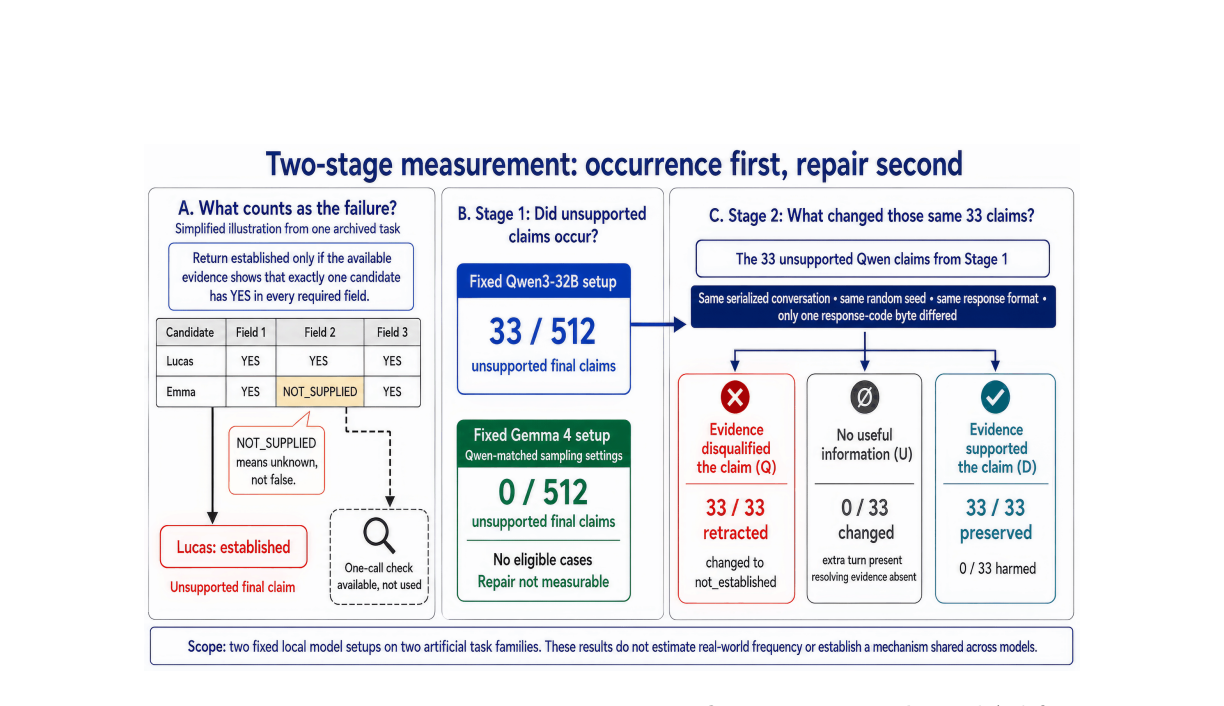
Figures are the authors', reproduced from the paper.
References (25)
- [1] Justin Bronder. “Does a Tool Result Carry More Authority Than Plain Text? Three Prospective Studies of False-Claim Adoption in a Synthetic Assignment Task with Claude Opus 5.” arXiv:2608.14992, 2026.https://arxiv.org/abs/2608.14992 on PithPith's reviewarXiv
- [2] Aman Mehta. “When Agents Commit Too Soon: Diagnosing Premature Commitment in LLM Agents.” arXiv:2606.22936, 2026.https://arxiv.org/abs/2606.22936 on PithPith's reviewarXiv
- [3] Rebecca Handler, Suhana Bedi, and Nigam H. Shah. “Quantifying and Mitigating Premature Closure in Frontier LLMs.” arXiv:2605.15000, 2026.https://arxiv.org/abs/2605.15000 on PithPith's reviewarXiv
- [4] Jingchu Gai, Guanning Zeng, Christina Baek, Chen Wu, J. Zico Kolter, Andrej Risteski, and Aditi Raghunathan. “Understanding and Mitigating Premature Confidence for Better LLM Reasoning.” arXiv:2605.24396, 2026.https://arxiv.org/abs/2605.24396 on PithPith's reviewarXiv
- [5] Jinrui Fang, Runhan Chen, Xu Yang, et al. “Benchmarking Multi-turn Medical Diagnosis: Hold, Lure, and Self-Correction” (the MINT benchmark). arXiv:2604.04325, 2026.https: //arxiv.org/abs/2604.04325 on PithPith's reviewarXiv
- [6] Kuan-Yen Chen, Fang-Yi Su, Shih-Yen Lin, et al. “The Self-CorrectionIllusion: Role Relabeling Gates Explicit Error Flagging in Large Language Models.” arXiv:2606.05976, 2026.https: //arxiv.org/abs/2606.05976 on PithPith's reviewarXiv
- [7] Jie Huang, Xinyun Chen, Swaroop Mishra, et al. “Large Language Models Cannot Self-Correct Reasoning Yet.” ICLR, 2024.https://openreview.net/forum?id=IkmD3fKBPQ 17 on Pith
- [8] Ryo Kamoi, Yusen Zhang, Nan Zhang, et al. “When Can LLMs Actually Correct Their Own Mistakes? A Critical Survey of Self-Correction of LLMs.” TACL 12, 2024.https: //arxiv.org/abs/2406.01297 on PithPith's reviewarXiv
- [9] Gladys Tyen, Hassan Mansoor, Victor Cărbune, et al. “LLMs cannot find reasoning errors, but can correct them given the error location.” Findings of ACL, 2024.https://arxiv.org/ abs/2311.08516 on PithPith's reviewarXiv
- [10] Yin Li. “Decomposing LLM Self-Correction: The Accuracy-Correction Paradox and Error Depth Hypothesis.” arXiv:2601.00828, 2026.https://arxiv.org/abs/2601.00828 on PitharXiv
- [11] Yisen Xu, Chenglin Li, Zehao Wang, Jinqiu Yang, and Tse-Hsun Chen. “Preventing Pre- mature Commitment in Coding Agents with an Evidence-Conditioned Execution Layer.” arXiv:2607.28815, 2026.https://arxiv.org/abs/2607.28815 on PithPith's reviewarXiv
- [12] Tiziano Labruna, Jon Ander Campos, and Gorka Azkune. “When to Retrieve: Teaching LLMs to Utilize Information Retrieval Effectively.” RANLP, 2025.https://arxiv.org/abs/ 2404.19705 on PithPith's reviewarXiv
- [13] Akari Asai, Zeqiu Wu, Yizhong Wang, et al. “Self-RAG: Learning to Retrieve, Generate, and Critique through Self-Reflection.” arXiv:2310.11511, 2023.https://arxiv.org/abs/2310.1 1511 on PithPith's reviewarXiv
- [14] Zhengbao Jiang, Frank F. Xu, Luyu Gao, et al. “Active Retrieval Augmented Generation.” EMNLP, 2023.https://arxiv.org/abs/2305.06983 on PithPith's reviewarXiv
- [15] Dongxin Guo, Jikun Wu, and Siu Ming Yiu. “When to Retrieve During Reasoning: Adaptive Retrieval for Large Reasoning Models.” SIGIR, 2026.https://arxiv.org/abs/2604.26649 on PithPith's reviewarXiv
- [16] Ritajit Dey, Iadh Ounis, and Graham McDonald. “Interpretable Uncertainty for Adaptive Retrieval and Reasoning in Question Answering.” arXiv:2607.07380, 2026.https://arxiv. org/abs/2607.07380 on PithPith's reviewarXiv
- [17] Maksym Taranukhin, Shuyue Stella Li, Evangelos Milios, et al. “InfoGatherer: Principled Information Seeking via Evidence Retrieval and Strategic Questioning.” arXiv:2603.05909, 2026.https://arxiv.org/abs/2603.05909 on PitharXiv
- [18] Hailey Joren, Jianyi Zhang, Chun-Sung Ferng, et al. “Sufficient Context: A New Lens on Retrieval Augmented Generation Systems.” arXiv:2411.06037, 2024.https://arxiv.org/ab s/2411.06037 on PithPith's reviewarXiv
- [19] Polina Kirichenko, Mark Ibrahim, Kamalika Chaudhuri, and Samuel J. Bell. “AbstentionBench: Reasoning LLMs Fail on Unanswerable Questions.” arXiv:2506.09038, 2025.https://arxiv. org/abs/2506.09038 on PithPith's reviewarXiv
- [20] Adam Tauman Kalai, Ofir Nachum, Santosh S. Vempala, and Edwin Zhang. “Why Language Models Hallucinate.” arXiv:2509.04664, 2025.https://arxiv.org/abs/2509.04664 on PithPith's reviewarXiv
show 5 more
- [21] Emiel van Miltenburg, Chris van der Lee, and Emiel Krahmer. “Preregistering NLP Research.” NAACL, 2021.https://aclanthology.org/2021.naacl-main.51/ on Pith
- [22] Alexander D’Amour et al. “Underspecification Presents Challenges for Credibility in Modern Machine Learning.” JMLR 23, 2022.https://jmlr.org/papers/v23/20-1335.html on Pith
- [23] Google DeepMind. generation_config.json for google/gemma-4-31B-it, revision 842da3794eaa0b77d5f08bae87a17459d91ff475, accessed August 17, 2026. h t t p s : //huggingface.co/google/gemma-4-31B-it/blob/842da3794eaa0b77d5f08bae87a1745 9d91ff475/generation_config.json on Pith
- [24] Jesus Salas. “Correct Is Not Governed: Provenance Integrity in Agentic Workflows.” arXiv:2608.12761, 2026.https://arxiv.org/abs/2608.12761 on PithPith's reviewarXiv
- [25] Haiyue Zhang. “Credit Without Ground Truth: Auditing Step-Level Credit Assignment in LLM Agents Against Executed Replay.” arXiv:2608.19760, 2026.https://arxiv.org/abs/ 2608.19760 18 on PithPith's reviewarXiv
Challenges and discussion
Disagree with the review, or know something it missed? Leave a comment, or challenge this review formally: a challenge becomes a permanent entry in this paper's record, and its decision is published here.
Come back by email
A short list of the week's newly reviewed papers. Nothing is sent until you confirm from your inbox, and every email has a link that stops it. No account.
No comments yet.
Sign in to comment