Machine Learning · arXiv:2609.03026 v1 · submitted 2 Sep 2026 · 34 references
ObserverBench: Testing Mechanistic Estimates for Intervention and Control
The paper says
“Mechanistic interpretability is increasingly used to guide interventions such as activation steering, circuit removal, and safety monitoring. Yet an internal estimate that is accurate on average can still choose a poor action.”
more of the abstract
We present ObserverBench, a benchmark framework for testing whether an internal estimator—an observer—is adequate for the intervention, control, or safety task it directs. Each task fixes the model, information boundary, allowed actions, decision rule, held-out cases, and loss. The benchmark reports estimation accuracy separately from the loss caused by the chosen action. Theory and experiments show why both are needed. In closed-loop control, observer errors matter at the starting point and along directions the allowed intervention can reach. On circuit-intervention tasks in GPT-2-small and Qwen2.5-7B, pairwise observers predict unseen effects more accurately without always choosing better actions; observers trained on action loss choose lower-loss actions. In safety triage, a score that perfectly separates violations can allocate a fixed intervention budget poorly when violations have different costs. Across Qwen2.5-7B, Gemma-2-9B-it, and prospectively frozen Qwen3.5-9B APPS tasks, AUROC can rank monitors differently from deployment loss, and the best information source changes across models. Sparse SAE readouts also trail their layer-matched dense controls on the reported Qwen panels, under disclosed activation-density or checkpoint mismatches. ObserverBench provides fixed task contracts, runnable baselines, and table-based submissions for evaluating interpretability methods through the actions they enable.
from the abstract
Pith says
Machine review · deepseek-v4-flash · 8 Sep 2026 · what was read was not recorded · not checked by a person
It can be wrong. Challenge this review or reply to it.
The passes disagreed. Reader: holds up. Skeptic: agrees with the reader. Referee: major revision.
A well-crafted benchmark that shifts evaluation from statistical accuracy to decision quality, with experiments that support its central claim. This line is wrong
2 major objections · 6 minor
How often objections from reviews like this one are right: not yet measured
Not checked: figures, code, what the 34 references say.
The paper says, at Section 4.2.3, Table 9
The review did not quote this passage.
Pith says: Objection 1 of 2 · major
The Qwen copy-task description says "Calibration effects average 256 prompts; held-out effects average a separate 512." If each calibration mask's training signal is only a mean over prompts, the direct-loss observer cannot fit E_i|Y_i(m)-t|, which is a prompt-level quantity, and the reported 8.9% action-loss improvement would not be computable from the stated data.
more of objection 1
If instead per-prompt calibration outcomes are available to the direct-loss observer, that data matrix should be specified explicitly in the task contract. This ambiguity is load-bearing for the claim that the loss-trained pattern transfers to a larger model, so it must be resolved before the result can be evaluated.
The paper says, at Section 4.1.5, Tables 7 and 8
The review did not quote this passage.
Pith says: Objection 2 of 2 · major
The confirmation at t = 1 uses a target selected after inspecting pilot estimates that favored direct-loss training at that target. The manuscript discloses this, which is good, but the reported 18.5% reduction and its paired interval are post-selection quantities, and Table 8 shows that at t = 0.5 exact no-op is 46.2% better than the direct-loss observer.
more of objection 2
The paper should therefore state explicitly that the t = 1 estimate is conditional on a screened target, not a pre-specified confirmatory effect, or provide a selection-aware characterization. The target-sensitivity table already helps, but the word "confirmation" in the section heading overstates the evidential status.
6 minor objections
The paper says, at Section 3, Eq. 1
Pith says: minor objection 1 of 6
The equivalence between delta_0 in Proposition 1 and m_0 in Eq. 1 should be stated explicitly; a reader may otherwise wonder whether the two symbols denote different starting-state errors.
The paper says, at Throughout
Pith says: minor objection 2 of 6
The terminology "direct loss" and "direct risk" is used interchangeably across the text and tables; please unify the names.
show 4 more
The paper says, at Section 4.1.4, Table 6
Pith says: minor objection 3 of 6
The no-op limitation row is labeled "Not prespecified" in the table, but the text does not define the reported quantity clearly; please state what "Limitation loss 0.750" represents in the table caption or footnote.
The paper says, at Figure 4
Pith says: minor objection 4 of 6
The global 2% cutoff line is important but difficult to read in the figure; consider labeling the cutoff value and using a distinct dash pattern or color in both panels.
The paper says, at Section 5.2.2
Pith says: minor objection 5 of 6
The Qwen3.5 official SAE comparison is clearly disclosed as a base-to-posttraining transfer test, but the abstract and Section 5.2.2 use slightly different wording for the mismatch; please align the phrasing so the limitation is identical in both places.
The paper says, at Appendix B.3
Pith says: minor objection 6 of 6
The byte-identical recomputation is reassuring, but the phrase "identical at the byte level" should specify which files were compared, since the surrounding sentence refers to predictions, actions, and the 148-mask measurement.
What would settle it
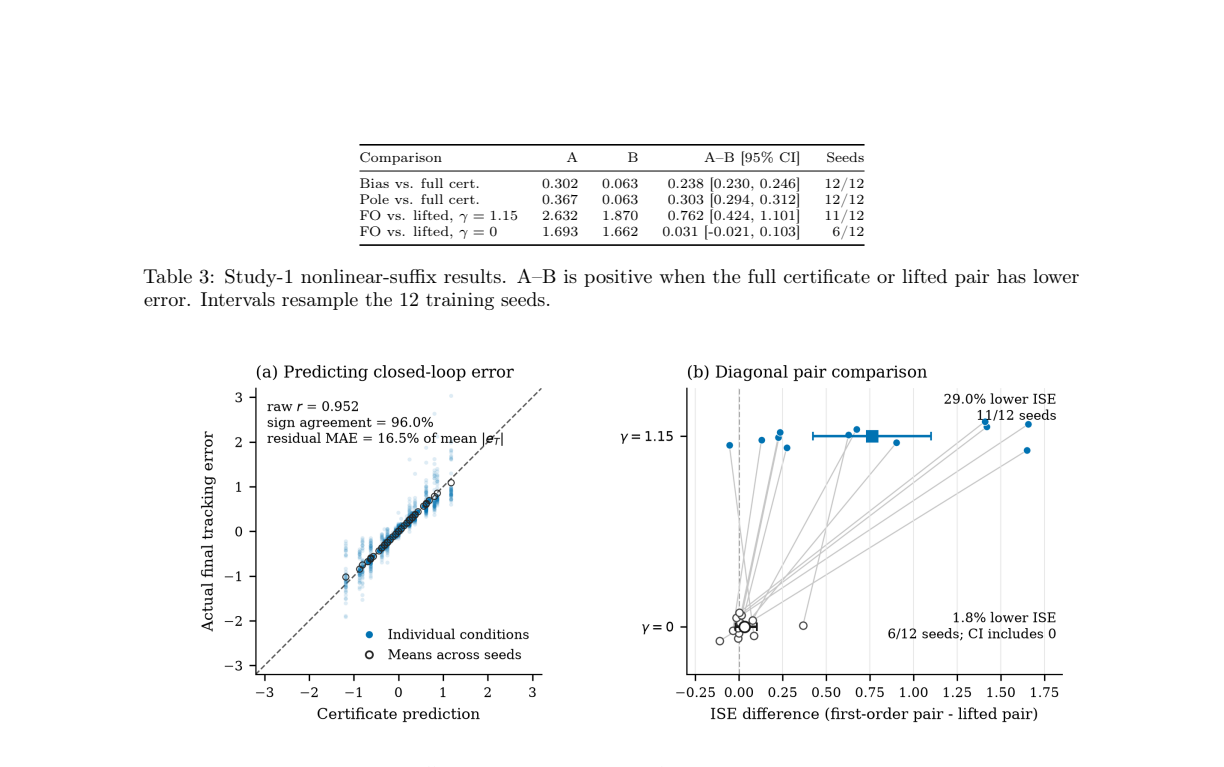
Run the Eq. 1 certificate decomposition on a larger pretrained model (e.g., Qwen2.5-7B) with residual-stream edits along a fixed steering direction, comparing predicted e_T to actual e_T over a 15-step horizon; if residual MAE exceeds about 20% of mean absolute final error, the theory's scope is confirmed limited, but the empirical divergence claim is unaffected.
from the skeptic's reading
How the review went
4 readings by deepseek-v4-flash · 8 Sep 2026
- Reader holds up
- Skeptic partly agrees
- Editor wrote the verdict above
- Referee major revision: 2 major objections, 6 minor
Not run on this paper: the simulated authors' defence.
Pith did not check this review's objections against the paper.
The review in full
The review in brief, machine-written
I read ObserverBench. The core argument is straightforward: an estimate that is accurate on average can still lead to a bad decision when used to choose a specific action. So judging interpretability methods by estimation accuracy alone is not enough—you should ask whether the estimate leads to a good action. That’s a valid point for the actionable interpretability and AI control crowd.
The paper builds a benchmark framework around this idea, with versioned tasks, sealed evaluation, and three operational modes: control, effect prediction, and safety triage. The theoretical control certificate is simple (Equation 1 separates three error sources) and it actually predicts final error in a small nonlinear Transformer, though that test is limited to a two-block model with known binary features. The experiments show the prediction–decision divergence across multiple models: in GPT-2 IOI, better mean-effect prediction did not yield better action selection, while direct-loss training improved action loss; in safety, an AUROC-1.0 classifier allocated a budget poorly when it ignored consequence costs. The cross-model replications on Qwen and Gemma give the same message, with honest disclosure of pilot-informed protocols and checkpoint mismatches.
Soft spots: the control theory is exact only for affine readouts, and the nonlinear validation is on a small transformer with known features—author says that is a scope limitation and it is. Some key comparisons (IOI confirmation, Qwen target choice) are pilot-informed, not independently preregistered, which weakens the statistical interpretation but does not kill the central claim. The SAE comparisons are limited by checkpoint mismatch, but the paper flags that clearly.
Overall, this is a solid paper that makes an actionable contribution. It sets a clear standard for evaluating observers through deployed decisions rather than proxy metrics. The evidence is proportionate to the claims. I would accept peer review—referees should ask for tighter preregistration in future versions, but the core work is publishable.
Who it is for: researchers in mechanistic interpretability, AI safety evaluation, and decision-focused learning. This paper gives them a concrete way to test whether their probes or steerings actually help.
I would not cite it in my own work in the next 12 months because my direction is different, but I might assign it in a reading group. It deserves a serious referee.
The strongest objection
The central claim is best read as an existential claim: an estimator that is accurate on conventional metrics can nonetheless choose a poor action, so the two should be measured separately. That claim is well supported by results that do not depend on the control theory. The GPT-2 confirmation (Sec. 4.1.5) shows an 18.5% action-loss reduction for direct-loss training over the same-feature mean observer, with a paired interval [0.115, 0.293] excluding zero, a passing clean gate, and exact no-op in the action set. The Qwen2.5 copy task (Sec. 4.2.3) shows an 8.9% aggregate reduction [0.053, 0.118] over the natural mean, with the per-target tie at the largest target disclosed. The authorization task (Sec. 5.1) provides a controlled demonstration that an AUROC-1.000 label score can allocate a fixed budget poorly when consequences are ignored, and that a global threshold can misallocate across subgroups despite perfect within-group separation. The one soft spot I find is the theoretical control certificate: Proposition 1 and Eq. 1 are exact only for affine readouts and proportional control, and the nonlinear validation uses a two-block Transformer with known binary features. This is a genuine scope limitation, disclosed in Sec. 7, but it is not load-bearing for the central claim because the prediction-decision divergence is established independently of the certificate, and the paper does not claim token-level large-model control. The manuscript discloses its pilot-informed protocols, failed checks, and checkpoint mismatches rather than hiding them, and none of the disclosed limitations undermines the headline result.
I read the paper's central claim as the reader states it: estimation accuracy and decision quality can diverge, so benchmarks should report both. This is an existential claim, and the paper supports it with multiple independent demonstrations. The strongest evidence is in effect prediction: the GPT-2 confirmation passes a clean gate, includes exact no-op, uses a frozen protocol with provenance checks, and reports a paired interval excluding zero. The Qwen transfer, while limited to eligible prompts, shows the same pattern in an aggregate with an interval excluding zero, and the per-target tie at the largest target is disclosed rather than hidden. In safety triage, the authorization task is a controlled construction where a perfect classifier demonstrably allocates a budget poorly; the APPS replications, despite being prospectively frozen rather than independently preregistered, show that AUROC and realized violations can order monitors differently. The reader's weakest assumption concerns the affine/proportional-control certificate. I agree this is a real limitation of the theoretical contribution, but it is not load-bearing for the central claim: the divergence results in Secs. 4 and 5 are empirical and do not rely on the certificate, and the paper explicitly limits its control claim to the tested regime and proposes a large-model next test. The manuscript is unusually transparent about failed checks, pilot-informed choices, and mismatches, and flagged limitations are consistent with the evidence. I therefore find no objection that would change the ACCEPT verdict.
The referee's report
If the findings hold, the paper makes a useful and timely contribution: it turns the prediction-decision distinction into a reproducible evaluation contract, with theory, controlled experiments, and externally sourced safety tasks. The central existential claim is well supported by several independent demonstrations, not by a single fragile result. The affine-control certificate is correct and its nonlinear validation is appropriately scoped; the disclosed limitation does not undermine the main point because the divergence between estimation quality and decision quality is established empirically without relying on the certificate. The manuscript is unusually transparent about protocol status: clean stop gates, exact no-op controls, failed checks, post hoc controls, pilot-informed selections, and checkpoint mismatches are all stated. The Qwen3.5 prospective freeze and paired bootstrap intervals are genuine strengths. The main weaknesses are a data-availability ambiguity in the Qwen direct-loss training and the post-selection status of the GPT-2 one-logit confirmation; both are fixable and neither appears fatal to the central claim.
Pith's reading of the paper (a machine's summary, not the authors')
ObserverBench is a benchmark framework that tests whether an internal estimator (an observer) is adequate for the intervention, control, or safety task it directs. The paper establishes that estimation accuracy \u2014 such as mean-effect MAE or AUROC \u2014 and the loss caused by the chosen action can diverge, and therefore must be measured separately. Across closed-loop control, effect prediction, and safety triage, the experiments show that a better mean predictor need not choose a better intervention, a perfect classifier can allocate a safety budget poorly, and the best measurement context can change between closely related model checkpoints. The framework provides fixed task contracts, runnable baselines, and table-based submissions to make these comparisons reproducible and task-relative.
What carries the argument. The core mechanism is the separation of the decision loop into observer, controller, and intervention, with each task defined by a fixed TaskCard specifying the target, information boundary, action space, decision rule, and loss. The theoretical certificate (Proposition 1, Eq. 1) states that for affine readouts, an observer need only match the target at the starting point $h_0$ and along directions in the reachable subspace $U$: $\delta_0 = 0$ and $P_U \delta_\beta = 0$, where $\delta_0$ is the initial error and $\delta_\beta$ is the readout-coefficient mismatch. This certificate is predictive of final tracking error in a small nonlinear Transformer experiment. The key empirical machinery is the direct-loss predictor: instead of predicting the average intervention effect, the observer predicts the prompt-level action loss $R_t(m) = \mathbb{E}_i[|Y_i(m) - t|]$, which decomposes into a mean-target term $|\mu(m)-t|$ and a dispersion penalty $J_t(m)$ that captures prompt-to-prompt variation.
Core claim. The paper demonstrates that an internal estimator that is accurate on average can still lead to a poor decision when used to choose a specific action. In closed-loop control, a finite-horizon certificate (Proposition 1, Eq. 1) separates errors into remaining reported error, starting-state mismatch, and response mismatch along the edit direction, showing that a convergent observer is not necessarily tracking the true target. In circuit-intervention tasks on GPT-2-small and Qwen2.5-7B, pairwise interaction terms improve held-out mean-effect prediction but do not reliably improve the chosen action, while observers trained directly on action loss choose lower-loss actions. In safety triage on Qwen2.5-7B, Gemma-2-9B-it, and Qwen3.5-9B, a label observer with AUROC 1.000 allocates a fixed intervention budget poorly when it ignores consequence costs, and the monitor ranking by AUROC can reverse the ranking by deployment loss.
The premise it rests on. The control-error certificate (Eq. 1) assumes affine readouts and proportional control, and its predictive power is tested only on a small two-block Transformer with known binary features; its applicability to large models with learned nonlinear activations and token-level interventions depends on the assumption that the affine approximation remains informative after nonlinear computation, which is tested only in that limited setting.
If the paper is right (Pith's inferences, not the authors')
Interpretability methods should be evaluated by the actions they enable, not by standalone accuracy metrics like AUROC or mean-effect MAE.
In safety triage, a classifier that perfectly separates violations can still be inadequate if it ignores the varying costs of different violations; consequence-aware scoring is necessary.
Training observers directly on the downstream decision loss (e.g., absolute target deviation) can yield better actions than training on intermediate predictions like the mean effect.
The best measurement context for safety monitoring (e.g., neutral activations vs. verdict-adjacent activations) can differ between model checkpoints, even within the same model family, so task-specific calibration is essential.
For circuit interventions, exact no-op should always be included in the action set, because an observer that ranks edits well may still produce worse loss than doing nothing when the target is small.
The paper's results suggest that current mechanistic interpretability benchmarks (which often use prediction metrics like AUROC or effect MAE) may need to be supplemented with decision-focused metrics when the results are intended to guide interventions.
The finding that neutral activations (from a model not asked for a verdict) can outperform verdict-adjacent activations for backdoor detection implies that safety-relevant information may be present in hidden representations before the model is explicitly probed, which might be harder for an adaptive attacker to spoof because it is not directly tied to the monitoring signal.
The demonstration that a sparse SAE readout with far fewer coefficients can have higher audit loss than a dense residual is a cautionary result for the common practice of using sparse autoencoders for downstream tasks; it suggests that compression gains do not automatically translate to better decisions, and that evaluation should be on the actual action loss, not just on reconstruction or predict
The protocol provenance checks and the disclosure of pilot-informed choices (e.g., the IOI confirmation at target $t=1.0$) highlight the importance of outcome-sealed evaluation and separating exploratory from confirmatory analyses; future work using ObserverBench should adopt similar transparency measures.
Check this review
Pith stored no record of this review's passes and took no fingerprint of it. Reviews made by code from 13 Nov 2026 on carry both.
How often reviews like this one are right
Reviews like this one: written by deepseek-v4-flash, where what was read was not recorded.
How often objections from reviews like this one are right: not yet measured
Reviews by people
This review was written by a machine. No person has reviewed this paper on Pith yet. A scientist listed on Pith can review it for a fee, and their review is published here whatever it concludes.
The paper
Abstract
Mechanistic interpretability is increasingly used to guide interventions such as activation steering, circuit removal, and safety monitoring. Yet an internal estimate that is accurate on average can still choose a poor action. We present ObserverBench, a benchmark framework for testing whether an internal estimator—an observer—is adequate for the intervention, control, or safety task it directs. Each task fixes the model, information boundary, allowed actions, decision rule, held-out cases, and loss. The benchmark reports estimation accuracy separately from the loss caused by the chosen action. Theory and experiments show why both are needed. In closed-loop control, observer errors matter at the starting point and along directions the allowed intervention can reach. On circuit-intervention tasks in GPT-2-small and Qwen2.5-7B, pairwise observers predict unseen effects more accurately without always choosing better actions; observers trained on action loss choose lower-loss actions. In safety triage, a score that perfectly separates violations can allocate a fixed intervention budget poorly when violations have different costs. Across Qwen2.5-7B, Gemma-2-9B-it, and prospectively frozen Qwen3.5-9B APPS tasks, AUROC can rank monitors differently from deployment loss, and the best information source changes across models. Sparse SAE readouts also trail their layer-matched dense controls on the reported Qwen panels, under disclosed activation-density or checkpoint mismatches. ObserverBench provides fixed task contracts, runnable baselines, and table-based submissions for evaluating interpretability methods through the actions they enable.
The paper's own sentences, arranged, kept beside the review and separate from it. Each label is drawn from a closed vocabulary; the number beside it is the probability the classifier gave that label. No sentence in this record was written by a model.
abstract compiled · 2026-09-23
The authors' main claim, as the classifier picked it out 0.65
“Theory and experiments show why both are needed.”
How the main claim is stated: asserted 1.00
What the abstract itself states, as probabilities: claims first 0.07 · states limitation 0.53 · human participants 0.05 · controlled comparison 0.90 · randomized assignment 0.02 · states quantitative result 0.28 · compares with prior results 0.86 · mentions code or data availability 0.52
The abstract, sentence by sentence
This table labels the abstract only (arXiv listing abstract v1). The number is the probability the classifier gave the label.
| Sentence | Role | The authors' own work | States the main conclusion | Strength |
|---|---|---|---|---|
| Mechanistic interpretability is increasingly used to guide interventions such as activation steering, circuit removal, and safety monitoring. | background 1.00 | 0.04 | 0.02 | asserted 0.99 |
| Yet an internal estimate that is accurate on average can still choose a poor action. | gap 0.70 | 0.09 | 0.23 | asserted 0.85 |
| We present ObserverBench, a benchmark framework for testing whether an internal estimator---an observer---is adequate for the intervention, control, or safety task it directs. | contribution 1.00 | 0.89 | 0.14 | asserted 0.98 |
| Each task fixes the model, information boundary, allowed actions, decision rule, held-out cases, and loss. | method 0.95 | 0.79 | 0.04 | asserted 1.00 |
| The benchmark reports estimation accuracy separately from the loss caused by the chosen action. | method 0.68 | 0.80 | 0.17 | asserted 1.00 |
| Theory and experiments show why both are needed. | interpretation 0.46 | 0.80 | 0.27 | asserted 1.00 |
| In closed-loop control, observer errors matter at the starting point and along directions the allowed intervention can reach. | interpretation 0.75 | 0.55 | 0.13 | asserted 1.00 |
| On circuit-intervention tasks in GPT-2-small and Qwen2.5-7B, pairwise observers predict unseen effects more accurately without always choosing better actions; observers trained on action loss choose lower-loss actions. | result 1.00 | 0.92 | 0.22 | asserted 1.00 |
| In safety triage, a score that perfectly separates violations can allocate a fixed intervention budget poorly when violations have different costs. | result 0.95 | 0.78 | 0.12 | asserted 0.94 |
| Across Qwen2.5-7B, Gemma-2-9B-it, and prospectively frozen Qwen3.5-9B APPS tasks, AUROC can rank monitors differently from deployment loss, and the best information source changes across models. | result 1.00 | 0.90 | 0.13 | asserted 1.00 |
| Sparse SAE readouts also trail their layer-matched dense controls on the reported Qwen panels, under disclosed activation-density or checkpoint mismatches. | result 0.88 | 0.70 | 0.04 | asserted 0.96 |
| ObserverBench provides fixed task contracts, runnable baselines, and table-based submissions for evaluating interpretability methods through the actions they enable. | contribution 0.90 | 0.81 | 0.15 | asserted 1.00 |
What kind of paper the classifier reports this is: dataset or benchmark 1.00 · evidence from observation or experiment 0.93
What was examined, and what was not
Sources read
- arXiv listing abstract v1
Not examined
- full text
- figures and tables
- references and citing sentences
- relations to other papers
Levels run
- P abstract
Not run
- S sections
- T body sentences
- C citations
- R cross-paper relations
How the labels were made
Compiled by classifier-1.13.0 via TypeSafe API, question bank abstract-p1-20260923, 2026-09-23: 1 request, 8,818 input tokens.
Every quoted sentence on this record is the authors'. Every label is from Pith's closed vocabulary, with the probability shown beside it. This record as JSON
Figures (4)


Figures are the authors', reproduced from the paper.
References (34)
- [1] V. Erramilli. Mechanistic tomography: designed measurement for control-oriented interpretability. arXiv:2608.19338, 2026.https://arxiv.org/abs/2608.19338 on PithPith's reviewarXiv
- [2] N.Agarwal, S.R.Dalal, andV.Misra. TheBayesiangeometryofTransformerattention. arXiv:2512.22471, 2025 on PithPith's reviewarXiv
- [3] A. Turner et al. Activation addition: steering language models without optimization. arXiv:2308.10248, 2023 on PithPith's reviewarXiv
- [4] A. Zou et al. Representation engineering: a top-down approach to AI transparency. arXiv:2310.01405, 2023 on PithPith's reviewarXiv
- [5] D. V. Nguyen, H. M. Vu, N. Y. Pham, L. Zhang, and T. M. Nguyen. Activation steering with a feedback controller. arXiv:2510.04309, 2025 on PithPith's reviewarXiv
- [6] J. Skifstad, X. A. Yang, and G. Chou. Local linearity of LLMs enables activation steering via model-based linear optimal control. arXiv:2604.19018, 2026 on PithPith's reviewarXiv
- [7] A. Syed, C. Rager, and A. Conmy. Attribution patching outperforms automated circuit discovery. BlackboxNLP, 2024 on Pith
- [8] J. Kramar, T. Lieberum, R. Shah, and N. Nanda. AtP*: an efficient and scalable method for localizing LLM behaviour to components. arXiv:2403.00745, 2024 on PithPith's reviewarXiv
- [9] A. Geiger, Z. Wu, C. Potts, T. Icard, and N. Goodman. Finding alignments between interpretable causal variables and distributed neural representations. CLeaR, 2024 on Pith
- [10] Z. Wu, A. Geiger, A. Arora, J. Huang, Z. Wang, N. D. Goodman, C. D. Manning, and C. Potts. pyvene: a library for understanding and improving PyTorch models via interventions. arXiv:2403.07809, 2024 on PithPith's reviewarXiv
- [11] S. Vaidyanathan, D. Arbour, A. Mueller, S. Niekum, and D. Jensen. The curse of multiple mediators: hidden interaction effects in activation patching. arXiv:2606.27510, 2026 on PithPith's reviewarXiv
- [12] A. Mueller et al. MIB: a mechanistic interpretability benchmark. ICML, 2025 on Pith
- [13] Z. Wu, A. Arora, A. Geiger, Z. Wang, J. Huang, D. Jurafsky, C. D. Manning, and C. Potts. AxBench: steering LLMs? Even simple baselines outperform sparse autoencoders. arXiv:2501.17148, 2025 on PithPith's reviewarXiv
- [14] R. Gupta, I. Arcuschin, T. Kwa, and A. Garriga-Alonso. InterpBench: semi-synthetic transformers for evaluating mechanistic interpretability. arXiv:2407.14494, 2024 on PitharXiv
- [15] H. Orgad et al. Interpretability can be actionable. ICML, 2026; arXiv:2605.11161 on PithPith's reviewarXiv
- [16] K. Wang, A. Variengien, A. Conmy, B. Shlegeris, and J. Steinhardt. Interpretability in the wild: a circuit for indirect object identification in GPT-2 small. ICLR, 2023 on Pith
- [17] T. McGrath, M. Rahtz, J. Kramar, V. Mikulik, and S. Legg. The Hydra effect: emergent self-repair in language model computations. arXiv:2307.15771, 2023 on PithPith's reviewarXiv
- [18] C. McDougall, A. Conmy, C. Rushing, T. McGrath, and N. Nanda. Copy suppression: comprehensively understanding an attention head. arXiv:2310.04625, 2023 on PithPith's reviewarXiv
- [19] C. Rushing and N. Nanda. Explorations of self-repair in language models. arXiv:2402.15390, 2024 on PithPith's reviewarXiv
- [20] R. Greenblatt, B. Shlegeris, K. Sachan, and F. Roger. AI control: improving safety despite intentional subversion. ICML, 2024; arXiv:2312.06942 on PithPith's reviewarXiv
show 14 more
- [21] R. Inglis et al. ControlArena. Software, 2025. https://github.com/UKGovernmentBEIS/ control-arena. 22 on Pith
- [22] M. Roughan, M. Thorup, and Y. Zhang. Traffic engineering with estimated traffic matrices. ACM IMC, pages 248–258, 2003.https://doi.org/10.1145/948205.948237 on PitharXiv
- [23] C. Olsson et al. In-context learning and induction heads. arXiv:2209.11895, 2022 on PithPith's reviewarXiv
- [24] Qwen Team. Qwen2.5 technical report. arXiv:2412.15115, 2024 on PithPith's reviewarXiv
- [25] Gemma Team. Gemma 2: Improving open language models at a practical size. arXiv:2408.00118, 2024 on PithPith's reviewarXiv
- [26] T. Lieberum, S. Rajamanoharan, A. Conmy, L. Smith, N. Sonnerat, V. Varma, J. Kramár, A. Dragan, R. Shah, and N. Nanda. Gemma Scope: Open sparse autoencoders everywhere all at once on Gemma 2. arXiv:2408.05147, 2024 on PithPith's reviewarXiv
- [27] B. Deng et al. Qwen-Scope: Turning sparse features into development tools for large language models. arXiv:2605.11887, 2026 on PithPith's reviewarXiv
- [28] S. Kantamneni, J. Engels, S. Rajamanoharan, M. Tegmark, and N. Nanda. Are sparse autoencoders useful? A case study in sparse probing. ICML, 2025 on Pith
- [29] P. L. Donti, B. Amos, and J. Z. Kolter. Task-based end-to-end model learning in stochastic optimization. NeurIPS, 2017 on Pith
- [30] A. N. Elmachtoub and P. Grigas. Smart “predict, then optimize.” Management Science, 68(1):9–26, 2022 on Pith
- [31] OpenAI. OpenAI and Hugging Face partner to address security incident during model evaluation. July 2026 on Pith
- [32] Hugging Face. Security incident disclosure—July 2026. July 2026 on Pith
- [33] R. Greenblatt, A. Cotra, and H. Wijk. Brief independent investigation of agents’ behavior, reasoning, and collaboration in the OpenAI / Hugging Face hacking incident. METR and Redwood Research, August 2026.https://metr.org/blog/2026-08-26-openai-hugging-face-incident-investiga... on Pith
- [240] The result concerns this checkpoint, layer, task, and probing rule; it is not a general claim that SAE features cannot support safety monitoring. Does the answer position explain the gap between prompted and neutral activations?The fixed calibration rule selects layer 28 for t... on Pith
Cited by 1 Pith paper
Reviewed papers on Pith that cite this one. The full citation record
Challenges and discussion
Disagree with the review, or know something it missed? Leave a comment, or challenge this review formally: a challenge becomes a permanent entry in this paper's record, and its decision is published here.
Come back by email
A short list of the week's newly reviewed papers. Nothing is sent until you confirm from your inbox, and every email has a link that stops it. No account.
No comments yet.
Sign in to comment